ISSN 1678-992X
ABSTRACT: Cobia is one of the most promising warm water aquaculture species. In Brazil, cobia farming began in 2008 in the state of Rio de Janeiro from experimental scale facilities to regular near-shore farms based on fresh/frozen fish diets composed mostly of Sardinella sp. Despite the encouraging results achieved in the promotion of sustainable cobia farming, we advocate the replacement of fresh/frozen fish by a practical formulated feed. This experiment evaluated the zootechnical performance and environmental efficiency of moist and practical formulated feeds in early grow-out phases in the cycle of cobia nearshore cage culture. Four hundred and twenty juvenile cobia (151 ± 7 g) were fed with moist feed and practical formulated feed for 56 days. Biometrics were taken every two weeks and diets were analyzed for proximate composition, fatty acid composition and pellet quality. Although growth performance was equivalent between treatments, feed consumption and feed conversion ratios (FCR) were different (p < 0.05) and varied according to water temperature. Cobia fed moist feed exhibited an FCR two times higher than those fed formulated feed. Elevated settling speed and low floatability contributed to higher heterogeneity and lower efficiency of fish fed moist diet. Nitrogen excretion rate was reduced (64 %) and protein efficiency ratio elevated (27 %) within formulated diet groups in comparison to those fed moist diet (79 % and 15 %, respectively). The fatty acid profile of cobia muscle was similar across the groups. With no negative effects of diet substitution on production performance and improvement of environmental efficiency, this approach can be applied and advocated globally and contribute to the responsible intensification of sustainable marine fish culture.
Keywords: aquaculture, environmental efficiency, protein efficiency ratio, nitrogen discharge, marine fish farming
Common moist diet replacement to promote sustainable Cobia
Rachycentron canadum
Felipe Schwahofer Landuci1* , Artur Nishioka Rombenso2 , Marcelo Duarte Pontes1 , Marcelo Pereira Maia1 , Giselle Eler1 , Bruno
Cavalheiro Araujo3 , Luis Henrique da Silva Poersch4
1Fundação Instituto de Pesca do Estado do Rio de Janeiro – Depto. de Pesquisa e Produção, Av. das Américas, 31501 – 23032-050 – Rio de Janeiro, RJ – Brasil.
2CSIRO, Agriculture and Food, Aquaculture Program, Bribie Island Research Centre, Woorim, QLD 4507, Australia. 3Universidade de São Paulo/Instituto de Biociências – Lab. de Metabolismo e Reprodução de Organismos Aquáticos, R. do Matão, 101 – 05508-900 – São Paulo, SP – Brasil. 4Universidade Federal do Rio Grande/Instituto de Oceanografia – Núcleo de Aquacultura e Biotecnologia Marinha, R. do Hotel, 02 – 96210-030 – Rio Grande, RS – Brasil.
*Corresponding author <[email protected]> Edited by: Gerson Barreto Mourão
Received June 20, 2017 Accepted November 17, 2017
Introduction
Cobia aquaculture started in Taiwan in the 90’s, and underwent expansion after the development of massive fingerling production technology in 1997, spreading in the following years to other Asian countries and the western hemisphere (Benetti et al., 2010; Liao et al., 2004; Nhu et al., 2011). Although cobia cultured in offshore net cage systems generally rely on formulated feeds (Liao et al., 2004), most traditional near-shore cobia production is still based on rough fish, commonly referred to as trash fish (Petersen et al., 2015).
Moist and fresh-frozen fish-based diets are still an important feed source for marine fish culture in Asian countries (Bunlipatanon et al., 2014). However, substitution of formulated feeds has been encouraged, by virtue of its significant implication for the environment and the culture system, which includes the increasing of nutrient input, risk of contamination, rise of pathogen incidence, variations in nutritional quality and higher related feed conversion ratio (Kim et al., 2007; Liao et al., 2004; New, 1996; Nhu et al., 2011)
In Brazil, cobia farming started in offshore net cages in the northeastern region, but prospered in the southern region in near-shore systems, encouraged by experimental ongrowing results (Sampaio et al., 2011).
In Rio de Janeiro, during the early grow-out period, cobia are fed moist diets based on a Sardinella sp. surplus generated by the trawl fisheries industry, which is a good nutritional quality resource with wide availability (Rombenso et al., 2016).
Despite the positive results achieved so far, the availability of a high quality cost-effective formulated aquafeed is paramount to guaranteeing a sustainable development allied to the economic feasibility of a near-shore cobia cage culture, but the issue is how to achieve a successful transition especially in view of the operational comprehension by producers of the benefits of practical formulated diets.
Accordingly, this experiment aimed to evaluate the zootechnical performance and environmental efficiency of moist to practical formulated feed substitution in early grow-out phases of cobia near-shore cage culture, providing reliable subsidies to encourage farmers to adopt this switch.
Materials and Methods
Experimental structures and animals
Juvenile cobia weighing an average of 3 g were acquired from a commercial producer in Ilha Bela, São Paulo, Brazil (23°51’36.92” S; 45°25’41.86” W; 16
Ecology
|
Resear
ch Ar
ticle
m altitude) and transported to a marine fish facility in Angra dos Reis, in the state of Rio de Janeiro, Brazil (23°6’50.83” S; 44°15’47.85” W; sea level). Eight hundred fish were acclimated into three near-shore cages of 24 m–3 (6 × 2 × 2 m) at a stocking density below 1 kg
m–3 for 3 months. During this period, fish were hand-fed
until apparent satiation a non-specific cobia diet (45 % crude protein and 16 % lipid), two times a day.
Experimental diet production process and analysis
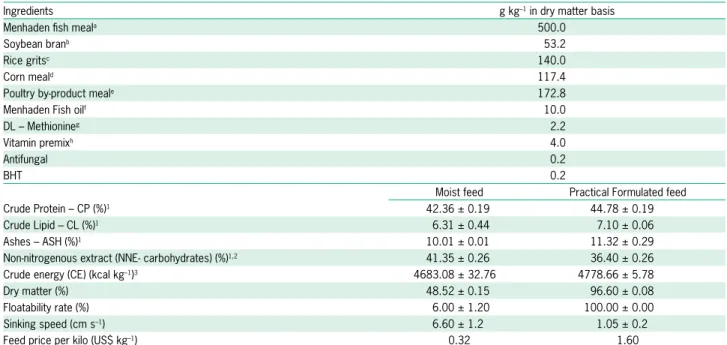
Practical Formulated feed (PFf) was formulated to meet or exceed cobia nutritional requirements (amino acids, fatty acids, vitamins and minerals) available in peer-reviewed scientific literature (Chou et al., 2001; Craig et al., 2006; Fraser and Davies, 2009) containing approximately 44.0 - crude protein, 8.0 - crude lipid, 11.0 - ashes, 36.0- non-nitrogenous extract, and g kg–1
on a dry matter basis. The PFf contained 500 g kg–1 of
imported menhaden fish meal as a principal protein source and imported menhaden fish oil as a lipid source (Table 1). PFf was extruded with a 7.5 mm die at an animal feed factory in Cordeiro, in the state of Rio de Janeiro, Brazil (22°14’47.52” S; 42°18’56.91” W; 688 m altitude) following in-house extrusion protocols and then shipped and stored in a frozen chamber (-20 °C) throughout the feeding trial.
Moist feed (Mf) was manufactured every week on a grow-out site according to fish producer feed making
protocol. Fresh sardines (72 %CP; 10 %CL) were ground, cooked, and mixed with a bran omnivorous fish feed (28 %CP; 4 %CL) in a 2:1 proportion and pelletized with a 7 mm die size on a meat grinder machine. After manufacturing, the moist feed was stocked in a freezer (-20 °C) and used on a weekly basis.
Proximate composition analysis
Diets and muscle were analyzed in triplicate for proximate composition (Table 1) according to the official methods of AOAC (2002). Moisture content was deter-mined by the dry method, and weighing samples were heated in an oven at 110 °C to constant weight. Ash con-tent was determined by incinerating samples in a muffle furnace at 600 °C for 4 h. Crude protein (CP) was produced by Kjedhal methods and crude lipid (CL) was determined by the Folch et al. (1957) method. The non-nitrogenous ex-tract (NNE) was calculated as the difference between total dry matter and the other nutrients (crude protein levels, crude lipid, ashes, and crude fiber). Crude energy content was determined by the following equation: Crude energy = 10*(5.65*CP + 9.45*CL + 4.10* NNE).
Physical pellet characteristics
To evaluate the percentage of floating pellets (%FLT) samples of both diets were sieved through a 1mm mesh to remove all the bran. Next, 50 pellets were dumped from a height of ten centimeters into a 100 mL
Table 1 – Formulation of experimental formulated diet and proximate composition and physical characteristics of experimental diets.
Ingredients g kg–1 in dry matter basis
Menhaden fish meala 500.0
Soybean branb 53.2
Rice gritsc 140.0
Corn meald 117.4
Poultry by-product meale 172.8
Menhaden Fish oilf 10.0
DL – Methionineg 2.2
Vitamin premixh 4.0
Antifungal 0.2
BHT 0.2
Moist feed Practical Formulated feed
Crude Protein – CP (%)1 42.36 ± 0.19 44.78 ± 0.19
Crude Lipid – CL (%)1 6.31 ± 0.44 7.10 ± 0.06
Ashes – ASH (%)1 10.01 ± 0.01 11.32 ± 0.29
Non-nitrogenous extract (NNE- carbohydrates) (%)1,2 41.35 ± 0.26 36.40 ± 0.26
Crude energy (CE) (kcal kg–1)3 4683.08 ± 32.76 4778.66 ± 5.78
Dry matter (%) 48.52 ± 0.15 96.60 ± 0.08
Floatability rate (%) 6.00 ± 1.20 100.00 ± 0.00
Sinking speed (cm s–1) 6.60 ± 1.2 1.05 ± 0.2
Feed price per kilo (US$ kg–1) 0.32 1.60
Survival rate SR final number of fish initial number
( )=100×
o of fish
Weight gain WG ( )=100× average final individual weight - averagge initial individual weight average initial individual weiight
Specific growth rate SGR ( )=100×log average final weight - le oog average initial weight
days of feeding
e
Daily feed intake FI ( )=100× average individual feed intake
avverage initial individual weight×average final individual weight days of feeding
( )0 5.
Feed conversion ratio FCR ( )=average individual matter feed intake average individual weight gain
Hepatosomatic index HSI( )=100× liver weight whole body weightt
Viscerosomatic index VSI( )=100× viscera weight whole body weiight
Protein deposition on carcass PD ( )=weight gain on dry matteer
days of feeding carcass crude protein content
Protein intake PI( )=feed intake in dry matter
days of feedinng ×crude protein in feed dry matter.
The values of protein deposition on carcass and protein intake were used to calculate the protein effi-ciency ratio (PER) by the linear equation: Y = A X + B, where: Y = carcass protein deposition (g) X, the protein intake (g), A, the straight inclination from linear regres-sion representing the protein efficiency ratio in percent-age terms (PER) and B, the constant representing the stretch interception point on the vertical axis (Sakomura and Rostagno, 2007).
Feed cost of production
Feed cost production was calculated by: FCR × Feed price kg–1. Feed cost did not consider processing
and storage costs as these were difficult to quantify. The labor provided to process the Mf is opposite to what gen-erally happens in Asian countries (Bunlipatanon et al., 2014). It is not provided by the farmers themselves and is an additional cost.
Nitrogen Budget
Nitrogen input in feed was calculated by the equation
NI=total feed imput on dry matter×crude protein in feed
6 2. 55 .
Nitrogen retained (NR) was estimated by
NR=Total biomass harvested crude protein on total crop×
Nitrogen lost on mortality (NM) was estimated by
NM=(number of deceased fish×average final weight) crude prootein content on carcass
6 25. .
Finally, Nitrogen excretion (NE) was calculated by the mass balance equation
NE = NI – NR – NM.
Becker filled with seawater (33 psu) at 25 °C. After one minute, the floating pellets were counted and then the FLT was calculated as follows:
% FLT =
(
50−)
×50 100
immersepellets
The settling speed was evaluated based on Cromey et al. (2009) with modifications. Briefly, 50 pellets were dumped individually into a graduated cylinder 48 cm high and 30 cm diameter filled with seawater (33 psu) at 25 °C. The settling speed was determined by recording the time each pellet took to reach the bottom.
Fatty acid analysis
Total lipids from diets and muscle were extracted us-ing the methodology described by Folch et al. (1957). Fatty acid (FA) was determined by gas chromatography (GC) cou-pled to a flame ionizer (FID) and auto-injector (Varian GC 3900). The oven temperature program was: 170 °C main-tained for 1 min, from 170 °C to 240 °C at 2.5 °C min–1,
maintained at 240 °C for 5 min. The temperature for both the detector and injector were kept at 250 °C and 260 °C, respectively, and a CP wax 52CB column was used, being 0.25 µm in thickness, 0.25 mm in internal diameter, and 30 m in length, with hydrogen as the carrier gas. The FA profile was determined by a time retention equation utiliz-ing a known-time standard retention time (SUPELCO®, 37 Standard e Larodan Chemical Company – Mixture Me93 e Qualmix PUFA fish M – Menhaden Oil).
Production performance assay
A feeding trial was carried out at a marine fishing facility in Angra dos Reis, in the state of Rio de Janeiro, Brazil (23°6’50.83” S; 44°15’47.85” W; at sea level). A completely randomized experimental design in a factorial scheme with two treatments (moist and formulated diets) was used, each one having three replicates, in a 56 day feeding trial.
Seventy cobia with individual initial weight of 151 ± 7 g were stocked per cage (2 × 2 × 1.5 m) with a 40 mm mesh achieving a stocking density of 1.7 kg m–3. Fish were hand-fed two times a day until
appar-ent satiation. Every two weeks, 40 fish per cage were anesthetized by 50 ppm clove oil for two min prior to weighing on a digital scale. Additionally, every sampling event consisted of three fish per tank being euthanized by clove oil overdose (150 ppm) and then eviscerated. Viscera and liver samples were collected and weighed for subsequent proximate composition analysis (crude protein, crude lipid, ashes and moist), using standard AOAC methods (AOAC, 2002).
Statistical analysis
Briefly, all data were tested for normality (Shap-iro Wilk) and homogeneity of variance (Cochran). When necessary, data were converted for parametric testing (Zar, 2010). All data are shown as means and standard errors and were analyzed by one-way analysis of vari-ance (ANOVA). When omnibus tests indicated significant post-hoc treatment effects, tests (Tukey´s, HSD) were used to determine the differences between the means. In all cases, an alpha level of 0.05 (p < 0.05) was used. Individual linear regression analyses were performed to investigate the relationship between abiotic factors and certain production metrics (e.g. feed conversation rate, weight gain, feed consumption and PER) using the PROC REG (p = 0.05) procedure from SAS/STAT soft-ware (Statistical Analysis System, 9.3 version).
Results
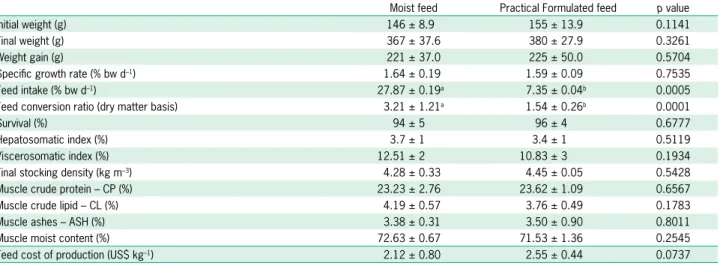
Juvenile cobia attained a final individual weight of 374.10 ± 33.15 g (grand mean ± SE) with final stock-ing densities lower than 5 kg m–3 under both treatments
(Table 2). No differences between treatments were ob-served for final individual weight, WG, SGR, HSI and VSI (p > 0.005). Feed intake (27.87-7.35 g) and FCR (3.21-1.54) were different between treatments (p < 0.005; Table 2), being higher in the Mf group and vary-ing accordvary-ing to water temperature (Figure 1A and B). In both treatments, FCR decreased as water temperature increased. For example, in the Mf group, FCR was 7.05 at 25 °C and 2.92 at 28 °C, whereas in the PFf group FCR declined from 1.87 at 25 °C to 1.22 at 28 °C. Ad-ditionally, negative correlation between feed consump-tion and temperature and positive correlaconsump-tion between weight gain and temperature were observed (Figure 1A and B).
PFf sinking speeds were slower (1.05 ± 0.2 cm s–1)
than Mf (6.60 ± 1.2 cm s–1), whereas the floatability rate
was higher (100 ± 0 %) when compared to the other test-ed diet (6 ± 1 %; Table 1).
Fish fed PFf exhibited higher PER (27 %, on dry matter basis) compared to those fed Mf (15 %; Figure 2A and B).
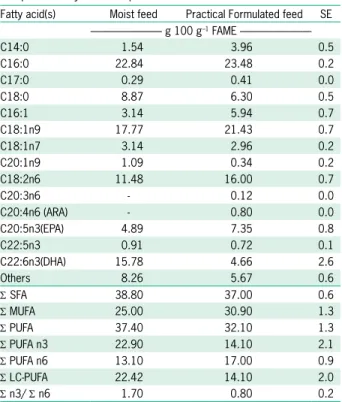
Fillet fatty acid profile mirrored dietary fatty acid composition (Table 3 and Table 4). Similar levels of satu-rated fatty acids (SFAs), polyunsatusatu-rated fatty acids (PU-FAs), Arachidonic acid (ARA), n-6 and n-3 fatty acids were
Table 2 – Production performance and muscle proximate composition of juvenile Rachycentron canadum L. fed experimental diets in near-shore cage system. Values are presented as LS-means ± standard error. Means with different letter are significantly different (p < 0.05).
Moist feed Practical Formulated feed p value
Initial weight (g) 146 ± 8.9 155 ± 13.9 0.1141
Final weight (g) 367 ± 37.6 380 ± 27.9 0.3261
Weight gain (g) 221 ± 37.0 225 ± 50.0 0.5704
Specific growth rate (% bw d–1) 1.64 ± 0.19 1.59 ± 0.09 0.7535
Feed intake (% bw d–1) 27.87 ± 0.19a 7.35 ± 0.04b 0.0005
Feed conversion ratio (dry matter basis) 3.21 ± 1.21a 1.54 ± 0.26b 0.0001
Survival (%) 94 ± 5 96 ± 4 0.6777
Hepatosomatic index (%) 3.7 ± 1 3.4 ± 1 0.5119
Viscerosomatic index (%) 12.51 ± 2 10.83 ± 3 0.1934
Final stocking density (kg m–3) 4.28 ± 0.33 4.45 ± 0.05 0.5428
Muscle crude protein – CP (%) 23.23 ± 2.76 23.62 ± 1.09 0.6567
Muscle crude lipid – CL (%) 4.19 ± 0.57 3.76 ± 0.49 0.1783
Muscle ashes – ASH (%) 3.38 ± 0.31 3.50 ± 0.90 0.8011
Muscle moist content (%) 72.63 ± 0.67 71.53 ± 1.36 0.2545
Feed cost of production (US$ kg–1) 2.12 ± 0.80 2.55 ± 0.44 0.0737
observed between treatments. cobia fed formulated feeds exhibited higher levels of monounsaturated fatty acids (MUFAs), 20:3n-3, Eicosapentanoic acid (EPA) and 22:5n-3 in the fillet, whereas those fed moist feeds presented
significantly higher levels of docosahexaenoic acid (DHA). Similarly, the nitrogen budget, presented in Table 5, was lower for the PFf group (67 %) in comparison to the Mf group (82 %). Nitrogen excretions in Mf (2.755 ± 0.369 mg g d–1) were higher (p < 0.005) than PFf (1.497
± 0.093 mg g d–1).
Discussion
A recent survey conducted in central Vietnam stressed that fish farmers choose to use trash fish for aquaculture due to the low cost, production perfor-mance, lack of alternative feeds and purchase conve-nience (Huntington and Hasan, 2009).
Focused on production performance, their surviv-al ratio was elevated, higher than 94 % for both treat-ments, which is consistent with other studies (Benetti et al., 2010; Liao et al., 2004; Sampaio et al., 2011; Weirich et al., 2010). Under both treatments, stocking density remained below this 5 kg m–3 rate reported to yield
op-timum growth for cobia (Benetti et al., 2010; Weirich et al., 2010).
Table 3 – Dietary fatty acid composition (g 100 g–1 fatty acid methyl
esters). Values are presented as LS-means ± standard error (SE) triplicate fatty acid samples.
Fatty acid(s) Moist feed Practical Formulated feed SE --- g 100 g–1 FAME
---C14:0 1.54 3.96 0.5
C16:0 22.84 23.48 0.2
C17:0 0.29 0.41 0.0
C18:0 8.87 6.30 0.5
C16:1 3.14 5.94 0.7
C18:1n9 17.77 21.43 0.7
C18:1n7 3.14 2.96 0.2
C20:1n9 1.09 0.34 0.2
C18:2n6 11.48 16.00 0.7
C20:3n6 - 0.12 0.0
C20:4n6 (ARA) - 0.80 0.0
C20:5n3(EPA) 4.89 7.35 0.8
C22:5n3 0.91 0.72 0.1
C22:6n3(DHA) 15.78 4.66 2.6
Others 8.26 5.67 0.6
Σ SFA 38.80 37.00 0.6
Σ MUFA 25.00 30.90 1.3
Σ PUFA 37.40 32.10 1.3
Σ PUFA n3 22.90 14.10 2.1
Σ PUFA n6 13.10 17.00 0.9
Σ LC-PUFA 22.42 14.10 2.0
Σ n3/ Σ n6 1.70 0.80 0.2
Low representative values were grouped in “others”. Σ SFA, Σ MUFA, Σ PUFA,
Σ PUFA n6, Σ PUFA n3 and Σ LC-PUFA represents the sum of saturated, monounsaturated, polyunsaturated, polyunsaturated n6, polyunsaturated n3 fatty acids, and long chain polyunsaturated fatty acids, respectively.
Table 4 – Fillet fatty acid composition (g 100 g–1 fatty acid methyl
esters) of Rachycentron canadum L fed moist and practical
formulated feeds. Values are presented as LS-means ± standard error triplicate fatty acid samples and p values resulting from one-way ANOVA test are also provided; means with common letter are not significantly different (p < 0.05).
Fatty acid(s) Moist feed Practical Formulated feed p value --- g 100 g–1 FAME ---C14:0 1.46 ± 0.49 1.23 ± 0.34 0.127 C16:0 19.17 ± 1.05 19.50 ± 1.20 0.827 C17:0 0.52 ± 0.05 0.35 ± 0.01 0.048 C18:0 8.40 ± 0.34b 8.87 ± 0.51a 0.041
Σ SFA 33.60 ± 1.10 33.30 ± 1.80 0.785 C16:1 3.25 ± 0.42 3.61 ± 0.65 0.702 C18:1n9 18.78 ± 0.59b 21.70 ± 0.91a 0.008 C18:1n7 2.28 ± 0.09b 2.64 ± 0.04a < 0.001 C20:1n9 0.50 ± 0.08a 0.41 ± 0.03b 0.018
Σ MUFA 26.10 ± 2.0b 28.80 ± 1.20a 0.022 C18:2n6 13.10 ± 1.33 12.77 ± 0.46 0.221 C20:2n6 0.43 ± 0.03 0.39 ± 0.06 0.535 C20:3n6 0.24 ± 0.08b 0.35 ± 0.07a 0.016 C20:4n6(ARA) 1.86 ± 0.31 1.59 ± 0.25 0.525 C20:5n3(EPA) 4.07 ± 0.33b 5.20 ± 1.23a 0.028 C22:5n3 1.16 ± 0.03b 1.65 ± 0.17a < 0.001 C22:6n3 (DHA) 17.38 ± 2.32a 13.33 ± 2.08b 0.018
Others 7.04 6.41 0.436
Σ PUFA 40.3 ± 2.9 37.9 ± 2.9 0.203
Σ PUFA n3 22.3 ± 3.9 21.3 ± 2.6 0.642
Σ PUFA n6 17.4 ± 1.7 16.1 ± 0.8 0.122
Σ LC-PUFA 24.8 ± 4.7 24.1 ± 3.0 0.768
Σ n3/ Σ n6 1.3 ± 0.3 1.3 ± 0.2 0.962 Low representative values were grouped on “others” Σ SFA, Σ MUFA, Σ PUFA,
Σ PUFA n6, Σ PUFA n3 and Σ LC-PUFA represents the sum of saturated, monounsaturated, polyunsaturated, polyunsaturated n6, polyunsaturated n3 fatty acids, and long chain polyunsaturated fatty acids, respectively.
In this same location and under similar conditions Moreira et al. (2015) observed an SGR of 2.3 % d–1 and
FCR of 2.3:1 in a 15-day period in juvenile cobia(15 - 30 g) fed nonspecific commercial feed (45 %CP; 16 %CL) at an average temperature of 24 °C. Additionally, at the culture site Sampaio et al. (2011), reported an SGR of 1.5 % d–1 and FCR of 5:1 in cage-bred cobia within the
weight range of 184-600 g, sardine fed at an average tem-perature of 24 °C.
Despite the different sizes, feed types and time intervals, the available literature indicates comparable SGR and higher FCR for nonspecific and sardine-based feeds in comparison to PFf.
Decreased FCR associated with increasing tem-perature was reported by Sampaio et al. (2011) with a minimum value (1.65:1) recorded during summer (highest average temperature of 28 °C), which corrobo-rates the present findings. Warmer water temperatures (31-33 °C) are reported to optimize growth and FCR of juvenile Cobia up to 200 g (Sun and Chen, 2014; Sun et al., 2006a, b).
Wills et al. (2013) testing three different commer-cial feeds for marine fish that would be suitable for grow out of juvenile Cobia: A (50 % CP:15 % CL); B (45 % CP:16 % CL) and C (44 % CP:15 %CL) reported a protein efficiency ratio of 25 ± 0; 23 ± 1 and 14 ± 1 % consis-tent with that registered in the PFf group (26 %) and the Mf group (15 %).
Feed type and feeding frequency affect directly the amount of lost feed during feeding events and are of great importance to polluting potential. As a general rule, moist and trash fish-based diets result in higher en-vironmental impact when compared to pelletized and extruded diets due to greater loss of nutrients and re-duced water stability (Islam, 2005; Wu, 1995). Mf pre-sented poor water stability quickly disintegrating once in contact with water. In terms of production, this could result in reduced feed efficiency, raising FCR. Mf also exhibited faster sinking speed, which could also have influenced the great heterogeneity of fish size. The short time of pellet in water column favors dominant fish to access feed and consequently develop more.
In agreement, Costa-Bomfim et al. (2014) reported the aggressive behavior of juvenile cobia during feeding events. On the other hand, PFf presented better water stability and a slow sinking rate increased feed oppor-tunity and homogeneity in this treatment. Similarly,
Moreira et al. (2015) highlighted that higher feed avail-ability reduced feeding competition and increased ho-mogeneity in experimental units.
Economically, feed represents the most expensive variable cost component in carnivorous fish production, and using an adequately formulated diet is critical to keeping cost down and minimizing metabolic waste products (Craig et al., 2006). PFf has a current stipulated cost of US$ 1.60 kg–1 and Mf US$ 0.32 kg–1, but in terms
of cost of feed per kilogram of fish this difference drops considerably, the price being US$ 2.55 ± 0.44 and 2.12 ± 0.80 kg–1, respectively. Despite lower prices, high
wa-ter content (51 %) has disadvantages in wa-terms of trans-port, handling, storage, expiration date and logistics of Mf and must be taken into account.
Cobia, in common with other carnivorous fish, have a limited capacity for synthesizing physiologically important n-3 LC-PUFAs (long-chain polyunsaturated fatty acids), such as ecosapentaenoic acid (EPA; 20:5n-3) and docosahexaenoic acid (DHA; 22:6n-3), to satisfy their physiological demand, requiring dietary supplementation (Sargent et al., 1999; Tocher, 2010; Trushenski et al., 2012). Although PFf contained a reduced level of DHA compared to the recommended levels of 8-12 g kg–1 fish fed this dietary treatment
exhibited similar performance, which is probably due to the elevated content of EPA in formulated feed that was bioconverted to DHA satisfying the nutritional and physiological demand of fish. Corroborating this, EPA content in fillet of fish fed formulated feeds was not as high as at dietary levels, but still higher than those fed the moist feed.
In terms of fillet fatty acid composition, the dietary fatty acid composition showed consistency with the literature available (Asdari et al., 2011; Tocher, 2010; Turchini et al., 2009; Zakeri et al., 2011). Although no differences in the fillet fatty acid profile of both treatments were observed for SFAs, PUFAs, ARA, n-6 and n-3 fatty acids, statistical differences were seen in the fatty acid signature of each diet. These findings are consistent with previous lipid and fatty acid research in cobia (Trushenski et al., 2012; Woitel et al., 2014).
Increased nitrogen levels in coastal waters due to anthropogenic sources are a worldwide concern, generally resulting in algal blooms and nutrient enrichment or eutrophication. Marine cage aquaculture operations are a recognized source of nitrogenous
Table 5 – Nitrogen budget of juvenile Rachycentron canadum L fed experimental diets. Means with different letter are significantly different (p < 0.05).
Moist feed Practical Formulated feed p value --- mg g d–1
---Nitrogen input (NI) 2.75 ± 0.37a 1.49 ± 0.10b 0.0056
Nitrogen retention (NR) 0.40 ± 0.03 0.40 ± 0.01 0.7644
Nitrogen lost on mortality (NM) 0.07 ± 0.08 0.09 ± 0.13 0.8780
Nitrogen excretion (NE) 2.27 ± 0.31a 1.00 ± 0.053b 0.0035
discharge released both in the form of particulate matter (uneaten feed and feces containing undigested feed that passes through the digestive tract of fish) and dissolved metabolic wastes including ammonia and urea (Price et al., 2015).
Nitrogen excretion levels recorded are lower in the PFf group (67 %) and higher in the Mf group (82 %) than those registered by Alston et al. (2005), who reported 79 % of the nitrogen fed to the fish was released into the water in a marine cage culture of Lutjanus analis and R. canadum.
Water temperature seems to affect cobia nitrogen excretion as well as growth (Sun and Chen, 2014). Furthermore, the same authors attested to a relatively constant nitrogen budget in elevated temperatures (27-33 °C) with more than 68 % of feed nitrogen being lost in excretion. Nitrogen excretion in the Mf fed group was higher even at lower temperatures whereas the PFf group remained close to these results.
Sun et al. (2006b) reported that feeding efficiency and fecal production are significantly affected by the feed type, observing higher nitrogen excretion in groups fed with in natura sardines compared to commercial di-ets, highlighting the great eutrophication potential of in
natura diets, the same pattern as was observed in this
study on the moist diet composed principally of raw in-gredients.
Currently, the limited supply of trash fish as the main feed source for cobia grow-out has become a major constraint for cobia culture in Vietnam and other coun-tries. Also, due to the increase in pressure on natural stocks of small pelagic fish used in aquaculture feed production, fishmeal utilization must be discouraged in order to reach environmental sustainability (Naylor et al., 2000).
In the Brazilian market, due to the paucity of at-tractiveness of the ingredients, previous experiences with a practical formulated feed introduction did not succeed (Moreira et al., 2015). Thus we opted for the use of im-ported premium fishmeal as the principal protein source. Several studies indicate a future positive outlook and potential for growth for the Latin American aquaculture industry, especially for the continued growth of cage culture for salmonids and warm water species including cobia, and projections concerning future market availability and the price of fishmeal and fish oil within the region are that supplies will remain tight and prices high. As in Europe, there is a need to reduce the dependence of the aquaculture sector on fishmeal and fish oil through the use of alternative, locally available feed ingredient sources, the production of which can keep pace with the growth and specific requirements of the aquaculture sector within the region.
With the expected wide adoption of cobia pelleted and extruded feeds, the next step in improvements to the sustainable expansion of cobia culture in Brazil, em-braces lowering fishmeal and fish oil content by adopting alternative proteins and lipid sources, including soybean
meal and oil, rapeseed oil, palm oil, poultry-by meal and fat, pork lard, beef tallow among other animal or plant ingredients, with proven suitability without production nor nutritional impairment (Betancor et al., 2016; Romb-enso et al., 2017; Suarez et al., 2013; Trushenski et al., 2012; Watson et al., 2014; Woitel et al., 2014).
This study successfully substituted moist with formulated feed without any impairment in produc-tion performance. Formulated diet was better used, less wasted, and promoted less eutrophication compared to the moist feed. Further research is encouraged to inves-tigate ways to incorporate the surplus from the fisher-ies into formulated extruded diets as fish meal and fish oil, or as silage among other possibilities. This approach would be beneficial for transforming this highly nutri-tional resource into a high-quality feed assisting with the available, satisfactory and affordable marine finfish feed constraint.
This approach can be applied and advocated glob-ally and thereby contribute to the responsible intensifi-cation of marine fish culture.
Acknowledgments
Thanks are due to the Coordenação de Aperfeiçoa-mento de Pessoal de Nível Superior (CAPES) and to the Conselho Nacional de Desenvolvimento Científico e Tecnológico (CNPq). The authors appreciate the support of Mr. Kazuo Tonack (Maricultura Costa Verde, Angra dos Reis, Brazil), as also Mr. Marcelo Lacerda and Julio Magno Ramos from the Depto. de Aquicultura e Pesca de Angra dos Reis, Mr. André Araujo and Paulo Marcio Costa from the Fundação Instituto de Pesca do Estado do Rio de Janeiro Costa Verde local office, Mr. Pablo Lopez and Ms. Alioune Diarra PROFIFISH S.A. representatives and Mr. Antonio Carlos Erthal, owner of North Central animal feeds.
Authors’ Contributions
Conceptualization: Landuci, F.S ., Pontes, M.D., Poersch, L.H.S. Data acquisition: Landuci, F.S ., Pontes, M.D. Data analysis: Landuci, F.S ., Rombenso, A.N., Maia, M.P., Eler, G., Araujo, B.C. Design of Methodol-ogy: Landuci, F.S ., Rombenso, A.N., Pontes, M.D., Maia, M.P., Poersch, L.H.S. Writing and editing: Landuci, F.S ., Rombenso, A.N., Poersch, L.H.S.
References
Asdari, R.; Aliyu-Paiko, M.; Hashim, R.; Ramachandran, S. 2011. Effects of different dietary lipid sources in the diet for Pangasius hypophthalmus (Sauvage, 1878) juvenile on growth performance, nutrient utilization, body indices and muscle and liver fatty acid composition. Aquaculture Nutrition17: 44-53. Association of Official Analytical Chemists – International
Benetti, D.D.; O’Hanlon, B.; Rivera, J.A.; Welch, A.W.; Maxey, C.; Orhun, M.R. 2010. Growth rates of cobia (Rachycentron canadum) cultured in open ocean submerged cages in the Caribbean. Aquaculture302: 195-201.
Betancor, M.B.; Sprague, M.; Montero, D.; Usher, S.; Sayanova, O.; Campbell, P.J.; Napier, J.A.; Caballero, M.J.; Izquierdo, M.; Tocher, D.R. 2016. Replacement of marine fish oil with de novo Omega-3 Oils From Transgenic Camelina sativa in feeds for gilthead sea bream (Sparus aurata L.). Lipids 51: 1171-1191.
Bunlipatanon, P.; Songseechan, N.; Kongkeo, H.; Abery, N.W.; Silva, S.S. 2014. Comparative efficacy of trash fish versus compounded commercial feeds in cage aquaculture of Asian seabass (Lates calcarifer) (Bloch) and tiger grouper (Epinephelus fuscoguttatus) (Forsskål). Aquaculture Research45: 373-388. Chou, R.L.; Su, M.S.; Chen, H.Y. 2001. Optimal dietary protein
and lipid levels for juvenile cobia (Rachycentron canadum). Aquaculture193: 81-89.
Costa-Bomfim, C.N.; Pessoa, W.V.N.; Oliveira, R.L.M.; Farias, J.L.; Domingues, E.C.; Hamilton, S.; Cavalli, R.O. 2014. The effect of feeding frequency on growth performance of juvenile cobia, Rachycentron canadum (Linnaeus, 1766). Journal of Applied Ichthyology30: 135-139.
Craig, S.R.; Schwarz, M.H.; McLean, E. 2006. Juvenile cobia (Rachycentron canadum) can utilize a wide range of protein and lipid levels without impacts on production characteristics. Aquaculture261: 384-391.
Cromey, C.J.; Nickell, T.D.; Treasurer, J.; Black, K.D.; Inall, M. 2009. Modelling the impact of cod (Gadus morhua L.) farming in the marine environment - CODMOD. Aquaculture289: 42-53.
Folch, J.; Lees, M.; Sloane Stanley, G.H. 1957. A simple method for the isolation and purification of total lipides from animal tissues. The Journal of Biological Chemistry226: 497-509. Fraser, T.W.K.; Davies, S.J. 2009. Nutritional requirements
of cobia, Rachycentron canadum (Linnaeus): a review. Aquaculture Research40: 1219-1234.
Huntington, T.C.; Hasan, M.R. 2009 Fish as feed inputs for aquaculture – practices, sustainability and implications: a global synthesis. p. 1-61. In: Hasan, M.R.; Halwart, M., eds. Fish as feed inputs for aquaculture - practice, sustainability and implications: a global synthesis. FAO, Rome, Italy. (FAO Fisheries and Aquaculture Technical Paper, 518).
Islam, M.S. 2005. Nitrogen and phosphorus budget in coastal and marine cage aquaculture and impacts of effluent loading on ecosystem: review and analysis towards model development. Marine Pollution Bulletin50: 48-61.
Kim, J.H.; Gomez, D.K.; Choresca Jr, C.H.; Park, S.C. 2007. Detection of major bacterial and viral pathogens in trash fish used to feed cultured flounder in Korea. Aquaculture272: 105-110.
Liao, I.C.; Huang, T.-S.; Tsai, W.-S.; Hsueh, C.-M.; Chang, S.-L.; Leaño, E.M. 2004. Cobia culture in Taiwan: current status and problems. Aquaculture237: 155-165.
Moreira, C.B.; Rombenso, A.N.; Candiotto, F.B.; Tsuzuki, M.Y. 2015. Feeding frequency affects growth of juvenile cobia Rachycentron canadum cultured in near-shore cages. Boletim do Instituto de Pesca42: 219-226.
Naylor, R.L.; Goldburg, R.J.; Primavera, J.H.; Kautsky, N.; Beveridge, M.C.M.; Clay, J.; Folke, C.; Lubchenco, J.; Mooney, H.; Troell, M. 2000. Effect of aquaculture on world fish supplies. Nature405: 1017-1024.
New, M. 1996. Responsible use of aquaculture feeds. Aquaculture Asia1: 3-4.
Nhu, V.C.; Nguyen, H.Q.; Le, T.L.; Tran, M.T.; Sorgeloos, P.; Dierckens, K.; Reinertsen, H.; Kjørsvik, E.; Svennevig, N. 2011. Cobia Rachycentron canadum aquaculture in Vietnam: recent developments and prospects. Aquaculture 315: 20-25.
Petersen, E.H.; Glencross, B.D.; Van Tien, N.; Tuan, V.A.; Phuong, T.H. 2015. Recent changes in the bioeconomic of finfish mariculture in Vietnam. Journal of Aquaculture Research & Development6: 1.
Price, C.; Black, K.D.; Hargrave, B.T.; Morris Jr, J.A. 2015. Marine cage culture and the environment: effects on water quality and primary production. Aquaculture Environment Interactions6: 151-174.
Rombenso, A.N.; Bowzer, J.C.; Moreira, C.B.; Sampaio, L.A. 2016. Culture of Caranx species [Horse-eye Jack Caranx latus (Agassiz), Blue Runner Caranx crysos (Mitchill), and Crevalle Jack Caranx hippos (Linnaeus)] in near-shore cages off the Brazilian coast during colder months. Aquaculture Research 47: 1687-1690.
Rombenso, A.N.; Trushenski, J.T.; Schwarz, M.H. 2017. Beef tallow is suitable as a primary lipid source in juvenile Florida pompano feeds. Aquaculture: DOI: 10.1111/anu.12502 Sakomura, N.K.; Rostagno, H.S. 2007. Research methods in
monagastric nutrition = Métodos de Pesquisa em Nutrição de Monogástricos. Funep, Jaboticabal, SP, Brazil (in Portuguese).
Sampaio, L.A.; Moreira, C.B.; Miranda-Filho, K.C.; Rombenso, A.N. 2011. Culture of cobia Rachycentron canadum (L) in near-shore cages off the Brazilian coast. Aquaculture Research42: 832-834.
Sargent, J.; McEvoy, L.; Estevez, A.; Bell, G.; Bell, M.; Henderson, J.; Tocher, D. 1999. Lipid nutrition of marine fish during early development: current status and future directions. Aquaculture 179: 217-229.
Suarez, J.A.; Tudela, C.; Davis, D.; Daugherty, Z.; Taynor, M.; Glass, L.; Hoenig, R.; Buentello, A.; Benetti, D.D. 2013. Replacement of fish meal by a novel non-GM variety of soybean meal in cobia, Rachycentron canadum: ingredient nutrient digestibility and growth performance. Aquaculture 416-417: 328-333.
Sun, L.; Chen, H. 2014. Effects of water temperature and fish size on growth and bioenergetics of cobia (Rachycentron canadum). Aquaculture426-427: 172-180.
Sun, L.; Chen, H.; Huang, L. 2006a. Effect of temperature on growth and energy budget of juvenile cobia (Rachycentron canadum). Aquaculture261: 872-878.
Sun, L.; Chen, H.; Huang, L.; Wang, Z. 2006b. Growth, faecal production, nitrogenous excretion and energy budget of juvenile cobia (Rachycentron canadum) relative to feed type and ration level. Aquaculture259: 211-221.
Trushenski, J.; Schwarz, M.; Bergman, A.; Rombenso, A.; Delbos, B. 2012. DHA is essential, EPA appears largely expendable, in meeting the n − 3 long-chain polyunsaturated fatty acid requirements of juvenile cobia Rachycentron canadum. Aquaculture326-329: 81-89.
Turchini, G.M.; Torstensen, B.E.; Ng, W.-K. 2009. Fish oil replacement in finfish nutrition. Reviews in Aquaculture 1: 10-57.
Watson, A.M.; Buentello, A.; Place, A.R. 2014. Partial replacement of fishmeal, poultry by-product meal and soy protein concentrate with two non-genetically modified soybean cultivars in diets for juvenile cobia, Rachycentron canadum. Aquaculture434: 129-136.
Weirich, C.R.; Wills, P.S.; Baptiste, R.M.; Riche, M.A. 2010. Production Characteristics and body composition of juvenile Cobia fed three different commercial diets in recirculating aquaculture systems. North American Journal of Aquaculture 72: 43-49.
Wills, P.S.; Weirich, C.R.; Baptiste, R.M.; Riche, M.A. 2013. Evaluation of commercial marine fish feeds for production of juvenile Cobia in recirculating aquaculture systems. North American Journal of Aquaculture75: 178-185.
Woitel, F.R.; Trushenski, J.T.; Schwarz, M.H.; Jahncke, M.L. 2014. More judicious use of fish oil in Cobia feeds. I. Assessing the relative merits of alternative lipids. North American Journal of Aquaculture76: 222-231.
Wu, R.S.S. 1995. The environmental impact of marine fish culture: towards a sustainable future. Marine Pollution Bulletin 31: 159-166.
Zakeri, M.; Kochanian, P.; Marammazi, J.G.; Yavari, V.; Savari, A.; Haghi, M. 2011. Effects of dietary n-3 HUFA concentrations on spawning performance and fatty acids composition of broodstock, eggs and larvae in yellowfin sea bream, Acanthopagrus latus. Aquaculture310: 388-394.