DNA sequencing analysis of several G6PD variants previously defined by
PCR-restriction enzyme analysis
Gerardo Vaca
1and Eliakym Arámbula Meraz
21
Centro de Investigación Biomédica de Occidente, División de Genética, Guadalajara, Jal, México.
2
Universidad Autónoma de Sinaloa, Facultad de Ciencias-Químico-Biológicas, Culiacán, Sin, México.
Abstract
Results of a corroborative DNA sequencing analysis for five glucose-6-phosphate dehydrogenase (G6PD) mutations previously defined by PCR-restriction enzyme analysis are presented. The suitability for performing DNA sequencing analysis is discussed along with the importance of selecting the proper PCR-REA strategy in order to define the presence of a specific mutation .
Key words:G6PD, mutations, PCR-restriction enzyme analysis. Received: January 24, 2005; Accepted: June 14, 2005.
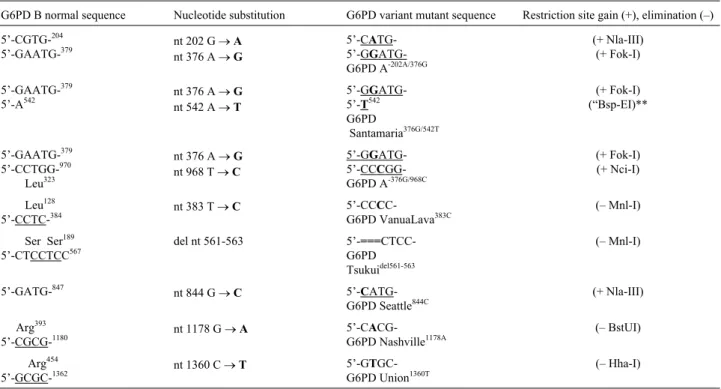
We previously screened more than 5000 individuals for glucose-6-phosphate dehydrogenase (G6PD) defi-ciency in order to determine the molecular basis of G6PD deficiency in Mexico (Arámbula et al. 2000; Arámbula 2002; Medinaet al.1995, 1997; Vaca et al.2002). In 67 (88%) of the G6PD deficient individuals detected, the mu-tation responsible being defined using PCR-restriction en-zyme analysis (PCR-REA) combined with single strand conformation polymorphism (Arámbula y Vaca, 2002). Eight different G6PD deficient variants were detected , three of which were double mutants (Table 1).Five muta-tions (nt 202 G®A (+Nla-III), nt 376 A®G (+Fok-I), nt 542 A®T (+”BspEI”), nt 844 G®C (+Nla-III), and nt 968 T®C (+Nci-I)) were defined based on their electro-phoretic banding pattern being compatible with the genera-tion of a restricgenera-tion enzyme site, and the four other mutations (nt 383 T®C (-Mnl-I), del nt 561-563 (-Mnl-I), nt 1178 G®A (-BstUI), and nt 1360 C®T (-Hha-I)) were defined by the elimination of a restriction site (Table 1).Since the methodology used could definitively define only 4 (202 G®A; 376 A®G; 542 A®T, and 844 G® C) out of 9 mutations , we decided to perform a corrobora-tive DNA sequencing analysis for the remaining five muta-tions (nt 383 T®C; del nt 561-563; nt 968 T®C; nt 1178 G®A, and nt 1360 C®T).
Exons 5, 6, 9, 10, and 11 were PCR amplified using previously described oligonucleotides primers (Beutleret al.1991a) and the DNA sequenced with the Big Dye termi-nator kit in an ABI PRISM 310 Genetic Analyser.
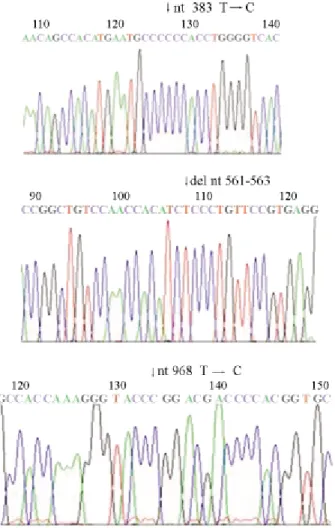
The DNA sequencing analysis confirmed the geno-types previously assigned by PCR-REA , partial sequences being shown in Figures 1 and 2.
A brief description of the PCR-REA strategy previ-ously used for the mutations corroborated by DNA se-quencing analysis is given below.
The nt 383 T®C (Leu 128 Pro) (G6PD Vanua Lava) mutation destroys a Mnl-I site and shows a complex elec-trophoretic banding pattern (Arámbula, 2002).The restric-tion site can also be eliminated by mutarestric-tions at nt 381-384 (Table 1). Any base change at nt 381 or 384 generates silent mutations(Ala 127 Ala or Leu 128 Leu respectively) with presumably normal G6PD activity. However nt substitu-tions at nt 382 or at nt 383 T®G or A generate missense mutations. To the best of our knowledge the only mutations at nt 381-384 reported to date are the G6PD Vanua Lava 383 T®C mutation and the silent polymorphisms at nt 381 C® T and nt 384 C®T (Beutler and Vulliamy 2002; Hamelet al.2002; Verelliet al.2002).
The del nt 561-563 (del Ser 188 or 189)(G6PD Tsukui) deletion eliminates a Mnl-I site and also shows a complex electrophoretic banding pattern (Arámbula, 2002). The observation of more rapid electrophoretic mo-bility of the undigested mutant PCR-product as compared
www.sbg.org.br
Send correspondence to Gerardo Vaca. Centro de Investigación Biomédica de Occidente, División de Genética, AP. 2-1079, Gua-dalajara 2, Jal, Mexico. E-mail [email protected].
to the normal PCR-product strongly suggest the presence of this deletion. The restriction site can also be eliminated by substitutions at nt 563-566 (Table 1). Any base change at nt 563, 565, or 566 generates missense mutations (e.g.nt 563 C®T (G6PD Mediterranean variant , the mutation gener-ates a Mbo-II site)), whereas nt substitutions at nt 564 gen-erate silent polymorphisms (Ser 188 Ser).
The nt 968 T®C (Leu 323 Pro) mutation generates a Nci-I site in the double mutant G6PD A-376G/968C(Table 1), although it should be remembered that because the enzyme recognition sequence is 5’-CCNGG-3’ where N = C or G, a base change at nt 968 T®G (Leu 323 Arg) can also gener-ates a Nci-I site. A similar situation occurs with the muta-tions nt 680 G ® T (Arg 227 Leu) (present in G6PD A-376G/680Tvariant) and nt 680 G®A (Arg 227 Gln) (G6PD Mexico City680A), both of these mutations generating a BstNI site (5’-CCNGG-3’ where N = T or A).
The nt 1178 G®A (Arg 393 His) (G6PD Nashville) mutation. The BstUI site at nt 1177-1180 can be eliminated by any base change of the enzyme recognition sequence
5’-CGCG-3’ (Table 1). Nt substitutions at nt 1179 generate silent polymorphisms (Arg393Arg) whereas nt substitu-tions at nt 1177, 1178, or 1180 generate missense mutasubstitu-tions such as the mutations at nt 1177 C®G (G6PD Wisconsin; Arg393 Gly), nt 1178 G ® A (G6PD Nashville; Arg393His), and nt 1180 G ® C (G6PD Alhambra; Val394Leu). The mutation present in the first variant also eliminates an Alw-I site whereas the mutation in the third variant generates a Pst-I site, the haplotype Alw-I/BstUI/ Pst-I +/–/ – suggesting the presence of the G6PD Nashville variant ,the presence of this haplotype being the accepted definition of the G6PD Nashville variant (Arámbula, 2002; Vacaet al.2002).However an identical haplotype can also be generated by base changes such as nt 1178 G®T, or C; nt 1179 C ®G, A, or T (silent mutations); and nt 1180 G®A, or T (Table 2).
The nt 1360 C®T (Arg 454 Cys) (G6PD Union) mu-tation. The Hha-I restriction site 5’-GCGC-3’ at nt 1359-1362 can be eliminated by any base change in the enzyme recognition sequence (Table 1). Nt substitutions at nt 1359 or 1362 generate silent polymorphisms (Val 453 Val or Arg 454 Arg respectively). Base changes at nt 1360 or 1361
Figure 1- Sequence analysis of a portion of exons 5, 6, and 9 showing the mutations at nt 383 T®C, del nt 561-563, and nt 968 T®C respectively.
generate missense mutations such as the mutation at nt 1361 G ® A (G6PD Andalus; Arg454His) which also eliminates a BspMI site. Thus, the haplotype Hha-I/ BspMI –/+ suggest the presence of the G6PD Union variant , the presence of this haplotype being the accepted definition of the G6PD Union variant (Arámbula 2002; Vacaet al.2002) but the same haplotype can also be generated by mutations at nt 1359 G ® C, A, or T or by mutations at nt 1360 C®G, or A (Table 2).
It is important to carefully select the PCR-REA strat-egy to be used to define the presence of a specific point mu-tation. The use of programs (e.g.NEB cutter: www.neb. com) to analize the restriction enzymes that could be used to excise the PCR-product is also important because simply assuming the presence of a “specific” mutation based on electrophoretic banding patterns compatible with the elimi-nation of a restriction site is inadequate , strategies based on the generation of a restriction site by a specific mutation be-ing better. Retrospectively we have realized that the G6PD Nashville and G6PD Union variants can be defined by PCR-REA using the restriction enzymes Mae-II and BsgI site respectively, a Mae-II site (5’-1178ACGT-3’) occurring in the G6PD Nashville variant and a BsgI site (5’-1359GTGCAG-3’) in the G6PD Union variant. Simi-larly, BsmFI PCR-REA would permit discriminate be-tween the mutations at nt 968 T®C or 968 T®G (both are Nci-I +) since the second mutation also generates a
BsmFI site (5’-968GGGAC-3’). Obviously, when possible, direct DNA sequencing is a good option, particularly in those cases in which mutations can not be categorically de-fined by PCR-REA.
To date a total of 18 different G6PD variants have been observed in Mexico (Arámbulaet al.2000; Arámbula 2002; Beutleret al.1991b; Beutleret al.1992; Liskeret al. 1981; Medinaet al.1995; Medinaet al.1997; Vacaet al. 2002; Vacaet al.2003) and 3 of them (both G6PD A– vari-ants along with G6PD Santamaria variant) account for more than 80% of the overall prevalence of G6PD defi-ciency in Mexico (Arámbula 2002; Lisker 1981; Vacaet al. 2002).This pattern of common G6PD variants is similar to that seen in other parts of the Americas such as Costa Rica (Beutleret al.1991c), Cuba (Roviraet al.1994), and Brazil (Hamel 2002; Weimer 1998).
In conclusion, it should be stressed that it is important to select the proper PCR-REA strategy because even a PCR-REA strategy based on the presence of a restriction site generated by a mutation could, in some cases, be inade-quate to categorically define the presence of a particular mutation. Even so, PCR-REA can be used not only to detect the presence or absence of certain alleles (and their fre-quency) in specific populations but also for the definition or exclusion of a molecular diagnosis for a specific mono-genic disease as well as for other estimates, definitions or exclusions. This methodology is important because
thera-Table 1- Glucose-6-phosphate dehydrogenase (G6PD) mutations detected by PCR-restriction enzyme analysis (PCR-REA). Nucleotide substitutions are in bold type and the restriction endonucleases recognition sequences are underlined.
G6PD B normal sequence Nucleotide substitution G6PD variant mutant sequence Restriction site gain (+), elimination (–)
5’-CGTG-204
5’-GAATG-379 nt 202 G
®A
nt 376 A®G
5’-CA TG-5’-GG ATG-G6PD A-202A/376G
(+ Nla-III) (+ Fok-I)
5’-GAATG-379 5’-A542
nt 376 A®G
nt 542 A®T
5’-GG ATG-5’-T542
G6PD Santamaria376G/542T (+ Fok-I) (“Bsp-EI)** 5’-GAATG-379 5’-CCTGG-970 Leu323
nt 376 A®G
nt 968 T®C
5’-GG ATG-5’-CCC GG-G6PD A-376G/968C
(+ Fok-I) (+ Nci-I)
Leu128 5’-CCTC-384
nt 383 T®C 5’-CCC
C-G6PD VanuaLava383C
(– Mnl-I)
Ser Ser189 5’-CTCCTCC567
del nt 561-563 5’-===
CTCC-G6PD Tsukuidel561-563
(– Mnl-I)
5’-GATG-847 nt 844 G®C 5’-C
ATG-G6PD Seattle844C
(+ Nla-III)
Arg393
5’-CGCG-1180 nt 1178 G
®A 5’-CA
CG-G6PD Nashville1178A
(– BstUI)
Arg454
5’-GCGC-1362 nt 1360 C
®T 5’-GT
GC-G6PD Union1360T
(– Hha-I)
peutic decisions and genetic counseling could be based on the assigned genotype.
References
Arámbula E (2002) Heterogeneidad molecular de la deficiencia de G6PD en México. PhD Thesis, Universidad de Guada-lajara, México.
Arámbula E, Aguilar JC and Vaca G (2000) Glucose-6-phosphate dehydrogenase mutations and haplotypes in Mexican Mes-tizos. Blood Cells Mol Dis 26:387-394.
Arámbula E and Vaca G (2002) Genotyping by “Cold Single-Strand Conformation Polymorphism” of theUGT1A1 pro-moter polymorphism in Mexican mestizos. Blood Cells Mol Dis 28:86-90.
Beutler E, Kuhl W, Gelbart T and Forman L (1991a) DNA se-quence abnormalities of human glucose-6-phosphate dehy-drogenase variants. J Biol Chem 266:4145-4150.
Beutler E, Kuhl W, Ramírez E and Lisker R (1991b) Some Mexi-can glucose-6-phosphate dehydrogenase variants revisited. Hum Genet 86:371-374.
Beutler E, Kuhl W, Saenz GF and Rodríguez W (1991c) Mutation analysis of glucose-6-phosphate dehydrogenase (G6PD) variants in Costa Rica. Hum Genet 87:462-464.
Beutler E, Westwood B, Prchal JT, Vaca G, Bartsocas CS and Baronciani L (1992) New glucose-6-phosphate dehydroge-nase (G6PD) mutations from various ethnic groups. Blood 80:255-256.
Beutler E and Vulliamy TJ (2002) Hematologically important mutations: Glucose-6-phosphate dehydrogenase. Blood Cells Mol Dis 28:93-103.
Hamel AR, Cabral IR, Sales TSI, Costa FF and Saad STO (2002) Molecular heterogeneity of G6PD deficiency in an Amazo-nian population and description of four new variants. Blood Cells Mol Dis 28:399-406.
Table 2- PCR-REA genotyping of the glucose-6-phosphate dehydrogenase (G6PD) G6PDNashville and G6PD Union variants. Nucleotide substitutions are in bold type and the restriction endonucleases recognition sequences are underlined.
G6PD B normal sequence Nt subst. G6PD variant
mutant sequence
Haplotype
Alw-I BstUI Pst-I
GATCC1177Alw-I 5’GATCCGCGTGCAG1185 CGCG1180BstUI
+ + –
Nt 1177 C®N1
C®G
G6PD Wisconsin
GATCG1177
1177
GGCG – – –
Nt 1178 G®N2
G®A
G6PD Nashville
GATCC1177
1177
CACG + – –
Nt 1179 C®N3
Undescribed
GATCC1177
CCNG1180 + – –
Nt 1180 G®N4
G®C
G6PD Alhambra
GATCC1177
CGCC1180 1180
CTGCAG Pst-I
+ +
– –
+or – +
Hha-I BspMI
GCGC1362 Hha-I 5’-GCGCAGGT-1366 GCAGGT1366BspMI
+ +
Nt 1359 G®N1
Undescribed
NCGC1362 GCAGGT1366
– +
Nt 1360 C®N2
C®T
G6PD Union
GTGC1362 GCAGGT1366
– +
Nt 1361 G®N3
G®A
G6PD Andalus
GCAC1362 1361
ACAGGT
– –
Nt 1362 C®N4
Undescribed GCGN1362
1361GNAGGT
– –
Lisker R (1981) Estructura Genética de la Población Mexicana. Aspectos Médicos y Antropológicos. Salvat Mexicana de Ediciones.
Medina MD, Vaca G, Esparza A, Westwood B and Beutler E (1995) Molecular heterogeneity of G6PD deficiency in Me-xico. Arch Med Res 26:111-113.
Medina MD, Vaca G, López-Guido B, Westwood B and Beutler E (1997) Molecular genetics of glucose-6-phosphate dehydro-genase deficiency in Mexico. Blood Cells Mol Dis 23:88-94.
Rovira A, Vives-Corrons JL, Estrada M, Gutiérrez A, Pujades MA, Colomer D, Corbella M and Americh M (1994) Identi-ficación de variants moleculares de la enzima glucosa--6-fosfato deshidrogenasa mediante la técnica de la reacción en cadena de la polimerasa. Med Clin 102:281-284.
Vaca G, Arámbula A and Esparza A (2002) Molecular heteroge-neity of glucose-6-phosphate dehydrogenase deficiency in Mexico: Overall results of a 7-year project. Blood Cells Mol Dis 28:436-444.
Vaca G, Arámbula A, Monsalvo A, Medina C, Núñez C, Sandoval L and López-Guido B (2003) Glucose-6-phosphate dehy-drogenase (PD) mutations in Mexico: Four new G-6-PD variants. Blood Cells Mol Dis 31:112-120.
Verelli BC, McDonald JH, Argyropoulos G, Destro-Bisol G, Froment A, Drousiotou A, Lefranc G, Helal AH, Loiselet J and Tishkoff SA (2002) Evidence for balancing selection from nucleotide sequence analysis of human G6PD. Am J Hum Genet 71:1112-1128.
Weimer TA, Salzano FM, Westwood B and Beutler E (1998) G6PD variants in three South American ethnic groups popu-lation distribution and description of two new mutations. Hum Hered 48:92-96.