Corresponding author: Dra. Fernanda Ramos Gadelha
e-mail: [email protected]
Received 11 December 2017
Accepted 5 June 2018
Rev Soc Bras Med Trop 51(6):831-835, Nov-Dec, 2018 doi: 10.1590/0037-8682-0411-2017
Short Communication
Using a Chagas disease hospital database: a clinical and
epidemiological patient profile
Andressa Bruscato
[1], Mariane Barroso Pereira
[2], Mariana Degaki Archilia
[1],
Thassia Mariane Teodoro
[1], Eros Antônio de Almeida
[2], Luiz Cláudio Martins
[2],
Eduardo de Figueiredo Peloso
[3]and Fernanda Ramos Gadelha
[1][1]. Departamento de Bioquímica e Biologia Tecidual, Instituto de Biologia, Universidade Estadual de Campinas, Campinas, SP, Brasil. [2]. Departamento de Clínica Médica, Faculdade de Ciências Médicas, Universidade Estadual de Campinas, Campinas, SP, Brasil.
[3]. Departamento de Bioquímica, Instituto de Ciências Biomédicas, Universidade Federal de Alfenas, Alfenas, MG, Brasil.
Abstract
Introduction: Chagas disease (CD) prevention and control rely on studies of its distribution, characteristics of individuals affected and mode of transmission. CD data in Brazil are scarce; a retrospective analysis of the clinical characteristics of 80 patients treated at the Clinical Hospital of UNICAMP, Campinas, Brazil, was performed. Methods: Patient data records were analyzed. Results: Thirty percent of the patients probably got infected through vector-borne transmission, 65% came from endemic areas, a predominance of cardiac and cardiodigestive forms was found among males, and the cardiac form prevailed (51%). Conclusions: The results update the view on the epidemiology of CD in Campinas, Brazil.
Keywords: Trypanosoma cruzi. Chagas disease. Clinical forms.
Chagas disease (CD) is an illness caused by a protozoan,
Trypanosoma cruzi. It is estimated that 8 million people are infected with this parasite worldwide1. CD is considered endemic in the American continent, being a major public health
problem in Brazil and Latin America. Despite the significant
number of people infected and at risk of acquiring the disease, CD is still considered a neglected disease. This fact is due to the lack of attention from governments and health agencies together with the fact that CD affects people living in low-income areas1. Due to the increase in immigration this disease has been reported in non-endemic areas, such as North America and Europe2.
Vector-borne transmission is the most common mode of acquiring the disease, but CD can also be transmitted by blood transfusion, vertically from mother to child, contaminated food (such as açaí and sugar cane juice), organ or bone marrow transplant, and laboratory accidents1,3. In recent years, CD oral transmission has been a major concern, especially in the Amazon region of Brazil, where it is now the main form of transmission3.
After 1 to 2 weeks, or 20 to 40 days after patient infection by vectorial transmission or blood transfusion, respectively, a
rarely identified acute phase is seen4. The diagnosis in this phase is based on the direct observation of the parasites in the blood,
due to their abundance in the peripheral blood4,5. After this period, there is a decrease in the amount of circulating blood parasites, which characterizes the chronic phase of the disease. At this stage, the illness is divided into four clinical forms: digestive, cardiac, cardiodigestive, and indeterminate4. During the chronic stage, in
order to confirm the diagnosis anti-T. cruzi IgG has to be detected by two distinct serologic tests, which can be chosen from enzyme-linked immunosorbent assay (ELISA), indirect hemagglutination
(IHA), or indirect immunofluorescence assay (IFA)5. Other methods can be used during this stage, such as molecular biology techniques in cases of doubtful serology results.
Since 1992, Brazil and other Southern Cone countries, such as Chile and Uruguay, began an initiative to eliminate the main insect vector, Triatoma infestans. Chilean and Uruguayan
lands were certified as being free of vector transmission in
1999 and 1997, respectively6. Only in 2006 Brazil received the
international certificate of elimination of CD transmission by
Brazil. After approval by the Institutional Ethics Committee at UNICAMP (protocol number (35510214.7.0000.5404) data records were collected at the Medical Archives of the Hospital, organized in graphs, and analyzed descriptively. Statistical
analysis was conducted using χ2 tests, where the significance level was set at 5%. The patient inclusion criteria were having positive serology for CD and medical care from 2010 to 2015. The professionals followed procedures that are in accordance with standards and protocols previously established by competent bodies, such as the National Secretariat of Health Surveillance / Ministry of Health, Brazil5. Through medical care, electrocardiography, and radiographs of the chest, esophagus,
and colon, the patients were classified into distinct CD clinical
forms. The criteria used to evaluate the progression of the disease were also in accordance with standards and protocols previously established by competent bodies, such as the National Secretariat of Health Surveillance / Ministry of Health, Brazil5.
Individuals were predominantly between 50–70 years old. It is understood that most patients sought treatment only when the symptoms began to arise, due to the high prevalence of symptomatic cases in the records of the patients analyzed. Those who remained asymptomatic (21%) reached GEDoCh through the blood banks of their respective birth regions or were referred from other hospitals.
Combined with their ages, the birth region of the patients was predominantly in Southeastern Brazil, most likely due to the proximity of Campinas to the region where these patients lived (65% of patients lived in or near Campinas, and most of them were from the endemic areas in São Paulo or Minas Gerais).
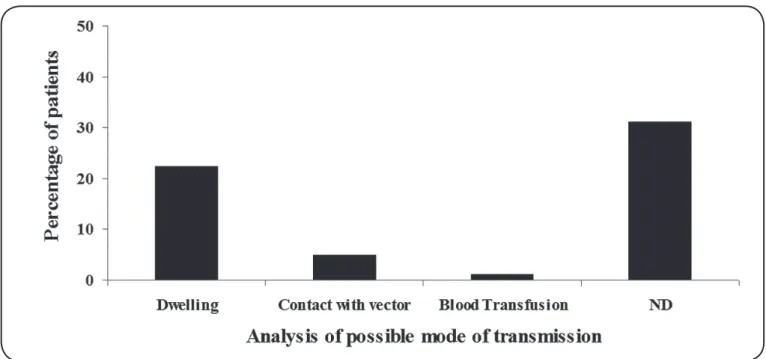
FIGURE 1: Data regarding possible mode of transmission according to the report of the patients analyzed. ND: not determined.
occurred during the late 80s and early 90s. Oliveira-Marques et al9 also showed that the age of infected people among 163 blood donors ranged from 18 to 63 years, in which 65% were male. Furthermore, Teixeira et al10 evaluated the clinical profile of 43 patients, and found that 63% were over 40 years, and that 28% were female and 72% male. In this study, the higher proportion of male patients was attributed to the greater exposure and contact with the environment due to occupational activity, which requires them to enter and establish housing in natural habitat areas of CD vectors10. The majority of the patients reported that family members and relatives had also been diagnosed with CD. The information regarding contact with the vector, living in an endemic area, and type of residence was not found in all the records, although through the patient clinical interview, it was possible to determine that the majority of the patients were not sure how they got infected (Figure 1). Approximately 25% reported seeing the vector around their residence and only a few of them (around 5%) had contact with the vector (Figure 1).
However, only one patient remembered being bitten by a triatomine at the age of 5 years. Another patient reported being infected through blood transfusion at two months of age in 1987, prior to CD control in blood banks, as mentioned above. In the study conducted by Bozelli et al11 in 32% of the records as the mode of transmission of the disease, 53% reported the presence of triatomines at home and 3% had previously received blood transfusion; however, 43% had not received blood transfusions and were unaware of the vector11.
Rev Soc Bras Med Trop 51(6):831-835, Nov-Dec, 2018
Unfortunately, benznidazole can lead to considerable collateral effects in some patients, especially older ones12. Benznidazole (manufactured nowadays by the Laboratório Farmacêutico Estatal / Brasil) is the only drug currently used in Brazil for the treatment of CD. Treatment is formally prescribed for patients with acute or congenital forms of the disease or reactivation, although for adults with the chronic phase, aged 19–50 years, treatment should also be prescribed. Interestingly, in patients with cardiomyopathy, the attenuation of clinical cardiac deterioration could not be observed. However, when benznidazole is used before the appearance of the clinical conditions, the treatment seems to prevent the occurrence of electrocardiographic alterations13.
The diagnosis of CD can be made by several parasitological, serological, and molecular methods. In the chronic phase, characterized by low parasitemia, the diagnosis is essentially serologic and should use two tests with different principles: one with a high sensitivity such as ELISA or IFA, and another
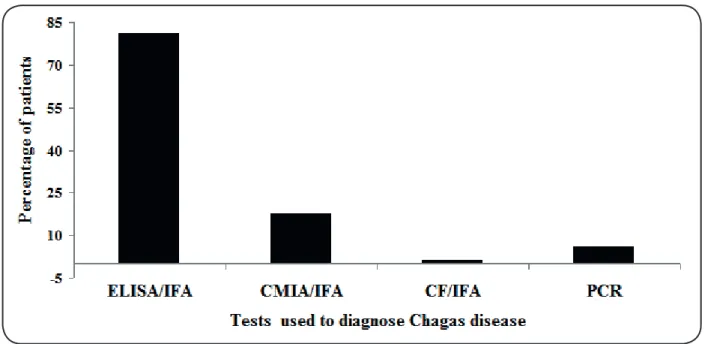
with high specificity, for example the IHA5. The results show that almost all the patients were diagnosed with the disease by ELISA/IFA. Analysis of the parasite in blood was performed in 3 patients; however, this diagnostic method is unusual because the incidence of acute infection has decreased substantially since the interruption of transmission by vectors and blood transfusions in most Latin American countries14,15. Among the analyzed medical records, three patients (4%) were subjected to a fresh direct blood test but, of those, only one returned positive. The three predominant sets of serological methods employed by the Hospital are ELISA / IFA, Carbonylmetalloimmunoassay (CMIA) / IFA, and complement fixation (CF) / IFA. The majority of the patients (81%) were diagnosed by ELISA/IFA (Figure 2). CMIA and IFA methods were used in fourteen (18%)
FIGURE 2: Tests used to diagnose Chagas disease according to the records analyzed. ELISA: enzyme-linked immunosorbent assay; IFA: indirect immunofluorescence assay; CMIA: Carbonylmetalloimmunoassay; CF: complement fixation; PCR: polymerase chain reaction.
of the patients studied. Among the total data records analyzed, 76 patients (95%) were considered reactive according to the serological tests adopted. In four cases (5%) of this study, the
polymerase chain reaction (PCR) was essential to confirm the
diagnosis. In a study analyzing 95 patient records, serology
was confirmed in 28% by indirect immunofluorescence, 28%
by ELISA, 7% by IHA and in 36% the method used were not described11. In case of doubt, as in the four cases described in the serological test, it is possible to perform the PCR12, to access cure control in areas where there is no infestation by Trypanosoma rangeli, which shares 60% of its antigens with T. cruzi5.
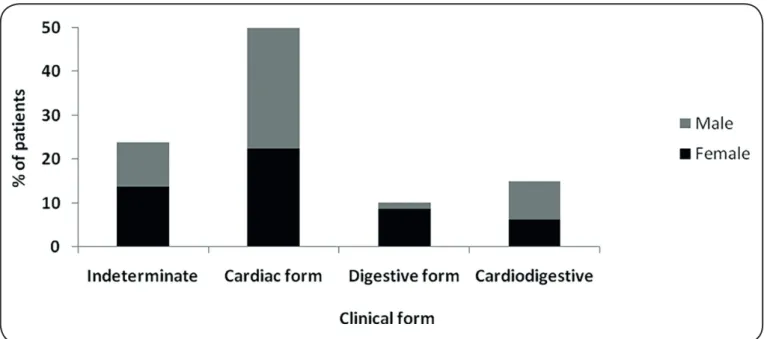
Analyzing the data records in the most recent diagnosis, 24% of the patients monitored had the indeterminate form of the disease. The cardiac manifestation of the disease was the most common clinical form found (51%), while the digestive form was found in only 10% of cases, and the cardiodigestive form in 15% (Figure 3). It was observed that on average, 18 years after being diagnosed with one of the CD clinical forms, some of the patients (11%) evolved to another CD manifestation.
In this regard, among the 31% of the patients firstly diagnosed
in the indeterminate form of CD, 12% progressed to cardiac, 8% to digestive, and another 8% to the cardiodigestive forms of the disease. However, most of them (72%) remained in the indeterminate form. Furthermore, of the patients diagnosed with the cardiac or digestive forms (59%), only 4% evolved to the cardiodigestive form.
Regarding clinical manifestation, it is known that the digestive form is mainly observed in countries of South America14,15, and represented 10% of the analyzed records.
In parallel, it is noteworthy that, to confirm the diagnosis, a
and clinical features indicated that the patients had the disease despite the negative serological tests. Bozelli et al11 also found that the cardiac form was the most prevalent (39%), followed by digestive (26%), indeterminate (20%), and cardiodigestive (15%) forms. Nevertheless, in 57% of patients, the presence of
comorbidities was identifi ed11.
Interestingly, when the difference in the gender of the
80 patients was analyzed, a signifi cant correlation between
the developed symptomatic clinical form and the gender of the patient was positively associated (p<0.001), where a predominance of the cardiac and cardiodigestive clinical manifestations was found among male patients (Figure 3). de Oliveira-Marques et al9, when comparing the clinical forms of CD with age, observed that the chronic cardiac form had lower frequency in patients younger than 30 years (2%). Also, in this study, when the clinical form was compared to the gender, the chronic cardiac form was recorded in 33% of female patients and in 41% of male patients9, corroborating our fi ndings.
In summary, according to the data obtained, studies based on regional population are interesting to increase our knowledge on the disease and to estimate the affected population. Given the elimination of the main vector of the disease, this mapping
provides information for understanding the new profi le of
patients bearing CD.
Confl ict of interest
The authors declare that they have no confl ict of interest.
Financial Support
This study was supported by Fundação de Amparo à Pesquisa do Estado de São Paulo (FAPESP) (FRG 2015/24595-9). Fellowships were provided by
Conselho Nacional de Desenvolvimento Científi co e Tecnológico (CNPq)
FIGURE 3: Correlation between gender and clinical form of Chagas disease among the patients whose data records were analyzed.
(FRG 309764/2015-7) and Coordenação de Aperfeiçoamento de Pessoal de Nível Superior (Capes) (AB, MMP).
REFERENCES
1. WHO, 2017. Neglected tropical diseases. Available from: http:// www.who.int/neglected_diseases/diseases/en/, on the 10th May, 2018.
2. Gascon J, Bern C, Pinazo MJ. Chagas disease in Spain, the United States and other non-endemic countries. Acta Trop. 2010;115(1-2): 22-7.
3. Martins-Melo FR, Ramos Jr AN, Alencar CH, Heukelbach J. Prevalence of Chagas disease in Brazil: a systematic review and meta-analysis. Acta Trop. 2014;130:167-74.
4. Moncayo A, Ortiz Yanine MI. An update on Chagas disease (human American trypanosomiasis). Ann Trop Med Parasitol. 2006;100(8):663-77.
5. SVS. Consenso Brasileiro em Doença de Chagas. Rev Soc Bras Med Trop. 2005;38: 1-29.
6. Guhl F, Pinto N, Aguilera G. Sylvatic triatominae: a new challenge in vector control transmission. Mem Inst Oswaldo Cruz. 2009;104(Suppl 1):71-5.
7. Kamiji MM, Oliveira RB de. O perfi l dos portadores de doença de Chagas, com ênfase na forma digestiva, em hospital terciário de Ribeirão Preto, SP. Rev Soc Bras Med Trop. 2005;38(4):305-9.
8. Pereira L dos S, Freitas EC, Fidalgo ASO de BV, Andrade MC, Cândido D da S, da Silva Filho JD, et al. Clinical and
Epidemiological Profi le of Elderly Patients With Chagas Disease
Followed Between 2005-2013 By Pharmaceutical Care Service in Ceará State, Northeastern Brazil. Rev Inst Med Trop São Paulo. 2015;57(2):145-52.
9. de Oliveira-Marques DS, Bonametti AM, Matsuo T, Gregori
Junior F. The epidemiologic profi le and prevalence of cardiopathy
10. Teixeira RB, Oliveira SMC de. Profile of patients chagas disease carriers in Rio Branco, Acre, Brazil. Rev Soc Bras Clin Med. 2015;13(4):262-5.
11. Bozelli CE, Araújo SM de, Guilherme ALF, Gomes ML. Perfil clínico-epidemiológico de pacientes com doença de Chagas no Hospital Universitário de Maringá, Paraná, Brasil. Cad Saúde Publica. 2006;22(5):1027-34.
12. Machado-de-Assis GF, Diniz GA, Montoya RA,Dias JC, Coura JR, Machado-Coelho GL, et al. A serological, parasitological and clinical evaluation of untreated Chagas disease patients and those treated with benznidazole before and thirteen years after intervention. Mem Inst Oswaldo Cruz. 2013;108(7):873-80.
13. Fragata-Filho AA, França FF, Fragata C da S, Lourenço AM, Faccini CC, Costa CA de J. Evaluation of Parasiticide Treatment with Benznidazol in the Electrocardiographic, Clinical, and Serological Evolution of Chagas Disease. PLoS Negl Trop Dis. 2016;10(3):e0004508.
14. Nunes MCP, Dones W, Morillo CA, Encina JJ, Ribeiro AL. Chagas disease: an overview of clinical and epidemiological aspects. J Am Coll Cardiol. 2013;62(9):767-76.
15. Buscaglia CA, Di Noia JM. Trypanosoma cruzi clonal diversity and the epidemiology of Chagas’ disease. Microbes Infect. 2003;5(5):419-27.