Article
J. Braz. Chem. Soc., Vol. 29, No. 7, 1382-1387, 2018 Printed in Brazil - ©2018 Sociedade Brasileira de Química
*e-mail: [email protected]; [email protected]
Rapid and Efficient Uncatalyzed Knoevenagel Condensations from Binary Mixture
of Ethanol and Water
JoãoM.G.O.Ferreira,aJoãoB.M.deResendeFilho,bPolianeK.Batista,a
ErculesE.S.Teotonio*,aandJulianaA.Vale*,a
aDepartamento de Química, Universidade Federal da Paraíba, 58051-970 João Pessoa-PB, Brazil
bInstituto Federal de Educação, Ciência e Tecnologia da Paraíba, 58800-970 Sousa-PB, Brazil
This paper presents a new green protocol for Knoevenagel condensations of aldehydes and compounds with an active methylene group in a binary mixture of ethanol/water (3:7, v/v). This medium favored the uncatalyzed Knoevenagel reactions and easy workup products can be obtained by precipitation in this medium and showed good isolated yields (55-100%) in short reaction times (1-60 min).
Keywords: Knoevenagel condensation, ethanol/water, green approach, binary mixture, active methylene compounds and aldehydes
Introduction
The Knoevenagel condensation is an aldol reaction between carbonylated substances (such as ketones and aldehydes) and active methylene compounds (–CH2–
attached to two electron withdrawing groups, EWGs) producing alkenes.1-3 It is one of the most useful reactions
to form C–C bonds, generally used to assist the synthesis of several compounds with biological relevance4 and other
possible applications, such as drugs,5-10 natural products,11,12
and polymers.13-15
Weak bases, such as amines and basic salts, usually catalyze these reactions.1-3 The base furthers the
deprotonation of the active methylene compound to create a carbanion, which, in turn, attacks the carbonyl. In the earliest works, the amines used to catalyze the reactions presented a considerable level of toxicity.16,17 Thus, many
papers have been published in recent years concerning proposals for ecofriendly reaction conditions,18-22 in
accordance with the principles of green chemistry.22-25
From this perspective, many researchers have developed new catalysts involving the mentioned principles. One such type, which have received great attention, are the heterogenized catalysts.26-28 They present certain advantages
compared with their respective homogeneous compounds, such as facile separation methods (filtration, magnetic
separation, etc.) for recovery of the catalyst, easier reuse, stability at high temperatures and pressures, and relatively low toxicity. Some of these reactions even occur without solvents, decreasing the toxicity of the reaction medium.29-31
Furthermore, other researchers32-34 have reported
solvent-catalyzed Knoevenagel condensations, generally using ionic liquids or water (green solvents), under different conditions.
In our studies, we noted that Knoevenagel condensations were faster in ethanol than in other solvents (apolar or polar, protic or aprotic). Many papers have reported this reaction in ethanol using catalysts,35,36 but none have discussed
this reaction uncatalyzed in ethanol until this report. In addition, the uncatalyzed Knoevenagel condensations reported in the literature generally use water37,38 or ionic
liquids39-41 as solvents. Thus, this work presents a new
green approach for the quick and efficient uncatalyzed Knoevenagel condensation of different substrates in a mixture of ethanol/water.
Experimental
Reagents and instruments
were prepared in volumetric proportions (1:9, 1:1, 3:7, 7:3, v/v). All chemicals were employed without further purification.
General procedures for Knoevenagel condensations
The aldehyde (0.2 mmol) and the compound with the active methylene group (0.2 mmol) were added to a test tube followed by the addition of the solvent (ethanol/ water 3:7, 0.8 mL). The system was maintained at 80 °C and magnetically stirred until the reaction completed. The reaction progress was monitored by thin layer chromatography (TLC). The products were obtained by precipitation with cooled water or by extraction with ethyl acetate. The extract was purified by column chromatography. All the products were characterized by Fourier transform infrared spectroscopy (FTIR), gas-chromatography mass spectrometry (GC-MS), 1H
and 13C nuclear magnetic resonance (NMR).
Results and Discussion
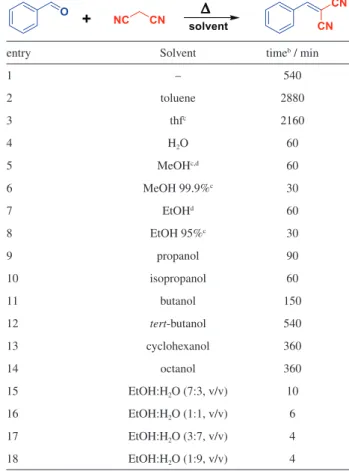
To examine the effects of the different solvents in uncatalyzed Knoevenagel condensations it was tested a standard reaction between benzaldehyde and malononitrile in solvent-free conditions and in aprotic polar, protic polar and apolar solvents (Table 1).
As seen in Table 1, the reaction times in toluene (entry 2, apolar solvent) and tetrahydrofuran (thf, entry 3, aprotic polar solvent) were the slowest. These results are in agreement with the mechanism of these amine-free reactions.42 This mechanism is well known to involve
carbanion formation and an ionic intermediate (enolate). Therefore, the reaction in a polar solvent (thf, for example) would be expected to be faster than in an apolar solvent (toluene, for example). When this reaction was carried out under solvent-free conditions (entry 1), the reaction time was even faster than those mentioned above.
The reactions in protic polar solvents (entries 4-15, water and alcohols) were considerably faster than in the aprotic polar and apolar solvents. The reaction times increased when long carbon chain alcohols were used as solvents (entries 5, 7, 9-14). In water (entry 4), the reaction was completed at the same time (60 min) as the reactions in methanol (entry 5) and ethanol (entry 7) high-performance liquid chromatography (HPLC) grade (anhydrous). However, when using ethanol 95% or methanol 99.9%, the reaction time surprisingly decreased to 30 min (half the time). This event promoted our curiosity for the study of this reaction in the mixtures of ethanol/water (entries 15-18). As can be observed in
the Table 1, when the mixture of ethanol/water presents a small volume of ethanol the reaction occurs faster than the one with the largest volume of ethanol. The same reaction in water (entry 4) or anhydrous ethanol (entry 7) is considerable slower than any mixture of ethanol/water. The mixture ethanol/water 3:7 v/v showed the best results (entry 17) and it was used as a solvent in subsequent reactions.
In addition, the reaction between benzaldehyde and malononitrile in ethanol/water, 3:7 v/v, was carried out at room temperature and under ultrasound conditions (both 150 min). However, these reactions were slower than those carried out with heating at 75 °C.
The ethanol-water mixture presents particular properties compared with the isolated solvents that further the Knoevenagel condensation when performed in the mixed system: (i) a higher solvation power because of the formation of molecular chains interacting by hydrogen bonds (cluster formation); (ii) the lower dielectric constant of these mixtures when compared with the pure solvents
Table 1. The effect of solvents on Knoevenagel condensation of benzaldehyde and malononitrilea
entry Solvent timeb / min
1 – 540
2 toluene 2880
3 thfc 2160
4 H2O 60
5 MeOHc,d 60
6 MeOH 99.9%c 30
7 EtOHd 60
8 EtOH 95%c 30
9 propanol 90
10 isopropanol 60
11 butanol 150
12 tert-butanol 540
13 cyclohexanol 360
14 octanol 360
15 EtOH:H2O (7:3, v/v) 10
16 EtOH:H2O (1:1, v/v) 6
17 EtOH:H2O (3:7, v/v) 4
18 EtOH:H2O (1:9, v/v) 4
aReaction conditions: benzaldehyde (0.1 mmol), malononitrile (0.1 mmol),
0.4 mL of solvent, 75 °C; bthe reactions were monitored by TLC; creflux
temperature: 65 °C; dHPLC grade.
Table 1. The effect of solvents on Knoevenagel condensation of benzaldehyde and malononitrilea
entry Solvent timeb / min
1 – 540
2 toluene 2880
3 thfc 2160
4 H2O 60
5 MeOHc,d 60
6 MeOH 99.9%c 30
7 EtOHd 60
8 EtOH 95%c 30
9 propanol 90
10 isopropanol 60
11 butanol 150
12 tert-butanol 540
13 cyclohexanol 360
14 octanol 360
15 EtOH:H2O (7:3, v/v) 10
16 EtOH:H2O (1:1, v/v) 6
17 EtOH:H2O (3:7, v/v) 4
18 EtOH:H2O (1:9, v/v) 4
aReaction conditions: benzaldehyde (0.1 mmol), malononitrile (0.1 mmol),
0.4 mL of solvent, 75 °C; bthe reactions were monitored by TLC; creflux
can favor stronger interactions with small polar molecules such as malononitrile; (iii) the possibility to increase the solubility of organic compounds when compared to the use of water as solvent; and (iv) the ability to form cavities.43-45
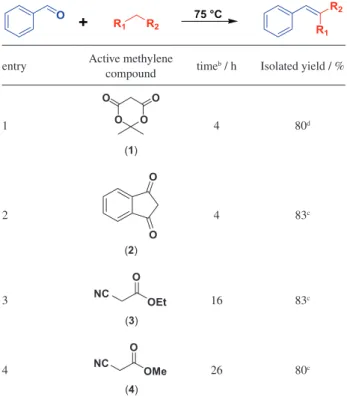
Benzaldehyde was chosen to react with different active methylene compounds such as cyanoesters, Meldrum’s acid, and betadiketones (Table 2).
As expected, the reaction with malononitrile (entry 17, Table 1) was faster than with other active methylene compounds (Table 2). However, the difference of the reaction times was significant and cannot be simply explained by the pKa of the methylene groups, suggesting
that other factors are relevant.
The base-catalyzed Knoevenagel condensation of aldehydes and Meldrum’s acid often gave the bis adduct, due to the Michael addition with a second molecule of the Meldrum’s acid. Cunha and Santana46 reported the
uncatalyzed Knoevenagel reactions in water (75 °C, 2 h) and they observed the preferential formation of Knoevenagel product.Bigi et al.47 found the same results,
however, the uncatalyzed reactions carried out in ethanol as solvent were unselective and a mixture of Knoevenagel
and bis adduct was obtained. Interestingly, the reactions with Meldrum’s acid in the mixture ethanol/water were a selective reactions giving only the Knoevenagel product and no trace of bis adduct was detected.
After the optimization of the conditions for the Knoevenagel condensations, several aldehydes were reacted with malononitrile (active methylene compound) in the selected conditions (Table 3).
In general, the reactions showed good isolated yields in short times (Table 3). The standard reaction with benzaldehyde and malononitrile (entry 1) was completed in 4 min (yield 82%). The reaction with 4-NO2-benzaldehyde
(entry 2) was faster than mentioned above due to the presence of the strong electron withdrawing group (NO2)
at the 4-position. In addition, the reactions with an electron donating group (entries 4 and 5) at the 4-position were slower than those with an electron withdrawing group at the same position.
The aldehydes with substituents (electron donating or withdrawing group) in the 3-position (entries 6 and 7) and 2-position (entries 8 and 9) exhibited behavior similar to reactions with those substituents at the 4-position. In addition, considerable steric hindrance was observed in the substrates with groups at the 2-position. The reactions with di-substituted aldehydes (entries 10-12) finished in 25-45 min and showed good yields. Surprisingly, the reaction time was very low for the tri-substituted aldehyde, compound 17 (entry 13), reacting completely in only 3 min, with isolated yield of 99%.
The reactions with heteroaromatic aldehydes (entries 20, 22) finished in a short time. As the n-pyridinecarboxyaldehydes (n = 3 or 4, entries 20, 21) are rather reactive electrophiles and are completely miscible in water, the reactions with these substrates were incredibly fast (in seconds). The aliphatic aldehyde (entry 19) completed at a time close to the substituted aromatic aldehydes.
These products were easily obtained by precipitation with the addition of cooled water and any purification process was used. However, in the cases that the product are soluble in the mixture of ethanol/water, it was obtained by extraction with ethyl acetate and after purified by chromatographic column.
The Knoevenagel condensation of ketones and malononitrile in the mixture of ethanol/water 3:7 (v/v) was initially verified and presented good results. The reactions between 4-methylcyclohexanone or 3-methylcyclohexanone and malononitrile, for example, finished in five and six hours, respectively, with 75% isolated yield for both. The study of these reactions (with ketones) in this mixture is still in progress.
Table2. Knoevenagel condensations of benzaldehyde and different active methylene compounds in ethanol/water 3:7 (v/v)a
entry Active methylene compound time
b / h Isolated yield / %
1 4 80d
2 4 83c
3 16 83c
4 26 80c
aReaction conditions: benzaldehyde (0.1 mmol), active methylene
compound (0.1 mmol), 0.4 mL EtOH/H2O 3:7 (v/v), 75 °C; bthe
reactions were monitored by TLC; cproducts obtained by precipitation
and wash cooled water; dproducts obtained by extraction and purified by
chromatographic column.
Table2. Knoevenagel condensations of benzaldehyde and different active methylene compounds in ethanol/water 3:7 (v/v)a
entry Active methylene compound time
b / h Isolated yield / %
1 4 80d
2 4 83c
3 16 83c
4 26 80c
aReaction conditions: benzaldehyde (0.1 mmol), active methylene
compound (0.1 mmol), 0.4 mL EtOH/H2O 3:7 (v/v), 75 °C; bthe reactions
were monitored by TLC; cproducts obtained by precipitation and washing
with cooled water; dproducts obtained by extraction and purified by
Table3. Knoevenagel condensations of aldehydes and malononitrile in ethanol/water 3:7 (v/v)a
entry Product time
b /
min
Isolated yield / %
time (yield / %)c /
min
1 4 82d 30 (91)48
2 1 93d 20 (91)48
3 20 84d 30 (94)48
4 60 85d 60 (91)48
5 50 94d 45 (90)49
6 25 72e 50 (93)50
7 40 75d 90 (92)51
8 3 94e 10 (92)49
9 50 80d 15 (90)52
10 25 92e –
11 25 94d 240 (66)51
entry Product time
b /
min
Isolated yield / %
time (yield / %)c /
min
12 45 89e 50 (92)49
13 3 99e –
14 20 89d 40 (92)53
15 30 95d 30 (99)26
16 15 75e 30 (92)54
17 15 55d 30 (94)54
18 10 100d 20 (94)55
19 30 76e 30 (72)56
20 1 92e 3 (86)57
21 1 91e 30 (95)58
aReaction conditions: aldehyde (0.2 mmol), malononitrile (0.2 mmol),
0.8 mL of EtOH/H2O 3:7 (v/v), 75 °C; bthe reactions were monitored by
TLC; creaction time and isolated yield reported in literature; dproducts
obtained by precipitation and washing with cooled water; eproducts
Conclusions
The mixture of ethanol/water 3:7 (v/v) was used as a solvent for uncatalyzed Knoevenagel condensation reactions and showed surprisingly excellent results (good yields, 55-100%, and excellent times, 1-60 min) when compared with these reactions in ethanol or water. In recent decades, many works have reported syntheses of new molecules that used the Knoevenagel condensation in at least one step. Therefore, the development of new protocols is important to provide new ecofriendly methods for organic synthesis. The mixture of ethanol/water 3:7 (v/v) is an ecofriendly solvent, and many products of Knoevenagel condensations of aldehydes and compounds with an active methylene can be obtained by precipitation in this medium. This green protocol can provide the synthesis of new molecules from the Knoevenagel condensation or new ways to re-synthesize known molecules.
Supplementary Information
Supplementary data are available free of charge at http://jbcs.sbq.org.br as PDF file.
Acknowledgments
Tha authors thank CAPES and CNPq for financial support and Unical (Unidade da Central Analítica) of the IPeFarM-UFPB (Instituto de Pesquisa em Fármacos e Medicamentos da UFPB) for assistance with the NMR analysis.
References
1. Knoevenagel, E.; Ber. Dtsch. Chem. Ges. 1894, 27, 2345. 2. Knoevenagel, E.; Ber. Dtsch. Chem. Ges. 1896, 29, 172. 3. Jones, G.; Org. React. 1967, 15, 204.
4. Lavanya, G.; Padmavathi, V.; Padmaja, A.; J. Braz. Chem. Soc.
2014, 25, 1200.
5. Zhang, J.; Li, W. L.; Wu, L. Q.; J. Braz. Chem. Soc. 2011, 22, 1236.
6. Beutler, U.; Fuenfschilling, P. C.; Steinkemper, A.; Org. Process Res. Dev. 2007, 11, 341.
7. Reddy, N. S.; Mallireddigari, M. R.; Cosenza, S.; Gumireddy, K.; Bell, S. C.; Reddy, E. P.; Reddy, M. R.; Bioorg. Med. Chem. Lett. 2004, 14, 4093.
8. Gupta, J. K.; Sharma, P. K.; Dudhe, R.; Chaudhary, A.; Singh, A.; Verma, P. K.; Mondal, S. C.; Yadav, R. K.; Kashyap, S.; Med. Chem. Res. 2012, 21, 1625.
9. Patel, R. V.; Kumari, P.; Rajani, D. P.; Chikhalia, K. H.; Med. Chem. Res. 2013, 22, 195.
10. Kaminskyy, D.; Den Hartog, G. J. M.; Wojtyra, M.; Lelyukh, M.; Gzella, A.; Bast, A.; Lesyk, R.; Eur. J. Med. Chem. 2016, 112, 180.
11. Tan, H.; Chen, X.; Chen, H.; Liu, H.; Qiu, S.; Eur. J. Org. Chem.
2015, 2015, 4956.
12. Lashkari, M.; Maghsoodlou, M. T.; Hazeri, N.; Habibi-Khorassani, S. M.; Akbarzadeh Torbati, N.; García-Granda, S.; Torre-Fernández, L.; J. Heterocycl. Chem. 2015, 52, 873. 13. Kwak, G.; Fujiki, M.; Macromolecules 2004, 37, 2021. 14. Birzan, L.; Cristea, M.; Draghici, C. C.; Tecuceanu, V.; Maganu,
M.; Hanganu, A.; Razus, A. C.; Buica, G. O.; Ungureanu, E. M.; Dyes Pigm. 2016, 131, 246.
15. Zhuang, X.; Zhao, W.; Zhang, F.; Cao, Y.; Liu, F.; Bi, S.; Feng, X.; Polym. Chem. 2016, 7, 4176.
16. Green, B. T.; Lee, S. T.; Panter, K. E.; Brown, D. R.; Food Chem. Toxicol. 2012, 50, 2049.
17. Cushny, A. R.; J. Exp. Med. 1896, 1, 202.
18. Brahmachari, G.; ACS Sustainable Chem. Eng. 2015, 3, 2350. 19. Jafari, A. A.; Ghadami, M.; Environ. Chem. Lett. 2016, 14, 215. 20. Dandia, A.; Parewa, V.; Kumari, S.; Bansal, S.; Sharma, A.;
Green Chem. 2016, 18, 2488.
21. Dhorajiya, B. D.; Dholakiya, B. Z.; Res. Chem. Intermed. 2015, 41, 277.
22. Eskandari, K.; Karami, B.; Khodabakhshi, S.; Farahi, M.; J. Chin. Chem. Soc. 2015, 62, 473.
23. Lenardão, E. J.; Freitag, R. A.; Dabdoub, M. J.; Batista, A. C. F.; Silveira, C. D. C.; Quim. Nova 2003, 26, 123.
24. Anastas, P.; Eghbali, N.; Chem. Soc. Rev. 2010, 39, 301. 25. Anastas, P. T.; Warner, J. C.; Green Chemistry: Theory and
Practice; Oxford University Press, 1998.
26. Srivastava, S.; Aggarwal, H.; Gupta, R.; Cryst. Growth Des.
2015, 15, 4110.
27. Regati, S.; He, Y.; Thimmaiah, M.; Li, P.; Xiang, S.; Chen, B.; Zhao, J. C. G.; Chem. Commun. 2013, 49, 9836.
28. Mrówczyński, R.; Nan, A.; Liebscher, J.; RSC Adv. 2014, 4, 5927.
29. Parveen, M.; Azaz, S.; Ahmad, F.; Malla, A. M.; Alam, M.; Catal. Lett. 2016, 146, 1687.
30. Dhinakaran, I.; Padmini, V.; Bhuvanesh, N.; ACS Comb. Sci.
2016, 18, 236.
31. Dumbre, D. K.; Mozammel, T.; Selvakannan, P. R.; Hamid, S. B. A.; Choudhary, V. R.; Bhargava, S. K.; J. Colloid Interface Sci. 2015, 441, 52.
32. de Paula, B. R. S.; Zampieri, D. S.; Zukerman-Schpector, J.; Tiekink; E. R. T.; Rodrigues, J. A. R.; Moran, P. J. S.; J. Braz. Chem. Soc. 2012, 23, 825.
33. Seyyedi, N.; Shirini, F.; Langarudi, M. S. N.; RSC Adv. 2016, 6, 44630.
34. Hu, X.; Zheng, Q.; Ngwa, C.; Curr. Org. Synth. 2016, 13, 101. 35. Wach, A.; Drozdek, M.; Dudek, B.; Łątka, P.; Kuśtrowski, P.;
36. Elhamifar, D.; Kazempoor, S.; J. Mol. Catal. A: Chem. 2016, 415, 74.
37. Isobe, K.; Hoshi, T.; Suzuki, T.; Hagiwara, H.; Mol. Diversity
2005, 9, 317.
38. Abedini, M.; Shirini, F.; Omran, J. M. A.; Seddighi, M.; Goli-Jolodar, O.; Res. Chem. Intermed. 2016, 42, 4443. 39. Bednarz, S.; Bogdal, D.; Int. J. Chem. Kinet. 2009, 41, 589. 40. Ouyang, F.; Zhou, Y.; Li, Z. M.; Hu, N.; Tao, D. J.; Korean J.
Chem. Eng. 2014, 31, 1377.
41. Wang, Y.; Shang, Z. C.; Wu, T. X.; Fan, J. C.; Chen, X.; J. Mol. Catal. A: Chem. 2006, 253, 212.
42. Siddiqui, I. R.; Shamim, S.; Rai, P.; Waseem, M. A.; Srivastava, A.; Srivastava, A.; J. Heterocycl. Chem. 2015, 53, 849. 43. Mejía, S. M.; Flórez, E.; Mondragón, F.; J. Chem. Phys. 2012,
136, 144306.
44. Akerlof, G.; J. Am. Chem. Soc. 1932, 54, 4125. 45. Van Leeuwen, M. E.; Fluid Phase Equilib. 1994, 99, 1. 46. Cunha, S.; Santana, L. L. B.; Quim. Nova 2012, 35, 642. 47. Bigi, F.; Carloni, S.; Ferrari, L.; Maggi, R.; Mazzacani, A.;
Sartori, G.; Tetrahedron Lett. 2001, 42, 5203.
48. Zhao, X. L.; Yang, K. F.; Zhang, Y. P.; Zhu, J.; Xu, L. W.; Chin. Chem. Lett. 2014, 25, 1141.
49. Patil, S.; Jadhav, S. D.; Deshmukh, M. B.; J. Chem. Sci. 2013, 125, 851.
50. Mobarakeh, M. I.; Saffar-Teluri, A.; Tabrizi, S. A. H.; Res. Chem. Intermed. 2015, 41, 6625.
51. Wang, X. S.; Zeng, Z. S.; Li, Y. L.; Shi, D. Q.; Tu, S. J.; Wei, X. Y.; Zong, Z. M.; Synth. Commun. 2005, 35, 1915. 52. Pourjavadi, A.; Hosseini, S. H.; Amin, S. S.; Chem. Eng. J.
2014, 247, 85.
53. Yang, Y.; Yao, H. F.; Xi, F. G.; Gao, E. Q.; J. Mol. Catal. A: Chem. 2014, 390, 198.
54. Zhao, X. L.; Yang, K. F.; Zhang, Y. P.; Zhu, J.; Xu, L. W.; Chin. Chem. Lett. 2014, 25, 1141.
55. Li, J. T.; Chen, G. F.; Wang, S. X.; He, L.; Li, T. S.; Aust. J. Chem. 2005, 58, 231.
56. Paun, C.; Barklie, J.; Goodrich, P.; Gunaratne, H. Q. N.; Mckeown, A.; Parvulescu, V. I.; Hardacre, C.; J. Mol. Catal. A: Chem. 2007, 269, 64.
57. Yadav, J. S.; Reddy, B. V. S.; Basak, A. K.; Visali, B.; Narsaiah, A. V.; Nagaiah, K.; Eur. J. Org. Chem. 2004, 2004, 546. 58. Moemeni, M. H.; Amrollahi, M. A.; Tamaddon, F.; Bulg. Chem.
Commun. 2015, 47, 7.
Submitted: September 27, 2017
Published online: December 21, 2017