https://doi.org/10.1590/0004-282X20180126
ARTICLE
Alarming lack of knowledge about
antithrombotic therapy among patients with
atrial fibrillation
Terapia antitrombótica: alarmante falta de conhecimento em pacientes com fibrilação
atrial
Julia Miguel Leitão
1, Fernanda Maria Dutra Spagnuolo Moreira
1, Ingrid Eyng Thiel
1, Isadora Yasbick
Spricido
1, Rômulo Henrique Malaquias Silva
1, Viviane Flumignan Zétola
2Large population campaigns have been conducted in
Brazil to improve knowledge about the signs and
symp-toms of stroke and the importance of time to care. Along
with receiving the correct treatment, prevention by all
means must be a priority to reduce the morbidity and
mor-tality of stroke.
Atrial fibrillation (AF) is a supraventricular arrhythmia
that leads to a total disorganization of atrial electrical activity,
impairing the atrium’s contraction capacity and inhibiting
the sinus node
1. Stroke is the main complication of AF. At
least one in five strokes is associated with AF, and thrombo
-embolic strokes in patients with AF are usually more severe
and incapacitating than in patients without AF
2,3. More than
100,000 deaths due to stroke are registered annually in Brazil
4.
Stroke is also one of the main causes of death and is the major
cause of disability in Brazil and in the world
2,5,6,7.
1Universidade Federal do Paraná, Curitiba PR, Brasil;
2Universidade Federal do Paraná, Hospital de Clínicas, Serviço de Neurologia, Curitiba PR, Brasil.
Correspondence: Viviane Flumignan Zétola; Hospital de Clínicas da UFPR, Serviço de Neurologia; Rua General Carneiro, 181; 80060-900 Curitiba PR, Brasil; E-mail: [email protected]
Conflict of interest: There is no conflict of interest to declare.
Received 04 April 2018; Received in final form 11 July 2018; Accepted 27 August 2018.
ABSTRACT
Large population campaigns have been conducted in Brazil to improve knowledge about the signs and symptoms of stroke and the importance
of time to care.
Objective:
Parallel to these important actions, we aimed to evaluate the lay knowledge of patients with atrial fibrillation,
a well-recognized etiology of stroke, adequate treatment and management of which can prevent up to 30% of cerebrovascular events.
Methods:
We questioned 143 patients with atrial fibrillation about the risks associated with the disease.
Results:
Ninety-one percent were
on anticoagulation treatment. Of the total, 63.6% reported having been informed about the risks and benefits of anticoagulants but only
46.9% were able to correctly mention one of these risks. Ischemic stroke was identified as a risk by only 25.9% and hemorrhagic stroke was
not mentioned. A CHADS
2≥
2 was scored by 84.0% of the patients.
Conclusions:
Our study showed an alarming knowledge gap in patients
with atrial fibrillation. Difficulty in adherence to treatment resulting from the failure of this communication is possibly one of the factors
responsible for the high incidence and recurrence of stroke, and should not go unnoticed.
Keywords: A
trial fibrillation; stroke; patient medication knowledge; warfarin; anticoagulants.
RESUMO
Campanhas populacionais para melhorar o conhecimento sobre os sinais e sintomas do acidente vascular encefálico e a importância do tempo
para o tratamento têm sido realizadas no nosso país, visando a melhoria da linha do atendimento.
Objetivo:
Paralelamente a estas relevantes
ações, objetivamos avaliar o conhecimento leigo de pacientes portadores de fibrilação atrial, etiologia determinada e prevalente do acidente
vascular encefálico, cujo tratamento e manejo adequado podem prevenir até 30% dos eventos cerebrovasculares.
Métodos:
Entrevistamos
portadores de fibrilação atrial sobre os riscos associados à doença.
Resultados:
Noventa e um por cento estavam sob uso de anticoagulantes.
Do total, 63,6% responderam terem sido informados sobre riscos e benefícios da terapia anticoagulante, mas apenas 46,9% souberam citar
corretamente um desses riscos. Acidente vascular encefálico isquêmico foi associado ao risco por apenas 25,9% e acidente vascular encefálico
hemorrágico não foi mencionado. CHADS
2≥
2 foi pontuado por 84,0% dos pacientes.
Conclusões:
Nosso estudo demonstra uma alarmante falha
no conhecimento do risco de acidente vascular encefálico nos portadores de fibrilação atrial. Dificuldade na aderência ao tratamento resultante
da falha dessa comunicação é fator relevante na incidência e recorrência do acidente vascular encefálico e não deve ser negligenciado.
Chronic therapy with oral anticoagulant drugs plays a
crucial role in AF treatment by significantly avoiding the risk
of thromboembolic stroke, although it brings a risk of
intra-cerebral, or other hemorrhage
8. Warfarin remains the most
frequent oral anticoagulant prescribed in Brazil due to its
efficiency and low cost
6,9,10,11.
Risk stratification of thromboembolic events helps iden
-tify which patients have a stroke risk, and this clarifies the
anticoagulant therapy
12. Although the congestive heart
fail-ure, hypertension, age ≥ 75 years, diabetes mellitus, stroke,
vascular disease, age 65-74 years, sex category (CHA
2DS
2VASc)
13score has been proposed by vascular physicians, the
congestive heart failure, hypertension, age ≥ 75 years, diabe
-tes mellitus, stroke (CHADS
2) score is one of the main scales
used for thromboembolic risk evaluation in patients with
AF
by nonspecialists
6,14,15. Treatment success in AF is highly
correlated with patients’ understanding about their
condi-tion and therapy complicacondi-tions. Prevencondi-tion of
cerebrovascu-lar diseases must be one of the priorities in patient
educa-tion, as the layperson’s recognition of its signs and symptoms
remains poor
16,17,18.
We aimed to evaluate patients’ knowledge about
anti-thrombotic therapy in AF. We also evaluated whether the
therapeutic orientation received by the patient correlated
with the CHADS
2score.
METHODS
A cross-sectional study was conducted in a Brazilian
Public University Hospital from September 2015 to May 2016.
A total of 150 outpatients were interviewed, seven of whom
did not meet the inclusion criterion. They were recruited
from neurology and cardiology clinics. The inclusion criterion
was patients who had been assisted by physicians at least
once after receiving the diagnosis of AF. The study excluded
patients with cognition impairment reported by caregivers,
and those who did not sign the consent form.
A questionnaire with seven questions related to AF dis
-ease and its treatment was applied to the participants.
Question 1 was about the patient’s identification (age and
gender). Question 2 asked if the patient had attended at least
one medical appointment after receiving the diagnosis of
AF. If the answer was ‘yes’ we continued with the next five
questions. Question 3: “What is the treatment suggested by
your doctor?” Question 4: “Did someone explain to you the
risks in case of nonadherence to the anticoagulant
treat-ment?” Question 5: “If so, do you know what those risks are?”
Question 6: “Have you ever had a stroke?” Finally, question 7
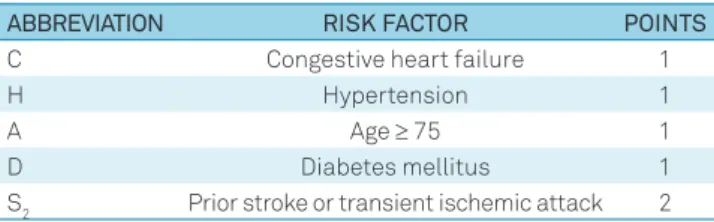
asked about information used to calculate the CHADS
2risk
score (Table 1). For better accuracy, we asked what the medi
-cations in use were.
We classified the patients as “with basic knowledge” and
“without basic knowledge” according to what the authors
expected patients would answer as complications of
nonad-herence to antithrombotic therapy (question 5). Therefore,
answers such as “stroke”, “thrombus formation”, “hyper
-coagulability”, “embolic situations” or other vascular com
-plications were considered as correct in connection with
risks (group A). The only vascular exception was myocardial
infarction or heart attack. Different answers not involving a
vascular system were considered “without basic knowledge”
about antithrombotic therapy (group B).
Data analysis
Data were analyzed with Software R (
R Core Team, 2015;
version 3.2.3
). Data description was made through absolute
and relative frequencies, means and standard deviations.
Fisher’s Exact Test was used to correlate variables from ques
-tions 4 and 5 and the Difference Between Two Propor-tions
Test, which indicates the probability of a correct decision
based on the alternate hypothesis, was applied on data from
question 3. The significance level considered was p < 0.05.
Ethical aspects
The study was approved by the Human Research Ethics
Committee (protocol 1.207.053), in agreement with Brazilian
National Commission for Ethics in Research.
RESULTS
A total of 150 patients from Brazil’s Public Health System
were initially interviewed. Seven patients answered “NO” to
question 2 and did not follow through on the questionnaire.
They were excluded from the statistical analysis and results.
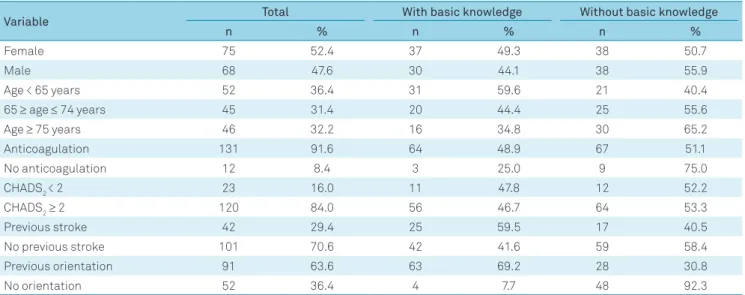
The mean age was 67 ± 10.65 years old (about one third
of patients were < 65 years; one third ≥ 65 and ≤ 74 years;
and one third ≥ 75 years). Gender distribution was approx
-imately 1:1. In total, 131 (91.6%) were on anticoagulation
therapy with warfarin, and the rest were using antiplatelet
agents (Table 2). No-one was using a non-vitamin K
antago-nist oral anticoagulant.
Ninety-one (63.6%) patients felt they were informed
about the risks of lack of adherence to the treatment (ques
-tion 4), but when asked to identify what those risks were, only
37 (25.9%) identified “stroke”. Fifty-four (37.7%) patients said
they didn’t know of any risk; 20 (14.0%) identified “blood thick
-ening”; 16 (11.2%) identified other vascular complications
Table 1.
CHADS
2score for thromboembolic risk stratification.
ABBREVIATION
RISK FACTOR
POINTS
C
Congestive heart failure
1
H
Hypertension
1
A
Age
≥
75
1
D
Diabetes mellitus
1
S
2Prior stroke or transient ischemic attack
2
such as “thrombosis” and “pulmonary thromboembolism”; 14
(9.8%) identified “thrombus formation”, “hypercoagulability”
or “embolic situations” and 2 (1.4%) identified “death”. No one
identified hemorrhagic stroke (Figure).
According to question 5, 67 (46.9%) patients were
included in group A (with basic knowledge) and 76 (53.1%)
patients were included in group B (without basic knowledge).
Among the 91 patients who had been informed about the
risks, 63 (69.2%) showed a basic knowledge (group A) and
28 (30.8%) did not (group B). Thirty-five (38.4%) identified
“stroke” as a risk factor; 15 (16,5%) identified other vascular
complications; 13 (14.3%) identified “thrombus formation”,
“hypercoagulability” or “embolic situations”; 16 (17.6%) iden
-tified “blood thickening”; 11 (12.1%) said they did not know,
and 1 (1.1%) identified “death” as a risk factor.
On the other hand, among the 52 patients who said they
had never been informed about the risks, 4 (7.7%) showed a
basic knowledge and 48 (92.3%) did not. Two (3.9%) of them
identified stroke as a risk; 1 (1.9%) identified other vascu
-lar complications; 1 (1.9%) identified “thrombus formation”,
“hypercoagulability” or “embolic situations”; 4 (7.7%) identi
-fied “blood thickening”; 43 (82.7%) said they did not know
and 1 (1.9%) identified “death”. The correlation between the
variables “had been informed” and “not had been informed”
was statistically significant (p < 0.0001).
Forty-two (29.4%) patients had a previous history of
stroke, 27 (64.3%) of whom were women. Among these 42
patients who had already had a stroke, 16 (38.0%) identified
stroke as a complication from AF in the case of treatment
nonadherence and 26 (62.0%) did not.
Figure.
Patients’ knowledge
25.90%
11.20%
9.80%
37.70%
14.00%
1.40%
0.00%
25.00%
Stroke
Other Vascular Complications
Thrombus Formation/Hypercoagulability/
Embolic Situations
No Answer
Blood Thickening
Death
Without Basic Knowledge
With Basic Knowledge
40.00%
35.00%
30.00%
20.00%
15.00%
10.00%
5.00%
Table 2.
Sample characteristics (%).
Variable
Total
With basic knowledge
Without basic knowledge
n
%
n
%
n
%
Female
75
52.4
37
49.3
38
50.7
Male
68
47.6
30
44.1
38
55.9
Age < 65 years
52
36.4
31
59.6
21
40.4
65
≥
age
≤
74 years
45
31.4
20
44.4
25
55.6
Age
≥
75 years
46
32.2
16
34.8
30
65.2
Anticoagulation
131
91.6
64
48.9
67
51.1
No anticoagulation
12
8.4
3
25.0
9
75.0
CHADS
2< 2
23
16.0
11
47.8
12
52.2
CHADS
2≥
2
120
84.0
56
46.7
64
53.3
Previous stroke
42
29.4
25
59.5
17
40.5
No previous stroke
101
70.6
42
41.6
59
58.4
Previous orientation
91
63.6
63
69.2
28
30.8
No orientation
52
36.4
4
7.7
48
92.3
Of all the patients with CHADS
2≥ 2, 109 (90.8%) were on
anticoagulation and 11 (9.2%) were taking antiplatelet agents.
Of 23 patients with CHADS
2< 2, 22 (95.7%) were on antico
-agulation and 1 (4.3%) was taking an antiplatelet agent.
DISCUSSION
According to Hobbs et al.
2,
the worldwide incidence of AF
is 1% to 2% of the total population. Although the incidence is
higher among men, the morbidity and mortality associated
with the illness is higher in women
12,19,20. There were no statis
-tical differences in sex in our sample. The patients’ ages were
also equivalent to the mean average in other studies.
Our patients showed a good correlation of the CHADS
2score with treatment. Of the patients who were on
antico-agulation, only 25.9% identified stroke as a risk of nonadher
-ence to AF anticoagulant treatment. This alarming number
shows us why patients with AF continue to frequently be
seen in stroke units, even in the face of a well-known primary
risk
21,22. The crucial role of anticoagulation and adherence to
therapy in AF should be as evident for patients as it is to phy
-sicians. The level of information should be as clear as possi
-ble. Considering the risks of anticoagulation therapy, mainly
of warfarin, both types of stroke must be addressed.
An interesting point was that no patient mentioned
hem-orrhagic stroke or any other hemhem-orrhagic complication of
anticoagulation. Although there was no specific question
about this, it was expected that patients with full
understand-ing about antithrombotic therapy would mention those risks
at some point. However, this result may be a bias from
inter-pretation of the questionnaire.
To improve communication with patients, we should try
to understand their reality. Warfarin is the only oral
antico-agulant available in Brazil’s Public Health System
23. It is well
known that warfarin has many food and drug interactions
and demands a strict and frequent control of the interna
-tional normalized ratio (INR) to avoid risks that are obstacles
for optimal treatment
24,25. Therefore, the patients’ education
about the disease and its risks is essential to improve
adher-ence and reduce complications
26,27,28.
The alarming lack of knowledge about basic concepts of
AF and stroke shown in this study might also help explain
the high rate of stroke incidence and recurrence. We found
that 62.0% of patients with a previous history of stroke had
no knowledge about stroke as a complication of AF. We can
-not assume that this lack of knowledge is totally explained by
the negligence of medical assistants. Among the 67 patients
categorized in group A (with basic knowledge), 63 said they
had received previous information about the risks. However,
more than two-thirds of the sample did not mention stroke
risk in any way, so we can assume that there was a problem in
the communication. Inadequate language and lack of effort
in teaching the patients may be interrelated. A low
socioeco-nomic and educational level may also have contributed to
the patients’ poor comprehension, which may be a limitation
to the generalization of results. We did not evaluate this.
Anticoagulation therapy had been prescribed for the
majority of patients with CHADS
2≥ 2, but not for 11 of them.
On the other hand, 22 of 23 patients with CHADS
2< 2 were
on warfarin and only one patient was on antiplatelet
ther-apy. We assume that some patients had been recently
hos-pitalized and could be under acute treatment for AF, or that
anticoagulation therapy was indicated or contraindicated
because of concomitant treatment of other pathologies that
were not evaluated by this study
29,30. The CHADS
2
is not the
only determinant of anticoagulation. Overall, we found it to
be a good therapeutic indication.
The non-vitamin K antagonist oral anticoagulants are an
alternative to stroke prevention in patients with AF. The wider
use of these may improve adherence by providing a better qual
-ity of life and fewer drug and food interactions, but the risks of
stroke and the need for education will still remain a concern
9,31.
In addition, since INR monitoring is not required, the patients’
contact with health care professionals may be less frequent, as
well as the opportunities to receive effective education.
Better approaches to achieving patient
understand-ing should be considered. Educational campaigns, teachunderstand-ing
manuals and adequacy of language could be useful. The phy
-sician’s compliance with the use of anticoagulants can never
be forgotten, irrespective of which drug is administered.
We reinforce this with our results.
References
1. Longo DL, Fauci AS, Kasper DL, Hauser SL, Jameson JL, Loscalzo J. Medicina interna de Harrison. 18a ed. Porto Alegre: AMGH, 2013.
2. Hobbs FR, Taylor CJ, Jan Geersing G, Rutten FH, Brouwer JR. European Primary Care Cardiovascular Society (EPCCS) consensus guidance on stroke prevention in atrial fibrillation (SPAF) in primary care. Eur J Prev Cardiol. 2016 Mar;23(5):460-73. https://doi.org/10.1177/2047487315571890
3. Kalantarian S, Ay H, Gollub RL, Lee H, Retzepi K, Mansour M et al. Association between atrial fibrillation and silent cerebral infarctions: a systematic review and meta-analysis. Ann Intern Med. 2014 Nov;161(9):650-8. https://doi.org/10.7326/M14-0538
4. Instituto Brasileiro de Geografia e Estatístca – IBGE. Diretoria de Pesquisas. Coordenação de População e Indicadores Sociais. Projeção da população do Brasil por sexo e idade para o período 2000-2060. Rio de Janeiro: Instituto Brasileiro de Geografia e Estatístca; 2013.
5. Ministério da Saúde (BR). Secretaria de Atenção à Saúde. Departamento de Atenção Especializada. Manual de rotinas para atenção ao AVC. Brasília, DF: Ministério da Saúde; 2013
7. Ministério da Saúde (BR). Secretaria de Atenção à Saúde. Departamento de Ações Programáticas Estratégicas. Diretrizes de atenção à reabilitação da pessoa com acidente vascular cerebral. Brasília, DF: Ministério da Saúde; 2013.
8. Adam SS, McDuffie JR, Ortel TL, Williams JW Jr. Comparative effectiveness of warfarin and new oral anticoagulants for the management of atrial fibrillation and venous thromboembolism: a systematic review. Ann Intern Med. 2012 Dec;157(11):796-807. https://doi.org/10.7326/0003-4819-157-10-201211200-00532
9. Verheugt FW, Granger CB. Oral anticoagulants for stroke prevention in atrial fibrillation: current status, special situations, and unmet needs. Lancet. 2015 Jul;386(9990):303-10. https://doi.org/10.1016/S0140-6736(15)60245-8
10. de Lima Silva RG, Bertollo CM, Ferreira IG, Brant LC, Martins MA. Assessment of oral anticoagulation control at two pharmacist-managed clinics in Brazil. Int J Clin Pharm. 2017 Dec;39(6):1157-61. https://doi.org/10.1007/s11096-017-0511-x
11. Martins MA, Costa JM, Mambrini JV, Ribeiro AL, Benjamin EJ, Brant LC et al. Health literacy and warfarin therapy at two anticoagulation clinics in Brazil. Heart. 2017 Jul;103(14):1089-95. https://doi.org/10.1136/heartjnl-2016-310699
12. Mason PK, Lake DE, DiMarco JP, Ferguson JD, Mangrum JM, Bilchick K et al. Impact of the CHA2DS2-VASc score on anticoagulation recommendations for atrial fibrillation. Am J Med. 2012 Jun;125(6):603.e1-6. https://doi.org/10.1016/j.amjmed.2011.09.030
13. Lip GY, Nieuwlaat R, Pisters R, Lane DA, Crijns HJ. Refining clinical risk stratification for predicting stroke and thromboembolism in atrial fibrillation using a novel risk factor-based approach: the euro heart survey on atrial fibrillation. Chest. 2010 Feb;137(2):263-72. https://doi.org/10.1378/chest.09-1584
14. Klein D, Levine M. Are family physicians using the CHADS2 score? Can Fam Physician. 2011;57(8):e305-9.
15. Karthikeyan G, Eikelboom JW. The CHADS2 score for stroke risk stratification in atrial fibrillation: friend or foe? Thromb Haemost. 2010 Jul;104(1):45-8. https://doi.org/10.1160/TH09-11-0757 •
16. Nóvak EM, Zétola VH, Muzzio JA, Puppi M, Carraro Júnior H, Werneck LC. [Lay knowledge about stroke]. Arq Neuropsiquiatr. 2003 Sep;61(3B):772-6. Portuguese. https://doi.org/10.1590/S0004-282X2003000500013
17. Pontes-Neto OM, Silva GS, Feitosa MR, Figueiredo NL, Fiorot Junior JA, Rocha TN et al. Stroke awareness in Brazil: alarming results in a community-based study. Stroke. 2008 Feb;39(2):292-6. https://doi.org/10.1161/STROKEAHA.107.493908
18. Campos-Sousa RN, Soares VY, Almeida KJ, Carvalho LI, Jacobina KS, Athayde Netto AE et al. Knowledge of stroke among a Brazilian urban population. Arq Neuropsiquiatr. 2007 Sep;65(3a 3A):587-91. https://doi.org/10.1590/S0004-282X2007000400007
19. Andrade JG, Deyell MW, Lee AY, Macle L. Sex differences in atrial fibrillation. Can J Cardiol. 2018 Apr;34(4):429-36. https://doi.org/10.1016/j.cjca.2017.11.022
20. Schnabel RB, Yin X, Gona P, Larson MG, Beiser AS, McManus DD et al. 50 year trends in atrial fibrillation prevalence, incidence, risk factors, and mortality in the Framingham Heart Study: a cohort study. Lancet. 2015 Jul;386(9989):154-62. https://doi.org/10.1016/S0140-6736(14)61774-8
21. Cabral NL, Volpato D, Ogata TR, Ramirez T, Moro C, Gouveia S. [Atrial fibrillation, stroke and anticoagulation: under-use of warfarin?] Arq Neuropsiquiatr. 2004 Dec;62(4):1016-21. Portuguese. https://doi.org/10.1590/S0004-282X2004000600016
22. Amaral CH, Amaral AR, Nagel V, Venancio V, Garcia AC, Magalhaes PS et al. Incidence and functional outcome of atrial fibrillation and non-atrial fibrillation- related cardioembolic stroke in Joinville, Brazil: a population-based study. Arq Neuropsiquiatr. 2017 May;75(5):288-94. https://doi.org/10.1590/0004-282x20170039
23. Ministério da Saúde (BR). Secretaria de Ciência, Tecnologia e Insumos Estratégicos. Departamento de Assistência Farmacêutica e Insumos Estratégicos. National relation of essential medicines: RENAME. Brasília, DF: Ministério da Saúde; 2017.
24. Morgan CL, McEwan P, Tukiendorf A, Robinson PA, Clemens A, Plumb JM. Warfarin treatment in patients with atrial fibrillation: observing outcomes associated with varying levels of INR control. Thromb Res. 2009 May;124(1):37-41. https://doi.org/10.1016/j.thromres.2008.09.016
25. Xie Z, Tian Y, Lv X, Xiao X, Zhan M, Cheng K et al. The selectivity and bioavailability improvement of novel oral anticoagulants: an overview. Eur J Med Chem. 2018 Feb;146:299-317. https://doi.org/10.1016/j.ejmech.2018.01.067
26. Silva T, Schenkel EP, Mengue SS. [Patient knowledge about drugs prescribed in a teaching hospital]. Cad Saude Publica. 2000;16(2):449-55. Portuguese. https://doi.org/10.1590/S0102-311X2000000200015
27. Hernández Madrid A, Potpara TS, Dagres N, Chen J, Larsen TB, Estner H et al. Differences in attitude, education, and knowledge about oral anticoagulation therapy among patients with atrial fibrillation in Europe: result of a self-assessment patient survey conducted by the European Heart Rhythm Association. Europace. 2016 Mar;18(3):463-7. https://doi.org/10.1093/europace/euv448
28. Potpara TS, Pison L, Larsen TB, Estner H, Madrid A, Blomström-Lundqvist C et al. How are patients with atrial fibrillation approached and informed about their risk profile and available therapies in Europe? Results of the European Heart Rhythm Association Survey. Europace. 2015 Mar;17(3):468-72. https://doi.org/10.1093/europace/euv025
29. Zimerman LI, Fenelon G, Martinelli Filho M, Grupi C, Atié J, Lorga Filho A et al. Sociedade Brasileira de Cardiologia. Diretrizes Brasileiras de Fibrilação Atrial. Arq Bras Cardiol. 2009;92(6 supl. 1):1-39.
30. Camm AJ, Kirchhof P, Lip GY, Schotten U, Savelieva I, Ernst S et al. Guidelines for the management of atrial fibrillation: the task force for the management of atrial fibrillation of the European Society of Cardiology (ESC). Eur Heart J. 2010 Oct;31(19):2369-429. https://doi.org/10.1093/eurheartj/ehq278