Original Article Zanetti et al.
Rev Bras Ativ Fís Saúde 2016;21(1):94-101
DOI: 10.12820/rbafs.v.21n1p94-101 RBAFSSOCIEDADE BRASILEIRA DE ATIVIDADE FÍSICA E SAÚDE
Brazilian Journal of Physical Activity and Health
RBAFS
Revista Brasileira de Atividade Física & Saúde
SOCIEDADE BRASILEIRA DE ATIVIDADE FÍSICA E SAÚDE
Brazilian Journal of Physical Activity and Health
RBAFS
Revista Brasileira de Atividade Física & Saúde
SOCIEDADE BRASILEIRA DE ATIVIDADE FÍSICA E SAÚDE
Brazilian Journal of Physical Activity and Health
Brazilian Journal of Physical Activity and Health
Sociedade BraSileira de atividade FíSica & Saúde
Introduction
Since the beginning of detection tests, infection cau-sed by the Human Immunodeficiency Virus (HIV) and the Acquired Immunodeficiency Syndrome (AIDS) have become international public health problems,
and there has been growing concern about the infec-ted individuals’ life and quality of life. However, the development of drugs to control the replication of the virus in the bloodstream in the mid-1990s has signi-ficantly increased survival time and has changed the epidemiological profile of HIV infection1,2.
Adherence to antiretroviral therapy (ART) has positive effects on clinical results: it controls the ad-1 Universidade Federal do Triângulo Mineiro - Programa de Pós-Graduação em
Educação Física – Uberaba/MG, Brasil
Abstract
The study aimed to evaluate the effect of periodized resistance trai-ning on the quality of life of people infected with HIV. Thirty HI-V-infected people, sedentary and receiving antiretroviral therapy, were randomly divided into two groups. The resistance training group (RT) participated in a 12-week periodized exercise program while the control group (CON) was asked to maintain daily ha-bits. Before and after the twelve weeks, all volunteers answered a quality of life questionnaire (Patient-Reported Outcomes Quality of Life-HIV) in the Portuguese language version, containing eight domains: 1) physical health and symptoms (PHS); 2) body change (BC); 3) social relationships (SR); 4) intimate relationships (IR); 5) stigma (ST); 6) emotional distress (ED); 7) health concerns (HC); and 8) treatment impact (TI). A mixed-design analysis of variance for repeated measures was used to analyze the effects of time, treatment and interaction, having significant value when p <0.05. Interactions were found for the following domains: PHS (p <0.0001), BD (p <0.0001), SR (p <0.0001), IR (p<0.002), ST (p <0.0001), ED (p <0.0001), HC (P <0.0001) and TI (p <0.0001). RT improves quality of life in HIV-infected individuals and points to the need for its implementation in health care services targeted at this population.
Keywords
Human Immunodeficiency Virus; Acquired Immunodeficiency Syndrome; Quality of Life; Exercise.
Resumo
Avaliar o efeito do exercício resistido periodizado na qualidade
de vida de pessoas infectadas pelo HIV. Trinta pessoas infecta-das pelo HIV, sedentários e em uso de terapia antirretroviral foram randomicamente alocados em dois grupos. O grupo treinamento resistido (TR) participou de um programa de 12 semanas de exercício físico periodizado enquanto o grupo con-trole (CON) foi orientado a manter os hábitos diários. Antes e após as doze semanas, todos os voluntários responderam um questionário de qualidade de vida (Patient-Reported Out-comes Quality of Life HIV Instrument) na versão para língua portuguesa, contendo oito domínios: 1) saúde física e sinto-mas (SFS); 2) mudanças corporais (MC); 3) relacionamento social (RS); 4) relacionamento íntimo (RI); 5) estigma (ES); 6) angústia emocional (AE); 7) preocupações com a saúde (PS) e; 8) impacto do tratamento (IT). A análise de variância de design
misto de medidas repetidas foi empregada para análise dos efei-tos do tempo, tratamento e interação, tendo valor significativo quando p < 0,05. Foram encontradas interações para os
domí-nios SFS (p < 0,0001); MC (p < 0,0001); RS (p < 0,0001); RI (p = 0,002; ES (p < .0001); AE (p < 0,0001); PS (p < 0,0001) e IT (p < 0,0001). TR melhorou todos domínios da qualidade de vida em pessoas infectadas pelo HIV e sinaliza para necessidade de sua implementação nos serviços de atenção à saúde dessa po-pulação.
Palavras-chave
Vírus da imunodeficiência humana; Síndrome da Imunodefi-ciência Adquirida; Qualidade de vida; Exercício físico.
Resistance training improves quality of life in
people with HIV: a randomized clinical trial
Treinamento resistido melhora qualidade de vida em pessoas com HIV:
ensaio clínico randomizado
vance of the disease, reduces viral replication, increases the count of CD4+
lym-phocytes and reduces patients’ mortality rate3. However, ART causes undesirable
effects that include chronic fatigue, nausea, vomits, diarrhea, nephropathy, car-diovascular diseases, hepatotoxicity and persistent immunosuppression2,4,5. These
symptoms produce a ripple effect that begins with discontinuity of medication use, increases the possibility of development of opportunistic infections, and cul-minates in an increase in HIV resistance. These events contribute to deteriorate the health and quality of life of the infected person6.
The individual’s perception of their position in life in the context of the culture and value systems in which they live and in relation to their goals, expectations, standards and concerns defines the term “quality of life”7. It is known that HIV
infection directly affects the emotional, social and sexual life of infected indivi-duals8,9. Thus, it is important to measure quality of life, mainly in clinical practice,
to complement routine tests like viral load, CD4+ cell count and history of
oppor-tunistic diseases10.
Although more than three decades have elapsed since the emergence of HIV, studies on the quality of life of infected people remain controversial. The first stu-dies were carried out before the emergence of ART and included physical variables like generalized pain and fatigue. These studies found deterioration in the quality of life of patients for whom more time had passed since HIV diagnosis11. Life
ex-pectancy of HIV-infected people has been increasing and intervention proposals to improve quality of life should be concerned about factors that influence effec-tiveness, increasing adherence and reducing costs12.
Therefore, physical exercise has emerged as a simple, low-cost tool with a posi-tive impact on the quality of life of diverse population groups. One of these groups is HIV-infected individuals, mainly because it reduces the side effects caused by ART13-16. Roubenoff and Wilson17 have reported that HIV-infected people enrolled
in a resistance training (RT) program presented an improvement in self-reported physical function. In addition, the study carried out by Gomes et al.18 evaluated
the effect of programs combining strength, flexibility and aerobic exercises and observed an improvement in HIV-infected people’s perception of satisfaction. Other RT approaches need to be tested in order to amplify the possibilities of application to treatment of HIV-infected people. Thus, the present study aimed to evaluate the effect of RT periodized in a non-linear way on the quality of life of HIV-infected people.
Methods
Sample
Sample size (34 individuals) was calculated by the software G*power with selec-tion of the statistical test ANOVA for repeated measures (2 groups x 2 times) and interaction, moderate size effect (F = 0.25), an 80% power and a 5% significance level.
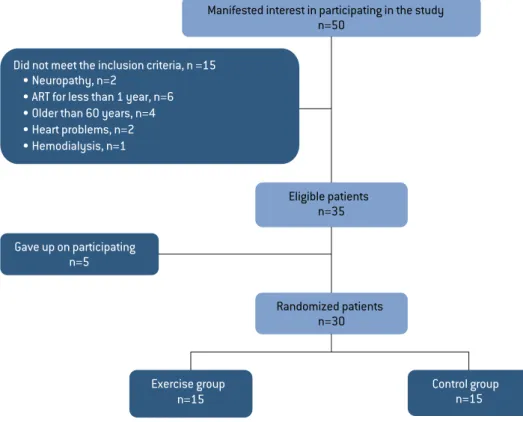
Initially, 50 patients infected with HIV were identified in the sector of Infec-tious and Parasitic Diseases of Hospital das Clínicas of Universidade Federal do Triângu-lo Mineiro (state of Minas Gerais, Southeastern Brazil), and all of them were invited to participate in the study. The following inclusion criteria were adopted: having a positive diagnosis for HIV infection; having been receiving ART for at least one year; being between 18 and 60 years of age; not having practiced systematized phy-sical exercise over the past six months; not having had opportunistic diseases over
the past five years; not having heart problems, neuropathy, hepatopathy nor ne-phropathy. Fifteen patients did not meet the inclusion criteria and five decided not to participate after they were informed of the study’s development (Figure 1). The 30 patients who accepted to participate were randomly allocated to two groups: resistance training (RT, n=15) and control group (CON, n=15).
Figure 1 – Flowchart of the study’s participants.
Procedures
Initially, the participants were interviewed to collect demographic data and disea-se status. Afterwards, they were submitted to a physical asdisea-sessment. In addition, before and after the 12-week program, the participants answered a questionnaire about quality of life.
Demographic aspects and disease status
The participants answered a questionnaire developed by the researchers themsel-ves to collect data referring to sex, age, race and complete level of schooling (ele-mentary, high school or higher education). Time since diagnosis and the period of time during which the participant has been receiving ART were obtained from the medical records of each participant.
Anthropometric measures
Body mass (kg) and height (meters) were measured by means of a mechanical scale with a stadiometer (Filizola®, Campo Grande, state of Mato Grosso do Sul, Brazil. Maximum
capacity: 150 kg; sensitivity: 100 grams; precision: 0.1 cm). Body Mass Index (BMI) was obtained by means of the Quetelet index (BMI = body mass (kg)/height2 (m)).
Quality of Life
Quality of Life-HIV Instrument (PROQOL-HIV), Portuguese version19. This
instru-ment is composed of 43 questions divided into eight domains, namely: 1) physical health and symptoms (PHS) (9 questions); 2) body change (BC) (4 questions); 3) social relationships (SR) (2 questions); 4) intimate relationships (IR) (3 questions); 5) stigma (ST) (2 questions); 6) emotional distress (ED) (4 questions); 7) health con-cerns (HC) (4 questions); and 8) treatment impact (TI) (10 questions). Moreover, the global health domain (1 question) and the domain referring to religious and financial conditions (4 questions) do not suffer score effect.
Patients were questioned about the degree in which they had experienced each domain over the past 12 weeks. Each question had a five-point Likert scale in which: 0 – “never”; 1 = “rarely”; 2 = “sometimes”; 3 = “frequently”; and 4 = “always”. To de-termine the final score, the instrument provides specific equations to each domain19.
The questionnaire was administered in a hospital environment, with the pre-sence of the evaluator and the participant only. This procedure was adopted to minimize the embarrassment bias and the occurrence of influences on the ans-wers. Only one evaluator was responsible for the interviews. All the questions and options of answers were read in detail, and the first answer given by the patient was marked.
Resistance exercise program
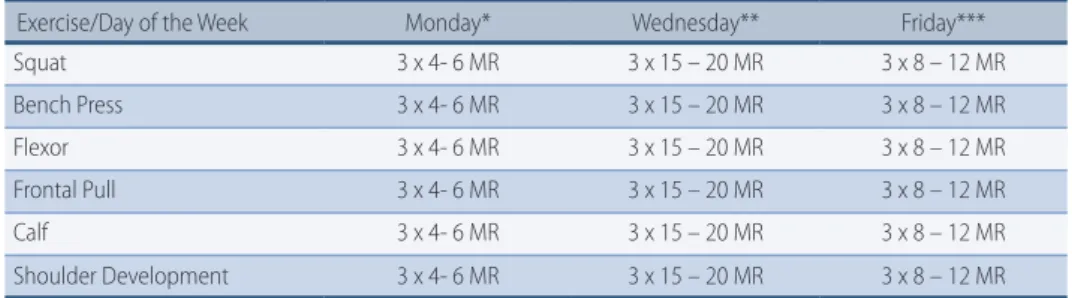
The RT group was submitted to twelve weeks of physical exercise performed three times per week on nonconsecutive days and supervised by a Physical Education professional. The exercises and periodization are presented in Table 1.
Table 1 – Protocol of periodized non-linear resistance exercise performed by HIV-infected patients during 12 weeks.
Exercise/Day of the Week Monday* Wednesday** Friday*** Squat 3 x 4- 6 MR 3 x 15 – 20 MR 3 x 8 – 12 MR Bench Press 3 x 4- 6 MR 3 x 15 – 20 MR 3 x 8 – 12 MR Flexor 3 x 4- 6 MR 3 x 15 – 20 MR 3 x 8 – 12 MR Frontal Pull 3 x 4- 6 MR 3 x 15 – 20 MR 3 x 8 – 12 MR Calf 3 x 4- 6 MR 3 x 15 – 20 MR 3 x 8 – 12 MR Shoulder Development 3 x 4- 6 MR 3 x 15 – 20 MR 3 x 8 – 12 MR
* Recovery Interval (RI) between series = 3’; ** RI of 45’’; *** RI of 1’30’’; MR: maximum repetitions.
Ethical procedures
All the participants in this study were informed about the objectives and risks. Participation was voluntary and the participants read and signed a consent do-cument. The study’s methods and procedures were approved by the Ethics Com-mittee for Research with Human Beings (protocol no. 994.745/2015) and by the Brazilian Register of Clinical Trials (protocol RBR-4rnq3v).
Statistical analyses
Data normality was verified by the Shapiro-Wilk test. The Mauchly test verified sphericity violation (F) for repeated measures and, when this value was violated, the Greenhouse-Geisser correction was used. A mixed-design analysis of variance (ANOVA) for repeated measures was used to analyze the effects of time, treatment and interaction. Cohen’s d coefficient was used to estimate the magnitude of the effect (η2) of the intervention, interpreted as small (η2 = 0.2), medium (η2 = 0.5), or
The software Statistical Package for the Social Sciences (SPSS) 20.0, Portuguese version, was utilized for the analyses.
Results
The desired sample size to guarantee the magnitude of moderate effect and the test’s power (80%) to reveal interaction effects was 34 patients. However, after applying the inclusion criteria and after providing information about the deve-lopment of the study, 30 patients were randomized into two groups. This fact reduced the test’s power to 75%.
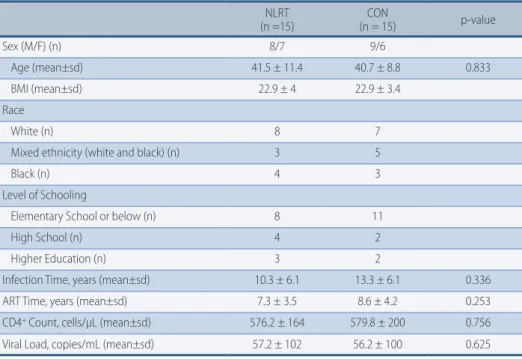
Table 2 shows the demographic profile and disease status of the HIV-infected patients. The total sample was composed of a majority of men (56.6%) of white ethnicity (50%), whose level of schooling was equal to or lower than elementary school (63.3%). There was no difference between groups regarding age (p = 0.833), ART time (p = 0.253), CD4+ cell count (p = 0.756) and viral load (p = 0.625). Table 2 – Demographic profile and disease status of HIV-infected patients.
NLRT (n =15) (n = 15)CON p-value Sex (M/F) (n) 8/7 9/6 Age (mean±sd) 41.5 ± 11.4 40.7 ± 8.8 0.833 BMI (mean±sd) 22.9 ± 4 22.9 ± 3.4 Race White (n) 8 7
Mixed ethnicity (white and black) (n) 3 5
Black (n) 4 3
Level of Schooling
Elementary School or below (n) 8 11
High School (n) 4 2
Higher Education (n) 3 2
Infection Time, years (mean±sd) 10.3 ± 6.1 13.3 ± 6.1 0.336 ART Time, years (mean±sd) 7.3 ± 3.5 8.6 ± 4.2 0.253 CD4+ Count, cells/µL (mean±sd) 576.2 ± 164 579.8 ± 200 0.756 Viral Load, copies/mL (mean±sd) 57.2 ± 102 56.2 ± 100 0.625
NLRT: Nonlinear Resistance Training; CON: control; M: male; F: female; BMI: body mass index; sd = standard deviation; n = number of subjects.
Table 3 presents the quality of life domains with the respective values befo-re and after 12 weeks. It is observed that thebefo-re was interaction for PHS [F(1,28) = 125.845, p < 0.0001; η2 = 0.818]; BD [F (1,28) = 114.116; p < 0.0001; η2 = 0.803]; SR [F(1,28) = 14.365; p < 0.0001; η2 = 0.339]; IR [F (1,28) = 12.081, p = 0.002; η2 = 0.301]; ST [F(1,28) = 15.758; p < 0.0001; η2 = 0.360]; ED [F (1,28) = 19.750; p < 0.0001; η2 = 0.414]; HC [F(1,28) = 24.967; p < 0.0001; η2 = 0.471]; TI [F (1,28) = 30.288; p < 0.0001; η2 = 0.520].
Discussion
This study verified the effect of 12 weeks of periodized resistance training on the quality of life of HIV-infected patients. Participation in the physical exercise pro-gram improved all the quality of life domains, mainly “physical health and symp-toms” and “body change”. The effect’s magnitude was considered large according to Cohen’s methodology20.
space for non-pharmacological interventions like physical exercise21. Physical
exercise enables to maintain functionality and improves quality of life22,23, as our
study has demonstrated. Thus, maintenance of physical and functional aptitude has become one of the priority objectives in the treatment of patients living with HIV/AIDS, mainly those with a diagnosis of pronounced loss of muscle mass24.
Generally speaking, it is understood that physical-functional aptitude helps to improve quality of life perception25 and the findings presented in this study
corro-borate this line of reasoning.
Furthermore, HIV-infected people present changes in their self-concept of body image26. In the majority of cases, this perception is related to lipodystrophy
syndrome, characterized by an increase in central adiposity and lipoatrophy in the peripheral region of the body4. The results of the present study are in accordance
with what was discussed above, as there was an effect that was considered large (η2 = 0.803) for the domain “body change” after the intervention with periodized
resistance training. Resistance training is known to be effective for muscle mass increase and body adiposity reduction, which contributes to improve quality of life in this domain.
Beyond alterations in physiological factors, regular physical exercise favors mental health. Recent evidence suggests that physically active people, indepen-dently of the type of training, present improvements in their wellbeing, as well as reductions in depression symptoms27. These data corroborate the findings of
this study, as the studied domains were potentially better in the RT group when compared to the CON group. In order to understand the mechanism through which exercise can improve psychological functions and, consequently, quality of life, LaPerriere28 et al. have proposed an immuno-psycho-physiological model. In
this model, regular physical exercise contributes to improve emotional state, in-creasing the liberation of endogenous opioids and reducing activity in the hypo-thalamic-pituitary- adrenocortical system. Thus, physical training would have the potential for modulating psycho-physiological sequelae of chronic diseases, including HIV.
Finally, it is important to highlight that quality of life is a valuable aspect during the therapeutic process of the HIV-infected patient. Although it is a subjective as-pect, it must be taken into account, as it can be used as a parameter for decision-ma-king referring to treatments and approval of new therapeutic regimes29. In addition,
we highlight that the participants in the present study have low level of schooling
Table 3 – Score of the domains of the quality of life questionnaire (PROQOL) in HIV-infected patients before and after 12 weeks of inter-vention.
Domains NLRT (n=15) CON (n=15) ANOVA (p)
BEFORE AFTER BEFORE AFTER Time Group Interaction
PHS 50.3 ± 13.3 86.8 ± 6.1* 55.1 ± 9.6 50.1 ± 12.9 0.001 0.001 0.001 BD 47.5 ± 13.5 87.0 ± 9.2* 55.4 ± 20.8 52.1 ± 18.6 0.365 0.006 0.001 SR 73.3 ± 29.2 95.1 ± 7.9* 75.0 ± 22.1 70.0 ± 18.1 0.128 0.254 0.001 IR 61.1 ± 27.7 82.7 ± 15.2* 61.1 ± 27.9 58.0 ± 29.2 0.273 0.053 0.002 ST 41.6 ± 26.5 55.6 ± 15.5* 41.6 ± 27.8 42.3 ± 19.9 0.288 0.288 0.001 ED 44.1 ± 22.7 80.4 ± 11.2* 45.8 ± 21.7 44.1 ± 20.6 0.001 0.012 0.001 HC 31.2 ± 17.3 61.2 ± 19.5* 31.6 ± 16.2 29.1 ± 18.1 0.006 0.002 0.001 TI 74.8 ± 11.1 85.6 ± 7.8* 75 ± 9.16 71.1 ± 11.4 0.580 0.005 0.001
NLRT: Nonlinear resistance training; PHS: physical health and symptoms; BD: body change; 3) SR: social relationships; IR: intimate rela-tionships; ST: stigma; ED: emotional distress; HC: health concerns; TI: treatment impact; * significant difference.
and low purchasing power, which strengthens the need to restructure health care models that are based exclusively on the pharmacological context. It is necessary to expand the teams that provide health care for HIV-infected patients, with the inclu-sion of Physical Education profesinclu-sionals, and to amplify and strengthen practice scenarios that include patients and professionals in the context of physical exercise. In spite of some methodological limitations, mainly the non-control of the participants’ nutrition routine and a small sample size, this study suggests that regular practice of physical exercise directly influences the quality of life of HIV -infected people.
References
1. Lange JM, Ananworanich J. The discovery and development of antiretroviral agents. Antiviral therapy. 2014;19 Suppl 3:5-14.
2. Hartmann M. The side effects of antiretroviral therapy. Der Hautarzt; Zeitschrift fur Dermatologie, Venerologie, und verwandte Gebiete. 2006;57(11):969-74.
3. Chiou PY, Kuo BI, Lee MB, Chen YM, Chuang P, Lin LC. A programme of symptom management for improving quality of life and drug adherence in AIDS/HIV patients. Journal of advanced nursing. 2006;55(2):169-79.
4. Barbaro G. Metabolic and cardiovascular complications of highly active antiretroviral therapy for HIV infection. Current HIV research. 2006;4(1):79-85.
5. Havlir DV, Currier JS. Complications of HIV disease and antiretroviral therapy. Topics in HIV medicine : a publication of the International AIDS Society, USA. 2006;14(1):27-35.
6. Ruiz-Perez I, Olry de Labry-Lima A, Prada-Pardal JL, Rodriguez-Bano J, Causse-Prados M, Lopez-Ruz MA, et al. Impact of demographic and psychosocial factors on adherence to antiretroviral treatment. Enfermedades infecciosas y microbiologia clinica. 2006;24(6):373-8.
7. Canavarro MC, Serra AV, Simoes MR, Rijo D, Pereira M, Gameiro S, et al. Development and psychometric properties of the World Health Organization Quality of Life Assessment Instrument (WHOQOL-100) in Portugal. International journal of behavioral medicine. 2009;16(2):116-24.
8. Bajunirwe F, Tisch DJ, King CH, Arts EJ, Debanne SM, Sethi AK. Quality of life and social support among patients receiving antiretroviral therapy in Western Uganda. AIDS care. 2009;21(3):271-9.
9. Mrus JM, Williams PL, Tsevat J, Cohn SE, Wu AW. Gender differences in health-related quality of life in patients with HIV/AIDS. Quality of life research : an international journal of quality of life aspects of treatment, care and rehabilitation. 2005;14(2):479-91.
10. Casado A. Measurement of quality of life of HIV individuals: Perspectives & future directions. The Indian journal of medical research. 2005;122(4):282-4.
11. Breitbart W, Passik S, McDonald MV, Rosenfeld B, Smith M, Kaim M, et al. Patient-related barriers to pain management in ambulatory AIDS patients. Pain. 1998;76(1-2):9-16.
12. Wren A. How best to approach endocrine evaluation in patients with HIV in the era of combined antiretroviral therapy? Clinical endocrinology. 2013;79(3):310-3.
13. Malita FM, Karelis AD, Toma E, Rabasa-Lhoret R. Effects of different types of exercise on body composition and fat distribution in HIV-infected patients: a brief review. Canadian journal of applied physiology = Revue canadienne de physiologie appliquee. 2005;30(2):233-45.
14. Mendes EL, Ribeiro Andaki AC, Brito CJ, Cordova C, Natali AJ, Santos Amorim PR, et al. Beneficial effects of physical activity in an HIV-infected woman with lipodystrophy: a case report. Journal of medical case reports. 2011;5:430.
15. Troseid M, Ditlevsen S, Hvid T, Gerstoft J, Grondahl T, Pedersen BK, et al. Reduced trunk fat and triglycerides after strength training are associated with reduced LPS levels in HIV-infected individuals. Journal of acquired immune deficiency syndromes. 2014;66(2):e52-4.
16. Yarasheski KE, Tebas P, Stanerson B, Claxton S, Marin D, Bae K, et al. Resistance exercise training reduces hypertriglyceridemia in HIV-infected men treated with antiviral therapy. Journal of applied physiology. 2001;90(1):133-8.
17. Roubenoff R, Wilson IB. Effect of resistance training on self-reported physical functioning in HIV infection. Medicine and science in sports and exercise. 2001;33(11):1811-7.
18. Gomes RD, Borges JP, Lima DB, Farinatti PT. Effects of physical exercise in the perception of life satisfaction and immunological function in HIV-infected patients: Non-randomized clinical trial. Revista brasileira de fisioterapia. 2010;14(5):390-5.
19. Duracinsky M, Herrmann S, Berzins B, Armstrong AR, Kohli R, Le Coeur S, et al. The development of PROQOL-HIV: an international instrument to assess the health-related quality of life of persons living with HIV/AIDS. Journal of acquired immune deficiency syndromes. 2012;59(5):498-505.
20. Cohen J. Statistical Power Analysis for the Behavioral Sciences, 2nd edn. Hillsdale, NJ: Laurence Erlbaum Associates1988.
21. Scevola D, Di Matteo A, Lanzarini P, Uberti F, Scevola S, Bernini V, et al. Effect of exercise and strength training on cardiovascular status in HIV-infected patients receiving highly active antiretroviral therapy. Aids. 2003;17 Suppl 1:S123-9.
22. Yahiaoui A, Smith BA, Voss JG. Effect of exercise on cardiac and metabolic outcomes in people living with HIV. Annual review of nursing research. 2013;31:277-96.
23. Rueda S, Raboud J, Mustard C, Bayoumi A, Lavis JN, Rourke SB. Employment status is associated with both physical and mental health quality of life in people living with HIV. AIDS care. 2011;23(4):435-43.
24. Raso V, Shephard RJ, Casseb J, Duarte AJdS, Silva PRS, Greve JMDA. Association between muscle strength and the cardiopulmonary status of individuals living with HIV/AIDS. Clinics. 2013;68:359-64.
25. Roubenoff R. Acquired immunodeficiency syndrome wasting, functional performance, and quality of life. The American journal of managed care. 2000;6(9):1003-16.
26. Santos CP, Felipe YX, Braga PE, Ramos D, Lima RO, Segurado AC. Self-perception of body changes in persons living with HIV/AIDS: prevalence and associated factors. Aids. 2005;19 Suppl 4:S14-21.
27. Takacs J. Regular physical activity and mental health. The role of exercise in prevention and intervention of depressive disorders. Psychiatria Hungarica : A Magyar Pszichiatriai Tarsasag tudomanyos folyoirata. 2014;29(4):386-97.
28. LaPerriere A, Ironson G, Antoni MH, Schneiderman N, Klimas N, Fletcher MA. Exercise and psychoneuroimmunology. Medicine and science in sports and exercise. 1994;26(2):182-90.
29. Ruiz-Perez I, Olry de Labry-Lima A, Lopez-Ruz MA, del Arco-Jimenez A, Rodriguez-Bano J, Causse-Prados M, et al. Clinical status, adherence to HAART and quality of life in HIV-infected patients receiving antiretroviral treatment. Enfermedades infecciosas y microbiologia clinica. 2005;23(10):581-5.
CORRESPONDING AUTHOR
Hugo ribeiro ZaneTTi
received 10/12/2015
reviewd 23/12/2015
approved 23/12/2015
Universidade Federal do Triângulo Mineiro - Programa de Pós-Graduação em Educação Física - Avenida Tutunas, nº 490 Bairro Tutunas – CEP: 38061-500 - Uberaba/MG, Brasil