42 www.ejthr.com
Research
EJTHRTourism
European Journal of Tourism, Hospitality and Recreation
Research
EJTHRTourism
European Journal of Tourism, Hospitality and Recreation
© 2011 Polytechnic Institute of Leiria. All rights reserved Printed in Portugal
EFFECTS OF CLiMATE CHANGE
ON rOMANiAN MOUNTAiN
TOUriSM:
are they positive or mostly negative?
Camelia Surugiu Marius ‑razvan Surugiu Cristi Frent NationalInstituteforResearch andDevelopmentinTourism,Romania Zélia Breda UniversityofAveiro,Portugal AbstrAct: Climate change represents a real threat for the winter sport resorts, especially
those situated at low altitudes and without any diversification of the tourism product. Moun-tain tourism represents a real attraction for the holidays and for short weekends being mos-tly visited by tourists in summer and winter season, which make them more vulnerable to the lack of snow in the cold season, floods, storms or even heat waves. This paper has two main objectives, firstly to measure the impact of the climate change on tourism demand for Ro-manian mountain tourism, and secondly to identify sustainable solutions for adaptation of vulnerable mountain resorts, such as Sinaia, one of the most known winter sport resorts in Romania. First, the authors will identify the impacts of climate change on Romanian moun-tain tourism, starting with the effect of the temperature increase, snow depth variation and the extreme weather events occurring in mountain resorts on tourist flows. Positive and ne-gative effects of climate change will be identified, and starting from the results, the authors will present necessary measures to transform the Romanian mountain tourism in an adaptive destination. Acknowledgement: This paper was supported by CNCSIS-UEFISCU, project number PN II-RU 94/2010, Contract no. 30/28.07.2010. Keywords: tourism, mountain, cli-mate change, effects, Romania.
resumen: El cambio climático representa una amenaza real para los deportes de invierno, especialmente aquellos ubicados a baja altura y sin la diversificación del producto turístico. El turismo de montaña representa una verdadera atracción para los días festivos y fines de se-mana cortos, siendo más visitados por los turistas durante la temporada de verano e invier-no, lo que los hace más vulnerables a la falta de nieve en la temporada de frío, inundaciones, tormentas o incluso por las olas de calor. Este estudio tiene dos objetivos principales: en pri-mer lugar, medir el impacto del cambio climático sobre la demanda turística para el turismo de montaña de Rumania, y en segundo lugar, identificar soluciones sostenibles para la adapta-ción de las estaciones de montaña vulnerables, como Sinaia ubicado en el Valle de Prahova, uno de los centros más conocidos de este deporte en Rumania. En primer lugar, van a identificar cuáles son los impactos del cambio climático en el turismo de montaña en Rumania, empe-zando por el efecto del aumento de la temperatura, la variación de la profundidad de la nieve y fenómenos meteorológicos extremos, en los resorts turismo de montaña. Los efectos po-sitivos y negativos del cambio climático serán identificados y, a partir de los resultados, los autores presentan los pasos necesarios para transformar el turismo de montaña de Rumania en un destino adaptado al cambio climático a través de la innovación, del desarrollo de pro-ductos, de las asociaciones y de la iniciativa empresarial. Palabras clave: turismo, montaña, cambio climático, efectos, Rumania.
resumo:As alterações climáticas constituem uma ameaça real para os desportos de Inverno, principalmente quando são praticados em locais situados a baixa altitude e sem diversificação do produto turístico. o turismo de montanha é uma verdadeira atracção durante as férias e nos fins -de -semana prolongados, sendo mais praticado pelos turistas nas épocas de Verão e de In-verno, o que torna especialmente vulnerável: no InIn-verno, devido à falta de neve, a inundações e a tempestades; no Verão, devido às ondas de calor. Este artigo tem dois objectivos principais: em primeiro lugar, medir o impacto das alterações climáticas sobre a procura turística no tu-rismo de montanha da Roménia, e, em segundo lugar, identificar soluções sustentáveis para a adaptação das estâncias de montanha vulneráveis, como Sinaia, situada no Vale de Prahova, um dos centros mais conhecidos deste desporto na Roménia. Em primeiro lugar, são identi-ficados os tipos de impactos das alterações climáticas no turismo de montanha na Roménia, começando pelos efeitos do aumento da temperatura, da variação da profundidade da neve e dos fenómenos meteorológicos extremos, nos resorts de turismo de montanha. São identifi-cados os efeitos positivos e negativos das alterações climáticas e, com base nesses resultados, os autores apresentam os passos necessários para transformar o turismo de montanha da Ro-ménia num destino adaptado às alterações climáticas através da inovação, do desenvolvimento de produtos e de iniciativas empresariais e associativas. Palavras -chave: turismo, montanha, alterações climáticas, efeitos, Roménia.
INTRodUCTIoN
Mountain tourism is strongly dependent on natural and cultural re-sources. Environmental conditions, especially climate, affect tourism development in mountain areas. These areas are also amongst the most threatened ecosystems by climate changes.
The interdependence of economic activities implies that climate im-pacts would extend far beyond resources, activities, and regions where physical effects are initially observed (Rose et al., 2000). The negative effects generated by climate change on agriculture, forestry, fishery, and infrastructure will leave their mark on the tourism sector, decreas-ing the quality of the services provided to tourism operators, affectdecreas-ing them in terms of inputs, outputs, incomes, and prices.
More scientists are agreeing that the climate is likely to change in the decades to come. Regional weather patterns, including change of land-scape and on nature due to changed weather conditions; the perception and evaluation of climate change in society and political, administrative and economic reactions; and weather conditions in competing desti-nations may influence tourism in a given mountain area, namely its at-tractiveness as a destination and the motivation of visitors to go there.
Winter tourism is particularly vulnerable to climate change, but its sensitivity varies considerably across regions. Climate change will come with “winners” and “losers”, both in terms of regions, and in terms of ski areas themselves, with low -lying ski areas being considerably more vulnerable than areas with high altitudinal range (oECd, 2007). For most mountain resorts, good snow conditions are a necessity, but with a differentiated tourism product the resorts will not be endangered. Still, financial viability of mountain cable -way companies will be seri-ously affected and ski tourism will no longer be profitable.
In tourism, and not only, adaptation measures are necessary to face climate changes. There is a continuous need for tourism destinations
and economic agents from tourism to adapt to climate change in a sus-tainable manner, in order to minimize the risks and to understand the new opportunities that may appear.
This paper aims not only to measure the impact of climate change on tourism demand for Sinaia resort as a winter sport destination, but also to identify sustainable adaptation solutions for vulnerable moun-tain resorts. In the second section the authors will focus on the litera-ture review on the impact of climate change on mountain resorts and particularly winter sport destinations. The third section will present the tourism activity in Sinaia resort and its exposure to climate change. In the fourth section the vulnerability of Sinaia resort will be depicted, with the authors presenting the methodology of analysis and the re-gression analysis and final results. Positive and negative effects of cli-mate change will be identified and starting from the results, in the fifth section the authors will present the necessary measures for adaptation and mitigation to climate change to transform the Romanian mountain resorts in adaptive destinations to climate change through innovation, product development, partnership and entrepreneurship.
LITERATURE REVIEW oN THE IMPACT oF CLIMATE CHANGE oN MoUNTAIN RESoRTS
Climate in mountain areas varies considerably. In these areas, effects of climate change may refer to issues such as less snow, melting of the glaciers, etc. and as a result some impacts over mountain agriculture, mountain tourism, etc. may appear. Changes in climate, including the frequency of extreme events, will alter a wide range of characteristics of mountain systems: the cryosphere, ecosystems, and mountain econ-omies (Björnsen Gurung, 2006).
As a result of the temperature increase in the winter season, the precipitation will vary considerably, the duration of snow and its thick-ness will be reduced. Warmer winters will come with more rain and less snow. Climate change will also bring uwanted events in nature that also affect the environment, such as fires in wild forests, storm, floods that also affect households located near rivers, etc. These events are already taking place, though with a bigger power than in the past, and in many places of the planet. The uncertainty and the crisis in Euro-pean mountain tourism are both caused by climate and geo -cultural change (Bourdeau, 2009).
Various changes could have impacts on mountain settlements, on agriculture -based livelihoods, infrastructure from those areas, peo-ple’s health, environment, etc. Today, the mountains are facing enor-mous pressure from global changes related to drivers such as climate change, industrialisation, increasing population, and changes in land use that place added demands on the ecosystem services the moun-tains offer (ICIMod, 2009).
Climate change is a long -term challenge, which may alter the com-petitive relationship between tourism destinations (Scott, 2003), being both an indicator for structural contradictions and weaknesses of al-pine tourism, and a “booster” for a cultural, geographic and econom-ic revolution in the tourism industry (Bourdeau, 2009) and leading to a new pattern of favoured and disadvantaged ski tourism regions, with increasing pressure on ecologically sensitive high -mountain re-gions (Bürki et al., 2003).
In the last few years researchers attempted to estimate the ef-fect of climate changes on mountain tourism, analysing the patterns of climate -tourism relationship. Thus, Koenig and Abegg (1997) ex-amined the impacts of three consecutive snow -deficient winters at the end of the 1980s on the winter tourism industry in Switzerland, show-ing that ski areas in lower altitudes suffered severe consequences, but ski areas at higher altitudes increased their transport figures. The snow--reliability of all Swiss ski fields under current climate conditions and under a 2ºC warming are investigated by authors, concluding that un-der current climate conditions 85% of all Swiss ski areas are snow--reliable, but this number would drop to 63% if the temperatures are going to rise by 2ºC. Rebetez et al. (1997) analyzed the debris flows in the region of Ritigraben (Valais, Swiss Alps), which generally occur in the months of August and September, in relation to meteorological and climatic factors. debris flows linked to rain are likely to be trig-gered when total rainfall amount over a three -day period exceeds a significant extreme precipitation event. The analysis has highlighted the fact that the number of extreme rainfall events capable of trigger-ing debris flows in August and September has increased. Breiltrigger-ing and Charamza (1999) deal with Austrian winter tourism and skiing and use a model that describes seasonal snow -cover depth related to altitude in six Alpine climate regions. According to the authors, the direction of economic impacts is clear, in terms of income losses and adapta-tion costs, but magnitude and time frames remain uncertain.
Richardson and Loomis (2001) apply a contingent behaviour anal-ysis to estimate the effects of changes in climate and resource vari-ables on nature -based tourism demand, and a visitor survey was used for a research study among visitors at Rocky Mountain National Park (USA) to analyse how their visitation behaviour would change under hypothetical climate scenarios. The results indicated that the effects of changes in certain climate variables would have a positive impact on visitation levels, temperature being found as a positive and signifi-cant determinant of visitation behaviour. Although the demand for mountain tourism in the national park was found to increase with high-er temphigh-eratures, the results suggest a threshold effect whhigh-ere visitation may decline at levels of extreme heat.
duchosal (2007) assessed the impact of climate change in win-ter tourism in the northern French Alps, the research method adopt-ed being a questionnaire -basadopt-ed survey, the study revealing that a part of the resorts are more involved in the climate change management, like the lowest resorts compared with the high altitude resorts. The survey finds out that the diversification strategy is not directly linked to climate change but to the new customer needs. Moen and Fredman (2007) discuss the future development of the downhill skiing industry in Sweden and show that future climate change may have significant negative effects on both ski season lengths and associated econom-ic impacts. The analysis of the authors show predeconom-icted losses for the skiing industry in Sweden that are larger than current ski -ticket sales. Vrtacnik Garbas (2007) deals with the potential influences of climate changes on tourist demand in selected winter sport centres in Slovenia. By using the method of inquiry, the author tried to ascertain how skiers perceive climate changes and what their potential responses are. The results of the survey, carried out in the winter 2004/05, showed that climate change would have a great influence on the structure of tour-ist demand and the frequency of visits. The loss of half of the present skiers would mean an enormous loss in terms of profits and the ma-jority of ski centres (mostly smaller and middle size ones) would prob-ably stop operating.
Scott and dawson (2007) examined the supply -side vulnerability of the US Northeast ski industry under six climate change scenarios for the 21st century and under all scenarios, natural snow became an in-creasingly scarce resource causing decreased ski season lengths and increased snowmaking requirements. Based on the analysis, it would appear that it is not the entire US Northeast ski industry that is at risk to climate change but rather individual ski businesses and communi-ties that rely on ski tourism.
dawson et al (2007) use a climate change analogue approach to ex-amine how a wider range of ski area performance indicators were affected by anomalously warm winters in the New England region of the USA. Tervo (2007) surveys the attitudes and preparedness for climate change of nature -based tourism entrepreneurs in Finland. The study also assesses which climatic conditions and weather events af-fect or limit the viability of snow -based tourism activities, including the differences between skiing and other snow -based activities. Based on thematic interviews and a questionnaire of nature -based tourism entrepreneurs, the results indicate that entrepreneurs providing tour-ism activities seem to be well prepared for normal climatic variability. Tepfenhart et al. (2007) analyzed possible impacts of climate change on the traffic dynamics on access roads to ski resorts. The authors
plied a discrete choice model for day tourism to the hydrological catch-ment of the Upper danube, covering parts of southern Germany, Austria and Switzerland and they applied a macroscopic traffic model in order to simulate the traffic dynamics on the road network. In dif-ferent scenarios, the authors systematically study the traffic dynamics on the access roads to the ski areas, varying the shift of the lower lim-it of snow -reliabillim-ity and hence the concentration of ski resorts. The results show that with increasing lower limit of snow reliability traffic jams will become significantly more frequent on the access roads to the ski resorts. Scott et al (2007) examine how climate change may influ-ence park tourism in the Rocky Mountain region by focusing on both the direct and indirect impacts of climate change for visitation to Wa-terton Lakes National Park (WLNP) (Alberta, Canada). A statistical model of monthly visitation and climate was developed to examine the direct impact of climate change on visitation and the model pro-jected that annual visitation would increase between 6% and 10% in the 2020s and between 10% and 36% in the 2050s. The environmental change scenarios for the 2020s and 2050s were found to have minimal influence on visitation, however the environmental change scenario for the 2080s was found to have a negative effect on visitation.
Surugiu et al. (2010) analysed the relation between climate variabil-ity and tourism activvariabil-ity in Predeal resort, one of the most representa-tive ski destination in Romania, showing that tourism activity became vulnerable to meteorological parameters (temperature and snow -cover depth), with a negative relation between temperatures and tourism, which means that an increase in air temperature will generate a decrease in tourism parameters. dingeldey and Soboll (2010) present an inter-acting multi -agent model as a new method of examining the impact of climate change on Alpine leisure tourism and ski areas in a complex interacting model network. The authors have developed a simulation model to rate the tourism development under different climate and so-cietal scenarios in the German and Austrian Upper danube catchment. According to authors, the effects of climate change are very different on a small spatial scale: some larger and higher located ski resorts will operate very successfully in the next decades and will profit from the shift of guests caused by the problems that smaller and no more snow--reliable ski areas are facing.
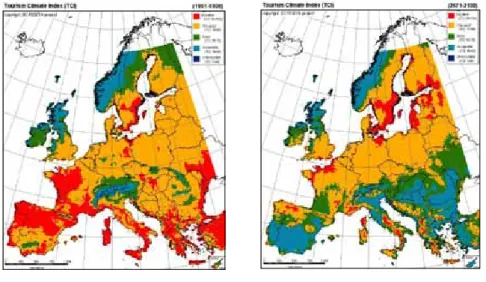
In order to measure the climatic suitability for general summer tour-ism purposes, the Tourtour-ism Climate Index (TCI) was computed (Figure 1). According to the study, some regions will see their climatic attrac-tiveness improve in the summer, with other regions facing deteriora-tion. Southern Europe will experience climatic conditions that are less favourable to tourism (extreme heat). At the same time, the traditional
outbound northern countries will enjoy better conditions in summer, as well as a longer season with good weather. There will be significant shifts in the climatic suitability for tourism, with the excellent summer conditions moving from the Mediterranean towards northern Europe. Besides deteriorating thermal conditions, increasing water shortages are predicted, particularly in southern Europe. The TCI thus enables a comparison between destinations and therefore provides a notion of the relative severity of the impacts of climate changes.
Changes in climate occur every year, taking place more frequently than ever; this is a reality observable just by taking a look around us. According to Beniston (2003), climate change is likely to have direct and indirect impact on mountain tourism, direct impacts referring to changes in climatic conditions necessary for specific activities, and indirect impacts resulting from changes in mountain landscapes and wider -scale socio -economic changes.
Source: PESETA project.
Figure 1. Tourism Climate Index, 1961 -1990 and 2071 and 2100 Year after year, it seems that milder winters and hot summers are more frequent. Without any complicated statistical estimations, the world’s population may observe these changes in patterns of seasons. We can ask ourselves what policies and what measures governments could adopt in different countries or regions around the world to cope with the effects of the climate change phenomenon, but also what each individual can do to reduce the effect of climate change, start-ing from what each “citizen” of this planet does day by day through their behaviour to influence the ecological and environmental balance.
ToURISM ACTIVITY ANd EXPoSURE To CLIMATE CHANGE: THE CASE oF SINAIA RESoRT
Prahova Valley is one of the most representative tourism regions from the country. The well known resorts from the Prahova Valley area (Breaza, Sinaia, Busteni, Predeal), both on the national and inter-national tourist market, are concentrating an important tourist number all over the year which use the existing tourist facilities to experience different types of tourism. Tourism in this region is a tradition now and it supports the development of the Prahova Valley from an eco-nomic, social and cultural point of view.
The main types of tourism which are developed in the Prahova Val-ley – Brasov area are:
• Winter tourism. The most important component of the moun-tain tourism is represented by winter sports, skiing, sledding, bobsleighing, and snowboarding. The configuration of the Carpathians permits the practice of skiing from 800 -2200 m altitude, without the danger of avalanches and snow storms. In the study area there are sloops and cable transportations (ski
lifts, chair lifts, drag lifts, gondola lifts, baby ski lifts) which
fa-cilitate the development of these tourism forms. Some moun-tain areas, especially from Bucegi, offer conditions to extend the winter sports season until April – May, planning the sloops and cable transportation in a cascade system. Still the winter tourism has a lot of undeveloped tourism potential.
• Active tourism. The forms of relief make it possible for tourists to practice mountaineering, hiking, climbing, rappel, mountain biking.
• Recreational tourism supported by the presence of the Car-pathian Mountains, natural potential, weather conditions and all natural conditions.
• Business tourism encouraged by the presence of various meet-ing centres for seminars, conferences, reunions in different re-sorts (e.g., Sinaia, Poiana Brasov, Predeal).
• Itinerary and cultural tourism, developed because in the region there are important cultural and historic monuments and an important heritage (archaeological sites, rich ethnographic and folkloric potential, Peles Palace, Pelisor Palace, Sinaia Mon-astery, George Enescu Memorial House, Cantacuzino Castle). • Health (wellness, balneal, treatment) tourism, developed because of the presence of tonic and stimulating bioclimate, rich in
ul-traviolet radiations and increased ionization, pure air, rich in oxygen, without dust, relatively low atmospheric pressure, sulphate spring waters and multimineral waters.
• Weekend tourism which has been developed because of the closeness of important urban centres like Bucharest, Brasov, Sibiu and so on.
• Other forms of tourism, like hunting and fishing tourism, gas-tronomic tourism, ecotourism, agrotourism, speleological tourism, wine tourism.
Sinaia, also called “the Pearl of the Carpathians” is one of the most famous mountain resorts in Romania. Proximity to Bucharest, the cap-ital, only 123 km on the road well known as “Prahova Valley” is the main asset of Sinaia (INCdT, 2007). The resort is situated at altitudes which are altering between 880 m in the south and 1000 m in the west. The first documentary mention dates from the year 1690, when the Si-naia Monastery was built by a Romanian nobleman Mihail Cantacuzino after undertaking a pilgrimage to Mount Sinai, Egypt. Initially, in this place there was a small village called Izvorul which on the desire of King Carol I, became the summer residence of the Hohenzollern Royal Family. The development of the locality started between 1870 -1875, and became a town in 1880.
The most important tourist attraction in Sinaia is the Peles Castle
built by King Carol I in the latter half of the 19th century. He
attempt-ed to imitate the Germanic styles from his former homeland, creat-ing a Bavarian settcreat-ing in the Romanian mountains. The Castle has 160 rooms and valuable collections of arts, weapons, furniture and it is one of the best preserved royal palaces in Europe. The castle is decorated, both the interior and the exterior, with intricate wood carvings and paintings of scenes from Wagner operas. Nearby Peles Castle is Pelisor Castle, built by Carol I for Ferdinand and Maria, the niece of queen Victoria of Great Britain. The interiors are built in the German Re-nascence style. The town is well known as a balneal climatic resort, various natural therapeutic factors being present in this area like bio-climate, sulphate, bicarbonate, calcium, magnesium spring waters and mountain relief. The official accommodation capacity in Sinaia reach-es 1,639 rooms and 3,385 bed -placreach-es according to the data provided by the register of accommodation units classified by the central tourism authority (MdRT, 2010). The same source indicates 90 accommoda-tion establishments out of which 33 were boarding houses, 17 hotels and 16 villas (Table 1).
Table 1. Accommodation capacity by types of units in Sinaia resort in 2010
Type of units No of units No of rooms No of bed places
Hotels 17 1,035 2,026 Boarding houses 33 291 600 Villas 16 133 264 Chalets 4 42 147 other units 20 138 348 Total 90 1,639 3,385
Source: own calculations, MDRT, 2010.
It is important to note that hotels account for the majority of ac-commodation capacity with 1,035 rooms and 2,026 bed-places respec-tively, thus demonstrating the high share of hotels in tourism activity at Sinaia. This also shows the dominance of business tourism as a type of tourism. This is demonstrated too by the large number of confer-ence halls (54) cumulating 3,766 seats (INCdT, 2009).
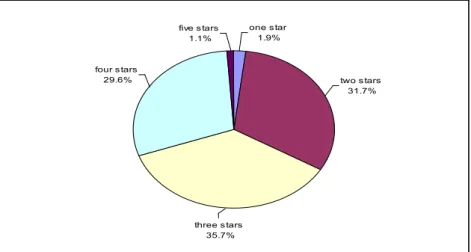
When analysing the classification categories of bed -places (Figure 2) these are equally distributed by two, three and four stars pointing out that the resort has diversified services categorization meeting the requirements of various types of tourists.
five stars 1.1% one star 1.9% three stars 35.7% four stars 29.6% two stars 31.7%
Source: own calculations, MDRT (2010).
Figure 2. Number of bed -places by classification categories existent in Sinaia resort
As regards tourist flows in 2007, Sinaia registered over 200,000 tour-ists and 500,000 overnight stays (dJS Prahova, 2008). It is important to see the evolution of these flows in the period 2002 -2007 (Figure 3) observing that there is an obviously dynamic increasing trend both in arrivals and overnight stays. The fact that overnight stays have greater growth rates than arrivals confirms a consistent tourism development in the resort in the analysed period.
0,0% 10,0% 20,0% 30,0% 40,0% 50,0% 60,0% 70,0% 80,0% 90,0% 2004 2005 2006 2007
arrivals overnight stays Source: own calculations, DJS Prahova, 2008.
Figure 3. Growth rates of arrivals and overnight stays in Sinaia resort, 2004 -2007
2003 – base year
However it must be mentioned that these figures refer only to of-ficially registered accommodated tourists and not to same -day visitors or tourists staying at friends and relatives, or in small unclassified tour-ist establishments.
It is important to analyse also the profile of the tourism market based on the breakdown of overnight stays of Romanian and foreign tourists (Figure 4). This shows a concentration on the domestic mar-ket, the overnight stays of Romanian tourist representing around 80% of the total overnights recorded in the resort in the analysed period.
It has to be mentioned that this characteristic is in line with the fig-ures for all Romanian tourism where the domestic market prevails, and Sinaia is no exception to this rule.
Besides accommodation facilities there are also other tourist facili-ties which contribute to the tourism activity in the resort. Therefore 65 classified Food and Beverage (F&B) facilities are located in Sinaia cumulating 8,242 table seats (MdRT, 2010). F&B facilities are also di-versified as regards their categorization, half are superior categories (three and four stars), while the rest are low categories (one or two stars).
19,1% 22,2% 21,8% 19,0% 19,7% 80,9% 77,8% 78,2% 81,0% 80,3% 0% 20% 40% 60% 80% 100% 2003 2004 2005 2006 2007 Foreigners Romanians
Source: own calculations, DJS Prahova (2008).
Figure 4. Breakdown of overnight stays recorded in Sinaia resort, 2003 -2007
Table 2. Food and Beverage facilities in Sinaia resort, 2010
No of units No of table seats
Total, of which 65 8,242
one star 3 145
two stars 31 4,483
three stars 21 2,260
four stars 10 1,354
Source: own calculations, MDRT (2010).
However one must be aware of the fact that the major attraction of the resort and one of the major cultural attractions in Romania is the Peles Castle, the former summer residence of Romanian kings
dating from the 19th century. The tourist product is completed with
other important attractions such as Sinaia orthodox monastery, the old Casino and historical buildings. Moreover natural resources giv-en by the presgiv-ence of Bucegi Mountains should also be mgiv-entioned. In this regard one should underline the ski area of the resort which by its extent and possibilities of tourist planning is one of the most
representative tourist resource of the resort (INCdT, 2008). From all points of view Sinaia provides a complex tourist product combing both cultural and natural attractions.
Returning to the ski area Sinaia there are 9 homologated ski slopes in Sinaia, all of them being located at altitudes above 1,500 meters. Also 6 cable transport installations should be added as ski facilities such as one chair lift, one gondola, two cable cars and two ski lifts.
Although Sinaia has most of the ski area located at relatively high al-titudes, the exposure to climate change should not be neglected. In this regard it is important to analyse the temperatures for 6 consecutive winter seasons more precisely to observe the evolution of the mean, maximum and minimum temperatures for the period November – April 2002 -2007 (Figure 5). Some real fluctuations of the temperatures can be observed, which indicate the climatic change in each year.
-30 -20 -10 0 10 20 30 5 10 15 20 25 30 35
TEMP_S MAXTEMP_S MINTEMP_S
Source: CLAVIER: Climate Change and Variability: Impact on Central and Eastern Europe, 6th Framework Programme.
Figure 5. Mean, Max and Min air temperature for Sinaia resort: November -April 2002 -2007 (ºC)
So as a possible exposure to climate change one might speak also about the vulnerability of the resort.
VULNERABILITY oF SINAIA MoUNTAIN RESoRT: METH-odoLoGY ANd dATA ANALYSIS
This section will investigate the relation between climatic parameters (air temperature, snow -cover depth) and tourism indicators (tourist ar-rivals, overnight stays, accommodation capacity in function, occupan-cy rate) in Sinaia mountain resort. The analysis will be carried out for the winter season, which runs from November to April, for the period
2002 -2007. For this purpose, an econometric analysis will be carried out, aiming at the identification of the connections existing between climate and tourism. Some aspects regarding the cointegration, causality and correlation will be revealed. Regression analysis will also be finished and the results explained. The short chronological series of monthly data for tourist indicators (2002 -2007) didn’t allow the investigation for each of the winter season months of the relation climate/tourism.
Cointegration analysis
Frequently, the specialists use the cointegration test to study the statistical property of time series variables. Studies in empirical macr-oeconomics almost always involve nonstationary and trending variables (Greene, 2002). The issue of cointegration applies when two series are I(1), but a linear combination of them is I(0). In this case, the regres-sion of one on the other is not spurious, but instead tells us something about the long -run relationship between them (Wooldridge, 2002).
Table 3. ADF tests results for Sinaia
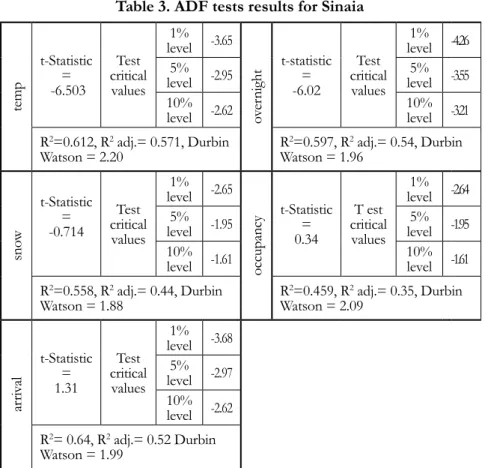
te m p t -Statistic = -6.503 Test critical values 1% level -3.65 ov er ni gh t t -statistic= -6.02 Test critical values 1% level -4.26 5% level -2.95 level5% -3.55 10% level -2.62 10% level -3.21 R2=0.612, R2 adj.= 0.571, durbin Watson = 2.20 R 2=0.597, R2 adj.= 0.54, durbin Watson = 1.96 sn ow t -Statistic = -0.714 Test critical values 1% level -2.65 oc cu pa nc y t -Statistic= 0.34 T est critical values 1% level -2.64 5% level -1.95 level5% -1.95 10% level -1.61 10% level -1.61 R2=0.558, R2 adj.= 0.44, durbin Watson = 1.88 R 2=0.459, R2 adj.= 0.35, durbin Watson = 2.09 ar riv al t -Statistic = 1.31 Test critical values 1% level -3.68 5% level -2.97 10% level -2.62 R2= 0.64, R2 adj.= 0.52 durbin Watson = 1.99
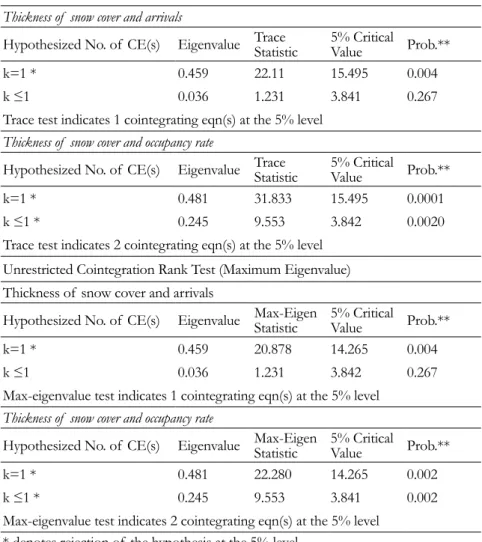
To perform an Augmented dickey -Fuller (AdF) test for nonsta-tionarity, the Eviews software was used. According to the AdF test, for the analysed period, the data regarding the air temperature for Si-naia proved to be stationary, including an intercept but not a trend (the series are displayed in Figure 5). The data available for the snow -cover depth in Sinaia proved to be non -stationary and cointegrated with the non -stationary data on tourist arrivals. Engle and Granger (1987) point-ed out that a linear combination of two or more non -stationary series may be stationary. If such a stationary linear combination exists, the non -stationary time series are said to be cointegrated.
Table 4. Johansen cointegration tests results
Unrestricted Cointegration Rank Test (Trace)
Thickness of snow cover and arrivals
Hypothesized No. of CE(s) Eigenvalue TraceStatistic 5% Critical Value Prob.**
k=1 * 0.459 22.11 15.495 0.004
k ≤1 0.036 1.231 3.841 0.267
Trace test indicates 1 cointegrating eqn(s) at the 5% level
Thickness of snow cover and occupancy rate
Hypothesized No. of CE(s) Eigenvalue TraceStatistic 5% Critical Value Prob.**
k=1 * 0.481 31.833 15.495 0.0001
k ≤1 * 0.245 9.553 3.842 0.0020
Trace test indicates 2 cointegrating eqn(s) at the 5% level Unrestricted Cointegration Rank Test (Maximum Eigenvalue) Thickness of snow cover and arrivals
Hypothesized No. of CE(s) Eigenvalue Max -Eigen Statistic 5% Critical Value Prob.**
k=1 * 0.459 20.878 14.265 0.004
k ≤1 0.036 1.231 3.842 0.267
Max -eigenvalue test indicates 1 cointegrating eqn(s) at the 5% level
Thickness of snow cover and occupancy rate
Hypothesized No. of CE(s) Eigenvalue Max -Eigen Statistic 5% Critical Value Prob.**
k=1 * 0.481 22.280 14.265 0.002
k ≤1 * 0.245 9.553 3.841 0.002
Max -eigenvalue test indicates 2 cointegrating eqn(s) at the 5% level * denotes rejection of the hypothesis at the 5% level
**MacKinnon -Haug -Michelis (1999) p -values
AdF -Test reveals that the occupancy rates in Sinaia are non--stationary. Furthermore, the Johansen test indicated that these data are cointegrated with snow -cover depth. The results of the cointegra-tion test are more reliable for occupancy rate and snow -cover depth, Max -eigenvalue test indicates 2 cointegrating equations at the 5% lev-el (Table 4).
The overnight stays in Sinaia are trend -stationary at the 1% signifi-cance level. Taking into consideration that the air temperature and over-night stays are stationary data, the regressions will be constructed using these data series. The simple regressions using as dependent variable tourist arrivals or overnight stays or occupancy rates and as predictor the snow -cover depth didn’t prove to be reliable, the p -value very high and the R -squared very low.
Test of Granger -causality presumes the use of covariance station-ary data (Arize, 1993). This test is a technique for determining whether one time series is useful in forecasting another. Applying the Granger--causality test indicated that the hypothesis that snow-cover depth does not Granger-cause arrivals cannot be rejected (Table 5). Therefore, it appears that Granger causality runs one -way from climatic param-eters to tourism indicators.
Table 5.Granger Causality Test Results
Null Hypothesis: F -Statistic Probability
overnight does not Granger Cause temp 0.450 0.642 temp does not Granger Cause overnight 9.681 0.0006
Source: authors own calculations.
The concept of Granger causality, by which we actually understand precedence, is based on the idea that a cause cannot come after its effect (Konya, 2004). More precisely, the variable snow -cover depth is said to Granger -cause the tourist arrivals, because the current value of arriv-als is conditional on the past values of snow depth. For our case study, Granger causality test indicates that the air temperature causes the over-night stays, but not the other way around, using a lag of zero.
Regression analysis and results
The second step of our analysis implied the construction of the regression equation and the discussion of the results. First, using the Chow Test (Chow, 1960) in simple linear regression analyses, the results didn’t show any structural breaks for the data series on overnight stays
and arrivals as dependent variables and the climate parameters, namely air temperature and snow -cover depth as independent variables.
In the case of Sinaia resorts, multiple linear regressions will be per-formed. When there is more than one independent variable, the regres-sion line cannot be visualized in the two dimenregres-sional space, but can be computed just as easily. In this case, multiple regression procedures will estimate a linear equation of the form:
This multiple regression analysis was preferred because some other pa-rameters like tourism offer expressed through the accommodation ca-pacity exercised a higher influence on the arrivals and overnight stays than the climate. The general purpose of multiple regressions is to learn more about the relationship between several predictor variables and a criterion variable.
First it was tested for the simple linear regression, but afterwards the accommodation capacity in function (accommodation s) measured in
bed -places -days1 was introduced as manipulated variable, also due to the
availability of the data series. The introduction of an additional explan-atory variable improved the significance of the regression equation.
Various regression equations between tourism indicators (i.e., over-night stays, tourist arrivals and occupancy rates) as responding variables and climatic parameters (mean, max and min temperature, snow -cover depth, number of days with the snow -cover depth higher than 30 cm) and accommodation capacity in function as explanatory variables were tested for the period 2002 -2007, the winter season which was extended from November to April (Figure 6). The regression equations were
mod-elled using the EViews software. EViews’ default approach is oLS/TSLS
(ordinary Least Squares, Two -Stage Least Squares), which technique minimizes the sum -of -squared residuals for each equation, accounting for any cross -equation restrictions on the parameters of the system.
The most viable results were obtained when the overnight stays were
used as controlled variable and theaccommodation capacity in
func-tion in combinafunc-tion with minimum temperature and snow -cover depth as predictors.
1 According to Romanian National Institute of Statistics, tourist accommodation
capac-ity in function (expressed in places -days) represents the number of accommodation places made available for tourists by establishments of tourist reception with functions of tourist accom-modation, multiplied with the number of days when the establishments are open during the respective period. Places in rooms or establishments temporarily closed because of lack of tourists, for repairs or other reasons, are excluded.
Source: authors own representation.
Figure 6. Scatter plot over overnight_s vs. temp_s and accommodation_s - Sinaia
The estimated model can be expressed as follows:
Where Overnight represents the dependent variable, α the
param-eter representing the overall constant in the model, βi the regressors
coefficients,Accommodation is the accommodation capacity in
func-tion, Snow is the snow -cover depth, MinTemp is the minimum air
temperature, ε is the error terms.
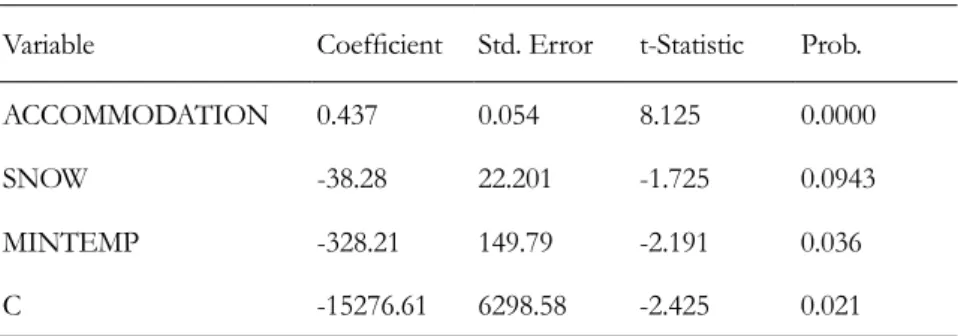
The summary of the linear multiple regressions for Sinaia is compiled in Table 6. The multiple linear regressions were tested for significance.
The interpretation of the reported R -squared and F -statistics shows that they describe the explanatory power of the entire specification tak-ing into consideration the number of parameters, and the number of estimated coefficients. The R -squared statistic measures the success of the regression in predicting the values of the dependent variable with-in the sample. In standard settwith-ings, may be with-interpreted as the fraction of the variance of the dependent variable explained by the independ-ent variables. The R -squared value indicates that the variation of the regressors explains 67.4% of the variation of the overnight stays vari-able, whereas the remaining 32.6% can be explained by unknown, lurk-ing variables (promotion expenditure, incomes, prices) or inherent vari-ability, suggesting a very tight fit of the overall regression.
The p -value given for the F -statistic is the marginal significance level of the F -test. The p -value is essentially zero, so we reject the null
hy-pothesis that all the regression coefficients are zero, showing that the model is relevant. The p -value for the coefficients of the regression equation are validated, accommodation and minimum temperature at 5%, while snow -cover depth is significant at 10% level.
EViews reports the durbin -Watson (dW) statistic as a part of the standard regression output. The dW statistic is a test for first -order se-rial correlation. More formally, the dW statistic measures the linear as-sociation between adjacent residuals from a regression model. The value of the dW statistic reported above (5% significance points of dL and dU), namely, dU = 1.353 < dcalc = 2.135 < (4 -1.353 = 2.647) shows that the residual variables are not serially correlated.
Table 6. Multiple regression results for Sinaia resort_VAR1
dependent Variable: oVERNIGHT_S
Sample: November -April 2002 -2007
Method: Least Squares Included observations: 36
Variable Coefficient Std. Error t -Statistic Prob.
ACCoMModATIoN 0.437 0.054 8.125 0.0000
SNoW -38.28 22.201 -1.725 0.0943
MINTEMP -328.21 149.79 -2.191 0.036
C -15276.61 6298.58 -2.425 0.021
R -squared = 0.674, Adjusted R -squared = 0.643, durbin -Watson stat = 2.135 F -statistic = 22.03, Prob(F -statistic) = 0.000000
Source: authors own calculations.
The regression coefficients indicate the direction of the relation-ship between variables, showing that the relation between minimum air temperature and overnight stays is negative. That means that mini-mum air temperature doesn’t stimulate the tourists to stay in the re-sort during the winter season, and thus overnight stays will decrease. one degree Celsius increase in the minimum air temperature will gen-erate an average decrease of overnight stays of 328 tourists -days. The expected sign for the snow -cover depth (SNoW) was positive as the higher snow -cover attracts the skiers and the winter sports. The sign of the regressor is negative, contrary to what we expected, this leaves
us to the idea that the profile of the resort does not entirely depend on winter sports and ski slopes.
A second multiple linear regression was finished using as predic-tive variables the overnight stays and as predictors, the mean air
tem-perature (Temp) and minimum air temperature (MinTemp ), number
of days with the snow -cover depth higher than 30 cm (Days _Snow)
and accommodation capacity in function (Accom modation).
The results of the second regression are displayed in Table 7. The p -value given for the coefficient of the regressors and p -value for the F -statistic suggest that they are significant different from zero. The R -squared value indicates that the variation of the regressors explains 73.6% of the variation of the overnight stays variable. The value of the dW statistic reported above (5% significance points of dL and dU), namely, dU = 1.295 < dcalc = 2.352 < (4 -1.295 = 2.705) shows that the residual variables are not serially correlated.
Table 7. Multiple regression results for Sinaia resort_VAR2
Dependent Variable: OVERNIGHT_S
Sample: November -April 2002 -2007
Method: Least Squares Included observations: 36
Variable Coefficient Std. Error t -Statistic Prob.
dAYS_SNoW -71.28 23.63 -3.017 0.0051
MINTEMP -405.49 139.70 -2.903 0.0068
TEMP 79.23 29.16 2.72 0.0107
ACCoMModATIoN 0.460 0.0498 9.24 0.0000
C -19077.93 5918.81 -3.22 0.0030
R -squared = 0.736, Adjusted R -squared = 0.702, durbin -Watson stat = 2.352, F -statistic = 21.66, Prob(F -statistic) = 0.000000
Source: authors own calculations.
As it regards the influence of each regressor, results are quite simi-lar to the previous regression equation. Thus, an increase in minimum temperature decreases the number of overnights which are not
attract-ed by low temperature in the mountain resorts. The increase in mean air temperature increases the number of the overnights. The number of days with snow -cover depth higher than 30 cm does not necessar-ily attract tourists to stay longer as the profile of Sinaia resort is more for business tourism and weekend tourism, recreational tourism and not the first option for winter sports tourism.
The regression equations indicate to us that the resort is not as much vulnerable to climate change and reduction in snow -cover depth, as expected, and an increase in temperature on the contrary seems to attract the tourists.
The most influencing air temperature parameter seems to be the minimum temperature. Conceptually, if a critical temperature level is reached conditions would likely be too uncomfortable for most peo-ple (i.e., frosty weather), and rather than increasing, visitation would begin to stabilize and then decline.
Still, the vulnerability of the resorts to climate change remains, as we can not conclude that Sinaia is not totally vulnerable to climate change effects (i.e., extreme weather events). Even so, Sinaia seems to register more positive effects from the climate change as the number of tourist arrivals increases in the hot period of the summer season, when visitors from Bucharest and other important cities come to this mountain resort attracted by colder temperatures and fresh and clean air. CLIMATE CHANGE AdAPTATIoN ANd MITIGATIoN MEASURES
In order to reduce the adverse effects of climate change on nation-al economies, mitigation and adaptation policies have been adopted. Mitigation involves reductions in the concentrations of greenhouse gases, while adaptation measures involve acting to tolerate the effects of global warming.
The United Nations Framework Convention on Climate Change (UNFCCC) is the global framework for fighting climate change. It was constituted in 1992 in order to stimulate industrialised countries in tack-ling climate change. The Kyoto Protocol, concluded in 1997, is prob-ably the most recognized action taken by UNFCCC. It commits indus-trialised nations to cut their emissions of greenhouse gases.
The European Union (EU) is setting the example, having put in place legislation in order to cut its greenhouse gas emissions to 20% below 1990 levels by 2020 (ECCA, 2010a). The European Commission (EC) launched, in June 2000, the European Climate Change Programme (ECCP), aiming to identify and develop all the necessary elements of an EU strategy to implement the Kyoto Protocol.
Although the European Commission has taken many climate -related initiatives since 1991, when it issued the first Community strategy to limit carbon dioxide emissions and improve energy efficiency, re-search in support of planning of national and international adaptation measures started only recently. Therefore adaptation, unlike mitigation,
as a policy response to climate change, is still in its early stages of de-velopment, being a new policy area for the European climate change policy (ECCA, 2010b).
The ECCP II was launched in october 2005, and the Impacts and Adaptation Workgroup has been set up as part of this second pro-gramme. In June 2007, the European Commission adopted the Green Paper “Adapting to Climate Change in Europe – options for EU Ac-tion”. It represents the Commission’s first comprehensive policy initia-tive on adaptation to climate change and can therefore be considered as a milestone. The paper offers a concise assessment of the situa-tion in Europe and of the challenges it is facing. It argues that, paral-lel to deep cuts in greenhouse gas emissions, it is necessary to adapt to the changing climate conditions. It describes possible avenues for action at the EU level.
A public debate followed, in the second half of 2007, on the need for adaptation in Europe, and specifically on the role of the EU. A ‘White Paper on Adaptation to Climate Change’ was developed in April 2009. The European Commission is therefore exploring its role and the scope for a policy strategy to adapt to the impacts of climate change and how to best assist local, regional and national efforts.
only a few European countries have already developed adaptation measures to climate change. one of them is Spain, which carried out a National Adaptation Plan (oficina Española de Cambio Climático, 2006). Some of the proposed measures, activities and work areas for the assessment of impacts, vulnerability and adaptation related to the tourism sector are:
• Evaluating the role of the current climate in the Spanish tourism system and the impacts which would result from cli-mate change in vulnerable areas and products, integrating the different scales of manifestation of the phenomenon; • Mapping critical and vulnerable areas for tourism, under dif-ferent climatic change scenarios;
• development of indicators on the relationship between tourism and climate change for measurement and detection purposes;
• development of management models to optimize the adap-tive main options and implications for tourism policy;
• Evaluation of the potential impacts of climate change on cultural heritage (tangible and intangible) and its impact on tourism.
Portugal, for instance, has recently approved the national strate-gic plan for adaptation, prepared based on the findings of the most comprehensive study on the impact of climate change in Portugal – Scenarios, Impacts and Adaptation Measures (SIAM) project (Santos, Forbes & Moita, 2002). In the framework of international
commit-ments, notably the Kyoto Protocol, Portugal has pledged limiting the growth of the country’s greenhouse gases (GHG) emissions by 27 % in the period 2008 -2012. To accomplish this goal, it established fun-damental tools:
• The National Climate Change Programme (firstly approved in 2004, with a second programme in 2006, and its amendment in 2008) defines a set of internal policies and measures aimed at reducing GHG emissions by various sectors of activity; • The National Allocation Plan for Emission Allowances, which is applicable to a range of facilities strongly emitting GHG, and as such included in the European Union Emission Trading Scheme (EU ETS);
• The Portuguese Carbon Fund, established in 2006, aiming to develop activities for the crediting of GHG emissions, no-tably through investment in flexible mechanisms of the Kyo-to ProKyo-tocol.
As for Romania, its greenhouse gas emissions are still below the Kyoto target, however, they are expected to continue to grow. Mitiga-tion policies need to put into practice in order to limit emissions. Nev-ertheless, adapting to climate change strategies and actions are a pri-ority, in order to tackle the severe threats from increased temperature, particularly increased risk of droughts and flooding (CoWI, 2010).
All over the world, tourism representatives at political, entrepre-neurial and organizational levels are already taking some actions to fight the consequences of climate change, which represents a new challenge for tourism, particularly for winter tourism in mountain areas. These areas are adopting a growing body of action in order to minimize the negative impacts of climate change, namely the snow cover loss. These measures include technological measures, such as artificial snow mak-ing, or the diversification of services of mountain resorts to compen-sate for the loss of winter tourism caused by the lack of snow.
For example, in France and in Austria, large investments were made in order to introduce snow making machines. despite their large costs, they contributed to prolong the ski season. Their introduction was also driven by other socio -economic factors, namely the enhancement of the reliability of resorts to increase revenues and expand their ski areas beyond previous natural limits (EEA, n.d.).
In Scotland, given the importance of winter tourism to the economy, some actions are already taking place, namely exploring other moun-tain experiences, so as to cater for a wider range of visitors, other than skiers, climbers and walkers. It is also being considered taking diversi-fication actions to ensure the survival of winter tourism. The most ex-treme being the concentration on summer activities, with the eventual
closure of ski resorts, or new winter activity schemes, such as indoor sports using artificial snow (Harrison et al., 2005).
Bürki et al. (2005) believe that climate change can also affect posi-tively tourism in mountain areas. It can be viewed as a catalyst that re-inforces and accelerates the pace of structural changes in the tourism industry, highlighting opportunities, namely the emergence of a two -tier structure: the co -existence of top resorts and smaller locations with less extensive developments and offers. This is a good way to alleviate the pressure from some areas, where the carrying capacity might have been already reached, or is on the way to be attained.
Nonetheless, climate change calls for the adoption of strategies and measures by tourism managers and tourists, in order to adjust to new realities. These strategies can result from four different paths (Figure 7). one of the most familiar strategies, although struggling against snow -deficient winters, is maintaining ski tourism. This may be at-tained by introducing artificial and high cost snow -making facilities, developing infrastructures in higher terrains, working on ski slope de-sign and on safeguards against slope instability, or adopting coopera-tion accoopera-tions between stakeholders. Another strategy is to develop al-ternatives to ski tourism, through non -snow related activities during the winter, or through all -year round tourism, based on other sports activities or nature related, for instance. Tourism promotion campaigns might be needed in order to infuse the destination image as a non -ski based destination.
Source: Bürki, Elsasser, Abegg & Koenig, 2005.
Adopting a fatalistic approach means that both consumers and suppli-ers are not willing to change their behaviour, adopting a ‘business as usu-al’ attitude. Alternatively, they can simply cancel ski tourism, by closing down tourist facilities that were used for winter sports, not attempting to promote or develop other types of tourism. The last strategy is re-lated with the subsidies, usually attributed by public entities, so as to ensure the survival of these winter ski resorts.
other measures relate to urban planning and how it can be applied to measures in order to reduce the heat load in the cities. Additional-ly, the improvement of the public transportation network was recom-mended, which could help to reduce road accidents and the air pollution. CoNCLUSIoNS
The changes in climate represent a challenge for the tourism sector, especially for the industry from mountain areas, because, for mountain tourism, less snow, more and more extreme events, etc., represent some issues that require immediate solutions and represent a threat for set-tlements, agriculture, business, etc., from this area.
According to the literature, climate change will bring both positive and negative effects for mountain tourism and winter sport tourism. It appears that not all the resorts will be at risk to climate change, but rather individual destinations, ski resorts or even business.
Sinaia as a mountain resort stands out thanks to its rich tourism po-tential, attracting important numbers of tourists, mostly domestic but also foreigners. This resort is the biggest on Prahova Valley and the visitors have the possibility to enjoy several types of tourism, winter tourism, active tourism, recreational tourism, business tourism, itiner-ary and cultural tourism, health (wellness, balneal, treatment) tourism, weekend tourism. Sinaia provides a complex tourist product, combining both cultural and natural attractions to offer a diverse tourism infra-structure (accommodation, food and beverage, recreational facilities, conference rooms, ski slopes).
In order to test the influence of climatic parameters (mean and min-imum temperature, snow -cover depth, number of days with the snow--cover depth higher than 30 cm) on tourism demand in Sinaia resorts, econometric analyses were finished, starting with cointegration analysis and AdF - Tests, Granger causality and finishing with the construction of two regression equations. First, it resulted that Granger causality runs one -way from climatic parameters to tourism indicators. Secondly, the regression results indicated that the minimum temperature has the highest influence on the number of overnight stays, tourists not be-ing attracted by very low temperatures. The tourist profile of the re-sort is not entirely made up by skiers, as the snow -cover depth and the number of days with snow -cover depth higher than 30 cm does not
necessarily attract tourists to stay longer. The regression equations in-dicate that the resort is not as much vulnerable to climate change and reduction in snow -cover depth as expected, and an increase in tem-perature on the contrary seems to attract the tourists. Climate change expressed through increase in temperature does not necessarily bring only negative effects, but depending on the adaptive capacity of the resorts, it can also bring positive effects.
Thus, the second type of the results of the present paper focused on identifying the adaptation measures referring especially to the tour-ism product diversification and attracting tourists for various activi-ties. Sinaia resort has a high chance to adapt to climate changes effects as it has various other tourist resources, both natural and cultural and with proper financial resources they could be sustained and developed in a sustainable manner.
The tourism sector has to be prepared to face extreme climatic events at national and local levels through improved coordination between disaster management offices, tourism administrations, businesses and host communities, and national meteorological services.
Future research should examine the way in which not only tourists, but also people living in mountain settlements, think that they would adapt to changes in climate from mountain areas, and also take into consideration other variables in the model we developed in this study, which may have an important impact over the dependent variable.
In the end, there are some questions to think about. Is it possible to circulate in large and crowded cities, and not only, with anything else than big cars that consume high quantities of fuel? Is it possible to take other measures to cool the air in the apartments, except through the use of air conditioning systems, which we know are big consumers of energy? Is it possible that deforestation, which happens for several reasons, and in many parts of the world, can be reduced? Such ques-tions, and many others, should concern us all and may represent some future research topics, the results of such studies helping to develop strategies for a country to cope with the effects of climate changes in mountain areas.
REFERENCES
Arize, A.C. (1993). determinants of income velocity in the United King-dom: multivariate Granger causality. The American Economist, 37(2), 40 -5.
Balteanu, d., dogaru, d., Surugiu, C., dinca, A. I., Micu, d., & dragota, C. (2009). Summer tourism case study: Romanian black sea coast - an assess-ment of sectoral vulnerability to climate change on case study level.
CLA-VIER: Climate Change and Variability: Impact on Central and Eastern Europe, 6th
Beniston, M. (2003). Climatic change in mountain regions: a review of pos-sible impacts. Climatic Change, 59, 5–31.
Björnsen Gurung, A. (Ed.) (2006). Global change and mountain regions (GLoCHAMoRE), Research Strategy. A joint project of the mountain research
initiative (MRI), UNESCOMAB and IHP, and the EU framework programme 6.
Available at: http://unesdoc.unesco.org/images/0014/001471/147170e.pdf. Bourdeau, P. (2009). Mountain tourism in a climate of change. Alpine
Space - Man & Environment, 7. Available at:
http://www.climalptour.eu/con-tent/sites/default/files/bourdeau_0.pdf.
Breiling, M., & Charamza, P. (1999). The impact of global warming on win-ter tourism and skiing: a regionalised model for Austrian snow conditions.
Regional Environmental Change, 1 (1).
Bürki, R., Elsasser, H., & Abegg, B. (2003). Climate change - impacts on the tourism industry in mountain areas, 1st International Conference on
Cli-mate Change and Tourism, djerba, 9 -11 April 2003. Available at: http://www.
breiling.org/snow/djerba.pdf.
Bürki, R., Elsasser, H., Abegg, B., & Koenig, U. (2005). Climate Change and tourism in the Swiss Alps. In C. M Hall & J. Higham (Eds), Tourism,
rec-reation and climate change (pp. 155 -163). Clevedon: Channel View.
CEC (2009). Adapting to climate change: towards a European framework for
ac-tion. Brussels: Commission of the European Communities.
Chow, G. C. (1960). Tests of equality between sets of coefficients in two linear regressions. Econometrica 28(3),591–605.
CoWI (2010). Climate Change Strategy for Romania. Accessed on 23 oc-tober 2010 at http://www.cowi.com/menu/project/EconomicsManage-mentandPlanning/
dawson, J., Scott, d., & McBoyle, G. (2007). Using an analogue approach to examine climate change vulnerabilty of the new england (USA) ski tourism industry. In A. Matzarakis, C. R. de Freitas, & d. Scott (Eds.), Developments
in tourism climatology. Commission Climate, Tourism and Recreation,
Interna-tional Society of Biometeorology. Available at: http://www.urbanclimate. net/cctr/ws3/report/dTcl_2007_dawsonetal.pdf.
dingeldey, A., & Soboll, A. (2010). The impact of climate change on alpine
lei-sure. Tourism in Germany and Austria. Available at:
http://ertr.tamu.edu/at-tachments/3112_dingeldey%20Soboll.pdf.
dJS Prahova (2008). Directia Judeteana de Statistica Prahova. [data provided upon request to INCdT], February 2008.
duchosal, E. (2007). Climate change impacts and adaptation to winter tourism.
How adapting winter tourism to climate change? Based on a survey realised in the
Northern French Alps, Master of Arts in European Tourism Management, Bournemouth University (UK), September 2007. Available at: http://www. du.se/PageFiles/5054/duchosal.pdf.
ECCA (2010a). EU action on climate change: Working with international partners. Accessed 20 october 2010 at http://ec.europa.eu/clima/policies/interna-tional/index_en.htm
ECCA (2010b). Impacts and Adaptation. Accessed 20 November 2010 at http://ec.europa.eu/clima/policies/international/index_en.htm
EEA (n.d.), Economic consequences of climate change. European Environment Agency.
Engle, R. F., & Granger, C. W. J. (1987). Co -integration and error--correction: representation, estimation and testing. Econometrica, 55, 251 -276.
Greene, W. H. (2002). Econometric analysis. New Jersey: Prentice Hall. Harrison, S. J., Winterbottom, S. J., & Johnson, R. C. (2005). Changing snow cover and winter tourism and recreation in the Scottish Highlands. In C. M Hall & J. Higham (Eds), Tourism, recreation and climate change (pp. 143 -154). Clevedon: Channel View.
ICIMod (2009). Mountain biodiversity and climate change. Available at: http:// www.bdresearch.org.bd/home/climate_knowledge/cd1/pdf/IMPACT/ South%20Asia_Impact/icimod -mountain_biodiversity_and_climate_change. pdf.
INCdT (2007). Studiu de fundamentare privind reatestarea oraşului Sinaia
ca staţiune turistică de interes naţional (in Support study on the certification of Sinaia as a resort of national interest). National Institute of Research Development in Tourism, Bucharest, october 2007.
INCdT (2009). Masterplan în turism pe Valea Prahovei şi zona Braşov
Râşnov (in Tourism masterplan for Prahova valley and Brasov Rasnov area). National
Institute of Research development in Tourism, Bucharest, August 2009. Koenig, U., & Abegg, B. (1997). Impacts of climate change on winter tour-ism in the Swiss Alps. Journal of Sustainable Tourtour-ism, 5(1). Available at: http:// www.linkbc.ca/torc/downs1/jost0050046.pdf.
Kónya, L. (2004). Exports and growth: Granger causality analysis on OECD
coun-tries with a Panel Data Approach. Presented at the Economic Society of
Aus-tralia’s 33rd Conference of Economists, Sydney, 27 -30 September 2004, Pub-lished in the Conference Proceedings.
MdRT (2010). Register of classified units in tourism – updated at 25 October. Ministry of Regional development and Tourism. Available at: http://mdrt. ro/turism/unitati -clasificate [Accessed 26 october 2010].
Moen, J., & Fredman, P. (2007). Effects of climate change on Alpine Ski-ing in Sweden. Journal of Sustainable Tourism, 15(4). Available at: http://www. clima -net.org/docs/elibrary/articles/effectsofclimatechange.pdf.
Agrawala, S. (Ed.) (2007). Climate change in the European Alps, adapting winter
tourism and natural hazards management. oECd.
oficina Española de Cambio Climático (2006), Plan Nacional de Adaptación
al Cambio Climático: Marco para la coordinación entre Administraciones Públicas para las actividades de evaluación de impactos, vulnerabilidad y adaptación al cambio climatic.
Rebetez, M., Lugon, R., Baeriswyl, P. A. (1997). Climatic change and de-bris flows in high mountain regions: the case study of the Ritigraben torrent (Swiss Alps). Climatic Change, 36,371–389. Available at: http://www.wsl.ch/ info/mitarbeitende//rebetez/veroeffentlichungen_EN/Rebetez -Lugon--Baeris -B6A39.pdf.
Richardson, R. B., Loomis, J. B. (2001). The effects of climate change on
moun-tain tourism: a contingent behavior methodology. Available at: http://fama2.
us.es:8080/turismo/turismonet1/economia%20del%20turismo/turismo%20 de%20monta%F1a%20y%20nieve/EFFECTS%20oF%20CLIMATE%20 CHANGE%20oN%20MoUNTAIN%20ToURISM.PdF.
Rose, A., Cao, Y., oladosu, G. (2000). Simulating the economic impacts of climate change in the Mid -Atlantic Region. Climate Research, 14, 175 -183.
Santos, F. d., Forbes, K., & Moita, R. (Eds.) (2002). Climate change in
Por-tugal: scenarios, impacts and adaptation measures - SIAM Project. Lisbon: Gradiva.
Scott, d. (2003). Climate change and tourism in the mountain regions of North
America, 1st International Conference on Climate Change and Tourism,
djerba, Tunisia, 9 -11 April 2003. Available at: http://www.linkbc.ca/torc/ downs1/danielscott.pdf.
Scott, d., dawson, J. (2007). Climate Change Vulnerabilty of the US North-east (USA) Ski Industry. In A. Matzarakis, C. R. de Freitas, & d. Scott (Eds.) (2007), Developments in tourism climatology. Commission Climate, Tourism and Recreation, International Society of Biometeorology. Available at: http:// www.urbanclimate.net/cctr/ws3/report/dTcl_2007_scottdawson.pdf.
Scott, d., Jones, B., Konopek, J. (2007). Implications of climate and envi-ronmental change for nature -based tourism in the Canadian Rocky Mountains: a case study of Waterton Lakes National Park. Tourism Management 28, 570 -579
Surugiu, C., dincă, A. I., Micu, d. (2010). Tourism destinations vulnerable to climate changes: an econometric approach on predeal resort.
Buletinul Universităţii Petrol – Gaze din Ploieşti, Seria Ştiinţe Economice,
62(1), 111 -120.
Tepfenhart, M., Mauser, W., & Siebel, F. (2007). The impacts of climate change on ski resorts and tourist traffic. In A. Matzarakis, A., C. R. de Frei-tas, & d. Scott (Eds.) (2007), Developments in tourism climatology, Commission Climate, Tourism and Recreation, International Society of Biometeorology. Available at: http://www.urbanclimate.net/cctr/ws3/report/dTcl_2007_tep-fenhartetal.pdf.
Tervo, K. (2007). Weather and climate as limiting factors in winter tour-ism in polar areas: changing climate and nature -based tourtour-ism in Northern Finland. In A. Matzarakis, A., C. R. de Freitas, & d. Scott (Eds.) (2007),
De-velopments in tourism climatology, Commission Climate, Tourism and Recreation,
International Society of Biometeorology. Available at: http://www.urbancli-mate.net/cctr/ws3/report/dTcl_2007_tervo.pdf.
Vrtačnik G. K. (2007). The potential influences of climate changes on tourist demand in winter sport centres in Slovenia. In A. Matzarakis, A., C. R. de Freitas, & d. Scott (Eds.) (2007), Developments in tourism climatology, Commission Climate, Tourism and Recreation, International Society of Biometeorology. Available at: http://www.urbanclimate.net/cctr/ws3/ report/dTcl_2007_vrtacnikgarbas.pdf.
Wooldridge, J. M. (2002). Introductory econometrics: a modern approach. South--Western College.
Submitted: 04th October 2010 Final version: 08th January 2011 Accepted: 28th