http://www.uem.br/acta ISSN printed: 1806-2636 ISSN on-line: 1807-8672
Doi: 10.4025/actascianimsci.v39i1.32356
Agronomic traits and nutritional value of forage sorghum genotypes
Luciana Oliva Barbosa Lima1*, Daniel Ananias de Assis Pires1, Marielly Maria Almeida Moura1, José Avelino Santos Rodrigues2, Daniella Cangussú Tolentino1 and Maria Celuta Machado Viana3
1
Universidade Estadual de Montes Claros, Avenida Reinaldo Viana, 2630, 39440-000, Cx. Postal 91, Janaúba, Minas Gerais, Brazil. 2
Empresa Brasileira de Pesquisa Agropecuária, Sete Lagoas, Minas Gerais, Brazil. 3Empresa de Pesquisa Agropecuária de Minas Gerais, Prudente de Morais, Minas Gerais, Brazil. *Author for correspondence. E-mail: [email protected]
ABSTRACT. This study aimed to evaluate the agronomic performance of 24 sorghum genotypes in four Brazilian regions and the chemical characteristics of genotypes grown in Sete Lagoas, state of Minas Gerais. Genotypes BRS655 and 12F37005 had higher average production of green matter (> 44 ton ha-1) and dry
matter (> 17 ton ha-1), respectively. Genotypes 12F38019, 12F40019, 12F37005, 12F37043 and Volumax
took more days to flower in three of the four municipalities (75-90 days). Genotypes 12F38006, 12F40006 and 12F37016 were taller (> 2 m). Values of dry matter, crude protein and neutral detergent fiber ranged from 37.15 to 50.13; 5.51 to 10.28 and 43.57 to 65.69%, respectively. The genotypes were not different regarding acid detergent fiber content, with mean value of 34.83%. Genotypes 12F38019, 12F37016, 12F39005, 12F39019, 12F37007, 12F37014, 12F39014 and BRS 655 showed the best values of dry matter digestibility (64.31 to 74.20%) and crude protein content (8.33 to 10.28%). Among them, 12F139014 exhibited the lowest lignin content (3.32%), suggesting less effect of this fraction on digestibility. Genotype 12F39014 is the most suitable for cultivation, as it presented the best nutritional value and good dry matter production in the four municipalities.
Keywords: chemical composition, hybrids, productivity.
Características agronômicas e valor nutritivo de genótipos de sorgo forrageiro
RESUMO. Objetivou-se avaliar o desempenho agronômico de 24 genótipos de sorgo em quatro regiões brasileiras e as características bromatológicas dos genótipos cultivados em Sete Lagoas-MG. O BRS655 apresentou média superior de produção de matéria verde (> 44 ton ha-1) e o 12F37005 quanto à produção
de matéria seca (> 17 ton ha-1) nos quatro municípios. Os genótipos 12F38019, 12F40019, 12F37005,
12F37043 e Volumax floresceram em três das quatro cidades no prazo de 75 a 90 dias. Os genótipos 12F38006, 12F40006 e 12F37016 foram superiores quanto à altura (> 2 m). Quanto ao teor de matéria seca, proteína bruta e fibra em detergente neutro variaram de 37,15 a 50,13; 5,51 a 10,28 e 43,57 a 65,69%, respectivamente. Os genótipos não diferiram quanto aos teores de fibra em detergente ácido com média de 34,83%. Os genótipos 12F38019, 12F37016, 12F39005, 12F39019, 12F37007, 12F37014, 12F39014 e BRS 655 apresentaram os melhores valores de digestibilidade da matéria seca (64,31 a 74,20%) e teor de proteína bruta (8,33 a 10,28%). Dentre eles o 12F139014 apresentou o menor valor de lignina (3,32%), sugerindo menor efeito desta fração sobre a digestibilidade. O genótipo 12F39014 é mais indicado para cultivo, pois apresentou o melhor valor nutritivo e boa produção de matéria seca nos quatro municípios.
Palavras-chave: composição bromatológica, híbridos, produtividade.
Introduction
In Brazil, beef production on pasture is modulated by the occurrence of irregular rainfall, concentrated in a short rainy season, followed by a long period without rainfall events, affecting the productivity of forages and maintenance of animal production. The cultivation of plants more resistant to drought stress reduces the effects of the forage production seasonality and ensures the maintenance of animal production throughout the year.
As Brazil has a great diversity in terms of weather conditions, it is not expected a common behavior of sorghum hybrids in all regions. The identification of cultivars adapted to each region becomes essential as the crop expands to planting at different times and soil and weather conditions (Silva et al., 2013).
Thus, the present study evaluated the agronomic performance of 24 sorghum genotypes in four Brazilian regions and the qualitative characteristics of genotypes grown in Sete Lagoas, state of Minas Gerais.
Material and methods
The experiment was conducted in four municipalities in November and December 2012, when occurred the first rainfall events in each of
them: Sete Lagoas (November 22nd), Nova
Porteirinha (December 06th), Passo Fundo
(November 26th) and Goiânia (December 12nd). Sete
Lagoas is located in the north central part of the state of Minas Gerais at 19°28' S and 44°15' W. Local climate is classified, according to Köeppen, as Cw, savannah with dry winter. Nova Porteirinha belongs to the northern region of the state of Minas Gerais, at latitude 15°45' S and longitude 43°17' W, typical climate is Aw, that is, savannah with dry winter. Passo Fundo is located in the state of Rio Grande do Sul, at 28°15' S and 52°24' W. The municipality is located in the fundamental temperate climate zone (C), with fundamental humid climate (f) and subtropical specific variety (Cfa). Goiania is the capital of the state of Goiás, situated at 16°40' S and 49°15' W. According to Köppen classification, climate is tropical rainy, savannah Aw, with sub-humid character and two well-defined seasons: a dry, lasting four to five months; and a rainy season, from late September to April (Ratke, Frazão, Calil, & Cedro, 2013). The climate date provide by the Agrometeorological Monitoring System, referring to the months in which the experiment was carried out,are Table 1.
We evaluated 24 sorghum genotypes, three forage genotypes (BRS610, BRS655 and Volumax) and 21 hybrids obtained from crosses between forage males and grain females (12F38019, 12F38006, 12F40006, 12F40005, 12F40019, 12F37016, 12F37005, 12F37043, 12F39006, 12F39005, 12F39019, 12F38005, 12F38007, 12F37007, 12F39007, 12F40007, 12F38014, 12F37014, 12F39014, 12F40014 and 12F38009).
Planting was made in three blocks, made up of 24 plots, each with six rows of six meters long and 70 cm spaced apart. The fertilization was performed according to soil analysis and requirements of the
crop. The genotypes planted in the four municipalities were evaluated for their agronomic traits and materials sown in Sete Lagoas were analyzed for chemical characteristics. The dates of planting and harvesting in each municipality is shown in Table 2.
Table 1. Average temperature and rainfall (mm) during the experimental period per municipality.
Municipality Average temperature (ºC) Rainfall (mm) Sete Lagoas 24.8 389.9 Nova Porteirinha 26.9 485.9 Passo Fundo 21.6 730.7
Goiânia 25.2 1028.4
Source: Agritempo (2014).
Table 2. Dates of planting and harvesting and experimental period in days per municipality.
Municipality Planting Harvesting Sete Lagoas 22/11/2012 19/03/2013 Nova Porteirinha 06/12/2012 15/04/2013 Passo Fundo 26/11/2012 18/04/2013 Goiânia 12/12/2012 26/03/2013
The two central rows of each plot were used to determine the age at flowering: days for the sorghum flower to emerge after planting; plant height: from ground level to the upper end of the plant, in 20% plants in each plot; production of green matter: from the weighing of all the plants of the useful area of the plot, determined after cutting 15 cm from the ground; and production of dry matter: calculated from the production of green matter and DM content of each genotype at the time of cutting.
Chemical characteristics of the genotypes were determined by evaluating the materials grown in Sete Lagoas, using the two central rows of each plot. After harvest, plants were minced, homogenized, weighed and pre-dried in a forced ventilation oven at 55°C for 72 hours to determine pre-dried matter. The pre-dried material was taken to the city of Janaúba, state of Minas Gerais, for chemical analysis at the Food Analysis Laboratory, State University of Montes Claros (Unimontes). Pre-dried samples were ground in a Wiley mill with a 1 millimeter sieve, and stored in polyethylene vials for further analysis. Dry matter content (DM) was determined in an oven at 105°C, ash and crude protein (CP); neutral detergent fiber (NDF), acid detergent fiber (ADF), cellulose, hemicellulose and lignin were determined according to Detmann et al. (2012). The in vitro dry matter digestibility was calculated according to procedure described by Tilley and Terry (1963), using the in vitro incubator Tecnal® (TE-150), with
made using non-woven fabric (TNT - 100 g m-2) in
agreement with Casali et al. (2014).
After data collection, the agronomic traits were determined by individual analysis for all variables, once met the requirements necessary, as recommended by Banzatto and Kronka (1989), we ran a joint analysis to analyze the interactions between regions and sorghum hybrids. When the F-test was significant, hybrids and regions and the interaction between these factors were compared by Scott-Knott test at 5% level through Sisvar (Ferreira, 2011). Chemical data were tested by analysis of variance through Sisvar and when F-test showed significance for the main factors and the interaction between them, the mean of the factor genotype was compared by Scott-Knott test at 5%, according to the following statistical model a Equation 1:
Yik = μ + Gi + Bk + ℮ik (1)
where:
Yik = Observation of genotype i, in repetition k; μ = overall mean;
Gi = effect of genotype i, with i= 1, 2, 3... 24; Bj = effect of block k, where k = 1, 2 and 3;
℮ik = experimental error associated with observed values (Yik) .
Results and discussion
The production of green matter (PMV) and dry matter (PMS) (Tables 3 and 4) were different in all evaluated municipalities (p < 0.05). In comparison between genotypes for PMV, the BRS655 presented higher mean value in all municipalities, and genotypes 12F37016, 12F37043, VOLUMAX and BRS610 in at least three municipalities. However, all these had the production influenced by the cultivation site, and the BRS610 was the most affected, with increased production in Nova Porteirinha.
For genotypes 12F40005, 12F39005, 12F38007, 12F37007, 12F39007, 12F38014, 12F39014, 12F38009 and 12F40014, there was no variation in PMV between municipalities (p < 0.05), demonstrating that these materials maintained the PMV at different sites (Table 3). For the other genotypes, production was influenced by location (p > 0.05). Passo Fundo was the municipality that had higher mean values of productivity for most genotypes, i.e., the municipality that presented the best growing conditions for most genotypes. The production of genotype BRS655 was influenced by the cultivation site, as mentioned earlier, and presented higher mean value in all evaluated
municipalities. Although some materials have maintained the production levels, when analyzed the different cultivation sites, they had lower PMV than BRS655, in the comparison between genotypes in, at least, one of the municipalities.
Table 3. Mean values of green matter production (ton ha-1
) of 24 sorghum genotypes grown Sete Lagoas (MG), Nova Porteirinha (MG), Passo Fundo (RS) and Goiânia (GO).
Genotype Sete Lagoas Nova Porteirinha Passo Fundo Goiânia 12F38019 34.14 Bb 39.47 Bb 48.86 Aa 39.33 Ab 12F38006 46.43 Aa 38.71 Bb 43.14 Ba 37.90 Bb 12F40006 45.43 Aa 37.85 Bb 44.19 Ba 34.66 Bb 12F40005 33.14 Ba 33.43 Ba 36.28 Ca 34.24 Ba 12F40019 34.99 Bb 35.95 Bb 45.00 Ba 35.47 Bb 12F37016 41.57 Ab 48.76 Aa 54.19 Aa 36.99 Bb 12F37005 43.71 Ab 49.71 Aa 42.28 Bb 35.38 Bc 12F37043 37.14 Bb 44.90 Aa 49.91 Aa 39.24 Ab 12F39006 43.85 Aa 38.81 Bb 45.90 Ba 33.66 Bb 12F39005 42.43 Aa 41.90 Ba 41.90 Ba 35.57 Ba 12F39019 34.57 Bb 35.33 Bb 46.76 Ba 35.57 Bb 12F38005 38.14 Bb 42.09 Ba 44.57 Ba 32.76 Bb 12F38007 40.43 Aa 39.24 Ba 43.05 Ba 34.76 Ba 12F37007 35.57 Ba 40.95 Ba 43.86 Ba 40.43 Aa 12F39007 40.43 Aa 38.24 Ba 43.34 Ba 36.99 Ba 12F40007 37.28 Bb 33.38 Bb 44.19 Ba 36.24 Bb 12F38014 38.14 Ba 37.52 Ba 42.67 Ba 34.99 Ba 12F37014 39.71 Bb 39.09 Bb 47.81 Aa 39.52 Ab 12F39014 36.57 Ba 38.90 Ba 41.90 Ba 38.95 Aa 12F40014 39.43 Ba 38.43 Ba 34.67 Ca 36.57 Ba 12F38009 38.14 Ba 42.14 Ba 46.38 Ba 41.57 Aa BRS 655 45.14 Ab 50.19 Aa 52.66 Aa 44.14 Ab VOLUMAX 34.43 Bb 52.23 Aa 54.67 Aa 40.47 Ab BRS610 43.14 Ab 51.95 Aa 45.71 Bb 43.66 Ab
Means followed by different upper case letters, in the same column, and different lower case letters, in the same row, are significantly different by Scott-Knott test (p < 0.05). Coefficient of variation: 9.66%.
Table 4. Mean values of dry matter production (ton ha-1
) of 24 sorghum genotypes grown in Sete Lagoas (MG), Nova Porteirinha (MG), Passo Fundo (RS) and Goiânia (GO).
Genotype Sete Lagoas Nova Porteirinha Passo Fundo Goiânia 12F38019 13.02 Cb 15.06 Db 18.64 Aa 15.00 Bb 12F38006 17.96 Aa 17.30 Ca 19.29 Aa 16.95 Aa 12F40006 17.30 Aa 14.67 Cb 17.11 Ba 13.42 Bb 12F40005 15.44 Ba 13.21 Ca 14.33 Ca 13.52 Ba 12F40019 12.72 Cb 13.69 Cb 17.14 Ba 13.51 Bb 12F37016 16.44 Bb 19.98 Ba 22.20 Aa 15.16 Bb 12F37005 18.88 Ab 23.15 Aa 19.71 Ab 16.48 Ac 12F37043 15.07 Bb 17.34 Ca 19.26 Aa 15.15 Bb 12F39006 18.26 Aa 14.10 Db 16.69 Ba 12.23 Bb 12F39005 18.47 Ab 21.00 Ba 21.00 Aa 17.83 Ab 12F39019 13.92 Cb 13.97 Db 18.49 Aa 14.06 Bb 12F38005 14.83 Bb 19.56 Ba 20.72 Aa 15.23 Bb 12F38007 15.97 Ba 16.95 Ca 18.59 Aa 15.01 Ba 12F37007 15.89 Ba 17.44 Ca 18.67 Aa 17.21 Aa 12F39007 15.97 Ba 15.52 Da 17.56 Ba 14.99 Ba 12F40007 15.28 Bb 14.28 Db 18.90 Aa 15.49 Bb 12F38014 14.72 Bb 15.63 Db 17.76 Ba 14.58 Bb 12F37014 19.90 Aa 16.45 Cb 20.12 Aa 16.63 Ab 12F39014 16.99 Aa 16.94 Ca 18.25 Aa 16.96 Aa 12F40014 16.79 Aa 15.12 Da 13.64 Ca 14.39 Ba 12F38009 16.31 Ba 16.97 Ca 18.67 Aa 16.74 Aa BRS 655 17.76 Ab 19.51 Ba 20.48 Aa 17.16 Ab VOLUMAX 13.16 Cb 19.41 Ba 20.31 Aa 15.04 Bb BRS610 16.03 Bb 20.52 Ba 18.06 Bb 17.25 Ab
Means followed by different upper case letters, in the same column, and different lower case letters, in the same row, are significantly different by Scott-Knott test (p < 0.05). Coefficient of variation: 9.74%.
conditions of each region, which leads to the need for trials with genotypes in different regions to investigate the interaction genotype x environment.
There were differences in PMS between genotypes for all cultivation sites (p < 0.05) (Table 4), ranging from 12.23 to 23.15 ton ha-1 for
genotypes 12F39006 and 12F37005, Goiânia and Nova Porteirinha, respectively.
Comparing the genotypes within each municipality, 12F37005 exhibited higher mean value in all municipalities and genotypes 12F37014, 12F39014 and BRS 655 in at least three municipalities. Between municipalities, for most genotypes, there was variation in PMS (p < 0.05). Genotypes 12F38006, 12F40005, 12F38007, 12F37007, 22 12F39007, 12F39014, 12F40014 and 12F38009 kept the DM production in the different municipalities. When assessed production within each municipality, genotype 12F37005 presented higher mean value in all municipalities, despite the influence of cultivation site on production. As well for PMV, Passo Fundo showed higher mean values for PMS for most of genotypes. It is noteworthy that the rainfall in this municipality is greater than in the others (larger volume and better distribution), corroborating the results for production.
In the four municipalities, there were differences between genotypes as for days to flowering (p < 0.01), and for all genotypes, there were differences between the municipalities for this trait (p < 0.01) (Table 5).
Table 5. Mean values of flowering period (days) of 24 sorghum genotypes grown in Sete Lagoas (MG), Nova Porteirinha (MG), Passo Fundo (RS) and Goiânia (GO).
Genotype Sete Lagoas Nova Porteirinha Passo Fundo Goiânia 12F38019 82 Bb 87 Aa 81 Ab 76 Ac 12F38006 80 Ba 79 Ca 82 Aa 72 Bb 12F40006 78 Cb 83 Ba 77 Bb 74 Ac 12F40005 79 Cb 86 Aa 78 Bb 75 Ab 12F40019 81 Bb 86 Aa 79 Ab 75 Ac 12F37016 81 Ba 83 Ba 82 Aa 74 Ab 12F37005 82 Bb 87 Aa 80 Ac 76 Ad 12F37043 83 Ba 85 Aa 80 Ab 75 Ac 12F39006 78 Ca 79 Ca 78 Ba 73 Bb 12F39005 79 Ba 81 Ba 76 Bb 74 Ab 12F39019 80 Ba 81 Ba 78 Bb 75 Ab 12F38005 80 Bb 87 Aa 76 Bc 74 Ac 12F38007 80 Ba 77 Ca 77 Ba 72 Bb 12F37007 80 Ba 81 Ba 78 Ba 71 Bb 12F39007 77 Ca 75 Da 76 Ba 71 Bb 12F40007 78 Ca 77 Ca 76 Ba 70 Bb 12F38014 76 Ca 76 Da 76 Ba 70 Bb 12F37014 76 Ca 79 Ca 76 Ba 71 Bb 12F39014 76 Ca 76 Da 74 Ba 71 Bb 12F40014 75 Da 76 Da 74 Ba 71 Bb 12F38009 82 Ba 82 Ba 78 Bb 72 Bc BRS 655 74 Db 74 Db 79 Aa 72 Bb VOLUMAX 90 Aa 84 Bb 82 Ab 77 Ac BRS610 75 Db 74 Db 78 Ba 71 Bc
Means followed by different upper case letters, in the same column, and different lower case letters, in the same row, are significantly different by Scott-Knott test (p < 0.05). Coefficient of variation: 2.63%.
Genotype 12F37005 is among the later genotypes, because except for Sete Lagoas, where Volumax had the highest mean value among all genotypes, the 12F37005 genotype showed higher mean values in the other municipalities (Table 5). This may explain the superiority of this material for PMS, once, according Almeida Filho et al. (2014), genotypes presenting later cycle tend to be more productive because they have a longer vegetative stage.
In relation to plant height (Table 6), genotypes 12F38006, 12F40006 and 12F37016 showed higher mean values in the four municipalities investigated and both were influenced by the cultivation site.
Table 6. Mean values of plant height (m) of 24 sorghum genotypes grown in Sete Lagoas (MG), Nova Porteirinha (MG), Passo Fundo (RS) and Goiânia (GO).
Genotype Sete Lagoas Nova Porteirinha Passo Fundo Goiânia 12F38019 2.47 Ba 1.88 Bc 1.83 Bc 2.04 Ab 12F38006 2.65 Aa 2.06 Ab 2.04 Ab 2.15 Ab 12F40006 2.63 Aa 2.05 Ab 2.19 Ab 2.11 Ab 12F40005 2.38 Ca 1.83 Bb 1.83 Bb 1.96 Bb 12F40019 2.28 Ca 1.72 Cc 1.93 Ab 1.91 Bb 12F37016 2.68 Aa 2.18 Ab 2.19 Ab 2.23 Ab 12F37005 2.83 Aa 1.97 Bb 1.92 Bb 1.83 Bb 12F37043 2.47 Ba 1.88 Bb 1.99 Bb 2.06 Ab 12F39006 2.52 Ba 2.10 Ab 2.23 Ab 2.21 Ab 12F39005 2.47 Ba 1.95 Bb 1.87 Bb 1.83 Bb 12F39019 2.32 Ca 1.72 Cc 1.82 Bc 1.99 Bb 12F38005 2.38 Ca 1.80 Cb 1.88 Bb 2.02 Ab 12F38007 2.52 Ba 1.87 Bb 1.82 Bb 1.88 Bb 12F37007 2.57 Ba 1.80 Cc 1.82 Bc 2.01 Ab 12F39007 2.47 Ba 1.95 Bb 1.97 Bb 2.06 Ab 12F40007 2.33 Ca 1.68 Cc 1.84 Bb 1.99 Bb 12F38014 2.35 Ca 1.90 Bb 1.86 Bb 1.96 Bb 12F37014 2.40 Ca 1.92 Bb 1.83 Bb 1.95 Bb 12F39014 2.18 Da 1.90 Bb 1.95 Bb 2.05 Aa 12F40014 2.22 Da 1.87 Bb 1.85 Bb 1.86 Bb 12F38009 2.33 Ca 1.97 Bb 1.99 Bb 2.04 Ab BRS 655 2.45 Ba 2.23 Ab 1.86 Bc 1.88 Bc VOLUMAX 2.45 Ba 2.13 Aa 1.94 Ba 2.00 Ba BRS610 2.45 Ba 2.12 Ab 1.86 Bc 1.94 Bc
Means followed by different upper case letters, in the same column, and different lower case letters, in the same row, are significantly different by Scott-Knott test (p < 0.05). Coefficient of variation: 5.48%.
In Passo Fundo, despite the good rainfall regime, there were lower thermal indices, which may have contributed to the lower height compared to Sete Lagoas. In the municipality of Nova Porteirinha, despite good light and good thermal indices for the growth of plants like sorghum, rainfall was lower than in other municipalities.
The agronomic differences between Goiânia and Sete Lagoas, which have good soil and climatic conditions, may be because planting has not been done on the same day, which may have influenced the availability of light for plants.
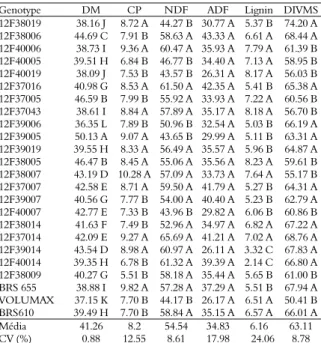
and harvested on the same date, and showed remarkable differences in the DM content, ranging from 37.15 to 50.13% for genotypes Volumax and 12F39005, respectively (Table 7).
Table 7. Chemical composition and dry matter digestibility of 24 sorghum genotypes grown in Sete Lagoas, state of Minas Gerais.
Genotype DM CP NDF ADF Lignin DIVMS 12F38019 38.16 J 8.72 A 44.27 B 30.77 A 5.37 B 74.20 A 12F38006 44.69 C 7.91 B 58.63 A 43.33 A 6.61 A 68.44 A 12F40006 38.73 I 9.36 A 60.47 A 35.93 A 7.79 A 61.39 B 12F40005 39.51 H 6.84 B 46.77 B 34.40 A 7.13 A 58.95 B 12F40019 38.09 J 7.53 B 43.57 B 26.31 A 8.17 A 56.03 B 12F37016 40.98 G 8.53 A 61.50 A 42.35 A 5.41 B 65.38 A 12F37005 46.59 B 7.99 B 55.92 A 33.93 A 7.22 A 60.56 B 12F37043 38.61 I 8.84 A 57.89 A 35.17 A 8.18 A 56.70 B 12F39006 36.35 L 7.89 B 50.96 B 32.54 A 5.03 B 66.19 A 12F39005 50.13 A 9.07 A 43.65 B 29.99 A 5.11 B 63.31 A 12F39019 39.55 H 8.33 A 56.49 A 35.57 A 5.96 B 64.87 A 12F38005 46.47 B 8.45 A 55.06 A 35.56 A 8.23 A 59.61 B 12F38007 43.19 D 10.28 A 57.09 A 33.73 A 7.64 A 55.17 B 12F37007 42.58 E 8.71 A 59.50 A 41.79 A 5.27 B 64.31 A 12F39007 40.56 G 7.77 B 54.00 A 40.40 A 5.23 B 62.79 A 12F40007 42.77 E 7.33 B 43.96 B 29.82 A 6.06 B 60.86 B 12F38014 41.63 F 7.49 B 52.96 A 34.97 A 6.82 A 67.22 A 12F37014 42.09 E 9.27 A 65.69 A 41.21 A 7.02 A 68.76 A 12F39014 43.54 D 8.98 A 60.97 A 26.11 A 3.32 C 67.83 A 12F40014 39.35 H 6.78 B 61.32 A 39.39 A 2.14 C 66.80 A 12F38009 40.27 G 5.51 B 58.18 A 35.44 A 5.65 B 61.00 B BRS 655 38.88 I 9.82 A 57.28 A 37.29 A 5.51 B 67.94 A VOLUMAX 37.15 K 7.70 B 44.17 B 26.17 A 6.51 A 50.41 B BRS610 39.49 H 7.70 B 58.84 A 35.15 A 6.57 A 66.01 A Média 41.26 8.2 54.54 34.83 6.16 63.11 CV (%) 0.88 12.55 8.61 17.98 24.06 8.78
Means followed by different upper case letters, in the same column, and different lower case letters, in the same row, are significantly different by Scott-Knott test (p < 0.05).
For Volumax, values between 31.9 and 21% DM are reported by Ribeiro et al.(2007) and Von Pinho, Vasconcelos, Borges, and Resende (2007), respectively, both lower than the values observed in this study for the same material. In turn, Machado et al. (2014) evaluated the chemical composition of the silages of sorghum hybrids BRS 610, BR 700 and BRS 655 at milky, pasty and dough maturity stages and reported DM content of silages ranging from 22.86 to 41.27%, with 26.75% for BRS610 and 27.17% for BRS655. These values are lower than those reported here for the same genotypes.
Genotypes 12F40005, 12F40014 and 12F38009 showed optimal levels to meet the nitrogen requirements for ruminal flora and for a good functioning of the rumen, which is at least 7% (Table 7). CP content of sorghum depends on the combination of several factors, including the agronomic behavior of genotype, maturity stage and soil and climatic conditions of the planting area. The greater proportion of leaf and grain contributes to higher protein content and these proportions are affected by height, age of harvesting and fertilization. Rodrigues et al. (2012) reported for BRS610 and BRS655, CP content of 6.00 and 6.52% respectively, both lower than those reported in this study for the same genotypes.
There was variation between genotypes for NDF (p > 0.05). The values ranged from 43.57 to 65.69% in materials 12F39005 and 12F37014, respectively (Table 7).
According to Van Soest (1994), the NDF content should be in the range of 50-60%. And although some materials present NDF higher than 60%, the same materials did not differ from others with values within the suggested range. NDF values observed in this study suggest that the consumption of materials would not be impaired; however, the high values of ADF content could negatively affect the digestibility, which did not occur. Thus, more important than evaluating separately the content of NDF and/or ADF is to evaluate the composition of the fiber fractions.
In addition to the NDF and ADF content, the determination of lignin levels is important for understanding the use of forages by the animal, with consequent increase or decrease in DIVMS, depending on the concentration of this phenolic compound.
In this study, lignin values ranged from 2.14 to 8.23% for genotypes 12F40014 and 12F38005 (Table 6). Lower values of lignin content were obtained in genotypes 12F40014 and 12F39014, values of 2.14 and 3.32, respectively. The lower the lignin content in the forage, the more efficient the food degradation process in the rumen. Skonieski et al. (2010) determined production and nutritional value of sorghum silages and reported values of 5.22 and 4.83% lignin for forage and dual purpose materials, respectively.
Most genotypes with lower lignin content showed higher values of DIVMS. All genotypes showed DIVMS values above 50%, suggesting good potential for rumen degradability and digestibility. In this condition, sorghum genotypes evaluated can be better used by animals, because the greater the digestibility, the greater the absorption of nutrients.
Conclusion
In relation to the agronomic traits, genotype 12F37005 showed higher mean values of dry matter production in all evaluated municipalities, demonstrating its adaptation to different cultivation sites. However, genotype 12F39014 is the most suitable for cultivation due to good nutritional value and good dry matter production.
Acknowledgements
To Embrapa Maize and Sorghum and Agricultural Research Company of Minas Gerais (Epamig) and the Research Support Foundation of Minas Gerais (Fapemig) for support.
References
Agritempo. (2014). Sistema de monitoramento agrometeorológico. Retrieved on July 20, 2014 from http://www.agritempo.gov.br/agritempo/index.jsp Almeida Filho, J. E., Tardin, F. D., Daher, R. F., Silva, K.
J., Xavier Neto, J. B., Bastos, E., ... Menezes, C. B. (2014). Avaliação agronômica de híbridos de sorgo granífero em diferentes regiões produtoras do Brasil. Revista Brasileira de Milho e Sorgo, 13(1), 82-95.
Banzatto, D. A., & Kronka, S. N. (1989). Experimentação agrícola. Jaboticabal, SP: Funep.
Buso, W. H. D., Morgado, H. S., Silva, L. B., & França, A. F. S. (2011). Utilização do sorgo forrageiro na alimentação animal. Pubvet, 5(23), 1-26.
Casali, A. O., Detmann, E., Valadares Filho, S. C., Pereira, C., Henriques, L. T., Freitas, S. G., & Paulino, M. F. (2014). Influência do tempo de incubação e do tamanho de partículas sobre os teores de compostos indigestíveis em alimentos e fezes bovinas obtidos por procedimentos in situ. Revista Brasileira de Zootecnia, 37(2), 335-342.
Detmann, E., Souza, M. A., Valadares Filho, S. C., Queiroz, A. C., Berchielli, T. T., Saliba, E. O. S., & Azevedo, J. A. G. (2012). Métodos para análise de alimentos. Visconde do Rio Branco, MG: Suprema. Ferreira, D. F. (2011). Sisvar: a computer statistical
analysis system. Ciência e Agrotecnologia, 35(6), 1039-1042.
Machado, F. S., Rodriguez, N. M., Gonçalves, L. C., Rodrigues, J. A. S., Ribas, M. N., Lobato, F. C. L., ... Pereira, L. G. R. (2014). Valor nutricional de híbridos de sorgo em diferentes estádios de maturação. Arquivo
Brasileiro de Medicina Veterinária e Zootecnia, 66(1), 244-252.
Pires, D. A. A., Rocha Junior, V. R., Sales, E. C. J., Reis, S. T., Jayme, D. G., Cruz, S. S., ... Esteves, B. L. C. (2013). Características das silagens de cinco genótipos de sorgo cultivados no inverno. Revista Brasileira de Milho e Sorgo, 12(1), 68-77.
Ratke, R. F., Frazão, J. J., Calil, P. M., & Cedro, D. A. B. (2013). Caracterização ambiental da microbacia do córrego Samambaia, Goiânia-GO, utilizando SIG. Global Science Technology, 6(1), 1-11.
Ribeiro, C. G. M., Gonçalves, L. C., Rodrigues, J. A. S., Rodriguez, N. M., Borges, I., Borges, A. L. C. C., ... Ribeiro Junior, G. O. (2007). Padrão de fermentação da silagem de cinco genótipos de sorgo. Arquivo Brasileiro de Medicina Veterinária e Zootecnia, 59(6), 1531-1537.
Rodrigues, J. A. S., Machado, F. S., Rodríguez, N. M., Ribas, M. N., Teixeira, A. M., Ribeiro Júnior, G. O., ... Pereira, L. G. R. (2012). Qualidade da silagem de híbridos de sorgo em diferentes estádios de maturação. Arquivo Brasileiro de Medicina Veterinária e Zootecnia, 64(1), 711-720.
Silva, K. J., Menezes, C. B., Tardin, F. D., Emygdio, B. M., Souza, V. F., Carvalho, G. A., & Silva, M. J. (2013). Seleção de híbridos de sorgo granífero cultivados no verão em três localidades. Revista Brasileira de Milho e Sorgo, 12(1), 44-53.
Skonieski, F. R., Nornberg, J. L., Azevedo, E. B., David, D. B., Kessier, J. D., & Menegas, A. L. (2010). Produção, caracterização nutricional e fermentativa de silagens de sorgo forrageiro e sorgo duplo propósito. Acta Scientiarum. Animal Sciences, 32(1), 27-32.
Tilley, J. M., & Terry, R. A. (1963). A two stage technique for the in vitro digestion of forage crops. Journal of the British Grassland Society, 18(2), 104-111.
Van Soest, P. J. (1994). Nutritional ecology of the ruminant (2nd ed.). Ithaca, NY: Cornell University Press. Von Pinho, R. G., Vasconcelos, R. C., Borges, I. D., &
Resende, A. V. (2007). Produtividade e qualidade da silagem de milho e sorgo em função da época de semeadura. Bragantia, 66(2), 235-245.
Received on June 19, 2016. Accepted on August 23, 2016.