(Annals of the Brazilian Academy of Sciences)
Printed version ISSN 0001-3765 / Online version ISSN 1678-2690 http://dx.doi.org/10.1590/0001-3765201720160230
www.scielo.br/aabc
Simultaneous Determination of Furan and Vinyl Acetate in Vapor
Phase of Mainstream Cigarette Smoke by GC-MS
AiFei Xu1
, ZhonG FAn1
, ZhiyAn Chen1
, yun Zhou1
, ShAohuA Liu1
, Shijie huAnG1
, Xueqin Xu1
, ConGyun LonG2
, WeiGAnG WAnG1
, jinG Zhu1
, XiAoLAn Li1
and ChunPinG Xu3
1
Technical Center of China Tobacco Guangxi Industrial Co. Ltd., 530001, Nanning, China
2
Liuzhou Cigarette Factory, China Tobacco Guangxi Industrial Co. Ltd., 545005, Liuzhou, China
3
College of Food and Biological Engineering, Zhengzhou University of Light Industry, Zhengzhou, 450002, Henan, China
Manuscript received on April 22, 2016; accepted for publication on January 23, 2017
ABSTRACT
A simple and sensitive method for simultaneous determination of furan and vinyl acetate (VA) in vapor phase of mainstream cigarette smoke with cold trap and gas chromatography-mass spectrometry (GC-MS)
was developed. A Cambridge filter pad (CFP) was placed in front of the impingers of smoking machine
to remove the particle phase from cigarette smoke. Furan and VA in vapor phase of mainstream cigarette
smoke were collected in two impingers connected in series by filled with methanol at –78°C. The solutions
were added with deuterium-labeled furan-d4 and VA-d6 as internal standards and analyzed by GC-MS. The results showed that the calibration curves for furan and VA were linear (r2
> 0.9995) over the studied concentration range. The intra- and inter-day precision values for furan and VA were <7.07% and <9.62%, respectively. The extraction recoveries of furan and VA were in the range of 94.5-97.7% and 92.3-94.9%, respectively. Moreover, the limits of detection for furan and VA were 0.028 µg mL-1 and 1.3 ng mL-1, respectively. The validated method has been successfully applied to determine the emissions of furan and VA in the vapor phase of mainstream cigarette smoke under International Organization for Standardization (ISO) and Canadian Intense (CI) smoking regimen.
Key words: vapor phase, mainstream cigarette smoke, furan, vinyl acetate, cold trap, gas chromatography-mass spectrometry.
Correspondence to: Xiaolan Li E-mail: [email protected] Chunping Xu
E-mail: [email protected]
* Contribution to the centenary of the Brazilian Academy of Sciences
inTRoDuCTion
Both furan and vinyl acetate (VA) were classified
as possibly carcinogenic to the human (group
2B) by the International Agency for Research on
Cancer (IARC) (Smith et al. 2000). They were
also considered as harmful or potentially harmful compounds (HPHCs) in tobacco products and tobacco smoke by US Food and Drug Administration (FDA) (Oldham et al. 2014). Specially, furan was
included in Hoffmann List of tobacco carcinogens (Hoffmann et al. 2001). The formation of furan in
cigarette smoke was degradation of amino acids and/or reducing sugars, and oxidation of ascorbic
by Maillard reaction during combustion (Baltes and Bochmann 1987, Becalski and Seaman 2005, Locas and Yaylayan 2004, Yaylayan 2006). The VA monomer was reported to be primarily used in the production of polyvinyl acetate (PVA), which was a thermoplastic polymer commonly used as the sideseam adhesive in cigarette paper in the tobacco industry (Levy and Hinojosa 1992). Hence, the formation of VA in cigarette smoke was probably from PVA adhesives, and some sugars in the tobacco were also involved (Coggins et al. 2013).
Up to now, the major trapping methods of furan in vapor phase of mainstream cigarette smoke were direct injection method (Hatzinikolaou et al. 2006, Grob et al. 1965, Vickroy et al. 1976) and gas bag trapping method (Sampson et al. 2014). Grob et al. (1965) reported on determination of furan in cigarette smoke directly through a gas sampling valve by gas chromatography (GC) coupled with flame ionization detector (FID) without sample collection. Vickroy et al. (1976) presented the gas bag trapping method, that is, fresh smoke was collected with a gas bag and the furan was determined by GC-FID. Hatzinikolaou et al. (2006) developed a method for the analysis of furan in the vapor phase of cigarette smoke by a GC coupling with diode array photometric spectral detection in the ultraviolet region (UV-DAD). However, all of above three reports showed poor separation
results and had adverse effect on the accuracy of quantification furan. Adam et al. (2006) developed a novel method for the direct determination of furan in fresh vapor phase of mainstream cigarette smoke by a GC with single photon ionisation time-of-flight mass spectrometry (GC-SPI-TOFMS) without sample collection prior to analysis. Eschner et al. (2011) developed a technique that furan in the vapor phase of mainstream cigarette smoke was analyzed by fast GC coupled to single
photon ionisation time-of-flight mass spectrometry. Furthermore, quantification of furan was actualized for two different smoking regimes (International
Organization for Standardization) ISO and (Canadian Intense) CI machine smoking regimens). However, soft photoionization and puff-by-puff analysis were adopted in their reports, which made
these methods complicated and difficult to operate.
Sampson et al. (2014) reported a method that the vapor phase of mainstream cigarette smoke was collected by a gas bag, and furan was detected by solidphase microextraction gas chromatography - mass spectrometry (SPME-GC-MS). And the emissions of furan in the research cigarettes (1R5F and 3R4F) under ISO and CI smoking regimens were reported. However, the SPME technique made
the method difficult to operate and time-consuming
(Sampson et al. 2014).
The major trapping methods of VA in vapor phase of mainstream cigarette smoke are direct injection (Norman et al. 1968), cold trap (Diekmann et al. 2002) and gas bag trapping combining with solid-phase microextraction (SPME) (Sampson et al. 2014). The VA content in cigarette smoke could be determined by GC-MS. Norman et al. (1968) reported a method that the VA form mainstream cigarette smoke was quantitatively analyzed by GC-FID, but no VA was detected in the vapor phase of mainstream cigarette smoke under ISO smoking conditions because of its poor sensitivity and selectivity. Diekmann et al. (2002) reported a method that the VA in vapor phase of mainstream cigarette smoke was trapped in three impings
connected in series at -78 oC filled with acetone,
the impinger solutions were fortified with
VA-d6 asinternal standard and analyzed by GC-MS.
application of solidphase microextraction made the
method difficult to operate and time-consuming. In this study, A Cambridge filter pad (CFP)
was placed in front of the impingers to remove the particle phase from the smoke. Then, furan and VA in vapor phase of mainstream cigarette smoke were collected in 2 impingers connected in series at
–78°C filled with methanol. The impinger solutions
were spiked with deuterium-labeled internal standards (i.e. furan-d4 and VA-d6) and analyzed by GC-MS. Moreover, furan and VA in vapor phase of mainstream cigarette smoke under ISO and CI machine smoking regimens were detected in this study.
MATeRiALS AnD MeThoDS
CHEMICALS AND CIGARETTES
Furan and VA were purchased from Ultra Scientific
Inc. (North Kingstow, RI). Furan-d4 and VA-d6 were purchased from Cambridge Isotope Laboratoris, Inc. (Andover, MA), and methanol (HPLC grade) was purchased from Dikama Corporation (Richmond Hill, NY). The reference cigarettes 1R5F and 3R4F were purchased from the University of Kentucky (Lexington, KY) and 15 commercial cigarettes were purchased from Chinese market with packet labeled tar ranged from 3 to 11 mg cig−1.
PREPAREATION OF STOCK SOLUTIONS
The stock solutions of furan and VA were prepared in methanol at the concentrations of 1000 and
10 µg mL-1, respectively. The stock solutions of
furan-d4 and VA-d6 were prepared in methanol
at concentrations of 2000 and 20 µg mL-1,
respectively. The standard solutions of furan and VA were prepared by diluting with methanol at the
concentration range of 0.2-50.0 µg mL-1and
0.02-0.5µg mL-1, respectively. The concentrations of
furan-d4and VA-d6in the standard solutions were
10 mL-1and 0.1µg mL-1, respectively.
SAMPLES COLLECTION AND GC-MS ANALYSIS
Before smoking, the cigarettes were conditioned with ISO 3402:1999 recommended conditions
of 22 ± 1 oC and 60 ± 2% relative humidity for
48 hours. The mainstream cigarette smoke was generated on an automatic, 20-port RM 20H rotary smoke machine (H. Borgwaldt, Hamburg, Germany). Ten cigarettes were smoked following
the ISO 3308 smoking regimen (35mL puff volumn with 2 s durations every 60 s) and five cigarettes
were smoked following the Canadian intense T-115 smoking regimen (55mL puff volumn with 2 s durations every 30 s, 100% ventilation blocked), respectively. The cigarette mainstream smoke collection was adapted from a CORESTA recommended method (CORESTA 2013). A
Cambridge filter pad (CFP) was placed in front of
the impingers to remove the particle phase from cigarette smoke. Furan and VA in vapor phase of mainstream cigarette smoke were collected in
two impingers connected in series filled with 15
mL methanol per impinger. The impingers were
cooled to -78 o
C with a mixture isopropanol and dry ice prior to smoking. After smoking, each impinger solution was equivalently spiked with 75
μL furan-d4 and 75 μL VA-d6 stock solution and stirred vigorously. Then two impinger solutions
were combined and kept in the Dewar flasks for
further use.
An aliquot of the impinger solutions was used to analyze the contents of furan and VA in cigarette smoke by GC-MS (7890/5975C, Agilent
Technologies, U.S.) fitted with a Supelco VOCOL (60 m × 0.32 mm i.d., and 1.8μm film thickness)
capillary column. The split mode was a ratio of
10:1 and each injection volume was 2 μL. The temperature and pressure of the inlet were 180°C
and 8.7 psi, respectively. Helium carrier gas was
maintained at 1.5 mL min-1, which corresponded
to a linear velocity of about 31.4 cm s−1. The GC
heated to 220°C at 20°C min-1 and held for 6 min.
The MS was operated in EI (70eV) mode. The MS
transfer line temperature was set at 230°C, and
an ion source temperature and an MS quadrupole
were maintained at 230°C and 150°C, respectively.
Enhanced ChemStation (MSD ChemStation. F.01.01.2317) of Agilent Technologies was applied to determine chromatogram peak areas automatically (Choe et al. 2012).
ReSuLTS AnD DiSCuSSion
COLUMN SELECTION AND TRAPING PREPARATION
Initially, three different GC columns were compared, including Agilent J&W DB-624 (60 m
× 0.25 mm i.d., and 1.4 μm film thickness) column,
Agilent J&W DB-624 (60 m × 0.32 mm i.d., and 1.8
μm film thickness) and Supelco VOCOL (60 m × 0.32 mm i.d., and 1.8μm film thickness). The peaks
of furan and VA were overlapped by other peaks when both Agilent J&W columns were employed. However, when Supelco VOCOL column was
used, furan and VA could be separated sufficiently,
as shown in Fig. 1.
The trapping efficiency of furan and VA in vapor phase of mainstream cigarette smoke was evaluated under ISO and CI smoking regimens. Three impingers containing 15 mL methanol per impinger were connected in series after CFP. And the vapor phase of mainstream cigarette smoke was collected by the three impingers. Two types of cigarettes (Virginia type cigarette and blended type cigarette) were examined and the results were shown in Table I. It showed that the furan and VA
were found in both the first and second impinger
solution, while they were not observed in the third impinger solution. Therefore only two impingers were enough to trap furan and VA in vapor phase of mainstream cigarette smoke completely.
METHOD VALIDATION
Linearity, limit of detection (LOD) and limit of quantitation (LOQ)
The calibration curves were produced for furan and VA with a concentration range of 0.2-50.0
µg ml-1 and 0.02- 0.5µg ml-1, respectively. The
linear regression equation of furan was Y=0.993X
+ 0.030 and that of VA was Y= 1.178X + 0.049.
The correlation coefficient (r2) for furan was
0.9997 and that for VA was 0.9993. The method exhibited excellent linear response in the selected concentration range.
The limit of detection (LOD) and limit of quantitation (LOQ) are terms used to describe the smallest concentration of a measure and that can be reliably measured by an analytical procedure.
The concentration of 0.028 μg mL-1
was found to be the LOD of furan, and LOQ of furan was 0.092
μg mL-1
. While the LOD and LOQ of VA were 1.3
ng mL-1 and 4.5 ng mL-1, respectively. Under the
ISO and CI smoking regimens, the LOQ of furan
was observed as 0.28μg cig-1 and 0.56 μg cig-1
,
respectively, while LOQ of VA was 13.5ng cig-1
and 27.0 ng cig-1, respectively.
Precision
Intra-day and inter-day precisions were determined using the reference cigarette 3R4F (the names of these cigarettes provided by University of Kentucky
for research purposes) which were analyzed six times on the same day and six successive days. As shown in Table II, the intra-day precisions of furan and VA were determined as 4.96% and 7.07%, respectively, and the inter-day precisions of furan and VA were 6.86% and 9.62%, respectively. These
results, which fulfilled the acceptable criteria for
accuracy and precision, indicate that the method is reliable and reproducible for the quantitative analysis of the analytes in furan and VA contents in vapor phase of mainstream cigarette smoke (Wang et al. 2013).
Recovery
A recovery study was performed by spiking three different concentration levels of standard solutions of furan and VA as shown in Table II. The
TABLe i
The trapping efficiency of furan and VA in vapor phase of mainstream cigarette smoke under ISO and CI smoking
regimens.
cigarette
furan VA
ISO smoking
regimen CI smoking regimen
ISO smoking regimen
CI smoking regimen 1st
(%) 2nd (%)
3rd (%)
1st (%)
2nd (%)
3rd (%)
1st (%)
2nd (%)
3rd (%)
1st (%)
2nd (%)
3rd (%)
Virginia
type 90.6 9.4 0.0 87.1 12.9 0.0 95.0 5.0 0.0 93.4 6.6 0.0
Blended
type 92.7 7.3 0.0 90.2 9.8 0.0 96.9 3.1 0.0 94.9 5.1 0.0
TABLe ii
Intra-day, inter-day precision, and recovery of furan and VA.
Analyte intra-day precision inter-day precision Recovery
Measurement
± SD RSD(%)
Measurement
± SD RSD(%)
Tested
concentration Recovery (%)
(μg mL-1
) (n=6) (μg mL-1
) (n=6) (μg mL-1
) (±SD, n=3)
furan 7.94±0.39 4.96 7.81±0.55
5.0 94.5±4.7
7.07 10.0 96.2±4.3
20.0 97.7±2.9
VA 0.0978±0.0067
0.05 92.3±6.5
6.86 0.1008±0.0097 9.62 0.10 93.8±5.0
recovery of furan was between 94.5% and 97.7%
of the expected value. The recovery of VA was between 92.3% and 94.9%, respectively. These
results indicated that the extracts had little or no detectable coeluting endogenous substances that
could influence the extraction of the analytes.
Stability
Stability tests were performed by analyzing furan and VA solutions under two different storage
conditions (room temperature and -20 oC) for 32
h. The difference was less than 4.9%, indicated
that the sample of furan and VA was quantitatively
stable under two different storage conditions.
APPLICATION UNDER ISO AND CI MACHINE SMOKING REGIMENTS
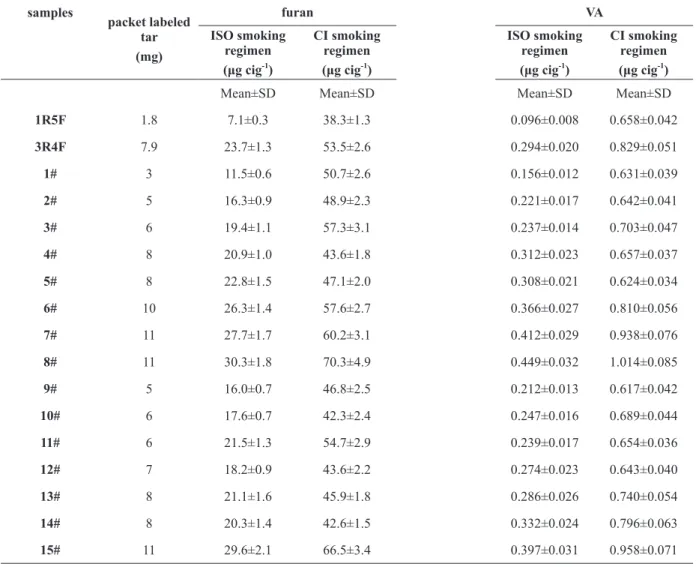
To Apply this optimal method, two reference cigarettes (1R5F and 3R4F) and 9 commercial cigarette purchased from China market were used and furan and VA in vapor phase of mainstream cigarette smoke under ISO and CI machine smoking regimens were determined. As shown in Table III,
TABLe iii
Furan and VA yields in vapor phase of mainstream cigarette smoke samples under ISO and CI smoking regimens (n=3).
samples
packet labeled tar
(mg)
furan VA
iSo smoking regimen
(μg cig-1)
Ci smoking regimen
(μg cig-1)
iSo smoking regimen
(μg cig-1)
Ci smoking regimen
(μg cig-1)
Mean±SD Mean±SD Mean±SD Mean±SD
1R5F 1.8 7.1±0.3 38.3±1.3 0.096±0.008 0.658±0.042
3R4F 7.9 23.7±1.3 53.5±2.6 0.294±0.020 0.829±0.051
1# 3 11.5±0.6 50.7±2.6 0.156±0.012 0.631±0.039
2# 5 16.3±0.9 48.9±2.3 0.221±0.017 0.642±0.041
3# 6 19.4±1.1 57.3±3.1 0.237±0.014 0.703±0.047
4# 8 20.9±1.0 43.6±1.8 0.312±0.023 0.657±0.037
5# 8 22.8±1.5 47.1±2.0 0.308±0.021 0.624±0.034
6# 10 26.3±1.4 57.6±2.7 0.366±0.027 0.810±0.056
7# 11 27.7±1.7 60.2±3.1 0.412±0.029 0.938±0.076
8# 11 30.3±1.8 70.3±4.9 0.449±0.032 1.014±0.085
9# 5 16.0±0.7 46.8±2.5 0.212±0.013 0.617±0.042
10# 6 17.6±0.7 42.3±2.4 0.247±0.016 0.689±0.044
11# 6 21.5±1.3 54.7±2.9 0.239±0.017 0.654±0.036
12# 7 18.2±0.9 43.6±2.2 0.274±0.023 0.643±0.040
13# 8 21.1±1.6 45.9±1.8 0.286±0.026 0.740±0.054
14# 8 20.3±1.4 42.6±1.5 0.332±0.024 0.796±0.063
the packet labeled tar yields of these commercial cigarettes ranged from 3 mg cig-1 to 11 mg cig-1,
and sample 1-7# were Virginia type cigarettes, sample 8-15# were blended type cigarettes. Furan and VA in vapor phase of mainstream cigarette smoke were quantitatively analyzed under ISO and CI smoking regimens. The results found that the emissions of furan and VA in vapor phase of
mainstream cigarette smoke ranged of 7.1-30.3 μg
cig-1 and 0.096- 0.449 μg cig-1, respectively, under ISO smoking regimen. However, the furan and VA in the vapor phase of mainstream cigarette smoke
yields ranged of 38.3-70.3 μg cig-1 and 0.624-1.014 μg cig-1
respectively, under CI smoking condition. It indicated that the furan and VA yields in the vapor of the mainstream cigarette smoke under CI smoking condition were much higher than those under ISO smoking regimen. This trend was more
significant in the cigarettes with the packet labeled
tar below 6 mg cig-1. The reason might be due to
the different smoke parameters (e.g., larger puff
volume, shorter duration and 100% vent blocking under CI smoking regimen than those under ISO smoking regimen) and different cigarette
design parameters (e.g., cigarette paper and filter
ventilation) (Roemer and Carchman 2011). This method was proved to be easy to operate, more sensitive and selective, and could be successfully applied to detect the emissions of furan and VA for the reference cigarettes (1R5F and 3R4F) and commercial cigarettes purchased from China market.
ConCLuSionS
A simple and sensitive method for simultaneous determination of furan and vinyl acetate (VA) in vapor phase of mainstream cigarette smoke with cold trap and gas chromatography-mass spectrometry (GC-MS) was developed. This method had a good linearity, quantitation limit, precision and perfect recovery. The furan and VA yields in
the vapor phase of the mainstream cigarette smoke under CI smoking condition are much higher than those under ISO smoking regimen, This method is applicable to the determination of fuan and VA in the vapor phase of mainstream cigarette smoke under ISO and CI smoking rengimen.
ACKnoWLeDGMenTS
This work was supported by the National Science Foundation of China (Grant no. B060806) and Henan Science and Technology Innovation Talent Support Program (no.14HASTIT020).
ReFeRenCeS
ADAM T, MICTSCHKE S, STREIBL T, BAKER RR AND ZIMMERMANN R. 2006. Puff-by-puff resolved characterisation of cigarette mainstream smoke by single photon ionisation (SPI)-time-of-flight mass spectrometry (TOFMS): Comparison of the 2R4F research cigarette and pure Burley, Virginia, Oriental and Maryland tobacco cigarettes. Anal Chem 76: 219-229.
BALTES W AND BOCHMANN G. 1987. Model reactions on roast aroma formation. II. Mass spectrometric identification of furans and furanones from the reaction of serine and threonine with sucrose under the conditions of coffee roasting. Z Lebensm Unters Forsch 184: 478-484. BECALSKI A AND SEAMAN S. 2005. Furan precursors
in food: A model study and development of a simple headspace method for its determination. J AOAC Int 88: 102-106.
CHOE S, WOO SH, KIM DW, PARK Y, CHOI H, HWANG BY, LEE D AND KIM S. 2012. Development of a target component extraction method from GC-MS data with an in-house program for metabolite profiling. Anal Biochem 426(2): 94-102.
COGGINS CR, JEROME AM, LILLY PD, MCKINNEY WJ JR AND OLDHAM MJ. 2013. A comprehensive toxicological evaluation of three adhesives using experimental cigarettes. Inhal Toxicol 25(Suppl 2): 6-18. CORESTA. 2013. CORESTA recommended method No.
DIEKMANN J, BIEFEL C AND RUSTEMEIER K. 2002. Analysis of Cigarette Mainstream Smoke for 1,1-Dimethylhydrazine and Vinyl Acetate by Gas
Chromatography–Mass Spectrometry. J Chromatogr Sci
40(10): 509-514.
ESCHNER MS, SELMANI I, GRÖGER TM AND ZIMMERMANN R. 2011. Online comprehensive two-dimensional characterization of puff-by-puff resolved cigarette smoke by hyphenation of fast gas chromatography to single-photon ionization time-of-flight mass spectrometry: quantification of hazardous volatile organic compounds. Anal Chem 83(17): 6619-6627. GROB K. 1965. Gas chromatography of cigarette smoke, Part
III. Separation of the overlap region of gas and particulate phase by capillary columns. J Chromatogr Sci 3(2): 52-56. HATZINIKOLAOU DG, LAGESSON V, STAVRIDOU
AJ, POULI AE, LAGESSON-ANDRASKO L AND STAVRIDES JC. 2006. Analysis of the gas phase of cigarette smoke by gas chromatography coupled with UV-diode array detection. Anal Chem 78(13): 4509-4516. HOFFMANN D, HOFFMANN I AND EL-BAYOUMY K.
2001. The less harmful cigarette: a controversial issue. A tribute to Ernst L. Wynder. Chem Res Toxicol 14(7): 767-790.
LEVY LB AND HINOJOSA L. 1992. Effect of oxygen on vinyl acetate polymerization. J Appl Polym Sci 45: 1537-1544. LOCAS CP AND YAYLAYAN VA. 2004. Origin and
mechanistic pathways of formation of the parent furana food toxicant. J Agric Food Chem 52: 6830-6836.
NORMAN V, NEWSOME JR AND KEITH CH. Smoking machines for the analysis of the vapor phase of cigarette smoke. Tobacco Sci 1968(12): 216-221.
OLDHAM MJ, DESOI DJ, RIMMER LT, WAGNER KA AND MORTON MJ. 2014. Insights from analysis for harmful and potentially harmful constituents (HPHCs) in tobacco products. Regul Toxicol Pharmacol 70(1): 138-148. ROEMER E AND CARCHMAN RA. 2011. Limitations of
cigarette machine smoking regimens. Toxicol Lett 203(1): 20-27.
SAMPSON MM, CHAMBERS DM, PAZO DY, MOLIERE F, BLOUNT BC AND WATSON CH. 2014. Simultaneous analysis of 22 volatile organic compounds in cigarette smoke using gas sampling bags for high-throughput solid-phase microextraction. Anal Chem 86(14): 7088-7095. SMITH CJ, PERFETTI TA, MULLENS MA, RODGMAN
A AND DOOLITTLE DJ. 2000. “IARC Group 2B carcinogens” reported in cigarette mainstream smoke. Food Chem Toxicol 38(9): 825-848.
VICKROY DG. 1976. The characterization of cigarette smoke from Cytrel1 smoking products and its comparison to smoke smoke from flue-cured tobacco. BeitraÈge zur Tabak-forschung 7(8): 415-421.
WANG Q, BAO B, YULAN C AND NAYINTAI DAI. 2013. Simultaneous determination of six flavonoids in rat plasma by high-performance capillary electrophoresis and its application to a pharmacokinetic study. J Food Drug Anal 21: 369-375.