Productive performance of dairy cows fed with hydrolyzed sugarcane
Desempenho produtivo de vacas leiteiras alimentadas com cana-de-açúcar hidrolisada
Donizeti Teixeira JuniorI Regis Luis MissioII Mariana Paula Rossi SforciniI
Mauro Dal Secco de OliveiraIII Viviane Borba FerrariIV Rafael Ferreira SantosIV
ISSN 0103-8478
ABSTRACT
This study aimed to evaluate the productive performance of dairy cows fed with sugarcane treated with 5g kg-1 of
calcium oxide (CaO) or hydroxide [Ca(OH)2]. Eight Holstein cows with 638.01±12.52kg of body weight and milk yield of 20.32±1.5kg d-1 were randomly assigned into two 4x4 Latin squares, fed with the
following diets composed of corn silage (CS), fresh sugarcane (FS), sugarcane treated with calcium oxide (STCO) or calcium hydroxide (STCH) as only forage. Data collection lasted five days, after 15 days of adaptation to diets and facilities. The dry matter intake (% of body weight) was higher in diets with CS (3.08) compared to those with FS (2.67), STCO (2.73) or STCH (2.73), which did not differ. Diets with CS determined milk production adjusted for 4% fat (20.05kg d-1) similar to diets containing STCO and STCH
(18.01 and 17.89kg d-1, respectively) and higher than those with FS
(17.33kg d-1). The experimental diets did not alter the composition
of milk. The use of sugarcane treated with Ca(OH)2 is a viable option for feeding Holstein cows with average genetic potential for milk production because it allows production and composition similar to milk dairy cows fed with corn silage, besides benefiting the logistics of feeding in the rural properties.
Key words: hydrated lime, hydrolysis, milk fat, nutrient intake, quicklime.
RESUMO
Objetivou-se avaliar o desempenho produtivo de vacas leiteiras alimentadas com cana-de-açúcar tratada com 5g kg-1 de óxido (CaO) ou hidróxido de cálcio [Ca(OH)
2]. Foram
utilizadas oito vacas da raça Holandesas com 638,01±12,52kg de peso corporal e produção média de leite de 20,32±1,5kg dia-1, distribuídas aleatoriamente em dois quadrados latinos
balanceados 4x4, alimentadas com dietas contendo silagem de milho (SM), cana-de açúcar in natura (CIN), cana-de-açúcar tratada com óxido de cálcio (CTOC) ou hidróxido de cálcio
(CTHC) como único volumoso. O período de coleta de dados foi de cinco dias, após 15 dias de adaptação às instalações e dietas. O consumo de matéria seca (% do peso corporal) foi superior nas dietas com SM (3,08) em relação àquelas com CIN (2,67), CTOC (2,73) ou CTHC (2,73), as quais não diferiram entre si. Dietas com SM determinaram produção de leite ajustada para 4% de gordura (20,05kg dia-1), similar às dietas contendo CTOC e
CTHC (18,01 e 17,89kg dia-1, respectivamente) e superior àquelas
com CIN (17,33kg dia-1). As dietas experimentais não alteraram
a composição do leite. A utilização da cana-de-açúcar tratada com Ca(OH)2 é uma alternativa alimentar viável para vacas
Holandesas com potencial genético médio para produção leiteira, já que possibilita produção e composição do leite similar à vacas alimentadas com silagem de milho, além de beneficiar a logística de alimentação nas propriedades rurais.
Palavras-chave: cal hidratada, cal virgem, consumo de nutrientes, gordura do leite, hidrólise.
INTRODUCTION
The sugarcane is a cosmopolitan culture, easy to grow, providing high production of dry matter at low costs, which has been important to be chosen as forage for dairy cows in order to reduce costs with hay and silage. Moreover, sugarcane time of harvest coincides with low production of tropical pastures, favoring its use as forage during dry season. However, this material has low mineral and protein contents
and high indigestible fiber, which limits dry matter
intake (MAGALHÃES et al., 2004). Moreover, the fresh sugarcane supply for dairy cows requires the
IPrograma de Pós-graduação em Zootecnia, Universidade Estadual Paulista “Júlio de Mesquita Filho” (Unesp), Jaboticabal, SP, Brasil. IIUniversidade Tecnológica Federal do Paraná (UTFPR), 85503-390, Pato Branco, PR, Brasil. E-mail: [email protected]. Corresponding author. IIIUnesp, Jaboticabal, SP, Brasil.
IVDepartamento de Zootecnia, Unesp, Jaboticabal, SP, Brasil.
daily cut, undermining the logistics of feeding in the rural properties (MISSIO et al., 2012).
According to the potential as ruminant feed, as well as limitations of its use, recently the amount of research about sugarcane has been
intensified aiming to improve the nutritional
characteristics and decrease cut frequency of this material by treating with alkalizing agents (DIAS et al., 2011; MISSIO et al., 2012). The use of limes microprocessor enables increased storage time of sugarcane due to the improvement in aerobic stability of hydrolyzed sugarcane in relation to fresh sugarcane (DOMINGUES et al., 2011) and enable increased
digestibility of the fiber fraction of forage (PIRES et al., 2010), which can benefit the production of milk
(ALVES et al., 2010).
Despite the increasing number of studies with cased limes, the results related to the use of hydrolyzed sugarcane in dairy cow diet are still inconsistent. Thus, the aim of this study was to evaluate yield and milk composition of dairy cows fed with sugarcane treated with calcium oxide (CaO) or hydroxide [Ca(OH)2].
MATERIAL AND METHODS
It was used eight Holstein cows, second and third order of birth, from 40 to 135 days of lactation, average of 638,01±12.52kg body weight and average milk yield of 20.32±1.5kg d-1. The animals were
designed according to milk yield in two 4x4 Latin squares (four treatments and four periods). The tested diets were composed of corn silage (CS), fresh sugarcane (FS), sugarcane treated with calcium oxide (STCO) or calcium hydroxide (STCH) as only forage. Data
collection lasted five days after 15 days of adaptation to
the facilities and diets, completing 80 days.
Animals were kept in Tie Stall system,
provided with concrete floor, water and feed troughs.
The body weight was obtained by weighing tape
(mean of three measurements) on fifteenth day of each period, preceding the first meal. Animals were
fed ad libitum, allowing 10% orts, provided twice daily (08h and 16h). Feed intake was measured daily by weighing the feed and orts from the previous day.
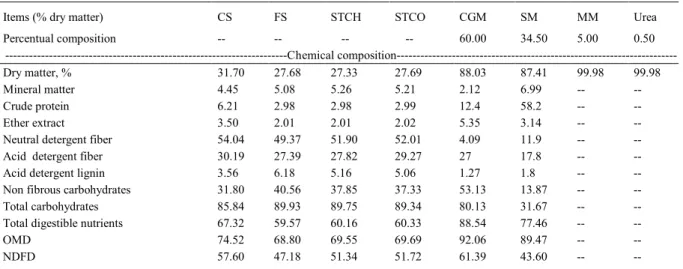
The concentrate (Table 1) was fixed in one kg for each
three kg of milk, according to milk yield before the experiment, being mixed with the forage immediately after supplying.
The hybrid corn used for silage was the AG5011, cut at 20cm from the ground, 36% of grain in dry matter (DM). The sugarcane used was cv. ‘RB 855536’, aged 10-12 months, chopped in a forage
machine set to provide 8-10mm particles. After chopped, sugarcane was spread in 20cm layers on
a concrete floor under a shed and a solution of lime
were added using a watering can. The solution was prepared with 0.5kg of virgin or hydrated lime in 2 liters of water 100kg-1 of sugarcane (OLIVEIRA,
2010). After homogenization of lime solution with sugarcane, the material concentration in heaps (500kg, 80cm) was performed and stored for at least eight hours and maximum of 48 hours before its supply. The fresh sugarcane, on the other hand, was provided immediately after chopping.
Virgin lime contains 72% Ca(OH)2 and 0.5% MgO, determining 92% of total CaO (hydrolyzing agent). Hydrated presents 95.5% of Ca(OH)2 and 1.5% MgO, with 72.5% of total CaO. The remaining components of the virgin and hydrated limes, 27.5 and 3% respectively of their composition,
are not identified by the producer.
Feed and ort samples were collected in
the last five days of each experimental period,
pre-dried in a forced air ventilation oven at 55oC for 72
hours and ground in a Willey mill equipped with 1mm diameter sieves. The dry matter, mineral matter (MM), ether extract (EE) and crude protein (CP) were determined by AOAC (1995). The content
of neutral detergent fiber (NDF) was determined
according to VAN SOEST et al. (1991). The levels
of acid detergent fiber and lignin were determined
according to VAN SOEST (1973). The content of
total carbohydrates (TC) and non-fiber carbohydrates
(NFC) was determined according to SNIFFEN et al. (1992): TC=100-(CP+EE+MM) and NFC=TC-NDF. The content of total digestible nutrients (TDN), organic matter digestibility (OMD) and digestibility
of neutral detergent fiber (NDFD) were determined
according to WEISS (1993): TDN=(DCPap x CP)+(2.25xEE)+[0.98 x (100-NDFn-CP-Ashes-EE- 1)]+0.75 x {(NDFn-lignin) x [1-(lignin/ NDFn)0.667]} - 7, OMD=(DCPap x CP)+(EE x
2.25)+[0.98x(100-NDFn-CP-Ashes-EE-1)]+0.75 x {(NDFn-lignin) x [1-(lignin/NDFn)0.667]}/(100-MM)
x 100, NDFD={[0.75 x (NDFn-lignin)] x [1-(lignin/ FDNn)0.667]/NDFn} x 100, where: DCPap is digestible
Cows were milked twice-daily (05h and 14h), milk yield was individually obtained by measurers coupled to milking system. Milk yield was corrected to 4% fat (4%FCMY) according NRC (2001), where: 4%FCMY=(0.4 x kgd-1 of milk) + [15
x (fat yield x milk yield/100)]. Milk composition was determined in samples proportional to daily milk yield collected on 17th and 19th days of each experimental
period. These samples were refrigerated at 4°C in tubes containing 2-bromo-2-nitropropane-1-3diol at 2oC and
analyzed at Clínica do Leite - Esalq/USP for protein, fat, lactose, total solids, and nonfat milk solids.
Data were subjected to analysis of variance and Pearson correlation, the means were compared by
Tukey test (α=0.5), using the PROC MIXED of SAS
statistical software (version 8.02). The mathematical model used was represented by: Yijkl=m+qi+vj(qi)+pk (qi)+tl+(tlqi)+eijkl, where Yijkl = dependent variable;
m = general mean; qi = effect of square i; vj(qi) = effect of cow j; pk(qi) = effect of period k; tl = effect of treatment l; (tlqi) = interaction between treatment l and square i; eijkl = experimental error.
RESULTS AND DISCUSSION
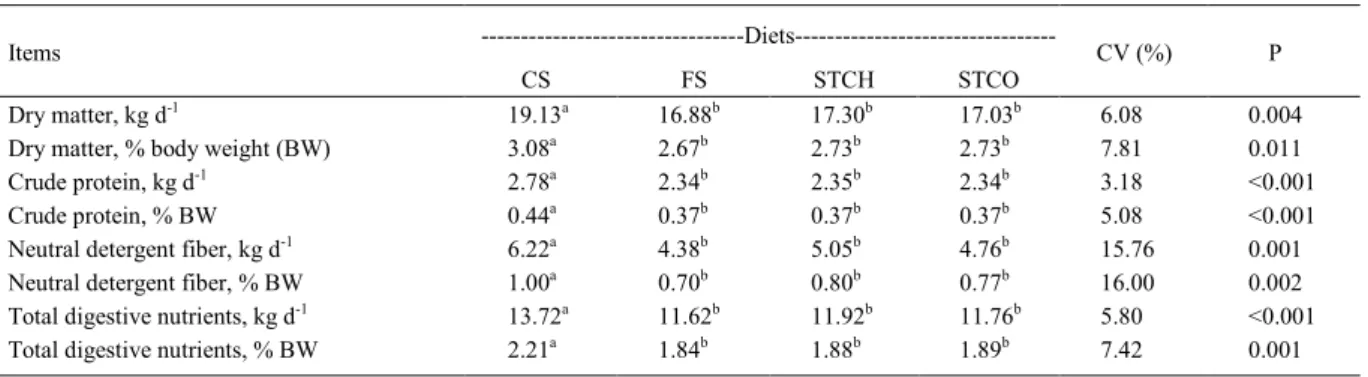
The effects of diets on dry matter intake and nutrients are shown in table 2. The dry matter intake of cows fed with corn silage (CS) was 11.8, 9.6 and 11% greater (P<0.05) than cows fed with fresh sugarcane (FS), sugarcane treated with calcium oxide (STCO) or hydroxide (STCH), respectively.
The DMI (% of body weight) had similar behavior to DMI, expressed as kg/d, cows fed with CS had DMI 13.3, 11.4, and 11.4% higher (P<0.05) than cows fed with FS, STCO or STCH, respectively. These results demonstrated that the use of hydrolyzed sugarcane or not in the diet limited the DMI as function of
the filling reticulum-rumen. This is due the high proportion of indigestible fiber of FS in relation to
CS, which may represent 60% of the neutral detergent
fiber (NDF) in the fresh sugarcane (FERNANDES
et al., 2003), while in corn and sorghum silages, the indigestible portion of NDF is 28-33% (PIRES et al.,
2010). The high content of indigestible fiber of FS
compared to CS provides lower passage rate of the feed in the animal digestive tract, determining the physical limitation of consumption (ALLEN, 2000). According to MAGALHÃES et al. (2004), for every percentage point of FS replacing CS for lactating cows, DMI decreases 0.0266kg.
The presented results were similar to those obtained by MENDONÇA et al. (2004),
which verified DMI 15% higher for cows fed with
diets containing 60% of CS in relation to diets with the same percentage of FS. CORRÊA et al. (2003) found lower difference (6.52%) for DMI between diets with CS and FS, due to the use of higher amount of concentrate in the diet, stressing the
rumen fill as a limiting factor to feed intake in fresh
sugarcane based diets. It is noteworthy, moreover, that the treatment of sugarcane with lime did not cause changes in the palatability or acceptability of
Table 1 - Percentage composition of concentrate and chemical composition of diet ingredients.
Items (% dry matter) CS FS STCH STCO CGM SM MM Urea
Percentual composition -- -- -- -- 60.00 34.50 5.00 0.50
---Chemical
composition---Dry matter, % 31.70 27.68 27.33 27.69 88.03 87.41 99.98 99.98
Mineral matter 4.45 5.08 5.26 5.21 2.12 6.99 --
--Crude protein 6.21 2.98 2.98 2.99 12.4 58.2 --
--Ether extract 3.50 2.01 2.01 2.02 5.35 3.14 --
--Neutral detergent fiber 54.04 49.37 51.90 52.01 4.09 11.9 --
--Acid detergent fiber 30.19 27.39 27.82 29.27 27 17.8 --
--Acid detergent lignin 3.56 6.18 5.16 5.06 1.27 1.8 --
--Non fibrous carbohydrates 31.80 40.56 37.85 37.33 53.13 13.87 --
--Total carbohydrates 85.84 89.93 89.75 89.34 80.13 31.67 --
--Total digestible nutrients 67.32 59.57 60.16 60.33 88.54 77.46 --
--OMD 74.52 68.80 69.55 69.69 92.06 89.47 --
--NDFD 57.60 47.18 51.34 51.72 61.39 43.60 --
the forage, fact supported by the feed intake, result contrary to that obtained by MISSIO et al. (2013).
However, these results confirm those presented in
the literature (CARVALHO et al., 2010; MISSIO et al., 2012) which, in most cases, there was no changes in feed intake by the addition of lime to sugarcane. Nevertheless, MISSIO et al. (2013) argue that when the treatment of sugarcane with lime increase the
fiber digestibility it is expected higher feed intake in
diets with hydrolyzed sugarcane in relation to those with fresh sugarcane.
The crude protein (CPI), neutral detergent
fiber (NDFI) and total digestible nutrients (TDNI)
intakes were higher (P<0.05) in diets with CS than those with FS, STCO and STCH (Table 2), exceeding the average of diets with sugarcane in 15.7, 23.9 and 14.2%, respectively. However, the CPI, NDFI and TDNI did not differ among diets with FS, STCO and STCH. These variations in
nutrient intake reflect the feed intake since the correlation coefficients of DMI with the CPI, NDFI
and TDNI are 0.93; 0.85 and 0.99, respectively. The results obtained in this study were similar to those observed by MISSIO et al. (2012), who found that the addition of 5g kg-1 of Ca(OH)
2
to sugarcane and stored for 24, 48 or 72 hours did not change CPI, NDFI and TDNI. However, DIAS et al. (2011) evaluating amounts of Ca(OH)2 (0, 8, 16 and 24g kg-1) found higher point for CPI and NDFI
for 8g kg-1 of lime, due to increased digestibility
of dry matter. MISSIO et al. (2013), on the other hand, found lower CPI, NDFI and TDNI for Nellore heifers fed with sugarcane treated with 5g kg-1
Ca(OH)2, which was associated to the palatability and acceptability of hydrolyzed sugarcane by animals. For CS supplementation, results were similar to those
observed by COSTA et al. (2005), who found CPI, NDFI and TDNI, 15.7, 21.1 and 9.9% lower for FS based diets compared to CS, respectively.
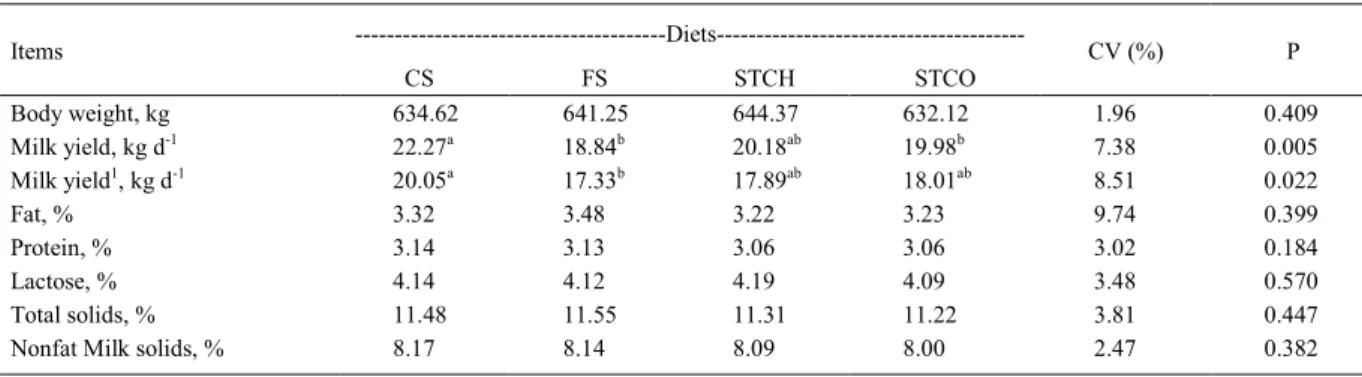
Milk yield (kg d-1) was similar (P>0.05)
between diets with CS and STCH (Table 3), and higher in diets with CS than those with FS and STCO. On the other hand, no difference was observed for milk yield between diets with FS, STCO and STCH. When corrected to 4% fat (4% FCM), diets with hydrolyzed sugarcane determined similar milk yield in relation to the diets with CS and FS, while diets with FS had lower milk yield than those with CS. Considering the variation in the body weight of the animals, it can be inferred that milk production was mainly determined by DMI and quality of diets, since, according to NRC (2001), the shift from one point of body condition score (scale from 1 to 5) is associated with variation of 80kg body weight of the animals, excluding the possibility of producing milk maintained at the expense of mobilization of body fat in the diet with sugarcane.
These results showed that hydrolyzed sugarcane is a viable alternative feed and may be used as only forage in diet without compromising milk yield dairy cows of medium genetic potential. Furthermore,
the addition of lime allowed greater flexibility in supply
logistics, as it was used with 48 hours of storage, and reduced incidence of bees, corroborating the results obtained by MISSIO et al. (2012).
The similarity between the 4% FCM from cows fed with hydrolyzed sugarcane and CS possibly
reflected the good rumen conditions by the presence
of alkaline agents, which promoted higher ruminal pH, providing favorable conditions to cellulolytic
bacteria growth, improving digestion, as verified
by DIAS et al. (2011). In addition, the alkali agent
Table 2 - Nutrient intake by Holstein cows fed with different diet roughages.
---Diets---Items
CS FS STCH STCO
CV (%) P
Dry matter, kg d-1 19.13a 16.88b 17.30b 17.03b 6.08 0.004
Dry matter, % body weight (BW) 3.08a 2.67b 2.73b 2.73b 7.81 0.011
Crude protein, kg d-1 2.78a 2.34b 2.35b 2.34b 3.18 <0.001
Crude protein, % BW 0.44a 0.37b 0.37b 0.37b 5.08 <0.001
Neutral detergent fiber, kg d-1 6.22a 4.38b 5.05b 4.76b 15.76 0.001 Neutral detergent fiber, % BW 1.00a 0.70b 0.80b 0.77b 16.00 0.002 Total digestive nutrients, kg d-1 13.72a 11.62b 11.92b 11.76b 5.80 <0.001 Total digestive nutrients, % BW 2.21a 1.84b 1.88b 1.89b 7.42 0.001
acts on feed fiber increasing nutrients availability
(soluble carbohydrates and lignin free structural
carbohydrates), increasing fiber digestibility (PIRES
et al., 2010; MISSIO et al., 2012), fact also detected in this study (Table 1).
Milk composition was not affected (P<0.05) by the bulky diets (Table 3), results are consistent with literature (MAGALHÃES et al., 2004; MENDONÇA et al., 2004; COSTA et al., 2005) since, in most cases, fat (F), protein (P), lactose (L), total solids (TS) and nonfat milk solids (NFMS) levels are not affected between CS and FS based diets. It is important to stress that F, P, L, TS and NFMS were similar to values recorded in the literature (MAGALHÃES et al, 2004; MENDONÇA et al., 2004; COSTA et al., 2005). Therefore, MENDONÇA et al. (2004) reported 3.8; 3.2; 9.1; 12.9 and 3.9, 3.2, 9.0, 12.9 for F, P, TS, and NFMS and diets with 60% of CS and 50% of FS, respectively. COSTA et al. (2005) reported 3.6, 3.6, 4.1, 12.5 and 3.2; 3.7, 4.2, 12.2 of F, P, L and TS, for diets 60% of CS and 50% of FS, respectively.
CONCLUSION
The use of sugarcane treated with Ca (OH)2 is a viable option for feeding Holstein cows with average genetic potential for milk production, after lactation peak, because it allows production and composition similar to milk dairy cows fed with corn silage, besides
benefiting the logistics of feeding in rural properties.
BIOETHICS AND BIOSSECURITY COMMITTEE APPROVAL
The animals were kept in good housing conditions and there was no discomfort to them. The authors take responsibility
for any questioning about the future experiment. This way, considering the tales is the theunderstanding of the Editorial Board of this magazine for processing the article.
ACKNOWLEDGEMENTS
We thank the Fundação de Amparo à Pesquisa do
Estado de São Paulo (FAPESP) by financial support.
REFERENCES
ALLEN, M.S. Effects of diet on short-term regulation of feed intake by lactating dairy cows. Journal of Dairy Science, v.83, n.7, p.1598-1624, 2000.
ALVES, A.C. do N. et al. Desempenho produtivo de vacas mestiças alimentadas com cana-de-açúcar hidrolisada e
in natura. Nucleus Animalium, v.2, n.2, p.99-105, 2010. Available from: <http://www.nucleus.feituverava.com.br/index. php/animalium/article/view/497>. Accessed: Apr. 09, 2014. doi: 10.3738/na.v2i2.497.
ASSOCIATION OF OFFICIAL ANALYTICAL CHEMISTS (AOAC). Official methods of analysis. 16..ed. Arlington: AOAC International, 1995. 1025p.
CARVALHO, G.G.P. et al. Consumo e digestibilidade aparente em novilhas alimentadas com dietas contendo cana-de-açúcar tratada com óxido de cálcio. Revista Brasileira de Zootecnia, v.39, n.12, p.2703-2713, 2010. Available from: <http://www.scielo.br/pdf/rbz/ v39n12/a22v39n12.pdf>. Accessed: Oct. 18, 2013. doi: 10.1590/ S1516-35982010001200022.
CORRÊA, C.E.S. et al. Performance of Holstein cows fed sugar cane or corn silages of different grain textures. Scientia Agricola, v.60, n.4, p.621-629, 2003.
COSTA, M.G. et al. Desempenho produtivo de vacas leiteiras alimentadas com diferentes proporções de cana-de-açúcar e concentrado ou silagem de milho na dieta. Revista brasileira de Zootecnia, v.34, n.6, p.2437-2445, 2005. (supl.). Available from: <http://www.scielo.br/pdf/rbz/v34n6s0/a32v3460.pdf>. Accessed: Oct. 17, 2013. doi: 10.1590/S1516-35982005000700032. Table 3 - Milk yield and composition of Holstein cows fed with different roughages.
---Diets---Items
CS FS STCH STCO
CV (%) P
Body weight, kg 634.62 641.25 644.37 632.12 1.96 0.409
Milk yield, kg d-1 22.27a 18.84b 20.18ab 19.98b 7.38 0.005
Milk yield1, kg d-1 20.05a 17.33b 17.89ab 18.01ab 8.51 0.022
Fat, % 3.32 3.48 3.22 3.23 9.74 0.399
Protein, % 3.14 3.13 3.06 3.06 3.02 0.184
Lactose, % 4.14 4.12 4.19 4.09 3.48 0.570
Total solids, % 11.48 11.55 11.31 11.22 3.81 0.447
Nonfat Milk solids, % 8.17 8.14 8.09 8.00 2.47 0.382
DIAS, A.M. et al. Sugar cane treated with calcium hydroxide in diet for cattle: intake, digestibility of nutrients and ingestive behavior. Revista Brasileira de Zootecnia, v.40, n.8, p.1799-1806, 2011. Available from: <http://www.scielo.br/pdf/rbz/ v40n8/25.pdf>. Accessed: Oct. 17, 2013. doi: 10.1590/S1516-35982011000800025.
DOMINGUES, F.N. et al. Estabilidade aeróbia, pH e dinâmica de desenvolvimento de microrganismos da cana-de-açúcar in natura
hidrolisada com cal virgem. Revista Brasileira de Zootecnia, v.40, n.4, p.715-719, 2011. Available from: <http://www.scielo. br/pdf/rbz/v40n4/03.pdf>. Accessed: Oct. 18, 2013. doi: 10.1590/ S1516-35982011000400003.
FERNANDES, A.M. et al. Composição químico-bromatológica de variedades de cana-de-açúcar (Saccharum spp.L.) com diferentes ciclos de produção (precoce e intermediário) em três idades de colheita. Revista Brasileira de Zootecnia, v.32, n.4, p.977-985, 2003.
LICITRA, G. et al. Standardization of procedures for nitrogen fractionation of ruminant feeds. Animal Feed Science and Technology, v.56, [s.n], p.347-358, 1996.
MAGALHÃES, A.L.R. et al. Cana-de-açúcar em substituição à silagem de milho em dietas para vacas em lactação: desempenho e viabilidade econômica. Revista Brasileira de Zootecnia, v.33, n.5, p.1292-1302, 2004. Available from: <http://www.scielo.br/ pdf/rbz/v33n5/a22v33n5.pdf>. Accessed: Oct. 17, 2013. doi: 10.1590/S1516-35982004000500022.
MENDONÇA, S.S. et al. Consumo, digestibilidade aparente, produção e composição do leite e variáveis ruminais em vacas leiteiras alimentadas com dietas à base de cana-de-açúcar. Revista Brasileira de Zootecnia, v.33, n.2, p.481-492, 2004. Available from: <http://www.scielo.br/pdf/rbz/v33n2/21263.pdf>. Accessed: Oct. 17, 2013. doi: 10.1590/S1516-35982004000200027.
MISSIO, R.L. et al. Consumo de matéria seca e desempenho de novilhas Nelore alimentadas com dietas contendo cana-de-açúcar hidrolisada. Ciência Rural, v.43, n.6, p.1050-1056, 2013. Available from: <http://www.scielo.br/pdf/cr/2013nahead/
a16713cr2012-0591.pdf>. Accessed: Oct. 17, 2013. doi: 10.1590/ S0103-84782013005000069.
MISSIO, R.L. et al. Characteristics of forage and feeding behavior of Nellore heifers fed with hydrolyzed sugarcane. Revista Brasileira de Zootecnia, v.41, n.9, p.2092-2100, 2012. Available from: <http://www.scielo.br/pdf/rbz/v41n7/25.pdf>. Accessed: Sept. 28, 2013b. doi: 10.1590/ S1516-35982012000900018.
NATIONAL RESEARCH COUNCIL (NRC). Nutrient requirements of dairy cattle. 7.ed. rev. Washington, D.C., 2001. 381p.
OLIVEIRA, M.D.S. Cana-de-açúcar hidrolisada na alimentação de bovinos – Técnica da hidrólise com cal virgem ou hidratada. Jaboticabal: FUNEP, 2010. 116p.
PIRES, A.J.V. et al. Chemical treatment of roughage. Revista Brasileira de Zootecnia, v.39, p.192-203, 2010. (Supl esp.). Available from: <http://www.scielo.br/pdf/rbz/v39sspe/22.pdf>. Accessed: Oct. 18, 2013. doi: 10.1590/S1516- 35982010001300022.
PIRES, A.J.V. et al. Degradabilidade ruminal da matéria seca,
da proteína bruta e da fração fibrosa de silagens de milho, sorgo
e de Brachiaria brizantha. Arquivo Brasileiro de Medicina Veterinária e Zootecnia, v.62, n.2, p.391-400, 2010. Available from: <http://www.scielo.br/pdf/abmvz/v62n2/20.pdf>. Accessed: Oct. 17, 2013. doi: 10.1590/S0102-09352010000200020.
SNIFFEN, C.J. et al. A new carbohydrate and protein system for evaluating cattle diets. II. Carbohydrate and protein availability.
Journal of Animal Science, v.70, n.12, p.3562-3577, 1992.
VAN SOEST, P.J. Collaborative study of acid detergent fiber
and lignin. Journal of the Association of Official Analytical
Chemists, v.56, p.81-784, 1973.
VAN SOEST, P.J. et al. Methods for dietary fiber, neutral detergent fiber, and nonstarch polysaccharides in relation to animal nutrition,
Journal of dairy Science, v.74, p.3583-3597, 1991.