Carlos Pestana Barros & Nicolas Peypoch
A Comparative Analysis of Productivity Change in Italian and Portuguese Airports
WP 006/2007/DE _________________________________________________________
Francisco Louçã
Should The Widest Cleft in Statistics
- How and Why Fisher opposed Neyman and Pearson
WP 02/2008/DE/UECE _________________________________________________________
Department of Economics
W
ORKINGP
APERSISSN Nº0874-4548
School of Economics and Management
The Widest Cleft in Statistics
- How and Why Fisher opposed Neyman and Pearson
Francisco Louçã (UECE-ISEG, UTL, Lisbon)
Abstract
The paper investigates the “widest cleft”, as Savage put it, between frequencists in the foundation of modern statistics: that opposing R.A. Fisher to Jerzy Neyman and Egon Pearson. Apart from deep personal confrontation through their lives, these scientists could not agree on methodology, on definitions, on concepts and on tools. Their premises and their conclusions widely differed and the two groups they inspired ferociously opposed in all arenas of scientific debate.
As the abyss widened, with rare exceptions economists remained innocent of this confrontation. The introduction of probability in economics occurred in fact after these ravaging battles began, even if they were not as public as they became in the 1950s. In any case, when Haavelmo, in the 1940s, suggested a reinterpretation of economics according to the probability concepts, he chose sides and inscribed his concepts in the Neyman-Pearson tradition. But the majority of the profession indifferently used tools developed by each of the opposed groups of statisticians, and many puzzled economists chose to ignore the debate.
Economics became, as a consequence, one of the experimental fields for
“But the age of chivalry is gone. That of sophisters, economists, and calculators, has succeeded; and the glory of Europe is extinguished for ever.” Edmund Burke, 1790
1.
The cleft
Modernity was, since its inception, a hurricane devastating previous traditions, modes
of thought, habits and creeds. Its sweep represented as well a loss of innocence for the
new ages, and this is far clearer in science than in any other domain: looking for facts,
for causes and for consequences, as an exhaustive quest for quantification and for
certainty, science superseded all other forms of knowledge and imposed the social
authority of numbers and experts moved by the superior ideal of control of nature. If a
book evokes no numbers and experimental reasoning, “commit it then to the flames for
it contains nothing but sophistry and illusion”, urged Hume (1748: 165). The laments of
the likes of Edmund Burke against the emergence of modernity and expressing the fear
of enlightenment could not challenge this movement.
Science was therefore developed as measurement and quantification, as the perception
of the numbers ruling the universe. The age of chivalry was indeed gone, and the epoch
of calculators and economists succeeded: mechanics was the name for that knowledge.
Mechanisms were discovered to rule everything, from the Newtonian cosmic laws to
geometry, from clocks taming time to motors and other artefacts moving the world. All
science could not be but mechanistic. Even Darwin’s anti-deterministic The Origin of
the Species was celebrated by Boltzmann as the introduction of “a mechanical view of
Nature” (Gigerenzer et al., 1989: 136).
This view was certainly shared by major biologists. For Ronald Aylmer Fisher, one of
the protagonists of this narrative, evolutionary theory was constructed in analogy with
statistical mechanics, since evolution by natural selection “may be compared to the
analytic treatment of the theory of gases, in which it is possible to make the most varied
laws as to the behavior of gases” (Fisher, 1922: 324). Fisher’s model of Mendelian
populations was in fact metaphorised from the molecular models of statistical
mechanics applied to gases, as he always made clear (Morrison, 2002: 64).
This analytical treatment of such diverse subjects as gases and genes was the function of
statistics, the modern form of measurement and quantification, that corpus of techniques
permitting the nomad analogy to travel from the theory of gases to all other domains
and to impose mechanics as the paradigm.
Statistics, therefore, was the motum for the modern revolution in sciences. But statistics
developed through time in two different directions. The first was measurement as such,
with statistics posing as the representation of reality as data gathering. For classical
mechanics, probability was a condition for measurement since human ignorance
impinged errors in statistics, and the computation should either clean or at least
miminize the error abusively superimposed on perfect determination: the error is part of
the observer. The second direction was, on the contrary, to conceive of probability as
the expression of the very structure of nature, as quantum mechanics or evolutionary
biology suggested: the error is part of nature.
This was more difficult to generalise, in particular in social sciences, since it required a
new conception of human agency and indeed “probability has not been a basic building
block of scientific theorizing except in physics and in evolutionary biology. (…)
Economists, for example, construct their theories as if they were mechanical systems;
yet in applications these theories are given a stochastic representation for the purposes
of empirical adequacy” (Kruger et al., 1987: 3), and consequently the exact statute of
the stochastic process is not frequently established in economic models – a theme for
the last section of this paper.
Modern frequencists, as the probability revolution unfolded under the lead of quantum
mechanics, shared both the epistemic view of statistics as measurement and the
ontologic view of the intrinsic stochastic nature of nature. In biology, they were all the
better prepared to accept both the requirement for measurement and the concept of
variation, since that was the core of Darwinism. As a consequence, in the 1930s
evolutionary biology was one of the first sciences to be reconstructed on probabilistic
ability to measure and both the possibility and the will to make inferences. And the
most distinguished of them had also an immense capacity to fight. Evolutionary biology
became consequently the field of experimentation of new statistical methods and of
confrontation of different emerging approaches.
The divergences opposing some of the founders of the modern statistics and
evolutionary biology were epic, “one of the most bitter disputes in science”
(Keuzenkamp and Magnus, 1995: 10). As Savage put it in a volume edited by Neyman,
“the widest cleft between frequencists is that between R.A. Fisher and those who side
closely with him on the one hand and those who more or less associate themselves with
the school of Jerzy Neyman and Egon Pearson” (Savage, 1961: 577). The two groups
opposed on almost everything, from the concept of scientific inference to the definition
of statistics.
Yet, this was not necessarily the only possible destiny of their conversation. In fact,
both Fisher and Neyman felt the vocation to supersede Karl Pearson’s heritage in
statistics: the former was a personal adversary of Pearson, and the second underrated his
mathematical capacities and, although less outspoken given his cooperation with Karl’s
son, Egon, did never hide the feeling that a new start was required (Louçã, 2007). For a
time, this provided motivation for convergence between both men.
When trying to move to Western Europe to enhance his academic opportunities and to
avoid danger in those frightful 1930s, the Polish Jerzy Neyman corresponded with
Fisher, only four years his elder, believing he was the man to help him. They were
indeed quite close in the vision of statistics as the language for the new science to rule
all other sciences. Gosset, a friend of both, emphasised their motivational vicinity when
he wrote to Fisher in order to arrange for the visit of Neyman to Rothamstead: “He is
fonder of algebra than correlation tables [meaning, against Karl Pearson] and is the only
person except yourself I have heard talk about maximum likelyhood (sic) as if he
enjoyed it” (quoted in Joan Fisher, 1978: 451).
A curious letter in 1932 presents some preliminary results by Neyman, claiming “these
results [to be] in splendid disagreement with the last articles of Professor Pearson”,
certainly a conclusion meant to please Fisher. The suggested best tests “guarantee the
false one”, an anticipation of the line of research Neyman was then following with Egon
Pearson (Neyman to Fisher, 9 February 1932). Neyman insisted on the opportunity for
working under Fisher’s guidance: “I am often thinking that it would be very useful for
me to work in contact with you. Unfortunately this requires considerable amount of
money – without speaking of your consent – of course” and later asked again for a
place.1
The opportunity to leave Poland only presented later, and it was Egon Pearson who
managed to get a job for his co-author, who came in 1934 to University College,
London, to find Fisher segregated in a different floor and department. There is evidence
that, at first, they got along well enough.2 Neyman presented a paper in 1934 phrasing
his proposal of confidence intervals as a reformulation of Fisher’s fiducial argument,
and the latter was “ironically one of the few to comment favourably on Neyman’s
paper”, although criticising him for the limited inferential value since not using all
available information (Zabell, 1992: 374).
Yet, the following year their relation broke and the pretext was the discussion on
Neyman’s paper on agricultural experiments. The clash was violent, as the flourished
rhetorical bombardments witness and, as Fisher mounted his attack on Neyman, Egon
Person came to the rescue of his co-author, accusing Fisher of nothing less than
ignorance, after Neyman having been accused of the same sin.3
But by that time the “widest cleft” was already deep enough and, when in 1938 Neyman
moved to Berkeley and was in position to otherwise influence the development of his
1 Neyman to Fisher, 28 October 1932 and 13 June 1933. When he approached Fisher for a job, Neyman had already developed and published with Egon Pearson the first building-blocks of his own theory of estimation. It is obvious he did not consider that to be in contradiction with Fisher’s ideas. Fisher highlighted this connection as he accepted, even when the quarrel was installed, that “For several years it is certain that Neyman thought, in speaking of ‘confidence-intervals, that he was only systematising and developing a new exposition appropriate to the fiducial argument I had put forward and pressed upon his notice” (Fisher to M.G. Kendall, 3 November 1943).
2
Neyman’s biographers state that “Initially Fisher was gracious and Neyman admiring, but they soon came into conflict” (Lehmann and Reid, 1982: 161). Joan Fisher declares that Neyman, after a short period of peace, “sniped” at her father since the 1935 debate (Fisher, 1978: 262-3).
3
science, the offences of the civil war in statistics were numerous.4 Neyman himself later
addressed this topic in a paper on the “Silver Jubilee” of his quarrel with Fisher,
although presenting an unfairly biased account of the confrontation.5
It is interpretative and therefore highly subjective and impossible to establish the
complete set of personal reasons for the opposition between these scientists. Some clues
are given in the correspondence by Fisher to some colleagues, but no uncontroversial
reason can be identified as the main cause for this malaise. Fisher, who “sometimes
became an irascible protagonist” (Bennett, 1990: vii), accused Neyman of using his own
work without reference,6 but still this would imply their theories to be related, a claim
both vehemently denied. In any case, the confrontation grew exponentially, to the point
of reference to “mad Neymanians in California”,7 to people “being ‘bawled down’ by
Neymanians”, who were supposed to “intimidate Americans successfully enough,
especially refugees anxious to get posts in American Universities”,8 since “Neyman is,
judging by my own experience, a malicious mischief-maker. Probably by now this is
sufficiently realised in California. I would not suggest to anyone to engage in scientific
controversy with him, for I think that scientific discussion is only profitable when good
faith can be assumed in the common aim of getting at the truth”,9 all this from a man
who candidly confessed “averse to controversy in print or in letters”.10
Neyman retorted in the same measure, simply accusing his opponent of incompetence:
“the theory of fiducial inference is simply non-existent in the same way as, for example,
a theory of numbers defined by mutually contradictory definitions” (Neyman, 1941:
149).
4
It is to be noted that Egon Pearson ceased the intense collaboration he had with Neyman since the latter moved to the US.
5
Neyman argued that Fisher intensely persecuted his views through his entire career, but this description is wrong. This could only be true as far as the animosity between both men led to a campaign of private letters mixing disdain and argument; but Fisher only twice criticised his opponents in public until the 1955 book although from then he did not stop (Zabell, 1992: 376). It is certainly true to say that, in this story, neither side spared the other.
6
Fisher often suggested that Neyman and Pearson had taken from him their theory of inference and confidence intervals “and proceeded to expound it to the world with the minimum reference to its origin” (Fisher to M.G. Kendall, 9 but also 2 November 1942, just as he had wrote to W.A. Shewhart, 2 February 1940).
7 Fisher to D.D.A. Sprott, 13 January 1962. 8 Fisher to D.A.S. Fraser, 11 January 1962. 9 Fisher to H. Gray, 2 July 1951.
In any case, as powerful as he was in theory making and in practice and teaching, Fisher
was confronted with the vigorous success of the Neyman-Pearson method. One of his
friends, G.A. Barnard, who was the vice-president the Royal Statistical Society under
Fisher’s presidency, noted that his antagonists were fashionable enough:
If I may say so, it has for a long time struck me that Neyman and Pearson’s ideas
have caught on widely, because they are based on an explicit theory of
probability (the neo-classical theory), and they are therefore more easily put in
‘clear’ mathematical language than your own ideas. (…) As far as I know (and I
should be very grateful for correction), your own ideas on probability, as distinct
from statistical testing, have not been set out explicitly in a complete form. (G.A.
Barnard to Fisher, 14 October 1945)
Much later, Barnard still complained in the same sense: “almost everyone agrees with
your criticisms of Neyman and Jeffreys, and with at least a part of your general theory.
But nearly all become highly convoluted because (I think) their mathematical training
has followed the now fashionable trend towards axiomatics to such an extent as to make
them sometimes incapable of following a semantic argument”.11 As Barnard noticed,
the explicit support of the Neyman-Pearson technology on a theory of probability and
its axiomatics propelled it to large audiences.12 In fact, this gained Neyman a large
support that Fisher was wrong to undervalue. As Seidenfeld put it, “by the end of World
War II the overwhelming majority of practising statisticians took it [Neyman-Pearson’s
theory] as the received position” (Seidenfeld, 1979: 30), and others state that “at the
formal level Neyman and Pearson seem to have won the battle with Fisher”
(Keuzenkamp and Magnus, 1995: 13). But Fisher had weapons to oppose his
adversaries and did not hesitate to fight back.
The temptation to explain this confrontation through the idiosyncrasies of the
contenders frequently emerged. Indeed, in particular the personal characteristics of
Fisher generated a legend, and it was not without reason. His daughter and biographer,
Joan Fisher Box, wrote that “He grew up without developing a sensitivity to the
ordinary humanity of his fellows. He was unaware of the effects of his own behavior,
and often expressed his love ineptly”. Furthermore, “He was at once exceedingly
11 Barnard to Fisher, 27 February 1958.
12
centered and utterly self-forgetful, charming and impossible. And his friends learned to
accept his inconsiderate and irritable behavior because they perceived the greatness of
his character”, in spite of the fact that “He would ‘fly off the handle’ for not apparent
reason and was fiercely intolerant of petty inconveniences. His anger was
unpredictable” (Joan Fisher, 1978: 10, 12, 170).
Karl Pearson, one of his opponents, accepted he was an “apt controversialist” (Pearson,
quoted in Inman, 1994: 6), and Neyman emphasised “Fisher’s remarkable talent in
polemics” (Neyman, 1956: 292), although the younger Bartlett – who was another
fighter in these early skirmishes – was less measured, noticing he had been “downright
rude” and “did not argue fairly” against Neyman and Pearson, to conclude that “The
trouble with great men, especially those with temperaments of comparable stature, is
that they are liable to excite either allegiance or rebellion” (Bartlett, 1965: 397, 408).
For Savage, Fisher “sometimes published insults that only a saint could entirely
forgive” and added “I am surely not alone in having suspected that some of Fisher’s
major views were adopted simply to avoid agreeing with his opponents” (Savage, 1976:
446). In the same mood, Mackenzie registered his“extreme egocentricity and violent
temper” (Mackenzie, 1981: 184). In any case, Fisher certainly impressed by animosity
and imposing attitude, namely his “English spoken in a Shakespearean style and
delivered in the manner of a Spanish grandee” (Hoyle, 1999).
However relevant these personal characteristics may have been, the nature of the debate
about the foundations of statistics invites for a balanced assessment of the very
2.
Ravaging battles between R.A. Fisher
and Jerzy Neyman-Egon Pearson
R.A. Fisher’s best selling books13 and acclaimed papers were the driving force for a
major dislocation of the themes of statistics: instead of the correlation established
between variables describing large populations in a causeless world, in the mood of
Karl Pearson, under Fisher rigorous protocols of experimentation, randomisation and
modelling were defined, allowing for sampling and inference. Among Fisher’s major
contributions, one can count the analysis of variance and the definition of the concept of
maximum likelihood.14 As a consequence, statistics gained both a solid mathematical
basis and an experimental reference imposing its authority.
This process of transformation was intensely disturbed when the “widest cleft” was
declared. There was a “negative impact upon science from the disagreement” and it
“had a significantly deleterious effect upon the practice of statistics in science,
essentially because it has led to widespread confusion” (Berger, 2003: 2, 4).
This widespread confusion was to be expected since, as their investigations proceeded,
Fisher and Neyman-Pearson generated successive domains of confrontation spreading
over all the major topics of statistics. One of the protagonists, Egon Pearson,
appreciated these shocks as harmful blows to statistics: “The titanic battles which have
from time to time been waged across the statistical field were perhaps enlivening to the
onlookers, but they were very real and I think harmfully moving to the participants”
(Pearson, 1968: 456).
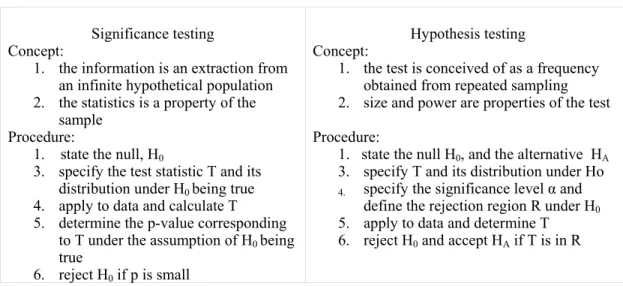
Let me state some of the differences of practical application, as both Fisher and
Neyman-Pearson proposed their concepts (Table 1), before appreciating their rationale.
13
The first book, “Statistical Methods for Research Workers” was initially ignored by the peers but acclaimed by the researchers: “it did not receive a single good review” (Joan Fisher, 1978: 130) and yet it became a bestseller.
Table 1: Fisher and Neyman compared: P-value (Fisher) versus fixed-error probabilities
(Neyman-Pearson) testing
Significance testing Concept:
1. the information is an extraction from an infinite hypothetical population 2. the statistics is a property of the
sample Procedure:
1. state the null, H0
3. specify the test statistic T and its distribution under H0 being true
4. apply to data and calculate T 5. determine the p-value corresponding
to T under the assumption of H0 being
true
6. reject H0 if p is small
Hypothesis testing Concept:
1. the test is conceived of as a frequency obtained from repeated sampling 2. size and power are properties of the test Procedure:
1. state the null H0, and the alternative HA
3. specify T and its distribution under Ho
4. specify the significance level α and
define the rejection region R under H0
5. apply to data and determine T 6. reject H0 and accept HA if T is in R
The application of these methodologies can deliver very different conclusions in some
cases. Berger proposes the following example: suppose {X1… XN} are iid from N(µ, σ)
with known variance, n=10, and we test H0:µ=0 versus HA:µ#0. If z=2,3 (or z=2.9), then
Fisher would report p=0,021 (or p=0,0037) and Neyman, prescribing an error Type I of
0,05, would report α=0,05 in either case (Berger, 2003: 1). Other authors suggest
otherwise that the methods are generally equivalent: “For it turned out that both
methods were mathematically equivalent. The tail area is, for the usual choices of
alternative hypothesis, nothing more than the projections of a rejection region on the
real line, and can be justified on the grounds of avoiding an error of the first kind.
Furthermore, it turns out that many Fisherian choices of a test statistics are equivalent to
a choice of an alternative hypothesis” (Gigerenzer et al., 1989: 99-100). In any case,
either confusion is the result of these alternative presentations of testing, or divergence
in conclusions challenges the rigour and objectivity of statistics, both implications being
highly undesirable.
In spite of the impacts of the cleft on the general perception of the ability of statistical
science, both sides proved to be unrepentant. Indeed, Fisher always rejected the core
concepts of the Neyman-Pearson approach: the notion of error of the second kind, the
idea of repeated samples from the same population and, moreover, the behavioristic
rejection of the null. Alternatively, Neyman argued that Fisher had no logical basis for
the choice of his test statistics and that it did not obey the frequencist criteria.
These divergences are recapitulated below in three sections. The first deals with the
theory of induction and its foundations, while the second evaluates the views on
refutation and confirmation and the third discusses the concepts of models and
experiments. In each case, the cleft is reassessed and the views of both camps are
compared.
The final result of the cleft is yet to be established. Some scholars argue that “At the
formal level Neyman and Pearson seen to have won the battle with Fisher”, in spite of
the fact that econometric practice seems to follow Fisher rather than Neyman and
Pearson: “But how often is the question that an econometrician has to answer a decision
problem in the context of repeated sampling? Fisher’s interpretation of a small P-value
(which follows the tradition of Laplace to K. Pearson), that either something very
unlikely has happened or the null is false, may be more useful in econometric practice”
(Keuzenkamp and Magnus, 1995: 13, 18).
2.1. The first difference: the theory of induction
Probability, as the heart of statistical theory, is since its origins predicated upon a theory
of induction. The success of R.A. Fisher’s methods was precisely based on his
contribution to the definition of statistical induction as a model of scientific inference
itself and in that sense he stood almost alone among his contemporaries. Fisher was
philosophically committed to the Laplacean ambition of a statistical redescription of a
fully deterministic world, and he singled out as one of the few capable of providing the
arguments for this ambitious scientism. The history of Fisher’s adherence to the modern
views on statistical inference is consequently very relevant for this narrative.
In the scholar year of 1912-3, having been granted a studentship in physics, Fisher
dedicated his graduate research in Cambridge to study quantum mechanics with the
physicist James Jeans and the theory of errors with F.J.M. Stratton. As Joan Fisher
summarizes, as a consequence he accepted the divulgation of Heisenberg’s principle of
uncertainty in the 1930s as a natural implication of physics, unlike other scientists
From that time and through his whole life as he was exposed to biological
experimentation and statistical inference, his heroes were the improbable pair of Darwin
and Boltzmann (Depew and Weber, 1996: 246). From Boltzmann, Fisher concluded that
probabilities were an objective feature of the world, unrelated to subjective states of
mind; consequently, statistics should be able to decipher the natural laws and not just to
point out the omnipresence of stochasticity (Depew and Weber 1996: 254, 272).
Boltzmann and quantum mechanics, provided the methods, as Fisher unreluctantly
emphasised: “the whole investigation may be compared to the analytical treatment of
the Theory of Gases, in which it is possible to make the most varied assumptions as to
the accidental circumstances, and even the essential nature of individual molecules, and
yet to develop the general laws as to the behavior of gases” (Fisher, 1922: 321-2).
It is obvious Fisher was conceiving this analytical treatment not as forces in action, but
as the physics of energy, namely fitness being the equivalent to entropy:
It will be noticed that the Fundamental Theorem (…) bears some remarkable
resemblances to the Second Law of Thermodynamics. Both are properties of
populations, or aggregates, true irrespective of the nature of the units which
compose them; both are statistical laws; each requires the constant increase of a
measurable quantity, in the one case the entropy of a physical system and in the
other the fitness (…) of a biological population. (Fisher, 1930: 36-7, my italics)
Fitness, like entropy, was consequently measured as part of a dynamic maximization
process tending to a most probable distribution, its equilibrium (Depew and Weber,
1996: 262). As quantum physics suggests, these measures are supposed to be qualities
of the populations: in that sense, Fisher was the biologist whose propositions were akin
to the Boltzmannian approach. In that he differed from J.B.S. Haldane, who looked for
the modification in one single gene, to be amplified in the population, whereas for
Fisher only the dynamics of arrays of genes in the population mattered.
The concept of population therefore became a cornerstone of the introduction of
2.1.1. The concept of population
The probabilistic revolution entered in biology as the Mendelian reconfiguration of
Darwinism, and Fisher was instrumental to that synthesis. Indeed, after a generation of
heated confrontation between biometricians and Mendelians, a convergence was
obtained, and that was the result of proof via statistics. Evidence shows that, at least for
Fisher, the synthesis in biology incorporated the benefits from an education in quantum
physics, namely in the definition of probability itself. For Fisher, as he stated in an early
statement, biological populations were conceived as an analogy with the populations of
atoms in gas theory, following the approach of the molecular models of statistical
mechanics in order to define variation at the level of Mendelian characters and not at the
level of the phenotypes (Fisher and Stock, 1915).
In this sense, Fisher imposed the notion of data as being drawn from an infinite and
therefore imagined population as the condition for statistical inference from an
experiment:
The object is accomplished by constructing a hypothetical infinite population, of
which the actual data are regarded as constituting a random sample. The law of
distribution of this hypothetical population is specified by relatively few
parameters, which are sufficient to describe it exhaustively in respect of all
qualities under discussion. (Fisher, 1922: 311)
A simple example argues for this notion of an infinite population:
The idea of an infinite hypothetical population is, I believe, implicit in all
statements involving mathematical probability. If, in a Mendelian experiment,
we say that the probability is one half that a mouse born in a certain mating shall
be white, we must conceive of our mouse as one of an infinite population of
mice which might have been produced by that mating. The population must be
infinite for in sampling from a finite population the fact of one mouse being
white would affect the probability of others being white, and this is not in the
hypothesis we wish to consider (…). Being infinite the population is clearly
Both the concept of population and the definition of a model to interpret it fuelled the
main early confrontations between Fisher and the elder Pearson. Karl Pearson strongly
rejected Mendelism, since his radical positivism denied any theoretical entity such as a
gene and favoured instead an acausal and purely descriptive strategy for biology. Yet,
the core of his divergence with Fisher was the definition and model of a population:
“The dispute between Pearson and Fisher centred on how populations should be
characterised with respect to the individuals they comprise” (Morrison, 2002: 62).
Indeed, Fisher’s path-breaking contribution to the synthesis between Mendelism and
Darwinism was precisely the notion of demonstration of natural selection operating in
Mendelian populations, and his analysis of variance was conceived as a determination
of the distinctive genetic and environmental influences.
Karl Pearson strongly opposed to the concept of an infinite population, something his
positivism could not accept in any case; instead, for Fisher, the specification of an
infinite and hypothetical population was the condition to infer the parameters of the
model.15 Consequently, statistics could not live without the concept of the infinite
population. It could not come as a surprise if Fisher bombarded Neyman and the
younger Pearson with the same argument he was so proud to differentiate him from
Karl Pearson since the successful beginning of his career.
As the story unfolded, it became clear that it was due to these essential philosophical
anxieties, namely coherence with the Boltzmannian concepts of probability, that Fisher
opposed Neyman and Pearson about their concept of repeated samples, which was
clearly in contradistinction with his own notion of information as an extraction from a
population.
Although the background in theoretical physics and statistics of this debate was not
invoked by the contenders, it is not without importance. In fact, physics was at the time
of the formation of Fisher’s and Neyman’s approaches evolving from statistical
mechanics (probability being applied to aggregates of elements and systems, measured
as relative frequencies) to quantum mechanics (also extended to the probability of
behaviour of a single element). Furthermore, Maxwell had introduced the ergodic
15
hypothesis, following Boltzmann, considering that a system in equilibrium assumes all
states compatible with the conservation of energy, and promoting as a consequence an
“ensemble approach” studying the population of possible systems distributed over all
states compatible with the observed magnitudes, as Gibbs summarised it. The concept
of population of possible events referred therefore to this epistemic interpretation of
probability as the chance of finding the one event under scrutiny, an interpretation put
forward by Fisher. Working in this frontier of the theory of errors inspired by
Boltzmann and the “ensemble approach”, Fisher felt secured by the coherence of this
approach he was championing in statistical biology.
2.1.2. Laplace between Fisher and Neyman
A peculiar aspect of the “widest cleft” was the vindication of the authority of the fathers
of statistics. Both groups of contenders frequently referred to the work of ancestors in
order to reinforce their points, so that Laplace and Gosset were frequently quoted in
their arguments and counter-arguments. Egon Pearson used a letter by “student”, alias
Gosset, to argue the pertinacity of the tests of hypotheses, but it was about Laplace that
the dispute turned bitter.
Indeed, both sides had strong points. For Fisher, and he was right on that, Neyman and
Pearson had abandoned the Laplacean pretence of a theory of induction, and therefore
of a general method for scientific inference. In fact, Neyman rejected Fisher’s
programme of disproving the null as the basis for inductive inference, and instead
argued for an inductive behaviour using the test of hypothesis as a decision rule (Kruger
et al., 1987: 18; Gigerenzer et al, 1989: 207; Keuzenkamp and Magnus, 1995: 10).
Consequently, Fisher “believed Neyman had mistakenly reinterpreted his tests of
significance in terms of acceptance procedures, an ideological point of view that valued
expediency over truth” (Gigerenzer et al, ibid.: 104).
The direct probability statement produced by Fisher was challenged by Neyman and
Pearson, who preferred a model of decision, an acceptance procedure that was part of
the behaviouristic approach they preached for statistics. In that sense, they abandoned
Nevertheless, Neyman and Pearson considered that this was the price for fidelity, since
a pure frequencist approach ought to sacrifice the philosophical pretence to the
statistical convenience. The repeated sampling approach, according to them a condition
to interpret the tests of hypotheses as probability statements, was considered to be the
rationale for statistical decision: “Without consideration of hypotheses alternative to the
one under test and without the study of probabilities of errors of the two kinds, no
purely probabilistic theory of tests is possible” (Neyman, 1956: 288). In fact, Neyman –
who was obviously the leading theoricist of this cooperation with Pearson – accused
Fisher of subjectivism given his supposition of a hypothetical population, and
furthermore suspected Fisher of abandoning a strict frequencist attitude for the sake of
his design of scientific inference, and in that he was right. And so he could turn the
accusation and vindicate Laplace: since Fisher denounced Neyman, Pearson, Wald and
Bartlett “allegedly based on an attitude identifying ordinary research with industrial
acceptance sampling”, i.e. on the basis of the repeated sampling interpretation, Neyman
could present a quotation from Laplace sustaining his views on that topic (ibid.: 293).16
Apart from this dispute on the borrowed credibility of a respected founder of statistics,
the reference to Laplace highlights other difficulties shared by both Fisher and Neyman.
The first is related to the nature of the frequencist view. Indeed, although both the
behaviouristic and the inductive model of inference were relative to an imaginary
framework – since Fisher’s population was as imaginary as Neyman’s repeated
sampling procedure17 – Fisher could claim his method led to a direct probability
statement, since his test was a property of the sample, whereas the operational concepts
of size and power defined by Neyman and Pearson were conditional on the test itself.18
16
Hacking supports Neyman’s claim on the precedence of Laplace in the theory of hypothesis testing, given his emphasis on the importance of a rival hypothesis, and argues that Fisher “was wrong in this respect” (Hacking, 1964: 16).
17
Fisher denounced the “fallacious approach to tests of significance introduced by Neyman and Pearson, and usually expressed in such phrases as, ‘the frequency found in repeated samples from the same population’. (…) I have only realised recently (…) to what extent Neyman and Pearson’s approach, including this question of ‘repeated samples from the same population’, is due to their thinking of a test of significance as though it were a kind of acceptance procedure in which the repeated samples have an objective reality, and are not, as they are with tests of significance, constructs of the statistician’s imagination” (Fisher to H.F. Smith, 27 August 1954).
18
From that Fisher concluded that “in the end Neyman denies the possibility of making
any probability statement about the natural facts behind the observations”.19
The second difficulty is related to the very concept of probability. It is obvious Fisher
was unease with the limiting frequency interpretation of probability, since it supports no
proposition on a specific fact, for instance it allows for no statement of probability of a
particular throw of dice (Seidenfeld, 1979: 71). Fisher argued that probability
statements are only a peculiar class of strictly mathematical specifications, not to be
generalised to all cases of inference from observations:
From my point of view the important point is that the original concept of
probability is not adequate to specify the nature of uncertainty inherent in many
forms of inference from observations. From this point of view it is almost
unfortunate that a group of cases has been found in which inductive inference
may properly be expressed in terms of probability, using the fiducial mode of
argument; for this has tempted some mathematicians, and will, I fear, tempt
more, to imagine that this type of argument is more widely applicable than is
really the case, and to avoid enlarging their imagination sufficiently to grasp the
cases where no probability statement is adequate. This is, in my view, a decisive
reason against enlarging the meaning of the theory of probability so as to cover
all types of inductive inference, since the word ‘probability’ must be tied closely
to one quite defined mathematical concept.” (Fisher to A.C. Aitken, 23 January
1936)
This view he maintained through all his life work:
I have reiterated repeatedly that the concept of mathematical probability is
inadequate to express the nature and extent of our uncertainty in the face of
certain types of observational material, while in all cases the concept of
mathematical likelihood will supply very helpful guidance, if we are prepared to
repeatedly, and has ‘no objective reality, being exclusively the product of the statistician’s imagination’” (Gigerenzer et al, 1989: 103). Moreover, “In place of what Neyman and Pearson saw as Fisher’s quasi-Bayesian view that the exact level of significance somehow measures the discordance of data with the null hypothesis, their interpretation of statistical inference was a purely behavioristic one that refrained from any epistemic interpretation. The concept of size and power apply to a test, whereas Fisher’s significance level is a property of the sample” (ibid.).
give up our irrational urge to express ourselves only in terms of mathematical
probability. (Fisher to D.J. Finney, 14 September 1954)
This profound scepticism perplexed many of his contemporaries. Jeffreys, a leading
Bayesian, questioned Fisher on the generalisation of probability statements,20 and E.B.
Wilson was tutored on the relevance of Keynes’s concept of “the degree of rational
belief” for those cases “from which no statement of probability can be derived”.21 The
reason for this attitude was not mistrust in statistics but, on the contrary, a commitment
to the role statistics should play as a rigorous instrument for scientific inference. This
was precisely the reason for imposing the experimental nature of the probability
statements:
In the first place you seem to express surprise at my belief that ‘statements of
probability can be verified by observational frequencies’. It would have been
more explicit had I said ‘statements of probability in the Natural Sciences’ or
‘statements of probability referring to the real world’ (…). In the second place
you do not seem to grasp the central characteristic of the concept of
mathematical probability, namely that it enables a statement of uncertainty to be
made with rigorous exactitude. This requires a specification not only of what is
known, or can be validly asserted on the data, but also of what is unknown, in
order that the probability statement should be distinguishable from a statement
of certainty. (Fisher to J. Tukey, 18 July 1955)
Of course, these observational frequencies obtained from investigation in natural
sciences did not apply, according to Fisher, to the tests of hypotheses as suggested by
20
When Jeffreys questioned him, since “I cannot follow your objection to the generalization to all probabilities of the laws of probability obtained for samples” (H. Jeffreys to Fisher, 24 February 1934), Fisher retorted: “I do not object to the generalization to all probabilities of the laws appropriate to the games of chance, but I do think, and indeed claim to have shown, that there are also logical situations in which a rigorous statement of the nature of uncertainty in our uncertain inferences is expressible not in terms of probability, but in terms of likelihood, a quantity which does not obey to these laws” (Fisher to Jeffreys, 26 February 1934).
21
Neyman and Pearson: “The absence of reference to experience seems to me a serious
flaw in their work”.22
2.1.3. Fisher’s criticism of Neyman’s and Pearson’s theory of hypotheses
testing
Fisher conceived statistical research as the production of a direct probability statement
for the limited class of cases for which that would be possible. The statement refers to
the determination of the p-value, the test statistics being compared to its known
distribution under Ho being true, and attributing to the researcher a decision on rejection
or acceptance based upon experience (Fisher, 1922). Although Fisher loudly prevented
the misinterpretation of p-values as error probabilities – as the obtained value of p is a
function of a single data set –, Neyman criticised this approach as a violation of the
frequencist principle and, at least at first, he conceived his own effort as an attempt to
correct and extend this method to the choice of an efficient test based on a precise
axiomatic and allowing for an objective protocol of acceptance or rejection.23 But it
soon became obvious that both Fisher and Neyman understood the divergence
separating their investigations and theoretical foundations. Jeffreys, on the other hand,
sharply rejected the use of p-values, arguing that a true hypothesis could eventually be
rejected for not predicting values not having occurred (Jeffreys, 1961).
On the other hand, for Fisher, the Neyman-Pearson technology was unsound essentially
given that the level of significance could not be defined as a relative frequency of
repeated sampling from the same population: as his biographer stated, “the sampling
property of confidence intervals (…) says nothing at all about the probability of θ given
the result of the one particular sample of data actually obtained” (Joan Fisher, 1978:
451). Three reasons contributed to this denial. First, there is no opportunity for repeated
sampling, because the values of the ancillary statistics cannot be fixed from one sample
to the other simply given the fact that the population – or the reference set – changes
from sample to sample. Second, the evidence against the null does not necessarily
22 Fisher to C.I. Bliss, 6 October 1938.
23
match the relative frequency with which that p-value is attained (Johnstone, 1987:
492).24 Third, Fisher pointed out a logical difficulty: if the true hypothesis is
unspecifiable, it is immaterial to define the error of the second kind relative to the
alternative hypothesis. Consequently, the sampling approach fails:
There is a great deal in the approach chosen by Neyman and Pearson that I
disagree with, but so far it seems to have led to nothing more than the conclusion
that the tests of significance which I and those who agree with me had
previously put forward were the best possible for their purposes (…). It is
however, in my opinion, a pity that these writers have introduced the concept of
‘errors of the second kind’, i.e. of accepting an hypothesis when it is false,
seeing that until the true hypothesis is specified, such errors are undefined both
in magnitude and in frequency. (Fisher to Deming, 19 September 1935)
For Fisher, the null hypothesis simply cannot be considered true only because it failed
to be contradicted, and the notion of the error of the second kind is incomputable
whenever it depends on an unknown alternative.
Furthermore, Fisher strongly favoured applied research against mathematical
abstractions and, namely, he rejected statistics to be part of deductive reasoning. In this
he differed from Neyman: “Fisher was a research scientist using mathematical skills,
Neyman a mathematician applying mathematical concepts to experimentation” (Joan
Fisher, 1978: 265).
Other authors developed this discussion, suggesting that the logical mode of reasoning
implied in Neyman’s and Pearson’s approach leads to the fallacy of denying the
consequent, since obtaining atypical data under a certain hypothesis is no proof of the
falsity of that hypothesis. Otherwise, the significance test under the null is not enough
evidence for the hypothesis.
The notions of size and power became the focus of much attention. Gill suggests they
are contradictory: “Note that α and β are probabilities conditional on two mutually
exclusive events: α is conditional on the null hypothesis being true, and β is conditional
on the null hypothesis being false” (Gill, 1999: 651), whereas Spielman recapitulates an
example by Neyman to argue that these concepts may be misleading and concurring to
wrong decisions, and are therefore irrelevant as decision tools (Spielman, 1973: 202,
215). Consequently, these authors support Fisher's rejection of the Neyman-Pearson
approach as unsuited for a theory of inference (Seidenfeld, 1979: 47).
Nevertheless, when he had presented his own alternative to Bayesian inverse
probability, Fisher defined a confidence interval approach as part of the concept of
fiducial probability.25 In the early 1930s, most statisticians regarded fiducial probability
and Neyman’s confidence intervals as synonymous (Zabell, 1992: 371-3). Bartlett, a
supporter of the Neymanian approach, argued that fiducial intervals are a particular case
of confidence intervals, under a frequencist interpretation (Bartlett, 1965: 395). It is
certainly obvious that afterwards, for polemic reasons as well as for deep convictions on
the nature of statistics, Fisher rejected both the confidence intervals approach and its
theoretical assumptions on the nature of frequencism, since evidence from the data
should not be confused with a limit of actual frequencies but should be thought of as a
frequency from the imagined population as well as a measure of rational belief. In this
sense, the difference opposing Fisher and Neyman stood as philosophical questions on
the essence of statistical inference. Whereas for Neyman probability was defined as the
“idealization of long-run frequency in a long sequence of repetitions under constant
conditions” (Lehmann, 1993: 1245), for Fisher the concept was ambiguous.
Furthermore, for practical purposes, Fisher generally opposed the choice of fixed levels
of significance for a decision procedure, therefore transformed into acceptance rules, a
notion Pearson attributed to Neyman (Lehmann, 1993: 1244).
These differences opposing both camps confronted the inductive behaviour, solely
based on deduction and theory of probability, against inductive inference, respectively
championed by Neyman and by Fisher.
25
2.2. The second difference: statistics as a tool for refutation
The value of statistical propositions has always been a mystery for a number of
prestigious scientists. That was certainly the case in the period of emergence of statistics
as the science of measurement and inference. One curious instance of that perplexity is
the refrain of the song the director of Rothamstead wrote for the Christmas party of
1928:
“Statistics, you see, is a wondrous cult For a non-mathematical mind,
Which wants but the final, or end result – As to how its attained is quite blind”
The paradox in this blind process of a wondrous cult, the song went, was the importance
of the error, a bizarre event only someone versed in statistics would be able to tame: as
another verse assured, “Fisher can always allow for it” (Joan Fisher, 1978: 138-9). What
to make of statements proved by error was in any case a matter of dispute among
statisticians.
Indeed, if the first difference between Fisher and Neyman-Pearson concerns the logic of
inference, the second is complementary if not derived from that and concerns the very
nature of the statistical propositions. What they discussed was not at all trivial, since it
provided an anticipation of the crucial confrontations in the twentieth-century
epistemology on the nature of inference.
When it came to rationalize the practice of statistics, the Hypothetico-Deductive model
was offered as a norm: it establishes a set of hypotheses and deduces a prediction out of
them in order to be tested against the facts, asking then for confirmation (propounded by
the Vienna Circle and Carnap) or, as it became the accepted view, for refutation (as
suggested by Karl Popper). A disciple of Popper, Imre Lakatos, praised Neyman’s and
Pearson’s test of hypothesis as “rest[ing] completely on methodological
falsificationism” (Lakatos, 1978: 25), although the fact is that they developed their
methodology independently and previously to Popper. Others emphasise, more
rigorously, that the Fisherian test of significance is closer to Popperian falsificationism,
in this case the concept was established well before Popper published his 1935 magnum
opus.26
In fact, Fisher used the principle of refutation as an argument against his opponents,
although he was at times ambiguous on the value of confirmation. What in any case it
obvious is that Neyman fully endorsed a logic of confirmation, which was embedded in
the choice of the most powerful test and in the concept of test of alternatives since “the
numerical values of probabilities of errors of the second kind are most useful for
deciding whether or not the failure of a test to reject a given hypothesis could be
interpreted as any sort of ‘confirmation’ of this hypothesis” (Neyman, 1956: 290).
Therefore, Neyman’s approach is alien to Popperianism, which would question the
mechanics of acceptance of whatever alternative hypothesis as a consequence of the
rejection of the null.
Fisher rejected this approach: typically, he argued that “every experiment may be said
to exist only to give the facts a chance of disproving the null hypothesis” (Fisher, 1935:
16). This radical claim was reiterated by Fisher on several occasions. One of such was a
debate in the pages of Nature with the aged Karl Pearson, which was ignited by a letter
by an applied scientist, John Buchanan-Wollaston, on the irrelevance of tests.
Buchanan-Wollaston argued that one cannot test simultaneously “untruth on one
hypothesis and the truth of the reverse hypothesis” (Inman, 1994: 3), and Fisher used
the opportunity to tackle the Neyman-Pearson approach:
It would, therefore, add greatly to the clarity with which the tests of significance
are regarded if it were generally understood that tests of significance, when used
accurately, are capable of rejecting or invalidating hypotheses, in so far as these
are contradicted by the data; but that they are never capable of establishing them
as certainly true. In fact the ‘errors of the second kind’ are committed only by
those who misunderstood the nature and application of tests of significance.
(quoted in Inman, 1994: 5)
Karl Pearson was also totally at odds with his son Egon, since his positivism radically
prevented the acceptance of any claim of truth related to the hypothesis. In that he was
followed by Fisher: not rejecting the null does not establish its truth. But Karl Pearson
was more radical than Fisher, since he considered that even rejection was restricted to
the strange case of zero probability: “There is only one case in which a hypothesis can
be definitely rejected, namely when its probability is zero” (quoted in Inman, 1994: 7).
Therefore, except in this case, anything goes.
In this polemics with Neyman and Egon Pearson via Karl Pearson, R.A. Fisher attacked
another assumption of the strategy of tests of hypotheses, its sampling interpretation, the
condition for an acceptance procedure in a decision framework. Instead, Fisher
proposed a nonsampling interpretation of the level of significance: the determination of
a level of 0.05 does not imply that the investigator will be deceived once in twenty
occasions.
The different interpretations of the meaning of a significance level opposed Fisher
(interpreting the result as that of an individual test rather than of sequences of tests) and
Neyman-Pearson (establishing the size and power of the test as derived from a series of
similar tests). Furthermore, since the population is imaginary, the provisional
conclusion is referred to the test and not to reality itself. In that, he distanced from
Popper, who asked for refutation grounded on experimental evidence for a realistic
conclusion. For Fisher, the whole procedure was only a matter of scientific attitude:
What is particularly troublesome is that Neyman, in importing from Eastern
Europe his misconceptions as to the nature of scientific research, should have
chosen so ubiquitous a scientific tool as the test of significance as the subject on
which to fasten ideas relevant only to the acceptance procedure. A typical test of
significance is based on a probability statement derived from the hypothesis to
be tested, and therefore existing only in the hypothetical world created by this
hypothesis. Typically it leads to no probability statement in the real world, but to
a change in the investigator’s attitude towards the hypothesis under
consideration, for which if we choose to use the word ‘rejection’ we must
remember that the rejection is only provisional, and that our hypothetical
calculations have shown that there would be a finite probability of our obtaining
the observed level of significance even were the hypothesis true.” (Fisher to N.
Contradictorily and in certain occasions, Fisher indulged in the acceptance of a
provisional confirmation: “if the observations are such that with reasonable probability
they might have arisen on the hypothesis under test, this hypothesis, though not proved,
has at least so far been confirmed, and, pending further and more stringent observations,
may be accepted” (Fisher, 1951: 36-7).
Refuting or provisionally accepting the hypothesis, Fisher’s approach established that “a
significance test does not permit one to assign any specific degree of probability to the
hypothesis” and that only in specific cases can the uncertainty of the hypothesis be
expressed in probabilistic terms (Gigerenzer et al 1989: 93). In this framework, the test
of significance tests the null for plausibility, measuring the deviations of observations,
even if it is an unsettled question to know “if a significance level is a meaningful
measure for discrepancy” (ibid.: 94). This is why Fisher adhered to the Keynesian
notion of the “degree of rational belief” as a condition for inference in those cases in
which no statement of frequencist probability could be derived: finally and in general, it
would be up to the researcher, considering his knowledge and wisdom, to formulate his
own intuition on the statistical evidence from the experiment, and no technology could
substitute the experience of the experimenter.
2.3. The third difference: the concept of model and experiment
The notion of a statistical model was introduced by Fisher in 1922, with the paper “On
the Mathematical Foundations of Theoretical Statistics”. It refined the concept of
variables and parameters and established the distinction between sample and population,
defining the hypothetical infinite population. The subsequent work on statistics built on
these definitions.
Neyman and Pearson initially shared this definition of the model, although suggesting a
confirmationist interpretation of the results of the test:
A model is a set of invented assumptions regarding invented entities such that, if
one treats these invented entities as representations of appropriate elements of
the phenomena studied, the consequences of the hypotheses constituting the
degree of conformity appears to us satisfactory, then we consider the model an
adequate model. (Neyman, 1957: 8)
What differenced Neyman and Fisher on the function of the model was the eventual
incorporation of a decision framework as part of the definition of the test itself. For
Neyman, the description of the model was reinterpreted in a behaviouristic framework
and hypothesis testing was therefore part of a reiterated process, similar to quality
control sampling, in order to establish the optimal procedure. In that sense, for Neyman
the logic of inference emancipated from the notion of the hypothetical population
(Lenhard, 2006).
Fisher rejected this concept of a behaviouristic approach to modelling and considered it
was a consequence of alienation from the practical needs of applied research and
explained the suport gained by Neyman: “I do not of course say, or, I hope, seem to
imply, that in all mathematical departments the Neyman fog has settled in, but that it
has settled in only in those departments which are insulated from practical research in
the Natural Sciences” (Fisher to Barnard, 8 May 1961). Instead, he favoured a common
sense approach to decision in testing:
I am a little sorry that you have been worrying yourself at all with that
unnecessary portentous approach to tests of significance represented by the
Neyman and Pearson critical regions, etc. In fact, I and my pupils through the
world would never think of using them. If I am asked to give an explicit reason
for this I should say they approach the problem entirely from the wrong end, i.e.
not from the point of view of a research worker, with a basis of well grounded
knowledge on which a very fluctuating population of conjectures and incoherent
observations is continually under examination. What he needs is a confident
answer to the question ‘Ought I to take notice of that?’. This question can, of
course, and for refinement of thought should, be framed as ‘Is this particular
hypothesis overthrown, and if so at what level of significance, by this particular
body of observations?’. It can be put in this form unequivocally only because the
genuine experimenter already has the answers to all the questions that the
followers of Neyman and Pearson attempt, I think vainly, to answer by merely
2.4. Hybridization
The final result of the widest cleft is to be established. What is certainly obvious is that
the quarrel is essentially ignored in contemporary statistical theorising and that the
practical workers indistinctively apply tools derived from one or the other of the
contending camps, for instance the notion of the power of the test and that of
significance. As Keuzenkamp and Magnus refer in relation to econometrics:
Testing hypotheses belongs to the basic pastimes of econometricians. It is a
compulsory topic in any course in introductory statistics and econometrics. In
such a course, students are made familiar with notions like Type I and Type II
errors, significance levels, and power. This is firmly in the tradition of statistical
testing along the lines proposed by Jerzy Neyman and Egon Pearson. However,
econometric practice seems closer to the approach of Sir R.A. Fisher, although
he is rarely mentioned (apart from references to the F-test). (Keuzenkamp and
Magnus, 1995: 6)
This is the result of what Gigerenzer and his co-authors named hybridization, the
synthesis established in spite of the cleft and reconciling the points of view the original
authors considered irreconcilable (Gigerenzer et al., 1989: 106 f.). Hybridization is a
strategy of maximizing the benefits from both approaches, considering
Neyman-Pearson’s more suited for evaluation of the costs of alternative options, but less suited
for scientific inference. Consequently, hybridization suggests a forest of interpretative
deviations: “The researcher must specify the level of significance before conducting the
experiment (following Neyman and Pearson rather than Fisher); he must not draw
conclusions from a non-significant result (following Fisher’s writings, but not
Neyman-Pearson); and so on. Neyman’s behavioristic interpretation did not become part of the
hybrid, and Type I and Type II errors are given an epistemic interpretation. This has led
to an enormous confusion about the meaning of a significance level” (ibid.: 107).
Confusion and personal bias, since, furthermore, it is accepted that all statistical
alternatives require doubtful choices tainted with subjectivism: Fisher arbitrarily
chooses the model and the test, Neyman and Pearson the class of hypotheses and the
As a consequence, hybridization evolved to several attempts to correct subjectivism
through the establishment of rigid protocols in testing. Berger suggested a conditional
error probabilities approach, following Fisher rather than Neyman (Berger, 2003), and
Lenhard suggested John Tukey’s exploratory data analysis as a convenient synthesis
(Lenhard, 2006). Lehmann, a disciple of Neyman, also battled for a unified approach,
suggesting avoiding the omission of power (in Fisher’s strategy) and the omission of
conditioning (in Neyman-Pearson’s; Lehmann, 1993: 1247). None of these was
imposed as the authoritative synthesis in statistics and, as a consequence, hybridization
remains an open menu for statisticians.
3. Conclusion
Modern statistics went through many great advancements: the extension of probability
from games of chance to the concept of measurement and the further extension to the
concept of nature itself. As a consequence, by the end of the nineteenth century
statistics was reshaped by biology, engaged as it was in modelling variation and not so
much in reducing error (Gigerenzer et al, 1989: 68). Karl Pearson and Ronald A. Fisher
emerged as the constructors of modern statistics as they were both experimentally and
theoretically involved in the explanation of variation, first under biometrics and then
under the statistical exploration in the Darwin-Mendel synthesis.
The empirical foundation of biology favoured the adoption of a frequencist approach,
but it was inside this camp that the wildest cleft developed opposing Fisherian tests of
significance and concept of likelihood to the Neyman-Pearson theory of tests of
hypotheses. The cleft distinguished between concepts of probability, concepts of sample
and population, concepts of inference and as consequence the concepts of the tests
themselves. Both contenders clearly defined their theories in the field they proceeded
from: for Fisher, postulating an infinite hypothetical population was trivial, since the
extraction of a small sample of biological entities was not supposed to change the nature
of the population, whereas for the mathematically abstract entities defined by Neyman
the probability could be conceived of as the frequency of successive sample extractions
For economists, instead, none of the concepts apply trivially and that was the reason for
so much resistance and miscomprehension. For in any realistic economic context,
repeated extractions are not independent given time-dependency and, furthermore, there
is not a stable population through time given structural change. Haavelmo addressed
this problem suggesting a meta-historical view of a supra-population of “histories”, and
read this as the incorporation of the repeated sampling approach in order to sustain the
applicability of Neyman-Pearson’s theory. In this sense, he hybridized the available but
contradictory theories in statistics.
The consequence was that economic variables were themselves to be reconsidered as
stochastic processes, if this narrative were coherent. But the price for this is high
enough and it was not unperceived by the contemporary economists, since this requires
the abandonment of strict determinism: economics could not any more be written as the
exploration in mechanical determination, in finding laws of behaviour and of action and
consequence, but should instead consist in the description of laws of distribution and the
determination of probabilities derived from them. It does not come as a surprise that this
was accepted in words but not practiced in deeds.
References
Arrow, K. (1978), “Jacob Marschak”, Challenge, March-April, 69-71
Bartlett, M.S. (1965), “R.A. Fisher and the Last Fifty Years of Statistical
Methodology”, Journal of the American Statistical Association, 60(310): 395-409
Berger, J. (2003), “Could Fisher, Jeffreys and Neyman Have Agreed on Testing?”,
Statistical Science, 18(1): 1-32
Bjerkholt, O. (2007), “Writing ‘The Probability Approach’ with Nowhere to Go: Haavelmo in the United States, 1939-1944”, Econometric Theory, 23: 775-837
Davidson, D. and Marschak, J. (1959), “Experimental Tests of a Stochastic Decision Theory”, in Churchman, C.W., Ratoosh, P. (eds.), Measurement: Definitions and Theories, New York: Wiley. 233-69, also Cowles Foundation Paper 137
Depew, D. and Weber, B. (1996), Darwinism Evolving – Systems Dynamics and the Genealogy of Natural Selection, Cambridge, Mass.: Bradford
Ezekiel, M. (1928), “Statistical Analyses and the ‘Laws’ of Prices”, Quarterly Journal of Economics, 42: 199-227