HAREM: An Advanced NER Evaluation Contest for Portuguese
Diana Santos
∗, Nuno Seco
†, Nuno Cardoso
‡and Rui Vilela
⊕Linguateca: nodes of∗Oslo,†Coimbra,‡XLDB in Lisbon, and⊕Braga
[email protected], [email protected], [email protected], [email protected]
Abstract
In this paper we provide an overview of the first evaluation contest for named entity recognition in Portuguese, HAREM, which features several original traits and provided the first state of the art for the field in Portuguese, as well as a public-domain evaluation architecture.
1.
Introduction
Although there is a wide awareness of NER evaluation after the MUC conferences (Hirschman, 1998), there were sev-eral points that could be improved in the evaluation setup of (Grishman and Sundheim, 1996). After all, the NE task was inspired as a follow-up of an information extraction task about a particular kind of events, and there is more to NER than that, if we take the position, as (Romacker and Hahn, 2000) do, that NER is a subtask of semantic inter-pretation.
HAREM1was organized by Linguateca and had 10 partic-ipants from 6 different countries, who submitted 15 runs (plus 6 non-official ones, i.e. sent after the deadline). Roughly, the participants had 48 hours to tag a large and varied collection (the HAREM collection with 1202 doc-uments (over 466,000 words) from 8 different genres and several varieties of Portuguese), of which a smaller part (the HAREM golden collection, described in section 3) had been manually handcoded by the organization, according to detailed guidelines discussed with the participants, who also provided some initial annotation effort.
HAREM features several innovative traits, which we de-scribe in more detail below:
• Separation between properly identifying (or detecting,
or flagging) and classifying NEs;
• Introduction of a morphological task, given that the
“same” NE may represent different things in a differ-ent gender or number;
• Taking into account vagueness and indeterminacy,
both while building the golden resource and when evaluating the systems;
• Allowing the choice of a subset of semantic categories
for evaluation, i.e. a kind of partial ontology mor-phism;
• Definition of several measures to reflect subtle
distinc-tions, such as partial overlap, overgeneration, and dis-tinguishing assignment of minor type vs. major type;
• Providing meta-information associated with the texts,
to allow investigation on genre and Portuguese variety.
1HAREM stands for “HAREM - Avaliac¸˜ao de sistemas de
Reconhecimento de Entidades Mencionadas”.
As a result of the first HAREM evaluation contest (avail-able from http://www.linguateca.pt/HAREM/), we can present:
• a fully documented modular architecture, whose
source code is available under GPL;
• a valuable resource for the deployment of further
sys-tems in this area, the golden collection (GC), also use-ful to conduct research on the problem and on the evaluation methodology, as in Morfolimp´ıadas (San-tos and Barreiro, 2004; San(San-tos et al., 2003);
• a first state of the art for Portuguese.
As a less objective – but not less rewarding – result of our work with HAREM, we can report on the emergence of an active community dealing with NER for Portuguese. This paper starts by describing the evaluation architecture, then the resources and finally sketches possible future de-velopments in Portuguese NER.
2.
The Evaluation Setup
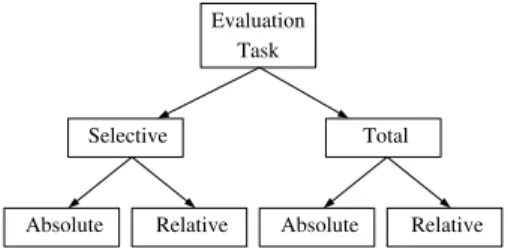
Evaluation in HAREM was divided into three tasks, each capturing different aspects of the NER problem, namely (i) identification; (ii) semantic classification; and (iii) morpho-logical classification. Participating systems were, in addi-tion, allowed to choose a subset of the categories in which they wanted to be evaluated. By allowing a selective par-ticipation, systems which were fine tuned for certain pur-poses could be evaluated accordingly, making their scores increasingly relevant to their designers. As such, for each submitted run, we analyzed two different scenarios:
total Taking into account all categories defined in
HAREM.
selective Taking into account a subset of the categories,
namely those which the system is tuned to recognize. Another important aspect of our evaluation framework is that we distinguish between two types of evaluation:
absolute Taking into account all entities in the GC and all
the NEs identified by the system.
relative Taking into account only the NEs that were
re-garded as correct and partially correct in the identifi-cation task.
Figure 1: Evaluation configurations
In other words, absolute evaluation considers missing and spurious NEs, whereas relative evaluation does not. Figure 1 visually sums up the evaluation combinations. For com-parison purposes, let us state that MUC only dealt with a total absolute combination.
2.1. Entity Alignment
Before delving into the details of evaluating each task, we must first explain how we achieve accurate alignment of the entities tagged by the system (the target NEs henceforth) with the entities manually tagged (the source NEs hence-forth) in the GC. Alignment of target and source NEs is a crucial task and heavily influences the caliber of the results, as is convincingly argued by (Kehler et al., 2001).
The alignment procedure was particularly difficult in our case, since many of the participating systems modified the texts that they were only supposed to tag. In other con-tests, these systems would probably have been disqualified and their submission ignored, but in HAREM we tried to salvage these submissions by implementing a robust entity aligner that could cope with these issues.
In order for the reader to get a better grasp of the problem at hand, consider the two documents of figure 2, depicting the same text in the GC and as classified by a system. Several differences become immediately apparent. In the submitted text, contractions were “expanded” (DA,DOand
PELA were replaced by DE A, DE O and POR A, respec-tively). Spaces were introduced between non-alphanumeric and alphanumeric characters; one particular numerical to-ken (1937) was split. Some systems introduced preceding backslash (\) before some characters (e.g. 01\/01\/1997),
others ignored (and consistently tagged as normal text) meta-information such as genre and variety, provided by the organization.
These and many other modifications to the original text – we gathered a list of about 80 different types of intrusive modifications – made the alignment process quite hard. A naive approach trying to map words (tokens) in equal posi-tions of both texts would be deemed to fail. We had, there-fore, to design software that could deal with this in a robust fashion. The main idea underlying our approach was to
concentrate on the strings classified as source NEs, and find them in the systems’ outputs. This means we can
ig-nore all words/tokens in the texts except for those that are part of source NEs.2
We have in addition to take into consideration the order-ing of the tokens: we need to guarantee that the first
oc-2
This statement is not entirely true, as we will need to consider the tokens that belong to target NEs in order to determine spurious NEs, but this is a relatively straightforward step.
currence of a source token aligns with the first occurrence of the same token in the target text. This requirement is achieved by numbering each occurrence of a particular to-ken; see figure 3 for illustration. Considering the text given in figure 3, all tokens relevant to the alignment process are:
ST = {<1>DCC</1>, <2>DCC</2>, <3>DCC</3>,
<1>Departamento</1>, <1>Cultura</1>, <1>Cient´ıfica</1>, <1>Centro</1>, <1>Acadˆemico</1>, <1>Pedro</1>,
<1>Nunes</1>, <1>CAPB</1>, <1>UNIFESP</1>, <1>EPM</1>, <1>1</1>, <1>9</1>, <1>3</1>, <1>7</1>}.
Note that the year 1937 was tokenized into four tokens in order to deal with faulty submissions that split numerical entities (dates, numbers, ...) during the tagging process. The same numbering scheme (considering the same tokens) can then be applied to the target text. By doing so we uniquely identify each token, facilitating the alignment pro-cess. Alignment is now a question of mapping identical tokens from each text to each other. The elements of the setST represent the tokens that we have to identify in the
target NEs.3
By aligning tokens we may trivially derive the NE align-ments simply by considering that the alignment of a
source token with a target token entails (some) align-ment of the NEs (source and target) to which the tokens belong. Applying the above rule and numbering scheme
allows us to infer, for the texts in figure 2, the alignments depicted in figure 4.
NEs alignments are obviously not always perfect one-to-one mappings. Rather, we have to deal with the following five different cases: one to one, many to one, one to many, none to one (the system has incorrectly identified a (spuri-ous) NE), and one to none (one source NE has been missed by the system).
2.2. Identification
The identification task aimed at evaluating systems with respect to their ability to correctly limit the bounds of a named entity, irrespective of its semantic or
morpholog-ical classification. We consider five different scores for
every pairing of source and target NEs:
Correct if all tokens correctly match (except for the above
mentioned stopwords)
Partially correct by Excess if at least one token matches
with a token belonging to a source entity, but the target entity has an equal or greater number of tokens than the source entity.
Partially correct by Shortage if at least one token matches with a token belonging to a source entity, but the target entity has a smaller number of tokens than the source entity.
Spurious if the target entity has no counterpart in the GC. Missing if the source entity has no corresponding target
entity, i.e., the particular GC entity has not been iden-tified by the system.
3
Because most changes occurred in contractions and other grammatical words, we created a stopword list of tokens which we ignore in the alignment process.
HIST´ORICO Esta sec¸˜ao traz de volta um pouco da longa hist´oria do <ORGANIZACAO TIPO="SUB"
MORF="M,S">DCC</ORGANIZACAO>. O <ORGANIZACAO TIPO="SUB" MORF="M,S">DCC</ORGANIZACAO> - <ORGANIZACAO TIPO="SUB" 5 MORF="M,S">Departamento de Cultura Cient´ıfica do Centro
Acadˆemico Pedro Nunes </ORGANIZACAO> (<ORGANIZACAO TIPO="SUB" MORF="M,S">DCC/CAPB</ORGANIZACAO>), ´org˜ao respons´avel pela representac¸˜ao e encaminhamento cient´ıfico dos alunos da
10 <ORGANIZACAO TIPO="INSTITUICAO" MORF="F,S">UNIFESP/EPM </ORGANIZACAO>, fundado em <TEMPO TIPO="DATA">1937 </TEMPO>, atua junto aos alunos promovendo v´arios cursos extracurri-culares, palestras, conferˆencias e discuss˜oes de interesse `a ´area m´edica.
→
HIST´ORICO Esta sec¸˜ao traz de volta um pouco de a longa hist´oria de o <ORGANIZACAO TIPO="SUB"
MORF="M,S">DCC</ORGANIZACAO> . O <ORGANIZACAO TIPO="SUB" MORF="M,S">DCC - Departamento de Cultura</ORGANIZACAO> 5 <ORGANIZACAO TIPO="SUB" MORF="M,S">Cient´ıfica de o
Centro Acadˆemico Pedro Nunes </ORGANIZACAO> ( DCC / CAPB) , ´org˜ao respons´avel
por a representac¸˜ao e
encaminhamento cient´ıfico de os alunos de a 10 UNIFESP / EPM , fundado em
19<TEMPO TIPO="DATA">37</TEMPO>,
atua junto aos alunos promovendo v´arios cursos
extracurri-culares,palestras, conferˆencias e discuss˜oes de interesse `a ´area m´edica .
Figure 2: The same document in the golden collection (to the left) and tagged by a system (to the right).
HIST´ORICO Esta sec¸˜ao traz de volta um pouco da longa hist´oria do <ORGANIZACAO TIPO="SUB" MORF="M,S"><1>DCC</1> </ORGANIZACAO>. O <ORGANIZACAO TIPO="SUB" MORF="M,S"><2>DCC</2></ORGANIZACAO>-<ORGANIZACAO TIPO="SUB" MORF="M,S"> <1>Departamento</1> de <1>Cultura</1> <1>Cient´ıfica</1> do <1>Centro</1> <1>Acadˆemico</1> <1>Pedro</1> <1>Nunes</1>
</ORGANIZACAO> (<ORGANIZACAO TIPO="SUB" MORF="M,S"><3>DCC</3>/<1>CAPB</1></ORGANIZACAO>), ´org˜ao respons´avel pela
Figure 3: The previous document with all tokens inside NE’s duly numbered. In the case of partial identifications we associate a weight
to these entities that reflects their contribution to the overall score. The weight is calculated according to equation:
0.5 ∗ (nc/nd) (1)
wherenc and nd correspond to the number of common
to-kens and the number of distinct toto-kens, respectively. This metric essentially measures the degree of similarity be-tween two NEs, while the factor of 0.5 guarantees that the sum of two or more partially correct entities is always less than 1. Going back to our example in figure 4 we can see that the source NE Departamento de Cultura Cient´ıfica do Centro Acadˆemico Pedro Nunes is aligned with two target NEs, Departamento de Cultura and Cient´ıfica do Centro Acadˆemico Pedro Nunes. Accordingly, our metric yields the score 0.17 for the first NE and 0.33 for the second. Note that, if we had not employed the 0.5 factor, the sum of the two would yield 1, which is the score assigned to exact (pre-cise) identification – obviously inadequate in this case. It could be argued that NEs should be atomic, and so it makes little sense to consider two target NEs as partially correct each instead of the large NE as missing. This may be right in some cases; however, it is undeniable that some NEs are intrinsically compositional, so that allowing for partial credit seems reasonable. Consider again the NE De-partamento de Cultura Cient´ıfica do Centro Acadˆemico Pe-dro Nunes (a department (DCC) inside a larger organization (CAPN) named after the scientist Pedro Nunes): if a system identifies the two “institutions” separately, it seems to de-serve some credit. Conversely, if it identifies Pedro Nunes as a PERSONand fails to find any organization, although it still gets some credit in the identification task4, it is consid-ered wrong in the other tasks.
2.3. Semantic classification
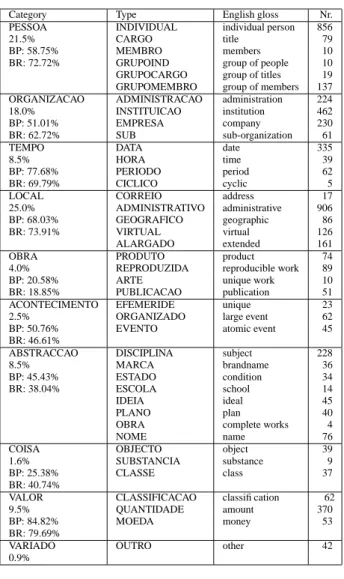
Semantic classification is the assignment of a semantic cat-egory and type to every identified NE from a predefined set of categories and types, diplayed in Table 2. Systems could use the OUTRO (“other”) type if they did not want to perform subcategorization for some categories, or use the selective option to choose a subset of types.
4
Our evaluation package has the possibility of both strategies (HAREM and MUC-style) to allow for experimentation.
Evaluation of semantic classification, which takes place af-ter evaluating the identification task, considers the seman-tic tags assigned to the target NEs. As illustrated above, the same NE can be considered correct in the identification task, but missing or spurious in terms of semantic content. Consider also the alignments of figure 5. In terms of iden-tification, the first alignment is considered correct, but con-sidering the semantic content of the second (given by the tags employed), the ORGANIZACAO NE is missing in the system’s output while theLOCALtarget NE is spurious. We provide four different metrics for measuring a systems’ performance in the semantic classification task, which can be conceived as complementary evaluation viewpoints:
Only categories Only categories are evaluated, types are
ignored.
Only types Given the subset of NEs with correct
cate-gories, this measure evaluates the types submitted.
Combined Categories and types are evaluated
simultane-ously. This metric tries to model the intuition that the more types there are, the more information a correct choice brings, and therefore a higher reward is de-served. The formula is:
0, if category is incorrect;
1, if category is correct and type is incorrect;
2 − 1
n, if both category and type are correct
wheren represents the number of types that the given
category could have.
Flat Considers the pair (category, type) as the tag, and only
if the same pair appears in the target NE is it consid-ered correct. This is stricter than simple category eval-uation, since if the category is correct but the type is not, then the NE is considered incorrectly classified.
2.4. Morphological Classification
Morphological classification of NEs as defined by HAREM consists of filling theMORFattribute of identified NEs with values for the gender and number attributes, respectively F,M,? and S,P,?, with “?”standing for underspecified.
<ORGANIZACAO TIPO="SUB" MORF="M,S"><1>DCC</1></ORGANIZACAO> ---> [<ORGANIZACAO TIPO="SUB" MORF="M,S"><1>DCC</1> </ORGANIZACAO>]
<ORGANIZACAO TIPO="SUB" MORF="M,S"><2>DCC</2></ORGANIZACAO> ---> [<ORGANIZACAO TIPO="SUB" MORF="M,S"><2>DCC</2> </ORGANIZACAO>]
5 <ORGANIZACAO TIPO="SUB" MORF="M,S"><1>Departamento</1> de <1>Cultura</1> <1>Cient´ıfica</1> do <1>Centro</1>
<1>Acadˆemico</1> <1>Pedro</1> <1>Nunes</1></ORGANIZACAO> ---> [<ORGANIZACAO TIPO="SUB" MORF="M,S"><1>Departamento</1> de <1>Cultura</1></ORGANIZACAO>, <ORGANIZACAO TIPO="SUB" MORF="M,S"><1>Cient´ıfica</1> do <1>Centro</1>
<1>Acadˆemico</1> <1>Pedro</1> <1>Nunes</1></ORGANIZACAO>]
<ORGANIZACAO TIPO="SUB" MORF="M,S"><3>DCC</3>/<1>CAPB</1> </ORGANIZACAO> ---> [null]
10 <ORGANIZACAO TIPO="INSTITUICAO" MORF="F,S"><1>UNIFESP</1>/<1>EPM</1> </ORGANIZACAO> ---> [null]
<TEMPO TIPO="DATA"><1>1</1><1>9</1><1>3</1><1>7</1></TEMPO> ---> [<TEMPO TIPO="DATA"><1>3</1><1>7</1></TEMPO>] <ESPURIO><1>cursos extracurriculares</1></ESPURIO> ---> [<ORGANIZACAO TIPO="SUB"><1>cursos extracurriculares</1> </ORGANIZACAO>]
Figure 4: Alignments: Golden collection to the left; system’s output to the right
<ORGANIZACAO TIPO="SUB" MORF="M,S">DCC</ORGANIZACAO> ---> [<LOCAL TIPO="VIRTUAL" MORF="M,S">DCC</LOCAL>]
<ORGANIZACAO TIPO="SUB" MORF="M,S">DCC</ORGANIZACAO> ---> [<ORGANIZACAO TIPO="EMPRESA" MORF="M,S">DCC</ORGANIZACAO>]
Figure 5: Semantically correct and incorrect alignments Note that not all NEs are supposed to require
morphologi-cal classification: it simply does not make sense to classify URLs, postal addresses, movie names, etc. according to number and gender. We have thus made a choice in the GC as to which NEs should have morphological information, and we disregard in HAREM whatever MORF values the systems may have come up with in those cases.
For the evaluation of morphological classification, we com-pute two distinct scoring fields and a combined one (Gen-der, Number, Combined). For each of the previous fields, a given alignment can be considered:
Correct If the two values are equal and the NE was
iden-tified correctly;
Partially correct If the two values are equal, the NE was
identified as partially correct, and the two NEs share (agree in) their beginning;
Wrong If a wrong specific value was provided;
Missing Several different cases are characterized as
miss-ing: (i) if the NE was missing in the identification task; (ii) if the system did not assign the attribute MORF, even though it properly identified the NE; (iii) if the system classified as underspecified a case which had a specific value in the GC; or (iv) if a partially correctly identified NE does not share its first token with the one it aligns with in the GC.
Spurious If a given NE does not exist at all in the GC but
has been morphologically classified by the system;
Overspecified If the system produced a specific value
when in the golden collection the NE was considered morphologically underspecified.
An example of morphological assessment is presented in figure 6. In the first case, morphological classification is considered correct. In the next case, the system has pro-duced a gender different from the one in the golden col-lection, therefore it scores gender as wrong, but number as correct. The final case, in which a system is not able to as-sign gender or number to an NE, which was classified for both properties in the GC, is dealt with by considering both attributes missing.
3.
Building the Golden Collection
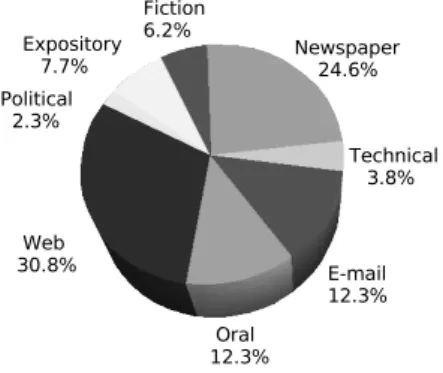
HAREM’s Golden Collection (henceforth GC) is a collec-tion of texts from several origins (table 1) and genres (fig-ure 7), in which NEs have been identified, semantically classified and morphologically tagged in context, and re-vised independently, according to a large set of directives approved (and discussed) by all participants.
Origin Text extracts Words NEs Portugal 63 33 618 2 550
Brazil 60 42 073 2 274
Asia 3 2 864 233
Africa 3 1 253 75
Table 1: Language variety distribution
Figure 7: Genre distribution in the GC
Some important design decisions for this evaluation re-source were:
• Use a preliminary corpus-based assessment to decide
on the final categories relevant for Portuguese (instead of forcing a top down approach)
• Select types (subdivision of the main categories)
which had some linguistic marking in Portuguese: for example, the distinction between unique works and not reproducible ones, or between an atomic event or a large one;
• Do not recursively annotate NEs;5
5
No participating system actually accepted embedded NEs, so there was no point in making the whole evaluation setup unneces-sarily complex.
<PESSOA TIPO="INDIVIDUAL" MORF="M,S">Marcelo Calixto </PESSOA> ---> [<EM MORF="M,S">Marcelo Calixto</EM>] :[Correcto]
<LOCAL TIPO="ADMINISTRATIVO" MORF="M,S">Pedro Leopoldo 5 </LOCAL> ---> [<EM MORF="M,S">Pedro Leopoldo</EM>]:
[Correcto]
<LOCAL TIPO="GEOGRAFICO" MORF="F,S">Costa Africana </LOCAL> ---> [<EM MORF="?,?">Costa Africana</EM>]: [Correcto]
→
<EM MORF="M,S">Marcelo Calixto</EM> ---> [<EM MORF= "M,S">Marcelo Calixto</EM>]:[(G´enero: Correcto 1) (N´umero: Correcto 1) (Combinada: Correcto 1)] <EM MORF="M,S">Pedro Leopoldo</EM> ---> [<EM MORF= 5 "F,S">Pedro Leopoldo</EM>]:[(G´enero: Incorrecto 0)
(N´umero: Correcto 1) (Combinada: Incorrecto 0)] <EM MORF="F,S">Costa Africana</EM> ---> [<EM MORF= "?,?">Costa Africana</EM>]:[(G´enero: Em Falta 0) (N´umero: Em Falta 0) (Combinada: Em Falta 0)]
Figure 6: Examples of morphological evaluation after alignment
• Classify NEs in context, in a more refined way than
usual (see below for discussion on this point).
Category Type English gloss Nr. PESSOA INDIVIDUAL individual person 856
21.5% CARGO title 79
BP: 58.75% MEMBRO members 10 BR: 72.72% GRUPOIND group of people 10 GRUPOCARGO group of titles 19 GRUPOMEMBRO group of members 137 ORGANIZACAO ADMINISTRACAO administration 224 18.0% INSTITUICAO institution 462 BP: 51.01% EMPRESA company 230 BR: 62.72% SUB sub-organization 61
TEMPO DATA date 335
8.5% HORA time 39
BP: 77.68% PERIODO period 62 BR: 69.79% CICLICO cyclic 5
LOCAL CORREIO address 17
25.0% ADMINISTRATIVO administrative 906 BP: 68.03% GEOGRAFICO geographic 86 BR: 73.91% VIRTUAL virtual 126 ALARGADO extended 161
OBRA PRODUTO product 74
4.0% REPRODUZIDA reproducible work 89 BP: 20.58% ARTE unique work 10 BR: 18.85% PUBLICACAO publication 51 ACONTECIMENTO EFEMERIDE unique 23 2.5% ORGANIZADO large event 62 BP: 50.76% EVENTO atomic event 45 BR: 46.61%
ABSTRACCAO DISCIPLINA subject 228
8.5% MARCA brandname 36
BP: 45.43% ESTADO condition 34 BR: 38.04% ESCOLA school 14
IDEIA ideal 45
PLANO plan 40
OBRA complete works 4
NOME name 76
COISA OBJECTO object 39
1.6% SUBSTANCIA substance 9 BP: 25.38% CLASSE class 37 BR: 40.74%
VALOR CLASSIFICACAO classification 62 9.5% QUANTIDADE amount 370
BP: 84.82% MOEDA money 53
BR: 79.69%
VARIADO OUTRO other 42
0.9%
Table 2: HAREM categories and types, their distribution in the GC, and best precision and recall, BP and BR. When-ever a NE is considered vague betweenA1andA2, we in-cremented both counters.
Table 2 describes the population of the GC in terms of the HAREM categories, providing also the best results per cat-egory.
There are in principle two ways to NE-annotate a corpus: (i) to consider the main category a given NE represents, and use it; or (ii) to try to make a finer classification on how they are used in text. Two examples should make this distinction clear: the case of countries, and of newspapers. Form (i), which we believe to be mainstream, would NE-classify any reference to a country as COUNTRY (or LOCATION), and any reference to a newspaper as NEWSPAPER (or ORGA-NIZATION). For us, this is a much simpler task than to
decide in which role a given proper name is mentioned in a given context, which was the path taken in HAREM. It is well known that different kinds of proper names have a number of distinct roles related to their semantics, that is: a country is generally associated with a geographical location, a political organization, and an abstract property; while a reference to a newspaper typically reflects the many different roles of: place of publication, workplace, product, organization, or even a reporter representing the newspa-per. Generalizing further, any concrete thing can also be employed to refer to a place in space; any event can also be used in place of a date, or to refer to its organization committee, or even metonymically to its spokesman. In HAREM we wanted to compare systems in a meaning-ful task, not a middle/intermediate task that would require further interpretation and processing to be useful. We are convinced that names of countries as geographical locations are clearly separated from names of countries as political entities, and that most applications would rather be able to select which of these two. Also, a person interested in find-ing out which companies are lately firfind-ing their employees would not like to see any other reference to a newspaper than the ones in which it is referred to as a company. We were in any case aware that this decision would make considerably harder the task of the systems; conversely, it led to the creation of a incomparably richer and more com-plex resource. To create it also resulted in much work, and not every decision – although documented in detail – is con-sensual. In order to give an idea of what kinds of decisions had to be taken (detailed in (Santos and Cardoso, 2006)), we list here some:
• we only allow a fixed small set of uncapitalized NE
beginnings: titles and address forms (such as in ma-jor Otelo and senhor Alves) and disease hyperonyms (such as in doenc¸a de Alzheimer, and sindroma de Down);
• if a title is followed by a name of a person (who has
this title), consider only one NE, as in Presidente do Parlamento Europeu Stefano Prodi;
• acronyms in parentheses after a given name are
con-sidered as a new NE (inside the parentheses). This al-lows us to distinguish these from cases of a particular NE also having parentheses or acronyms in its name. Also, we hold the view that ceiling effects are as relevant in evaluation contests as are baselines. Accordingly, dur-ing manual annotation of the golden collection we were ex-tremely careful in maintaining vagueness (OR categories) in the annotation, both in semantic classification (where we marked NEs as< A1|A2|An >), in identification, where
we used an<ALT> tag to mark alternative identification
solutions, and in morphology, where the ”?” category is treated as different from no morphological classification provided.
Size GC HAREM Collection
Words 92 761 520 752
Text extracts 129 1 202
Named entities 5 132 ca. 40 000 Vague NEs in classification 131 ca. 1000 Vague NEs in identification 65 ca. 500
Table 3: Statistics of the collections
We therefore provide a quantitative description of the cases where indeterminacy was our best annotation choice in ta-ble 3, discriminating the number of NEs with<ALT>, and
the number of NEs semantically classified with one or more alternatives in the GC.
4.
Concluding remarks
We believe that methodological questions and architecture description are more interesting for an international audi-ence than reporting the actual results obtained by the par-ticipants, each of which received a 100-pages report on the individual and comparative performance of their system, but the (anonymized) results are publically available on the HAREM website for anyone interested.
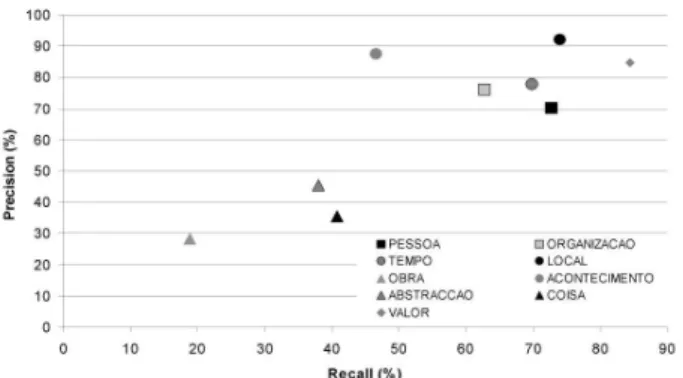
However, over and above the results of the systems, as or-ganizers, we wanted to investigate some questions with our setup, most notably the influence of genre in the NER task, and produce some ranking of the categories: are there some more difficult than others? Figures 8 and 9 graphically il-lustrate some initial results (Seco et al., 2006).
Figure 8: Precision vs Recall for text genres Currently (one year after the event) we are organizing the first HAREM sequel, with a new golden collection, to study both the systems’ evolution and the statistical reliability of the compiled material (Cardoso, 2006).
Reflections around the building of the golden resource sug-gest that even more information should have been manually coded, such as annotation of the deviant cases in terms of spelling or punctuation (too many capitals, too little capi-tals); as well as a thorough explicit encoding of anaphoric or reduced NEs.
Figure 9: Precision vs Recall for Categories (Best)
5.
Acknowledgements
The authors wish to thank Fundac¸˜ao para a Ciˆencia e Tec-nologia for the grant POSI/PLP/43931/2001, co-financed by POSI. We are also grateful to all participants of HAREM, in particular to Cristina Mota for her initial ef-fort in the field and the many stimulating discussions.
6.
References
Nuno Cardoso. 2006. Avaliac¸˜ao de Sistemas de Recon-hecimento de Entidades Mencionadas. Master’s thesis, FEUP, Porto, Portugal. In preparation.
Ralph Grishman and Beth Sundheim. 1996. Message un-derstanding conference-6: a brief history. In Proceed-ings of the 16th conference on Computational linguistics, pages 466–471, Morristown, NJ, USA. ACL.
Lynette Hirschman. 1998. The evolution of evaluation: lessons from the message understanding conference. Computer Speech and Language, 12(4):281–305. Andrew Kehler, John Bear, and Douglas Appelt. 2001. The
need for accurate alignment in natural language system evaluation. Computational Linguistics, 27(2):247–248. Martin Romacker and Udo Hahn. 2000. An empirical
as-sessment of semantic interpretation. In Proceedings of NAACL, pages 327–334, Seattle, Washington.
Diana Santos and Anabela Barreiro. 2004. On the prob-lems of creating a consensual golden standard of in-flected forms in Portuguese. In Lino et al, editor, Pro-ceedings of LREC’2004, pages 483–486, Lisbon. Diana Santos and Nuno Cardoso. 2006. A golden resource
for named entity recognition in Portuguese. In Proceed-ings of the 7th Workshop on Computational Processing of Written and Spoken Portuguese, PROPOR 2006, Itati-aia, Rio de Janeiro, Brasil, 13th-17th May. Springer. Diana Santos, Lu´ıs Costa, and Paulo Rocha. 2003.
Coop-eratively evaluating portuguese morphology. In Nuno J. Mamede, Jorge Baptista, Isabel Trancoso, and Maria das Grac¸as Volpe Nunes, editors, Computational Process-ing of the Portuguese Language, 6th International Work-shop, PROPOR 2003, pages 259–266, Faro, Portugal, June. Springer.
Nuno Seco, Diana Santos, Nuno Cardoso, and Rui Vilela. 2006. A complex evaluation architecture for HAREM. In Proceedings of the 7th Workshop on Computational Processing of Written and Spoken Portuguese, PROPOR 2006, Itatiaia, Rio de Janeiro, Brasil, 13th-17th May. Springer.