CASE REPORT
J of Evidence Based Med & Hlthcare, pISSN- 2349-2562, eISSN- 2349-2570/ Vol. 2/Issue 4/Jan 26, 2015 Page 451
COLLISION TUMOR OF THE THYROID: AN UNCOMMON ENTITY
Sumana Sindhuram1, S. Kokila2, Ramya M3, M. Bharathi4
HOW TO CITE THIS ARTICLE:
Sumana Sindhuram, S. Kokila, Ramya M, M. Bharathi. ”Collision Tumor of the Thyroid: An Uncommon Entity”. Journal of Evidence based Medicine and Healthcare; Volume 2, Issue 4, January 26, 2015;
Page: 451-454.
ABSTRACT: INTRODUCTION: Collision tumor of the thyroid is the presence of histopathologically distinct tumors within the thyroid. The concomitant presence of both papillary and squamous cell carcinoma within the thyroid is an uncommon finding. Possible etiological considerations include entrapment of embryonic squamous epithelium within the thyroid, long standing inflammation or induction of squamous metaplasia by an underlying thyroid carcinoma. CASE REPORT: This is a case of an elderly female who presented with sudden increase in size of a long standing nodule of the right lobe of thyroid. The tumor was locally aggressive and unresectable at surgery. DISCUSSION: Papillary carcinoma, frequently the tall cell variant, can rarely coexist with squamous cell carcinoma. This type of combined papillary- squamous cell carcinoma has to be distinguished from papillary carcinoma with squamous metaplasia. This is because, while papillary carcinoma with combined squamous cell carcinoma is locally aggressive and portends a poor prognosis, papillary carcinoma with squamous metaplasia behaves like a conventional papillary carcinoma.
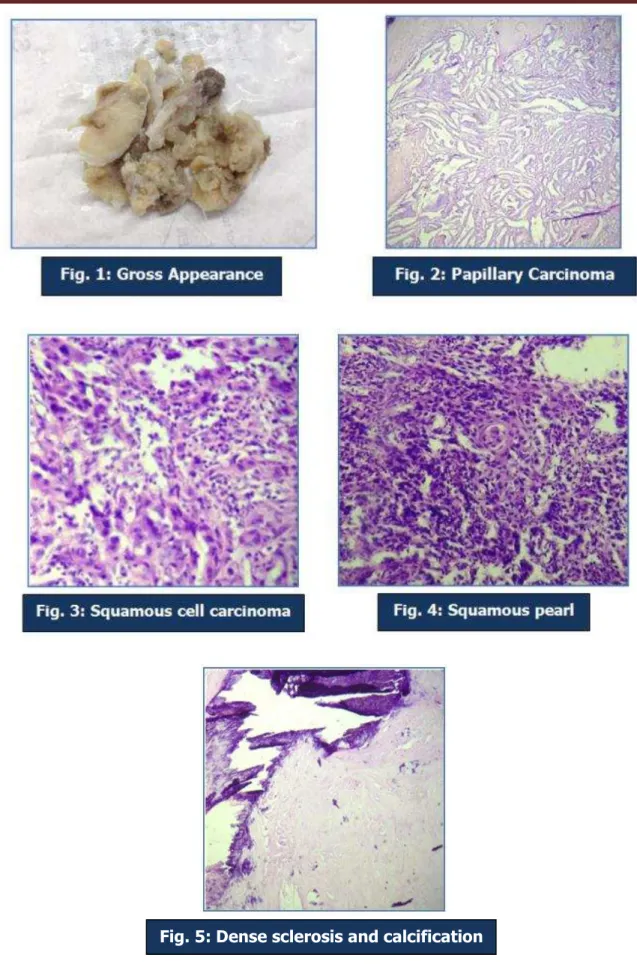
CASE REPORT: A case of a 70-year-old female with a long standing neck swelling with a rapidly enlarging neck mass and dyspnea. On surgical resection tumor infiltration into adjacent structures was seen. On gross appearance the thyroid showed grey white firm areas with irregular borders (Fig. 1).
Histopathological examination showed evidence of papillary carcinoma coexisting with well to moderately differentiated squamous cell carcinoma. Areas harbouring papillary carcinoma showed tumor cells arranged in a branching and arborising papillary pattern. The individual tumor cells had distinct ground glass nuclei with irregular nuclear membrane and occasional longitudinal nuclear grooving. Moderate amount of eosinophilic cytoplasm was seen (Fig. 2). Areas with evidence of Squamous cell carcinoma showed malignant squamous epithelium in nests, irregular clusters and individually scattered. Individual tumour cells showed cytomorphological features of nuclear hyperchromasia, pleomorphism, prominent nucleoli and eosinophilic cytoplasm (Fig. 3). Squamous pearl formation was evident (Fig. 4). Stroma showed sclerosis, psammoma bodies (Fig. 5) and a dense lymphocytic infiltrate.
CASE REPORT
J of Evidence Based Med & Hlthcare, pISSN- 2349-2562, eISSN- 2349-2570/ Vol. 2/Issue 4/Jan 26, 2015 Page 452
CASE REPORT
J of Evidence Based Med & Hlthcare, pISSN- 2349-2562, eISSN- 2349-2570/ Vol. 2/Issue 4/Jan 26, 2015 Page 453
DISCUSSION: “Collision tumor” of the thyroid is defined as coexistence of histopathologically
distinct and independent tumors within the thyroid gland. Papillary carcinoma of thyroid is a commonly encountered thyroid malignancy. However, squamous cell carcinoma is comparatively rare, constituting less than 1% of thyroid malignancies.
The normal thyroid gland does not contain squamous epithelium. Therefore the occurrence of squamous cell carcinoma within the thyroid is enigmatic. A probability of squamous epithelium being entrapped as embryonic rests within the thyroid has been elucidated. Further, an underlying chronic inflammation or malignancy within the thyroid can promote metaplastic change in the squamous epithelium and eventually malignant transformation.
Papillary carcinoma of thyroid commonly occurs in women in their 3rd or 4th decade and its clinical behavior is typically indolent. Squamous cell carcinoma of thyroid on the other hand affects women in their 5th or 6th decade and is locally aggressive. SCC of thyroid causes rapid thyroid enlargement causing compressive symptoms of dyspnea, dysphagia and hoarseness of voice.
Hence while a pure papillary carcinoma of thyroid behaves indolently, additional presence of the SCC component leads to local invasion into neighbouring structures and early metastatic spread. The SCC component imparts a worse survival and poor prognostic outcome.
REFERENCES:
1. Meir Warman, Noga Lipschitz, Sergey Ikher, and Doron Halperin, “Collision Tumor of the Thyroid Gland: Primary Squamous Cell and Papillary Thyroid Carcinoma, ”ISRN Otolaryngology, vol. 2011, Article ID 582374, 2 pages, 2011. doi: 10.5402/2011/582374 2. F. Booya, T. J. Sebo, J. L. Kasperbauer, and V. Fatourechi, “Primary squamous cell
carcinoma of the thyroid: report of ten cases, ”Thyroid, vol. 16, no. 1, pp. 89–93, 2006. 3. C. G. Kleer, T. J. Giordano, and M. J. Merino, “Squamous cell carcinoma of the thyroid: an
aggressive tumor associated with tall cell variant of papillary thyroid carcinoma, ” Modern Pathology, vol. 13, no. 7, pp. 742–746, 2000.
CASE REPORT
J of Evidence Based Med & Hlthcare, pISSN- 2349-2562, eISSN- 2349-2570/ Vol. 2/Issue 4/Jan 26, 2015 Page 454
AUTHORS:
1. Sumana Sindhuram 2. S. Kokila
3. Ramya M. 4. M. Bharathi
PARTICULARS OF CONTRIBUTORS: 1. Assistant Professor, Department of
Pathology, Mysore Medical College and Research Institute.
2. Post Graduate, Department of
Pathology, Mysore Medical College and Research Institute.
3. Post Graduate, Department of
Pathology, Mysore Medical College and Research Institute.
4. Professor and HOD, Department of Pathology, Mysore Medical College and Research Institute.
NAME ADDRESS EMAIL ID OF THE CORRESPONDING AUTHOR: Dr. Sumana Sindhuram,
No. 1081, Lalithadri Road, Opp. Vidya Vardhaka School, N.R. Complex, Kuvempunagar, Myosre – 23.
E-mail: [email protected]