EUROPEAN ORGANIZATION FOR NUCLEAR RESEARCH (CERN)
CERN-PH-EP/2013-037 2016/02/22
CMS-EXO-15-001
Search for narrow resonances decaying to dijets in
proton-proton collisions at
√
s
=
13 TeV
The CMS Collaboration
∗Abstract
A search for narrow resonances in proton-proton collisions at √s = 13 TeV is
pre-sented. The invariant mass distribution of the two leading jets is measured with the
CMS detector using a data set corresponding to an integrated luminosity of 2.4 fb−1.
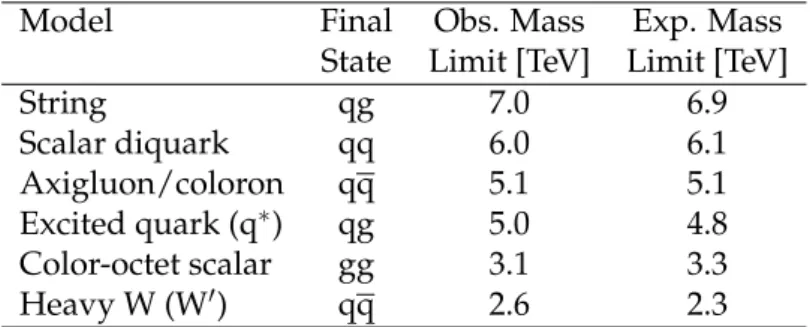
The highest observed dijet mass is 6.1 TeV. The distribution is smooth and no evi-dence for resonant particles is observed. Upper limits at 95% confievi-dence level are set on the production cross section for narrow resonances with masses above 1.5 TeV. When interpreted in the context of specific models, the limits exclude string reso-nances with masses below 7.0 TeV, scalar diquarks below 6.0 TeV, axigluons and col-orons below 5.1 TeV, excited quarks below 5.0 TeV, color-octet scalars below 3.1 TeV,
and W0bosons below 2.6 TeV. These results significantly extend previously published
limits.
Published in Physical Review Letters as doi:10.1103/PhysRevLett.116.071801.
c
2016 CERN for the benefit of the CMS Collaboration. CC-BY-3.0 license
∗See Appendix A for the list of collaboration members
1
Deep inelastic proton-proton (pp) collisions often produce two or more energetic jets when the
constituent partons are scattered with large transverse momenta (pT). The invariant mass mjj
of the pair of jets having the largest values of pT in the event (the dijet) has a spectrum that
is predicted by quantum chromodynamics (QCD) to fall steeply and smoothly with increasing dijet mass [1, 2]. Many extensions of the standard model predict the existence of new massive particles that couple to quarks (q) and gluons (g) and can be detected as resonances in the dijet mass spectrum. In this Letter, we report a search for narrow resonances, those with natural widths that are small compared to the experimental resolution. The search uses the dijet mass
spectrum measured with the CMS detector at a center-of-mass energy of√s = 13 TeV. The
data correspond to an integrated luminosity of 2.4 fb−1 from the 2015 running of the CERN
LHC (Run 2).
The most stringent current bounds on dijet resonance production have been presented by the
CMS [3–7] and ATLAS [8–12] Collaborations, using proton-proton collisions at √s = 7 and
8 TeV from LHC Run 1. A summary of previous searches and a comparison of the different strategies are presented in Ref. [13]. The present search is expected to be more sensitive than previous studies for dijet masses above 2 TeV, and has similar sensitivity as a contemporaneous
search from ATLAS at √s = 13 TeV [14]. We present a model-independent search and, in
addition, consider the following models of s-channel dijet resonances: string resonances [15, 16], scalar diquarks [17], axigluons [18, 19], colorons [19, 20], excited quarks (q∗) [21, 22],
color-octet scalars [23], new gauge bosons (W0 and Z0) [24], and Randall–Sundrum (RS) gravitons
(G) [25]. More details on the specific choices of couplings for these models can be found in Ref. [5].
The CMS detector and its coordinate system, including the azimuthal angle φ (in radians) and the pseudorapidity η, are described in detail in Ref. [26]. Events are selected using a two-tier trigger system. Events satisfying loose jet requirements at the first level (L1) are examined by the high-level trigger (HLT), where jets are clustered from particle-flow (PF) [27, 28] candidates,
discussed in the next paragraph. The jets with pT > 40 GeV and |η| < 3 are used to compute
HT, the scalar sum of the jet pT. Events are accepted if they have HT > 800 GeV or include a
jet with pT > 500 GeV. At least one reconstructed vertex is required with |z| < 24 cm. The
primary vertex is defined as the vertex with the highest sum of p2
T of the associated tracks.
The PF algorithm is used to reconstruct the particles in an event and to identify them as muons, electrons (with associated Bremsstrahlung photons), photons (unconverted and converted into
e+e−pairs), and either charged or neutral hadrons. These PF candidates are clustered into jets
using the anti-kt algorithm [29] with a distance parameter of 0.4, implemented in the FASTJET
package [30]. Charged PF candidates not originating from the primary vertex are removed prior to the jet finding. An event-by-event jet-area-based correction [31–33] is applied to the jets to remove the estimated energy from additional collisions in the same or adjacent bunch crossings (pileup). The jet momenta and energies are further corrected using calibration
con-stants obtained from simulation, test beam results, and pp collision data at√s=13 TeV, using
methods described in Ref. [33] with all in situ calibrations obtained from the current data. All jets are required to have pT > 30 GeV and|η| < 2.5. The two jets with largest pT are defined
as the leading jets. Jet identification criteria [34] are applied to remove spurious jets associated with calorimeter noise. An event is rejected if either of the two leading jets does not satisfy the jet identification criteria.
Geometrically close jets are combined into “wide jets” and used to determine the dijet mass, as in our previous searches [4–7]. The wide-jet algorithm, designed for dijet resonance event reconstruction, reduces the analysis sensitivity to gluon radiation from the final state
par-tons. The two leading jets are used as seeds and the four-vectors of all other jets, if within
∆R =
√
(∆η)2+ (∆φ)2 < 1.1, are added to the nearest leading jet to obtain two wide jets,
which then form the dijet system. The background from t-channel dijet events is suppressed
by requiring the pseudorapidity separation of the two wide jets to satisfy |∆ηjj| < 1.3. The
above requirements, originally developed for the analysis of Run 1 data, maximize the search sensitivity for isotropic decays of dijet resonances in the presence of QCD dijet background.
It has been verified that these requirements remain optimal for collisions at√s = 13 TeV. We
select events with mjj > 1.2 TeV for which the combined L1 trigger and HLT are found to be
fully efficient.
2000
3000
4000
5000
6000
[pb / TeV]
jj/ dm
σ
d
3 −10
2 −10
1 −10
1
10
210
310
Data Fit QCD MCColor-octet scalar (3.1 TeV) Excited quark (5.0 TeV) Scalar diquark (6.0 TeV)
Wide jets | < 1.3 jj η ∆ | < 2.5, | η | (13 TeV) -1 2.4 fb CMS
Dijet mass [TeV]
2 3 4 5 6 stat
σ
(Data-Fit)
−−32 1 −0 1 2 3Figure 1: Dijet mass spectrum (points) compared to a fitted parameterization (solid curve) and
to the prediction of the PYTHIA 8 [35] QCD MC event generator including simulation of the
detector (dashed curve). The lower panel shows the difference between the data and the fitted parametrization, divided by the statistical uncertainties. The predicted distributions of narrow resonance signals for three models, with resonance mass values corresponding to the respective 95% confidence level exclusion limit, are shown in both panels (dash-dotted curves).
Figure 1 shows the dijet mass spectrum, defined as the observed number of events in each bin divided by the integrated luminosity and bin width, with predefined bins of width correspond-ing to the dijet mass resolution [3]. The highest dijet mass observed is 6.1 TeV. The data are
3
compared with a leading-order QCD Monte Carlo (MC) prediction from the PYTHIA8 (v205)
[35] generator with the CUETP8M1 tune [36, 37], including a GEANT4-based [38] simulation
of the CMS detector. The PYTHIA simulation uses the NNPDF2.3LO [39] parton distribution
functions (PDF). The renormalization and factorization scales are both set at the pTvalue of the
hard-scattered partons. The MC prediction is normalized to the integrated contents of the data in Fig. 1, requiring multiplication of the predicted cross section by a factor of 0.88.
To test the smoothness of the measured dijet mass spectrum, we fit the data with the parame-terization dσ dmjj = P0(1−x) P1 xP2+P3ln(x) , (1) where x = mjj/ √
s and P0, P1, P2, and P3are fitted parameters. This functional form was also
used in previous searches [3–12, 40] to describe the data and the QCD predictions. In Fig. 1 we
show the result of the binned maximum likelihood fit, which yields χ2 = 31 for 35 degrees of
freedom, where the χ2is determined using the Poisson uncertainties shown in Fig. 1. The data
are seen to be well described by the fit.
We search in the dijet mass spectrum for narrow resonances. Figure 2 shows example dijet
mass distributions for simulated signal events, generated with thePYTHIA8 program. The
pre-dicted mass distributions have Gaussian cores from the jet energy resolution, and tails towards lower mass values primarily from QCD radiation. The contribution of this low-mass tail to the lineshape depends on the parton content of the resonance (qq, qg, or gg). Resonances contain-ing gluons, which emit QCD radiation more strongly than quarks, have a more pronounced tail. For the high-mass resonances, there is also a significant contribution that depends both on the PDF and on the natural width of the Breit–Wigner resonance. For resonances produced through interactions of nonvalent partons in the proton, the low-mass component of the Breit– Wigner resonance distribution is amplified by the rise of the parton probability distribution at low fractional momentum. These effects cause a large tail at low mass values. Neglecting the tails, the approximate value of the dijet mass resolution varies with resonance mass from 7% at 1.5 TeV to 4% at 7 TeV.
There is no evidence for a narrow resonance in the data, as seen from Fig. 1. The most signifi-cant excess in the data relative to the background fit occurs for a dijet mass of 3.9 TeV. A fit to the hypothesis of a narrow qq resonance, which includes contributions from the bin at 3.9 TeV and neighboring bins, has a local statistical significance of 1.7 standard deviations. Figure 1 includes example signal distributions of the three kinds of narrow resonances (qq, qg, and gg) at the mass values (6.0, 5.0, and 3.1 TeV) corresponding to the limit set on the respective models (scalar diquark, excited quark, and color-octet scalar). These limits are presented below. We use the dijet mass spectrum from wide jets, the background parameterization, and the dijet resonance shapes to set limits on new particles decaying to the parton pairs qq (or qq), qg, and gg. A separate limit is determined for each final state (qq, qg, and gg) because of the dependence of the dijet resonance shape on the type of the two final-state partons.
The dominant sources of systematic uncertainty are the jet energy scale, jet energy resolution, integrated luminosity, and the estimation of background. The uncertainty in the jet energy scale is 2%, determined from Run 2 data using the methods described in Ref. [33]. This
un-certainty is propagated to the limits by shifting the dijet mass for signal events by ±2%. The
uncertainty in the jet energy resolution translates into an uncertainty of 10% in the resolution of the dijet mass [33], and is propagated to the limits by increasing and decreasing by 10% the reconstructed width of the dijet mass shape for signal. The luminosity scale and its uncertainty are estimated from beam-beam scans utilizing the methods from Ref. [41]. The uncertainty in
Dijet mass [TeV]
0 1 2 3 4 5 6 7 8
Normalized yield / TeV
0 0.5 1 1.5 2 2.5 3 3.5 4 4.5 quark-quark quark-gluon gluon-gluon
CMS Simulation
= 13 TeV s Wide jets |<1.3 jj η ∆ |<2.5, | η |Figure 2: The reconstructed resonance mass spectrum predicted by thePYTHIA8 [35] MC event
generator, including simulation of the detector, for resonances generated with mass values 1,
3, 5, and 7 TeV, for quark-quark processes modeled by qq →G →qq (solid), for quark-gluon
processes modeled by qg → q∗ → qg (dotted), and for gluon-gluon processes modeled by
5
the integrated luminosity is 12%, and is propagated to the normalization of the signal. Not included in this analysis is a recent re-evaluation of the integrated luminosity that increases the measured value by 4.3% and reduces the systematic uncertainty to 4.6%. Changes in the values of the parameters describing the background introduce a change in the signal strength that is accounted for as a systematic uncertainty. The dependence of the signal mass distributions on the number of pileup interactions is negligible.
To set upper limits on signal cross sections we use a Bayesian formalism [42] with a uniform prior for a positive signal cross section; log-normal priors are used to model systematic uncer-tainties in the jet energy scale, jet energy resolution, and integrated luminosity, all treated as nuisance parameters to be integrated over. We calculate the likelihood, namely the posterior probability density as a function of resonance cross section, independently at each value of res-onance pole mass from 1.5 to 7.2 TeV in 0.1 TeV steps. Resres-onances with masses less than 1.5 TeV are too close to the lower edge of our dijet mass spectrum to produce a peak distinguishable from the background and are therefore not considered. Examples of the resonance shapes used are shown in Fig. 2. The data are fitted with the background function plus a signal shape, with the signal cross section a fitted parameter. The resulting fitting function, with the signal cross section set to zero, is used as the background estimate. The likelihood is formed using as in-put the data, the background estimate from the best fit of the signal+background hypothesis to the data, and the resonance shape multiplied by the resonance cross section. The uncertainty in the background is incorporated through marginalization, i.e., by integrating the likelihood over the background parameters using uniform priors. The integration is performed for each of the background nuisance parameters in a range around the best-fit values, corresponding to a decrease in the likelihood by a factor of 1000 from its maximum value for each parameter independently.
Figure 3 shows the model-independent observed upper limits at 95% confidence level (CL) on
σ B A, i.e., the product of the cross section (σ), the branching fraction (B), and the acceptance (A)
for the kinematic requirements|∆ηjj| <1.3 and|η| <2.5, for narrow qq, qg, and gg resonances.
The acceptance of the requirement mjj > 1.2 TeV has been taken into account by correcting the
limits, and therefore does not appear in the acceptance A. Figure 3 also shows the expected limits on the cross section and their bands of uncertainty. The expected limits are estimated with pseudo-experiments generated using background-only hypotheses. The generated mass spectra are fit with a background+signal model to extract expected upper limits. The difference in the limits for qq, qg, and gg resonances at the same resonance mass originates from the difference in their lineshapes. All upper limits presented are compared to the parton-level predictions of σ B A, without detector simulation, to determine mass limits on new particles. The model predictions shown in Fig. 3 are calculated in the narrow-width approximation [13] using the CTEQ6L1 [43] PDF at leading order, with a next-to-leading order correction factor
of approximately 1.3 included for the W0 and Z0 models [44], and approximately 1.2 for the
axigluon and coloron models [19]. The branching fraction B includes the direct decays of the resonance into qq, qg, and gg only, excluding top quarks, and no other decays giving jets are considered in the theoretical calculation of the model cross section. The acceptance is evaluated at the parton level for the resonance decay to two partons. In the case of isotropic decays it is
A≈0.6 independent of resonance mass.
For a given model, new particles are excluded at 95% CL in mass regions where the theoretical prediction lies at or above the observed upper limit for the appropriate final state of Fig. 3. The mass limits reported in Table 1 represent significant extensions of the most stringent observed limits from LHC Run 1 [7, 12]. For string resonances, the observed mass limit of 7.0 TeV ex-tends the previous CMS limit of 5.0 TeV; for scalar diquarks, the observed mass limit of 6.0 TeV
qq resonance mass [TeV] 1 2 3 4 5 6 7 [pb] A B σ -3 10 -2 10 -1 10 1 10 2 10 95% CL upper limits Observed Expected 1 std. deviation ± 2 std. deviation ± Scalar diquark Axigluon/coloron W’ Z’ (13 TeV) -1 2.4 fb CMS
qg resonance mass [TeV]
1 2 3 4 5 6 7 [pb] A B σ -3 10 -2 10 -1 10 1 10 2 10 95% CL upper limits Observed Expected 1 std. deviation ± 2 std. deviation ± String Excited quark (13 TeV) -1 2.4 fb CMS
gg resonance mass [TeV]
1 2 3 4 5 6 7 [pb] A B σ -3 10 -2 10 -1 10 1 10 2 10 95% CL upper limits Observed Expected 1 std. deviation ± 2 std. deviation ± Color-octet scalar (13 TeV) -1 2.4 fb CMS
Resonance mass [TeV]
1 2 3 4 5 6 7 [pb] A B σ -3 10 -2 10 -1 10 1 10 2 10 95% CL upper limits gluon-gluon quark-gluon quark-quark String Scalar diquark Excited quark Axigluon/coloron Color-octet scalar W’ Z’ RS graviton (13 TeV) -1 2.4 fb CMS
Figure 3: The observed 95% CL upper limits on the product of the cross section, branching fraction, and acceptance for quark-quark (top left), quark-gluon (top right), and gluon-gluon (bottom left) type dijet resonances, shown as symbols connected by solid curves, and a com-parison of all types (bottom right). The corresponding expected limits (dash-dotted curves) and their variation at the 1 and 2 standard deviation levels (shaded bands) are also shown. The limits are compared to the predicted cross sections of string resonances [15, 16], scalar di-quarks [17], excited di-quarks [21, 22], axigluons [18, 19], colorons [19, 20], color-octet scalars [23],
7
extends the previous CMS limit of 4.7 TeV; for axigluons and colorons, the observed mass limit of 5.1 TeV extends the previous CMS limit of 3.6 TeV; for excited quarks, we set a mass limit of 5.0 TeV compared to the ATLAS limit of 4.06 TeV; for a color-octet scalar, the observed mass
limit of 3.1 TeV improves the ATLAS limit of 2.70 TeV; and for a W0 boson, we exclude masses
up to 2.6 TeV, just beyond the ATLAS limit of 2.45 TeV. With the current data sample we
can-not set mass limits on Z0 bosons with standard-model-like couplings or on RS gravitons with
dimensionless coupling less than 0.1.
In summary, a search for narrow resonances decaying into a pair of jets has been performed
using a data sample of pp collisions at√s=13 TeV corresponding to an integrated luminosity
of 2.4 fb−1. The dijet mass spectrum has been measured to be a smoothly falling distribution.
In the analyzed data sample, there is no evidence for resonant particle production. We present generic upper limits on the product σ B A that are applicable to any model of narrow dijet reso-nance production. This search is more sensitive than previous searches for dijet resoreso-nances for masses above 2 TeV. We set the most stringent limits to date on the masses of string resonances,
scalar diquarks, axigluons, colorons, excited quarks, color-octet scalars, and W0bosons.
Table 1: Observed and expected mass limits for analyses that exclude the listed models at 95% CL for a resonance mass from 1.5 TeV up to the indicated values.
Model Final Obs. Mass Exp. Mass
State Limit [TeV] Limit [TeV]
String qg 7.0 6.9 Scalar diquark qq 6.0 6.1 Axigluon/coloron qq 5.1 5.1 Excited quark (q∗) qg 5.0 4.8 Color-octet scalar gg 3.1 3.3 Heavy W (W0) qq 2.6 2.3
Acknowledgments
We congratulate our colleagues in the CERN accelerator departments for the excellent perfor-mance of the LHC and thank the technical and administrative staffs at CERN and at other CMS institutes for their contributions to the success of the CMS effort. In addition, we gratefully acknowledge the computing centers and personnel of the Worldwide LHC Computing Grid for delivering so effectively the computing infrastructure essential to our analyses. Finally, we acknowledge the enduring support for the construction and operation of the LHC and the CMS detector provided by the following funding agencies: BMWFW and FWF (Austria); FNRS and FWO (Belgium); CNPq, CAPES, FAPERJ, and FAPESP (Brazil); MES (Bulgaria); CERN; CAS, MoST, and NSFC (China); COLCIENCIAS (Colombia); MSES and CSF (Croatia); RPF (Cyprus); MoER, ERC IUT and ERDF (Estonia); Academy of Finland, MEC, and HIP (Finland); CEA and CNRS/IN2P3 (France); BMBF, DFG, and HGF (Germany); GSRT (Greece); OTKA and NIH (Hungary); DAE and DST (India); IPM (Iran); SFI (Ireland); INFN (Italy); MSIP and NRF (Re-public of Korea); LAS (Lithuania); MOE and UM (Malaysia); CINVESTAV, CONACYT, SEP, and UASLP-FAI (Mexico); MBIE (New Zealand); PAEC (Pakistan); MSHE and NSC (Poland); FCT (Portugal); JINR (Dubna); MON, RosAtom, RAS and RFBR (Russia); MESTD (Serbia); SEIDI and CPAN (Spain); Swiss Funding Agencies (Switzerland); MST (Taipei); ThEPCenter, IPST, STAR and NSTDA (Thailand); TUBITAK and TAEK (Turkey); NASU and SFFR (Ukraine); STFC (United Kingdom); DOE and NSF (USA).
References
[1] CMS Collaboration, “Measurement of the differential dijet production cross section in
proton-proton collisions at√s=7 TeV”, Phys. Lett. B 700 (2011) 187,
doi:10.1016/j.physletb.2011.05.027, arXiv:1104.1693.
[2] ATLAS Collaboration, “Measurement of dijet cross sections in pp collisions at 7 TeV centre-of-mass energy using the ATLAS detector”, JHEP 05 (2014) 059,
doi:10.1007/JHEP05(2014)059, arXiv:1312.3524.
[3] CMS Collaboration, “Search for Dijet Resonances in 7 TeV pp Collisions at CMS”, Phys. Rev. Lett. 105 (2010) 211801, doi:10.1103/PhysRevLett.105.211801,
arXiv:1010.0203. [Erratum doi:10.1103/PhysRevLett.106.029902]. [4] CMS Collaboration, “Search for resonances in the dijet mass spectrum from 7 TeV pp
collisions at CMS”, Phys. Lett. B 704 (2011) 123,
doi:10.1016/j.physletb.2011.09.015, arXiv:1107.4771.
[5] CMS Collaboration, “Search for narrow resonances and quantum black holes in inclusive
and b-tagged dijet mass spectra from pp collisions at√s=7 TeV”, JHEP 01 (2013) 013,
doi:10.1007/JHEP01(2013)013, arXiv:1210.2387.
[6] CMS Collaboration, “Search for narrow resonances using the dijet mass spectrum in pp
collisions at√s = 8 TeV”, Phys. Rev. D 87 (2013) 114015,
doi:10.1103/PhysRevD.87.114015, arXiv:1302.4794.
[7] CMS Collaboration, “Search for resonances and quantum black holes using dijet mass
spectra in proton-proton collisions at√s=8 TeV”, Phys. Rev. D 91 (2015) 052009,
doi:10.1103/PhysRevD.91.052009, arXiv:1501.04198.
[8] ATLAS Collaboration, “Search for New Particles in Two-Jet Final States in 7 TeV Proton-Proton Collisions with the ATLAS Detector at the LHC”, Phys. Rev. Lett. 105 (2010) 161801, doi:10.1103/PhysRevLett.105.161801, arXiv:1008.2461. [9] ATLAS Collaboration, “Search for new physics in dijet mass and angular distributions in
pp collisions at√s=7 TeV measured with the ATLAS detector”, New J. Phys. 13 (2011)
053044, doi:10.1088/1367-2630/13/5/053044, arXiv:1103.3864.
[10] ATLAS Collaboration, “Search for new physics in the dijet mass distribution using 1 fb−1
of pp collision data at√s = 7 TeV collected by the ATLAS detector”, Phys. Lett. B 708
(2012) 37, doi:10.1016/j.physletb.2012.01.035, arXiv:1108.6311. [11] ATLAS Collaboration, “ATLAS search for new phenomena in dijet mass and angular
distributions using pp collisions at√s=7 TeV”, JHEP 01 (2013) 029,
doi:10.1007/JHEP01(2013)029, arXiv:1210.1718.
[12] ATLAS Collaboration, “Search for new phenomena in the dijet mass distribution using
pp collision data at√s=8 TeV with the ATLAS detector”, Phys. Rev. D 91 (2015) 052007,
doi:10.1103/PhysRevD.91.052007, arXiv:1407.1376.
[13] R. M. Harris and K. Kousouris, “Searches for dijet resonances at hadron colliders”, Int. J. Mod. Phys. A 26 (2011) 5005, doi:10.1142/S0217751X11054905,
References 9
[14] ATLAS Collaboration, “Search for New Phenomena in Dijet Mass and Angular
Distributions from pp Collisions at√s = 13 TeV with the ATLAS Detector”, (2015).
arXiv:1512.01530. Submitted to Phys. Lett. B.
[15] L. A. Anchordoqui et al., “Dijet Signals for Low Mass Strings at the LHC”, Phys. Rev. Lett.
101(2008) 241803, doi:10.1103/PhysRevLett.101.241803, arXiv:0808.0497.
[16] S. Cullen, M. Perelstein, and M. E. Peskin, “TeV strings and collider probes of large extra dimensions”, Phys. Rev. D 62 (2000) 055012, doi:10.1103/PhysRevD.62.055012,
arXiv:hep-ph/0001166.
[17] J. L. Hewett and T. G. Rizzo, “Low-energy phenomenology of superstring-inspired E(6) models”, Phys. Rept. 183 (1989) 193, doi:10.1016/0370-1573(89)90071-9.
[18] P. H. Frampton and S. L. Glashow, “Chiral Color: An Alternative to the Standard Model”, Phys. Lett. B 190 (1987) 157, doi:10.1016/0370-2693(87)90859-8.
[19] R. S. Chivukula, E. H. Simmons, A. Farzinnia, and J. Ren, “Hadron collider production of massive color-octet vector bosons at next-to-leading order”, Phys. Rev. D 87 (2013) 094011, doi:10.1103/PhysRevD.87.094011, arXiv:1303.1120.
[20] E. H. Simmons, “Coloron phenomenology”, Phys. Rev. D 55 (1997) 1678,
doi:10.1103/PhysRevD.55.1678, arXiv:hep-ph/9608269.
[21] U. Baur, I. Hinchliffe, and D. Zeppenfeld, “Excited Quark Production at Hadron Colliders”, Int. J. Mod. Phys. A 02 (1987) 1285, doi:10.1142/S0217751X87000661. [22] U. Baur, M. Spira, and P. M. Zerwas, “Excited quark and lepton production at hadron
colliders”, Phys. Rev. D 42 (1990) 815, doi:10.1103/PhysRevD.42.815. [23] T. Han, I. Lewis, and Z. Liu, “Colored resonant signals at the LHC: largest rate and
simplest topology”, JHEP 12 (2010) 085, doi:10.1007/JHEP12(2010)085,
arXiv:1010.4309.
[24] E. Eichten, I. Hinchliffe, K. D. Lane, and C. Quigg, “Supercollider physics”, Rev. Mod. Phys. 56 (1984) 579, doi:10.1103/RevModPhys.56.579.
[25] L. Randall and R. Sundrum, “An Alternative to compactification”, Phys. Rev. Lett. 83 (1999) 4690, doi:10.1103/PhysRevLett.83.4690, arXiv:hep-th/9906064. [26] CMS Collaboration, “The CMS experiment at the CERN LHC”, JINST 3 (2008) S08004,
doi:10.1088/1748-0221/3/08/S08004.
[27] CMS Collaboration, “Particle–Flow Event Reconstruction in CMS and Performance for
Jets, Taus, and EmissT ”, CMS Physics Analysis Summary CMS-PAS-PFT-09-001, 2009.
[28] CMS Collaboration, “Commissioning of the Particle-flow Event Reconstruction with the first LHC collisions recorded in the CMS detector”, CMS Physics Analysis Summary CMS-PAS-PFT-10-001, 2010.
[29] M. Cacciari, G. P. Salam, and G. Soyez, “The Anti-ktjet clustering algorithm”, JHEP 04
(2008) 063, doi:10.1088/1126-6708/2008/04/063, arXiv:0802.1189.
[30] M. Cacciari and G. P. Salam, “Dispelling the N3myth for the ktjet-finder”, Phys. Lett. B
[31] M. Cacciari, G. P. Salam, and G. Soyez, “FastJet user manual”, Eur. Phys. J. C 72 (2012) 1896, doi:10.1140/epjc/s10052-012-1896-2, arXiv:1111.6097.
[32] M. Cacciari and G. P. Salam, “Pileup subtraction using jet areas”, Phys. Lett. B 659 (2008) 119, doi:10.1016/j.physletb.2007.09.077, arXiv:0707.1378.
[33] CMS Collaboration, “Determination of jet energy calibration and transverse momentum resolution in CMS”, JINST 6 (2011) P11002,
doi:10.1088/1748-0221/6/11/P11002, arXiv:1107.4277.
[34] CMS Collaboration, “Jet Performance in pp Collisions at√s=7 TeV”, CMS Physics
Analysis Summary CMS-PAS-JME-10-003, 2010.
[35] T. Sj ¨ostrand, S. Mrenna, and P. Skands, “A brief introduction to PYTHIA 8.1”, Comp. Phys. Comm. 178 (2008) 852, doi:10.1016/j.cpc.2008.01.036,
arXiv:0710.3820.
[36] CMS Collaboration, “Event generator tunes obtained from underlying event and multiparton scattering measurements”, (2015). arXiv:1512.00815. Submitted to Eur. Phys. J. C.
[37] P. Skands, S. Carrazza, and J. Rojo, “Tuning PYTHIA 8.1: the Monash 2013 tune”, Eur. Phys. J. C 74 (2014) 3024, doi:10.1140/epjc/s10052-014-3024-y,
arXiv:1404.5630.
[38] GEANT4 Collaboration, “GEANT4—a simulation toolkit”, Nucl. Instrum. Meth. A 506 (2003) 250, doi:10.1016/S0168-9002(03)01368-8.
[39] NNPDF Collaboration, “Parton distributions with LHC data”, Nucl. Phys. B 867 (2013) 244, doi:10.1016/j.nuclphysb.2012.10.003, arXiv:1207.1303.
[40] CDF Collaboration, “Search for new particles decaying into dijets in proton-antiproton
collisions at√s=1.96 TeV”, Phys. Rev. D 79 (2009) 112002,
doi:10.1103/PhysRevD.79.112002, arXiv:0812.4036.
[41] CMS Collaboration, “CMS Luminosity Based on Pixel Cluster Counting - Summer 2013 Update”, CMS Physics Analysis Summary CMS-PAS-LUM-13-001, (2013).
[42] Particle Data Group Collaboration, “Review of Particle Physics”, Chin. Phys. C 38 (2014) 090001, doi:10.1088/1674-1137/38/9/090001.
[43] J. Pumplin et al., “New generation of parton distributions with uncertainties from global QCD analysis”, JHEP 07 (2002) 012, doi:10.1088/1126-6708/2002/07/012, arXiv:hep-ph/0201195.
[44] K. Gumus, N. Akchurin, S. Esen, and R. M. Harris, “CMS Sensitivity to Dijet Resonances”, Technical Report CMS-NOTE-2006-070, 2006.
11
A
The CMS Collaboration
Yerevan Physics Institute, Yerevan, Armenia
V. Khachatryan, A.M. Sirunyan, A. Tumasyan
Institut f ¨ur Hochenergiephysik der OeAW, Wien, Austria
W. Adam, E. Asilar, T. Bergauer, J. Brandstetter, E. Brondolin, M. Dragicevic, J. Er ¨o, M. Flechl, M. Friedl, R. Fr ¨uhwirth1, V.M. Ghete, C. Hartl, N. H ¨ormann, J. Hrubec, M. Jeitler1, V. Kn ¨unz,
A. K ¨onig, M. Krammer1, I. Kr¨atschmer, D. Liko, T. Matsushita, I. Mikulec, D. Rabady2,
B. Rahbaran, H. Rohringer, J. Schieck1, R. Sch ¨ofbeck, J. Strauss, W. Treberer-Treberspurg,
W. Waltenberger, C.-E. Wulz1
National Centre for Particle and High Energy Physics, Minsk, Belarus
V. Mossolov, N. Shumeiko, J. Suarez Gonzalez
Universiteit Antwerpen, Antwerpen, Belgium
S. Alderweireldt, T. Cornelis, E.A. De Wolf, X. Janssen, A. Knutsson, J. Lauwers, S. Luyckx, M. Van De Klundert, H. Van Haevermaet, P. Van Mechelen, N. Van Remortel, A. Van Spilbeeck
Vrije Universiteit Brussel, Brussel, Belgium
S. Abu Zeid, F. Blekman, J. D’Hondt, N. Daci, I. De Bruyn, K. Deroover, N. Heracleous, J. Keaveney, S. Lowette, L. Moreels, A. Olbrechts, Q. Python, D. Strom, S. Tavernier, W. Van Doninck, P. Van Mulders, G.P. Van Onsem, I. Van Parijs
Universit´e Libre de Bruxelles, Bruxelles, Belgium
P. Barria, H. Brun, C. Caillol, B. Clerbaux, G. De Lentdecker, G. Fasanella, L. Favart, R. Goldouzian, A. Grebenyuk, G. Karapostoli, T. Lenzi, A. L´eonard, T. Maerschalk, A. Marinov, L. Perni`e, A. Randle-conde, T. Seva, C. Vander Velde, P. Vanlaer, R. Yonamine, F. Zenoni,
F. Zhang3
Ghent University, Ghent, Belgium
K. Beernaert, L. Benucci, A. Cimmino, S. Crucy, D. Dobur, A. Fagot, G. Garcia, M. Gul, J. Mccartin, A.A. Ocampo Rios, D. Poyraz, D. Ryckbosch, S. Salva, M. Sigamani, M. Tytgat, W. Van Driessche, E. Yazgan, N. Zaganidis
Universit´e Catholique de Louvain, Louvain-la-Neuve, Belgium
S. Basegmez, C. Beluffi4, O. Bondu, S. Brochet, G. Bruno, A. Caudron, L. Ceard, C. Delaere,
D. Favart, L. Forthomme, A. Giammanco5, A. Jafari, P. Jez, M. Komm, V. Lemaitre, A. Mertens,
M. Musich, C. Nuttens, L. Perrini, K. Piotrzkowski, A. Popov6, L. Quertenmont, M. Selvaggi,
M. Vidal Marono
Universit´e de Mons, Mons, Belgium
N. Beliy, G.H. Hammad
Centro Brasileiro de Pesquisas Fisicas, Rio de Janeiro, Brazil
W.L. Ald´a J ´unior, F.L. Alves, G.A. Alves, L. Brito, M. Correa Martins Junior, M. Hamer, C. Hensel, A. Moraes, M.E. Pol, P. Rebello Teles
Universidade do Estado do Rio de Janeiro, Rio de Janeiro, Brazil
E. Belchior Batista Das Chagas, W. Carvalho, J. Chinellato7, A. Cust ´odio, E.M. Da Costa,
D. De Jesus Damiao, C. De Oliveira Martins, S. Fonseca De Souza, L.M. Huertas Guativa, H. Malbouisson, D. Matos Figueiredo, C. Mora Herrera, L. Mundim, H. Nogima, W.L. Prado
Universidade Estadual Paulistaa, Universidade Federal do ABCb, S˜ao Paulo, Brazil
S. Ahujaa, C.A. Bernardesb, A. De Souza Santosb, S. Dograa, T.R. Fernandez Perez Tomeia,
E.M. Gregoresb, P.G. Mercadanteb, C.S. Moona,8, S.F. Novaesa, Sandra S. Padulaa, D. Romero
Abad, J.C. Ruiz Vargas
Institute for Nuclear Research and Nuclear Energy, Sofia, Bulgaria
A. Aleksandrov, R. Hadjiiska, P. Iaydjiev, M. Rodozov, S. Stoykova, G. Sultanov, M. Vutova
University of Sofia, Sofia, Bulgaria
A. Dimitrov, I. Glushkov, L. Litov, B. Pavlov, P. Petkov
Institute of High Energy Physics, Beijing, China
M. Ahmad, J.G. Bian, G.M. Chen, H.S. Chen, M. Chen, T. Cheng, R. Du, C.H. Jiang, R. Plestina9,
F. Romeo, S.M. Shaheen, A. Spiezia, J. Tao, C. Wang, Z. Wang, H. Zhang
State Key Laboratory of Nuclear Physics and Technology, Peking University, Beijing, China
C. Asawatangtrakuldee, Y. Ban, Q. Li, S. Liu, Y. Mao, S.J. Qian, D. Wang, Z. Xu
Universidad de Los Andes, Bogota, Colombia
C. Avila, A. Cabrera, L.F. Chaparro Sierra, C. Florez, J.P. Gomez, B. Gomez Moreno, J.C. Sanabria
University of Split, Faculty of Electrical Engineering, Mechanical Engineering and Naval Architecture, Split, Croatia
N. Godinovic, D. Lelas, I. Puljak, P.M. Ribeiro Cipriano
University of Split, Faculty of Science, Split, Croatia
Z. Antunovic, M. Kovac
Institute Rudjer Boskovic, Zagreb, Croatia
V. Brigljevic, K. Kadija, J. Luetic, S. Micanovic, L. Sudic
University of Cyprus, Nicosia, Cyprus
A. Attikis, G. Mavromanolakis, J. Mousa, C. Nicolaou, F. Ptochos, P.A. Razis, H. Rykaczewski
Charles University, Prague, Czech Republic
M. Bodlak, M. Finger10, M. Finger Jr.10
Academy of Scientific Research and Technology of the Arab Republic of Egypt, Egyptian Network of High Energy Physics, Cairo, Egypt
Y. Assran11,12, S. Elgammal11, A. Ellithi Kamel13,13, M.A. Mahmoud14,14
National Institute of Chemical Physics and Biophysics, Tallinn, Estonia
B. Calpas, M. Kadastik, M. Murumaa, M. Raidal, A. Tiko, C. Veelken
Department of Physics, University of Helsinki, Helsinki, Finland
P. Eerola, J. Pekkanen, M. Voutilainen
Helsinki Institute of Physics, Helsinki, Finland
J. H¨ark ¨onen, V. Karim¨aki, R. Kinnunen, T. Lamp´en, K. Lassila-Perini, S. Lehti, T. Lind´en, P. Luukka, T. Peltola, E. Tuominen, J. Tuominiemi, E. Tuovinen, L. Wendland
Lappeenranta University of Technology, Lappeenranta, Finland
J. Talvitie, T. Tuuva
DSM/IRFU, CEA/Saclay, Gif-sur-Yvette, France
13
S. Ganjour, A. Givernaud, P. Gras, G. Hamel de Monchenault, P. Jarry, E. Locci, M. Machet, J. Malcles, J. Rander, A. Rosowsky, M. Titov, A. Zghiche
Laboratoire Leprince-Ringuet, Ecole Polytechnique, IN2P3-CNRS, Palaiseau, France
I. Antropov, S. Baffioni, F. Beaudette, P. Busson, L. Cadamuro, E. Chapon, C. Charlot, O. Davignon, N. Filipovic, R. Granier de Cassagnac, M. Jo, S. Lisniak, L. Mastrolorenzo, P. Min´e, I.N. Naranjo, M. Nguyen, C. Ochando, G. Ortona, P. Paganini, P. Pigard, S. Regnard, R. Salerno, J.B. Sauvan, Y. Sirois, T. Strebler, Y. Yilmaz, A. Zabi
Institut Pluridisciplinaire Hubert Curien, Universit´e de Strasbourg, Universit´e de Haute Alsace Mulhouse, CNRS/IN2P3, Strasbourg, France
J.-L. Agram15, J. Andrea, A. Aubin, D. Bloch, J.-M. Brom, M. Buttignol, E.C. Chabert,
N. Chanon, C. Collard, E. Conte15, X. Coubez, J.-C. Fontaine15, D. Gel´e, U. Goerlach,
C. Goetzmann, A.-C. Le Bihan, J.A. Merlin2, K. Skovpen, P. Van Hove
Centre de Calcul de l’Institut National de Physique Nucleaire et de Physique des Particules, CNRS/IN2P3, Villeurbanne, France
S. Gadrat
Universit´e de Lyon, Universit´e Claude Bernard Lyon 1, CNRS-IN2P3, Institut de Physique Nucl´eaire de Lyon, Villeurbanne, France
S. Beauceron, C. Bernet, G. Boudoul, E. Bouvier, C.A. Carrillo Montoya, R. Chierici, D. Contardo, B. Courbon, P. Depasse, H. El Mamouni, J. Fan, J. Fay, S. Gascon, M. Gouzevitch, B. Ille, F. Lagarde, I.B. Laktineh, M. Lethuillier, L. Mirabito, A.L. Pequegnot, S. Perries, J.D. Ruiz Alvarez, D. Sabes, L. Sgandurra, V. Sordini, M. Vander Donckt, P. Verdier, S. Viret
Georgian Technical University, Tbilisi, Georgia
T. Toriashvili16
Tbilisi State University, Tbilisi, Georgia
L. Rurua
RWTH Aachen University, I. Physikalisches Institut, Aachen, Germany
C. Autermann, S. Beranek, L. Feld, A. Heister, M.K. Kiesel, K. Klein, M. Lipinski, A. Ostapchuk,
M. Preuten, F. Raupach, S. Schael, J.F. Schulte, T. Verlage, H. Weber, V. Zhukov6
RWTH Aachen University, III. Physikalisches Institut A, Aachen, Germany
M. Ata, M. Brodski, E. Dietz-Laursonn, D. Duchardt, M. Endres, M. Erdmann, S. Erdweg, T. Esch, R. Fischer, A. G ¨uth, T. Hebbeker, C. Heidemann, K. Hoepfner, S. Knutzen, P. Kreuzer, M. Merschmeyer, A. Meyer, P. Millet, S. Mukherjee, M. Olschewski, K. Padeken, P. Papacz, T. Pook, M. Radziej, H. Reithler, M. Rieger, F. Scheuch, L. Sonnenschein, D. Teyssier, S. Th ¨uer
RWTH Aachen University, III. Physikalisches Institut B, Aachen, Germany
V. Cherepanov, Y. Erdogan, G. Fl ¨ugge, H. Geenen, M. Geisler, F. Hoehle, B. Kargoll, T. Kress, A. K ¨unsken, J. Lingemann, A. Nehrkorn, A. Nowack, I.M. Nugent, C. Pistone, O. Pooth, A. Stahl
Deutsches Elektronen-Synchrotron, Hamburg, Germany
M. Aldaya Martin, I. Asin, N. Bartosik, O. Behnke, U. Behrens, K. Borras17, A. Burgmeier,
A. Campbell, C. Contreras-Campana, F. Costanza, C. Diez Pardos, G. Dolinska, S. Dooling,
T. Dorland, G. Eckerlin, D. Eckstein, T. Eichhorn, G. Flucke, E. Gallo18, J. Garay Garcia,
A. Geiser, A. Gizhko, P. Gunnellini, J. Hauk, M. Hempel19, H. Jung, A. Kalogeropoulos,
O. Karacheban19, M. Kasemann, P. Katsas, J. Kieseler, C. Kleinwort, I. Korol, W. Lange,
A.B. Meyer, G. Mittag, J. Mnich, A. Mussgiller, S. Naumann-Emme, A. Nayak, E. Ntomari,
H. Perrey, D. Pitzl, R. Placakyte, A. Raspereza, B. Roland, M. ¨O. Sahin, P. Saxena, T.
Schoerner-Sadenius, C. Seitz, S. Spannagel, K.D. Trippkewitz, R. Walsh, C. Wissing
University of Hamburg, Hamburg, Germany
V. Blobel, M. Centis Vignali, A.R. Draeger, J. Erfle, E. Garutti, K. Goebel, D. Gonzalez, M. G ¨orner, J. Haller, M. Hoffmann, R.S. H ¨oing, A. Junkes, R. Klanner, R. Kogler, N. Kovalchuk,
T. Lapsien, T. Lenz, I. Marchesini, D. Marconi, M. Meyer, D. Nowatschin, J. Ott, F. Pantaleo2,
T. Peiffer, A. Perieanu, N. Pietsch, J. Poehlsen, D. Rathjens, C. Sander, C. Scharf, P. Schleper, E. Schlieckau, A. Schmidt, S. Schumann, J. Schwandt, V. Sola, H. Stadie, G. Steinbr ¨uck, F.M. Stober, H. Tholen, D. Troendle, E. Usai, L. Vanelderen, A. Vanhoefer, B. Vormwald
Institut f ¨ur Experimentelle Kernphysik, Karlsruhe, Germany
C. Barth, C. Baus, J. Berger, C. B ¨oser, E. Butz, T. Chwalek, F. Colombo, W. De Boer, A. Descroix,
A. Dierlamm, S. Fink, F. Frensch, R. Friese, M. Giffels, A. Gilbert, D. Haitz, F. Hartmann2,
S.M. Heindl, U. Husemann, I. Katkov6, A. Kornmayer2, P. Lobelle Pardo, B. Maier, H. Mildner,
M.U. Mozer, T. M ¨uller, Th. M ¨uller, M. Plagge, G. Quast, K. Rabbertz, S. R ¨ocker, F. Roscher, M. Schr ¨oder, G. Sieber, H.J. Simonis, R. Ulrich, J. Wagner-Kuhr, S. Wayand, M. Weber, T. Weiler, S. Williamson, C. W ¨ohrmann, R. Wolf
Institute of Nuclear and Particle Physics (INPP), NCSR Demokritos, Aghia Paraskevi, Greece
G. Anagnostou, G. Daskalakis, T. Geralis, V.A. Giakoumopoulou, A. Kyriakis, D. Loukas, A. Psallidas, I. Topsis-Giotis
National and Kapodistrian University of Athens, Athens, Greece
A. Agapitos, S. Kesisoglou, A. Panagiotou, N. Saoulidou, E. Tziaferi
University of Io´annina, Io´annina, Greece
I. Evangelou, G. Flouris, C. Foudas, P. Kokkas, N. Loukas, N. Manthos, I. Papadopoulos, E. Paradas, J. Strologas
Wigner Research Centre for Physics, Budapest, Hungary
G. Bencze, C. Hajdu, A. Hazi, P. Hidas, D. Horvath20, F. Sikler, V. Veszpremi, G. Vesztergombi21,
A.J. Zsigmond
Institute of Nuclear Research ATOMKI, Debrecen, Hungary
N. Beni, S. Czellar, J. Karancsi22, J. Molnar, Z. Szillasi2
University of Debrecen, Debrecen, Hungary
M. Bart ´ok23, A. Makovec, P. Raics, Z.L. Trocsanyi, B. Ujvari
National Institute of Science Education and Research, Bhubaneswar, India
S. Choudhury24, P. Mal, K. Mandal, D.K. Sahoo, N. Sahoo, S.K. Swain
Panjab University, Chandigarh, India
S. Bansal, S.B. Beri, V. Bhatnagar, R. Chawla, R. Gupta, U.Bhawandeep, A.K. Kalsi, A. Kaur, M. Kaur, R. Kumar, A. Mehta, M. Mittal, J.B. Singh, G. Walia
University of Delhi, Delhi, India
Ashok Kumar, A. Bhardwaj, B.C. Choudhary, R.B. Garg, S. Malhotra, M. Naimuddin, N. Nishu, K. Ranjan, R. Sharma, V. Sharma
15
Saha Institute of Nuclear Physics, Kolkata, India
S. Bhattacharya, K. Chatterjee, S. Dey, S. Dutta, N. Majumdar, A. Modak, K. Mondal, S. Mukhopadhyay, A. Roy, D. Roy, S. Roy Chowdhury, S. Sarkar, M. Sharan
Bhabha Atomic Research Centre, Mumbai, India
A. Abdulsalam, R. Chudasama, D. Dutta, V. Jha, V. Kumar, A.K. Mohanty2, L.M. Pant,
P. Shukla, A. Topkar
Tata Institute of Fundamental Research, Mumbai, India
T. Aziz, S. Banerjee, S. Bhowmik25, R.M. Chatterjee, R.K. Dewanjee, S. Dugad, S. Ganguly,
S. Ghosh, M. Guchait, A. Gurtu26, Sa. Jain, G. Kole, S. Kumar, B. Mahakud, M. Maity25,
G. Majumder, K. Mazumdar, S. Mitra, G.B. Mohanty, B. Parida, T. Sarkar25, N. Sur, B. Sutar,
N. Wickramage27
Indian Institute of Science Education and Research (IISER), Pune, India
S. Chauhan, S. Dube, A. Kapoor, K. Kothekar, S. Sharma
Institute for Research in Fundamental Sciences (IPM), Tehran, Iran
H. Bakhshiansohi, H. Behnamian, S.M. Etesami28, A. Fahim29, M. Khakzad, M. Mohammadi
Najafabadi, M. Naseri, S. Paktinat Mehdiabadi, F. Rezaei Hosseinabadi, B. Safarzadeh30,
M. Zeinali
University College Dublin, Dublin, Ireland
M. Felcini, M. Grunewald
INFN Sezione di Baria, Universit`a di Barib, Politecnico di Baric, Bari, Italy
M. Abbresciaa,b, C. Calabriaa,b, C. Caputoa,b, A. Colaleoa, D. Creanzaa,c, L. Cristellaa,b, N. De
Filippisa,c, M. De Palmaa,b, L. Fiorea, G. Iasellia,c, G. Maggia,c, M. Maggia, G. Minielloa,b, S. Mya,c, S. Nuzzoa,b, A. Pompilia,b, G. Pugliesea,c, R. Radognaa,b, A. Ranieria, G. Selvaggia,b, L. Silvestrisa,2, R. Vendittia,b
INFN Sezione di Bolognaa, Universit`a di Bolognab, Bologna, Italy
G. Abbiendia, C. Battilana2, A.C. Benvenutia, D. Bonacorsia,b, S. Braibant-Giacomellia,b,
L. Brigliadoria,b, R. Campaninia,b, P. Capiluppia,b, A. Castroa,b, F.R. Cavalloa, S.S. Chhibraa,b, G. Codispotia,b, M. Cuffiania,b, G.M. Dallavallea, F. Fabbria, A. Fanfania,b, D. Fasanellaa,b,
P. Giacomellia, C. Grandia, L. Guiduccia,b, S. Marcellinia, G. Masettia, A. Montanaria,
F.L. Navarriaa,b, A. Perrottaa, A.M. Rossia,b, T. Rovellia,b, G.P. Sirolia,b, N. Tosia,b,2, R. Travaglinia,b
INFN Sezione di Cataniaa, Universit`a di Cataniab, Catania, Italy
G. Cappelloa, M. Chiorbolia,b, S. Costaa,b, A. Di Mattiaa, F. Giordanoa,b, R. Potenzaa,b,
A. Tricomia,b, C. Tuvea,b
INFN Sezione di Firenzea, Universit`a di Firenzeb, Firenze, Italy
G. Barbaglia, V. Ciullia,b, C. Civininia, R. D’Alessandroa,b, E. Focardia,b, V. Goria,b, P. Lenzia,b, M. Meschinia, S. Paolettia, G. Sguazzonia, L. Viliania,b,2
INFN Laboratori Nazionali di Frascati, Frascati, Italy
L. Benussi, S. Bianco, F. Fabbri, D. Piccolo, F. Primavera2
INFN Sezione di Genovaa, Universit`a di Genovab, Genova, Italy
V. Calvellia,b, F. Ferroa, M. Lo Veterea,b, M.R. Mongea,b, E. Robuttia, S. Tosia,b
INFN Sezione di Milano-Bicoccaa, Universit`a di Milano-Bicoccab, Milano, Italy
S. Malvezzia, R.A. Manzonia,b,2, B. Marzocchia,b, D. Menascea, L. Moronia, M. Paganonia,b, D. Pedrinia, S. Ragazzia,b, N. Redaellia, T. Tabarelli de Fatisa,b
INFN Sezione di Napolia, Universit`a di Napoli ’Federico II’b, Napoli, Italy, Universit`a della Basilicatac, Potenza, Italy, Universit`a G. Marconid, Roma, Italy
S. Buontempoa, N. Cavalloa,c, S. Di Guidaa,d,2, M. Espositoa,b, F. Fabozzia,c, A.O.M. Iorioa,b, G. Lanzaa, L. Listaa, S. Meolaa,d,2, M. Merolaa, P. Paoluccia,2, C. Sciaccaa,b, F. Thyssen
INFN Sezione di Padova a, Universit`a di Padova b, Padova, Italy, Universit`a di Trento c, Trento, Italy
P. Azzia,2, N. Bacchettaa, L. Benatoa,b, D. Biselloa,b, A. Bolettia,b, R. Carlina,b, P. Checchiaa, M. Dall’Ossoa,b,2, T. Dorigoa, U. Dossellia, F. Gasparinia,b, U. Gasparinia,b, A. Gozzelinoa,
S. Lacapraraa, M. Margonia,b, G. Marona,31, A.T. Meneguzzoa,b, F. Montecassianoa,
M. Passaseoa, J. Pazzinia,b,2, N. Pozzobona,b, P. Ronchesea,b, F. Simonettoa,b, E. Torassaa, M. Tosia,b, M. Zanetti, P. Zottoa,b, A. Zucchettaa,b,2, G. Zumerlea,b
INFN Sezione di Paviaa, Universit`a di Paviab, Pavia, Italy
A. Braghieria, A. Magnania,b, P. Montagnaa,b, S.P. Rattia,b, V. Rea, C. Riccardia,b, P. Salvinia, I. Vaia,b, P. Vituloa,b
INFN Sezione di Perugiaa, Universit`a di Perugiab, Perugia, Italy
L. Alunni Solestizia,b, G.M. Bileia, D. Ciangottinia,b,2, L. Fan `oa,b, P. Laricciaa,b, G. Mantovania,b, M. Menichellia, A. Sahaa, A. Santocchiaa,b
INFN Sezione di Pisaa, Universit`a di Pisab, Scuola Normale Superiore di Pisac, Pisa, Italy
K. Androsova,32, P. Azzurria,2, G. Bagliesia, J. Bernardinia, T. Boccalia, R. Castaldia,
M.A. Cioccia,32, R. Dell’Orsoa, S. Donatoa,c,2, G. Fedi, L. Fo`aa,c†, A. Giassia, M.T. Grippoa,32,
F. Ligabuea,c, T. Lomtadzea, L. Martinia,b, A. Messineoa,b, F. Pallaa, A. Rizzia,b, A.
Savoy-Navarroa,33, A.T. Serbana, P. Spagnoloa, R. Tenchinia, G. Tonellia,b, A. Venturia, P.G. Verdinia
INFN Sezione di Romaa, Universit`a di Romab, Roma, Italy
L. Baronea,b, F. Cavallaria, G. D’imperioa,b,2, D. Del Rea,b,2, M. Diemoza, S. Gellia,b, C. Jordaa, E. Longoa,b, F. Margarolia,b, P. Meridiania, G. Organtinia,b, R. Paramattia, F. Preiatoa,b, S. Rahatloua,b, C. Rovellia, F. Santanastasioa,b, P. Traczyka,b,2
INFN Sezione di Torino a, Universit`a di Torino b, Torino, Italy, Universit`a del Piemonte Orientalec, Novara, Italy
N. Amapanea,b, R. Arcidiaconoa,c,2, S. Argiroa,b, M. Arneodoa,c, R. Bellana,b, C. Biinoa,
N. Cartigliaa, M. Costaa,b, R. Covarellia,b, A. Deganoa,b, N. Demariaa, L. Fincoa,b,2, B. Kiania,b,
C. Mariottia, S. Masellia, E. Migliorea,b, V. Monacoa,b, E. Monteila,b, M.M. Obertinoa,b,
L. Pachera,b, N. Pastronea, M. Pelliccionia, G.L. Pinna Angionia,b, F. Raveraa,b, A. Romeroa,b, M. Ruspaa,c, R. Sacchia,b, A. Solanoa,b, A. Staianoa
INFN Sezione di Triestea, Universit`a di Triesteb, Trieste, Italy
S. Belfortea, V. Candelisea,b, M. Casarsaa, F. Cossuttia, G. Della Riccaa,b, B. Gobboa, C. La Licataa,b, M. Maronea,b, A. Schizzia,b, A. Zanettia
Kangwon National University, Chunchon, Korea
A. Kropivnitskaya, S.K. Nam
Kyungpook National University, Daegu, Korea
D.H. Kim, G.N. Kim, M.S. Kim, D.J. Kong, S. Lee, Y.D. Oh, A. Sakharov, D.C. Son
Chonbuk National University, Jeonju, Korea
17
Chonnam National University, Institute for Universe and Elementary Particles, Kwangju, Korea
S. Song
Korea University, Seoul, Korea
S. Choi, Y. Go, D. Gyun, B. Hong, H. Kim, Y. Kim, B. Lee, K. Lee, K.S. Lee, S. Lee, S.K. Park, Y. Roh
Seoul National University, Seoul, Korea
H.D. Yoo
University of Seoul, Seoul, Korea
M. Choi, H. Kim, J.H. Kim, J.S.H. Lee, I.C. Park, G. Ryu, M.S. Ryu
Sungkyunkwan University, Suwon, Korea
Y. Choi, J. Goh, D. Kim, E. Kwon, J. Lee, I. Yu
Vilnius University, Vilnius, Lithuania
V. Dudenas, A. Juodagalvis, J. Vaitkus
National Centre for Particle Physics, Universiti Malaya, Kuala Lumpur, Malaysia
I. Ahmed, Z.A. Ibrahim, J.R. Komaragiri, M.A.B. Md Ali34, F. Mohamad Idris35, W.A.T. Wan
Abdullah, M.N. Yusli
Centro de Investigacion y de Estudios Avanzados del IPN, Mexico City, Mexico
E. Casimiro Linares, H. Castilla-Valdez, E. De La Cruz-Burelo, I. Heredia-De La Cruz36,
A. Hernandez-Almada, R. Lopez-Fernandez, A. Sanchez-Hernandez
Universidad Iberoamericana, Mexico City, Mexico
S. Carrillo Moreno, F. Vazquez Valencia
Benemerita Universidad Autonoma de Puebla, Puebla, Mexico
I. Pedraza, H.A. Salazar Ibarguen
Universidad Aut ´onoma de San Luis Potos´ı, San Luis Potos´ı, Mexico
A. Morelos Pineda
University of Auckland, Auckland, New Zealand
D. Krofcheck
University of Canterbury, Christchurch, New Zealand
P.H. Butler
National Centre for Physics, Quaid-I-Azam University, Islamabad, Pakistan
A. Ahmad, M. Ahmad, Q. Hassan, H.R. Hoorani, W.A. Khan, T. Khurshid, M. Shoaib
National Centre for Nuclear Research, Swierk, Poland
H. Bialkowska, M. Bluj, B. Boimska, T. Frueboes, M. G ´orski, M. Kazana, K. Nawrocki, K. Romanowska-Rybinska, M. Szleper, P. Zalewski
Institute of Experimental Physics, Faculty of Physics, University of Warsaw, Warsaw, Poland
G. Brona, K. Bunkowski, A. Byszuk37, K. Doroba, A. Kalinowski, M. Konecki, J. Krolikowski,
M. Misiura, M. Olszewski, M. Walczak
Laborat ´orio de Instrumenta¸c˜ao e F´ısica Experimental de Part´ıculas, Lisboa, Portugal
M. Gallinaro, J. Hollar, N. Leonardo, L. Lloret Iglesias, F. Nguyen, J. Rodrigues Antunes, J. Seixas, O. Toldaiev, D. Vadruccio, J. Varela, P. Vischia
Joint Institute for Nuclear Research, Dubna, Russia
S. Afanasiev, P. Bunin, M. Gavrilenko, I. Golutvin, I. Gorbunov, A. Kamenev, V. Karjavin,
A. Lanev, A. Malakhov, V. Matveev38,39, P. Moisenz, V. Palichik, V. Perelygin, S. Shmatov,
S. Shulha, N. Skatchkov, V. Smirnov, A. Zarubin
Petersburg Nuclear Physics Institute, Gatchina (St. Petersburg), Russia
V. Golovtsov, Y. Ivanov, V. Kim40, E. Kuznetsova, P. Levchenko, V. Murzin, V. Oreshkin,
I. Smirnov, V. Sulimov, L. Uvarov, S. Vavilov, A. Vorobyev
Institute for Nuclear Research, Moscow, Russia
Yu. Andreev, A. Dermenev, S. Gninenko, N. Golubev, A. Karneyeu, M. Kirsanov, N. Krasnikov, A. Pashenkov, D. Tlisov, A. Toropin
Institute for Theoretical and Experimental Physics, Moscow, Russia
V. Epshteyn, V. Gavrilov, N. Lychkovskaya, V. Popov, I. Pozdnyakov, G. Safronov, A. Spiridonov, E. Vlasov, A. Zhokin
National Research Nuclear University ’Moscow Engineering Physics Institute’ (MEPhI), Moscow, Russia
A. Bylinkin
P.N. Lebedev Physical Institute, Moscow, Russia
V. Andreev, M. Azarkin39, I. Dremin39, M. Kirakosyan, A. Leonidov39, G. Mesyats, S.V. Rusakov
Skobeltsyn Institute of Nuclear Physics, Lomonosov Moscow State University, Moscow, Russia
A. Baskakov, A. Belyaev, E. Boos, M. Dubinin41, L. Dudko, A. Ershov, A. Gribushin,
V. Klyukhin, O. Kodolova, I. Lokhtin, I. Myagkov, S. Obraztsov, S. Petrushanko, V. Savrin, A. Snigirev
State Research Center of Russian Federation, Institute for High Energy Physics, Protvino, Russia
I. Azhgirey, I. Bayshev, S. Bitioukov, V. Kachanov, A. Kalinin, D. Konstantinov, V. Krychkine, V. Petrov, R. Ryutin, A. Sobol, L. Tourtchanovitch, S. Troshin, N. Tyurin, A. Uzunian, A. Volkov
University of Belgrade, Faculty of Physics and Vinca Institute of Nuclear Sciences, Belgrade, Serbia
P. Adzic42, P. Cirkovic, J. Milosevic, V. Rekovic
Centro de Investigaciones Energ´eticas Medioambientales y Tecnol ´ogicas (CIEMAT), Madrid, Spain
J. Alcaraz Maestre, E. Calvo, M. Cerrada, M. Chamizo Llatas, N. Colino, B. De La Cruz, A. Delgado Peris, A. Escalante Del Valle, C. Fernandez Bedoya, J.P. Fern´andez Ramos, J. Flix, M.C. Fouz, P. Garcia-Abia, O. Gonzalez Lopez, S. Goy Lopez, J.M. Hernandez, M.I. Josa, E. Navarro De Martino, A. P´erez-Calero Yzquierdo, J. Puerta Pelayo, A. Quintario Olmeda, I. Redondo, L. Romero, J. Santaolalla, M.S. Soares
Universidad Aut ´onoma de Madrid, Madrid, Spain
19
Universidad de Oviedo, Oviedo, Spain
J. Cuevas, J. Fernandez Menendez, S. Folgueras, I. Gonzalez Caballero, E. Palencia Cortezon, J.M. Vizan Garcia
Instituto de F´ısica de Cantabria (IFCA), CSIC-Universidad de Cantabria, Santander, Spain
I.J. Cabrillo, A. Calderon, J.R. Casti ˜neiras De Saa, P. De Castro Manzano, M. Fernandez, J. Garcia-Ferrero, G. Gomez, A. Lopez Virto, J. Marco, R. Marco, C. Martinez Rivero, F. Matorras, J. Piedra Gomez, T. Rodrigo, A.Y. Rodr´ıguez-Marrero, A. Ruiz-Jimeno, L. Scodellaro, N. Trevisani, I. Vila, R. Vilar Cortabitarte
CERN, European Organization for Nuclear Research, Geneva, Switzerland
D. Abbaneo, E. Auffray, G. Auzinger, M. Bachtis, P. Baillon, A.H. Ball, D. Barney, A. Benaglia, J. Bendavid, L. Benhabib, G.M. Berruti, P. Bloch, A. Bocci, A. Bonato, C. Botta, H. Breuker, T. Camporesi, R. Castello, G. Cerminara, M. D’Alfonso, D. d’Enterria, A. Dabrowski, V. Daponte, A. David, M. De Gruttola, F. De Guio, A. De Roeck, S. De Visscher, E. Di
Marco43, M. Dobson, M. Dordevic, B. Dorney, T. du Pree, D. Duggan, M. D ¨unser, N. Dupont,
A. Elliott-Peisert, G. Franzoni, J. Fulcher, W. Funk, D. Gigi, K. Gill, D. Giordano, M. Girone, F. Glege, R. Guida, S. Gundacker, M. Guthoff, J. Hammer, P. Harris, J. Hegeman, V. Innocente, P. Janot, H. Kirschenmann, M.J. Kortelainen, K. Kousouris, K. Krajczar, P. Lecoq, C. Lourenc¸o, M.T. Lucchini, N. Magini, L. Malgeri, M. Mannelli, A. Martelli, L. Masetti, F. Meijers, S. Mersi, E. Meschi, F. Moortgat, S. Morovic, M. Mulders, M.V. Nemallapudi, H. Neugebauer,
S. Orfanelli44, L. Orsini, L. Pape, E. Perez, M. Peruzzi, A. Petrilli, G. Petrucciani, A. Pfeiffer,
M. Pierini, D. Piparo, A. Racz, T. Reis, G. Rolandi45, M. Rovere, M. Ruan, H. Sakulin, C. Sch¨afer,
C. Schwick, M. Seidel, A. Sharma, P. Silva, M. Simon, P. Sphicas46, J. Steggemann, B. Stieger,
M. Stoye, Y. Takahashi, D. Treille, A. Triossi, A. Tsirou, G.I. Veres21, N. Wardle, H.K. W ¨ohri,
A. Zagozdzinska37, W.D. Zeuner
Paul Scherrer Institut, Villigen, Switzerland
W. Bertl, K. Deiters, W. Erdmann, R. Horisberger, Q. Ingram, H.C. Kaestli, D. Kotlinski, U. Langenegger, D. Renker, T. Rohe
Institute for Particle Physics, ETH Zurich, Zurich, Switzerland
F. Bachmair, L. B¨ani, L. Bianchini, B. Casal, G. Dissertori, M. Dittmar, M. Doneg`a, P. Eller,
C. Grab, C. Heidegger, D. Hits, J. Hoss, G. Kasieczka, P. Lecomte†, W. Lustermann, B. Mangano,
M. Marionneau, P. Martinez Ruiz del Arbol, M. Masciovecchio, D. Meister, F. Micheli, P. Musella, F. Nessi-Tedaldi, F. Pandolfi, J. Pata, F. Pauss, L. Perrozzi, M. Quittnat, M. Rossini,
M. Sch ¨onenberger, A. Starodumov47, M. Takahashi, V.R. Tavolaro, K. Theofilatos, R. Wallny
Universit¨at Z ¨urich, Zurich, Switzerland
T.K. Aarrestad, C. Amsler48, L. Caminada, M.F. Canelli, V. Chiochia, A. De Cosa, C. Galloni,
A. Hinzmann, T. Hreus, B. Kilminster, C. Lange, J. Ngadiuba, D. Pinna, G. Rauco, P. Robmann, F.J. Ronga, D. Salerno, Y. Yang
National Central University, Chung-Li, Taiwan
M. Cardaci, K.H. Chen, T.H. Doan, Sh. Jain, R. Khurana, M. Konyushikhin, C.M. Kuo, W. Lin, Y.J. Lu, A. Pozdnyakov, S.S. Yu
National Taiwan University (NTU), Taipei, Taiwan
Arun Kumar, P. Chang, Y.H. Chang, Y.W. Chang, Y. Chao, K.F. Chen, P.H. Chen, C. Dietz, F. Fiori, U. Grundler, W.-S. Hou, Y. Hsiung, Y.F. Liu, R.-S. Lu, M. Mi ˜nano Moya, E. Petrakou, J.f. Tsai, Y.M. Tzeng
Chulalongkorn University, Faculty of Science, Department of Physics, Bangkok, Thailand
B. Asavapibhop, K. Kovitanggoon, G. Singh, N. Srimanobhas, N. Suwonjandee
Cukurova University, Adana, Turkey
A. Adiguzel, M.N. Bakirci49, A. Bat, Z.S. Demiroglu, C. Dozen, F.H. Gecit, S. Girgis,
G. Gokbulut, Y. Guler, E. Gurpinar, I. Hos, E.E. Kangal50, A. Kayis Topaksu, G. Onengut51,
M. Ozcan, K. Ozdemir52, S. Ozturk49, D. Sunar Cerci53, B. Tali53, H. Topakli49, C. Zorbilmez
Middle East Technical University, Physics Department, Ankara, Turkey
B. Bilin, S. Bilmis, B. Isildak54, G. Karapinar55, M. Yalvac, M. Zeyrek
Bogazici University, Istanbul, Turkey
E. G ¨ulmez, M. Kaya56, O. Kaya57, E.A. Yetkin58, T. Yetkin59
Istanbul Technical University, Istanbul, Turkey
A. Cakir, K. Cankocak, S. Sen60, F.I. Vardarlı
Institute for Scintillation Materials of National Academy of Science of Ukraine, Kharkov, Ukraine
B. Grynyov
National Scientific Center, Kharkov Institute of Physics and Technology, Kharkov, Ukraine
L. Levchuk, P. Sorokin
University of Bristol, Bristol, United Kingdom
R. Aggleton, F. Ball, L. Beck, J.J. Brooke, E. Clement, D. Cussans, H. Flacher, J. Goldstein,
M. Grimes, G.P. Heath, H.F. Heath, J. Jacob, L. Kreczko, C. Lucas, Z. Meng, D.M. Newbold61,
S. Paramesvaran, A. Poll, T. Sakuma, S. Seif El Nasr-storey, S. Senkin, D. Smith, V.J. Smith
Rutherford Appleton Laboratory, Didcot, United Kingdom
K.W. Bell, A. Belyaev62, C. Brew, R.M. Brown, L. Calligaris, D. Cieri, D.J.A. Cockerill,
J.A. Coughlan, K. Harder, S. Harper, E. Olaiya, D. Petyt, C.H. Shepherd-Themistocleous, A. Thea, I.R. Tomalin, T. Williams, S.D. Worm
Imperial College, London, United Kingdom
M. Baber, R. Bainbridge, O. Buchmuller, A. Bundock, D. Burton, S. Casasso, M. Citron, D. Colling, L. Corpe, P. Dauncey, G. Davies, A. De Wit, M. Della Negra, P. Dunne, A. Elwood,
D. Futyan, G. Hall, G. Iles, R. Lane, R. Lucas61, L. Lyons, A.-M. Magnan, S. Malik, J. Nash,
A. Nikitenko47, J. Pela, M. Pesaresi, K. Petridis, D.M. Raymond, A. Richards, A. Rose, C. Seez,
A. Tapper, K. Uchida, M. Vazquez Acosta63, T. Virdee, S.C. Zenz
Brunel University, Uxbridge, United Kingdom
J.E. Cole, P.R. Hobson, A. Khan, P. Kyberd, D. Leggat, D. Leslie, I.D. Reid, P. Symonds, L. Teodorescu, M. Turner
Baylor University, Waco, USA
A. Borzou, K. Call, J. Dittmann, K. Hatakeyama, H. Liu, N. Pastika
The University of Alabama, Tuscaloosa, USA
O. Charaf, S.I. Cooper, C. Henderson, P. Rumerio
Boston University, Boston, USA
21
Brown University, Providence, USA
J. Alimena, E. Berry, D. Cutts, A. Ferapontov, A. Garabedian, J. Hakala, U. Heintz, E. Laird, G. Landsberg, Z. Mao, M. Narain, S. Piperov, S. Sagir, R. Syarif
University of California, Davis, Davis, USA
R. Breedon, G. Breto, M. Calderon De La Barca Sanchez, S. Chauhan, M. Chertok, J. Conway, R. Conway, P.T. Cox, R. Erbacher, G. Funk, M. Gardner, W. Ko, R. Lander, C. Mclean, M. Mulhearn, D. Pellett, J. Pilot, F. Ricci-Tam, S. Shalhout, J. Smith, M. Squires, D. Stolp, M. Tripathi, S. Wilbur, R. Yohay
University of California, Los Angeles, USA
R. Cousins, P. Everaerts, A. Florent, J. Hauser, M. Ignatenko, D. Saltzberg, E. Takasugi, V. Valuev, M. Weber
University of California, Riverside, Riverside, USA
K. Burt, R. Clare, J. Ellison, J.W. Gary, G. Hanson, J. Heilman, M. Ivova PANEVA, P. Jandir, E. Kennedy, F. Lacroix, O.R. Long, M. Malberti, M. Olmedo Negrete, A. Shrinivas, H. Wei, S. Wimpenny, B. R. Yates
University of California, San Diego, La Jolla, USA
J.G. Branson, G.B. Cerati, S. Cittolin, R.T. D’Agnolo, M. Derdzinski, A. Holzner, R. Kelley, D. Klein, J. Letts, I. Macneill, D. Olivito, S. Padhi, M. Pieri, M. Sani, V. Sharma, S. Simon,
M. Tadel, A. Vartak, S. Wasserbaech64, C. Welke, F. W ¨urthwein, A. Yagil, G. Zevi Della Porta
University of California, Santa Barbara, Santa Barbara, USA
J. Bradmiller-Feld, C. Campagnari, A. Dishaw, V. Dutta, K. Flowers, M. Franco Sevilla, P. Geffert, C. George, F. Golf, L. Gouskos, J. Gran, J. Incandela, N. Mccoll, S.D. Mullin, J. Richman, D. Stuart, I. Suarez, C. West, J. Yoo
California Institute of Technology, Pasadena, USA
D. Anderson, A. Apresyan, A. Bornheim, J. Bunn, Y. Chen, J. Duarte, A. Mott, H.B. Newman, C. Pena, M. Spiropulu, J.R. Vlimant, S. Xie, R.Y. Zhu
Carnegie Mellon University, Pittsburgh, USA
M.B. Andrews, V. Azzolini, A. Calamba, B. Carlson, T. Ferguson, M. Paulini, J. Russ, M. Sun, H. Vogel, I. Vorobiev
University of Colorado Boulder, Boulder, USA
J.P. Cumalat, W.T. Ford, A. Gaz, F. Jensen, A. Johnson, M. Krohn, T. Mulholland, U. Nauenberg, K. Stenson, S.R. Wagner
Cornell University, Ithaca, USA
J. Alexander, A. Chatterjee, J. Chaves, J. Chu, S. Dittmer, N. Eggert, N. Mirman, G. Nicolas Kaufman, J.R. Patterson, A. Rinkevicius, A. Ryd, L. Skinnari, L. Soffi, W. Sun, S.M. Tan, W.D. Teo, J. Thom, J. Thompson, J. Tucker, Y. Weng, P. Wittich
Fermi National Accelerator Laboratory, Batavia, USA
S. Abdullin, M. Albrow, G. Apollinari, S. Banerjee, L.A.T. Bauerdick, A. Beretvas, J. Berryhill, P.C. Bhat, G. Bolla, K. Burkett, J.N. Butler, H.W.K. Cheung, F. Chlebana, S. Cihangir, V.D. Elvira, I. Fisk, J. Freeman, E. Gottschalk, L. Gray, D. Green, S. Gr ¨unendahl, O. Gutsche, J. Hanlon, D. Hare, R.M. Harris, S. Hasegawa, J. Hirschauer, Z. Hu, B. Jayatilaka, S. Jindariani, M. Johnson, U. Joshi, B. Klima, B. Kreis, S. Lammel, J. Linacre, D. Lincoln, R. Lipton, T. Liu, R. Lopes De S´a, J. Lykken, K. Maeshima, J.M. Marraffino, S. Maruyama, D. Mason, P. McBride, P. Merkel,
E. Sexton-Kennedy, A. Soha, W.J. Spalding, L. Spiegel, S. Stoynev, N. Strobbe, L. Taylor, S. Tkaczyk, N.V. Tran, L. Uplegger, E.W. Vaandering, C. Vernieri, M. Verzocchi, R. Vidal, M. Wang, H.A. Weber, A. Whitbeck
University of Florida, Gainesville, USA
D. Acosta, P. Avery, P. Bortignon, D. Bourilkov, A. Carnes, M. Carver, D. Curry, S. Das, R.D. Field, I.K. Furic, S.V. Gleyzer, J. Konigsberg, A. Korytov, K. Kotov, P. Ma, K. Matchev,
H. Mei, P. Milenovic65, G. Mitselmakher, D. Rank, R. Rossin, L. Shchutska, M. Snowball,
D. Sperka, N. Terentyev, L. Thomas, J. Wang, S. Wang, J. Yelton
Florida International University, Miami, USA
S. Hewamanage, S. Linn, P. Markowitz, G. Martinez, J.L. Rodriguez
Florida State University, Tallahassee, USA
A. Ackert, J.R. Adams, T. Adams, A. Askew, S. Bein, J. Bochenek, B. Diamond, J. Haas, S. Hagopian, V. Hagopian, K.F. Johnson, A. Khatiwada, H. Prosper, M. Weinberg
Florida Institute of Technology, Melbourne, USA
M.M. Baarmand, V. Bhopatkar, S. Colafranceschi66, M. Hohlmann, H. Kalakhety, D. Noonan,
T. Roy, F. Yumiceva
University of Illinois at Chicago (UIC), Chicago, USA
M.R. Adams, L. Apanasevich, D. Berry, R.R. Betts, I. Bucinskaite, R. Cavanaugh, O. Evdokimov, L. Gauthier, C.E. Gerber, D.J. Hofman, P. Kurt, C. O’Brien, I.D. Sandoval Gonzalez, P. Turner, N. Varelas, Z. Wu, M. Zakaria
The University of Iowa, Iowa City, USA
B. Bilki67, W. Clarida, K. Dilsiz, S. Durgut, R.P. Gandrajula, M. Haytmyradov, V. Khristenko,
J.-P. Merlo, H. Mermerkaya68, A. Mestvirishvili, A. Moeller, J. Nachtman, H. Ogul, Y. Onel,
F. Ozok69, A. Penzo, C. Snyder, E. Tiras, J. Wetzel, K. Yi
Johns Hopkins University, Baltimore, USA
I. Anderson, B.A. Barnett, B. Blumenfeld, N. Eminizer, D. Fehling, L. Feng, A.V. Gritsan, P. Maksimovic, C. Martin, M. Osherson, J. Roskes, A. Sady, U. Sarica, M. Swartz, M. Xiao, Y. Xin, C. You
The University of Kansas, Lawrence, USA
P. Baringer, A. Bean, G. Benelli, C. Bruner, R.P. Kenny III, D. Majumder, M. Malek, M. Murray, S. Sanders, R. Stringer, Q. Wang
Kansas State University, Manhattan, USA
A. Ivanov, K. Kaadze, S. Khalil, M. Makouski, Y. Maravin, A. Mohammadi, L.K. Saini, N. Skhirtladze, S. Toda
Lawrence Livermore National Laboratory, Livermore, USA
D. Lange, F. Rebassoo, D. Wright
University of Maryland, College Park, USA
C. Anelli, A. Baden, O. Baron, A. Belloni, B. Calvert, S.C. Eno, C. Ferraioli, J.A. Gomez, N.J. Hadley, S. Jabeen, R.G. Kellogg, T. Kolberg, J. Kunkle, Y. Lu, A.C. Mignerey, Y.H. Shin, A. Skuja, M.B. Tonjes, S.C. Tonwar
Massachusetts Institute of Technology, Cambridge, USA
A. Apyan, R. Barbieri, A. Baty, K. Bierwagen, S. Brandt, W. Busza, I.A. Cali, Z. Demiragli, L. Di Matteo, G. Gomez Ceballos, M. Goncharov, D. Gulhan, Y. Iiyama, G.M. Innocenti, M. Klute,
23
D. Kovalskyi, Y.S. Lai, Y.-J. Lee, A. Levin, P.D. Luckey, A.C. Marini, C. Mcginn, C. Mironov, S. Narayanan, X. Niu, C. Paus, C. Roland, G. Roland, J. Salfeld-Nebgen, G.S.F. Stephans, K. Sumorok, M. Varma, D. Velicanu, J. Veverka, J. Wang, T.W. Wang, B. Wyslouch, M. Yang, V. Zhukova
University of Minnesota, Minneapolis, USA
B. Dahmes, A. Evans, A. Finkel, A. Gude, P. Hansen, S. Kalafut, S.C. Kao, K. Klapoetke, Y. Kubota, Z. Lesko, J. Mans, S. Nourbakhsh, N. Ruckstuhl, R. Rusack, N. Tambe, J. Turkewitz
University of Mississippi, Oxford, USA
J.G. Acosta, S. Oliveros
University of Nebraska-Lincoln, Lincoln, USA
E. Avdeeva, R. Bartek, K. Bloom, S. Bose, D.R. Claes, A. Dominguez, C. Fangmeier, R. Gonzalez Suarez, R. Kamalieddin, D. Knowlton, I. Kravchenko, F. Meier, J. Monroy, F. Ratnikov, J.E. Siado, G.R. Snow
State University of New York at Buffalo, Buffalo, USA
M. Alyari, J. Dolen, J. George, A. Godshalk, C. Harrington, I. Iashvili, J. Kaisen, A. Kharchilava, A. Kumar, S. Rappoccio, B. Roozbahani
Northeastern University, Boston, USA
G. Alverson, E. Barberis, D. Baumgartel, M. Chasco, A. Hortiangtham, A. Massironi, D.M. Morse, D. Nash, T. Orimoto, R. Teixeira De Lima, D. Trocino, R.-J. Wang, D. Wood, J. Zhang
Northwestern University, Evanston, USA
S. Bhattacharya, K.A. Hahn, A. Kubik, J.F. Low, N. Mucia, N. Odell, B. Pollack, M. Schmitt, K. Sung, M. Trovato, M. Velasco
University of Notre Dame, Notre Dame, USA
A. Brinkerhoff, N. Dev, M. Hildreth, C. Jessop, D.J. Karmgard, N. Kellams, K. Lannon,
N. Marinelli, F. Meng, C. Mueller, Y. Musienko38, M. Planer, A. Reinsvold, R. Ruchti, G. Smith,
S. Taroni, N. Valls, M. Wayne, M. Wolf, A. Woodard
The Ohio State University, Columbus, USA
L. Antonelli, J. Brinson, B. Bylsma, L.S. Durkin, S. Flowers, A. Hart, C. Hill, R. Hughes, W. Ji, T.Y. Ling, B. Liu, W. Luo, D. Puigh, M. Rodenburg, B.L. Winer, H.W. Wulsin
Princeton University, Princeton, USA
O. Driga, P. Elmer, J. Hardenbrook, P. Hebda, S.A. Koay, P. Lujan, D. Marlow, T. Medvedeva, M. Mooney, J. Olsen, C. Palmer, P. Pirou´e, H. Saka, D. Stickland, C. Tully, A. Zuranski
University of Puerto Rico, Mayaguez, USA
S. Malik
Purdue University, West Lafayette, USA
A. Barker, V.E. Barnes, D. Benedetti, D. Bortoletto, L. Gutay, M.K. Jha, M. Jones, A.W. Jung, K. Jung, A. Kumar, D.H. Miller, N. Neumeister, B.C. Radburn-Smith, X. Shi, I. Shipsey, D. Silvers, J. Sun, A. Svyatkovskiy, F. Wang, W. Xie, L. Xu
Purdue University Calumet, Hammond, USA
Rice University, Houston, USA
A. Adair, B. Akgun, Z. Chen, K.M. Ecklund, F.J.M. Geurts, M. Guilbaud, W. Li, B. Michlin, M. Northup, B.P. Padley, R. Redjimi, J. Roberts, J. Rorie, Z. Tu, J. Zabel
University of Rochester, Rochester, USA
B. Betchart, A. Bodek, P. de Barbaro, R. Demina, Y. Eshaq, T. Ferbel, M. Galanti, A. Garcia-Bellido, J. Han, A. Harel, O. Hindrichs, A. Khukhunaishvili, G. Petrillo, P. Tan, M. Verzetti
Rutgers, The State University of New Jersey, Piscataway, USA
J.P. Chou, E. Contreras-Campana, D. Ferencek, Y. Gershtein, E. Halkiadakis, D. Hidas, E. Hughes, S. Kaplan, R. Kunnawalkam Elayavalli, A. Lath, K. Nash, S. Salur, S. Schnetzer, D. Sheffield, S. Somalwar, R. Stone, S. Thomas, P. Thomassen, M. Walker
University of Tennessee, Knoxville, USA
M. Foerster, G. Riley, K. Rose, S. Spanier
Texas A&M University, College Station, USA
O. Bouhali70, A. Castaneda Hernandez70, A. Celik, M. Dalchenko, M. De Mattia, A. Delgado,
S. Dildick, R. Eusebi, J. Gilmore, T. Huang, T. Kamon71, V. Krutelyov, R. Mueller, I. Osipenkov,
Y. Pakhotin, R. Patel, A. Perloff, A. Rose, A. Safonov, A. Tatarinov, K.A. Ulmer2
Texas Tech University, Lubbock, USA
N. Akchurin, C. Cowden, J. Damgov, C. Dragoiu, P.R. Dudero, J. Faulkner, S. Kunori, K. Lamichhane, S.W. Lee, T. Libeiro, S. Undleeb, I. Volobouev
Vanderbilt University, Nashville, USA
E. Appelt, A.G. Delannoy, S. Greene, A. Gurrola, R. Janjam, W. Johns, C. Maguire, Y. Mao, A. Melo, H. Ni, P. Sheldon, S. Tuo, J. Velkovska, Q. Xu
University of Virginia, Charlottesville, USA
M.W. Arenton, B. Cox, B. Francis, J. Goodell, R. Hirosky, A. Ledovskoy, H. Li, C. Lin, C. Neu, T. Sinthuprasith, X. Sun, Y. Wang, E. Wolfe, J. Wood, F. Xia
Wayne State University, Detroit, USA
C. Clarke, R. Harr, P.E. Karchin, C. Kottachchi Kankanamge Don, P. Lamichhane, J. Sturdy
University of Wisconsin - Madison, Madison, WI, USA
D.A. Belknap, D. Carlsmith, M. Cepeda, S. Dasu, L. Dodd, S. Duric, B. Gomber, M. Grothe, R. Hall-Wilton, M. Herndon, A. Herv´e, P. Klabbers, A. Lanaro, A. Levine, K. Long, R. Loveless, A. Mohapatra, I. Ojalvo, T. Perry, G.A. Pierro, G. Polese, T. Ruggles, T. Sarangi, A. Savin, A. Sharma, N. Smith, W.H. Smith, D. Taylor, P. Verwilligen, N. Woods
†: Deceased
1: Also at Vienna University of Technology, Vienna, Austria
2: Also at CERN, European Organization for Nuclear Research, Geneva, Switzerland
3: Also at State Key Laboratory of Nuclear Physics and Technology, Peking University, Beijing, China
4: Also at Institut Pluridisciplinaire Hubert Curien, Universit´e de Strasbourg, Universit´e de Haute Alsace Mulhouse, CNRS/IN2P3, Strasbourg, France
5: Also at National Institute of Chemical Physics and Biophysics, Tallinn, Estonia
6: Also at Skobeltsyn Institute of Nuclear Physics, Lomonosov Moscow State University, Moscow, Russia
7: Also at Universidade Estadual de Campinas, Campinas, Brazil
![Figure 1: Dijet mass spectrum (points) compared to a fitted parameterization (solid curve) and to the prediction of the PYTHIA 8 [35] QCD MC event generator including simulation of the detector (dashed curve)](https://thumb-eu.123doks.com/thumbv2/123dok_br/16069787.1106364/4.892.214.679.378.917/spectrum-compared-parameterization-prediction-generator-including-simulation-detector.webp)
![Figure 2: The reconstructed resonance mass spectrum predicted by the PYTHIA 8 [35] MC event generator, including simulation of the detector, for resonances generated with mass values 1, 3, 5, and 7 TeV, for quark-quark processes modeled by qq → G → qq (sol](https://thumb-eu.123doks.com/thumbv2/123dok_br/16069787.1106364/6.892.205.683.357.834/reconstructed-resonance-predicted-generator-including-simulation-resonances-generated.webp)