Digital Brand Management in International Contexts:
Internship Report – Wondeotec SA
Master in Marketing
Carla Moreira Santos
[email protected]
Supervised by: Amélia Maria Pinto da Cunha Brandão, PhD 2017
ii
Short Biography
Carla Santos has a bachelor’s degree in Communication Sciences: Journalism, Public Relations and Multimedia from the University of Porto (2011/2014). Living in Espinho, she collaborated with four media organizations while completing bachelor’s degree. In order to expand her education, in September 2015 she started the Master in Marketing from Faculty of Economics of the University of Porto (Portugal) (2015/2017). In the meantime, she has been working as digital content editor in a publisher, as well as some freelance on social media management and marketing consultancy.
iii Acknowledgements
First of all, I would like to thank my supervisor Dr. Amélia Brandão, for that small conversation about the importance of curricular internships and all opportunities that comes from it, after a class back in April 2016. Her advices, academic and professional, and lately her friendship was crucial to develop this work.
I would like also to thank all Emailbidding’s team - Inês, the first person who contacted me and later became an important partner at work and life; Pedro, who gave me the best professional interview and is a leadership model to follow when I grow up; Rui, who always pushed me outside my comfort zone and always made me do my best in every single task; Marina, for all her friendship and willing to help; Tatiana, for all her patience, even with no brainer questions; Fabio for always making me feel included (and his car lifts to Espinho); and finally Celia, for being the fresh air everyone needed to focus on what matters at work and in life.
I’m very grateful for all the advices and support given from my colleagues at this Master, specially Anita, Patrícia and Tiago. Thank you for all your patience, sharing doubts, but mostly for all the nonsense talk.
A meaningful thank you goes to João, for all his support, translating skills, morning lifts during this internship, but specially for his love in a complete way, even when I said things for the 100th time.
Finally, I would like to express my profound gratitude to my parents and sister, Carlos, Maria José and Marta, for always supporting me, since the minute I applied to this Master. Without your encouragement, your lifts from college at night and company during dinner after classes, none of this would be possible.
iv
Resumo
A introdução das novas Tecnologias de Informação e Comunicação (TIC), assim como a Internet, inovaram a forma como as empresas se posicionam no mercado. Diversas pesquisas sugerem que os novos canais inerentes ao suporte digital propagaram e alargaram os horizontes do marketing, promovendo uma Cultura de Convergência, onde tudo e todos se encontram ligados de uma forma imediata. Contudo, pouco foi dito sobre os desafios que os gestores de marketing enfrentam no que toca ao estabelecimento de um plano de um produto puramente digital. Integrando uma abordagem quer da académica, quer das práticas de gestão, este relatório de estágio toma como objetivo avaliar o posicionamento internacional da empresa Wondeotec, através do produto Emailbidding. No âmbito do estágio curricular desenvolvido na referida empresa, o presente relatório recorreu a uma metodologia qualitativa para melhor entender os desafios da gestão da marca, em contexto digital. Foi possível inferir que as empresas
born global, dado a sua orientação e foco em desenvolver os mercados em que opera, por
vezes desconsideram algumas ferramentas implícitas ao ambiente digital envolvente. A dedicação em explorar novos e potenciais mercados, cria o pensamento que os canais de comunicação digitais poderá ser uma parte que se pode avançar e não integrar numa estratégia de marketing ntegrado. Este estudo sugere que a responsabilidade corporative deve ser reforçada em contexto digital, assim como uma presença online atualizada. Palavras-Chave: Gestão da Marca Digital; Marketing Digital; Born-Global; Responsividade; Responsabilidade; Sustentabilidade Digital.
v
Abstract
It is largely accepted the fact that Information and Communication Technologies (ICT), as well as the Internet, introduced a new way of doing business. Literature suggests that the digital context we’re inserted in spread marketing horizons and channels, promoting a Convergence Culture, where everything and everyone is available and connected. However, little has been said on what challenges marketing managers face when establishing a marketing plan, only having technological support. Combining both academic and managerial approach, this report aims to evaluate Wondeotec’s international positioning, namely its product Emailbidding. Through a curricular internship developed on the referred company, to reach this report’s purpose it was applied to this study qualitative methodology. It was possible to infer that born global firms, due to its intense market orientation, sometimes causes the implicit characteristics of this technological environment to be disregarded. The focus on exploring solemnly new potential markets, creates the thought that digital communication channels are only an accessory and not part of an international marketing plan. This study suggests then that responsibility and responsivity must be reinforced as important brand equity sources. All this must be supported by the possibility of automation, as well as an updated online presence. Regarding digital management practices, there must be a cohesive use of all tools WEB 2.0 offers.
Keywords: Digital Brand Management; Digital Marketing; Born-Global firms; Responsibility; Responsivity; Digital Sustainability.
vi
Contents
Short Biography ... ii
Resumo ... iv
Abstract ... v
Table Index ... vii
Figure Index ... viii
1. Introduction ... 1
2. Literature Review ... 3
2.1 Digital Marketing ... 3
2.1.2 The technological support: WEB 2.0 ... 3
2.1.2. Digital Marketing Definition ... 4
2.1.3. Changes in Marketing-Mix ... 6
2.1.4. Earned, Paid and Owned Media ... 9
2.2. Digital Brand Management ... 11
2.2.1 Digital brand equity sources: Innovativeness, Responsivity and Responsibility ... 12
2.3 Internationalization models in a digital context ... 17
2.3.1 Uppsala Method ... 17
2.3.2 International Network Theory ... 18
2.3.3 Born Global ... 19
2.3.4 International Entrepeneurship ... 19
2.4 International Branding ... 21
3. Empirical Study: Wondeotec, S.A. ... 25
3.1. From online Advertising to Digital Specialists ... 25
3.2. Emailbidding ... 25
3.3. Wondeotec’s Markets Overview ... 27
3.3.1. Portugal ... 28
3.3.2. Spain ... 30
3.3.3. France ... 32
vii 4. Research methodology ... 37 4.1. Methodology ... 37 4.1.1. Data collection ... 37 4.1.2. Data coding ... 39 5. Results ... 41 5.1. Content Results ... 41
5.2. Content Analysis Results ... 43
6. Discussion ... 48
7. Conclusions and Strategical Recommendations ... 54
Bibliography ... 62
Appendixes ... 68
Appendix 1 – Emailbidding’s results in 2016 ... 68
Appendix 2 – Emailbidding’s main competitors ... 69
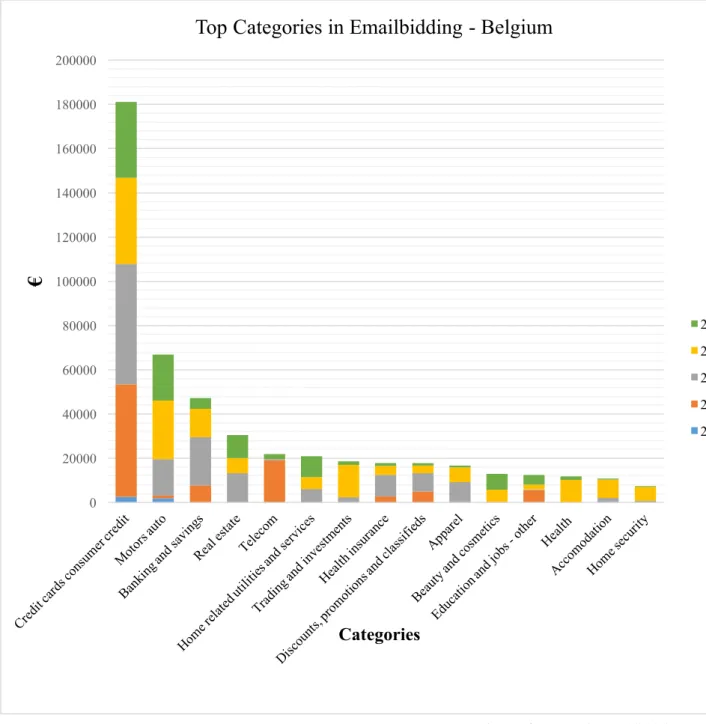
Appendix 3 – Emailbidding’s Categories Performance: 2013 to 2017 ... 70
Appendix 4 – Interview’s Guide ... 73
Appendix 5 – Célia Bras’ interview ... 75
Appendix 6 – Tatiana Ferreira’s interview ... 80
Appendix 7 – Marina Monteiro’s interview ... 84
Appendix 8 – Fábio Silva’s interview ... 86
Appendix 9 – Inês Santos’ interview ... 90
Table Index
Table 1:Digital Marketing Definitions ... 5Table 2: The Value Proposition of the Digital Context to Marketing-Mix ... 8
Table 3: Emailbidding's Marketing-Mix ... 26
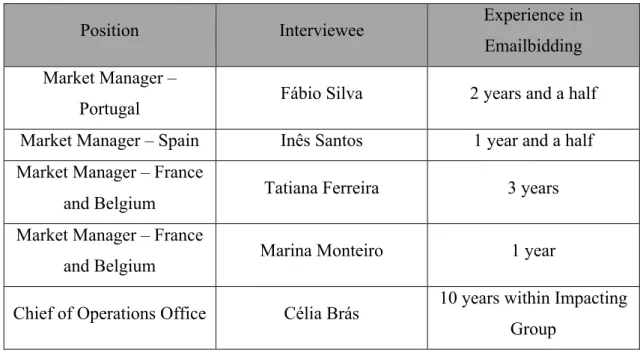
Table 4: Research's interviewees ... 38
viii
Figure Index
Figure 1: Top Categories Performance in Emailbidding - Portugal ... 29
Figure 2: Top Categories Performance in Emailbidding - Spain ... 31
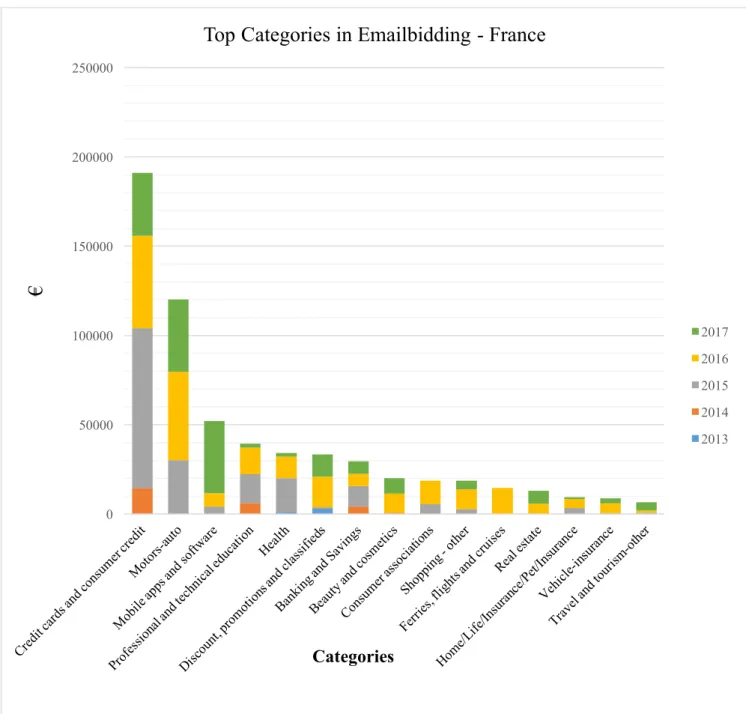
Figure 3: Top Categories Performance in Emailbidding - France ... 33
1
1. Introduction
The growing trend of internationalization by organizations is one of the factors that makes markets development even more competitive. In the digital environment, this paradigm is intensified, since the market becomes naturally global due to the absence of physical borders and low entry barriers. It is therefore important to re-evaluate the processes of internationalization, since markets are constantly changing in the digital universe and cultural barriers still represent a challenge to internationalization processes.
The rapid implementation of Information and Communication Technologies (ICT), as well as the Internet, has opened doors to innovation, sometimes in a disruptive way. Only in Portugal, it is expected that by the end of 2017, there are around 8.4 million Internet users, only in Portugal, and 4.5 billion euros (2.5% of GDP) will be transacted online (IDC/ACEPI, 2013).
However, the way technological support changed managerial practices does not have consensus within the academy. From technology as a mere interaction channel to separation between marketing and digital marketing, there are still some gaps regarding the factors that have to be considered in a marketing plan (Baltes, 2016).
It is important then to analyse brand management processes, based only on a technological support. Using external and internal analysis tools, purely online, it’s a challenge most marketing managers deal when building a marketing plan.
In terms of digital transformation, around 26% of industrial companies start to allocate a part of their budgets on digital channels (Järvinen & Karjaluoto, 2015). Thanks to ICT interactivity and development, it leverages learning skills about new and potential markets (idem). However, pressure caused by competitors moves, as known as Me Too Syndrome, is still the main reason to develop an integrated marketing strategy (Tiago & Veríssimo, 2014) (Järvinen & Karjaluoto, 2015).
Wondeotec also felt this need with Emailbidding. The current investigation was developed in a curricular internship in the referred company, between 8th September 2016
2 to 8th March 2017. Its main goal was to understand what’s the best positioning for Emailbidding –in Full Email format – in operating markets: Portugal, Spain, France and Belgium. With almost three years of existence and some conquered awareness in some markets, it will be this work’s purpose to evaluate the product’s positioning in its different international contexts.
Constant changings on technology sector still challenge dominant perspectives on companies’ managements, its markets and competition (Baltes, 2016). As previously referred, this internship’s report will be able to draw a path towards digital positioning, which is seen as a helpful contribute in terms of managerial practices. Simultaneously, to the academy this work can be seen as a guide to further and deeper analysis on what basis do brand management occurs in a pure play product or service.
Following this introduction, Chapter 2 presents a synthesis of literature on digital marketing, international growth and digital brand management, with a specific focus on how ICT can potentiate a marketing strategy, as well as international growth. Chapter 3 describes this research’s empirical case and Chapter 4 the methodology selected for this research. The results are analysed in Chapter 5 and its discussion on Chapter 6. Chapter 7 employs research’s conclusions, implications for management practices and academic research and gives some suggestions for further research.
3
2. Literature Review
ICT and Internet opened doors to a new approach towards internationalization processes: foreign investment may support itself on collecting information through new digital media (Matos, 2016). All new digital channels and platforms have innovated in the way of doing business and its value can be communicated (Kaufman & Horton, 2015). In this section, we will try to summarize the literature on the influence of ICT in the marketing area, focusing on the definition of digital marketing and how changes in marketing-mix, allows an establishment of an integrated strategy. Some models of internationalization, such as the Uppsala model, International Network Theory, Born Global and International Entrepreneurship, are also addressed, since they are the ones that best fit the context of the work to be developed.
2.1 Digital Marketing
2.1.2 The technological support: WEB 2.0
If initially technological changes could be spaced in time, the beginning of 21st century turned it into a complex challenge. WEB 2.0’s concept comes up in a brainstorming session between Tim O’Reilly and Media Live International, in 2004. However, the notorious changes in using this new technology - the Internet - has promoted numerous conferences subordinate to this new term. This concept assumes itself as the set of economic, social and technological trends that form the new generation of the Internet, making it a more mature medium. Consumer dominance predominates in this atmosphere, as well as the openness and transparency of relations and the networking effect (O'Reilly, 2007).
The technological tools associated to WEB 2.0 are oriented mainly to data and content creation, relying on interactive, easy-to-use and deconstruction software (Hess, et al., 2016). This content production is all done in an environment of collaboration and convergence. In the Convergence Culture, there is a trend towards media convergence, which in turn promotes consumer participation and collaboration (Jenkins & Deuze, 2008). Applied to business management issues, Convergence Culture allows all members
4 of an organization to collect information relevant to their performance, as well as the success of the organization where they collaborate. This information is subsequently shared with other members of that organization, enriching the shared vision of what is happening in the markets where it operates and what feedback this interaction and sharing allows (Maravilha-Lopes & Sérgio, 2013).
The accessibility of Web 2.0 media promotes changes on interactions between peers, companies and institutions, altering the way of doing business, making its sustainability more complex in this environment (idem). The use of information markets, collaborative software, crowd wisdom, wikis, blogs and other tools reinforce the idea of collective sharing and growth, sustained in an increasingly digital environment (Kaufman & Horton, 2015). There are also two major distinguishing marks of this participatory culture: value co-creation and the emergence of social networks (idem) (Tiago & Veríssimo, 2014). 2.1.2. Digital Marketing Definition
The very definition of the term Digital Marketing is not consensual. The existing terminology varied over time and according to the area and perspective of specialization of the authors who approached the theme. E-Marketing, internet marketing, mobile marketing, social media marketing are some of the recurring terms (Strauss&Frost,2001; Smith & Chaffey, 2005; Gabriel, 2010; El- Gohary, 2010; Adolpho, 2012; Chaffey, 2015; Kaufman e Horton,2015; Afonso, Monteiro, Amaral, & Neto, 2016). Regarding the current work, the term e-marketing or digital marketing are more comprehensive terms, as they consider the spectrum of numerous digital channels, that mobile devices - smartphones and tablets - are an example (Afonso, et al., 2016).
The growing terrain of new technologies in society, as described above, is becoming a relevant and important subject for marketers (Wymbs, 2011). The most innovative explore the possibilities that new digital media can offer in contact with their target audience. Today, it can be said that the border between the said traditional marketing and digital marketing is blurred, becoming almost consensual the mandatory presence of a digital strategy in a marketing plan (idem) (Spil, et al., 2016).
In the bibliography considered for the present study, the majority started with the definition of Marketing of the American Marketing Association, shaping it to the digital context: "It is the activity, set of institutions and processes to create, communicate, deliver
5 and exchange offers that bring value for Customers, suppliers, partners and society in general " (AMA, 2016).
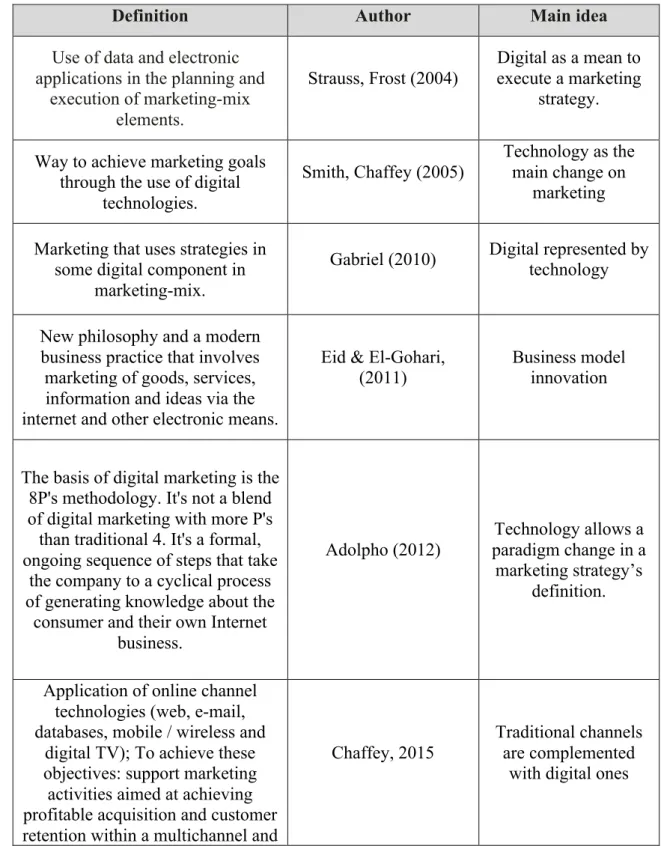
Table 1 shows an overview of digital marketing definitions:
Table 1:Digital Marketing Definitions
Definition Author Main idea
Use of data and electronic applications in the planning and
execution of marketing-mix elements. Strauss, Frost (2004) Digital as a mean to execute a marketing strategy.
Way to achieve marketing goals through the use of digital
technologies.
Smith, Chaffey (2005) Technology as the main change on marketing
Marketing that uses strategies in some digital component in
marketing-mix.
Gabriel (2010) Digital represented by technology
New philosophy and a modern business practice that involves marketing of goods, services, information and ideas via the internet and other electronic means.
Eid & El-Gohari,
(2011) Business model innovation
The basis of digital marketing is the 8P's methodology. It's not a blend of digital marketing with more P's than traditional 4. It's a formal, ongoing sequence of steps that take
the company to a cyclical process of generating knowledge about the
consumer and their own Internet business. Adolpho (2012) Technology allows a paradigm change in a marketing strategy’s definition.
Application of online channel technologies (web, e-mail, databases, mobile / wireless and
digital TV); To achieve these objectives: support marketing activities aimed at achieving profitable acquisition and customer retention within a multichannel and
Chaffey, 2015
Traditional channels are complemented
6 customer lifecycle purchasing
process; Through the use of these marketing tactics: recognizing the strategic importance of digital technologies and developing a planned approach to reach and migrate customers to online services through traditional electronic communications and
communications.
A marketing action is digital if it is dependent on a digital medium to
perform its specific function or complete the intended action.
Kaufman e Horton (2015) Intrinsic relationship with new technologies, not exclusive; Set of actions that allow to
accurately perceive the needs, interests and behaviours of the consumers, allowing a greater optimization of costs by contact and the possibility of developing more effective loyalty programs.
Afonso, Monteiro, et al (2016)
Integrated strategy based on the benefits
of new technologies
Sources: (Martins, 2015; Adolpho, 2011; Adams, 2009; Kaufman & Horton, 2015; Spil et. al, 2016; Strauss & Frost, 2014; Eid & El-Gohari, 2011; Gabriel, 2010)
The digital logic, integrated in the offline strategy is consensual for most authors consulted. It is about applying the new rules of the digital atmosphere without neglecting the basic marketing principles. This integrated strategy unequivocally becomes a competitive advantage (Martins, 2015) (Baltes, 2016).
2.1.3. Changes in Marketing-Mix
Although the new technological support is consensually accepted in the scope of the marketing activities, the degree and the intensity of the changes caused by this same one does not follow the same rhythm (Adolpho, 2011).
Considering that everything else remains constant, on one hand it can be understood that technological changes have fostered greater digital interactivity, which translates into a closer proximity between consumers and brands. However, the technology has brought
7 to the communication the accessibility and the convenience that later the digital came to add (Afonso, et al., 2016) (Baltes, 2016) (Lamberton & Stephen, 2016).
In a first approach, the changes could be delimited in five aspects: Cost, to the extent that the new means supported by the technology are less expensive in relation to the traditional sayings, although with investments in technology; Coverage, since digital media such as social networks, leverage the immediate availability of information, so that it does not expire; Audience, which, depending on the area of activity, implies new forms of interaction with the consumer, in a more integrated perspective; Immediatism in the dissemination of contents, almost instantaneous, filling the gap; Tracking, in that it is possible to have access to the history of consumers who interacted with the brand, at what time and from which device (Afonso, et al., 2016).
The in-depth reflection on the established technological changes raised the hypothesis of adding four P's to those initially proposed by McCarthy and accompanying the intense pace of changes and updates of the digital environment: Personalization and Participation, both framed in the Convergence Culture’s concept (Jenkins & Deuze, 2008) and aimed at consumer involvement in marketing-mix, giving relevance to their participation and opinions; Peer to Peer, in the sense that peer-to-peer content generate more trust than advertising itself, which poses some challenges to the socialization of brand messages; finally, Predictive Modelling, based on a technological context that allows rapid learning about consumer preferences, framed in an environment of respect for their privacy (Adams, 2009).
When considering the many tools of technology, there is still a proposal for a complete renewal in the elements of marketing-mix in the digital world (Adolpho, 2011). The idea of a new sequence of words, shaped specifically for the digital world - Research, Planning, Production, Publication, Promotion, Propagation, Personalization and Precision (idem).
However, this approach is purely technological, something that is not intended for this work. Through literature consulted, it is important to establish an integrated logic in marketing activities, which includes the elements of marketing-mix. Undoubtedly ICTs have innovated the way they plan and implement marketing activities. However, these
8 changes are not understood at a level of corruption with the path outlined so far, but rather in a perspective of optimization and diversification of the elements of marketing-mix. Even for so-called pure-play businesses, it is important to consider this integrated and coordinated logic in order to better know how to respond to the current strategic challenges (Lamberton & Stephen, 2016) (Baltes, 2016).
The pace of change in the digital context, since the beginning of the 21st century, can be marked by four major trends (Lamberton & Stephen, 2016). In a very succinct way, the first major trend (2000-2004) began to show the importance of digital channels and social networks for consumer behaviour and the intensification of the concept of culture of convergence and participation (Jenkins, 2006), the second (2005-2010) already shows "WEB 2.0" as a form of business development. (Idem) Find here the development of great online businesses, with an expanded offer without costs of production and storage, as it shows the Long Tail Theory (Anderson, 2006).
From 2011 onwards, the influence of social networks and their important inclusion in the strategic management of brands is verified. In the last two years, the great challenge that has arisen is the quantification of the benefits that the investment in these channels can bring to the organization (Lamberton & Stephen, 2016).
This reinforces the idea that there should be no separation between traditional marketing and digital marketing. The strategic strands and tools of both can and should be complemented, providing a solid competitive advantage the more integrated and harmonious the integration.
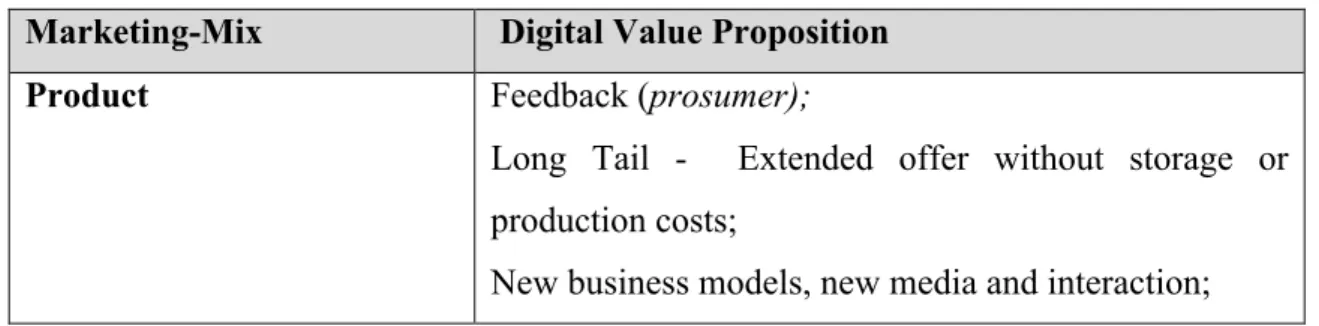
Table 2 shows a brief description on changes provided by digital age:
Table 2: The Value Proposition of the Digital Context to Marketing-Mix Marketing-Mix Digital Value Proposition
Product Feedback (prosumer);
Long Tail - Extended offer without storage or production costs;
9
Price Dynamic and segmented prices;
Auction, negotiation, promotional prices; Historical prices and transparency
Tax Free Zone;
Lower selling costs;
Placement Online store integrated on the value chain; Higher geographical coverage;
Higher offer without raising prices;
Promotion Marketing Mix’s element with the greatest changes: Website (SEO), blog, newsletters, social network (copywriters), webinars, banner &display ads, forums and online contests;
Personalization and Participation;
Customer Relationship Management (CRM); Interactivity and Affiliation;
Engagement; Performance; Word of Mouth; Physical Evidences Website as visit card;
User Experience;
People New values;
New shopping behaviour;
Processes Technological support;
E-fulfilment; Back office 24 X 7
Sources: (Kalyanam & Mclntyre, 2002; Adolpho, 2011; Afonso, Monteiro, Amaral, & Neto, 2016; Anderson, 2006; Baltes, 2016; Eid & El-Gohari, 2011; Kaufman & Horton, 2015; Adams, 2009) 2.1.4. Earned, Paid and Owned Media
Changes introduced by ICT have fostered a new relationship with consumers, where emphasis is on quick access to information and its quality and adaptation of the message to interactivity in communication (Hess, et al., 2016). Communication has proved to be a
10 key component of digital marketing, just as social networks have become a privileged channel in obtaining customer information and contacting stakeholders (Tiago & Veríssimo, 2014).
The online positioning for a particular brand acquires another status, made possible by the wide range of tools provided with the implementation of new technologies. Although for different targets, traditional means loses relevance to the so-called paid, owned and earned media (Hanna, et al., 2011).
Traditional means of marketing and advertising acquired by a company or brand can be considered as paid media. Included in the online world are banner ads, affiliate marketing and paid search (Search Engine Marketing) (Hanna, et al., 2011). Usually the strategy attributed to these means goes through the conquest of potential clients. However, special care is required with these media, since the sensitivity of the consumers to these media is increasing, easily distinguishing the paid content of the organic, and can put in question the strategy adopted (Hanna, et al., 2011) (Lawlor, et al., 2016).
Owned media, as the name implies, are the ones managed by the company, institution or brand. In this way, the SEO (Search Engine Optimization) strategy of the institutional website is better aligned with the position it occupies in the organic search results, as well as the number of direct visits to the site - direct writing of the URL of the website company (Baetzgen & Tropp, 2013). It also includes in these media the strategy of content followed in blogs, applications and social networks. The great interactivity of these media enhances the dialogue with customers, and can intensify their relationship with the brand and / or company (Hanna, et al., 2011) (Afonso, et al., 2016).
Earned media grows organically through consumers’ interactions with the organization. It includes sharing content developed by the firm, through social networks, blogs or forums for discussion and discussion. Aspects like product reviews, forum participation and content sharing generates an organic traffic, which later adds value to the brand (Hanna, et al., 2011) (Jenkins & Deuze, 2008). This sharing and participation environment fosters Word of Mouth (WOM) and User Generated Content, current trends in digital marketing (Lamberton & Stephen, 2016).
11 As previously stated, consumers' technological aptitude is irrefutable and should not be overlooked when designing an integrated marketing strategy. Although the ideal scenario would be to increase traffic through conquered media, it is important to know how to manage brand’s presence in these three channels, so as to appear genuine the intervention of the brand and consequently solidify its competitive advantage. Without an integrated marketing strategy, with constant evaluation of its performance, it becomes an inconsistent strategy, and without results that could be dynamic and easily adapted (Baetzgen & Tropp, 2013) (Baltes, 2016).
2.2. Digital Brand Management
If research in terms of brand sources continues, its complexity becomes wider when digital transformation is introduced. Information and Communication Technologies have created new ways of acquiring products / services, which compete with each other at various levels. The range of possibilities that technology offers supports the offer of a certain brand, making it more understandable and credible. So, terms such as "scanning," "automation and connectivity," combined with "Big Data," help provide consumers and stakeholders with complete information about their products and services, consolidating brand equity (Canli, et al., 2016).
These issues introduce some challenges in terms of brand management issues, especially as regards the accessibility and availability of information for purchase decision (idem). It is essential to plan, implement, but also evaluate a brand’s digital presence, since it can help (or not) to generate and / or preserve a positive brand reputation (Hohenhal, et al., 2014).
The moments of brand / consumer contact are thus important to manage, as they enable the moulding of perceptions about the brand (Canli, et al., 2016) (Canhoto, et al., 2016). These moments range from offline dating, such as testing a product in a local store to searching the online search engine, in order to compare characteristics and prices between products, as well as reviews of other consumers about the same product (Lecinski, 2011). The term “electronic Word of Mouth” (eWOM) has gained more and more weight in engagement and subsequent brand loyalty as sources of brand equity. The multiple online
12 platforms (social networks, forums, among others) foster interaction between consumers, who can share opinions about brands and product preferences, leveraging peer to peer eWOM (Moran et al., 2014).
The accelerated pace of new technological instruments requires more and more effective attention by brand managers to the points of contact between brand and consumer. The advent of Web 2.0 and its culture partaking, has made online presence of a brand implicit, not adding value to the brand. At the outset, it is already expected by consumers that the brand has an online presence. However, even if the online presence does not add value, absence may significantly reduce brand equity (Mathews, et al., 2015).
Along with eWOM, what has also gained importance regarding brand management issues are User Generated Content (UGC) and social networks. It becomes more and more important what peers say about the brand and what the brand itself says about itself. By sharing information, consumer power is given indirectly to other consumers (Canli, et al., 2016).
2.2.1 Digital brand equity sources: Innovativeness, Responsivity and Responsibility
The new technological context implies a major transformation in brand management (Afonso, et al., 2016). They see forced to increase its emotional and functional values, along with social values, in a way that the branding process ceases to be unidirectional, directed only at consumers, but a more complex process involving a multi-level collaboration between companies, consumers and the brand community (Lamberton & Stephen, 2016). This perspective of collective branding takes various forms, from UGC to communities, through engagement or social networks. The post-Internet era is, above all, about the availability and facilitation of conversations around the brand (Kotler, et al., 2017).
Recent investigations into the technological, digital and economic changes in the field of brand management suggest the addition of three new attributes that may enhance brand resonance in brand equity (idem) (Canli, et al., 2016). Emphasis on these attributes may contribute to the creation of lasting and meaningful relationships with consumers, since
13 they need, demand and value these attributes, making it possible to become a point of parity, but a point of difference without a doubt.
2.2.1.1 Innovativeness
If innovation was previously an important organizational factor, digital globalization and its rapid introduction of new products and services make innovativeness an increasingly critical factor when it comes to international expansion (Chandrasekaran & Tellis, 2008; Sood & Tellis, 2009). This is why sharing synergies between companies strengthens innovation. Strategic alliances and partnerships have fostered the innovation of a given organization. From the consumer's point of view, technological developments enhance the perception that innovative brands will be more useful and adapted to technological and market trends, which can lead to a solid and reliable brand image (Canhoto, et al., 2016).
As far as the research was carried out, there is no data to justify innovativeness as an important driver of brand equity, despite the effective demonstration of the same in the performance of the market and in the valuation of the companies. It would therefore be useful and meaningful to see how innovativeness can influence the intangible aspects of brand equity, namely brand awareness, uniqueness, and favorability. It will also be worthwhile to explore how the innovativeness attributes interactions with other seemingly conflicting important attributes or benefit associations of the brand, such as authenticity (Canli, et al., 2016) (Kotler, et al., 2017). While brands need to innovate to move forward and adapt to the rapidly changing competitive marketing environment, they also need to preserve their core values and authenticity to stay relevant. Hence, it is important to understand how to integrate these highly valued and diverse brand attributes into complementary aspects in brand management practices (idem).
2.2.1.2 Responsiveness
Digital tools have enabled a real-time flow of information, the constant and prioritized use of mobile devices, and increased applications and social networks. Shifting the focus to consumers, it creates new challenges in digital marketing management. Alongside affordability, consumers demand effective and immediate answers. Research shows that
14 customers demand as low as 60-min response rates to their queries from brands on social media (Baer, 2015). Also, customers indicate that they evaluate service experiences more on the timeliness of the responses they receive than the outcome of their interaction (Forbes 2015). With the increasing rate of mobile device penetration and the amount of time spent on mobile phones (more than 34h per month for the average American), communicating with consumers on mobile platforms is rapidly increasing as well (Nielsen, 2014). The interactive (two-way) communication environment has led companies to invest more in their customer relationship management (CRM) activities to develop responsive systems (Rigby & Ledingham 2004) and to directly interact with customers. How to stay in conversation with and respond to consumers on multiple channels, as well as the development of tools to measure brands’ responsiveness metrics, are issues growing in importance in this fast-paced and highly connected marketing environment.
It is thus important to convey a message in real time, in a creative, targeted and interactive way. Through online platforms and mobile tools, it has become more important for brands to deliver timely and targeted content to stand out in the competitive and congested communication environment (Tucker, 2014). Based on the discussed digital advances and increased connectivity, we argue that responsiveness - responding in ways to satisfy individuals' basic psychological needs (Thomson, 2006) - as a brand attribute has become particularly important for brands to build strong consumer relationships and to stand out of the competition. Alongside human responsiveness, brand responsiveness is shown to lead to higher brand attachment by fulfilling the basic psychological needs of autonomy, relatedness, and competence (idem). Generating instant, informative, creative, engaging, and targeted conversations with consumers may provide several benefits for brand knowledge. It may increase brand salience via recall and recognition. However, it is necessary to establish a border on what may be genuine in the brand and what may appear to be forced. Further research is needed to understand the right balance on the intensity of responsiveness and consumer interactions that brands need to assess.
15 2.2.1.3 Responsibility
The concept of sustainability has been a constant in the scope of organizational management. Companies are almost forced to have a sustainable business philosophy: stakeholders, government, NGOs, suppliers, partners, shareholders and citizens.
Organizational practices have to be more transparent, since there is greater pressure on companies to instil the issue of sustainability as a core value (Kotler 2011). Hence, companies need to be responsive towards the evolving concerns of their consumers, as well as other stakeholders. The growing body of research on corporate social responsibility (CSR) activities reveals that focusing on sustainability provides several benefits for the company or the brand (Kotler, et al., 2017) (Afonso, et al., 2016).
CSR activities help build brand equity by improving brand awareness and image, increasing consumer engagement, and creating a sense of community around the brand (Hoeffler and Keller 2002). While product attribute information is shown to be more influential in evaluating a company than its social responsibility actions (Gürhan-Canli and Batra 2004), consumer perceptions of the performance of a company's products may be enhanced by the company's prosocial activities (Chernev & Blair, 2015). Also, literature findings demonstrate a positive link between socially responsible activities and the financial performance of a company (Orlitzky et al., 2003). CSR activities may lead to willingness among consumers to pay higher prices for a company's products and to increased loyalty. (Laroche et al., 2001)
When it comes to digital business practices, recent empirical studies indicate that firms need a more tempered approach to data and analytics initiatives that involve the collection and use of customer information (Martin, et al., 2017). They must consider their approaches to data management carefully to avoid negative effects. Significant findings demonstrate that firms must acknowledge privacy policy dimensions as meaningful proxies for their actual data practices. With more access to information customers are aware of data practices, which affects critical behavioral outcomes. High transparency and control reduces the spread of negative WOM, deters switching, and suppresses negative stock price effects (idem). Thus, it is a dangerous practice for firms to tell customers exactly how they will be collecting data without also providing them with some
16 say over those practices. If they lack control, customers are left to worry about the various potential uses of their data—uses that have been made salient by their transparency. Knowledge alone has mixed effects as a vulnerability suppressor. Therefore, if firms intend to reveal their data use practices to customers, they also need to provide them with some element of control over the information.
Academic literature has also defended data privacy as a firm strategy. First research on the theme indicates that consumers are more willing to grant marketers permission to use their information when the company’s procedures for information use are fair—a case for procedural justice. In return, firms will obtain greater access to rich user data, providing them a competitive advantage over peers with consumer information procedures that are perceived as less fair (Martin & Murphy, 2016). By modeling the economics of consumer privacy, there also demonstration that it is in marketers’ best interest to offer at least some baseline protection to avoid complete erosion of privacy-based customer utility (Martin, et al., 2017). Other findings tell that marketers should have the ability to compete with privacy both in their primary market as a source of superior targeting and marketing to consumers, and in the secondary market where consumer information is sold to third-parties as a separate revenue generating source. It is also possible to find out that strategies where marketers attempt to exploit consumer information in both primary and secondary markets is high risk, and that to avoid privacy backlash corporations should emphasize one or the other (idem).
Ultimately, competing on privacy is both feasible and likely to be successful under certain conditions. In addition to academic research and scholarship that considers how marketers might differentiate on privacy, managerially-focused work suggests data privacy best practices. Strong privacy management provides consumers a positive brand experience, leading to competitive advantage. (Biesdorf, et al., 2013) As such, firms should not view stringent privacy measures as costs or constraints, but rather opportunities to improve the customer experience. Improved customer experience, in turn, should secure loyalty and strengthen relationships grounded in the perceived value of privacy protections (Tucker, 2014).
17 By strengthening the sense of connection and community created with consumers, responsible actions lead to more attached relationships, hence to stronger brand resonance. CSR activities can also be important drivers of brand value (Keller and Lehmann 2003). Predictably, the outcomes are reflected in higher customer loyalty, enhanced financial market performance, and increased shareholder value of the brand (Jennings, et al., 2017)While it is an increasingly important attribute for marketing and brand management practices, there are some conflicting findings about what extent brands should highlight this attribute. Some research indicates the negative effects of responsibility on product efficacy evaluations. On the other hand, some findings reveal that an image of responsibility may have a halo effect and lead to more favourable evaluations on the non-environmental attributes of green products (Haws et al., 2014) (Peloza et al., 2015). Research also draws attention to a critical gap between consumers' attitudes towards sustainable products and their current consumption behaviour (idem). In sum, sustainable developments provide both an opportunity and a challenge for companies.
2.3 Internationalization models in a digital context
Internet and Web 2.0 have opened a new approach to internationalization: investment abroad can be based on the collection of information made possible by new digital resources (Matos, 2016).
As far as the research for the current work was taken, there were some gaps in the internationalization of technological origin. However, new digital media are understood as a new way of communicating value and empowering business (idem).
In this section, a brief overview of the literature on internationalization will be sought, especially as new technologies can leverage the internationalization process.
2.3.1 Uppsala Method
Uppsala method (Johanson & Wiedersheimpaul, 1975) is one of the most frequent theories about internationalization. Inserted in a behavioralist approach, this method is related mainly to attitudes, perceptions and behaviors of the company (Pinto & Pereira, 2016).
18 The result of the experience acquired during the process of internationalization - market knowledge - is fundamental for the evaluation and choice of markets. The process of internationalization is slow and gradual, relying on the concepts of psychological distance (language, political system, education, industrial development) and cultural distance. The combination of the two can be decisive in choosing (or not) a target market (Pinto & Pereira, 2016) (Forsgren, 2016).
This is a successive learning process, which can be carried out by a sequence of modes of entry into the new markets. As a rule, this process begins in countries with a shorter cultural distance, gradually evolving as market knowledge (Pinto & Pereira, 2016) (Júnior, et al., 2016).
The globalization phenomenon and the consequent technological dynamism of markets, forces to reflect on the speed that can be taken in this process. In fact, it is no longer so gradual and relies mainly on the potential of the business network, on which it relies on market knowledge and experience (idem).
The idea of the gradual process of the Uppsala model poses some limitations, especially when it covers in a simple way a process that is, in terms of management, something complex and does not obey all the stages in a linear way (Pinto & Pereira, 2016) (Forsgren, 2016).
2.3.2 International Network Theory
The Network Theory assumes market as a complex network of interactions in which a particular company can be integrated. These networks can be composed of customers, customers of these same clients, competitors, suppliers, agents, consultants, among others (Chavan & Agarwal, 2016).
The market is characterized as highly dynamic, in which the company undertakes to reposition, through relationships that may establish (or not) with other companies in the network. These relationships prove to be powerful for a large part of small and medium-sized enterprises (SMEs), with limited resources, as they can share knowledge synergies with markets, customers, competitors and distribution channels (idem).
ICT has irrefutably facilitated this interaction within networks, spreading the social and international potential of a company (Knight & Liesch, 2016). Most of the contacts
19 established between elements of the same network are established through social networks or other communication platforms (Järvinen & Karjaluoto, 2015).
2.3.3 Born Global
The Born Global model, although not very recent, describes the context of most technology-based companies. This theory is also included in a dynamic, globalized and dynamic atmosphere in which the emergence of the digital media provides the creation of global networks, where demand and supply may be more specialized - Long Tail Theory (idem) (Anderson, 2006).
The flexibility and adaptability of the organizational structure, typical of small to medium-sized enterprises, intensifies the capacity to respond to market challenges (Eid & El-Gohari, 2011). Implicit in this is the entrepreneurial character, in which the world is seen as a single market, the trends of it influence the process of international evolution. As far as sales volume is concerned, most of them are located in the foreign market, where they begin to operate at the time of their origin, or shortly thereafter (Taylor, 2016) (Knight & Liesch, 2016).
ICTs thus appear as a new channel for the sale of products, and in some cases it is the only one for dispersed customers, without communication, transport and adaptation costs. The economic environment, as well as the technological, social and legal framework have enabled the creation and development of Born Global companies, with viable proposals and business models, highly competitive and quick response to the challenges of the global market (idem) (Madsen, 2013).
2.3.4 International Entrepeneurship
International entrepreneurship is a recent area, yet multifaceted, attracting debate, especially with regard to international strategy. The key idea for this model of internationalization is the exploration of opportunities in foreign markets. It is assumed that entrepreneurs are determined to venture in order to acquire knowledge, opportunities and tools from target markets (Oviatt & McDougall, 2005).
The entrepreneur is expected to be able to face risks and understand the market as a global, complex and competitive network (idem). The research on this theme allowed us to outline three profiles of entrepreneurs, namely the managerial entrepreneur, moderated
20 when it comes to taking risks, with a great sense of leadership and a desire for rapid growth; The entrepreneurial R & D, with a strong product orientation and great ability to take risks. Exportation is almost an imposition, yet there is no international strategy outlined. Finally, the social entrepreneur is geared towards new markets, and the ability to take risks is moderate / high. Within this profile, the entrepreneur establishes a mapping of the network and its positioning, influencing the same network the path to internationalization (Ghannad & Andersson, 2012).
This model of internationalization is also associated with small / medium-sized companies, knowledgeable and users of the technologies as a way of reaching an international scale. Market-oriented, this is an approach resulting from the process of exploring opportunities in external markets, the attitude towards risk and the development of competitive resources on the part of the entrepreneur and / or the company to obtain competitive advantage (Ghannad & Andersson, 2012) (Oviatt & McDougall, 2005). Studies on entrepreneurship as a model of internationalization raises the question whether entrepreneurship should be an individual characteristic or a shared value in organizational culture (Ghannad & Andersson, 2012). In order to better achieve international goals, the same values must be shared by all elements of the organization, aligning synergies, resources and internal competencies (McDougall, 1989).
By becoming aware of the technological breadth and complexity, it is not possible to analyse the processes of internationalization, mainly of technological base, only from the point of view of a theoretical model of internationalization. It is necessary to adopt an integrated vision of this process, oriented to the market, to the internal resources and competences and to the position that is occupied in the network of relations. It is also important to add to this analysis the role of the entrepreneur, the organizational culture and the competitive forces (Coviello & Jones, 2004). It is then proposed a news holistic perspective into internationalization processes (Crick & Spence, 2005). Also in the research to be developed in the present work is necessary an integrated and holistic vision of these different theories, since they complement and allow better understanding the process of technology-based internationalization.
21
2.4 International Branding
In light of international growth, there’s a latter concept in literature, helpful for this study which is International Branding. Inserted in an international marketing plan, this concept came up in early 70’s. Its main focus was to study companies’ challenges and decisions when entering new markets, regarding brand issues (name, identity, personality) (Ghannad & Andersson, 2012).
Branding strategy is a key component of a firm’s international marketing strategy, as brands are crucial for establishing a firm’s visibility and position in international markets (Weerawardenaa, et al., 2017). The branding strategy provides a structure to leverage strong brands into other markets (idem). However, to the extent of this research, there’s little consideration on international branding’s approach in Business to Business Context, mainly in relation to company’s exporting efforts, which remain one of the most significant drivers of economic growth.
To highlight the importance of branding in a B2B setting it is worth noting that six of the top sixteen world’s most valuable brands in 2015 are earning substantial revenue from B2B markets; Microsoft, IBM, General Electric, Intel, Cisco and Oracle (Interbrand, cit. in (Pyper & Gounaris, 2016).
Furthermore, when it comes to International Branding in a digital context, there are scarce resources, considering present research (Gabrielsson, 2005). However, some assumptions related to international branding of born-global corporations can be taken advantage of, that is, they view market itself as a priority and, at the outset, will have a large number of markets to manage their presence. If attention was focused for a long time on the standardization or adaptation of the brand in the different markets, today the performance and implications of these decisions are the main concern for literature consulted (idem).
When evaluating the differentiating potential of companies born globally, the research carried out explains that the size of these companies makes it scarce resources to dedicate themselves intensively to a marketing activity and brand building (Efrat, et al., 2017).
22 Instead, they take advantage of the innovative ability of their product to build awareness in the markets in which they operate (idem).
The focus on the market, typical of companies with a born-global philosophy, neglects an essential part of brand building, which is the implementation of internal and external marketing channels, as a way to strengthen brand identity (Aaker & Joachimsthaler, 2000). In these, an important decision is the clear choice for a "push" or "pull" strategy. If in the second one uses advertising and sales promotion to create pull for the brand among consumers. Personal sales, direct marketing and public relations are the typical strategies to deliver value at each point of contact with the consumer in each of the channels (Webster, 2000).
The average size born global companies and consequent lack of resources allows to conclude in the different studies, the degree of standardization is done on a continuum. For instance, from fully standardized brands whose positioning, personality, look, and feel are uniform across the countries to which they belong, the positions themselves as the true defenders of the local culture (Aaker & Joachimsthaler, 2000).
The need to distinguish between brand standardization and elements attached to the marketing plan and the standardization of management processes is also stressed. In the studies consulted, it is demonstrated that it will be easier to standardize branding process planning and best practices sharing system than the brand content itself (Gabrielsson, 2005). Although in terms of the brand standardization of born global, empirical evidence is scarce, it has nevertheless been proposed that born global apply highly standardized product and marketing strategies from the very beginning (idem).
A leading argument in much of this literature is that standardization should not exceed the level where not even minimum national requirements are acknowledged. Product life cycle stage and level of competition have been used in earlier studies as variables to international branding strategies (Weerawardenaa, et al., 2017). For instance, the spreading of the innovation to broader user groups usually requires more emphasis on branding as the newness of technology. However, this can be not enough to convince the
23 consumers that are more conservative. Besides, increased competition along the lifecycle may call for higher investments into branding to secure the global position (Zahra, et al., 2003).
The mismatch between the explored variables makes, according to the authors studied, makes born global to rely on supplementary competences sourced from other firms. In their distribution channels, they more often rely on close relationships and network partners (Madsen and Servais, cit. in Gabrielsson, 2005).
These business relationships provide born global with an opportunity to learn the necessary skills, which enables them to develop new markets, in which they can develop new relationships, with afterwards benefits in entering (Zou & Cavusgil, 2002). Hence, born global often form alliances with large distribution channels, in order to learn from their ready-built sales channels, reputation, and brands. In addition, they cooperate with large MNCs, which use born global products in their systems (idem). This can be beneficial for born global in an initial phase, but can become problematic if they become overwhelmingly inter-dependent on these large channels. Price negotiations and sales channel conflicts can become a burden.
A recent empirical investigation on Finland’s Born Global small and medium-sized companies confirm some of the earlier study assumptions that experience, motivation and global orientation are crucial qualities for the success of born global branding efforts (Zahra, et al., 2003) (Gabrielsson, 2005). More importantly, the theoretical assumption developed within this study says that business-to-business and business-to-consumer born global differ as to their branding strategies and brand- building approaches received support. For born global targeting consumers, a globally standardized brand is crucial. This brand could be their own or co-branded if resources are tight (idem). Typically, companies could leverage the brand image and awareness of a global film studio or a globally recognized magazine. In contrast, born global targeting business customers often utilize multiple brands, ranging from OEM, private label and brands of their own, depending on the segment and market in question. Thus, their products are offered to end-customers around the world in a less standardized manner (Gabrielsson, 2005).
24 Management of such multiple branding strategies was described by the business-to-business born global as challenging due to a high dependence on their large channels and to the potential for conflict (Zou & Cavusgil, 2002). Also, business-to-consumer born global firms reported that achievement of necessary recognition for their brand was sometimes the result of tough negotiations with their large co-branding partners (Jennings, et al., 2017). Moreover, there was support for the idea that business-to-business born global companies rely more on push based marketing and business-to-consumer born global also need to create demand pull by use of innovative and often new low-cost marketing techniques (Aaker & Joachimsthaler, 2000) (Zahra, et al., 2003).It was also determined that the born global should be divided into international beginners, already international, and global companies.
Established theoretical framework for this report, next chapter describes the empirical study under analysis.
25
3. Empirical Study: Wondeotec, S.A.
3.1. From online Advertising to Digital Specialists
The history of Wondeotec and the Impacting Group merges with the history of Adclick (founding company of the group) in 2007. Specialists in online advertising, the creation of their own digital tools and consequent adherence by the company's customers forced the partners - Founders to re-evaluate the market position of Adclick, which had a growth of 410% between 2010 and 2014.
Thus arises in 2014 the Impacting group, with a strategy of growth that aims at the separation of business. We have Adclick, a specialist in lead generation and content marketing; Wondeotec, owner of the Emailbidding platform, with base technology created at Adclick and Smarkio, a specialist in marketing automation.
3.2. Emailbidding
Emailbidding as an email marketing platform comes in the beginning of 2014, after checking a gap in the market in terms of email marketing channel. Initially, it was oriented to French Market only, through commercial partnership with Kwanko group. Nowadays, this partnership extents to Emailbidding’s most operating markets, namely Portugal, Spain, France, Belgium and Poland. The product is able to bridge the gap between advertisers and publishers that integrate their databases into the platform.
Through a campaign optimization algorithm, it will be possible to estimate the reach of a particular campaign, without the same user receiving two campaigns simultaneously. Advertisers can target the campaign according to user location, age, and gender.
Alongside targeting and estimated reach, advertisers can choose the best bid and budget for their campaign. In an auction perspective, the campaign is submitted to a Warming Up process for 3 days, in which the metrics for subsequent competition with other campaigns of the same genre are evaluated. It is important to highlight that price methodology influence campaign’s performance. In Emailbidding it is possible to pay in a CPC, CPO and CPM method. A Cost Per Click (CPC) campaign’s performance is influenced by Click-through-rate (CTR), combined with Open Rate (OR); Cost Per Open (CPO) is only influenced by Open Rate; Cost Per Thousand (CPM) charges advertisers for each thousand emails sent, with no metrics associated.
26 Not only there’s a strong behavioural, consumer-based element on the platform, but there’s also an associated human component on Emailbidding. Each market manager contacts and helps new clients to setup campaigns on Emailbidding. Adding to this, after submitting a campaign, market managers help also advertisers to improve its performance, giving expert advice and consulting on what can be improved.
All campaigns are send to Emailbidding’s publishers – database owners who share it within the platform. Besides external publishers, Emailbidding’s campaigns run also in Adclick’s database’s, reinforcing a sharing environment within Impacting Group. All database owners with potential of integrating it Emailbidding must fulfil double opt-in requirements. Reaching 30 million active contacts by the end of 2016, Emailbidding had a final outcome of 2 million euros last year (Appendix 1).
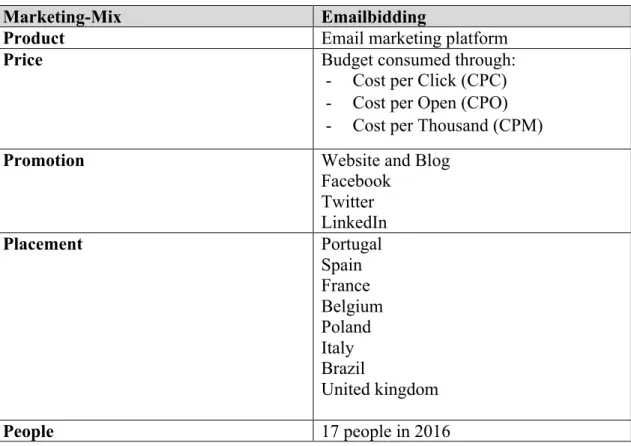
Table 3 synthesizes Emailbidding’s Marketing-Mix elements:
Table 3: Emailbidding's Marketing-Mix
Marketing-Mix Emailbidding
Product Email marketing platform
Price Budget consumed through:
- Cost per Click (CPC) - Cost per Open (CPO) - Cost per Thousand (CPM)
Promotion Website and Blog
Facebook Twitter LinkedIn Placement Portugal Spain France Belgium Poland Italy Brazil United kingdom People 17 people in 2016
27
Processes 1. User message – website
2. Contact via phone 3. Account creation
4. Campaign Submission by advertiser
5. Campaign Content and Requirements Approval by market manager
6. Campaign in Warming Up Stage for 3 days
7. After 3 days, competes with campaigns within the same category
Physical Evidences Website
Platform itself
Source: own elaboration
3.3. Wondeotec’s Markets Overview
To achieve the goals of this report, it is important to analyse each of the markets in terms of investment made in digital marketing, particularly through email communication. Such an analysis is crucial to making decisions inside the organization.
In a simple way, it can be said that affiliate networks are the main competitors of Emailbidding, however not directly. Advertiser’s possibility to control campaign’s in Emailbidding represents its added value in relation to affiliate networks.
A brief market research initially developed by Emailbidding market managers, with latter help during the internship helped identifying other Emailbidding’s competitors (Appendix 2). Although the majority is specialized in email marketing optimization, it only offers native advertising on newsletters belonging to other firms. There’s an exception however in this research – Livintent - but it entered the market only in 2017, and to the extent of the research its priority market is the United States of America.
This chapter will compare data relative to investment in advertising by sector in each market with the respective results in the Emailbidding platform (Appendix 3).
28 Worldwide, corporate reports indicate it is estimated that the investment in digital marketing will grow by 30% in the next five years, 7% of which will be in email marketing, thus surpassing other - usually considered more traditional - communication channels. (Oracle, 2016)
3.3.1. Portugal
In the end of 2016, the Portuguese advertising market was worth approximately 545 million euros. According to data from June, the investment is predicted to grow by 2%, reaching 556 million euros by the end of 2017 (Magna Global, 2017).
Although this growth is on par with the rest of the world, Portugal is still one of the few countries where digital marketing is not the leader in investment, with that lead belonging to television, with almost 50% of total investments, making it also the most attractive to advertisers (idem). In comparison, digital channels are valued in about 101 million euros in 2016, which represents nearly 19% of the total market. However, estimates predict a growth of 3% until the end of the year (idem).
To the extent of this research, it was not possible to verify how the investment in digital marketing is distributed among each channel, but according to the world estimate of 7% investment in email marketing, Portugal would have a 7 million euros investment in this digital marketing channel (Oracle, 2016). Following the same line of thought, the search channel would be one with most investment, with video and social networks as the main target of investment from advertisers.
Regarding sectors with digital presence, only 32% of Portuguese companies have online presence, from which 90% have an online website, but only 25% have a Mobile App (IDC/ACEPI, 2013). From the Distribution and Retail sector, 50% of companies have an online store. It is also worth noting that 72% of the Portuguese companies own only a .pt domain, since their contents and products target the Portuguese market exclusively (idem).
In fact, it is the Distribution and Retail sector that benefits from the most volume of visits from Portuguese internet users. During march of 2017, electronic commerce was led by consumer electronics, followed by books and price comparison platforms. The list goes
29 on with software, apparel, hardware, furniture, sports, supermarkets and shopping centres (ACEPI/IDC, 2015).
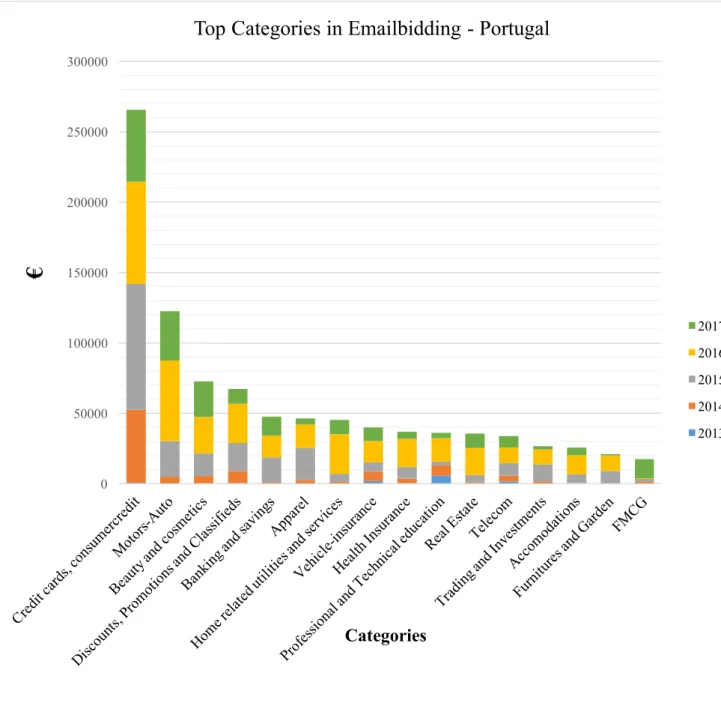
In Emailbidding, the Portuguese market represents about 38% of the platform results in 2016, with a value of 837 thousand euros (Appendix 1). Figure 1 shows the top performing categories in Emailbidding since 2013 (Appendix 3):
0 50000 100000 150000 200000 250000 300000
€
CategoriesTop Categories in Emailbidding - Portugal
2017 2016 2015 2014 2013
30 By analysing the above chart, “Credit cards, consumer credit” overwhelm the remaining categories. With a significant difference, but still well above the rest is the “Motors-Auto” category, which has been steadily growing throughout the analysed periods. Beauty and cosmetics, although with lower performance, shows a similar growth.
It is worth noting that many of the top categories are related to financial services - “Banking and savings”, “Vehicle-insurance”, “Health-insurance” and “Trading and investments”. The remaining categories are related to the services sector - “Home related utilities and services”, “Real estate” and “Telecom” - and retail - “Apparel”, “Furniture and garden” and “FMCG”, which is having a particularly high growth in 2017.
3.3.2. Spain
During the year of 2016, the Spanish advertising market saw an investment of 5396 million euros. Similarly to the Portuguese market, Television is still the leader in advertising investment, being slightly above 50% of the total value (IAB, 2017).
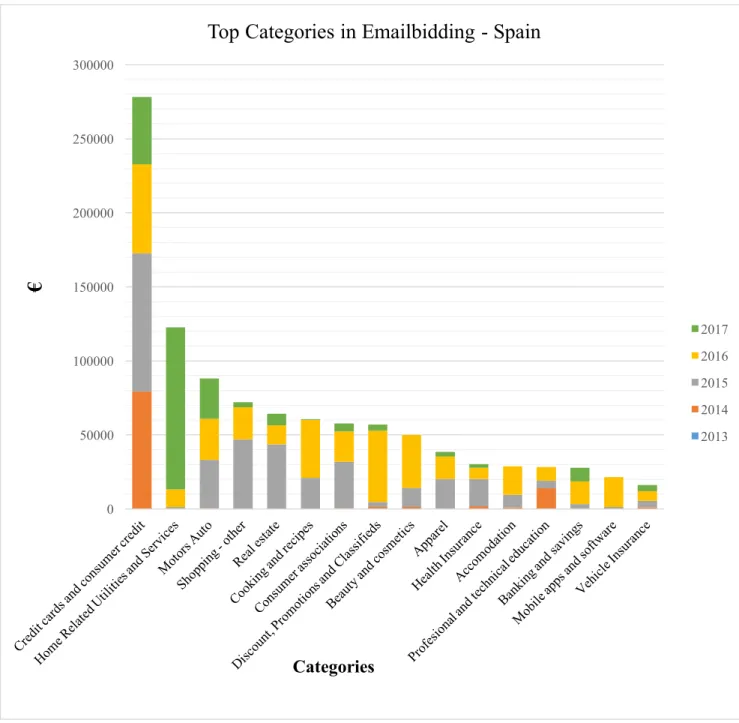
However, digital marketing receives 29%, having a growth of 21% when compared to 2015. Following the previous estimate, the investment in email marketing would be around 109 thousand euros (idem). Available information points that the sectors that most invest in digital marketing are automobile, followed by beauty and health and finally telecommunications. We can also pinpoint that the top spending brands are El Corte Inglés, Movistar, Renault/Dacia, Volkswagen and Ford (idem). In terms of marketing channels, search also occupies the top spot in digital marketing, followed by social networks and video. (idem)
Looking at Emailbidding’s results, the market has the lowest values of the platform, not reaching 5% of platform’s results in 2016 (Appendix 1) .
Figure 2 shows the best performing categories of the Spanish market in Emailbidding (Appendix 3):