of Urbanization
Maximiliano Nardelli1, Paula Marina Scalzo1, Marı´a Soledad Ramı´rez1, Marı´a Paula Quiroga1, Marcelo Herna´n Cassini2,3, Daniela Centro´n1*
1Laboratorio de Investigaciones de los Mecanismos de Resistencia a Antibio´ticos, Facultad de Medicina, Instituto de Microbiologı´a y Parasitologı´a Me´dica (IMPaM, UBA-CONICET), Universidad de Buenos Aires, Ciudad Auto´noma de Buenos Aires, Argentina,2Grupo GEMA, Departamento de Ciencias Ba´sicas, Universidad Nacional de Luja´n, Luja´n, Buenos Aires, Argentina,3Laboratorio de Biologı´a del Comportamiento, IBYME, Ciudad Auto´noma de Buenos Aires, Argentina
Abstract
Background: Class 1 integrons are one of the most successful elements in the acquisition, expression and spread of antimicrobial resistance genes (ARG) among clinical isolates. Little is known about the gene flow of the components of the genetic platforms of class 1 integrons within and between bacterial communities. Thus it is important to better understand the interactions among ‘‘environmental’’intI1, its genetic platforms and its distribution with human activities.
Methodology/Principal Findings:An evaluation of two types of genetic determinants, ARG (sul1andqacE1/qacED1genes) and lateral genetic elements (LGE) (intI1, ISCR1andtniCgenes) in a model of a culture-based method without antibiotic selection was conducted in a gradient of anthropogenic disturbances in a Patagonian island recognized as being one of the last regions containing wild areas. TheintI1, ISCR1genes andintI1pseudogenes that were found widespread throughout natural communities were not associated with urbanization (p.0.05). Each ARG that is embedded in the most common genetic platform of clinical class 1 integrons, showed different ecological and molecular behaviours in environmental samples. While thesul1gene frequency was associated with urbanization, theqacE1/qacED1gene showed an adaptive role to several habitats.
Conclusions/Significance:The high frequency ofintI1pseudogenes suggests that, althoughintI1has a deleterious impact within several genomes, it can easily be disseminated among natural bacterial communities. The widespread occurrence of ISCR1andintI1throughout Patagonian sites with different degree of urbanization, and within different taxa, could be one of the causes of the increasing frequency of multidrug-resistant isolates that have characterized Argentina for decades. The flow of ARG and LGE between natural and clinical communities cannot be explained with a single general process but is a direct consequence of the interaction of multiple factors operating at molecular, ecological, phylogenetic and historical levels.
Citation:Nardelli M, Scalzo PM, Ramı´rez MS, Quiroga MP, Cassini MH, et al. (2012) Class 1 Integrons in Environments with Different Degrees of Urbanization. PLoS ONE 7(6): e39223. doi:10.1371/journal.pone.0039223
Editor:Daniela Flavia Hozbor, Universidad Nacional de La Plata., United States of America
ReceivedNovember 10, 2011;AcceptedMay 17, 2012;PublishedJune 22, 2012
Copyright:ß2012 Nardelli et al. This is an open-access article distributed under the terms of the Creative Commons Attribution License, which permits unrestricted use, distribution, and reproduction in any medium, provided the original author and source are credited.
Funding:This study was supported by grant BID/OC 1723 ANPCyT 0690 from the Agencia Nacional de Promocio´n de Ciencia y Te´cnica (A.N.P.C.Y.T.), which was given to Dr. Centro´n. The funders had no role in study design, data collection and analysis, decision to publish, or preparation of the manuscript.
Competing Interests:The authors have declared that no competing interests exist.
* E-mail: [email protected]
Introduction
In addition to the global causes of death by viruses, bacteria and parasites, which are a huge burden on public health, the progressive increase of multidrug resistance in all geographical regions has been identified as a public health priority according to the World Health Organization, 2011 (http://www.who.int/ drugresistance). In recent years, research on the function of antibiotic resistance in non-clinical environments has begun to receive attention [1,2,3,4]. This interest is based on the idea that a better understanding of the diversity of patterns and biological functions of antibiotic resistance mechanisms may eventually help to control its threats towards human and also animal health. The role of the environment as a reservoir of strains that have never before been isolated from humans was demonstrated during the outbreak caused by enteroaggregative Escherichia coli that had acquired the genes to produce Shiga toxins in Germany in May
2011. This episode also stresses the negative consequence of having mechanisms of antimicrobial resistance in these isolates (blaTEM-1andblaCTX-M-15), which most likely helped the bacteria
to survive and persist in different habitats [5].
determinants such as integrons or transposons with the ARG elements, considering both ecological and molecular parameters.
Lateral genetic transference is a widespread phenomenon that is not only largely responsible for the ability of pathogenic and opportunistic bacteria to resist clinical antibiotic pressures [9], but also enables exchange of the accessory genome, which is a major contributor to bacterial evolution [10]. Of the different mecha-nisms involved in lateral genetic transfer, the class 1 integrons are one of the most successful elements in the acquisition, abundance, maintenance and spread of antimicrobial resistance gene cassettes among gram-negative bacilli isolated from clinical samples [11,12,13,14]. Although their role has not been yet investigated, class 1 integrons have been also found in gram-positive clinical strains, including methicillin-resistant Staphylococcus aureus and
Corynebacteriumspecies [15,16,17,18,19,20], from several hospitals around the world. The basic structure of an integron possesses a gene for an integrase (intI), a recombination site (attI) and a promoter (Pc) that permits the expression of gene cassettes
incorporated in the variable region [21]. Several genetic structures have been described at the 39end of the variable region of class 1 integrons [22,23,24,25,26,27,28]. There are three genetic plat-forms containing and spreading the class 1 integrons described in clinical samples from Argentina (Figure 1): (i) the most common one exhibits the well-known 39-conserved segment (39-CS) at the end of the variable region, which contains theqacED1gene that is a deleted form of the quaternary ammonium compounds resistance gene cassette, qacE, followed by the sul1 gene that confers resistance to sulphonamides, and finally the orf5 of unknown function [12] (Figure 1A); (ii) the complete or incomplete module of Tn402,tniC-tniQ-tniB-tniA[29] (Figure 1B); and (iii) the 39-CS can be invaded by the putative site-specific recombinase ISCR1, which adds a second variable region that can contain an important variety of antimicrobial resistance genes such asbla CTX-M-2andqnrB10, which are known as unusual or complex class 1
integrons [30,31,32,33] (Figure 1C). Neither class 1 integrons nor unusual class 1 integrons allow intracellular mobilization of the
intI1geneper se. However, almost all clinical members of class 1 integrons harbour the IR of the Tn402transposon, transforming this genetic platform into a mobile element when thetnsgenes are providedin trans[25,34]. In addition, Tn402targets plasmid and transposon resolution sites (res) [35], expanding the range of lateral gene transfer between clinical and natural communities [1]. It is very important from a clinical standpoint that the association of genes in the same genetic platform is co-selected under antibiotic pressure.
The relevant role of natural communities as a reservoir and original source of class 1 integrons was recently identified [1,15,36,37]. Since then, their distribution has been reported in environments with different degrees of human disturbance [1,15,36,37,38,39,40,41,42]. Overall, it is assumed that 2.65% of eubacterial cells in non-clinical samples contain a class 1 integron [41]. However, factors involved in the distribution of non-clinical class 1 integrons within natural communities remain largely unknown. What is known with certainty is that the class 1 integrons confer a benefit to the host cell due to their ability to acquire gene cassettes that could provide advantages for survival in hostile environments [43,44,45,46,47].
Concerning the molecular evolution of these elements, class 1 integrons were found to be chromosomally located, pre-dating the association with the Tn402-like transposon in non-clinical samples, suggesting that the ancestor of the clinical class 1 integron was more like a typical chromosomal integron [1]. The understanding of the molecular and environmental properties that contribute to the global success of class 1 integrons is the first step
towards compiling a comprehensive story of how genes, genetic platforms, bacterial populations and selection pressures interact with human activities. However, it is difficult to assess the directionality of the flow of genes among natural environment and human habitats. The different alleles of theintI1gene from natural communities led to the identification of the sources of both ‘‘environmental’’ and ‘‘clinical’’ class 1 integrons [48].
The aim of this study was to analyse the relationships among ‘‘environmental’’ intI1, its genetic platforms and its distribution with human activities in areas with different levels of urbanization (Table 1). Our methodology was based on two strategies: (i) we worked at two scales of analyses, molecular and ecological levels, and (ii) we evaluated two types of genetic elements from the same samples, ARG (sul1 and qacE1 genes) and genetic elements associated to lateral genetic transfer such asintI1, ISCR1andtniC
genes, called lateral genetic elements (LGE) for convenience in this paper and which comprise the genetic platforms of class 1 integrons. The first strategy allows the simultaneous analyses of ecological patterns and molecular mechanisms. The second strategy is based on the expectation that ARG will respond differently to LGE regarding the geographical variation of urbanization due to the different roles of these elements. We hypothesized that, if LGE serve as a general response mechanism to environmental stress, they should be present in both ‘‘clean’’ and urbanized habitats, as far as bacteria meet stressful conditions in ‘‘clean’’ habitats (for example, extreme seasonal or daily variations in weather conditions). Thus, they should present a weak relationship with the degree of urbanization. In contrast, ARG should be closely related to antibiotic pressure, and thus will present a strong link to geographical variations in urbanization and human presence. The field work was conducted in Tierra del Fuego, a Patagonian island from Argentina and Chile (Figure 2), which is recognized as being one of the last places on Earth that contains land areas that can still be considered wild or ‘‘clean’’, given its great extensions of intact, natural vegetation and large vertebrate assemblages, along with a low human population density [49].
Results and Discussion
Taxonomic Distribution of the Components of the Genetic Platforms of Class 1 Integrons
A previous study from Australia found a prevalence of intI1
genes in non-clinical isolates of b-proteobacteria strains in a similar culture-based method [1]. They also found a great dispersion of qacgenes in environmental samples, and proposed that selection for qac resistance before the antibiotic era contributed to the mobilization and widespread of class 1 integrons among the environmental Proteobacteria. They argued that when antibiotics began to be administrated it would be almost inevitable that class 1 integrons would come to play a major role in the dissemination of antibiotic resistance [50].
With the information available from ours and other studies [48,50], it is possible to build a hypothesis on the role of environmentalcandb-proteobacteria as sources of clinicalintI1
genes. In addition, we found that at each sampling site positive for
intI1, ISCR1was also detected and at least onesul1and/orqacE1/ qacED1gene was identified. Although the succession of molecular steps involved in the acquisition of components of the genetic
platforms of class 1 integrons circulating in hospitals nowadays (Figure 1) could not be determined, our study showed a scheme in which the c and b proteobacteria harbouring intI1genes share habitats with several other genera belonging toc, b -proteobac-teria, Actinobacteria and Bacteroidetes, which in turn have the ISCR1,sul1,tniCand/orqacE1/qacED1genes. These genes could have been co-acquired in one bacterial cell by mechanisms associated with lateral genetic transference and later selected by antimicrobial pressure within clinical settings and/or by human activities.
TheSul1Gene is the Only Genetic Marker Associated with Urbanization
The frequency of occurrence of sul1 was significantly and positively related to the level of urbanization, whereas the other genes,intI1, ISCR1,qacE1/qacED1andtniC, were not significantly related to this variable (p.0.05) (Figure 3; Table 3). All 10sul1
Figure 1. Genetic platforms class 1 integrons described in the clinical samples from Argentina.(A) The typical class 1 integron with the 39-CS end containingqacED1,sul1andorf5, (B) the unusual or complex class 1 integrons and, (C) the Tn402-type integrons. Arrows represent the different ORFs: the violet arrow exemplifies theintI1gene, the blue arrow represents thesul1gene, the green arrow stands for theqacED1gene, the red arrow represents thetniCgene, and the yellow arrow represents the ISCR1gene. The degree of colour intensity indicates different alleles for the corresponding gene. Grey rectangles stand forattCs(light grey) andattIs(dark grey). The dotted lines show the variable region of class 1 integrons (VR-1 is variable region 1). Full lines between the arrowheads above the integron structure show the expected amplification products using the different primer combinations. In order to define the different alleles for theintI1genes the sequences were compared to AN AM412236 (isolates 1AC4, 4SN1, 9SN1 and 9AL34) and AN DQ247972 (isolates 7AN1, 11601AL, 11602SL, 11603SL and 11604SL). Thesul1andtniCalleles show the percentage of identity to AN JF262166 and GQ857074, respectively. TheqacE1/qacDE1and the ISCR1sequences (indicated with an asterisk) were 100% identical to the clinical alleles AN HM999792 and EU722351, respectively. The graphic is not drawn to scale.
genes obtained by PCR were sequenced and 7 of them exhibited more than two mutations in 581-bp length compared to thesul1
from clinical isolates (accession number JF262166). In addition, high sequence diversity of thesul1gene (83% identity compared to thesul1sequence in accession number JF262166) was found in one strain isolated from a site with low-level anthropogenic distur-bances (3SC2 isolate, Table 2). In order to analyse the relationship between ‘‘environmental’’ and ‘‘clinical’’ types of genes we
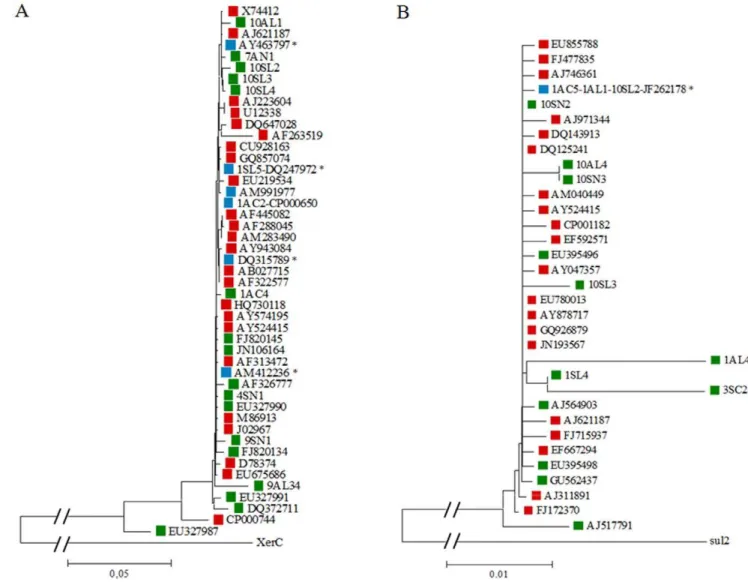
performed a phylogenetic analysis with sul1 alleles from the Genbank and from our work (Figure 4). More than 30 alleles of the
sul1gene were identified in this analysis. Only thesul1allele from the 39-CS of the integrons was found in both clinical and non-clinical isolates.
The high frequency of the sul1genes in urban sites could be the consequence of gene flow of the ‘‘clinical’’sul1allele from the hospital towards the open environment to which are added the
Figure 2. Study area.The geographic sites where the sampling was performed are numbered from 1 to 10 (see Table 1). The circles represent low (white), medium (light blue) and high (dark blue) degrees of urbanization.
doi:10.1371/journal.pone.0039223.g002
Table 1.Sampling sites of Tierra del Fuego Island.
Site Name Date Geographic location Houses Roads Other buildings Urbanization
1 Ushuaia 1 (Pipo River) 22/01/06 S54u4995899W68u2190599 .100 .10 10 High
2 Road Nu26 1 (Turbio River) 25/01/06 S54u4793799W67u1593699 0 1 0 Low
3 Road Nu26 2 (Turbera Maucasen) 25/01/06 S54u3593399W67 0393899 6 1 2 Medium
4 Escondido Lake 1 (hotel) 27/01/06 S54u4094999W67u4894899 15 2 2 Medium
5 Escondido Lake 2 (stream) 27/01/06 S54u419299W67u4993999 0 2 0 Low
6 National Park 1 (Ovando River) 01/02/06 S54u5093699W68u3494299 0 2 0 Low
7 National Park 2 (Ensenada Bay stream) 01/02/06 S54u5094899W68u2895699 0 1 1 Low
8 National Park 3 (Pipo River) 02/02/06 S54u499299W68u2893799 0 1 0 Low
9 Baliza Davidson stream (Moat) 04/02/06 S54u5692499W66u5493099 0 1 0 Low
10 Ushuaia 2 (Ushuaia River) 20/01/06 S54u4793799W68u1593699 .100 .10 10 High
Degree of urbanization was quantitatively estimated by counting the number of buildings and roads that were contained within a 1 km circular area around each site (see Material and Methods).
Table 2.Genetic features of samples isolated in this study.
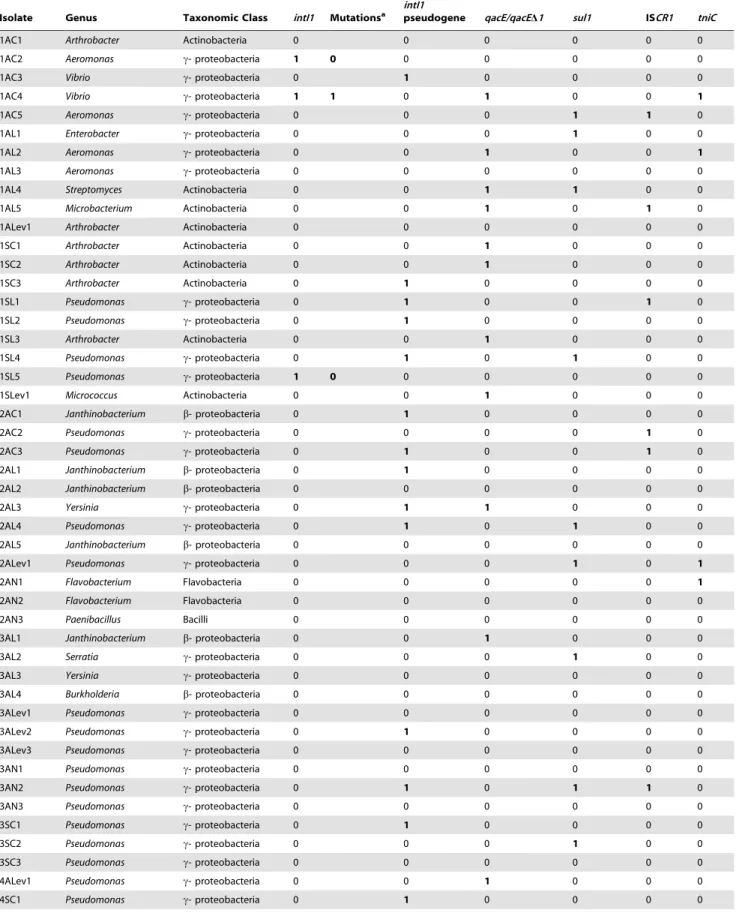
Isolate Genus Taxonomic Class intI1 Mutationsa
intI1
pseudogene qacE/qacED1 sul1 ISCR1 tniC
1AC1 Arthrobacter Actinobacteria 0 0 0 0 0 0
1AC2 Aeromonas c- proteobacteria 1 0 0 0 0 0 0
1AC3 Vibrio c- proteobacteria 0 1 0 0 0 0
1AC4 Vibrio c- proteobacteria 1 1 0 1 0 0 1
1AC5 Aeromonas c- proteobacteria 0 0 0 1 1 0
1AL1 Enterobacter c- proteobacteria 0 0 0 1 0 0
1AL2 Aeromonas c- proteobacteria 0 0 1 0 0 1
1AL3 Aeromonas c- proteobacteria 0 0 0 0 0 0
1AL4 Streptomyces Actinobacteria 0 0 1 1 0 0
1AL5 Microbacterium Actinobacteria 0 0 1 0 1 0
1ALev1 Arthrobacter Actinobacteria 0 0 0 0 0 0
1SC1 Arthrobacter Actinobacteria 0 0 1 0 0 0
1SC2 Arthrobacter Actinobacteria 0 0 1 0 0 0
1SC3 Arthrobacter Actinobacteria 0 1 0 0 0 0
1SL1 Pseudomonas c- proteobacteria 0 1 0 0 1 0
1SL2 Pseudomonas c- proteobacteria 0 1 0 0 0 0
1SL3 Arthrobacter Actinobacteria 0 0 1 0 0 0
1SL4 Pseudomonas c- proteobacteria 0 1 0 1 0 0
1SL5 Pseudomonas c- proteobacteria 1 0 0 0 0 0 0
1SLev1 Micrococcus Actinobacteria 0 0 1 0 0 0
2AC1 Janthinobacterium b- proteobacteria 0 1 0 0 0 0
2AC2 Pseudomonas c- proteobacteria 0 0 0 0 1 0
2AC3 Pseudomonas c- proteobacteria 0 1 0 0 1 0
2AL1 Janthinobacterium b- proteobacteria 0 1 0 0 0 0
2AL2 Janthinobacterium b- proteobacteria 0 0 0 0 0 0
2AL3 Yersinia c- proteobacteria 0 1 1 0 0 0
2AL4 Pseudomonas c- proteobacteria 0 1 0 1 0 0
2AL5 Janthinobacterium b- proteobacteria 0 0 0 0 0 0
2ALev1 Pseudomonas c- proteobacteria 0 0 0 1 0 1
2AN1 Flavobacterium Flavobacteria 0 0 0 0 0 1
2AN2 Flavobacterium Flavobacteria 0 0 0 0 0 0
2AN3 Paenibacillus Bacilli 0 0 0 0 0 0
3AL1 Janthinobacterium b- proteobacteria 0 0 1 0 0 0
3AL2 Serratia c- proteobacteria 0 0 0 1 0 0
3AL3 Yersinia c- proteobacteria 0 0 0 0 0 0
3AL4 Burkholderia b- proteobacteria 0 0 0 0 0 0
3ALev1 Pseudomonas c- proteobacteria 0 0 0 0 0 0
3ALev2 Pseudomonas c- proteobacteria 0 1 0 0 0 0
3ALev3 Pseudomonas c- proteobacteria 0 0 0 0 0 0
3AN1 Pseudomonas c- proteobacteria 0 0 0 0 0 0
3AN2 Pseudomonas c- proteobacteria 0 1 0 1 1 0
3AN3 Pseudomonas c- proteobacteria 0 0 0 0 0 0
3SC1 Pseudomonas c- proteobacteria 0 1 0 0 0 0
3SC2 Pseudomonas c- proteobacteria 0 0 0 1 0 0
3SC3 Pseudomonas c- proteobacteria 0 0 0 0 0 0
4ALev1 Pseudomonas c- proteobacteria 0 0 1 0 0 0
Table 2.Cont.
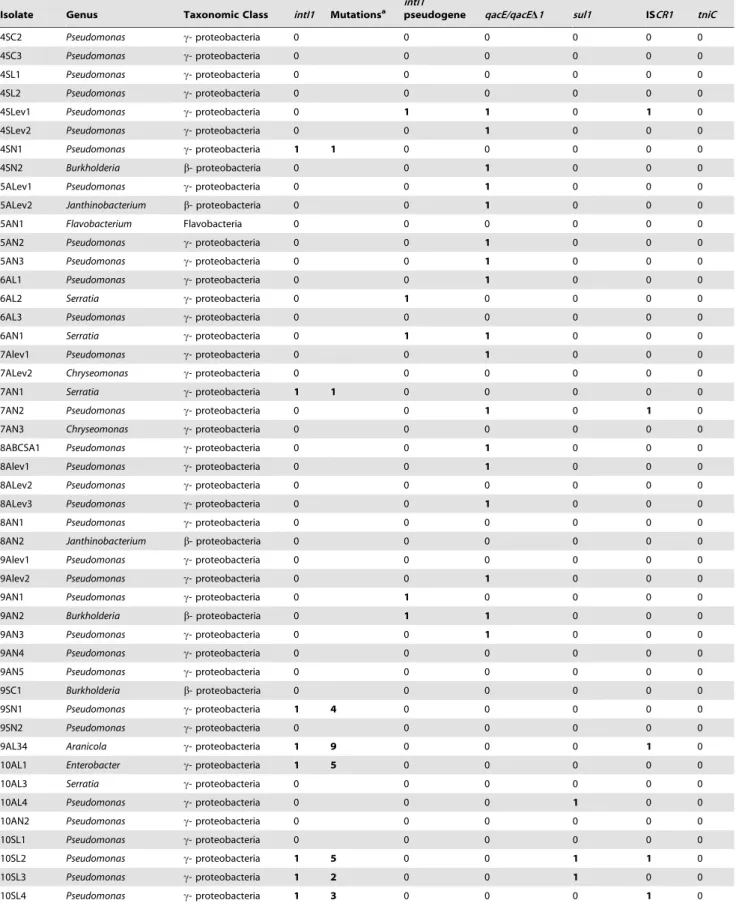
Isolate Genus Taxonomic Class intI1 Mutationsa
intI1
pseudogene qacE/qacED1 sul1 ISCR1 tniC
4SC2 Pseudomonas c- proteobacteria 0 0 0 0 0 0
4SC3 Pseudomonas c- proteobacteria 0 0 0 0 0 0
4SL1 Pseudomonas c- proteobacteria 0 0 0 0 0 0
4SL2 Pseudomonas c- proteobacteria 0 0 0 0 0 0
4SLev1 Pseudomonas c- proteobacteria 0 1 1 0 1 0
4SLev2 Pseudomonas c- proteobacteria 0 0 1 0 0 0
4SN1 Pseudomonas c- proteobacteria 1 1 0 0 0 0 0
4SN2 Burkholderia b- proteobacteria 0 0 1 0 0 0
5ALev1 Pseudomonas c- proteobacteria 0 0 1 0 0 0
5ALev2 Janthinobacterium b- proteobacteria 0 0 1 0 0 0
5AN1 Flavobacterium Flavobacteria 0 0 0 0 0 0
5AN2 Pseudomonas c- proteobacteria 0 0 1 0 0 0
5AN3 Pseudomonas c- proteobacteria 0 0 1 0 0 0
6AL1 Pseudomonas c- proteobacteria 0 0 1 0 0 0
6AL2 Serratia c- proteobacteria 0 1 0 0 0 0
6AL3 Pseudomonas c- proteobacteria 0 0 0 0 0 0
6AN1 Serratia c- proteobacteria 0 1 1 0 0 0
7Alev1 Pseudomonas c- proteobacteria 0 0 1 0 0 0
7ALev2 Chryseomonas c- proteobacteria 0 0 0 0 0 0
7AN1 Serratia c- proteobacteria 1 1 0 0 0 0 0
7AN2 Pseudomonas c- proteobacteria 0 0 1 0 1 0
7AN3 Chryseomonas c- proteobacteria 0 0 0 0 0 0
8ABCSA1 Pseudomonas c- proteobacteria 0 0 1 0 0 0
8Alev1 Pseudomonas c- proteobacteria 0 0 1 0 0 0
8ALev2 Pseudomonas c- proteobacteria 0 0 0 0 0 0
8ALev3 Pseudomonas c- proteobacteria 0 0 1 0 0 0
8AN1 Pseudomonas c- proteobacteria 0 0 0 0 0 0
8AN2 Janthinobacterium b- proteobacteria 0 0 0 0 0 0
9Alev1 Pseudomonas c- proteobacteria 0 0 0 0 0 0
9Alev2 Pseudomonas c- proteobacteria 0 0 1 0 0 0
9AN1 Pseudomonas c- proteobacteria 0 1 0 0 0 0
9AN2 Burkholderia b- proteobacteria 0 1 1 0 0 0
9AN3 Pseudomonas c- proteobacteria 0 0 1 0 0 0
9AN4 Pseudomonas c- proteobacteria 0 0 0 0 0 0
9AN5 Pseudomonas c- proteobacteria 0 0 0 0 0 0
9SC1 Burkholderia b- proteobacteria 0 0 0 0 0 0
9SN1 Pseudomonas c- proteobacteria 1 4 0 0 0 0 0
9SN2 Pseudomonas c- proteobacteria 0 0 0 0 0 0
9AL34 Aranicola c- proteobacteria 1 9 0 0 0 1 0
10AL1 Enterobacter c- proteobacteria 1 5 0 0 0 0 0
10AL3 Serratia c- proteobacteria 0 0 0 0 0 0
10AL4 Pseudomonas c- proteobacteria 0 0 0 1 0 0
10AN2 Pseudomonas c- proteobacteria 0 0 0 0 0 0
10SL1 Pseudomonas c- proteobacteria 0 0 0 0 0 0
10SL2 Pseudomonas c- proteobacteria 1 5 0 0 1 1 0
10SL3 Pseudomonas c- proteobacteria 1 2 0 0 1 0 0
sul1 alleles of non-clinical strains that could be in turn maintained by the presence of contaminants that co-select for sulphonamide resistance.
A Wide Dissemination of theqacE1/qacED1Gene was Found Between Taxa and Between Different Degrees of Urbanization in Patagonia
The distribution of the other ARG in this study, theqacE1/
qacED1gene, was wider among the environmental samples than found for sul1. Although we found that the qacE1/qacED1 gene was present in 28 out of 98 isolates and in 12 bacterial genera, this gene was not significantly related to ‘‘clean’’ or to urban sites (p.0.05) (Figure 3). We sequenced allqacE1/qacED1amplicons, which exhibited 100% identity in 241 bp to the clinical allele (accession number HM999792). The high frequency of qacgene cassettes (qacE,qacGandqacH) found in non-clinical samples from Australia [51] allowed the authors to propose a relevant role for theqacE1gene cassette in the origin of the most common genetic platform of the clinical class 1 integrons. Following their hypothesis, the common ancestor of class 1 integrons was embedded in a Tn402-like transposon harbouring a complete
qacE1gene cassette within the VR-1; this gene was subsequently deleted by insertion of thesul1gene and converted into the well-knownqacED1of the clinical 39-CS of class 1 integrons [1,52,53]. Recently, an environmental permafrost strain which was pre-sumed to date from to 15.000–40.000 years ago with a typical 39 -CS of clinical class 1 integrons was found in Siberia [54]. If this finding is not a contamination, it is likely that the 39-CS has been in nature and probably maintained without interaction with human activities before the antibiotic era.
Clearly, no matter which genetic platform contains theqacE1/
qacED1gene, its dissemination as either a cassette or a pseudogene between clinical and natural communities is widespread around the world since a long time ago [1,51,53,54] [this work], emphasizing the adaptive role that it possess for a large variety of genomes, habitats and possibly different types of stressors.
Multiple Interactions Define the Ecological and Molecular Behaviour of Each ARG
While we found that thesul1 and qacE1/qacED1 genes were usually located separately in our non-clinical isolates, both ARGs are embedded in the widespread 39-CS of class 1 integrons when they are detected in clinical samples [1,53]. We found both ARG together in only one isolate, 1AL4, which corresponds to
Streptomycesspp. (phylum: Actinobacteria). The sequence revealed 100% identity over 822 bp with the array of the 39-CS (accession number EU118148). This finding is probably the result of the flow of clinical strains harbouring class 1 integrons with the typical 39
-CS from the hospital to site 1. It is likely that a lateral genetic transfer event to the strain 1AL4 Actinobacteria has happened since this species is rarely isolated from human infections.
Previous reports have shown that sulphonamide and quaternary ammonium compound resistances are usually found in bacterial isolates from natural communities [40,51,55,56,57]. Also, very relevant for the evolution of multidrug isolates, both ARGs have been identified as possessing the potential to co-select for multidrug resistance in non-clinical and clinical samples [40,56,57,58,59].
However, both ARGs differ from functional, taxonomic distribution and molecular perspectives when they are analysed separately. It is well known that theqacE1gene is a mobile element since it has all of the features of a gene cassette, whereas thesul1is an open reading frame not associated with anattCsite. Thus, it is likely that the mobility conferred by the system’s integron/cassette could be one reason for the widespread dissemination of qacE1
within natural communities and genomes. The qacE1/qacED1
genes from our non-clinical samples were 100% identical to the 39 -CS of clinical class 1 integrons, showing a different molecular pattern to the sul1 gene. For the latter gene it is possible to distinguish its ‘‘clinical’’ or ‘‘environmental’’ origin on the basis of the different nucleotide sequences, as also shown for alleles ofintI1. The results of this study showed that thesul1andqacE1/qacED1
genes have a different distribution between sites with different degrees of urbanization in Patagonia and diverse behaviour from a molecular perspective, suggesting that multiple interactions define the abundance of each type of ARG at a particular site. So these factors need to be analysed in individual studies for each antimicrobial resistance gene.
Non-clinical Samples from Patagonia are a Reservoir of ISCR1
The ISCR1gene was found incand b-proteobacteria and in Actinobacteria isolates (n = 11) (Table 2), and it was common in
Pseudomonaceae (8 out of 11 positive isolates), which is the first description of this site-specific recombinase gene in non-clinical samples. The sequence of 475 bp from the 11 ISCR1-positive isolates revealed 100% identity with the clinical allele (EU722351). In a previous study from our laboratory on clinical isolates, this gene was present in 40% of 130Enterobacteriaceaestrains and only in 1% of 100 Pseudomonas aeruginosa isolates (data not shown), suggesting a different taxonomic distribution between clinical isolates compared to natural communities. The high frequency exhibited by ISCR1, as well as its distribution in several taxa in Patagonian samples, could be evidence of the important role of the open environment as a reservoir of this gene in our geographical region. The ISCR1gene was found in bacterial cells in the same Table 2.Cont.
Isolate Genus Taxonomic Class intI1 Mutationsa
intI1
pseudogene qacE/qacED1 sul1 ISCR1 tniC
10SN1 Pseudomonas c- proteobacteria 0 0 0 0 0 0
10SN2 Pseudomonas c- proteobacteria 0 0 0 1 0 0
10SN3 Pseudomonas c- proteobacteria 0 0 0 1 0 0
10SN4 Pseudomonas c- proteobacteria 0 0 0 0 0 0
The first number of each isolate corresponds to the sampling site (from 1 to 10, see Table1).
aMutations respect to the clinical alleles (AN DQ247972, EU855788 and CP000650). TheintI1gene of the isolates1AC2 and 1SL5 are 100% identical to AN CP000650 and
DQ247972, respectively.
sampling sites where isolates withintI1,qacE1/qacED1and/orsul1
were also identified that ensures an encounter among cells and a putative transference of genes. This pool of genes could be the source for the emergence of the first strain harbouringblaCTX-M-2
associated with ISCR1on the genetic platform of a complex class 1 integron that had emerged in a clinical isolate in Argentina in 1989 [31,60].
Abundance and Flow of theintI1Gene in Environmental Samples
We found a frequency of 11.2%intI1genes in 98 isolates by plating on nutritive agar without antibiotics in 5 out of the 10 sampling sites. This frequency is relatively high in comparison to those obtained in previous studies. Rosewarne et al. [42] found only 0.5% of positive strains (4/790 isolates) and Stokes et al. [1] found 2.1% (4/192 isolates) in a similar model of a culture-based isolation of non-clinical strains without antibiotics in Australia. These contrasting results could be the consequence of different methodologies of isolation, types of habitats, bacterial communi-ties, and also phylogenetic patterns could be involved in the abundance of this gene in different geographic regions. When we analysed the molecular features of theintI1genes from our study, we identified two ‘‘clinical’’ genes of theintI1gene that were found in the sampling site with the highest level of urbanization (site 1, Ushuaia city). These two ‘‘clinical’’ intI1genes could belong to different clinical strains since they were different alleles obtained from different species of bacteria: sample 1SL5 was from a
Pseudomonas spp. (accession number DQ247972 with 22.13% of
intI1 genes from Genbank) and sample 1AC2 was from an
Aeromonas spp. (CP000650 with 2.55% of intI1 genes from Genbank). The remaining nine alleles, which all were ‘‘environ-mental’’intI1genes (n = 5 inPseudomonasspp., n = 1 inVibriospp. and n = 3 inEnterobacteriaceae) (Table 2), showed sequence diversity with novel mutations that have never been described before; neither in non-clinical nor in clinicalintI1genes (Figure 4).
TheintI1gene flow from the hospital to the open environment has been well established [47,48,50]. Based on the large number of
intI1 alleles found in non-clinical samples [1,48][this study], in clinical isolates (from GenBank, up until August 2010, Figure 4), and also found in both types of environments (Figure 4), we propose that at least two different routes of the acquisition of class 1 integrons could have interacting in hospitals during the
antibiotic era: on one hand, the most common alleles of intI1
(accession numbers DQ247972, AY463797, AM412236 and DQ315789) must have been the first that were introduced in the hospital niche and, thereafter, were continuously selected by the pressure of antibiotics; and, on the other hand, in certain circumstances, ‘‘environmental’’intI1genes must have been taken from natural communities and thereby began their propagation and circulation in the clinical habitat under antimicrobial pressure. In our understanding, this flow of genes from the open environment to hospitals is also evidenced by the new and unusual 39ends of class 1 integrons that have been described in sporadic isolates worldwide. Examples of this are strains harbour-ing the IRt of Tn402[61] or IS440-sul3-orf1-IS26[26] instead of 39-CS. In fact, this latest genetic platform has been described as harbouring theqacH gene cassette within the VR-1, which has been detected very frequently in non-clinical samples [26,51]. The high frequency of differentintI1alleles found in clinical and non-clinical isolates shown in the phylogenetic tree of the Figure 4 also suggests that intI1 gene flow between human activities and the environment occurs in both directions.
The High Frequency ofintI1Pseudogenes Reveals a Similar Genomic and Ecological Behaviour for Integron Integrases
TheintI1pseudogenes were found in 9 out of the 10 sampling sites of Tierra del Fuego Island. From a total of 30intI1-positive isolates, the frequency of occurrence of intI1 genes was 11.2% (11/98) if the entireintI1gene sequence is considered, and it was 19.4% (19/98) if only the amplification of the integron integrase motif [62] is taken into account (Table 2). While the complete sequence of theintI1gene was only detected inc-proteobacteria, the intI1 pseudogenes were also found in two b-proteobacteria isolates and in one Actinobacteria isolate (1SC3). Thus, the range of dispersion ofintI1genes was increased between different taxa and between different sampling sites due to the identification of
intI1pseudogenes. However, this genetic marker was not related to urbanization, which demonstrates that the entire intI1 gene and its pseudogenes exhibit a similar ecological behaviour.
A previous bioinformatics study of all families of integron integrase genes found that 1/3 ofintIwere pseudogenes [63]. The prevalence ofintI1pseudogenes in our non-clinical samples was
two times higher than that of the entire intI1gene. This greater frequency ofintI1pseudogenes observed in this study is evidence of the significant adverse effects produced by the entire gene in many
different bacterial genomes. On the other hand, this widespread dissemination also highlights the fact that class 1 integrons possess a successful mechanism for spreading among natural bacterial communities. In addition, theintI1pseudogenes have a different pattern of distribution if we compare the natural with the clinical communities. The bioinformatics study we performed on DNA sequences from clinical strains in Genbank (up until August 2010) revealed that only Corynebacterium diphtheriae (accession number BX248353) has anintI1pseudogene. Thus, the low frequency of
intI1pseudogenes and, therefore, the high frequency of entireintI1
genes in the clinical isolates from GenBank revealed that the genomes circulating in clinical communities have possibly been selected because they have a genomic plasticity that facilitates maintenance of the entireintI1gene.
TheintI1Genes Isolated from the Open Environment
were not Related to Urbanization
Although a weak trend towards a high occurrence ofintI1genes in urban areas was observed, there were no statistical correlations
Figure 4. Phylogenetic trees forintI1(A) andsul1(B) genes.Sequences obtained in this study and alleles deposited in the GenBank were used. The phylogram was obtained with the CLUSTALW application in MEGA v 5.05 program with default parameters. Alleles were indicated with either the isolated name (sequences obtained in this work) or the accession number (GenBank sequences). The source of each allele is shown by a coloured square (red is for clinical isolates, green is for environment isolates and blue is for alleles that have been identified in both clinical an environmental isolates. Asterisks indicate the most common clinical alleles ofintI1(A) and the allele ofsul1embedded in the most common 39CS of clinical integrons (B). The outgroup branch has been reduced in order to appreciate better the other branches.
doi:10.1371/journal.pone.0039223.g004
Table 3.Wald statistic values obtained from the generalised lineal model analyses that were applied to the relationships between gene frequencies and 3 independent variables.
intI1 intI1
mutations
intI1
pseudogen tniCISCR1 sul1 qacE
Intercept 0.01 10.59 1.35 0.01 0.01 1.80 0.10
Substrate 2.09 1.94 0.12 0.79 0.76 0.05 0.10
Taxa 0.01 0.01 0.17 0.01 0.01 2.94 6.84*
Urbanization 0.01 0.01 0.70 0.01 0.01 7.55* 0.74
*represents p,0.05.
between the mean occurrence per site of theintI1genes and its pseudogenes and the three degrees of urbanization (p.0.05) (Figure 3; Table 3). In other words, ‘‘environmental’’intI1genes were not significantly more abundant in anthropic environments than in remote areas from urban centres.
However, previous reports showed that sites close to human activities have a higher frequency ofintI1genes, as a result of the
intI1flow from clinical samples to the open environment [42,64]. The discharge of genes should be maintained by the release of antibiotics at urban sites or by the presence of contaminants as metals [37,42,64]. The process of co-selection, would be involved in the maintenance of intI1 genes [42,47], as it is the case for transposon Tn21, which possesses determinants of resistance to mercury and usually has a class 1 integron embedded in its genetic platform [65]. Several studies evidenced the flow of class 1 integrons from humans to wastewater treatment plants, rivers, soil and domestic and wild animals [64,66,67,68,69,70,71,72]. From a molecular perspective, a similar scenario was found in our study, since the ‘‘clinical’’ alleles of theintI1gene were only found in sites with a high level of urbanization.
When class 1 integrons were searched for in E. coli strains isolated from several animal populations subjected to different degrees of anthropogenic disturbance, the abundance ofintI1was found to correlate with the closeness to humans [64]. Skurniket al. [64] explained the absence of class 1 integrons in wild animals as a result of never having been exposed to humans. However, the absence of class 1 integrons inE. coli strains not exposed to human disturbances can be expected since it has been suggested that the genome ofE. coliis not able to acquire or maintain class 1 integrons without antibiotic pressure [55]. In other study, Rosewarneet al.(2010) [42] compared the abundance ofintI1in catchments with different levels of human disturbance from the Greater Melbourne area of Victoria, Australia, and found a strong positive relationship between the frequency of occurrence of this gene and heavy metal pollution. One explanation for our findings is that the apparently ‘‘clean’’ sites of Tierra del Fuego Island in fact receive or have received some source of pollution (flow of intI1-positive clinical strains, antibiotics and/or heavy metals) that is not associated with the level of urbanization. Some sites are visited by tourists, but most only have a very low frequency of visitors in the months when there is no snow. Nor is it likely to be explained by current pollution levels from heavy metals, which are concentrated in areas close to the cities in this region [73,74]. Moreover, the existence of pollution sources in the past is unlikely as the island of Tierra del Fuego has remained largely untapped for decades because of its geograph-ical position and difficulty of access. Therefore, although cases of contamination could have been sporadic in the past, these could not explain the persistence ofintI1in non-urban regions. Another interpretation for our results it is that the lack of correlation found in our study could be due to the small sample size; however, the frequency of occurrence ofintI1in ‘‘clean’’ sites of Tierra del Fuego Island was sufficiently large to deserve attention. Another hypothesis for explaining the differences between studies regarding the incidence ofintI1in ‘‘clean’’ sites could be that there are regions of the Earth in which some lateral genetic transfer mechanisms might be more abundant, due to historical processes of regional scale. Independent phylogenetic processes may have caused the intI1 gene to be differentially adapted to different bacterial genomes. The consequence would be that, in certain regions, bacterial species maintain the intI1
gene irrespective of anthropogenic pressure. These type of analysis, based on molecular and ecological studies but on a global scale, could be helpful for disentangling the multiple
factors that are involved in the flow and maintenance of theintI1
gene between areas of human activities and natural communities.
Conclusions
Simultaneous analyses at ecological and molecular levels appeared to be a successful strategy for elucidating the role of each component of the genetic platforms associated to antimicro-bial resistance of class 1 integrons.
We found that both ARGs (sul1 and qacE1/qacED1 genes), which are usually embedded in the most common genetic platform of class 1 integrons within clinical habitats, showed different ecological and molecular behaviours in natural communities. While the presence of thesul1gene was the only component of the genetic platforms of class 1 integrons related to urbanization, the
qacE1/qacED1 gene was found to be widespread in natural communities with different degrees of anthropogenic disturbances, which highlights the adaptive role of this gene to several different habitats. The LGE (intI1, ISCR1andtniCgenes) can exhibit high levels of diversity and different levels of persistence depending on the habitat and regions of the world. Ecological analysis showed that theintI1gene, as well as the ISCR1genes, which are relevant mechanisms involved in the spreading of multidrug resistance mechanisms in clinical isolates in Argentina and worldwide, were not associated with urbanization in the Patagonian samples. A total of 30/98 intI1-positive isolates were identified, with a high frequency of intI1 pseudogenes (19/98), which suggests that althoughintI1 has a deleterious impact within several genomes, it can easily be disseminated throughout natural bacterial communities. We cannot rule out the possibility that the high percentage ofintI1and ISCR1genes that we found in the natural communities may be one of the factors that contributes to the increasing frequency of antimicrobial resistance isolates that have characterized Argentina for decades.
The main conclusion of this study is that the ability of natural bacterial communities to act as a reservoir and source of multidrug resistance mechanisms cannot be described by a general process but depend on multiple factors operating at molecular, ecological, phylogenetic and historical levels.
Materials and Methods
Study Area
The study was conducted in the south-eastern portion of Tierra del Fuego Island (Figure 2). The area lies within the Sub-Antarctic Deciduous Beech Forest, which is characterized by two species of southern beech,Nothofagus pumilio(Lenga) andNothofagus betuloides
(Guindo) [75]. Its climate belongs to the sub-polar oceanic type. Temperatures are cold all year round, with an average annual temperature of 5.7uC and low annual temperature variations, ranging from20.3uC in July to 9.4uC in January. There are two urban sites: Ushuaia city with 80,000 inhabitants on the southern coast of the island, bathed in the Beagle Channel, and Tolhuin, a town of about 8000 inhabitants. The island was only colonized at the end of the nineteenth century.
All necessary permits for the described field studies were obtained from Clotilde Lizarralde (Director of the Planning Department in the science and technology area of the province) and Laura Malmierca (Tierra del Fuego National Park Man-agement).
Definition of the Degree of Urbanization
estimated by counting the number of buildings and roads that were contained in a 1 km circular area around each site. These estimations were conducted using satellite images provided by Google Earth. We defined a high level of urbanization as being when the number of buildings was greater than 50 and the number of routes greater than 5. We defined a low level of urbanization as being when the number of buildings was less than 5 and the number of routes less than 2. Two sites were located in Ushuaia City, in the mouths of the Pipo (Site 1) and Ushuaia (Site 10) rivers; three sites were in Tierra del Fuego National Park, at a stream that ends in Ensenada Bay (Site 7), at an upper portion of Pipo River (Site 8) and at Ovando River (Site 6); two sites were at Escondido Lake, one on the shore of the lake where a hotel is located (Site 4) and the other one at a stream that finishes in this lake (Site 5); two sites were along the Provincial Road Nu 26 in a mountainous area south-east of Fagnano Lake, one of which was in the intersection of this road with Turbio River (Site 2) while the other was at Turbera Maucasen (Site 3); and site 9 was located in Moat Farm, in a stream close to the sea (Figure 2). Sites 3 to 9 had no history of clinical or industrial activities. Animal husbandry in the studied areas is minimal, and there is not systematic records of the use of antibiotics on domestic animals. The sites of Turbio River and Moat Farm are occasionally visited, mainly in the summer. Sites 1 and 10 were categorized as being highly disturbed, sites 3 and 4 were categorized as being medium-level disturbed, and the others were categorized as being low-level disturbed sites (Table 1).
Sampling Techniques
Samples were collected at each site between 20th January and 7thFebruary 2006. Shallow freshwater sediment and soil samples from the shore were plated on nutritive agar medium (Britania, Argentina) without a selection of antibiotics. The plates were incubated at 4uC for 8 days, after which all individual colonies from each site and from each plate were plated again in nutritive agar and incubated at 4uC for 4 days. Then, each colony was picked out and place onto Luria Bertani broth and incubated at 4uC for 48 h.
Molecular Analysis
Because the goal of this work was to analyse the genetic platforms of class 1 integrons, we worked with a culture-dependent technique in order to identify how many ARG or LGE could be harboured in a single strain. The isolates were identified using standard biochemical tests, microbiological test strips (API20NE-Biomerieux, France) and sequencing of 16 S RNA using universal primers [76]:Arthrobacterspp. (n = 6),Aeromonasspp. (n = 4),Vibrio
spp. (n = 2), Enterobacter spp. (n = 2), Streptomyces spp. (n = 1),
Microbacterium spp. (n = 1), Pseudomonas spp. (n = 56), Micrococcus
spp. (n = 1), Janthinobacterium spp. (n = 7), Yersinia spp. (n = 2),
Flavobacterium spp. (n = 3), Paenibacillus spp. (n = 1), Serratia spp. (n = 5),Burkholderiaspp. (n = 4), Chryseomonasspp. (n = 2),Aranicola
spp. (n = 1).
Then, total DNA was extracted and Polymerase Chain Reaction (PCR) amplifications were carried out in 50ml volumes containing 10 ng of DNA, 16 PCR buffer (Promega, USA), 0.2 mM of dNTPs mix (Genbiotech, Argentina), 0.4mM of each primer (Genbiotech, Argentina) and sterile distilled water, andTaq
DNA polymerase (Promega, USA) was added (0.25 U). For the detection of theintI1gene, two strategies were used by amplifying a PCR fragment of 925-bp length (59-cgaggcatagactgtac-39and 59 -ttcgaatgtcgtaaccgc-39) [32] and another of 483-bp length (59 -acatgcgtgtaa atcatcgtcg-39 and 59-gggtcaaggatctggatttcg-39) [77] that included the additional motif that it is conserved among integron integrases [62,78,79]. When only the 483-bp amplicon
was obtained, the HS915 primer (59-cgtgccgtgatcgaaatccag-39) in conjunction with the HS916 primer (59-ttcgtgccttcatccgtttcc-39) [80] was used in order to detect a putative, wholeintI1gene. The detection of intI1and intI1pseudogenes was performed by two people at different times with independent DNA extractions and repeated at least twice. Also, the presence ofsul1(59 -tttgaaggttc-gacagc-39 and 59-gacggtgttcggcattct-39) [81], qacE1/qacED1 (59 -gcgaagtaatcgcaacatcc-39 and 59- agccccatacctacaaagcc-39) [30], ISCR1 (59-atggtttcatgcgggtt-39 and 59-ctgagggtgtgagcgag-39) [32] and tniC (59-ccgagggagagcagctt-399 and 59-ccggtcacggtgcggcg-39) genes were investigated in all strains. The PCR products were sequenced after purification using the Wizard SV Gel and PCR clean-up System kit according to the manufacturer’s directions (Promega, USA); sequencing was performed on both DNA strands using ABIPrism 3100 BioAnalyzer equipment (Applied Biosys-tems, USA). The nucleotide sequences were analysed using Genetics Computer Group (GCG) and Blast V2.0 software (http://www.ncbi.nlm.nih.gov/BLAST/).
Definition of ‘‘Clinical’’ and ‘‘Environmental’’intI1Alleles
We called non-clinicalintI1genes those that were harboured by the strains isolated from water, sediment or soil in this work. The non-clinical intI1 gene can also be an ‘‘environmental’’ or a ‘‘clinical’’ allele as defined by Gillingset al.,suggesting a putative source from natural or clinical communities, respectively [48].
Bioinformatics Study of theintI1Gene
We identified 47 alleles from clinical samples in Genbank (up until August 2010); the most common alleles used for defining a ‘‘clinical’’ allele were those with the accession numbers DQ247972 (22.13%), AY463797 (19.15%), AM412236 (18.72%) and DQ315789 (17.02%).
Phylogenetic Analysis
Phylogenetic evolutionary analysis forintI1andsul1sequences were conducted using MEGA v 5.05 software [82]. Sequences obtained in this study as well as alleles deposited in GenBank were included. These sequences were aligned using ClustalW application in MEGA with default parameters. The evolutionary history was inferred using the Neighbor-Joining method. The evolutionary distances were computed using the Maximum Composite Likelihood method. All positions containing gaps were eliminated.
Statistical Analysis
The relationship between the environmental characteristics and the distribution of molecular components of antibiotic resistance were analysed using two statistical approaches (STATISTICA package). Generalized linear models (GLM) were applied with the following characteristics: (1) dependent variable: presence/absence ofintI1,sul1,tniCand ISCR1, and number ofintI1mutations; (2) independent variables: two categorical variables, substrate (water or soil) and taxa (c-proteobacteria or other taxa) and one ordinal variable, degree of urbanization (1, 2 or 3); (3) assumed distribution of the dependent variable: binomial for presence/ absence data and ordinal multinomial for mutations; (4) link function: logit.
Nucleotide Sequence Accession Numbers
IntI1 and sul1 sequences were deposited at GenBank as accession numbers JN870902 to JN870912 and JX048595 to JX048604 respectively.
Acknowledgments
We thank Sofı´a Piekar for assisting with the sample collection in Patagonia. M.N. is a recipient of an A.N.P.C.Y.T. fellowship and M.P.Q. is a recipient
of a C.O.N.I.C.E.T. fellowship. D.C., M.H.C. and M.S.R. are members of the Carrera del Investigador Cientı´fico, C.O.N.I.C.E.T., Argentina.
Author Contributions
Conceived and designed the experiments: DC MHC. Performed the experiments: MN PMS MSR MPQ DC. Analyzed the data: DC MHC MN. Contributed reagents/materials/analysis tools: DC. Wrote the paper: DC MHC.
References
1. Stokes HW, Nesbø CL, Holley M, Bahl MI, Gillings MR, et al. (2006) Class 1 integrons potentially predating the association with Tn402-like transposition genes are present in a sediment microbial community. J Bacteriol 188: 5722– 5730.
2. Martı´nez JL (2008) Antibiotics and antibiotic resistance genes in natural environments. Science 321: 365–367.
3. Singer RS, Hofacre CL (2006) Potential impacts of antibiotic use in poultry production. Avian Dis 50: 161–172.
4. Baquero F, Martı´nez JL, Canto´n R (2008) Antibiotics and antibiotic resistance in water environments. Curr Opin Biotechnol 19: 260–265.
5. Askar M, Faber M, Frank C, Bernard H, Gilsdorf A, et al. (2011) Update on the ongoing outbreak of haemolytic uraemic syndrome due to Shiga toxin-producingEscherichia coli(STEC) serotype O104, Germany, May 2011. Euro Surveill 16.
6. Macinga DR, Rather PN (1999) The chromosomal 29-N-acetyltransferase of
Providencia stuartii: physiological functions and genetic regulation. Front Biosci 4: D132–140.
7. Franklin K, Clarke AJ (2001) Overexpression and characterization of the chromosomal aminoglycoside 29-N-acetyltransferase ofProvidencia stuartii. Anti-microb Agents Chemother 45: 2238–2244.
8. Ragan MA, Beiko RG (2009) Lateral genetic transfer: open issues. Philos Trans R Soc Lond B Biol Sci 364: 2241–2251.
9. Walsh TR (2006) Combinatorial genetic evolution of multiresistance. Curr Opin Microbiol 9: 476–482.
10. Rasko DA, Webster DR, Sahl JW, Bashir A, Boisen N, et al. (2011) Origins of the E. coli strain causing an outbreak of hemolytic-uremic syndrome in Germany. N Engl J Med 365: 709–717.
11. Fluit AC, Schmitz FJ (2004) Resistance integrons and super-integrons. Clin Microbiol Infect 10: 272–288.
12. Orman BE, Pin˜eiro SA, Arduino S, Galas M, Melano R, et al. (2002) Evolution of multiresistance in nontyphoid Salmonella serovars from 1984 to 1998 in Argentina. Antimicrob Agents Chemother 46: 3963–3970.
13. Hall RM, Collis CM (1998) Antibiotic resistance in gram-negative bacteria: the role of gene cassettes and integrons. Drug Resist Updat 1: 109–119. 14. Mazel D (2006) Integrons: agents of bacterial evolution. Nat Rev Microbiol 4:
608–620.
15. Nandi S, Maurer JJ, Hofacre C, Summers AO (2004) Gram-positive bacteria are a major reservoir of Class 1 antibiotic resistance integrons in poultry litter. Proc Natl Acad Sci U S A 101: 7118–7122.
16. Tauch A, Go¨tker S, Pu¨hler A, Kalinowski J, Thierbach G (2002) The 27.8-kb R-plasmid pTET3 fromCorynebacterium glutamicum encodes the aminoglycoside adenyltransferase gene cassette aadA9 and the regulated tetracycline efflux system Tet 33 flanked by active copies of the widespread insertion sequence IS6100. Plasmid 48: 117–129.
17. Barraud O, Badell E, Denis F, Guiso N, Ploy MC (2011) Antimicrobial drug resistance inCorynebacterium diphtheriae mitis. Emerg Infect Dis 17: 2078–2080. 18. Pinilla G, Mun˜oz L, Ruiz AI, Chavarro B, Cifuentes Y (2009) Isolation of
Staphylococcus epidermidisstrain carrier of the class one integron in a septic neonatal patient. Infectio 13: 196–202.
19. Shi L, Zheng M, Xiao Z, Asakura M, Su J, et al. (2006) Unnoticed spread of class 1 integrons in gram-positive clinical strains isolated in Guangzhou, China. Microbiol Immunol 50: 463–467.
20. Xu Z, Li L, Alam MJ, Zhang L, Yamasaki S, et al. (2008) First confirmation of integron-bearing methicillin-resistantStaphylococcus aureus. Curr Microbiol 57: 264–268.
21. Hall RM, Stokes HW (1993) Integrons: novel DNA elements which capture genes by site-specific recombination. Genetica 90: 115–132.
22. Sa´enz Y, Vinue´ L, Ruiz E, Somalo S, Martı´nez S, et al. (2010) Class 1 integrons lackingqacED1andsul1genes inEscherichia coliisolates of food, animal and human origins. Vet Microbiol 144: 493–497.
23. Vinue´ L, Sa´enz Y, Rojo-Bezares B, Olarte I, Undabeitia E, et al. (2010) Genetic environment ofsulgenes and characterisation of integrons in Escherichia coli
isolates of blood origin in a Spanish hospital. Int J Antimicrob Agents 35: 492– 496.
24. Dawes FE, Kuzevski A, Bettelheim KA, Hornitzky MA, Djordjevic SP, et al. (2010) Distribution of class 1 integrons with IS26-mediated deletions in their 39 -conserved segments inEscherichia coliof human and animal origin. PLoS One 5: e12754.
25. Brown HJ, Stokes HW, Hall RM (1996) The integrons In0, In2, and In5 are defective transposon derivatives. J Bacteriol 178: 4429–4437.
26. Antunes P, Machado J, Peixe L (2007) Dissemination ofsul3-containing elements linked to class 1 integrons with an unusual 39conserved sequence region among
Salmonellaisolates. Antimicrob Agents Chemother 51: 1545–1548.
27. Valverde A, Canto´n R, Gala´n JC, Nordmann P, Baquero F, et al. (2006) In117, an unusual In0-like class 1 integron containing CR1 and blaCTX-M-2 and
associated with a Tn21-like element. Antimicrob Agents Chemother 50: 799– 802.
28. Hall RM, Brown HJ, Brookes DE, Stokes HW (1994) Integrons found in different locations have identical 59ends but variable 39ends. J Bacteriol 176: 6286–6294.
29. Marchiaro P, Viale AM, Ballerini V, Rossignol G, Vila AJ, et al. (2010) First report of a Tn402-like class 1 integron carryingblaVIM-2inPseudomonas putida
from Argentina. J Infect Dev Ctries 4: 412–416.
30. Arduino SM, Catalano M, Orman BE, Roy PH, Centro´n D (2003) Molecular epidemiology oforf513-bearing class 1 integrons in multiresistant clinical isolates from Argentinean hospitals. Antimicrob Agents Chemother 47: 3945–3949. 31. Arduino SM, Roy PH, Jacoby GA, Orman BE, Pin˜eiro SA, et al. (2002)bla
CTX-M-2is located in an unusual class 1 integron (In35) which includes Orf513.
Antimicrob Agents Chemother 46: 2303–2306.
32. Quiroga MP, Andres P, Petroni A, Soler Bistue´ AJ, Guerriero L, et al. (2007) Complex class 1 integrons with diverse variable regions, includingaac(69)-Ib-cr, and a novel allele,qnrB10, associated with ISCR1in clinical enterobacterial isolates from Argentina. Antimicrob Agents Chemother 51: 4466–4470. 33. Toleman MA, Bennett PM, Walsh TR (2006) ISCRelements: novel
gene-capturing systems of the 21st century? Microbiol Mol Biol Rev 70: 296–316. 34. Ma´rquez C, Labbate M, Raymondo C, Ferna´ndez J, Gestal AM, et al. (2008)
Urinary tract infections in a South American population: dynamic spread of class 1 integrons and multidrug resistance by homologous and site-specific recombination. J Clin Microbiol 46: 3417–3425.
35. Kholodii GY, Mindlin SZ, Bass IA, Yurieva OV, Minakhina SV, et al. (1995) Four genes, two ends, and aresregion are involved in transposition of Tn5053: a paradigm for a novel family of transposons carrying either ameroperon or an integron. Mol Microbiol 17: 1189–1200.
36. Rosser SJ, Young HK (1999) Identification and characterization of class 1 integrons in bacteria from an aquatic environment. J Antimicrob Chemother 44: 11–18.
37. Nemergut DR, Martin AP, Schmidt SK (2004) Integron diversity in heavy-metal-contaminated mine tailings and inferences about integron evolution. Appl Environ Microbiol 70: 1160–1168.
38. Goldstein C, Lee MD, Sa´nchez S, Hudson C, Phillips B, et al. (2001) Incidence of class 1 and 2 integrases in clinical and commensal bacteria from livestock, companion animals, and exotics. Antimicrob Agents Chemother 45: 723–726. 39. Barlow RS, Pemberton JM, Desmarchelier PM, Gobius KS (2004) Isolation and
characterization of integron-containing bacteria without antibiotic selection. Antimicrob Agents Chemother 48: 838–842.
40. Gaze WH, Abdouslam N, Hawkey PM, Wellington EM (2005) Incidence of class 1 integrons in a quaternary ammonium compound-polluted environment. Antimicrob Agents Chemother 49: 1802–1807.
41. Hardwick SA, Stokes HW, Findlay S, Taylor M, Gillings MR (2008) Quantification of class 1 integron abundance in natural environments using real-time quantitative PCR. FEMS Microbiol Lett 278: 207–212.
42. Rosewarne CP, Pettigrove V, Stokes HW, Parsons YM (2010) Class 1 integrons in benthic bacterial communities: abundance, association with Tn402-like transposition modules and evidence for coselection with heavy-metal resistance. FEMS Microbiol Ecol 72: 35–46.
43. Stokes HW, Holmes AJ, Nield BS, Holley MP, Nevalainen KM, et al. (2001) Gene cassette PCR: sequence-independent recovery of entire genes from environmental DNA. Appl Environ Microbiol 67: 5240–5246.
44. Holmes AJ, Gillings MR, Nield BS, Mabbutt BC, Nevalainen KM, et al. (2003) The gene cassette metagenome is a basic resource for bacterial genome evolution. Environ Microbiol 5: 383–394.
45. Michael CA, Gillings MR, Holmes AJ, Hughes L, Andrew NR, et al. (2004) Mobile gene cassettes: a fundamental resource for bacterial evolution. Am Nat 164: 1–12.
46. Gillings MR, Holley MP, Stokes HW, Holmes AJ (2005) Integrons in
47. Wright MS, Baker-Austin C, Lindell AH, Stepanauskas R, Stokes HW, et al. (2008) Influence of industrial contamination on mobile genetic elements: class 1 integron abundance and gene cassette structure in aquatic bacterial communi-ties. ISME J 2: 417–428.
48. Gillings MR, Krishnan S, Worden PJ, Hardwick SA (2008) Recovery of diverse genes for class 1 integron-integrases from environmental DNA samples. FEMS Microbiol Lett 287: 56–62.
49. Mittermeier RA, Mittermeier CG, Robles Gil P, Pilgrim JD, Konstant WR, et al. (2002) Wilderness: earth’s last wild places; CEMEX, editor. Mexico City. 50. Stokes HW, Gillings MR (2011) Gene flow, mobile genetic elements and the
recruitment of antibiotic resistance genes into Gram-negative pathogens. FEMS Microbiol Rev 35: 790–819.
51. Gillings MR, Holley MP, Stokes HW (2009) Evidence for dynamic exchange of
qacgene cassettes between class 1 integrons and other integrons in freshwater biofilms. FEMS Microbiol Lett 296: 282–288.
52. Gillings M, Boucher Y, Labbate M, Holmes A, Krishnan S, et al. (2008) The evolution of class 1 integrons and the rise of antibiotic resistance. J Bacteriol 190: 5095–5100.
53. Gillings MR, Xuejun D, Hardwick SA, Holley MP, Stokes HW (2009) Gene cassettes encoding resistance to quaternary ammonium compounds: a role in the origin of clinical class 1 integrons? ISME J 3: 209–215.
54. Petrova M, Gorlenko Z, Mindlin S (2011) Tn5045, a novel integron-containing antibiotic and chromate resistance transposon isolated from a permafrost bacterium. Res Microbiol 162: 337–345.
55. Dı´az-Mejia JJ, Ama´bile-Cuevas CF, Rosas I, Souza V (2008) An analysis of the evolutionary relationships of integron integrases, with emphasis on the prevalence of class 1 integrons in Escherichia coliisolates from clinical and environmental origins. Microbiology 154: 94–102.
56. Antunes P, Machado J, Sousa JC, Peixe L (2005) Dissemination of sulfonamide resistance genes (sul1,sul2, andsul3) in PortugueseSalmonella entericastrains and relation with integrons. Antimicrob Agents Chemother 49: 836–839. 57. Kazama H, Hamashima H, Sasatsu M, Arai T (1998) Distribution of the
antiseptic-resistance genesqacEandqacED1in gram-negative bacteria. FEMS Microbiol Lett 159: 173–178.
58. Paulsen IT, Littlejohn TG, Ra˚dstro¨m P, Sundstro¨m L, Sko¨ld O, et al. (1993) The 39 conserved segment of integrons contains a gene associated with multidrug resistance to antiseptics and disinfectants. Antimicrob Agents Chemother 37: 761–768.
59. Ra˚dstro¨m P, Swedberg G, Sko¨ld O (1991) Genetic analyses of sulfonamide resistance and its dissemination in gram-negative bacteria illustrate new aspects of R plasmid evolution. Antimicrob Agents Chemother 35: 1840–1848. 60. Bauernfeind A, Casellas JM, Goldberg M, Holley M, Jungwirth R, et al. (1992)
A new plasmidic cefotaximase from patients infected withSalmonella typhimurium. Infection 20: 158–163.
61. Roy Chowdhury P, Ingold A, Vanegas N, Martı´nez E, Merlino J, et al. (2011) Dissemination of multiple drug resistance genes by class 1 integrons inKlebsiella pneumoniaeisolates from four countries: a comparative study. Antimicrob Agents Chemother 55: 3140–3149.
62. Messier N, Roy PH (2001) Integron integrases possess a unique additional domain necessary for activity. J Bacteriol 183: 6699–6706.
63. Nemergut DR, Robeson MS, Kysela RF, Martin AP, Schmidt SK, et al. (2008) Insights and inferences about integron evolution from genomic data. BMC Genomics 9: 261.
64. Skurnik D, Ruimy R, Andremont A, Amorin C, Rouquet P, et al. (2006) Effect of human vicinity on antimicrobial resistance and integrons in animal faecal
Escherichia coli. J Antimicrob Chemother 57: 1215–1219.
65. Liebert CA, Hall RM, Summers AO (1999) Transposon Tn21, flagship of the floating genome. Microbiol Mol Biol Rev 63: 507–522.
66. Laroche E, Pawlak B, Berthe T, Skurnik D, Petit F (2009) Occurrence of antibiotic resistance and class 1, 2 and 3 integrons inEscherichia coliisolated from a densely populated estuary (Seine, France). FEMS Microbiol Ecol 68: 118–130. 67. Laroche E, Petit E, Fournier M, Pawlak B (2010) Transport of antibiotic-resistantEscherichia coliin a public rural karst water supply. Journal of Hydrology 392: 12–21.
68. Bonnedahl J, Olsen B, Waldenstro¨m J, Broman T, Jalava J, et al. (2008) Antibiotic susceptibility of faecal bacteria in Antarctic penguins. Polar Biology 31: 759–763.
69. Dolejska´ M, Bierosˇova´ B, Kohoutova´ L, Litera´k I, Cˇ izˇek A (2009) Antibiotic-resistant Salmonella and Escherichia coliisolates with integrons and extended-spectrum beta-lactamases in surface water and sympatric black-headed gulls. J Appl Microbiol 106: 1941–1950.
70. Litera´k I, Dolejska´ M, Radimersky T, Klimes J, Friedman M, et al. (2010) Antimicrobial-resistant faecalEscherichia coliin wild mammals in central Europe: multiresistantEscherichia coliproducing extended-spectrum beta-lactamases in wild boars. J Appl Microbiol 108: 1702–1711.
71. Bartoloni A, Pallecchi L, Rodrı´guez H, Ferna´ndez C, Mantella A, et al. (2009) Antibiotic resistance in a very remote Amazonas community. Int J Antimicrob Agents 33: 125–129.
72. Schlu¨ter A, Szczepanowski R, Kurz N, Schneiker S, Krahn I, et al. (2007) Erythromycin resistance-conferring plasmid pRSB105, isolated from a sewage treatment plant, harbors a new macrolide resistance determinant, an integron-containing Tn402-like element, and a large region of unknown function. Appl Environ Microbiol 73: 1952–1960.
73. Amin O, Ferrer L, Marcovecchio J (1996) Heavy metal concentrations in litteral sediments from the Beagle Channel, Tierra del Fuego, Argentina. Environ Monit Assess 41: 219–231.
74. Amin O, Comoglio L, Spetter C, Duarte C, Asteasuain R, et al. (2011) Assessment of land influence on a high-latitude marine coastal system: Tierra del Fuego, southernmost Argentina. Environ Monit Assess 175: 63–73.
75. Gutie´rrez E, Vallejo VR, Romanya` J, Fons J (1991) The subantarcticNothofagus
forests of Tierra del Fuego: distribution, structure and production. Oecologia Aquatica 10: 351–366.
76. Weisburg WG, Barns SM, Pelletier DA, Lane DJ (1991) 16 S ribosomal DNA amplification for phylogenetic study. J Bacteriol 173: 697–703.
77. Hoyle DV, Davison HC, Knight HI, Yates CM, Dobay O, et al. (2006) Molecular characterisation of bovine faecalEscherichia colishows persistence of defined ampicillin resistant strains and the presence of class 1 integrons on an organic beef farm. Vet Microbiol 115: 250–257.
78. Gravel A, Messier N, Roy PH (1998) Point mutations in the integron integrase IntI1 that affect recombination and/or substrate recognition. J Bacteriol 180: 5437–5442.
79. Nield BS, Holmes AJ, Gillings MR, Recchia GD, Mabbutt BC, et al. (2001) Recovery of new integron classes from environmental DNA. FEMS Microbiol Lett 195: 59–65.
80. Roy Chowdhury P, Merlino J, Labbate M, Cheong EY, Gottlieb T, et al. (2009) Tn6060, a transposon from a genomic island in aPseudomonas aeruginosaclinical isolate that includes two class 1 integrons. Antimicrob Agents Chemother 53: 5294–5296.
81. Barbolla R, Catalano M, Orman BE, Famiglietti A, Vay C, et al. (2004) Class 1 integrons increase trimethoprim-sulfamethoxazole MICs against epidemiologi-cally unrelatedStenotrophomonas maltophiliaisolates. Antimicrob Agents Chemother 48: 666–669.