Power and efficiency performances of a micro thermal Brownian heat engine with and without
external forces
Zemin Ding, Lingen Chen∗, and Fengrui Sun
Postgraduate School, Naval University of Engineering, Wuhan 430033, P.R. China (Received on 4 August, 2009)
Power and efficiency performances of a thermal Brownian heat engine, which consists of Brownian particles moving in a periodic sawtooth potential with and without external forces and contacting with alternating hot and cold reservoirs along the space coordinate, are studied in this paper. The performance characteristics are obtained by numerical calculations. It is shown that due to the heat flow via the change of kinetic energy of the particles, the Brownian heat engine is always irreversible and the efficiency can never approach the Carnot efficiency. The influences of the operation parameters, i.e. barrier height of the potential, asymmetry of the potential and temperature ratio of the heat reservoirs on the power output, the efficiency and the current perfor-mances of the Brownian heat engine are investigated in detail by numerical analysis. When there is no external force, the power output versus efficiency characteristic curves are closed loop-shaped ones, which are similar to those of real conventional irreversible heat engines; whereas when the external force is considered, the power output versus efficiency characteristic curves of the heat engine changed into open loop-shaped ones. Further-more, the limited regions of the external force and barrier height of the potential are explored by analyzing the current property of the model. It is shown that by reasonable choice of the parameters, the Brownian heat engine can be controlled to operate in the optimal regimes.
Keywords: Brownian heat engine, power output, efficiency, current, performance characteristics.
Nomenclature
A a defined function
a a defined function
B a defined function
b a defined function
F external force
f scaled external force
G a defined function
H a defined function
I a defined function
J steady state current
B
k Boltzmann’s constant
L period length of the potential
1,2
L L length of the left and right part of the potential
P power output (W)
Q& rate of heat flow (W)
T temperature (K)
U scaled barrier height of the potential
0
U barrier height of the potential
v drift velocity of the particle
x horizontal axis of the coordinate
∗Electronic address: [email protected] and [email protected]
Greek symbols
γ coefficient of friction of the Brownian particle
η efficiency
µ asymmetry of the potential
τ temperature ratio
Subscripts
C cold heat reservoir/Carnot value
c critical value
H hot heat reservoir
max maximum value
min minimum value
rev reversible
z a particular value at which the current is zero
Superscript
* dimensionless form
1. INTRODUCTION
Recently, there have been many interests in the study of Brownian heat engines. One motivation is the need to develop miniaturized devices in order to utilize energy re-sources at the microscopic scale [1-3]; and another motiva-tion is the desire in understanding the molecular motors in bioengineering and nanotechnology [4,5].
Actu-x
1
L L2
H
T TC
0
U
( )
U x
0
FIG. 1: Schematic diagram of the thermally driven Brownian heat engine.
ally, besides the thermal fluctuation, the nonequilibrium driv-ing force of the Brownian motors can be various. Typical examples are external modulation of an underlying poten-tial [11-13], external force [14-16], chemical potenpoten-tial dif-ferences [6,17], temperature difdif-ferences [7,8,18-20] and so on. According to the nonequilibrium driving force of the Brownian motors, Parrondo and de Cisneros [21] have dis-tinguished the Brownian motors mainly into three classes: the forced ratchet (motor), the chemical motors and the ther-mal motors. The Brownian heat engine that will be studied in this paper just belongs to the thermal Brownian motors.
FIG. 2: Characteristic curves ofη,ηrevand Carnot efficiency (ηC)
versus barrier heightU, for givenµ=0.3 andτ=0.3.
The model of thermal Brownian motor working due to nonuniform temperature was first studied by B¨uttiker [18], van Kampen [19] and Landauer [20]. And ever since then, the Brownian heat engine model driven by a contact with the heat reservoirs at different temperatures has been the subject of some authors [22-26] and many meaningful results have been obtained. As to the studies of Brownian motors, most have been on the velocity properties of the transport of the Brownian particles; whereas another important aspect is their thermodynamic properties [3,8,27-28]. Der´enyi et al. [29] gave a definition of generalized efficiency of the microscopic engines and analyzed its application to a Brownian heat en-gine. Meanwhile, some researchers [8,9,12,23,28,30,31] had investigated the efficiency performance of Brownian heat en-gines. In Matsuo and Sasa’s work [32], it was shown that the efficiency of the Brownian heat engine can attained Carnot efficiency at quasistatic limit. However, this is the case in
which the irreversible heat flow via the kinetic energy of the particles [30, 33] is neglected. If the heat flow via the kinetic energy is taken into account, the Brownian heat engine can never approach Carnot efficiency [34-37], even at quasistatic limit.
(a)
(b)
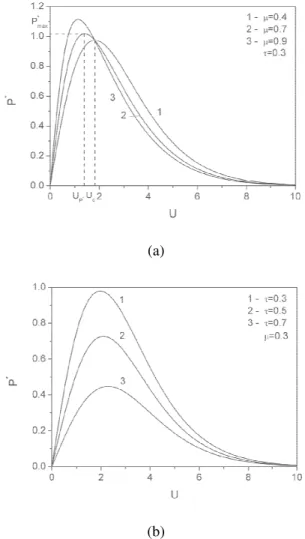
FIG. 3: Influences ofµandτon the power output (P∗) versus barrier
height (U) characteristic.
con-nected barrier series. However, the focus of this work [38] was on the velocity and efficiency performances while the thermodynamic properties of the heat engine model, such as the power versus efficiency characteristic and the influences of the operation parameters had not been extensively inves-tigated. Thus, a further step made in this paper is to analyze the thermodynamic performances of such a Brownian heat engine model with and without external forces extensively. The general expressions of the power and efficiency as func-tions of the major parameters that characterizing the engine are derived. The power versus efficiency characteristic and the influences of external force and other operation parame-ters are analyzed in detail by numerical calculations. More-over, the optimal regions of power and efficiency, as well as the limited regions of the external force and barrier height of the potential are determined. It is found that, if these pa-rameters are properly chosen, the Brownian heat engine can operate in the optimum regimes.
(a)
(b)
FIG. 4: Influences ofµandτon the efficiency (η) versus barrier height (U) characteristic.
2. MODEL OF THE BROWNIAN HEAT ENGINE
FIG. 5: Three dimensional diagram of power output (P∗) versusµ
andUfor givenτ=0.3.
Figure 1 shows the schematic diagram of the thermally driven Brownian heat engine. In the heat engine system, the Brownian particle which is placed in a periodic sawtooth po-tential moves in a viscous medium. The medium is alter-natively in contact with the hot (the temperature isTH) and cold (the temperature isTC) heat reservoirs along the space coordinate. The sawtooth potential is described by
U(x) =
U0(1+xL1), i f−L1<x≤0;
U0(1−xL2), i f0<x≤L2; (1) wherexis the horizontal axis of the coordinate; L1andL2, are respectively, the widths of the left and right part of the ratchet;L=L1+L2is the period length andU0is the barrier height of the potential.
The Brownian particle will attain a directed motion when it is exposed to the potential coupled with spatially periodic temperature field. For such a system, according to Refs. [23, 26], if the external forceFis considered, the general expres-sion for the steady state currentJfor the Brownian particle in any periodic potential is given by
J= −I
G1G2+HI
(2)
whereI,G1,G2andHare
I=ea−b−1
G1 =
L1
aTH
(1−e−a) + L2 bTC
e−a(eb−1),G2 = γL1
a (e a
−1) +γL2
b e a(
1−e−b) (3)
(a)
(b)
FIG. 6: Influences ofµandτon the power output (P∗) versus effi-ciency (η) characteristic.
whereγis the coefficient of friction of the Brownian particle, and
A = γ
TH (L1
a )
2(e−a+a−1),
B = γL1L2 abTC
(1−e−a)(eb−1),C= γ TC
(L2 b )
2(eb
−b−1)
a = (U0+FL1)TH,b= (U0−FL2)TC (4) IfF=0, equation (2) becomes the current when there is no external force. The drift velocityvof the particle is associ-ated to the steady state currentJand it is given byv=JL.
If the system works as a heat engine, the net flux of the particle is from hot reservoir to the cold reservoir. Thus, when the particle moves in the hot region of the ratchet, it must absorb energy in order to climb up the potential and to overcome the external force (F) and the viscous drag force (γv); when it moves in the cold region, the particle
will release energy as it moves down the potential hill while at the same time absorb energy to overcome the external force and the viscous drag force. Considering the heat flow (kB(TH−TL)/2) via the kinetic energy of the particles [30,
(a)
(b)
(c)
FIG. 7: Influences ofU,µandτon the power output (P∗) versus external force (f) characteristic.
33], the rates of total heat absorbed from the hot reservoir ( ˙QH) and released to the cold reservoir ( ˙QC) will be [38]
˙
QH=U0+ (F+γv)L1+kB(TH−TC)2 (5) ˙
(a)
(b)
(c)
FIG. 8: Influences ofU,µandτon efficiency (η) versus external force (f) characteristic.
FIG. 9: Influences of external force (f) on the power output (P∗) versus the current (J∗) characteristic, for givenµ=0.5 and
τ=0.3.
FIG. 10:
Influences of external force (f) on efficiency (η) versus the current (J∗) characteristic, for givenµ=0.5 andτ=0.3.
FIG. 11: Influences of external force (f) on the power output (P∗)
The power output (P) and the efficiency (η) of the Brown-ian heat engine can be expressed as
P=Q˙H−Q˙C= (F+γv)(L1+L2) =L(F+γv) (7)
η= P
˙ QH
= L(F+γv)
U0+ (F+γv)L1+kB(TH−TC)2 (8)
If the heat flow via the kinetic energy is ignored, the re-versible efficiency of the Brownian heat engine (ηrev) is
given by
ηrev=
L(F+γv)
U0+ (F+γv)L1
(9)
For the convenience of the following discussion, equations (2) and (7) can be rewritten into dimensionless forms
J∗=J
[TH(γL2)] (10)
P∗=P
(kBTH) (11)
As to the heat engine model, we introduce some scaled parameters, i.e. the scaled barrier height of potentialU= U0
(kBTH), the scaled external force f =FL
(kBTH), the asymmetry of the potential µ=L1L and the temperature ratio of heat reservoirsτ=TCTH. Equations (8) - (11) can be expressed as functions of the parametersU,f,µandτ. For simplicity, the Boltzmann’s constantkBis taken to be unity. In the following two sections, the power versus efficiency performance and the influences of these parameters will be investigated with and without external force, respectively, in detail.
3. POWER VERSUS EFFICIENCY CHARACTERISTIC
WITHOUT EXTERNAL FORCE
In the absence of the external force, i.e.F=0, using equa-tions (8) and (9), one can obtain the characteristic curves of
η,ηrevand Carnot efficiencyηC(ηC=1−τ) versus the bar-rier heightU, as shown in Figure 2. It can be seen thatηrevis a monotonic decreasing function ofU. When the heat engine approaches the quasistatic limit, i.e. U→0,ηrevwill attain the Carnot efficiency (ηC). It is also clear that, the value of
ηis always smaller thanηrevand thus it can never approach Carnot efficiency (ηC).
Using equations (8) and (11) and the conditionF=0, for given values of µandτ, the characteristic curves of power
output (P∗) and efficiency (
η) versus barrier height (U) can
be plotted as shown in Figures 3 and 4. It can be seen that the curves ofP∗andηversusUare all parabolic-like ones, and there exist the optimal barrier heightUP∗ andU
ηwhich lead to the maximum power output (P∗
max) and maximum ef-ficiency (ηmax), respectively. It is shown in Figures 3 (a) and
4 (a) that, for given values ofτ, the values ofUP∗andUηwill
decrease with the increase ofµ; there exists the critical value of barrier height (Uc) for the characteristic curve; ifU<Uc, P∗andµwill increase with the increase of ; ifU >Uc,P∗ andηwill decrease with the increase ofµ. While for given
values ofµ, as shown in Figure 3 (b) and 4 (b), the values of Uη,Pmax∗ andηmax will decrease whereasUP∗ will increase
with the increase ofτ.
Figure 5 shows the three dimensional diagram of power output (P∗) versus barrier height (U) and symmetry of the potential (µ) withτ=0.3. It can be seen that, for given
val-ues ofµ, the curves ofP∗versusU are parabolic-like ones; while for givenU, the curves ofP∗versusµare monotonic ones. It is found that the maximum power output (Pmax∗ ) first decreases and then increases with the increase ofµ. Simi-larly, using equation (8) and the conditionF=0, one can get the three dimensional diagram of efficiency (η) versusUand
µwithτ=0.3. Its shape is similar to Figure 5 and the
max-imum efficiencyηmaxalso first decreases and then increases with the increase ofµ.
Using equations (8) and (11) and the conditionF=0, one can obtain the characteristic curves of power output (P∗) ver-sus efficiency (η) as shown in Figure 6. Similar to the char-acteristics of the real conventional irreversible heat engines [39-43], the curves ofP∗versus
ηare all closed loop-shaped
ones and there exist two important points of states: the max-imum power point (ηP∗,P∗
max) and the maximum efficiency point (ηmax,Pη∗). When the Brownian heat engine is operat-ing in the regionsU≤UηandU≥UP∗, the power output will
increase with the increase of efficiency. When the Brownian heat engine is operating in the regionUη<U<UP∗, the
power output will decrease with the increase of efficiency. Usually, for a heat engine, one always wants to obtain the power and efficiency as large as possible for a given set of other parameters. Thus, it is more reasonable for the Brown-ian heat engine to operate in the regionUη<U<UP∗, which
will lead to the optimal regions of power and efficiency, i.e.
Pη∗<P∗<Pmax∗ , ηP∗<η<ηmax (12)
And the optimal barrier height of the potential should be located in the region
kBTHUη<U0<kBTHUP∗ (13)
4. POWER VERSUS EFFICIENCY CHARACTERISTIC
WITH EXTERNAL FORCE
FIG. 12: Characteristic curves of current (J∗) versus barrier height
Using equations (8) and (11), the characteristic curves of power output (P∗) and efficiency (η) versus external force (f) and the influences ofU,µandτcan be plotted as shown
in Figures 7 and 8. It is shown that the curves ofP∗and
ηversus f are all parabolic-like ones, and there exist opti-mal external forces fP∗ and fηwhich lead to the maximum
power output (P∗
max) and the maximum efficiency (ηmax). For given values ofµ andτ, the values ofPmax∗ , ηmax, fP∗ and
fηwill increase with the increase ofU. For given values of
U andτ, the values ofPmax∗ ,ηmax, fP∗ and fηwill increase
with the increase ofµ; and one can see that the influence ofµ here is quite different from the case that there is no external force, where P∗
max andηmax will first decrease and then in-crease with the inin-crease ofµ, as shown the three dimensional diagram in Figure 5. For given values ofµandU, the values ofPmax∗ andηmaxwill decrease while fP∗andfηwill increase
with the increase ofτ.
Combining equations (8), (10) with equation (11), the curves of power output (P∗) and efficiency (
η) as functions of
the current (J∗) can be plotted as shown in Figures 9 and 10. It can be seen from Figure 9 that the power output is a mono-tonic increasing function of currentJ∗. While the curves of efficiency versus current are loop-shaped ones, as shown in Figure 10. There exist the maximum efficiencyηmaxand the corresponding current J∗
η, as well as the maximum current
J∗
maxand the corresponding efficiencyηJ∗.
Combining equations (8) with (11), the influence of the external force (f) on the power output (P∗) versus efficiency (η) characteristics can be shown in Figure 11. The influ-ences of the external force are obvious: when there is no external force, i.e. f =0, the curves of power output versus efficiency are closed loop-shaped ones, as shown by curve 1 in Figure 11; when the external force is applied on the parti-cle, i.e. f =0.5, f =1.0, f =1.5 or f =2.0, the curves of power output versus efficiency are open loop-shaped ones, as shown by curves 2-5 in Figure 11. There also exist the max-imum powerP∗
max and the corresponding efficiencyηP∗, as
well as the maximum efficiencyηmaxand the corresponding power outputP∗
η. The performance of the Brownian heat en-gine depends greatly on the parameters f,U,µandτ; if the
values of the parameters are properly chosen, the Brownian heat engine can operate in the optimal regimes.
5. THE LIMITED REGIONS OF THE EXTERNAL
FORCE AND BARRIER HEIGHT OF THE POTENTIAL
Using equation (10), for given values of µ and τ, i.e.
µ=0.4 andτ=0.3, the characteristic curves of current (J∗) versus barrier height (U) and the influence of external force (f) can be plotted as shown in Figure 12. The curves ofJ∗ versusUare parabolic-like ones. When there is no external force (f =0), the current is always higher than zero. This indicates that, without external force, the particle always moves from the hot reservoir to the cold reservoir. When the external force is considered, there exists a critical value of the barrier height (Uz) at which the current changes its di-rection. IfU<Uz, the current is less than zero, which means that the engine model works as a refrigerator. IfU >Uz, the current is higher than zero, which means that the engine model works as a heat engine. Thus, if external force is
con-
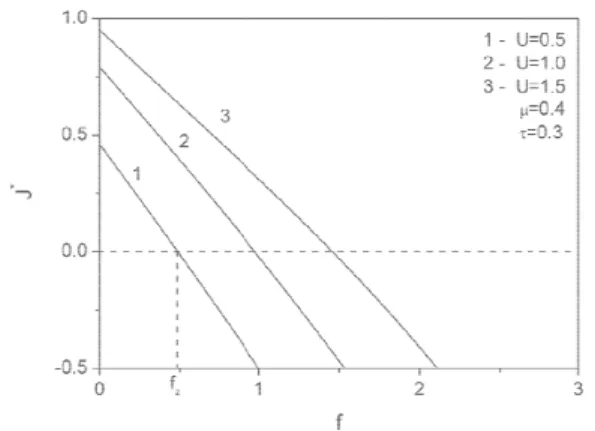
FIG. 13: Characteristic curves of current (J∗) versus external force (f) for givenµ=0.4 andτ=0.3.
sidered, for the barrier height (U0), only when the condition that
U0>UzkBTH (14) is satisfied, the engine model can work as a two-reservoir heat engine. When the engine model works as a heat engine, there exists the optimum barrier heightUJ∗ which leads to
the maximum currentJ∗
max. From Figure 9, one can see that the power output is a monotonic increasing function of the currentJ∗. Thus, the optimum barrier heightUJ∗ in Figure
12 which corresponds to the maximum current also leads to the maximum power output of the heat engine. With the in-crease of f,J∗
max will decrease whileUJ∗ will increase. This
is because that the direction of external force is opposite to the movement of the particle, it will hinder the transport of the particle. So the larger the f, the less theJmax∗ . Conse-quently, higher barrier height is needed for the heat engine in order to get the maximum current.
Similarly, using equation (10), for given values ofµand
τ, i.e. µ=0.4 andτ=0.3, the characteristic curves of
cur-rent (J∗) versus external force (f) and the influence of bar-rier height (U) can be plotted as shown in Figure 13. It is shown that the current is a monotonic decreasing function of f. There exists a particular external force (fz) at which the current changes its direction. When 0≤f<fz, the current is higher than zero, which means that the engine model works as a heat engine. When f > fz, the current is less than zero, which means that the engine model works as a refrigerator. Thus, for the external force (F), only when the condition that 0≤F<fzkBTHL (15) is satisfied, the engine model can work as a two-reservoir heat engine.
6. CONCLUSIONS
In the present work, the thermodynamic performance of a thermally driven Brownian heat engine is studied. The heat engine consists of Brownian particles moving in a pe-riodic sawtooth potential with and without external forces, where the viscous medium is alternately in contact with the hot and cold reservoirs along the space coordinate. The per-formance characteristics are analyzed by numerical calcula-tions. It is shown that the Brownian heat engine is always irreversible due to the heat flow via the change of kinetic en-ergy of the particle, and the efficiency can never approach the Carnot efficiency, even in the quasistatic limit. Numer-ical analysis has shown that the operation parameters, i.e. barrier height of the potential, asymmetry of the potential and temperature ratio of the heat reservoirs have great in-fluences on the power output, efficiency and current perfor-mances of the Brownian heat engine. It is found that when there is no external force, the power output versus efficiency characteristic curves are closed loop-shaped ones, which are similar to the characteristics of real conventional irreversible heat engines; whereas when the external force is applied on the particle, the power output versus efficiency
characteris-tic curves of the heat engine changed into open loop-shaped ones. The limited regions of the external force and barrier height of the potential are explored by analyzing the current property of the model. And it is found that only when the ex-ternal force and barrier height of the potential are located in the region 0<F<fzkBTHL,U0>UzkBTHorF=0,U0>0, the Brownian motor can operate as a two- reservoir heat en-gine. Results of numerical calculations show that through the proper choice of the parameters, the Brownian heat en-gine can be controlled to operate in the optimal regimes. The results obtained herein can provide some guidelines in re-vealing the general performance characteristics of thermal Brownian heat engines.
Acknowledgments
This paper is supported by The National Natural Science Foundation of P. R. China (Project No. 10905093), Pro-gram for New Century Excellent Talents in University of P. R. China (Project No. NCET-04-1006) and The Foundation for the Author of National Excellent Doctoral Dissertation of P. R. China (Project No. 200136).
[1] P. Reimann, Brownian motors: noisy transport far from equi-librium. Phys. Rep., 2002, 361(2/4): 57-265.
[2] R.D. Astumian, P. H¨anggi, Brownian motors. Phys. Today, 2002, 55 (11): 33-39.
[3] C. Van den Broeck, R. Kawai, P. Meurs, Microscopic analysis of a thermal Brownian motor. Phys. Rev. Lett., 2004, 93 (9): 090601.
[4] N. Thomas, R.A. Thornhill, The physics of biological molec-ular motors. J. Phys. D: Appl. Phys., 1998, 31 (3): 253-266. [5] M. Schliwa, G. Woehlke, Molecular motors. Nature, 2003,
422(6933): 759-765.
[6] R.D. Astumian, M. Bier, Fluctuation driven ratchets: molecu-lar motors. Phys. Rev. Lett., 1994, 72 (11): 1766-1769. [7] F. Takagi, T. Hondou, Thermal noise can facilitate energy
con-version by a ratchet system. Phys. Rev. E, 1999, 60 (4): 4954-4957.
[8] K. Sumithra, T. Sintes, Efficiency optimization in forced ratch-ets due to thermal fluctuations. Physica A, 2001, 297(1/2): 1-12.
[9] B.Q. Ai, X.J. Wang, G.T. Liu, L.G. Liu. Efficiency optimiza-tion in a correlaoptimiza-tion ratchet with asymmetric unbiased fluctu-ations. Phys. Rev. E, 2003, 68 (6): 061105.
[10] R.P. Feynman, R.B. Leighton, M. Sands, The Feynman Lec-tures on Physics. Vol. I Addison-Wesley, Reading, 1963. [11] L.P. Faucheux, L.S. Bourdieu, P.D. Kaplan, A.J. Libchaber.
Optical thermal ratchet. Phys. Rev. Lett., 1995, 74 (99): 1504-1507.
[12] J.M.R. Parrondo, J.M. Blanco, F.J. Cao, R. Brito. Efficiency of Brownian motors. Europhys. Lett., 1998, 43 (3): 248-254. [13] L. Dinis, J.M.R. Parrondo, F.J. Cao, Closed-loop strategy with
improved current for a flashing ratchet. Europhys. Lett., 2005, 71 (4): 536-541.
[14] J.L. Mateos, Chaotic transport and current reversal in deter-ministic ratchets. Phys. Rev. Lett., 2000, 84 (2): 258-261. [15] M.O. Marcelo, Forced thermal ratchets. Phys. Rev. Lett.,
1993, 71 (10):1477-1481.
[16] S. Savel’ev, F. Marchesoni, P. H¨anggi, F. Nori, Nonlinear
sig-nal mixing in a ratchet device. Europhys. Lett., 2004, 67 (2): 179-185.
[17] R.D. Astumian, I. Der´enyi, A chemically reversible Brownian motor: application to kinesin and Ncd. Biophys J., 1999, 77 (2): 993-1002.
[18] M. B¨uttiker, Transport as a consequence of state-dependent diffusion. Z. Phys. B, 1987, 68(2/3): 161-167.
[19] N.G. van Kampen, Relative stability in nonuniform tempera-ture. IBM J. Res. Dev., 1988, 32 (1): 107-111.
[20] R. Landauer, Motion out of noisy states. J. Stat. Phys., 1988, 53(1/2): 233-248.
[21] J.M.R. Parrondo, B.J. de Cisneros, Energetics of Brownian motors: a review. Appl. Phys. A, 2002, 75 (2): 179-191. [22] K. Sekimoto, Kinetic characterization of heat bath and
en-ergetics of thermal ratchet. J. Phys. Soc. Jpn., 1997, 66 (5): 1234-1237.
[23] M. Asfaw, M.Bekele, Current, maximum power and optimized efficiency of a Brownian heat engine. Eur. Phys. J. B, 2004, 38 (3): 457-461.
[24] P. Meurs, C. Van den Broeck. Thermal Brownian motor. J. Phys: Condens. Matter, 2005, 17 (47): S3673-S3684. [25] B.Q. Ai, H.Z. Xie, D.H. Wen, X.M. Liu, L.G. Liu. Heat flow
and efficiency in a microscopic engine. Eur. Phys. J. B, 2005, 48 (1): 101-106.
[26] M. Asfaw, M. Bekele, Exploring the operation of a tiny heat engine. Physica A, 2007, 384 (2): 346-358.
[27] R.D. Astumian, Thermodynamics and kinetics of a Brownian motor. Science, 1997, 276(5314): 917-922.
[28] S. Velasco, J.M.M. Roco, A. Medina, A. Calvo Hern´andez. Feynman’s ratchet optimization: maximum power and maxi-mum efficiency regimes. J. Phys. D: Appl. Phys., 2001, 34 (6): 1000-1006.
[29] I. Der´enyi, M. Bier, R.D. Astumian, Generalized efficiency and its application to microscopic engines. Phys. Rev. Lett., 1999, 83 (5): 903-906.
[31] M. Asfaw, M. Bekele. Energetics of a simple microscopic heat engine, Phys. Rev. E, 2005, 72 (5): 056109.
[32] M. Matsuo, S. Sasa. Stochastic energetics of non-uniform tem-perature systems. Physica A, 2000, 276(1/2): 188-200. [33] T. Hondou,K. Sekimoto, Unattainability of Carnot efficiency
in the Brownian heat engine. Phys. Rev. E, 2000, 62 (5): 6021-6025.
[34] B.Q. Ai, L. Wang, L.G. Liu. Brownian micro-engines and re-frigerators in a spatially periodic temperature field: heat flow and performances. Phys. Lett. A, 2006, 352(4/5): 286-290. [35] Y. Zhang, B. Lin, J. Chen. Performance characteristics of an
irreversible thermally driven Brownian microscopic heat en-gine. Eur. Phys. J. B, 2006, 53 (4): 481-485.
[36] B. Lin, J. Chen, Performance characteristics and parametric optimum criteria of a Brownian micro-refrigerator in a spa-tially periodic temperature field. J. Phys. A: Math. Theor., 2009, 42 (7): 075006.
[37] R. Benjamin, R. Kawai, Inertial effects in B¨uttiker-Landauer motor and refrigerator at the overdamped limit. Phys. Rev. E,
2008, 77 (5): 051132.
[38] M. Asfaw, Modeling an efficient Brownian heat engine. Eur. Phys. J. B, 2008, 65 (1): 109-116.
[39] J.M. Gordon, G. Huleihil, General performance characteristics of real heat engine. J. Appl. Phys., 1992, 72 (3): 829-837. [40] L. Chen, F. Sun, C. Wu, A generalized model of real heat
en-gines and its performance. J. Institute Energy, 1996, 69 (481): 214-222.
[41] L. Chen, F. Sun, C. Wu, Influence of internal heat leak on the power versus efficiency characteristics of heat engines. Energy Convers. Mgmt., 1997, 38 (14): 1501-1507.
[42] L. Chen, F. Sun, C. Wu, Effect of heat transfer law on the per-formance of a generalized irreversible Carnot engine. J. Phys. D: Appl. Phys., 1999, 32 (2): 99-105.