Evaluation and measurement of pain in the aging process
Andressa K.A.P. Pelegrin, Hilze B.O. Moura Siqueira, Márcia O.S.S. Garbi, Simone Saltareli,
Fátima Faleiros Sousa
Universidade de São Paulo, Ribeirão Preto, SP, Brazil
Abstract
The purpose of the present study was to evaluate pain in the aging process in long-term care institutions. The study included 46 elderly subjects of both genders and with chronic pain. Descriptors of chronic pain were analyzed using psychophysical category estimation methods, and the thematic content of semi-structured interviews was analyzed. Chronic pain was perceived in 33.33% of the elderly subjects. For the descriptors of pain, the results showed higher scores for “painful.” In the interview, the thematic units were time, start of symptoms, coping, pain-related causes, current situation, and other perceptions about pain. Pain was related to physical, emotional, and cognitive factors. The present results shed light on “pain” and “aging” phenomena and may contribute to improving the management of pain symptoms in long-term institution residents. Keywords: pain, pain measurement, aging, long-term institutions.
Received 30 January 2014; received in revised form 31 March 2014; accepted 02 April 2014. Available online 25 November 2014.
Introduction
The elderly population is a relatively new phenomenon worldwide. It is higher in countries like the United States, England, Japan, Switzerland, and Germany, which have more favorable socioeconomic conditions. In Brazil, this increase in the elderly population has been observed since 1960, which is estimated to have approximately 34 million elderly people by 2025, leading the country to sixth place among the countries with the highest elderly populations in the world. Furthermore, there is an increasing number of people over 80 years of age (Kalache, Veras, & Ramos, 1987).
The elderly population was recently addressed in the Collegiate Directory Resolution (RDC 283/05) of the National Agency of Sanitary Surveillance for Elderly Long-Term Institutions (ILPI). Such a resolution is based on Law 8.842/94 and the Elderly Statute to establish rules that guarantee the rights of people over 60 years of age with regard to the quality of services provided by these institutions(Agência Nacional de Vigilância Sanitária, 2005).
During the aging process, population growth is accompanied by a higher incidence of disabling, chronic, and non-transmissible diseases that make the elderly vulnerable to physical-functional deterioration and loss of autonomy, in addition to increasing complaints of pain and the search for health services relative to younger age groups (Epps, 2001; Faria, Machala, Corrêa Dias, & Domingues Dias, 2003; Paschoal, Salles, & Franco, 2005).
Pain is an unpleasant sensorial and emotional experience that is associated with the occurrence of tissue injury or referred to in such terms (International Association for the Study of Pain, 2010). Pain may be considered chronic when it persists for more than 3 months or is associated with the development of tissue injury (Portenoy, 1995).
Pain in the elderly is one of the main factors that can negatively impact quality of life by limiting activity and increasing the risk for stress and social isolation. The accurate measurement of such an experience can contribute to the management of its impact when the pain process is minimized by avoiding unnecessary suffering during that stage of the life cycle (Andrade, Pereira, & Faleiros Sousa, 2006).
Pain perception is known to be subjective and may
be inluenced by sensory, affective, cognitive, social,
and behavioral factors. Because of this subjectivity, the measurement of pain becomes a constant challenge (Faleiros Sousa & Da Silva, 2005). Therefore, many methods have been used to measure the perception of pain, and some consider pain as a simple, unique, one-dimensional quality that varies only in intensity. Others, however, consider it as a multidimensional experience that Andressa K.A.P. Pelegrin, Hilze B.O. Moura Siqueira, Márcia
is also composed of emotional factors (Faleiros Sousa, 2002; Faleiros Sousa, Pereira, Cardoso, & Hortense, 2010).
The Multidimensional Pain Evaluation Scale (MPES) consists of 100 descriptors of severe pain and 100 descriptors of chronic pain. It offers the possibility of widely knowing the painful phenomenon in a multidimensional way. The MPES was validated for the Brazilian culture in Portuguese and precisely evaluates the painful experience (Faleiros Sousa et al., 2010).
According to the literature, each person is able to judge and understand his/her own pain, with no change in pain perception regardless of advanced age (Pereira & Faleiros Sousa, 2007). Among the available pain measurement instruments, the MPES also allows the elderly to express their perception of pain experience (Faleiros Sousa et al., 2010).
The literature has indicated an interest in the problem of pain in the aging process, which unfortunately worsens.
However, there is a lack of scientiic studies of this aging
population compared with other life cycle phases. Thus, the aim of the present study was to evaluate pain perception in the aging process in residents of long-term institutions.
Methods
Participants
Forty-six elderly people of both genders who complained of chronic pain were included in the study. We excluded people without chronic pain complaints or without the necessary physical or cognitive skills to participate. All of the participants signed a consent form after being verbally instructed about the research and its goals.
Place and time
This study was developed in two long-term institutions in the city of Ribeirão Preto, São Paulo, from July to October 2009.
Ethical considerations
The study was approved by the Ethics Committee in Research of the Clinic Hospital, Ribeirão Preto Medical College, University of São Paulo (process no. 11.696).
Materials
The materials included pens, pads of paper, and a
tape recorder. The irst page of the instrument consisted
of sociodemographic indicators and questions related to
pain, with a protocol with speciic instructions for each
type of psychophysical method used. On subsequent pages was a list of 10 descriptors of chronic pain
with their deinitions and a semi-structured interview
with seven questions about the history of disease and beginning of pain symptoms.
Procedures
The procedures included a psychophysical method of category estimation and content analysis. In the
psychophysical method of category estimation, 10 descriptors were used, with higher scores on the MPES indicating chronic pain. The participants assigned a score that ranged from 0 to 10 for each descriptor of pain. The subject was instructed to report a score of 10 for descriptors that characterized the maximum pain intensity and 0 for the minimum pain intensity. The other intermediate scores (1 to 9) characterized intermediate degrees of pain.
For the semi-structured interview, the participants answered seven questions about their history of illness and development of pain. Parallel to this process were questions about thoughts and feelings that accompany the painful experience. The interviews were recorded and later transcribed in total.
Data analysis
For the MPES, the psychophysical method of category estimation was used, which calculated the arithmetic average (AA) and standard deviation (SD) and established positions of ranking of the 10 descriptors of pain. The results were organized into tables in a descriptive way. For the semi-structured interview, thematic content analysis was used (Minayo, 2004), which is a kind of method that allows the construction of thematic categories and analyses of the relationships between them. This stage began with transcribing all of the interviews, systematically reading the ideas, and subsequently constructing thematic units that were represented in a descriptive table.
Results
During data collection, we recorded data from a total of 142 elderly residents in two long-term institutions
(84 from a civil non-proit private-sector institution and 58 from a for-proit civil institution). The study
excluded 33 elderly residents who did not have chronic
pain, 38 who had cognitive deicits, 11 who declined to
participate, nine who died, three who left the institution, and two who dropped out the study.
The inal sample consisted of 46 elderly residents, 26 of whom resided in a non-proit institution and 20 who resided in a for-proit institution in São Paulo. The
average age was 78.26 years, and 43.48% were male and 56.52% were female.
Chronic pain was perceived in 33.33% of the institutionalized elderly. The regions most affected by pain, according to the participants, were the lower limbs (54.34%), dorsal region (39.13%), head (21.73%), and abdominal region (10.86%).
With regard to the duration of pain, 60.86% had no pain during the last week, 82.60% reported having pain
for over a year, and 69.56% reported no speciic time
that they felt it.
In the analysis of the phenomenon of pain, a
signiicant portion of the participants (30.43%) assigned
a score of 10 for the intensity of chronic pain, which corresponded to the worst pain perceived, with an AA of 7.02 ± 2.74. Table 1 presents the AAs and SDs for each of the 10 descriptors.
When considering the AA and SD of these results, the descriptor most frequently mentioned by the participants was “painful,” and the least mentioned was “disastrous.”
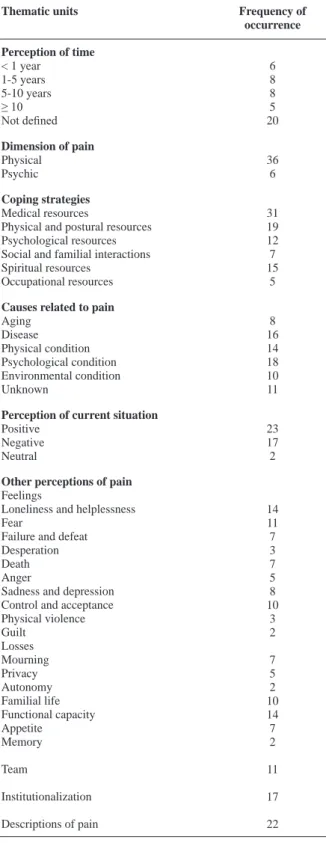
With regard to the semi-structured interview, chronic pain was perceived subjectively, and the following thematic units were found: perception of time, dimension of pain, coping strategies, causes related to pain, perception of the current situation, and other perceptions of pain. Table 2 shows an overview of the categories extracted from the interview and frequency of each thematic unit found.
The thematic units that showed the most signiicant
results according to the participants’ responses are detailed below.
Perception of time
In this thematic unit, the reports related to the perception of pain and beginning of symptoms were systematized. The analysis revealed a prevalence of participants’ experiencing chronic pain from 1 to 10 years.
Four…ive years had it... (Participant 14)
About eight years, seven to eight years. (Participant 15)
We also noticed a signiicant number of participants
who were unable to set the timeframe of their pain.
How I realized it? I felt it hurt. I do not remember, no. It is complicated, isn’t it? I don’t know how to explain it. It is a very…thing, I don’t have, I do not know how to explain. I do not know how to explain. It is a very... thing, I cannot remember. (Participant 20)
Dimensions of pain
In the dimensions of pain at the beginning of symptoms, 36 participants expressed feeling physical pain.
The whole leg hurt. It hurts from the waist down, the whole body. (Participant 7)
The psychic dimension of pain was described by six participants.
Ah, it is very distressing…I feel depressed…I feel unable…it is a pain that I feel useless. It disables me for the easier tasks to do. I cannot because of the pain. (Participant 8)
Coping strategies
Among the coping strategies reported was a predominance of using a medication for pain relief.
Only with medicine takes the pain away. A medicine… it takes my pain away, is not, a few is not. No…does not heal, but it makes me better, the pain is better. (Participant 3)
Physical-postural resources were also reported by the participants.
Because according to therapists, the pain I have, near the neck and spine, is more positional…I work out to eliminate the pain. (Participant 15)
Among other coping strategies, spiritual resources were expressively described by the participants.
I ask God to have pity and do not let happen [to me] what happens to others here…God helps. (Participant 4)
Psychological conditions were indicated by most of the participants among the causes associated with death.
The causes of my pain, I believe, are my nerves. Because when I am nervous, I feel more chest pain. (Participant 23)
Table 1. Distribution of descriptors of chronic pain in long-term institutions, 2009.
Descriptors of chronic pain Order of position Arithmetic average Standard deviation
Painful 1st 7.17 2.54
Uncomfortable 2nd 6.89 2.86
Prejudicial 3rd 6.72 3.17
Unbearable 4th 6.65 3.10
Anguishing 5th 6.28 3.15
Cruel 6th 6.02 3.51
Frightening 7th 6.00 3.66
Persistent 8th 5.87 3.19
Depressing 9th 5.63 3.43
Table 2. Categories and subcategories of the analyzed thematic units and their frequencies of occurrence in the accounts of residents of long-term institutions, 2009.
Thematic units Frequency of occurrence Perception of time
< 1 year 1-5 years 5-10 years ≥ 10 Not deined 6 8 8 5 20
Dimension of pain
Physical Psychic 36 6 Coping strategies Medical resources
Physical and postural resources Psychological resources Social and familial interactions Spiritual resources Occupational resources 31 19 12 7 15 5
Causes related to pain
Aging Disease Physical condition Psychological condition Environmental condition Unknown 8 16 14 18 10 11
Perception of current situation
Positive Negative Neutral 23 17 2
Other perceptions of pain
Feelings
Loneliness and helplessness Fear
Failure and defeat Desperation Death Anger
Sadness and depression Control and acceptance Physical violence Guilt Losses Mourning Privacy Autonomy Familial life Functional capacity Appetite Memory Team Institutionalization
Descriptions of pain
14 11 7 3 7 5 8 10 3 2 7 5 2 10 14 7 2 11 17 22
If I just make an effort, if I make an effort it increases…I just go about like that, then it tightens up and I have to warm it. Now, if I try to work, then it screws up everything. (Participant 4)
Perception of the current situation
In this thematic unit, the participants described their perceptions of their current situation going forward, be it aging, institutionalization, disease, or the experience of chronic pain. Most of the participants perceived the current situation in a positive way.
Oh, to me I feel good here, because before I was at home to take care of the house. Here, I don’t have to take care of anything, I have everything in my hands. And I’m in a place…such for me. Sometimes, I go to visit my children, they treat me like a queen, but I’m crazy about returning…here is my environment, my shower, my bed on my own, have the door in the bathroom…I feel good here. I’m here by choice, by option/choice. (Participant 8)
The current situation was also negatively perceived by the elderly.
I stay here without doing anything, thrown here… (Participant 3)
To my home I cannot go because I get there I get sicker, so I’m here…I feel because I will do that no other way. (Participant 6)
Other perceptions of pain
In the report about other perceptions of pain, the participants demonstrated freedom relating their pain with some feelings, loss, or issues that involved institutionalization and the team. Among the losses mentioned above, the participants focused on the absence of family life related to their own pain and loss of privacy.
I miss the family, miss my family so much. A very close-knit family. The brothers died…was just me. It causes pain and depression, sadness of anguish, miss them. (Participant 1)
I don’t like other persons giving me a bath. I like to let me take it. It hurts more, it hurts, it hurts, but it’s not...does not...heal well… (Participant 17)
The pain is painful… (Participant 22)
Discussion
The aging process influences the beginning and expression of pain in people. Pain, to be a subjective phenomenon, must be perceived by those who experience it. This way, it can provide information about the physical dimensions of the location and intensity of pain and the sensory, affective, and cognitive dimensions that involve it. Moreover, the literature shows that this phenomenon is difficult to quantify and qualify because of its subjective nature (Faleiros Sousa & Da Silva, 2002). Furthermore, the literature points to several one-dimensional In addition to psychological, the participants related
pain, their physical condition, and health.
and multi-dimensional instruments that have been applied to measure the perception and sensation of pain. Among these measurement instruments is the MPES, which is considered practical, reliable, sensitive, and valid and promotes advances in ordinal assessment in pain research in Brazil to link the phenomenon to the worldwide scene (Faleiros Sousa et al., 2010).
A Brazilian study identiied and validated the
categorization of descriptors of pain in adults and found that the descriptors that received the highest scores were “depressing,” “persistent,” “prejudicial,” “anguishing,” and “disastrous” (Cardoso & Faleiros Sousa, 2009). Such information differs from the results of the present study, in which the institutionalized elderly judged these same descriptors with lower scores, demonstrating a difference in the perception of pain between adults and the elderly.
Comparisons with a study that evaluated 100 adults with chronic ischemic pain perception and quality of life across two psychophysical methods, including the categorical estimation of magnitude (Pedrosa, 2009), indicated that their results are consistent with the present study, in which similar reporting of chronic pain descriptors with lower scores was found. This can be explained by the fact that the population most studied was the elderly.
The MPES results showed that the experience of pain was perceived with sensory, affective, and evaluative components, similar to previous studies on pain perception and evaluation based on the culture
of teaching, research, and assistance in the ield of
human suffering in Brazil (Pereira & Faleiros Sousa, 1998; Faleiros Sousa & Da Silva, 2005; Hortense, Evangelista, & Faleiros Sousa, 2005; Pereira & Faleiros Sousa, 2007; Cardoso & Faleiros Sousa, 2009; Faleiros Sousa et al., 2010).
In the semi-structured interview, the participants’ responses were systematized and organized into the following thematic units:
“Perceptions about the time”: A signiicant relationship was found between the beginning of pain symptoms and pain reported at 1 year. Most of the seniors reported having chronic pain from 1 to 10 years.
Another important inding in this thematic unit was that
a large proportion of the elderly were unable to precisely
deine the beginning of their pain symptoms. This
result is important because it may indicate detachment or a lack of memory about the temporal nature of the elderly’s own pain.
“Dimension of pain”: At the beginning of the
symptoms, physical pain was signiicant relative to
the location of the pain in the lower limbs and back. However, we must consider that chronic pain was perceived unanimously among the elderly. Although the physical dimension was emphasized, the psychic
dimension was also realized to be signiicant compared
with the theme “Other perceptions of pain,” which was
signiicantly increased. This may indicate the more open
expression of pain related to feelings of helplessness, loneliness, fear, failure, loss, depression, and other emotional issues.
“Coping strategies”: We observed a high prevalence of the use of medications, which may indicate that older people understand that the pain they felt could decrease or stop with the medications. A second feature we observed was physical-postural, which may promote distraction, change the focus on pain in the elderly, and be an effective way to manage the pain. A third feature was spiritual, in which the elderly had a divine belief that they could be healed and bad things could not happen.
“Cause related to pain”: Psychological conditions
were found to signiicantly inluence this theme in
conjunction with diagnosed chronic diseases. This observation coincided with physical conditions and health, in which the elderly participants’ reports indicated that the cause of their pain was disease.
“Perception of the current situation”: This was reported as positive, bringing contentment linked to not having to perform work activities. The elderly emphasized that the institution was a place where they could get welfare, peace, and rest during this phase of aging. Moreover, the environment was highlighted as a place where they could have their own privacy and freedom. The situation, however, was also perceived negatively by the elderly, who exhibited inactivity, feelings of annoyance, anger, helplessness, and loneliness, among others, related to their current life.
“Other perceptions regarding pain”: The elderly freely related their pain with some feelings and losses about institutionalization and questions about the team, in addition to describing more about their own pain. The elderly described their pain using descriptors of pain.
These results corroborate other studies conducted in Brazil in which descriptors were used to evaluate pain perception (Pereira & Faleiros Sousa, 1998; Hortense et al., 2005; Pereira & Faleiros Sousa, 2007; Cardoso & Faleiros Sousa, 2009; Pedrosa, 2009; Faleiros Sousa et al., 2010). A comparison between the theme “other
perceptions of pain” and a study that identiied situations
of discomfort experienced by 30 hospitalized elderly indicated that the participants felt invasion of their personal life and territorial space. The results showed that such invasion or loss of privacy was perceived in a
signiicant and unpleasant way, especially in situations
that affected sleep, personal space, and invasive procedures in intimate regions (Prochet, 2008).
who reported “being alone and without care.” These
indings may be related to exclusion and abandonment.
A comparison of these data with another study indicated structural connections of long-term institutionalization for the elderly. The results showed a negative image about institutions related to exclusion and abandonment (Creutzberg, Gonçalves, & Sobottka, 2008).
In short, the present study is relevant to different
scientiic ields, including medicine, sociology, and
psychology, that can enhance knowledge about the phenomena of “pain” and “aging” to contribute to better quality of care in the management of pain in long-term care institutions.
Acknowledgements
This research received inancial support from
the Foundation for Research Support of São Paulo (FAPESP no. 2009/06972-9 awarded to Andressa K.A.P. Pelegrin).
References
Agência Nacional de Vigilância Sanitária (2005). Regulamento Técnico para o funcionamento das Instituições de Longa Permanência para idosos. RDC Nº 283, de 26 de setembro de 2005. http://www.anvisa.gov.br/divulga/reportagens/280907.htm; accessed March 19, 2014.
Andrade, F.A., Pereira, L.V., & Faleiros Sousa, F.A.E. (2006). Mensuração da dor no idoso: uma revisão. Revista Latino-Americana de Enfermagem, 14(2), 271-276.
Cardoso, R.P.S., & Faleiros Sousa, F.A.E. (2009). The identiication
and validation of the Brazilian Chronic Pain Descriptors. Pain Management Nursing, 10(2), 85-93.
Creutzberg, M., Gonçalves, L.H.T., & Sobottka, E.A. (2008). Instituição de longa permanência para idosos: a imagem que permanece. Texto & Contexto Enfermagem, 17(2), 273-279. Epps, C.D. (2001). Recognizing pain in the institutionalized elder
with dementia. Geriatric Nursing, 22(2), 71-79.
Faria, J.C., Machala, C.C., Corrêa Dias, R., & Domingues Dias, J.M. (2003). Importância do treinamento de força na reabilitação da função muscular, equilíbrio e mobilidade do idoso. Acta Fisiátrica, 10(3), 133-137.
Faleiros Sousa, F.A.E. (2002) Dor: o quinto sinal vital. Revista Latino-Americana. Enfermagem, 10(3), 446-447.
Faleiros Sousa, F.A.E., & Da Silva, J.A. (2002). Por que medir a dor? Revista de Psiquiatria Clínica, 23(1), 79-85.
Faleiros Sousa, F.A.E., & Da Silva, J.A. (2005). Mensurando dor. Revista Dor: Pesquisa, Clínica e Terapêutica, 6(4), 680-687. Faleiros Sousa, F.A.E., Pereira, L.V., Cardoso, R., & Hortense, P.
(2010). Multidimensional Pain Evaluation Scale. Revista Latino-Americana de Enfermagem, 18(1), 3-10.
Hortense, P., Evangelista, R.A., & Faleiros Sousa, F.A.E. (2005). Post-hemorrhoidectomy pain descriptors. Revista Latino-Americana de Enfermagem, 13(2), 203-207.
International Association for the Study of Pain (2010). Pain terminology. http://www.iasp-pain.org/terms-p.html#Pain; accessed March 19, 2014.
Kalache, A., Veras, R., & Ramos, L.R. (1987). O envelhecimento da
população mundial: um desaio novo. Revista Saúde Pública, 21(1),
200-210.
Minayo, M.C. (2004). O desaio do conhecimento: pesquisa qualitativa em saúde. São Paulo: Hucitec.
Paschoal, S.M.P., Salles, R.F.N., & Franco, R.P. (2005). Epidemiologia do envelhecimento. In: C.E.T. Filho, & P.M. Netto (Eds.), Geriatria: fundamentos, clínica e terapêutica (pp. 19-35). São Paulo: Atheneu. Pedrosa, D.A.F. (2009). Avaliação e mensuração de dor crônica
isquêmica e da qualidade de vida. Dissertação de mestrado. Escola de Enfermagem de Ribeirão Preto da Universidade de São Paulo, Ribeirão Preto, SP, Brasil.
Pereira, L.V., & Faleiros Sousa, F.A.E. (1998). Category estimation of the postoperative pain descriptors. Revista Latino-Americana de Enfermagem, 6(4), 41-48.
Pereira, L.V., & Faleiros Sousa, F.A.E. (2007). Categorization of postoperative pain descriptors in the sensitive, affective and evaluative dimensions of painful experiences. Revista Latino-Americana de Enfermagem, 15(4), 563-567.
Prochet, T.C. (2008). Situações de desconforto vivenciadas pelo idoso hospitalizado com a invasão do espaço pessoal e territorial. Escola Anna Nery Revista de Enfermagem, 12(2), 310-315.