Conformational Stability of Furfural in Aqueous
Solution: The Role of Hydrogen Bonding
Roberto Rivelino, Sylvio Canuto,
Instituto de F´ısica, Universidade de S˜ao Paulo, CP 66318, 05315-970 S˜ao Paulo, Brazil
and Kaline Coutinho
CIIB, Universidade de Mogi das Cruzes, CP 411, 08701-970 Mogi das Cruzes, SP, Brazil
Received on 3 October, 2003.
The importance of hydration on the equilibrium involving internal rotation around carbon-carbon single bond is investigated for the furfural molecule dissolved in water. To analyze the solvent effects in stabilizing any preferred conformation of furfural, we perform Monte Carlo (MC)NPTsimulations corresponding to different
rotation angles of the carbonyl group. The hydrogen bonds formed between solute and solvent are also analyzed along the conformational equilibrium. They are found to be equivalent, both in number and in binding energy, for all rotation angles. These results give a strong evidence that the conformational stability and the rotation barrier of the furfural molecule in water relate to the bulk properties rater than solute-solvent hydrogen bonds.
1
Introduction
Biochemical processes are transformations that occur in, or by means of, living organisms. They involve a great variety of proteins, carbohydrates, lipids, steroids, and other sub-stances which have important and specific activities. Yet all these complex substances make up only a minor portion of the total weight of biochemical systems. In fact the main constituent is water, present in amounts far exceeding the total of all the other components [1]. Furthermore, water is known to be the indispensable matrix for the structural components and the activities of living organism. Thus, an important characteristic feature of water is the property of hydration. Because of its high dielectric constant [2], wa-ter can dissolve betwa-ter ionic compounds like salts, acids, and bases than any other medium. Also in aqueous environment compounds containing hydroxyl, carboxyl, amino, or keto groups are extensively hydrated [3]. All these groups can become interconnected with water molecules by hydrogen bonds [4, 5]. In virtue of these power to dissolve many dif-ferent substances water is considered a universal solvent.
The importance of hydration for conformational stability of organic molecules and for the specificity and affinity of folding and binding events has long been recognized [3, 6]. It is clearly important to obtain a detailed understanding of the origin of the hydration effects so that observations can be correctly interpreted and that accurate predictions can be made in the course of designing biological processes. For instance, the hydrophobic effect [7] is considered to be the major driving force for the folding of globular proteins and the formation of membranes and micelles in aqueous solu-tion [8]. Such phenomenon is related to the fact that water
has no attraction by non polar groups held in any molecule [9]. Thus, hydrophobic substances tend to be concentrated by decreasing entropy [8], with the non polar groups dipped into the bulk, and the non polar groups clustered together in the surface of water.
furfural. In doing this, we give a detailed statistical analysis of the hydrogen bonds formed between solute and solvent as a function of the rotational angle for the OO-cis⇄
OO-trans interconversion [19]. To asses the effects of hydrogen bonding in stabilizing any preferential conformer of furfural along the conformational equilibrium, we also perform MC simulations of furfural in chloroform (a weaker protic sol-vent) and compare the results.
O C
O H
O C
OO-cis (0o) TS (90o)
O C
H O
OO-trans (180o) H
O
Figure 1. Conformational equilibrium of furfural. The carbonyl group (−CHO) rotates along the furan ring.
2
Computational Details
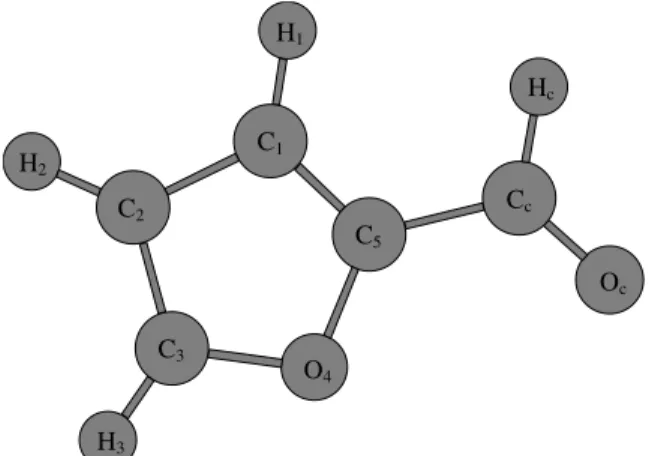
The conformational analysis of the furfural solutions is made using Monte Carlo (MC) statistical mechanics sim-ulations with Metropolis sampling technique [13, 14]. The conformers are analyzed rotating the dihedral angle (O4C5CcOc, shown in Fig. 2) by 9◦ from OO-cis (0◦) to OO-trans (180◦). The MC simulations are carried out with one specific conformation of furfural plus 450 molecules (in the case of water) and 343 (in the case of chloroform). All systems are contained in cubic boxes that are surrounded by images of themselves to remove the edge effects. The cal-culations are performed inNPT(isotermal-isobaric)
ensem-bles at temperature of 298.15 K and pressure of 1 atm. The intermolecular interaction is given by the three-parameter Lennard-Jones plus Coulomb potential [20] (εi,σi, andqi)
for each sitei, jon moleculesαandβ:
Uαβ(rij) =
onα
X
i
onβ
X
j
( 4εij
"µ
σij rij
¶12 −
µσ
ij rij
¶6# +qiqj
rij
)
,
(1) where the geometric combining rules for the parameters in Eq. (1) are given byεij= (εiεj)1/2andσij = (σiσj)1/2.
For the water molecules we use the SPC potential pa-rameters [21], with C2v symmetry, OH distance of 1.00
˚A, and HOH angle of 109.47◦. The chloroform molecules are modeled by the five-site potential parameter suggested by Barlette and Freitas [22]. For the furfural molecule we employ the OPLS-AA [23] set, but the atomic charges are calculated for each conformation with the CHELPG fitting method [24], at the MP2/6-311+G(d) level of theory [25]. We can notice that the oxygen atom in the carbonyl group (Oc) has always a larger negative charge than the ring oxy-gen (O4). Thus, as we shall see further, the occurrence of hydrogen bond formation is more likely in Oc than in O4 (Fig. 2).
Cc
Oc Hc
C5
O4 C1
C2
C3
H1
H2
H3
Figure 2. Symbols of the atomic sites in the furfural molecule showing the dihedral angle O4C5CcOc.
The MC simulations are carried out with the DICE code [26] and consist of a thermalization stage of 2.0×10⁶
MC steps, followed by an averaging stage of 27.0×10⁶ MC steps in the case of water; and 20.6 × 10⁶ MC steps in the case of chloroform. The intermolecular interactions are spherically truncated for a center of mass separation larger than the cutoff radius, which is half of the cubic box, and long-range corrections are calculated beyond this distance. To select statistically uncorrelated configurations we use the autocorrelation function of the energy [15, 16, 27] that pro-vides the correlation interval. In total, 60 configurations are obtained with less than 10% of statistical correlation. Using the radial distribution function we separate the first solvation shell, composed of one furfural molecule surrounded by 34 water molecules or one furfural molecule surrounded by 13 chloroform molecules.
3
Results and Discussion
Before discussing the solvent effects on the conformational equilibrium of furfural, it is interesting to mention that this molecule may exist in two possible conformations: OO-cis and OO-trans (Fig. 1). The OO-trans form is known to be more stable in the vapour, whereas the OO-cis form is more stable in polar media [18]. Recently, Baldridgeet al. [12]
showed that the conformer with larger dipole moment, OO-cis, prevails in solvents with dielectric constants higher than 5. However, the stability between both conformers does not obey a simple relationship with the dielectric constant [28]. This, of course, indicates that the solvent effects are more complex than could be inferred by a simple reaction field. The solvent dependence of the activation barrier for the cis-trans interconversion of furfural is really an important topic in biophysical chemistry.
ace-tone, and none for the protic solvent methanol. In toluene the activation entropy is obtained to be positive, indicating that the transition state is disordered compared to the pla-nar form. Conversely, in acetone it is observed a negative activation entropy, which means that the transition state is ordered with respect to the planar form. However, in the case of methanol there is no preferred interaction between the solvent and any conformation of furfural.
This analysis is of interest because one normally expects that in protic solvents like water the hydrogen bonds formed with the oxygen atoms in the furfural molecule should favor one conformation along the internal rotation of the carbonyl group. To understand the specific role of solute-solvent in-teractions, we perform a detailed investigation of the hydro-gen bonding along the OO-cis⇄OO-trans interconversion
in water, a strong protic solvent [19]. We also compare our results performing MC simulations for furfural in a weaker protic solvent, chloroform. Then, we perform an structural analysis, as obtained via converged atomistic MC simula-tions.
3.1
Hydrogen Bonding Patterns
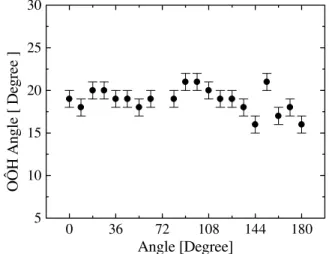
The number of hydrogen bonds formed between furfural and water, as well as the corresponding binding energies, are obtained as a function of the rotation angle O4C5CcOc de-scribed in Fig. 2. Our results correspond to 20 different MC simulations, one for each conformation of furfural. These provide a microscopic description of the specific interaction involving the proton acceptor furfural and the proton donor water during the cis-trans interconversion. The hydrogen bond is defined using the geometric and energetic criteria [15, 29, 30], which areROX≤3.7 ˚A,θOXH≤36◦, and pos-itive binding energy, as given in Fig. 3. Along the carbonyl rotation in water, we have obtained the geometric parame-ters as given in Figs. 4 and 5, i.e., about 3.0 ˚A for the inter-molecular O−O distance and 19◦for the hydrogen bonding angle. Also, in chloroform, a very similar result is found, i.e., about 3.3 ˚A and 21◦, respectively.
X
H
O C
C
4
H
3
O
H
θ
OXHR
OXFigure 3. Geometric parameters for the hydrogen bond formation. The X atom represents oxygen in the case of water and carbon in the case of chloroform.
In aqueous solution, by considering only the most rep-resentative conformers of furfural, OO-cis, OO-90◦ (tran-sition state), and trans, we calculated that for the OO-cis 23% of the configurations make no hydrogen bond, 58% make one, 17% make two, and 2% make even three hydro-gen bonds. Then, out of the 60 configurations selected there exist 58 hydrogen bonds in the OO-cis conformer, making
0 36 72 108 144 180
2.7 2.8 2.9 3.0 3.1 3.2 3.3
O..
.O Dist
an
ce
[
A
ngst
ro
m
]
Angle [Degree]
Figure 4. Intermolecular O−O distance (ROO) between
fur-fural and water calculated as a function of the rotational angle O4C5CcOc.
0 36 72 108 144 180
5 10 15 20 25 30
OÔH An
gl
e [
De
gr
ee
]
Angle [Degree]
Figure 5. Hydrogen bonding angle (θOOH) between furfural and water calculated as a function of the rotational angle O4C5CcOc.
therefore, 0.97 hydrogen bond on average. This is the statis-tics of the hydrogen bonding for the solution of furfural in water. In fact, most of the hydrogen bonds have the carbonyl oxygen (Oc) as the proton acceptor. Similar results are ob-tained for the OO-trans conformer and transition state, with an average number of 1.13 hydrogen bonds in the first case and 0.84 for the transition state.
is 0.8 kcal/mol, we cannot distinguish the conformers. For the transition state the binding energy is only 0.5 kcal/mol weaker than in the planar forms. The main conclusion is that hydrogen bonds between furfural and the water are es-sentially equivalent for all conformations and therefore they make no significant contribution for any rotamer.
(a)
(b)
O
H O
C
O
C
O
H
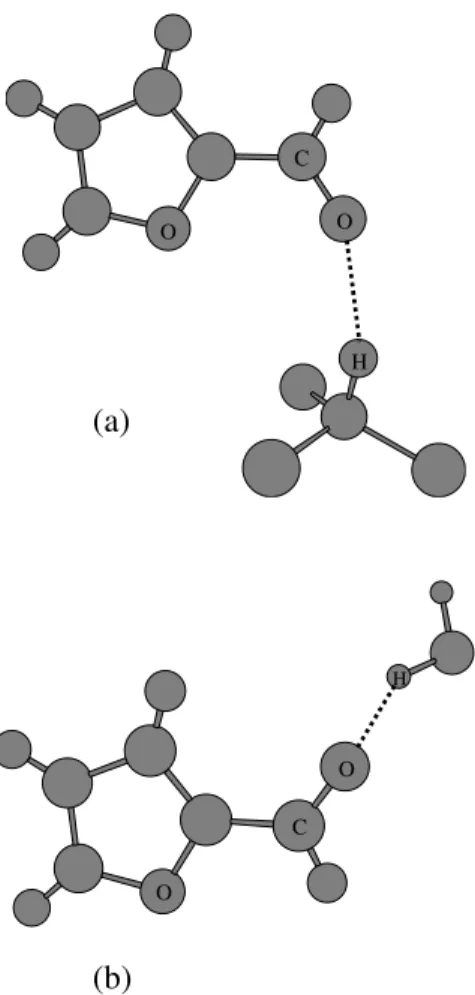
Figure 6. Hydrogen bonds formed between furfural and chloro-form (a) and furfural and water (b) along the conchloro-formational equi-librium.
Now we compare the statistical analysis for the hydro-gen bond formation of furfural dissolved in water by con-sidering the conformational equilibrium of furfural in chlo-roform, a weaker protic solvent than water. In this case we consider the three more important conformers of furfural, OO-cis, transition state, and OO-trans. The statistics for the other conformations are very similar to that for water. In Fig. 6 we show two types of hydrogen bonds formed with arbitrary conformers of furfural in both solvents. Our results are summarized in Tables 1 and 2. As we can observe, a sim-ilar hydrogen bonding pattern is obtained dissolving furfural in water or chloroform. Here, the average number and the strength of hydrogen bonds formed between the solute and the solvent are essentially constant along the internal rota-tion, giving again no contribution to the activation entropy. These results are in fair agreement with previous observa-tions from Bain and Hazendonk [28] for the investigation of furfural in methanol.
3.2
Stabilization of the Solute
Although the carbonyl group in furfural appears to make the hydrogen bonds less significant to stabilize any specific conformation of the solute, the entire dipole moment of the molecule is relatively high to allow an electrostatic stabiliza-tion. In gas phase the dipole moment of furfural is 3.97 D for the OO-cis form, 2.93 D for the transition state, and 3.23 D for the OO-trans form [18]. Thus, the difference in dipole moment for two species in equilibrium is large enough to drive the conformational stability. In polar solvents the more polar conformer is expected to be preferentially stabilized, as predicted by the reaction field theory [31]. For instance, in water the OO-cis form is predominant. However, in the case of chloroform (a low polarity solvent with dielectric constant of about 5) a simple reaction field analysis seems to be inappropriate in predicting which is the more stable conformer of furfural [12, 31]. In this case, the energy dif-ference between the OO-cis and OO-trans forms tends to approximately zero [18]. As given in Table 1, the hydro-gen bonding energy contribution predicts qualitatively that the higher dipole moment conformer, OO-cis, is more sta-ble when dissolved in water. In fact, a dielectric constant around 5 (e.g. chloroform) seems to be the turning-point for the OO-cis⇄OO-trans change in the conformational equi-librium of furfural [12].
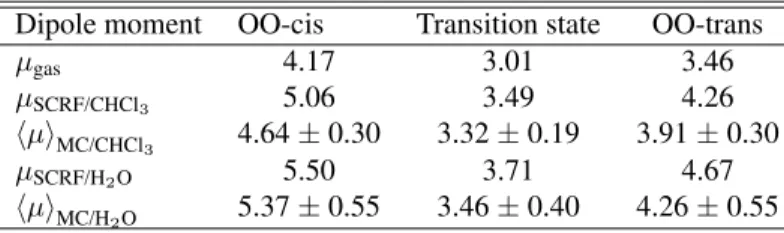
The polarization effects thats occur in the furfural molecule when dissolved in chloroform or water are bet-ter described by calculations of the dipole moment for the three more important conformers embedded in solvent and comparing them with the calculated dipole moments in the gas pase. Having obtained the solvation shells of furfural using the radial distribution functions, we treat the solvent as discrete molecules surrounding the solute. Then, dipole moment calculations are performed as averages over 60 MC configurations. To obtain these values we have employed a Monte Carlo/quantum mechanics (MC/QM) procedure with theab initioMP2/6-31+G(d) level of theory [25], treating
the molecules in the first solvation as point charges. We also compare our results, presented in Table 3, with the dipole moments calculated using the reaction field, where the sol-vents are characterized by their dielectric constantsǫ= 4.8 (for chloroform) andǫ= 78.5(for water). All calculations are carried out at the MP2/6-31+G(d) level with the same geometries of the furfural conformers. Using this method our calculated dipole moments for the gas phase are about of 0.2 D higher than the corresponding experimental values [18] of the more stable conformer, and only 0.08 D for the transition state.
Table 1. Statistics of the hydrogen bond formation in water. The distanceROOis given in ˚A, the anglesθOOHin degree, and binding energy−∆Ein kcal/mol. The standard deviations are also given.
Conformer hNo. of H-bondsi hROOi hθOOHi h−∆E/H-bondi
OO-cis 0.97 3.03±0.23 19.5±8.0 3.36±0.70
Transition state 0.84 2.98±0.23 20.8±8.0 3.08±0.60
OO-trans 1.13 2.95±0.23 16.5±8.0 3.45±0.70
H-bonding energy contribution in H2O:∆Ecis-trans =−0.64kcal/mol.
Table 2. Statistics of the hydrogen bond formation in chloroform. The distanceROCis given in ˚A, the angleθOCHin degree, and the binding energy−∆Ein kcal/mol. The standard deviations are also given.
Conformer hNo. of H-bondsi hROCi hθOCHi h−∆E/H-bondi
OO-cis 1.07 3.26±0.23 21.7±8.0 3.26±0.70
Transition state 0.97 3.24±0.23 20.9±8.0 3.21±0.50
OO-trans 0.92 3.27±0.23 20.7±8.0 3.19±0.60
H-bonding energy contribution in CHCl3:∆Ecis-trans= +0.56kcal/mol.
Table 3. Calculated dipole moments (in debye) of furfural in different media at the MP2/6-31+G(d). The statistical averages are performed over 60 uncorrelated MC configurations considering only the first solvation shell.
Dipole moment OO-cis Transition state OO-trans
µgas 4.17 3.01 3.46
µSCRF/CHCl3 5.06 3.49 4.26 hµiMC/CHCl3 4.64±0.30 3.32±0.19 3.91±0.30
µSCRF/H2O 5.50 3.71 4.67
hµiMC/H2O 5.37±0.55 3.46±0.40 4.26±0.55
analysis is more interesting in the case of water, when we use only a dielectric constant to model the solvent effects. Going from the gas phase to water in the OO-cis conforma-tion, the polarization is of 32%, whereas the MC/QM pro-cedure gives an value of 29%. On the other hand, consider-ing the less stable OO-trans form in water, the reaction field predicts a higher polarization of 35%. As expected, this con-former is found to be less polarized, with a dipole moment increase of 23%, when we use the MC/QM scheme.
4
Concluding Remarks
Water is the most important solvent in nature. Because of its high dielectric constant and ability to form hydrogen bonds, the hydration effects can control many different molecular processes. In this work we have investigated the mecha-nism of hydration on the conformational equilibrium of fur-fural. It is well known that this molecule can exist in two stable conformations, OO-cis and OO-trans, separate by a relatively large interconversion barrier. In aqueous solution, the conformer with the higher dipole moment (OO-cis) is the most stable. Comparing this stability in chloroform the re-verse occurs, i.e., the conformer with lower dipole moment
(OO-trans) is the most stable. However, considering both solvents, we have demonstrated that the hydrogen bonding patterns along the rotational equilibrium are very similar. For instance, the number of the hydrogen bonds formed and the binding energies do not vary much along the OO-cis⇄ OO-trans interconversion. This suggests that the hydrogen bond interaction makes no preference for any particular ro-tamer. These results are in agreement with experiments ob-tained for protic solvents.
other words, the bulk properties of water are responsible for keeping specific conformers of the solute.
Acknowledgments
This work has been partially supported by CNPq and FAPESP.
References
[1] J. T. Edsall and J. Wyman,Biophysical Chemistry,Academic Press, New York, 1951, vol. 1.
[2] K. Coutinho, R. C. Guedes, B. J. Cabral, and S. Canuto, Chem. Phys. Lett.369, 345 (2003).
[3] T. V. Chalikian, J. Phys. Chem. B105, 12566 (2001).
[4] S. Scheiner,Hydrogen Bonding, A Theoretical Perspective, Oxford University Press, Oxford, 1997.
[5] G. A. Jeffrey,An Introduction to Hydrogen Bonding,Oxford
University Press, Oxford, 1997.
[6] G. A. Jeffrey and W. Saenger,Hydrogen Bonding in Biologi-cal Structures, Springer, Berlin, 1991.
[7] L. R. Pratt, Annu. Rev. Phys. Chem.53, 409 (2002).
[8] J. Kyte, Biophys. Chem.100, 193, (2003).
[9] G. Hartley,Aqueous Solutions of Paraffin-Chain Salts,
Her-mann & Cie., Paris, 1936. As quoted in C. Tanford, The Hydrophobic Effect: Formation of Micelles and Biological Membranes, Wiley, New York, 1973, p. viii.
[10] C. J. Cramer and D. G. Truhlar, Chem. Rev.99, 2161 (1999). [11] P. Kollman, Chem. Rev.93, 2395 (1993).
[12] K. K. Baldridge, V. Jonas, and A. D. Bain, J. Chem. Phys.
113, 7519 (2000).
[13] M. P. Allen and D. J. Tildesley,Computer Simulation of Liq-uid, Oxford University Press, Oxford, 1987.
[14] N. Metropolis, A.W. Rosenbluth, M. N. Rosenbluth, A. H. Teller, and E. Teller, J. Chem. Phys.21, 1087 (1953). [15] S. Canuto and K. Coutinho, Int. J. Quantum Chem.77, 192
(2000).
[16] K. Coutinho, S. Canuto, and M. C. Zerner, J. Chem. Phys.
112, 9874 (2000).
[17] S. Canuto, K. Coutinho, and D. Trzesniak, Adv. Quantum Chem.41, 161 (2002).
[18] R. J. Abraham and E. Bretschneider, inInternal Rotation in Molecules, edited by W. J. Orville-Thomas, Wiley, New York,1974, pp. 481-584.
[19] R. Rivelino, K. Coutinho, and S. Canuto, J. Phys. Chem. B
106, 12317 (2002).
[20] J. O. Hirschfelder, C. F. Curtiss, and R. B. Bird,Molecular Theory of Gases and Liquids, Wiley, New York, 1954. [21] H. J. C. Berendsen, J. P. M. Postma, and W. F. van Gunsteren,
inIntermolecular Forces, edited by B. Pullman, Reidel, Dor-drecht, 1981, p 331.
[22] V. E. Barlette and L. C. G. Freitas, Quim. Nova22, 574
(1999).
[23] G. A. Kaminski and W. Jorgensen, J. Phys. Chem. B102,
1787 (1998).
[24] C. M. Breneman and K. B. Wiberg, J. Comput. Chem.11,
361 (1990).
[25] M. J. Frisch et al., Gaussian 98, Revision A.7, Gaussian, Inc.: Pittsburgh, PA, 1998.
[26] K. Coutinho and S. Canuto, DICE: A Monte Carlo Program for Molecular Liquid Simulation, University of S˜ao Paulo, Brazil, 1997.
[27] K. Coutinho, M. J. Oliveira, and S. Canuto, Int. J. Quantum Chem.66, 249 (1998).
[28] A. D. Bain and P. Hazendonk, J. Phys. Chem.101, 7182
(1997).
[29] F. H. Stillinger, Adv. Quantum Chem.31, 1 (1975).
[30] M. Mezei and D. L. Beveridge, J. Chem. Phys. 74, 622
(1981).