O
A
Profile of the Brazilian physical therapy
researcher
Perfil do pesquisador fisioterapeuta brasileiro
Coury HJCG, Vilella I
Abstract
Objective: To define the profile of the Brazilian physical therapy researcher in terms of training, productive outcomes, and grants and fellowships awarded by Conselho Nacional de Desenvolvimento Científico e Tecnológico (CNPq), an agency linked to the Ministry of Science and Technology and dedicated to promoting scientific research and developing human resources for research in Brazil. Methods:
We assessed the online curricula vitae of every Ph.D. physical therapy researcher available in the Lattes database (CNPq). This public source of information was chosen because it is where every Brazilian researcher interested in grants and fellowships or involved with graduate education must fill out an electronic curriculum vitae providing detailed career and academic productivity information. To ensure the precision of information provided, a password and a formal statement are required for the researcher to feed the database. General statistics on financial support available in the CNPq homepage were also consulted. A binary regression was run to investigate the influence of career and general productivity aspects on the publication of ISI/JCR indexed papers. Results: In the past ten years, there was an extraordinary increase (900%) in physical therapists with a Ph.D. in traditional and new fields of practice. There was also an increase in publications, dissertations and theses supervised by physical therapists. The variables investigated by the regression analysis explained 49.8% of the occurrence of indexed papers. Statistics on grants and fellowship showed a small investment by CNPq in physical therapy compared to other allied health areas. Conclusions: We expect that the information provided here will help the academic community to gain a perspective on their identity and to define future priorities for the furtherance of knowledge and professional practice.
Keywords: Physical therapy; productivity; human resources formation; scientific publication.
Resumo
Objetivo:Traçar um perfil do pesquisador fisioterapeuta quanto a sua formação, produção científica e fomento e bolsas obtidos pela área do Conselho Nacional de Desenvolvimento Científico e Tecnológico (CNPq). Métodos: Foram consultados os curricula vitae de cada pesquisador fisioterapeuta com doutorado disponíveis na Plataforma Lattes do CNPq, que é uma agência do MCT dedicada à promoção da pesquisa científica e à formação de recursos humanos para a pesquisa. A escolha dessa fonte pública de informação ocorreu porque cada pesquisador interessado em auxílios de pesquisa ou envolvidos com a pós-graduação deve preencher eletronicamente um curriculum vitae com informações sobre formação e produção científica. O sistema requer uma senha pessoal e uma declaração do pesquisador atestando a veracidade das informações fornecidas, o que assegura precisão no preenchimento. Estatísticas sobre fomento e bolsas disponíveis foram também consultadas. Uma análise de regressão binária foi rodada para explicar a ocorrência de publicações ISI/JCR. Resultados: Houve um crescimento extraordinário (900%) no número de doutores com graduação em Fisioterapia, na última década, em áreas tradicionais ou novos campos de atuação e crescimento expressivo em número de artigos publicados, dissertações e teses orientadas. Os fatores analisados pela regressão conseguiram explicar 49,8% da ocorrência de artigos indexados. Dados de fomento e bolsas mostram um investimento pequeno do CNPq na Fisioterapia comparativamente às demais áreas da Saúde. Conclusões: O perfil do pesquisador traçado aqui poderá prover à comunidade acadêmica uma perpectiva de sua identidade e auxiliar no estabelecimento de prioridades futuras para o aprimoramento do conhecimento e prática profissional.
Palavras-chave: Fisioterapia; produtividade; formação de recursos humanos; publicação científica.
Received: 30/04/2009 – Revised:10/06/2009 – Accepted:15/06/2009
Department of Physical Therapy, Universidade Federal de São Carlos (UFSCar), São Carlos (SP), Brasil
Introduction
he maturing and consolidation of a profession depends on the work of its members to expand and improve the avail-able body of knowledge, which can then be used to generate guidelines for eicient practice1. Evidence-based clinical
practice is made possible by the integration of individual experience with quality scientiic evidence available in the relevant literature2,3. his scientiic evidence is produced by
researchers in the ield and published in high-standard jour-nals, attested by a careful process of peer review and indexing in bibliographic databases.
Once consolidated, the health profession can prepare its members to meet the therapeutic needs of the population as well as predict future clinical and preventive demands. Within this perspective, it is helpful to know the proile of the physi-cal therapy researcher, the trends in his training, his scientiic production and capacity for training future researchers in order to develop a picture of our current identity and plan fu-ture scenarios. As training depends on funding, it also seems important to characterize the grants awarded by the country’s main funding agency for individual research grants in science and technology, the Conselho Nacional de Desenvolvimento Cientíico e Tecnológico (CNPq) of the Ministry of Science and Technology (http://www.cnpq.br).
When deining the proile of researchers and scientiic production, international studies1,4 have used a
combina-tion of bibliographic databases and reports from accredited research lecturers of undergraduate and graduate programs in physical therapy. However, this combination of sources was considered incomplete by researchers who endorsed the latest U.S. study1 on the subject, which resulted in several
let-ters to the editor3,5,6 challenging the methodology. he main
points mentioned indicate that the article underestimated the search results mainly because the searched databases only consider the ailiation of the irst author of each article. hus, when the irst author was from another ield, the physi-cal therapists who co-authored the study were not included in the survey. Physical therapy researchers associated with programs in other ields3 were also excluded.
Considering that Brazil has a powerful source of infor-mation on researchers, the CNPq Lattes database7 of online
curricula vitae completed by the researchers themselves, we decided to use this source to gather the data used in the pres-ent study. his option was reinforced by the following facts: a clear majority of PhD researchers in the country have a curriculum vitae in the Lattes database, which is needed to request any type of grant; all researchers enrolled in gradu-ate programs are required to have this curriculum for the program assessment conducted by the Coordenação de
Aperfeiçoamento de Pessoal de Nível Superior (Capes); the in-formation is provided by the researchers with the use a pass-word and formally attested by them, which may make it more accurate. As the physical therapy profession reaches 40 years of formal existence in Brazil (Decree-Law No. 938/1969)8 and
given that the knowledge of our characteristics may contrib-ute to a better understanding of our identity and deinition of future prospects, we have deined the proile of the Brazilian physical therapy researcher with regard to training, ield of practice, scientiic production and training of new research-ers. We have also described the national grants and fellow-ships recently awarded by CNPq.
Methods
To deine the proile of the physical therapy researcher with a PhD, we individually analyzed all curricula vitae from re-searchers in the ield available in the Lattes database7 of CNPq.
We also analyzed statistics on scientiic production available on the CNPq website (www.cnpq.br). For the data survey on national grants and fellowships, the website’s section on “Grant Statistics and Indicators” was also consulted.
Identiication of PhD physical therapy researchers: he curricula search system in the Lattes database has a feature that allows searches according to academic training. However, applying the Training/Academic Level ilter, with the word “physical therapy” in the “Subject” ield and the “PhD” database checked, the result should lead to the number and speciic list of PhD researchers with a physical therapy degree. When we performed this action in October 2008, we obtained a result of 2751 curricula, but individual veriication showed that not everyone had a degree in physical therapy. CNPq’s technical support was consulted and informed us that some of the il-ters were not working at the time of the search and that the Training/Academic Level ilter was still under construction. herefore, the system included in its search results researchers which were not physical therapists but had work related to the ield of physical therapy.
Given this limitation, each one of the 2751 curricula, which reached 2773 in December 2008, had to be accessed individu-ally. hose that, in fact, belonged to individuals with a bachelor degree in physical therapy were selected and listed to be in-cluded in the present study. hrough this procedure, 573 cur-ricula of PhD researchers with a physical therapy degree had been identiied by December 31st, 2008. hese curricula were
accessed again during the months of January and February 2009 for the collection of information, which was analyzed in March 2009. he selected information was included in the ar-ticle that was written in April 2009.
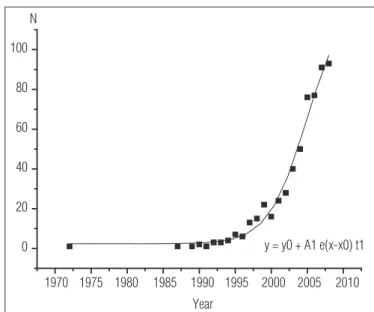
Figure 1. Number of researchers per year of PhD completion. y = y0 + A1 e(x-x0) t1
Year N
1970 1975 1980 1985 1990 1995 2000 2005 2010 0
20 40 60 80 100
Source: Individual Lattes curricula of the researchers with a degree in physical therapy - CNPq.
he aspects evaluated in the curricula were: year of award of doctoral degree, institutions that awarded the un-dergraduate and doctoral degrees, academic and practical specialty area, scientiic production and training of new re-searchers. he main results were presented descriptively. A binary logistic regression analysis was run to explain which factors contribute to the quality of knowledge produced by researchers. he chosen quality indicator was the researcher’s publication of international articles in the Institute for Scien-tiic Information/Journal Citation Reports (ISI/JCR) database, which was analyzed on the basis of ield of practice and other work and lines of research as possible factors of inluence. ISI/JCR publications are accessed and accepted internation-ally because they are peer-reviewed and, therefore, serve as a quality indicator of the researcher’s work.
Ethical aspects: Each researcher completes his own cur-riculum, attesting to the accuracy of the information provided and agrees, under the “Terms of Membership and Commitment - Lattes Platform curricula system,” to make the information public with the exception of certain personal details. hus, the available information was consulted, and no researcher was individually identiied.
Results and discussion
he rise in the number of PhD researchers with a degree in physical therapy was extraordinary in the past ten years, jump-ing from a total of 57 researchers in 1998 to 573 in 2008 (Figure 1). his result shows a great efort for scientiic training on the part of the physical therapy community.
hese numbers corroborate an advance in scientiic knowl-edge in the ield of physical therapy in Brazil, because there is a clear link between the development of human resources and scientiic production9,10. It is considered that the increase in
sci-entiic training, among other things, generates further develop-ment in research and thus an improvedevelop-ment in the profession, employment and population care. he number of PhDs in Brazil grew ten-fold between 1980 and 2006. Between 1990 and 2003, the growth rate was 16% per year, whereas from 2003 onwards the rate dropped to about 4% per year10. hus, this growth rate may
decrease in coming years also in the ield of physical therapy.
Training and practice characteristics of the
researchers
Most of the PhD researchers completed their undergradu-ate degree in the Southeast Region of the country, especially at Universidade Federal de São Carlos-UFSCar (N=71), Pon-tifícia Universidade Católica de Campinas-PUC-Campinas (N=46), Universidade Metodista de Piracicaba-Unimep (N=35) and Universidade Estadual Paulista-Unesp (N=31). he other institutions had values under 25. In the South Region, how-ever, most PhDs completed their undergraduate training at Universidade Estadual de Londrina-UEL (N=41) and Univer-sidade Federal de Santa Maria-UFSM (24). In the Northeast Region, most PhDs received their undergraduate degree in physical therapy at Universidade Federal da Paraíba-UFPB + Universidade Estadual da Paraíba-UEPB (25), UFPE (15) and Universidade Federal do Rio Grande do Norte-UFRN (9).
he major destinations of employment for graduate re-searchers were private universities (50% of rere-searchers) and public universities (37.2%). Few took up employment in hospi-tals (1.5%) or government bodies (0.7%) and none in research institutes. his suggests that there is a large, potential labor market to be explored by PhD physical therapists. he number of public universities (N=38, 10%) that hire a greater propor-tion of PhDs (5.6 per university) is still small, according to the latest INEP survey11. In contrast, private universities (N=341,
90%) employ an extremely small proportion of PhDs (0.84 per university).
A wide variety of areas of doctoral training was identiied. Currently, the most prominent is the area of physical therapy itself (39%), followed by physiology (11.2%), medicine (9.6%), morphology (5.4%) and many others, including three diferent engineering specialties, pharmacy, biochemistry, psychology, etc. Despite this diversity of areas, there is a predominance of biological and health sciences in the training of researchers.
Types of Production and Supervision
2002 Survey* 2004 Survey** 2006 Survey*** Lattes CV Physical therapy
(mean/ researcher/year of PhD completion)∆
All areas Allied
Health All areas
Allied
Health All areas
Allied Health
PhD completed until 1999
PhD completed 2000-2003
PhD completed 2004-2008
Nat+Inter Papers 1.36 1.84 1.41 1.97 1.57 2.33 1.85 1.35 2.78
Books 0.07 0.07 0.08 0.07 0.08 0.06 0.06 (n=61) 0.03 (n=32) 0.08 (n=86)
Chapters 0.29 0.45 0.34 0.49 0.41 0.59 0.13 (n=133) 0.19 (n=172) 0.32 (n=311)
Master’s Dissertations 0.41 0.39 0.40 0.39 0.43 0.40 0.54 0.30 0.07
PhD Theses Supervised 0.12 0.14 0.11 0.13 0.12 0.14 0.10 0.05
-Table 1. Scientific production per PhD researcher in all CNPq areas, for allied health researchers and physical therapy researchers. Mean number of master’s and PhD students supervised by researchers in all CNPq areas, for allied health researchers and physical therapy researchers according to time since degree.
Source: CNPq - Directory of Research Groups in Brazil. Surveys - 2002 (1998-2001)*, 2004 (2000-2003)** and 2006 (2004-2006)***. Table 7 and Lattes CV of 573 PhD physical therapy researchers accessed between January and February/2009∆.
majority of which (N=31) returned to Brazil to practice their pro-fessional activity. According to the data recorded in the Lattes curricula, some studied in the United States and Canada (N=15) and others in Europe (France, England, Belgium, Spain). A few studied in Latin America (N=3) or Australia (N=2). It is known that the main centers of excellence in the area are located in North America, Europe/Scandinavia and Australia. hus, the numbers indicate that the researchers who were able to com-plete a full doctorate abroad made good choices, selecting the best foreign universities for their training. his positive aspect may be a result of the diiculty involving the high competitive-ness to obtain a fellowship. he data from overseas fellowships supported by CNPq (http://www.cnpq.br/estatisticas Table 1.4.3) show that very little has been invested in the areas of the
Multidisciplinary Health Committee (physical therapy, physical education, speech pathology, occupational therapy) in the last decade.
he graduate researchers settled mainly in the Southeast Region (64%), whereas a very small number settled in the Mid-west Region (2.5%) and an even lower number in the North Region (0.7%). When analyzing the distribution of Masters and PhD programs in all areas of knowledge in the country, we see that there are few courses in the Midwest (6.4% and 4.1%, respectively) and North (3.5% and 1.8%, respectively)11
Regions. However, in the area of physical therapy there are still no graduate programs by research in these two regions of the country. hus, the number of researchers in these regions also relects this discrepancy in distribution.
Scientific production by researchers and
development of human resources
Table 1 shows the average number of national and inter-national publications per PhD researcher per year in all CNPq
areas of knowledge by allied health researchers and physical therapy researchers.
Considering the time since degree, the 76 researchers that completed their doctoral studies until 1999 published a cumula-tive total of 1830 articles over the course of their academic career, which, distributed according to time of completion, give an aver-age of 1.85 articles per researcher/year (Table 1). he 111 research-ers who graduated between 2000 and 2003 published 1199 articles, which, distributed according to time of completion, give a total of 1.35 articles per researcher/year. In contrast, the 386 researchers who earned their degree between 2004 and 2008 published 2.684 articles, generating an average of 2.78 articles per researcher/year. When compared with the values of the general CNPq survey for all areas and the allied health area, it can be observed that the rela-tively new area of physical therapy has very productive researchers. Although the census periods are slightly diferent from the periods classiied for physical therapy researchers, the weighting was done by researcher/year and the data became comparable.
he number of items reported in the curricula of the physi-cal therapists is compatible with the number of other areas and followed the same trend of growth. A more detailed analy-sis shows that the increase was relative for less experienced researchers and, recently, for more senior PhD researchers. A possible explanation for that fact may be the requirement of a greater number of publications by graduate programs. It can also be pointed out that researchers themselves need to publish more to compete for grants with their peers. Another interesting result is that only 29 researchers (5.1% of total) have not published a full article, which is very good for the area. he number of complete articles per researcher varied from a single published article (N=43 researchers, 7.5% of total) to 66 articles (N=1, 0.17%). he overall average of articles per researcher was 9.5, and the median was 6. It should be considered that these numbers refer to all articles reported by researchers in their curriculum as complete articles. An individual analysis of the
curricula showed that the information is not always complete because there are articles with no initial and inal page num-bers, duplicated information, etc. However, this is the source of data which CNPq itself uses to build the tables for all areas.
he average number of books published per researcher/ year, with few variations, is similar for all areas, including physical therapy, which showed 12.4% of researchers (N=71) with at least one book published. he number of chapters is relatively small compared to the other areas. Still 40% of physi-cal therapists (N=229) published at least one book chapter. For more recently graduated researchers, that number is close to the average of other general areas.
The number of master’s dissertations supervised by more senior PhD physical therapists is comparatively higher than the general average (Table 1). This was expected, given that the average of all areas includes all researchers in the Lattes database regardless of the time since degree. As was also expected, this value decreases for the researchers who graduated in the 2000-2003 quadrennium and decreases even more for recently graduated researchers. It is worth noting that the graduate programs (by research) in the field of physical therapy are relatively recent. The first master’s degree program was set up in 1997, and the first PhD pro-gram in 2000, both at UFSCar. In a short period of time, the number of graduate programs has grown, now totaling ten programs, including eight master’s and two PhD programs. Thus, the number of supervisions should increase soon. Until now, 111 doctoral theses have been supervised, and 20% of researchers (N=115) have had master’s students with completed dissertations.
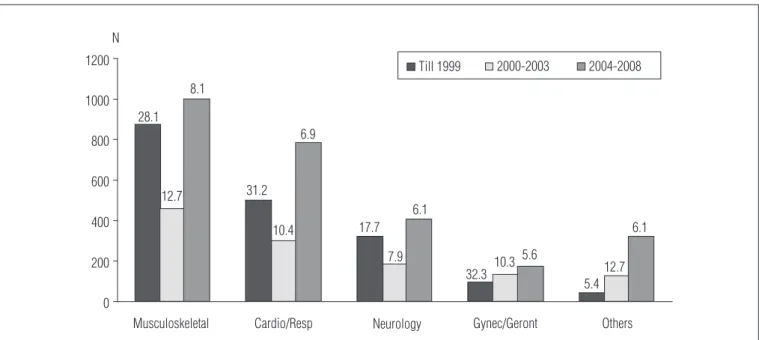
Figure 2 shows the total number of national and interna-tional papers accumulated for each subarea of physical therapy and per time of PhD completion. he numbers above each column indicate the average value of papers published by re-searchers for each condition.
he area of musculoskeletal physical therapy had 190 re-searchers (33.2% of total) and accumulated the largest number of published articles, even when the total was weighted by year of PhD completion. he area of cardiopulmonary physical therapy, with 158 researchers (27.6% of total researchers), had the second largest total number of published articles. he areas of adult and child neurology, with 107 researchers, published 18.7% of the total. he areas of gynecology and geriatric physical therapy, with 47 re-searchers, published 8.2%. hese last two areas were grouped to fa-cilitate data presentation, and there is no relationship between the content of their publications. In contrast, the last group (“Other”, with 71 researchers, 12.4% of total) includes several areas. Some are more traditional, such as physical therapy in dermatology, and others more recent, such as physical therapy applied to hepatol-ogy, endocrinolhepatol-ogy, oncolhepatol-ogy, public policies or a combination of several practices by the same researcher. he recent recognition of the specialty of physical therapy in occupational health12 is an
example of that growth. he number of articles published in new areas is higher for newly qualiied researchers, indicating that they seek innovative areas of education and research.
Considering the average number of articles published per lecturer, we see that researchers of musculoskeletal and cardio-respiratory areas had the highest rate of articles per researcher. According to a Creito-SP survey13, which involved 18299
physical therapists from the State of São Paulo, the three most
0 200 400 600 800 1000 1200
12345
Till 1999 2000-2003 2004-2008
28.1
31.2
17.7 6.9
32.3
5.4 8.1
12.7
10.4
7.9 6.1
10.3 5.6 12.7
6.1
Musculoskeletal Cardio/Resp Neurology Gynec/Geront Others
N
Areas Research Funding* Fellowships in Brazil**
Researchers (PhD)
per area∆
Funding per researcher
Increase in
undergraduate courses○
Total (R$1000) % Total (R$1000) % N % in R$ %
Physical Education 3206 1.37 17874 3.89 690 5.27 30.55 293.6
Nursing 5993 2.56 38377 8.35 997 7.61 44.50 443.5
Pharmacology/Pharmacy 51988 22.22 101756 22.15 1947 14.87 78.96 262.1
Physical Therapy + OT 2435 1.04 6225 1.35 309 2.37 28.02 741.5 (PT)
Speech Pathology 1831 0.78 5940 1.29 223 1.70 34.85 92.8
Medicine 63937 27.33 153594 33.44 4339 33.14 50.13 38.6
Dietetics 11929 5.10 19437 4.23 552 4.22 56.82 359.4
Dentistry 9386 4.01 52002 11.32 1734 13.24 35.40 50.0
Public Health 83256 35.59 64231 13.98 2301 17.58 64.09
Total 233961 100.00 459436 100.00 13092 100.00 - 150.7
Table 2. Funding provided by CNPq to allied health areas between 1998 and 2007, number of researchers per area in 2006 and increase in number of PT courses.
Sources: www.cnpq.br/estatísticas Tables 1.4.4* and 1.4.2**. Directory of Research Groups in Brazil – Statistics Summary 2006∆. INEP Bulletin, 2006○. OT=occupational therapy.
common ields of practice among these professionals are also musculoskeletal, pulmonology/cardiology and neuromuscular physical therapy. hus, despite the trend towards innovation among newly qualiied researchers, there is also a connection between professional practice in more traditional areas and the pursuit of professional development and scientiic production.
he percentage of PhD physical therapists with at least one article published in ISI/JCR indexed journals until 2008 was, on average, 57.8%, and when the number of articles was distributed according to time since degree, the percentages were 68.4, 58.5 and 55.4%, respectively, for graduates until 1999, between 00-03 and between 04-08. he absence of similar data for other areas prevent direct comparisons, however the numbers are very promising for a relatively new ield, as these numbers include not only the researchers with a PhD, but all PhDs in the ield with a Lattes curriculum. his information was obtained directly from individual curricula by using the Direct Object Identiier (DOI) when available or a feature available in the system to identify indexed journals: when the mouse cursor moves over the title of the journal, its impact factor appears. hus, considering the exceptions mentioned above for general complete articles (not indexed included), such information may be accepted as more reliable. he fact that more senior PhD researchers have a higher percentage of ISI/JCR publications was expected because of the obvious reason that they had more opportunities to publish. However, the shorter time frames for completion of doctoral studies may also have contributed to the fact that newly quali-ied researchers have a proportionally lower percentage.
Although statistically signiicant, the results of the regres-sion analysis shed little light on the factors associated with the publication of indexed articles. All of the possible factors of inluence combined, i.e. time of PhD completion, ield of practice, publication of general articles, books, chapters; su-pervision of dissertations and theses, explained only 49.8% of
the occurrence of ISI articles among researchers, while the publication of general articles alone explained 34.4% of that occurrence. In other words, there are factors related to the publication of scientiic articles of international circulation other than those considered in this analysis. Recently, Kauf-man14 assessed career factors that contribute to the variance
in the publication of indexed articles by American physical therapy researchers. According to the results, the factors stud-ied explained about 50% of the occurrence. he main factors were: career factors (17%) and demographic factors (12.4%). It is interesting to see that among career factors, career grant awards and time as researcher were the most signiicant. hus, the ability to publish articles with ISI indexing seems to depend on a great variety of factors, and having inancial resources can be decisive.
Main funding awarded by CNPq to the area of
physical therapy
Physical therapy is currently included in the CNPq Multidis-ciplinary Health Committee (Ministry of Health) with the areas of physical education, speech pathology and occupational therapy. For the purpose of internal distribution of grants and fellowships, physical therapy and occupational therapy are considered as a single area. As shown in Table 2, the distribu-tion of funding to the diferent areas is very uneven. he areas of dentistry, nursing, physical therapy, occupational therapy, speech pathology and physical education, which represent approximately 50% of the health sciences areas and 30% of its researchers, received only 10% of the total of grants. he areas of physical therapy and occupational therapy in particular re-ceived the least amount of funding per researcher.
According to INEP15, the number of graduate programs
in physical therapy have the highest increase in the period
1. Richter RR, Schlomer SL, Krieger MM, Siler WL. Journal publication productivity in academic physical therapy programs in the United States and Puerto Rico from 1988 to 2002. Phys Ther. 2008;88(3):376-86.
2. Maher CG, Sherrington C, Elkins M, Herbert RD, Moseley AM. Challenges for evidence-based physical therapy: accessing and interpreting high-quality evidence on therapy. Phys Ther. 2004;84(7):644-54.
3. Warden SJ. Letter to the editor. On “Journal publication productivity...” Richter et al. Phys Ther. 2008;88(3):376-86. Phys Ther. 2008;88(4): 538-9.
4. Holcomb JD, Selker LG, Roush RE. Scholarly productivity: a regional study of physical therapy faculty in schools of allied health. Phys Ther. 1990;70(2):118-24.
5. Maher C. Letter to the editor. On “Journal publication productivity...” Richter et al. Phys Ther. 2008;88(3):376-86. Phys Ther. 2008;88(4):539.
6. Harris SR. Letter to the editor. On “Journal publication productivity...” Richter et al. Phys Ther. 2008;88(3):376-86. Phys Ther. 2008; 88(6):791.
7. Ministério da Ciência e Tecnologia [homepage da internet]. Brasília: Conselho nacional de desenvolvimento científico e tecnológico: Plataforma Lattes [atualizada em 2008; acesso em 2008 Out e 2009 Fev]. Disponível em: http://lattes.cnpq.br
8. Provê sobre as profissões de fisioterapeuta e terapeuta ocupacional. 1969, Pub. Nº 3658, Sec 1, DOU. 197, Lei nº 938 (Out 10, 1969).
9. Ministério da Educação [homepage da internet]. Brasília: Plano Nacional de Pós-Graduação (PNPG) 2005-2010 - Capes. [atualizada em 2009; acesso em 16 Abr 2009]. Disponível em: http://www.capes.gov.br/servicos/plano-nacional-de-pos-graduacao.
10. Marques F. O fôlego na berlinda. Resultados incongruentes em dois rankings abrem debate sobre os limites do crescimento da população acadêmica brasileira. Revista Pesquisa FAPESP. 2008; 150:34-6.
11. Ministério da Educação [homepage da internet]. Brasília: CAPES - Coordenação de Aperfeiçoamento de Pessoal de Nível Superior: Cursos Recomendados. [atualizada em 2009; acesso em 16 Abr 2009]. Disponível em: http://www.capes.gov.br/cursos-recomendados.
between 1991 and 2004, with a growth of 741.5% in student registration compared to a national average of 150.7 for other health sciences courses (Table 2). It can also be noted that, while the funding values are destined for the two areas (phys-ical therapy and occupational therapy), the percentage of growth in graduate programs only applies to physical therapy. Naturally, the increase in graduate programs can not be seen as a direct indicator of the growth of a profession; however the data presented here also describe other indicators, such as a signiicant increase in the number of PhDs, in PhD pro-grams by research and in scientiic production. hus, when considered together, these indicators are clear and consistent markers of scientiic and professional maturity of the area of physical therapy in Brazil.
Final considerations and future prospects
Considering this evidence, the great academic efort made by physical therapy researchers must be recognized by the area itself and the agencies that fund research and development. It is only through recognition and support that this efort can be encouraged and converted into the development of knowledge in the area, professional consolidation and population health and quality of life. hus, more grants and fellowships are needed for the area as a concrete mechanism of support and encour-agement. he area would also beneit from a greater number of fellowships for study abroad in full or partial PhD programs as
well as post-PhD programs. Such direct support would be seen by researchers as a nod of approval from funding agencies for the tremendous efort expended by the academic community.
Among other concrete mechanisms to encourage the con-solidation of the area, we also envision the creation of more quality graduate programs for lecturer training in order to meet the demand generated by the large number of undergraduate courses in operation. Encouraging researchers to settle in less dense areas depends on government and institutional policies. New international indexing of scientiic journals already in exis-tence may be another important mechanism of consolidation. In this sense, it is important to recognize the excellent work of jour-nals such as the Brazilian Journal of Physical herapy in seeking indexing and disseminating quality research results in print and electronic format to reach the largest possible audience.
he researchers, in turn, will contribute by continuing their training, producing new knowledge and disseminating their re-sults in national and international indexed journals. Although the quantitative growth of publications has been described here, qualitative aspects of the research are also worthy of at-tention. Only clinically relevant and ethically acceptable studies can positively expand the body of knowledge of the profession and generate academic conditions for the development of new critical professionals and researchers. It is also important for members of the ield to relect on guidelines and priorities for their future research and professional practice as they work toward the consolidation of physical therapy in Brazil.
12. Baú LM, Klein A. O reconhecimento da especialidade em fisioterapia do trabalho pelo COFFITO e Ministério do Trabalho/CBO: uma conquista para a fisioterapia e a saúde do trabalhador. Rev Bras Fisioter. 2009;13(2):v-vi.
13. Peres LP. O perfil do profissional. Revista do CREFITO-SP. 2008;5:8-9.
14. Kaufman RR. Career factors help predict productivity in scholarship among
faculty members in physical therapist education programs. Phys Ther. 2009;89(3):204-16.
15. Ministério da Educação [homepage da internet]. Brasília: INEP – Instituto Nacional de Estudos e Pesquisas Educacionais Anísio Teixeira. Censo da Educação Superior 2005. [atualizada em 2009; acesso em 17 Abr 2009]. Disponível em: http://www.publicações.inep.gov/br.