Executive committee of working group of
the directing council the regional committee
PAN AMERICAN
WORLD
HEALTH
HEALTH
ORGANIZATION
ORGANIZATION
120th Meeting Washington, D.C.
June 1997
Provisional Agenda Item 4.4 CE12013 (Eng.)
9 April 1997 ORIGINAL: ENGLISH
ADOLESCENT HEALTH
The health of adolescents and young people is a key element in the social, economic, and political progress of the countries of the Region of the Americas and for ensuring the Region‘s success, development, and competitiveness in the next century.
The Pan American Health Organization has been a pioneer in addressing the health of adolescents and young people within the context of their social and economic environment, and in developing the mechanisms for meeting their needs for health services, particularly health promotion.
At the XXXVI Meeting of the Directing Council (September 1992), the Member States approved the Plan of Action for the Health of Adolescents in the Americas. In this regard, the Directing Council adopted Resolution CD36.R18, which urged the governments to establish national policies and plans for comprehensive adolescent health; develop bonds of collaboration between the agencies responsible for the health of this age group; promote the participation of adolescents in health promotion; and collaborate on specific programs.
During the period 1992-1997, PAHO’s Division of Health Promotion and Protection has been carrying out the Plan of Action, and national and international resources have been mobilized that have allowed substantive progress to be made.
The subject of adolescent health was submitted to the Subcommittee on Planning and Programming at its 27th Meeting in December 1996, and a presentation was made to the Subcommittee by the Adolescent Health Program. The Subcommittee endorsed the comprehensive, holistic approach advocated by the Program and made various suggestions that have been incorporated into the present document.
Based on this background, it is proposed that the Executive Committee evaluate the progress of the Plan of Action and discuss its future approach; consider a new conceptual framework for adolescent health and development; and consider providing decisive support to the search for national and international
CONTENTS
Page
EXECUTIVE SUMMARY 4
1. Introduction 4
2. Current Situation of Adolescents and Youth 5
3. A Recent History of PAHO‘s Work with Adolescents 7
3.1 Commitments and Plan of Action, 1992-1997 7
3.2 Implementing the Plan of Action, 1992-1997 8
3.3 Evaluation of Progress 8
3.3.1 National Programs in Adolescent Health 8
3.3.2 Prioritization of Adolescent Health 9
3.3.3 Human Resources Development 9
3.3.4 Quality of Health Services for Adolescents 9 3.3.5 Networks and Diffusion of Information 9 3.3.6 Community Participation and Youth Participation 10
3.4 Lessons Learned 10
4. Conceptual Framework for Adolescent Health and Development 10
5. PAHO’s Strategy for Adolescent Health and Development 12
5.1 Goal 14
5.2 Operational Strategies 14
5.3 Plan of Action 16
5.3.1 Development of Policy, Plans, and Programs in the Region 16
5.3.2 Human Resource Development 17
5.3.3 Development of Networks and Dissemination of Information 18 5.3.4 Improving Knowledge of Programs, Priorities, and Strategies through Research 18 5.3.5 Development of Social Communication and Advocacy 19
5.3.6 Mobilization of Resources 19
6. Action Requested 20
EXECUTIVE SUMMARY
The Pan American Health Organization has been a pioneer in addressing the health of adolescents and young people within the context of their social and economic environment, and in developing the mechanisms for meeting their needs for health services, particularly health promotion.
At the XXXVI Meeting of the Directing Council (September 1992), the Member States approved the Plan of Action for the Health of Adolescents in the Americas. At that time, Resolution CD36.R18 was adopted, urging the governments of the Region to: establish national policies and plans for promoting the comprehensive health of adolescents; develop bonds of collaboration between the agencies responsible for the health of this age group; promote the participation of adolescents in health promotion activities; and initiate collaborative projects between the different governmental sectors.
During the period 1992-1997, PAHO‘s Division of Health Promotion and Protection has been carrying out the Plan of Action and national and international resources have been mobilized for adolescent health. Support primarily from the W. K. Kellogg Foundation and also from the United Nations Population Fund played a key role in the initiation of the Plan of Action. The overall objective of the joint PAHOKellogg Initiative was to improve the scientific, technical, and administrative capacity of the national governments to initiate and strengthen comprehensive health programs for adolescents. The evaluation of progress made in following the Plan of Action found that while the countries have made tremendous progress in a short time in developing the infrastructure for adolescent health, there is still a long way to go and a stronger commitment is needed by all parties.
This paper describes PAHO’s regional strategy for adolescent health and development for the next four years, analyzes the operational guidelines, and establishes a new plan of action for the period 1998-2001.
Based on this background, the progress achieved, and the lessons learned, it is proposed that the Executive Committee:
- evaluate the progress of the Plan of Action and discuss future approaches; - consider a new conceptual framework for adolescent health and development;
- consider providing support for mobilizing national and international resources that will allow for appropriate implementation of the new Plan of Action;
1.
Introduction
The health of adolescents (10-19 years old) and youth (15-24 years old) is a key element for the social, economic, and political progress of all the countries and territories in the Americas. Far too often, however, adolescent needs and rights are absent from public policies or from the agenda of the health sector, except when they behave in troubling ways. One contributing factor is that, compared to very young children and to the elderly, adolescents suffer from few life-threatening conditions, and most of the unhealthy habits learned during adolescence do not produce morbidity or mortality during the period of adolescence itself.
2.
Current Situation of Adolescents and Youth
Adolescents and youth represented approximately 31% (137 million) of the population of Latin America and the Caribbean in 1995; in both the United States and Canada, the percentage is around 20% of the population. The number is expected to increase from 137 million to nearly 172 million by the year 2000, with the higher percentage concentrated in the poorer countries of the Region. The growth of this population will tax health, education, and labor systems that are presently unable to meet their demands. The Economic Commission for Latin America and the Caribbean (ECLAC) outlined four of the most influential changes in the Region impacting adolescents: (1) the serious economic crisis, leading to the need for economic restructuring and development of greater technological competence for dealing with an internationally competitive marketplace; (2) the resurgence and consolidation of democratic systems throughout the Region; (3) improved levels of educational enrollment for each successive generation of youth; and (4) rapid change in cultural institutions and values due to greater globalization in communications and transport. Despite the positive changes in society, adolescents continue to face many problems which threaten their healthy transition to adulthood.
Poverty
In some of the poorer countries and in poorer areas of the otherwise more developed countries of the Region, the manifestations of poverty in stunted growth and underweight, morbidity and mortality due to inadequate nutrition, tuberculosis (TB), acute respiratory infections, and diarrheal diseases are still evident in the adolescent years. In countries such as Bolivia, Ecuador, Guatemala, Nicaragua, and Paraguay, acute infectious diseases still rank among the leading causes of death in 10-14 year olds and TB incidence is high among 15-19 year olds.
Education
Urbanization
It is estimated that 75% of the young population in the Region were living in urban areas in 1995; this is expected to grow to 80% by the year 2000. High levels of unemployment and violence are the major urban characteristics that affect the youth. Adolescents have an unemployment rate twice that of adults, and if they have a job they are more likely to work in the informal sector, generally meaning poorly paid, low skill jobs without benefits or protections under the law.
Health Statistics
Epidemiological information on adolescents in the Region is scarce and influenced by the problems and risk behavior conceptual framework. Local and national statistics on health are generally not disaggregated for the age group 10-14 and 15-19 (adolescents) or 15-24 (youth) and by sex, making it difficult to make comparisons across communities, countries, or subregions. Also, social and development indicators of adolescent health need to be designed and tested in the Region. One important reason is to be able to measure the impact of programs that are designed to promote healthy development, rather than measuring their impact on mortality and morbidity.
The leading causes of death among adolescents aged 10-19 are external causes, which include homicides, suicides, accidents and injuries. Colombia and El Salvador are two of the countries hardest hit by violence. In Colombia, an important component of this epidemic is drug trafficking, while in countries such as El Salvador and Brazil, it is the growth of youth gangs. Suicides, the incidence of which is relatively low in the less- developed countries of the Region and is highest in the United States and Canada, have begun to show up in statistics from some Latin American countries, such as Argentina, Mexico, and Venezuela.
Reproductive Health
Violence
Intrafamilial violence and gender-based violence are some of the more hidden burdens of violence. A study in Kingston, Jamaica, found a high prevalence of violence in the lives of girls aged 13-14: 53% of the girls had experienced beatings at home; 63% had been beaten in school, by both male and female teachers; and many were afraid to go to school for fear of violence. The high rates of sexual abuse and incidence of rape, especially among the youngest teenage mothers, are only just beginning to surface in the Region.
Substance Abuse
Drug and alcohol abuse does not appear to discriminate by class. Use of inhalants by preadolescents is a serious problem among street children of Brazil and Guatemala, among others. Alcohol abuse by youth and its link to motor vehicle accidents, especially among males, is a problem for many of the more well-developed countries of the Region. The Region has a high prevalence of smoking among adolescents (57% of 15-19 year olds in Peru and 41% in Cuba) compared to 17% and 15%, respectively (1994), in Canada and the United States. Female youths are less likely to smoke, but their smoking rates are growing.
3.
A Recent History of PAHO‘s Work with Adolescents
3.1 Commitments and Plan of Action, 1992-1997
At the XXXVI Meeting of the Directing Council in September 1992, the Member States approved a Plan of Action for the Health of Adolescents in the Americas. The Directing Council adopted Resolution CD3618, requesting commitment from Member States to: (1) develop national initiatives for adolescent health; (2) establish and strengthen bonds of collaboration between different agencies responsible for adolescent health in their countries; (3) establish and strengthen bonds of collaboration between nongovernmental organizations, universities, and research centers; (4) promote the active participation by adolescents in health promotion activities in various settings; and (5) establish and strengthen collaborative projects between the ministries of health and education.
3.2 Implementing the Plan of Action, 1992-1997
During the period 1992-1997, PAHO has been carrying out the Plan of Action with its own resources and with support primarily from the W. K. Kellogg Foundation and also from the United Nations Population Fund (UNFPA) and the Swedish International Development Agency (SIDA). A large amount of resources have been mobilized at the country level as well.
The PAHOKellogg initiative for the comprehensive health of adolescents was started in 1992, with the overall goal to strengthen the institutional and technical capacity of the countries of the Region primarily through the establishment and support of national adolescent health programs. This initiative served the strategic purpose of jump-starting the implementation of the Plan of Action at both the Regional and the national levels. Specific outputs from these four years of the project include: (1) a network for systematizing and disseminating information on adolescent health to individuals and institutions in the Region; (2) development of a critical mass of human resources trained in various aspects of adolescent health in the countries; and (3) development of instruments for improving the quality of health services in the Region. The first cycle of the initiative cemented a collaborative relationship with the Kellogg Foundation, and a new four-year initiative is expected to be approved by the end of 1997.
Collaborative activities with UNFPA have focused specifically on the reproductive health of adolescents. Activities have included developing training materials for supporting services and programs addressing sexuality. A collaborative project with the Swedish International Development Agency was launched this year to begin to address violence and adolescents, as a critical public health issue for the Region.
3.3 Evaluation of Progress
In 1996, an external evaluation was conducted of the progress made in the various components of the Plan of Action in 22 countries of the Region, with participants including PAHO field staff, Kellogg focal points, national program directors, and key informants. Also, an assessment of national policies and plans in 30 countries was conducted with the George Washington University. The following are the results in key areas:
3.3.1 National Programs in Adolescent Health
universally present. While the majority of national programs collaborate with NGOs and international organizations, less than half work with the Ministry of Education or the legislative and judicial branches of government. In the area of policy, eight out of 30 countries surveyed in the Region were found to have an established national adolescent health policy, with another five countries in the process of developing one.
3.3.2 Prioritization of Adolescent Health
There was a general perception by respondents of low interest in adolescent health on the part of decision-makers and local governments, and two out of three respondents felt it occupied minimal space in the public agenda.
3.3.3 Human Resources Development
The lack of human resources with skills in adolescent health at all levels was clear. There is a need for program management skills to improve the quality of adolescent health programs, and training of primary health care workers in adolescent health is inadequate.
Since 1992, 1,200 professionals have been trained in various aspects of adolescent health through multiplier courses, intersectoral seminars, and sensitivity training workshops; 87.1% of the respondents affirmed that health service personnel in their countries had undergone some kind of training in adolescent health. Up to the present, however, in all of the 22 countries surveyed, human resources training was still rated as insufficient.
3.3.4 Quality of Health Services for Adolescents
The application of clinical norms and guidelines is an important strategy for improving the quality of health services. While specific content for adolescent health existed in the clinical setting in many countries, less than 2% of respondents felt that it was being used adequately in practice. The degree of integrity of care and service delivery by a multiprofessional staff was considered inadequate by the majority of respondents.
Six service development instruments were designed and tested by PAHO during the 1992-1996 cycle for evaluating and addressing quality of care issues. The level of application in the field was low, with five of the six instruments being used in less than one-fourth of the 22 countries. The norms and guidelines for services was being applied in the field by only one out of 10 of all respondents.
3.3.5 Networks and Diffusion of Information
adolescent health and the level of social communication in their countries as high. Access to information about adolescent health programs is also universally rated as low.
Since 1992, PAHO has developed and linked seven information centers into a network dedicated to adolescent health, called ADOLECBIREME. A database of individuals and institutions was designed with over 2,000 entries from throughout the Region. Results showed that the service provided by functioning ADOLEC centers was considered effective for disseminating information. However, the overall knowledge in the field of the existence of the network was low.
3.3.6 Community Participation and Youth Participation
Two out of three respondents knew of youth programs in their communities that incorporate adolescents in the decision-making process. However, within the health area, only between 8% and 16% felt that participation of the community, families, or adolescents was adequately integrated into health services at the local level. In response, PAHO developed the Guidebook of Participative Methodologies, but utilization in the field was affirmed by only 14.5% of the respondents.
3.4 Lessons Learned
Despite being a young program, and a relatively new area of health concern for the Region, significant progress has been made in a short time in developing the infrastructure for adolescent health. Still, the evaluation shows that there is a long way to go in following the 1992 Plan of Action, and a stronger commitment is needed by all parties. The critical lessons learned from the first four years of the Plan of Action have been the need to:
- prioritize advocacy of adolescent health among the public and decision-makers;
- focus not only on developing human resources among today’s health professionals, but also among future health professionals through work with university schools of health sciences; - encourage and facilitate the use of new information technologies to increase channels for disseminating information and increase coverage of human resources training;
- develop new models for encouraging youth participation and nurturing youth empowerment;
- focus both on establishing national programs of adolescent health and on building the capacity of human resources to manage national programs;
4.
Conceptual Framework for Adolescent Health and Development
The new Plan of Action provides a valuable opportunity for PAHO to outline and discuss a new conceptual framework for addressing adolescent health in the Region, based on a holistic view of adolescents and their needs.
Up to now, the thinking in the field has been dominated by a problem and risk behavior approach. Most programs serving adolescents focus on specific conditions and usually do not intervene until the conditions have reached the level of “problems.” These programs could be considered “tertiary attention”Ctrying to fix something after it is badly broken. Thus, there have been programs dealing with teenage mothers, school dropouts, substance abusers, and juvenile delinquents. What gets lost in this approach are the “whole” adolescents, their families, their environments, and the overall context in which these behaviors occur. Studies have shown that single-focus programs have not demonstrated a significant capacity to change the lives of adolescents. Moreover, they have proven to be quite expensive on a per client basis.
Research on the underlying factors contributing to the development of these problems reveals that they are interrelated and the same underlying conditions emerge time and again. A summary of research on risk factors identified the following as the common antecedents for most substance abuse, delinquency, teenage pregnancy, and school dropout: extreme economic deprivation, family conflict, and a family history of problem behavior. Furthermore, substance abuse, delinquency and violence all share neighborhood characteristics that suggest that these neighborhoods offer particular opportunities to engage in problem behaviors. The characteristics include: community norms or laws favorable to drug use or crime; the availability of firearms; peers engaging in problem behaviors; and low sense of community attachment. Under these circumstances, youth striving to achieve a sense of identity, develop life skills, and earn a livelihood have abundant opportunities for engaging in negative behavior and few opportunities for positive growth.
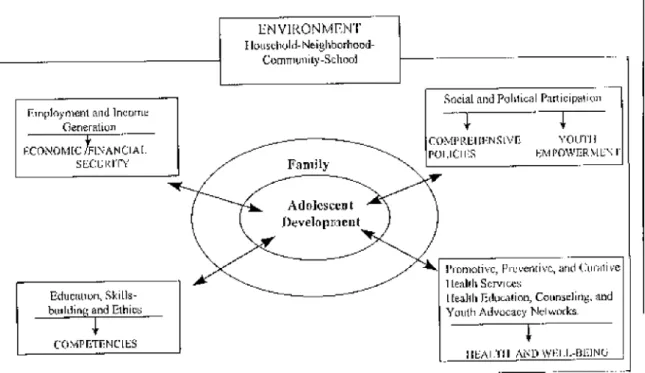
Rooted in these findings, the PAHO Program of Adolescent Health proposes a new conceptual framework based on human development that places adolescent development in the center, within the context of their families and their environment.
What do adolescents need for healthy development? Summarizing the findings of the World Health Organization, UNICEF and the Carnegie Council on Adolescent Development the following six key elements were identified:
(1) Access to accurate information allows young people to make informed choices, whether it be about sexuality or decisions about education and work.
(2) Acquiring practical skills and life skills, including decision-making, communication skills, conflict resolution, and how to resist pressure from peers and adults, is a critical developmental need of adolescents. Developing social competency and life skills enables adolescents to gain a sense of self-worth and to make informed decisions in social settings, in the workplace, and in relationships.
(3) Particularly important in today‘s global and high-technology economy, adolescents need access to training and other opportunities to develop technical, entrepreneurial, and vocational skills.
(4) Adolescents need adequate nutrition, as well as access to quality education and health services, including counseling.
(5) In a broader sense, for adolescents to grow up healthy, they require a safe and supportive environment beginning with families, and the experience of a sustained caring relationship with at least one adult, and encompassing schools, community institutions, and health care systems. Support for these institutions can be provided by policies and legislation, societal values, positive role models, and a wide range of media activities.
5.
PAHO’s Strategy for Adolescent Health and Development
In accordance with the conceptual framework and based on past evaluations and lessons learned, the following Plan of Action for 1998-2001 has been developed.
5.1 Goal
The Plan of Action seeks to promote health and favorable development of adolescents and young people between the ages of 10 and 24 by developing and strengthening national and local programs and services in the countries of Latin America and the Caribbean.
5.2 Operational Strategies
While the activities of the Plan of Action are intended to ultimately benefit the adolescents of the Region, the focus must be on developing the infrastructure and the capability within the countries to address the needs of their own adolescents and youth. This involves both institutional capacity building and development of a base of human resources in the Region, with the training, tools and opportunities to work effectively within these institutions.
The key institution for initiating country activities and for generating national level investments of human and financial resources is the national program of adolescent health. The ministries of education, labor, and justice, national legal bodies, mass media institutions, NGOs working directly with youth, schools, health services, and universities are some of the partners that are needed to commit to the Plan of Action through participation in collaborative projects, research grants, expert groups, training courses, and workshops. The development of relationships between countries of the Region through horizontal collaboration will continue to be used as a highly effective operational strategy. Based on the priorities of the countries of the different subregions, the activities will be organized to provide opportunities to learn from differences and similarities among them. Collaboration with other PAHO programs and divisions will be encouraged.
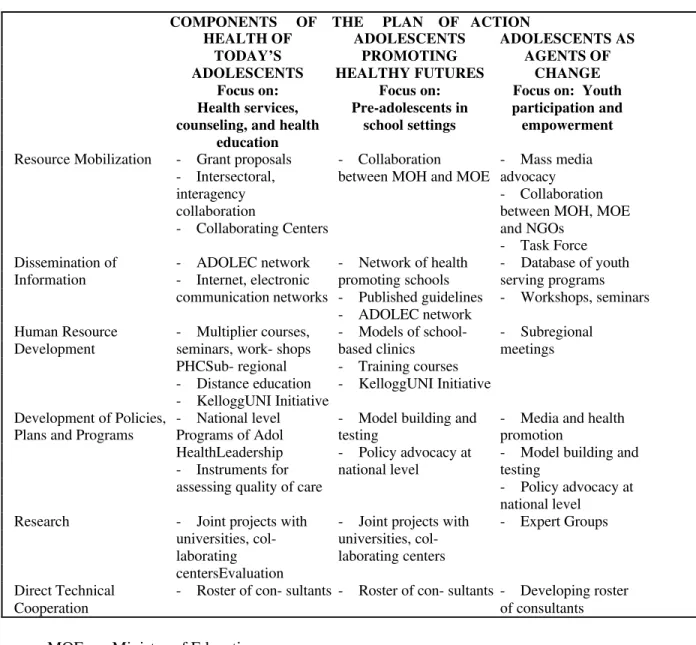
Table 1. Operational Strategies
COMPONENTS OF THE PLAN OF ACTION
HEALTH OF ADOLESCENTS ADOLESCENTS AS
TODAY’S PROMOTING AGENTS OF
ADOLESCENTS HEALTHY FUTURES CHANGE
Focus on: Focus on: Focus on: Youth Health services, Pre-adolescents in participation and counseling, and health school settings empowerment
education
Resource Mobilization - Grant proposals - Collaboration - Mass media - Intersectoral, between MOH and MOE advocacy
interagency - Collaboration
collaboration between MOH, MOE
- Collaborating Centers and NGOs - Task Force Dissemination of - ADOLEC network - Network of health - Database of youth Information - Internet, electronic promoting schools serving programs
communication networks - Published guidelines - Workshops, seminars - ADOLEC network
Human Resource - Multiplier courses, - Models of school- - Subregional Development seminars, work- shops based clinics meetings
PHCSub- regional - Training courses - Distance education - KelloggUNI Initiative - KelloggUNI Initiative
Development of Policies, - National level - Model building and - Media and health Plans and Programs Programs of Adol testing promotion
HealthLeadership - Policy advocacy at - Model building and - Instruments for national level testing
assessing quality of care - Policy advocacy at national level
Research - Joint projects with - Joint projects with - Expert Groups universities, col- universities,
col-laborating laborating centers centersEvaluation
Direct Technical - Roster of con- sultants - Roster of con- sultants - Developing roster
Cooperation of consultants
MOE: Ministry of Education
MOH: Ministry of Health
PHC: Primary health care
5.3 Plan of Action
5.3.1 Development of Policy, Plans, and Programs in the Region
National social policy can provide a framework for promoting health and addressing the need for services by: defining priorities, making a compelling case for action, developing consensus on priorities, and monitoring the implementation and impact of activities. A review of existing policies and legislation in the Region has already been initiated, and next steps include country case studies to generate policy models for adaptation in other countries in the Region. To meet the increasing demands for technical cooperation in this area, PAHO proposes to build capacity within the countries through strategies of horizontal cooperation, and the design and testing of analysis instruments, including policy development in human resources training.
Supporting national programs will continue to be a key strategy. Through technical cooperation and training in the areas of management, policy development, advocacy, and evaluation, PAHO proposes to strengthen the effectiveness of these programs to take the lead in adolescent health promotion in the Region.
Finally in the development of programs and services, the focus is on three specific areas:
(1) Comprehensive school health programs are recognized as a valuable strategy for both increasing the efficiency of the education sector by decreasing dropouts and non-attendance and by providing a health outreach to an age group that usually has little access to health services. The Plan will support the development of models of life skills, health education, and health service programs in schools, as well as the development and testing of models for sexual education that approach sexuality as a part of human development.
Activities
- Development of tools for conducting policy analyses, local-level advocacy, situation analyses at the national level, and evaluation of adolescent programs and services;
- strengthening of national programs of adolescent health with the infrastructure, tools and knowledgeable human resources to develop policy and a national plan of action, conduct situation analyses, and advocate for investment in adolescent health in five priority countries; - designing and testing of models of promoting adolescent health through the mass media in various settings (radio, television, newspapers) in three countries;
- realization of three country case studies of the development of comprehensive adolescent health policies in the Region.
5.3.2 Human Resource Development
Cultivating leadership within the countries and investing in human capital are part of the foundation of the new Plan of Action and a key to sustainable initiatives in the countries. Based on a profile of leadership and an overview of Regional leadership institutions, PAHO proposes to cultivate a multi-disciplinary group of leaders from the Region to spearhead programs, policies, and other initiatives in adolescent health.
To meet the overwhelming needs for training direct service providers, PAHO proposes to invest in education strategies using new technologies, including distance education courses, as well as continuing to support multiplier courses and intersectoral seminars. In the areas of school health programs and youth empowerment programs, site visits, courses, and participative workshops will be used to develop human resources in these areas.
A new initiative for PAHO will be to lay a foundation of adolescent health in the training of new generations of health professionals at the university level. A relationship has been established with the KelloggUniversity Initiative (UNI) that consists of 20 universities in the Region, to work with the undergraduate and graduate level programs of health sciences.
Activities
- Training of 25 leaders from different professional fields, in program management and evaluation, policy development, and advocacy;
- designing curriculums for primary health care training, life skills, and health education in schools and school-based clinics and the development of a base of human resources in the Region competent in these areas;
projects for undergraduate and graduate students;
- support for strengthening the effectiveness of national programs of adolescent health through training of staff in the areas of program management, policy development and evaluation (subregional workshops);
- training of 1,000 professionals per year through Internet courses in adolescent health.
5.3.3 Development of Networks and Dissemination of Information
Three important trends have been distilled that make networking between countries, institutions, and individuals a fundamental component of adolescent health: first, linking institutions, individuals and programs within a larger network of adolescent health becomes key as the trend in the Region moves away from centralized systems and towards decentralized, smaller components in charge of health; second, the rapidly developing communications technology has the potential to widen the already large information gap; and, third, lower costs. PAHO proposes to explore the potential of these new technologies, including distance education, electronic communications, and other Internet systems, while continuing to invest in traditional forms of information dissemination and communication.
Activities
- Implementation of an effective system in existing ADOLECBIREME centers for disseminating information on adolescent health and linking institutions and individuals using new technologies, including Internet and WorldWideWeb technologies;
- continuing to disseminate information through conferences and mass mailings;
- designing and testing models of new communications technologies in the Region, including distance education and dissemination of documents through the Internet;
- linking youth leaders from the KelloggUNI project with adolescent health experts from different fields, through new communication technologies;
5.3.4 Improving Knowledge of Programs, Priorities, and Strategies through Research
The foundation of both advocacy and decision-making requires solid data on the situation of adolescent health and development in the field, and what exists and what works in terms of programs, models, and strategies. PAHO proposes to stimulate the development of a “culture of evaluation” in the field of adolescent health in the Region. It will support cost-benefit analyses and impact evaluations of programs and services at all levels in order to develop a base of programs that are successful and can serve as models for replication.
Another line of action in this area will be to create opportunities in universities throughout the Region for research in critical areas of adolescent health, including violence prevention, gender studies, and resiliency in adolescence.
Activities
- Conduct situation analysis in adolescent health and carry out studies on the costs of not investing in adolescent health, in two countries;
- conduct cost-benefit evaluation and impact evaluation of programs and services at the national, district, and local levels to develop a roster of effective strategies and programs, including school-based clinics, sexuality education, and youth empowerment programs, in selected countries;
- support research in priority areas of adolescent health (e.g., male reproductive health, resiliency in adolescence, and violence and adolescents).
5.3.5 Development of Social Communication and Advocacy
Activities
- Develop and test models of media advocacy in different settings: television, radio, magazines, churches, and schools in three countries;
- develop health promotion videos, a character to speak to pre-adolescents, and advocacy fact sheets;
- support human resources training of health service providers, teachers, and national leaders in mass media strategies for advocacy.
- increase the sensitivity of media representatives to the issues of adolescent health.
5.3.6 Mobilization of Resources
PAHO’s Program of Adolescent Health is expecting to mobilize resources from outside institutions for work in several key areas of adolescent health. In the future, the program will work to develop initiatives in the area of violence and youth, further activities in health promotion with the W. K. Kellogg Foundation and in reproductive health with the United Nations Population Fund (UNFPA). Table 2 shows cost estimates. However, no amount of international resources will replace the necessary foundation of institutional, human, and financial resources that need to be mobilized at the national level, and the political commitment on the part of the countries of the Region.
Table 2. Human and Financial Resources:
Historical Trends and Proposed Resource Allocation, 1998-2001*
Year Regular funds Extra- budgetary TOTAL ____________ ______________
Personnel costs Other costs funds
1992 54,000 --- 209,619 263,619
1993 54,000 --- 463,680 517,680
1994 88,000 80,000 442,806 610,806
1995 88,000 95,000 382,940 564,940
1996 108,000 125,000 273,322 506,322
1997 210,000 150,000 1,150,000 1,516,000
1998 210,000 170,000 1,150,000 1,541,000
1999 210,000 170,000 1,150,000 1,674,000
2000 220,000 180,000 1,150,000 1,806,000
2001 220,000 180,000 1,150,000 1,806,000
* Subject to availability of funds
Activities
Swedish International Development Agency for initiatives in the area of violence and adolescents;
- mobilization of resources from the UNFPA for work in the area of reproductive health;
- supporting local institutions and persons to conduct research on priority topics, develop youth empowerment programs, and design and implement school-based health services and programs;
- advocating for adolescents and youth in the Region as a strategy to stimulate mobilization of local and national level resources.
6.
Action Requested
Bibliography
Blum R. Towards a New Millennium: Conceptual Model for Adolescent Health in the Americas. Discussion Paper in Conference on the Comprehensive Health of Adolescents and Youth in Latin America and the Caribbean. PAHO, Washington, D.C., 1996.
Burt M. Why Should We Invest in Adolescents? In Conference on the Comprehensive Health of Adolescents and Youth in Latin America and the Caribbean. PAHO, Washington, D.C., 1996. Comisión Económica para América Latina y el Caribe (CEPAL). Tendencias actuales y perspectivas de los jóvenes en América Latina y el Caribe. División de Desarrollo Social, Santiago, 1992.
Economic Commission for Latin America and the Caribbean (ECLAC). Social Panorama of Latin America. Washington, D.C., 1995.
Londoño, L. Poverty, Inequality, and Human Capital Development in Latin America, 1950-2025. Latin American Studies, World Bank. Washington, D.C., 1996.
PAHO. Comprehensive Health of Adolescents. Document CD3616. Washington, D.C., September 1992.
World Health Organization. A Picture of Health. Geneva, 1995.