CHARACTERIZATION AND CLASSIFICATION OF TWO
SOILS DERIVED FROM BASIC ROCKS IN PERNAMBUCO
STATE COAST, NORTHEAST BRAZIL
Lindomário Barros de Oliveira1*; Maria da Graça de Vasconcelos Xavier Ferreira2; Flávio Adriano Marques1
1
UFRPE - Depto. de Agronomia, R. Dom Manuel de Medeiros s/n, Dois Irmãos - 52171-900 - Recife, PE - Brasil. 2
UNICAP - Depto. de Engenharia, R. do Príncipe, 526, Boa Vista - 50050-900 - Recife, PE - Brasil. *Corresponding author <[email protected]>
ABSTRACT: Geomorphic surfaces that present soils derived from basic rocks under warm and humid climate are unique scenarios for studying tropical soils. This paper aimed to characterize and classify two pedons derived from basalt at the Atlantic Forest Zone, Pernambuco State, Northeastern coast of Brazil. Two representative pedons (P1 and P2) were selected on a hillslope at the Cabo de Santo Agostinho municipality. Field macromorphological descriptions were carried out and soil horizon were sampled for physical, chemical, mineralogical and micromorphological characterization. The soils were classified, according to the Brazilian System of Soil Classification (and US Soil Taxonomy) as: “Latossolo Vermelho-Amarelo distroférrico argissólico” (Typic Hapludox) (P1) and “Nitossolo Vermelho distroférrico típico” (Rhodic Paleudult) (P2). Pedon 1 differs from Pedon 2 in some aspects. For instance, P1 presents more yellowish colors, absence of clay illuviation, more friable consistence and the prismatic structure undergoes transformation to angular and subangular blocks. Pedon 2 presents ferri-argilans and leptocutans which indicate that vertical and lateral illuviation of clay is an active process in their formation. These chemically poor and mineralogically uniform soils are a result of the high temperature and rainfall of the studied area.
Key words: Red Nitisol, Red-Yellow Latosol, Cabo de Santo Agostinho, tropical soils
CARACTERIZAÇÃO E CLASSIFICAÇÃO DE DOIS SOLOS
DESENVOLVIDOS DE ROCHA BÁSICA NA ZONA DA
MATA ÚMIDA DE PERNAMBUCO, BRASIL
RESUMO: Superfícies geomórficas nas quais há ocorrência de solos derivados de rochas básicas sob condições de clima quente e úmido são cenários ímpares para estudos de solos tropicais. O presente trabalho objetivou caracterizar e classificar solos derivados de basalto na Zona da Mata Sul do Estado de Pernambuco. Dois pedons representativos foram selecionados no município do Cabo de Santo Agostinho. Após a descrição morfológica, foram coletadas amostras de seus horizontes para caracterização física, química, mineralógica e micromorfológica. Os solos foram classificados, de acordo com o Sistema Brasileiro de Classificação de Solos (e com o “Soil Taxonomy”), como: Latossolo Vermelho-Amarelo distroférrico argissólico (“Typic Hapludox”) (P1) e Nitossolo Vermelho distroférrico típico (Rhodic Paleudult”) (P2). O Latossolo difere do Nitossolo por apresentar cores mais amareladas (centradas no matiz 5YR), pela ausência de pedofeições que indiquem argiluviação, maior friabilidade e pela transformação da estrutura prismática em blocos angulares e sub angulares. Ferri-argilãs e leptorrevestimentos (leptocutãs) indicam que iluviação, vertical e lateral de argila, é um processo ativo na formação do Nitossolo estudado. Na encosta estudada as elevadas precipitações pluviais, associadas à temperaturas também elevadas durante todo o ano, conduzem à formação de solos quimicamente muito pobres e mineralogicamente uniformes.
Palavras-chave: Nitossolo Vermelho, Latossolo Vermelho-Amarelo, Cabo de Santo Agostinho, solos tropicais
INTRODUCTION
Climate conditions at the Atlantic Forest Zone of the Pernambuco State (Brazil) are warm and humid. In the geological viewpoint it is a sedimentary basin, named the Cabo Basin, filled out with lithic materials of differ-ent origins (igneous, metamorphic, and sedimdiffer-entary rocks). These rocks appear in different forms and
The occurrence of basic rocks such as basalt and andesite in warm and humid condition during the all year is not common in Brazilian territory. Thus, the re-gion of the Southern Forest Zone of Pernambuco State is a unique site for studying the genesis and character-ization of tropical soils developed on basic lithology. In this site, soils named (EMBRAPA, 1999) as Nitosol (Utisol), Latosol (Oxisols), and Cambisols (Inceptisols) are the more commonly formed soils (Jacomine et al., 1973).
The objective of this work is to characterize and classify two pedons derived from basalt at the Southern Forest Zone of Pernambuco State, Brazil, in an attempt to contribute to the understanding of tropical soil forma-tion and the improvement of the Brazilian System of Soil Classification.
MATERIAL AND METHODS
Location and description of sample site
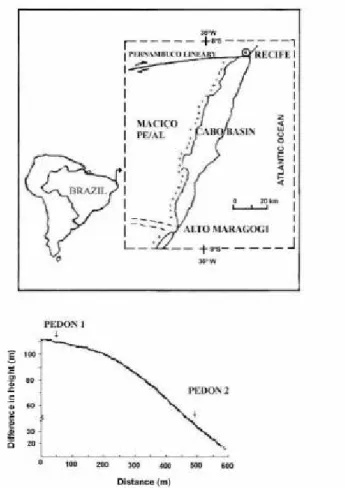
The Cabo Basin, a coastal sedimentary basin dated from the Cretaceous, runs along all Southern coastal area of Pernambuco State. Its surficial part is a narrow strip elongated in the North-South direction, measuring 100 by 12 km (Nóbrega, 1995). It is im-planted over pre-cambrian terrain limited by the Sergipe-Alagoas Basin, through the Maragogi High in the south, and by the Pernambuco-Paraíba Basin, through the Pernambuco Linearly, on the north. In the west, it is limited by the Maciço Pernambuco-Alagoas (Figure 1).
A sedimentary sequence cut, covered by volca-nic rocks, fills the Cabo Basin (Gomes, 2001). The vol-canic rocks (Ipojuca Formation) are represented by traquites, andesite, rhyolite occurring as dike, plugs, sill and laccolites besides igneous breccia, tuff and basalt flows (Sial et al., 1987 apud Gomes, 2001). The more ba-sic materials are basalts and andesite, which occur as aphanitic and holocrystalline mass with rare olivine fenocrystals (Borba, 1975).
The topography ranges from gently undulating to hilly; the slope ranges in 10 to 25% (Jacomine et al., 1973). The climate is tropical humid and classified as
Ams’ by Köppen and 3dTh by Gaussen (Jacomine et al.,
1973). The annual mean temperature is 24ºC (± 2.6ºC) and the mean annual rainfall is 2,140 mm. Although ir-regularly distributed, the rain is concentrated between March and July and the monthly mean is higher than 40 mm even in the drier months (October to December) (SUDENE, 1990). The original native vegetation was a semi-evergreen tropical forest, composed of a dense for-est formation with tall trees and great species diversity (Andrade-Lima, 1960). This vegetal formation, however, has been replaced almost entirely by sugarcane planta-tions.
Methods
Two pedons were chosen: Pedon 1 on hill sum-mit and Pedon 2 on hill backslope. They are located at Engenho Rosário in Cabo de Santo Agostinho municipal-ity (08º18’S and 34º59’W). These pedons occur 420 m from each other, and the summit differs 60 m in height. Macromorphological profile description and soil sampling were carried out according to standard procedures (Lemos & Santos, 1996). Bulk soil samples of all horizons were collected from each pedon, air dried, ground to pass a 2 mm sieve, and used for physical, chemical, and mineral-ogical analyses.
Physical and chemical analyses were carried out according to EMBRAPA (1997). Particle-size analysis was performed by the hydrometer method after
disper-sion with 0.35 mol L-1 hexametaphosphate and 0.08 mol
L-1 sodium carbonate, combined with strong mechanical
shaking for 15 min. The determination of dispersed clay in water followed the same procedure but without add-ing chemical dispersant. Bulk density was determined by oven drying the core samples at 105ºC overnight. Particle density analysis was carried out by the pycnometer method. Moisture retention at 0.034 and 1.52 MPa was determined using a pressure plate extractor.
Soil pH was measured in water and 1 mol L-1 KCl using a soil:solution ratio of 1:2.5. Exchangeable Ca, Mg
and acidity were displaced with 1 mol L-1 KCl. Ca2+ and
Mg2+ were determined by atomic absorption
spectropho-tometry, whereas exchangeable acidity was determined by
titration with 0.25 mol L-1 NaOH and expressed as Al3+.
Exchangeable Na and K were displaced with Mehlich-1 solution and determined by flame photometry. Potential
acidity was extracted using 0.5 mol L-1 pH 7.0 buffered
calcium acetate, and determined by titration with 0.0606
mol L-1 NaOH. Available P was extracted using
Mehlich-1 solution and determined by colorimetric method. Or-ganic C was determined following the Walkley-Black method. Total clay contents of Al, Fe, and Ti in soil were estimated by dissolution with sulfuric acid and Si by NaOH on the residue. Determination was by atomic
ab-sorption spectrometry and data was expressed as Al2O3,
SiO2, Fe2O3, and TiO2. Silt:clay ratio, total porosity, avail-able water, sum of bases, cation exchange capacity, base saturation, aluminum saturation, exchangeable sodium percentage, Ki [SiO2/Al2O3], and Kr [SiO2/(Al2O3 +
Fe2O3)] were calculated according to EMBRAPA (1997).
The coarse (2-0.2 mm) and fine (0.2-0.05 mm) sand fractions were examined by means of stereomicro-scope. Mineral contents percentages were estimated by point counting, after successively quartering the soil samples. About 300 grains were counted for each frac-tion, considering: color, shine, form and rounding degree. For mineral identification of those fractions, chemical tests with 30% hydrogen peroxide, magnetic attraction with pocket magnet, and petrographic analysis of thin sec-tions also were performed.
Silt and clay fractions were analyzed by X-ray diffractiometry. Those fractions were separated from sand by wet sieving, after removal of cementing agents. Clay and silt fractions were separated by sedimentation. Ex-changeable cations, organic matter and free iron oxides
were removed using 1 mol L-1 sodium acetate (pH 5.0),
30% H2O2, and citrate-bicarbonate-dithionite solutions,
respectively (Jackson, 1975). Clay Samples were
satu-rated with K+ and irradiated at 25º and after heating for
two hours at 550ºC. A second sample Mg2+ saturated and
glycerol treated was also irradiated at 25ºC.
The diffractograms were obtained using a diffractometer operating at: 40Kv tension, 20 mA current with Cu radiation tube and Ni filter. The 2θ interval ranged from 2 to 40º for the clay, and from 2 to 60º for the silt samples Interpretation was performed as a func-tion of the basal spacing and peak form and symmetry according to Grim (1968), Jackson (1975), Dixon & Weed (1989) and Moore & Reynolds Jr. (1989).
Vertically-oriented thin sections (5.0 × 8.0 cm
large and 30µm thick) were prepared for
micromorpho-logical examination (Jongerius and Heintzberger, 1975).
The thin sections were examined by petrographic micro-scope according to criteria and terminology proposed by Bullock et al. (1985) or Brewer (1976).
RESULTS AND DISCUSSION
Soil classification and morphological characteristics
Soils were classified, according to the Portuguese criteria and terminology of the recent Brazilian Soil Clas-sification System (EMBRAPA, 1999) and their U.S. Soil Taxonomy nearest equivalent (in brackets). Two classes were identified: Pedon 1 – “Latossolo Vermelho-Amarelo distroférrico argissólico textura muito argilosa A moderado fase floresta subperenifólia relevo suave ondulado” (Very-fine, Ferruginous, Isohyperthermic Typic Hapludox) and Pedon 2 – “Nitossolo Vermelho distroférrico típico textura muita argilosa A moderado fase floresta subperenifólia relevo ondulado” (Very-fine, Kaolinitic, Isohyperthermic Rhodic Paleudult).
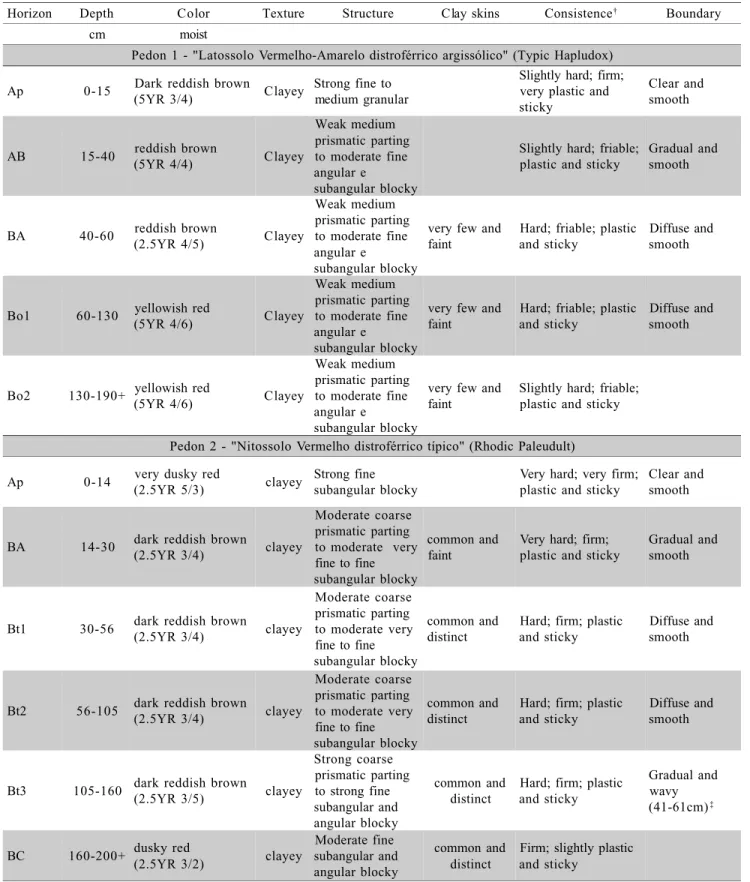
Pedon 1 presents predominant colors in the 5YR hue, with value between 3 and 4, and chrome between 4 and 6. The Ap horizon structure is strong, fine to medium, and granular. The B horizon structure is weak, medium, prismatic formed by moderate, fine, angular and subangular blocky. Very few and faint clay skins were observed dur-ing field examination, but (ferri-)argilans were not found in the thin sections of the soil’s horizons (Tables 1 and 6). The Pedon 2 had colors in the 2.5YR hue, with values from 2.5 to 3, and chrome between 2 and 4. The Ap horizon structure is strong, fine, and subangular blocky. The structure is moderate, coarse, prismatic formed by moderate, very fine and fine, and subangular blocky in the BA, Bt1 and Bt2 horizons. The Bt3 hori-zon structure is strong, coarse, and prismatic parting to strong, small, subangular and angular blocky. The clay skins in the BA horizon were faint and common. Clay skins were distinct and common in Bt1, Bt2, Bt3 and BC horizons (Table 1).
The very strong pedogenesis in the Pedon 1 pro-moted soil xanthization, the transformation of prismatic structure to angular and subangular blocky, and turned the soil more friable (Table 1). Although prismatic structure is not common in the Latosols, it has been observed in the “Latossolos Brunos” (Brown Latosols) also derived from basic rocks in Rio Grande do Sul, subtropical Bra-zil (Oliveira et al., 1992). Other soil characteristics typi-cally observed in the latosolic B horizon, including lack of expressive clay skins and high friability (Bennema, 1966), were present in this Latosol pedon.
categori-Table 1 - Morphology of two soil profiles developed from basic rock of Pernambuco State.
†dry, humid and wet, respectively. ‡Up and down limits.
cal level to express this transitional behavior, as used for Chernosol and some Latosol Classes (Dystrophic Red Latosol and Distroferic Red Latosol) in the Brazilian Sys-tem of Soil Classification. The ‘argisolic’ term means
soils with intermediate characteristics to “Argissolos”, and the distinctive characteristic for this soil class is an expressive clay accumulation in the B horizon, i.e., pres-ence of a textural B horizon.
Horizon Depth Color Texture Structure Clay skins Consistence† Boundary
cm moist
Pedon 1 - "Latossolo Vermelho-Amarelo distroférrico argissólico" (Typic Hapludox)
Ap 0-15 Dark reddish brown(5YR 3/4) Clayey Strong fine tomedium granular
Slightly hard; firm; very plastic and sticky
Clear and smooth
AB 15-40 reddish brown(5YR 4/4) Clayey
Weak medium prismatic parting to moderate fine angular e
subangular blocky
Slightly hard; friable; plastic and sticky
Gradual and smooth
BA 40-60 reddish brown(2.5YR 4/5) Clayey
Weak medium prismatic parting to moderate fine angular e
subangular blocky
very few and faint
Hard; friable; plastic and sticky
Diffuse and smooth
Bo1 60-130 yellowish red(5YR 4/6) Clayey
Weak medium prismatic parting to moderate fine angular e
subangular blocky
very few and faint
Hard; friable; plastic and sticky
Diffuse and smooth
Bo2 130-190+ yellowish red(5YR 4/6) Clayey
Weak medium prismatic parting to moderate fine angular e
subangular blocky
very few and faint
Slightly hard; friable; plastic and sticky
Pedon 2 - "Nitossolo Vermelho distroférrico típico" (Rhodic Paleudult)
Ap 0-14 very dusky red(2.5YR 5/3) clayey Strong finesubangular blocky Very hard; very firm;plastic and sticky Clear andsmooth
BA 14-30 dark reddish brown(2.5YR 3/4) clayey
Moderate coarse prismatic parting to moderate very fine to fine subangular blocky
common and faint
Very hard; firm; plastic and sticky
Gradual and smooth
Bt1 30-56 dark reddish brown(2.5YR 3/4) clayey
Moderate coarse prismatic parting to moderate very fine to fine subangular blocky
common and distinct
Hard; firm; plastic and sticky
Diffuse and smooth
Bt2 56-105 dark reddish brown(2.5YR 3/4) clayey
Moderate coarse prismatic parting to moderate very fine to fine subangular blocky
common and distinct
Hard; firm; plastic and sticky
Diffuse and smooth
Bt3 105-160 dark reddish brown(2.5YR 3/5) clayey
Strong coarse prismatic parting to strong fine subangular and angular blocky
common and distinct
Hard; firm; plastic and sticky
Gradual and wavy (41-61cm)‡
BC 160-200+ dusky red(2.5YR 3/2) clayey
Moderate fine subangular and angular blocky
common and distinct
Table 2 - Particle size distribution analysis, water-dispersed clay, flocculation index and silt:clay ratio of soils developed of basic rocks of Pernambuco State.
*Water- dispersed clay
Physical characteristics
The two pedons did not present expressive amount of coarse fractions (larger that 2 mm). Total sand content was very small as well. The values ranged from
70 to 120 g kg-1 in the Pedon 2, and 45 to 67 g kg-1 in
the Pedon 1 (Table 2). This trend results form the low content of resistant primary minerals and the aphanitic texture of the parent material (Buol et al., 1980).
The silt content ranged from 105 to 167 g kg-1
in the Pedon 1, and 100 to 320 g kg-1 in the Pedon 2. The
clay content ranged from 766 to g kg-1 in the Pedon 1,
and from 846 590 to 830 g kg-1 in the Pedon 2. Clay
con-tents larger than 500 g kg-1 are common in soils
devel-oped from basaltic rocks (Lima, 1979; Rauen, 1980; Rocha, 1990). It was observed clay accumulation in the nitic B horizon, but not enough to characterize textural gradient according to the criteria used by the Brazilian Taxonomy (EMBRAPA, 1999). More clay accumulation in the Pedon 2 B horizon than in the Pedon 1 is compat-ible with the soil profiles identification and selection dur-ing field work (Bennema, 1966). Higher silt content in the Ap horizon of Pedon 2 was probably due to prefer-ential removal of clay in this soil horizon. Low values of silt:clay ratio and high contents of clay in the “Latossolo” indicated that it is in a more advanced weathering stage than the “Nitossolo”.
Horizon Depth Gravel Fine Earth Coarse sand Fine sand Silt Clay WDC* Flocculation index Silt/clay ratio cm --- g kg- 1 de solo --- %
Pedon 1 - "Latossolo Vermelho-Amarelo distroférrico argissólico" (Typic Hapludox)
Ap 0-15 0 1000 30 37 167 766 46 94 0.22
AB 15-40 0 1000 20 26 128 826 66 92 0.15
BA 40-60 0 1000 19 27 108 846 56 93 0.13
Bo1 60-130 0 1000 20 25 109 846 46 94 0.13
Bo2 130-190 0 1000 23 26 105 846 66 92 0.12
Pedon 2 - "Nitossolo Vermelho distroférrico típico" (Rhodic Paleudult)
Ap 0-14 4 996 67 53 213 667 539 19 0.32
BA 14-30 3 997 43 34 123 800 79 90 0.15
Bt1 30-56 2 998 33 37 100 830 79 90 0.12
Bt2 56-105 0 1000 20 70 153 757 79 89 0.20
Bt3 105-160 0 1000 12 62 236 690 79 88 0.34
BC 160-200 0 1000 08 82 320 590 79 86 0.54
Table 3 - Bulk and particle densities, porosity, and water content of soils developed from basic rocks of Pernambuco State.
1. U = moisture (w/w); 2. Avail. = available
Horizon Depth Density Porosity Water content
Bulk Particle U1 -0.034MPa U1 -1.52MPa Avail. water2 cm Mg m- 3 % % ---Pedon 1 - "Latossolo Vermelho-Amarelo distroférrico argissólico" (Typic Hapludox)
Ap 0-15 1.08 2.90 62 36.9 27.3 9.6
AB 15-40 0.97 2.90 67 40.6 30.8 9.8
BA 40-60 0.95 2.90 69 40.1 30.6 9.5
Bo1 60-130 0.97 3.00 68 42.9 29.8 13.1
Bo2 130-160 0.98 3.00 67 42.9 30.3 12.6
Pedon 2 - "Nitossolo Vermelho distroférrico típico" (Rhodic paleudult)
Ap 0-14 1.46 2.86 49 38.0 26.6 11.4
BA 14-30 1.34 2.90 54 41.6 30.6 11.1
Bt1 30-56 1.29 2.86 55 46.3 33.4 12.9
Bt2 56-105 1.38 2.86 52 45.3 31.9 13.5
Bt3 105-160 1.47 2.98 51 45.7 30.1 15.6
Table 4 - Chemical characteristics of soils developed from basic rocks de Pernambuco State.
Horizon pH Ca2+ Mg2+ K+ Na+ Base sum Al3+ H+ CEC Base Sat. Al sat ESP C P H2O KCl --- cmolc kg
- 1 of soil --- --- % --- g kg- 1 mg kg- 1
Pedon 1 - "Latossolo Vermelho-Amarelo distroférrico argissólico" (Typic Hapludox)
Ap 4.9 4.2 5.5 3.0 0.12 0.10 8.7 0.7 10.2 19.6 44 7 <1 2.43 1
AB 4.9 4.2 0.3 1.2 0.03 0.05 1.6 1.0 7.3 9.9 16 38 <1 1.14 1
BA 4.8 4.2 0.2 1.0 0.03 0.06 1.3 0.9 7.3 9.5 14 41 <1 1.01 4
Bo1 4.8 4.4 0.1 0.9 0.02 0.04 1.1 0.8 7.2 9.0 12 42 <1 0.65 4
Bo2 4.8 4.3 0.1 0.8 0.01 0.03 0.9 0.8 7.1 8.8 10 47 <1 0.61 5
Pedon 2 - "Nitossolo Vermelho distroférrico típico" (Rhodic Paleudult)
Ap 4.9 4.2 1.0 0.5 0.16 0.15 1.8 0.6 7.1 9.5 19 25 2 2.62 1
BA 4.7 4.0 0.5 0.4 0.06 0.07 1.0 1.5 5.0 7.5 13 60 1 1.41 1
Bt1 4.7 4.0 0.4 0.3 0.04 0.08 0.8 1.6 4.7 7.1 11 67 1 0.95 1
Bt2 4.6 3.9 0.4 0.2 0.03 0.07 0.7 1.9 3.2 5.8 12 73 1 0.49 1
Bt3 4.6 3.9 0.4 0.4 0.03 0.08 0.9 3.6 2.6 7.1 13 80 1 0.27 1
BC 4.5 3.8 0.2 0.4 0.03 0.08 0.7 5.3 2.0 8.0 9 88 1 0.23 1
The water-dispersed clay content was very low for both pedons, except in the Ap horizon of the pedon 2 (539 g kg-1). As a result, the flocculation index was very high, in general higher than 85%. One can speculate that the high proportion of water-dispersed clay in the Ap ho-rizon of the Pedon 2 results from decreased participation of di and trivalent cations (Ca2+, Mg2+ and Al3+) in the exchange complex.
The bulk density ranged from 1.29 to 1.47 Mg m-3 for the “Nitossolo”, and 0.95 to 1.08 Mg m-3 for the “Latossolo”. These values are within the range for clayey soils, as mentioned by Prevedello (1996). The lowest val-ues of bulk density for the “Latossolo” are probably due to its expressive microporosity, which results from the large clay content and smaller structure, as pointed out by the micromorphological descriptions (Table 2 and Fig-ure 5IV). The particle density of both soils presented high
values (2.86-3.00 Mg m-3), due to high amounts of iron
bearing minerals, as shown by the sand and silt fractions mineralogical analyses.
The water content at various tensions is high. Even in the permanent wilting point (moisture at -1.52 MPa), these soils exhibited values above 26% (Table 3).
Chemical characteristics
The soil reaction was acidic, with pH in H2O
ranging from 4.5 to 4.9, and pH in KCl from 3.8 to 4.4. The pH in KCl was consistently lower than the pH in
H2O, an indication of negative net charges (Table 4).
Or-ganic carbon and exchangeable bases (Ca2+, Mg2+, K+,
Na+) were higher in the surficial horizon, decreasing with depth. Amount of basic cations were considered low
rang-ing from 0.7 and 2.0 cmolc kg-1. However, the Ap
hori-zon of the Pedon 1 had values as high as 8.7 cmolc kg-1
of soil, as a result of liming and fertilizes additions. Ex-changeable aluminum was higher values in the Pedon 2 than Pedon 1, especially in subsurface (5.3 cmolc kg-1), resulting in a high Al saturation (ranged from 25 to 88%). The exchangeable aluminum content in the Pedon 1 (≤ 1.0 cmolc kg-1 of soil) was lower than in the Pedon 2, and Al saturation ranged from 7 to 47%. CEC was low and usually < 10.0 cmolc kg-1. Clay activity was low in both
soils and ranged from 7.7 to 25.6 cmolc kg-1, which
re-sults from the kaolinitic and oxidic composition.
Large differences were observed between these two studied soils and the basic rock-derived soils from Southern of Brazil, which usually have higher CEC and are dominantly eutrophic (Lemos, 1975). Similar soils in São Paulo State, but dystrophic, are not rich in Al, and its Al saturation is lower than 18% (Oliveira & Menk, 1984). The ferric term in the Brazilian soil classification means high content of Fe2O3 (198 – 237 g kg-1). In the Pedon 2 Ki values, from 1.54 to 1.67, suggested the
pres-Table 5 - Elemental composition as access by dissolution by sulfuric acid of soils developed from basic rocks from Pernambuco State.
Horz. Depth SiO2 Al2O3 Fe2O3 TiO2 Sum Ki Kr cm --- g kg-1
---Pedon 1 - "Latossolo Vermelho-Amarelo distroférrico argissólico" (Typic Hapludox)
Ap 0-15 186 163 234 64 647 1.94 1.01 BA 40-60 192 178 237 59 666 1.83 0.99 Bo2 130-160 205 188 233 57 683 1.85 1.03
Pedon 2 - "Nitossolo Vermelho distroférrico típico" (Rhodic Paleudult)
ence of gibbsite, as indicated by Verdade (1975). How-ever, such trend was not confirmed by the soil mineral-ogical results. On the other hand, Ki values for Pedon 1, from 1.83 to 1.94, indicated the presence of minerals of the kaolinite group (Table 5).
The lowest values of Ki for Pedon 2 suggested that it is more weathered than the Pedon 1, although other evidences (silt:clay ratio, clay content, and landscape po-sition) indicated a contrary trend. The treatment with sul-furic acid may not be effective in the whole clay frac-tion, since it will also attack particles of other fractions if the analysis is carried out using samples of fine earth Verdade (1975). This can generate misunderstandings in the interpretation of the results. The sum of the oxides, obtained of dissolution by sulfuric acid method, should be approximately equal to the clay content Resende (1983). For the studied soils, the sum of the oxides is al-ways smaller than the clay content, except for the BC ho-rizon, which may indicate that the dissolution was not ef-fective in breaking up the whole clay fraction.
Mineralogy and micromorphology
Mineral on coarse and fine sand fractions were mostly quartz, opaques (rock fragments composed of magnetite and/or ilmenite), and hematite. These compo-nents were present in varying proportions in both pedons. Quartz grains amounts decrease with depth and pedon 1 has higher amounts of hematite than pedon 2 (Figure 2).
The quartz grains are colorless and coated with iron oxides films. They are sub-angular to subrounded in shape. The hematite grains are subrounded and rounded, with intense red color. The opaque minerals are subrounded, black, and are probably composed of mag-netite and/or ilmenite. Ilmenite identification in thin sec-tions is based at tendency to form grain clusters (FitzPatrick, 1984). Such behavior was not evident in thin sections analyses. However, the presence of ilmenite was
observed in the silt fraction X-ray diffracograms. It is thus possible that ilmenite also occurs in the sand fraction of these soils.
The opaque minerals were most probably inher-ited from the parent material and their large content in the pedon 2 suggests that this soil is in an early weather-ing stage as compared to the pedon 1. This is also sup-ported by the color gradation between opaque minerals and hematite, which seemingly starts with a loss of the metallic shine. In addition they present larger degree of roundness in the Pedon 1. It is thus believed that most of the hematite, whose larger percentage is found in pedon 2, has been produced by magnetite alteration, as sug-gested by Schwertmann & Taylor (1989). The hematite grains were also altered, exhibiting yellowish-colored rings, which suggests goethite neoformation. The yellow bodies alteration, identified as hematite pseudomorph in thin sections, reinforces this finding (Figure 6I and 6II). The X-ray diffractograms of the silt fraction, for both soils, presented peaks that allow the identification of quartz (0.334 and 0.197 nm), hematite (0.251 and 0.169 nm), ilmenite (0.274 and 0.172 nm), and no philosilicate (Figure 3).
The peaks of 0.720 and 0.357 nm in the diffractograms of the clay samples saturated with K (25ºC) and Mg-glicerol, and its disappearence when the clay samples were saturated with K and heated at 550ºC, allowed the identification of kaolinite as the dominant philosilicate in the clay fraction (Figure 4). This kaolin-ite is well crystallized, as observed by the basal symme-try and peak intensity. Despite the removal of free iron, the clay fraction diffractograms of the Pedon 1 showed a small goethite peak of 0.418 nm (Figure 4). The citrate-bicarbonate-dithionite method is not very efficient in the removal of goethite with high isomorphic substitution by aluminum (Jeanroy et at., 1991; Möller & Lourenço, 1994).
Table 6 - Syntheses of micromorphological description of soils derived from basic rocks from Pernambuco State, Brazil.
†Related Distribution Pattern;‡birefringence fabric.
Horizon RDP† b-fabric‡ Microstructure Voids Pedofeature
Pedon 1 - "Latossolo Vermelho-Amarelo distroférrico argissólico" (Typic Hapludox)
Ap Porphyric Undifferentiated Subangular and angular blockypeds Compound packing voids,planes, vughs and root channels
BA Porphyric Stipple-speckled Subangular and angular blocky peds and some parts prims
Compound packing voids, planes and vughs
Bo2 Porphyric Stipple-speckled Subangular and angular blockypeds and some parts prims Compound packing voids,planes and vughs
Pedon 2 - "Nitossolo Vermelho distroférrico típico" (Rhodic Paleudult)
Ap Porphyric Undifferentiated Subangular and angular blockypeds Vughs, compound packingvoids and root channels Ferri-argilans coat pedssurface; hematans
Bt2 Porphyric Stipple-speckled Prims and subangular blockypeds Planes, vughs and channels Leptocutans
Coarse sand
0% 20% 40% 60% 80% 100%
BC Bt3 Bt2 Bt1 BA Ap
Horizon
Content
Figure 2 - Mineralogical composition of coarse and fine sand of the two pedons derived form basic rocks from Pernambuco State, Brazil.
Figure 3 - X-ray diffractograms of the silt fraction of selected horizons of two pedons derived from basic rocks from Pernambuco State, Brazil. Hematite (He), quartz (Qz) e ilmenite (Im). K 25ºC, Mg-gl and K 550ºC are the treatments: saturation with K, with Mg-glycerol and with K and heating to 550ºC, respectively.
Figure 4 - X-ray diffractograms of clay fraction of selected horizons of two pedons derived from basic rocks from Pernambuco State, Northeast, Brazil. Kaolinite (Ct) and goethite (Gt). K 25ºC, Mg-gl and K 550ºC represent the treatments: saturation with K, with Mg-glycerol and with K and heating to 550ºC, respectively.
Pedon 2 - “Nitossolo Vermelho distroférrico típico” (Rhodic Paleudult)
2Teta
Pedon 1 - “Latossolo Vermelho-Amarelo distroférrico argissólico” (Typic Hapludox)
2Teta
Pedon 1 – “Latossolo Vermelho-Amarelo distroférrico argissólico” (Typic Hapludox) Coarse sand
0% 20% 40% 60% 80% 100% Bo2
Bo1 BA AB Ap
Horizon
Content
Fine sand
0% 20% 40% 60% 80% 100%
BC Bt3 Bt2 Bt1 BA Ap
Content
Fine sand
0% 20% 40% 60% 80% 100%
Bw2 Bw1 BA AB Ap
Content
Pedon 2 – “Nitossolo Vermelho distroférrico típico” (Rhodic Paleudult)
Pedon 1 - “Latossolo Vermelho-Amarelo distroférrico argissólico” (Typic Hapludox)
Figure 5 - Photomicrographs of the thin sectons of selected soil horizon. I – many ferri-argilans in Ap horizon of the Pedon 2 (Rhodic Paleudult),em PPL. II – equal, XPL. III - Ferri-argilan and part of prismatic structure of the Pedon 2 Bt2 horizon. IV – Blocky structure of the Pedon 1 Bo2 horizon. FE-AR, AG, PO e QZ mean ferri-argilans, aggregates, voids and quartz, respectively.
The mineralogical composition of these soils dif-fers from the soils developed from similar parental mate-rial in the South and Southeast of Brazil. The soils from Southern Brazil present mixed-layered chlorite-vermiculite-montmorillonite, gibbsite, and kaolinite (Lemos, 1975). Hydroxy-interlayered vermiculite has also been found in soils from this Brazilian region (Gomes et al., 2001).
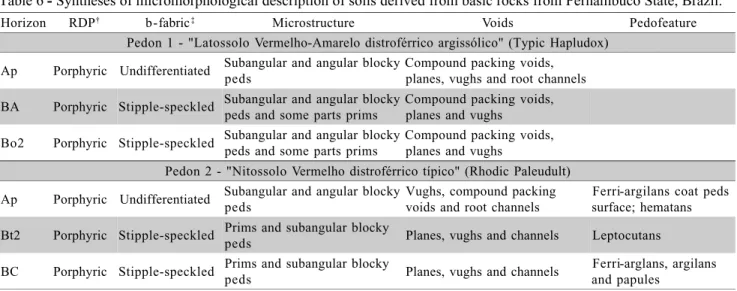
The related distribution pattern of soils was porphyric, i.e., the coarser particles occur in a ground-mass of finer material (Bullock et al., 1985). The Ap ho-rizon of Pedon 2 appears granular and subangular blocky microstructure. In the Bt2 and BC horizons, the micro-structure is predominantly prismatic and seldom subangular blocky (Table 6). The surface horizon of the Pedon 1 showed same microstructure as the surface ho-rizon of Pedon 2; however it was angular and subangular blocky, with few areas, where it was prismatic composed of subangular blocky in BA and Bo2 horizons.
The “Latossolo” microstructure probably resulted from the destruction of prismatic structure, which tends to form smaller aggregates. This new structural frame-work led to higher porosity, although it has not been quantified micromorphologically. This is also corroborated by the total porosity values of the “Latossolo”, which are about 10% higher than in “Nitossolo” (Table 3).
On the other hand, the absence of microgranular structure, which is common in Latosols derived from ba-sic rocks of the South and Southeast Region of Brazil (Rauen, 1980; Oliveira & Menk, 1984; Rocha, 1990), may be due to the gibbsite absence, as Schaefer (2001) has reported. Although gibbsite is not responsible directly for the development of the microgranular structure, it leads to the persistence of such structure. Schaefer (2001) advocated that the different kinds of microgranular struc-ture, present in Brazilian Latosols, were a long-term bi-otic product, and soil termites are among the major or-ganisms involved in their genesis. The stability and pres-ervation of the microaggregates, formed as a result of the mesofauna activity, are primarily favored by gibbsite, and secondarily by iron oxides.
Coatings (ferri-argilans in the Brewer’s terminol-ogy) are common in the Ap horizon of Pedon 2 and sug-gest high clay mobility, which should be related to the low degree of clay flocculation, as shown by the physi-cal analyses. In the Bt horizon, the ferri-argilans, that are coating ped surfaces, are usually very thin and may be named leptocoatings (leptocutans), as suggested by Creutzberg & Sombroek (1987). However, better pre-served ferri-argilans were obpre-served as well (Figure 5).
The iron oxides from the cutans masks their anisotropy and, due also to their finesses, made their iden-tification more difficult. Perhaps, due to this reason, Eswaran (1978) did not mention such pedofeature when analyzed thin sections of similar soil to the pedon 2.
The thicker ferri-argilans and argilans of the stud-ied soils, which occured as infillings, were observed in the BC horizon of the Pedon 2 (Figure 6). Great papules were present in this horizon as well. According to Buol & Hole (1961), the decrease of pedoturbation with depth allows features of such nature to be relatively undisturbed. It was not observed features that indicated clay movement in the Pedon 1, and, thus, argilluviation was not either an expressive process in its formation or its sub-sequent processes masked its effects. That is, the haplodization destroyed the possible features generated by horizonation.
FINAL REMARKS
The soils developed from basalt, in warm and hu-mid climate in the Southern Forest Zone of the Pernambuco State, are chemically very poor, and kaolin-ite and oxides are the dominant minerals in the clay frac-tion. It is suggest the inclusion, in the Brazilian System of Soil Classification, of a nitisolic subgroup in the class of Dystrophic Red-Yellow Latosol, to include the soils of this class that present intermediate characteristics with Nitisols
ACKNOWLEDGMENTS
To Paulo Kinger Tito Jacomine and Mateus Rosas Ribeiro (UFRPE) for help in soil description, and to Carmem Sueze Miranda Masutti (UFPE) for translation of the original Portuguese version.
REFERENCES
ANDRADE-LIMA, D. Estudos fitogeográficos de Pernambuco. Arquivos do IPA, v.5, p.305-341, 1960.
BENNEMA, J. Report to the government of Brazil on classification of Brazilian soils. Rome: FAO, 1966. 83p.
BORBA, G.S. Rochas vulcânicas da faixa costeira sul de Pernambuco: aspectos petrográficos e geoquímicos. Rio de Janeiro:UFRJ, 1975. 134p. (Dissertação-Mestrado).
BUOL, S.W.; HOLE, F.D. Clay skin genesis im Wisconsin soils. Soil Science Society of America Proceedings, v.25, p.377-379, 1961.
BUOL, S.W.; HOLE, F.D.; MCCRACKEN, R.J. Soil genesis and classification. 2. ed. Ames: Iowa State University Press, 1980. 404p. BREWER, R. The basis of interpretation of soil micromorphological data.
Geoderma, v. 8, n. 3. p.81-94. 1972.
BREWER, R. Frabric and mineral analysis of soil. New York: R. E. Krieger, 1976. 428p.
BULLOCK, P.; FEDEROFF, N.; JONGERIUS, A.; STOOPS, G.; TURSINA, T.; BABEL, U. Handbook for the soil thin section description. Wolerhampton: Waine Research Publications, 1985. 153p. CREUTZBERG, D.; SOMBROEK, W.G. Micromorphological characteristics of Nitisols. In: FEDEROFF, N.; BRESSON, L.M.; COURTY, M.A. Soil micromorphology. Paris: Association Française Pour l’Étude du Sol, 1987. p.151-155.
DIXON, J.B.; WEED, S.B. (Eds.) Minerals in soil environments. 2ed. Madison, SSSA, 1989. 1244p.
EMPRESA BRASILEIRA DE PESQUISA AGROPECUÁRIA. Centro Nacional de Pesquisa de Solos. Sistema brasileiro de classificação de solos. Brasília: Embrapa Produção de Informações, 1999. 412p. ESWARAN, H. Report on the micromorphology of selected Brazilian
pedons. In: INTERNATIONAL SOIL CLASSIFICATION WORKSHOP, 1, Rio de Janeiro, 1978. Anais. Rio de Janeiro: EMBRAPA, 1978. p.309-337.
FERREIRA, M.G.V.X.; RIBEIRO, M.R.; JACOMINE, P.K.T.; LIMA, J.F.W.; HECK, R.J.; OLIVEIRA, L.B. Intensidade do intemperismo nos solos de referência da Zona da Mata de Pernambuco. In: SIMPÓSIO DE GEOLOGIA DO NORDESTE, 17., Recife, 2002. Anais. Recife: Sociedade Brasileira de Geologia, 2000. p.16.
FITZPATRICK, E.A. The micromorphology of soil. Aberdeen: University of Aberdeen, 1984. 433p.
GOMES, H.A. (Org.) Geologia e recursos minerais do estado de Pernambuco. Brasília: CPRM; DIEDIG; DEPAT, 2001. 198p. GOMES, I.A.; SANTOS, R.D.; FASOLO, P.J.; RAMOS, D.P. (Org.) Guia
de excursão de estudos no estado do Paraná. In: CONGRESSO BRASILEIRO DE CIÊNCIA DO SOLO, 28. Londrina, 2001. Guia de excursão pós-congresso. Rio de Janeiro: Embrapa Solos, 2001.p.11-35.
GRIM, R.E. Clay mineralogy. 2.ed. New York: McGraw-Hill, 1968. 596p JACKSON, M.L.Soil chemical analysis: advanced course. 29.ed. Madison:
Univsersity of Wisconsin, 1975. 895p.
JACOMINE, P.K.T.; CAVALCANTI, A.C.; BURGOS, N.; PESSOA, S.C.P.; SILVEIRA, C.O. Levantamento exploratório: reconhecimento de solos do Estado de Pernambuco. Recife: Divisão de Pesquisa Pedológica, l972. v.2. 354p. (Boletim Técnico, 26; Pedologia, l4). JACOMINE, P.K.T.; CAVALCANTI, A.C.; BURGOS, N.; PESSOA, S.C.P.;
SILVEIRA, C.O. Levantamento exploratório: reconhecimento de solos do Estado de Pernambuco. Recife: Divisão de Pesquisa Pedológica, l973. v.1. 359p. (Boletim Técnico, 26; Pedologia, l4). JEANROY, E.; RAJOT, J.L.; PILION, P.; HERBILON, A.J. Differential
dissolution of hematite and goethite in dithionite and its implications on soils yellowing. Geoderma, v. 50, p. 79-94. 1991.
JONGERIUS, A.; HEINTZBERGER, G. Methods in soil micromorphology: a technique for preparation of large thin sections. Wageningen: Soil Survey Institute, 1975.
LEMOS, R.C. Os solos de eruptivas básicas do Sul do Brasil. In: CONGRESSO BRASILEIRO DE CIÊNCIA DO SOLO, 15., Campinas, 1975.Anais. Campinas: SBCS, 1975. p.351-358.
LEMOS, R.C.; SANTOS, R.D. Manual de descrição e coleta de solo no campo. 3. ed. Campinas: SBCS, l996. 84p.
LIMA, J.M.J.C. Estudo de uma seqüência de solos desenvolvidos de rochas básicas do Sudoeste do estado do Paraná. Piracicaba:USP/EASALQ, 1979. 123p. (Dissertação-Mestrado).
MÖLLER, M.R.F.; LOURENÇO, M.R.C. Manual de métodos de laboratório para determinações mineralógicas da fração argila. I – prétratametnos. Belém: FCAP, 1994. 40p. (Informe Didático, 12) MOORE, D. M. & REYNOLDS JR., R. C.X-ray diffraction identification
and analysis of clay minerals. Oxford: Oxford University Press, 1989. 332p.
NÓBREGA, V.A. Características petrográficas e evolução diagenética da Formação Cabo no Graben do Cupe Bacia Cabo Pernambuco -Nordeste do Brasil. Recife: UFPE, 1995. 150p. (Dissertação-Mestrado). OLIVEIRA, J.B.; MENK, J.R.F. Latossolos Roxos do Estado de São Paulo. Campinas: Instituto Agronômico de Campinas, 1984. 132p. (Boletim Técnico, 82).
OLIVEIRA, J.B.; JACOMINE, P.K.T.; CAMARGO, M.N. Classes gerais de solos do Brasil: guia auxiliar para seu reconhecimento. Jaboticabal: FUNEP, 1992. 201p.
PARAHYBA, R.B.V. Gênese de solos planossólicos do Agreste de Pernambuco. Recife: UFRPE, 1993. 201p. (Dissertação-Mestrado). PREVEDELLO, C.L. Física do solo: com problemas resolvidos. Curitiba:
SAEAFS, 1996. 446p.
RAUEN, M.J. Mineralogical identification of a toposequence of soils from basaltic rocks in the State of Paraná, Brazil. Lafayette, 1980. 161p. Tese (M. S.) – Purdue University.
RESENDE, M. Bruno-não-cálcico, interpretação de um perfil. Mossoró: ESAM/FGD/UFV, 1983. 165p.
ROCHA, G.C. Características e dinâmica de coberturas pedológicas sobre rochas básicas nas regiões Norte e Sul do Brasil. Piracicaba: USP/ ESALQ, 1990. 246p. (Tese-Doutorado).
SCHAEFER, C.E.R. Brazilian latosols and their B horizon microstructure as long-term biotic constructs. Australian Journal of Soil Research, v. 39, p.909-926. 2001.
SCHWERTMANN, U.; TAYLOR, R.M. Iron oxides. In: DIXON, J.B.; WEED, S.B. (Ed.) Minerals in soil environments. 2.ed. Madison: SSSA, 1989. p.379-438 (Book Series, 1).
SUPERINTENDÊNCIA DO DESENVOLVIMENTO DO NORDESTE.
Dados pluviométricos mensais do Nordeste: Estado de Pernambuco. Recife: SUDENE, l990. p.363. (Série Pluviométrica, 6).
VERDADE, F.C. Análise química total. In: MONIZ, A.C. Elementos de pedologia. Rio de Janeiro: Livros Técnicos e Científicos, 1975. p.209-221.