the Upper Paraná River floodplain, Brazil
Mendonça, LB.
a*, Lopes, EV.
aand Anjos. L.
baPrograma de Pós-Graduação em Ecologia de Ambientes Aquáticos Continentais,
Universidade Estadual de Maringá – UEM,
Av. Colombo, 5790, PEA, Bloco G90, CEP 87020-900, Maringá, PR, Brazil
bDepartamento de Biologia Animal e Vegetal, Universidade Estadual de Londrina – UEL,
CP 6001, CEP 86051-970, Londrina, PR, Brazil *e-mail: [email protected]
Received November 25, 2008 – Accepted March 10, 2009 – Distributed June 30, 2009
Abstract
The Upper Paraná River floodplain (UPR) represents the last stretch of the Paraná River in Brazilian territory where a river-floodplain ecosystem still exists. However, the region had been subjected to intense deforestation in previous decades, and more than half of the original floodplain has been lost due to the construction of the Porto Primavera dam, which may have resulted in the local extinction of species. In the present study, we compared the list of bird species recorded before the construction of Porto Primavera dam (1926-1996) to that gotten afterwards (1999-2007) under the Long-Term Ecological Research program (LTER-site 6). We aim to investigate biogeographical and eco-logical traits of species potentially lost in the UPR. Endemism, proximity to the edge of species’ geographic range, low tolerance to human-altered habitats and habitat specificity were associated to the potential extinction of birds in the UPR. The region represents an important opportunity for conservation, and should be target of conservation efforts to avoid further loss of species and ecological processes.
Keywords: local extinction, birds, Atlantic Forest, floodplain.
Sobre a possível extinção de aves da planície alagável do Alto Rio Paraná, Brasil
Resumo
A planície alagável do Alto Rio Paraná (ARP) representa o último trecho do Rio Paraná em território brasileiro em que ainda existe um extensivo ecossistema do tipo rio-planície alagável. No entanto, a região sofreu intenso processo de desmatamento nas décadas passadas e mais da metade da extensão original da planície foi perdida com a formação do lago da usina hidrelétrica de Porto Primavera, o que pode ter resultado na extinção local de espécies. No presente estu-do, comparou-se a lista de espécies de aves registradas no ARP antes da construção da referida usina (1926-1996) com aquelas registradas após este período (1999-2007) no âmbito do programa de Pesquisas Ecológicas de Longa Duração (PELD-sítio 6), com o objetivo de investigar características biogeográficas e ecológicas das espécies potencialmente extintas no local. Endemismo, proximidade das espécies de seus limites de distribuição geográfica, baixa tolerância a habitats alterados e especificidade de habitat podem estar associados à perda de espécies no ARP. A região representa uma importante oportunidade para a conservação e deve receber esforços para evitar a perda futura de espécies e de processos ecológicos.
Palavras-chave: extinção local, avifauna, Floresta Atlântica, planície alagável.
1. Introduction
The rate at which humans are changing natural land-scapes, in general terms, is much higher than that seen through the dynamics of disturbance in natural ecosys-tems (Tabarelli and Gascon, 2005), and habitat loss and fragmentation are perhaps the main factors associated to loss in biodiversity (Marini and Garcia, 2005; Tabarelli and Gascon, 2005; IUCN, 2008). The floodplain located at the border of the States of Paraná and Mato Grosso do
had been subjected to intense deforestation in previous decades due to human colonization (Agostinho, 1997; Campos and Souza, 1997). Moreover, the construction of the Porto Primavera hydroelectric plant has created a large water reservoir, which has possible implications on the dynamics of local plant and animal populations.
Originally, the UPR stretched over nearly 480 km, especially over the right bank system of the river in the State of Mato Grosso do Sul. With the formation of the reservoir lake of the Porto Primavera hydroelectric plant (1998-2001), more than half of this ecosystem was lost. Even so, the remaining portion, extending roughly 230 km, represents a biodiverse ecosystem, which is considered a priority for conservation (MMA, 2003; Agostinho et al., 2004). This region has been desig-nated a conservation unit by the Federal Government: the “Área de Proteção Ambiental das Ilhas e Várzeas do Rio Paraná”. The mouth of the Ivinhema River (an im-portant tributary of the Paraná River), also included in the area, belongs to the “Parque Estadual das Várzeas do Rio Ivinhema”, a state park. The UPR is also included in the Atlantic Forest Biosphere Reserve, of the Unesco-MAB program. Since 1999, this area has been studied under the Long Term Ecological Research program identified as site 6 (site 6; Agostinho et al., 2004). LTER-site 6 comprises a large group of researchers studying social, physical and biological aspects of UPR; the avi-fauna is one of the groups of organisms studied.
The avifauna of the UPR and adjacent areas is highly diverse due to the mosaic of habitats in the region; the aquatic, terrestrial and transitional environments form a complex mosaic. In addition, the UPR is located is a tran-sition zone between the Atlantic Forest and the Cerrado (Ab’Sáber, 2003; Souza et al., 2004), and their respec-tive endemic areas (Porzecanski and Cracraft, 2005). It is also influenced by the Chaco (Campos and Souza, 1997). The first ornithological records in the UPR date from 1920s (Sztolcman, 1926). Aftewards, Straube et al. (1996) organized an annotated checklist of the avifauna of the northwestern Paraná and bordering areas, includ-ing the UPR region. The paper of Straube et al. brinclud-ings together previously information on species records, based on literature, museum specimens and their own field observations. In addition, short-term surveys of bird species were conduced as part of the environmental diagnostic for the construction of the Porto Primavera hydroelectric plant (Themag and Engea, 1994). After the construction of Porto Primavera dam (1998-2001), or-nithological studies in the UPR have been carried out, under the LTER-site 6 program, since 1999 (Gimenes and Anjos, 2004; 2006; 2007; Loures-Ribeiro and Anjos, 2004; 2006; Mendonça et al., 2004; Mendonça and Anjos, 2006; ongoing studies). The list of birds recorded in those studies is presented in Gimenes et al. (2007), together with additional records made by Gimenes and collaborators; this list encompasses all records of bird species obtained under the LTER-site 6. Considering all inventories, 372 bird species are accounted for the UPR.
Comparisons between historical data and recent in-ventories are important when assessing extinction proc-esses (Ribon et al. 2003). In the present study, we com-pared the list of bird species recorded in the period from 1926-1996 to that gotten from 1999-2007 (referred here as currently recorded species; CR species). We aim to investigate biogeographical and ecological traits of spe-cies potentially lost (referred here as PL spespe-cies), when these two lists are compared.
2. Material and Methods
2.1. Study area
The section of the UPR and bordering areas con-sidered in the present study, corresponds to the segment between the reservoir lake of the Porto Primavera hy-droelectric plant and the upper mouth of the Ivinhema River (22° 32’S to 22° 59’ S and 53° 08’ W to 53° 4’ W; 230 m a. s. l.). The region’s climate is classified as Cfa (tropical-subtropical), with a mean annual temperature of 22 °C (26 °C in summer and 19 °C in winter) and a mean annual rainfall of 1,500 mm (Centrais Elétricas do Sul do Brasil, 1986).
Currently, the original forest cover of the UPR (sea-sonal semi-deciduous forest) is reduced to small rem-nants located in areas close to the Paraná River and its islands (Campos and Souza, 1997), in a matrix domi-nated by agricultural and pasture lands. The landscape of UPR is a complex mosaic that includes forest remnants (rarely exceeding 300 ha), stretches of riparian tion, marsh forests, buriti palm groves, shrubby vegeta-tion, grasslands, and wetlands. Besides the segments of large rivers – such as the Paraná, Ivinhema and Baía (the latter situated completely within the floodplain) – flood-plain lakes, secondary channels, over 100 islands, sandy and swampy beaches are found in the region.
2.2. Ornithological data
The list of bird species found in the UPR and bordering areas prior to the formation of the Porto Primavera reservoir (1926-1996) was obtained in Themag and Engea (1994) and Straube et al. (1996). The list of birds recorded after this period (1999-2007) was obtained in Gimenes et al. (2007).
was performed using the software ArcExplorer 9.2. For species whose distributions do not include the UPR (Ridgely et al., 2007), a zero value was adopted for the distance to their edge of geographic range, assuming that the recording of the species at the location represents a new limit for its range.
The ecological traits considered were: 1) habitat use, 2) tolerance to habitat alteration, 3) habitat specificity, and 4) diet. Habitat use: species were classified as forest species, which occur in the interior and/or edges of for-ests; semi-open species, observed more often in non-for-est habitats such as shrubby vegetation and open areas; species that inhabit both forests and semi-open habitats; aquatic species, whose feeding or reproduction depends directly on aquatic habitats. Classification was based mostly on Parker III et al. (1996). Tolerance to habitat alteration: species that can occur in human-altered habi-tats, such as second-growth forest and woodlands, pas-tures and agricultural lands, and second-growth scrub (habitats F15, N13 and N14 sensu Parker III et al., 1996) were considered tolerant to human-altered habitats. Habitat restriction: species that occur in only one habitat type according to Parker III et al. (1996) were consid-ered habitat restricted. Diet: species were classified as omnivores, insectivores, carnivores, frugivores, or nec-tarivores according to Del Hoyo et al. (1992-2005). For species not included in Del Hoyo et al. (1992-2005), we considered diets reported by Ridgely and Tudor (1989, 1994), Sick (1997), and Isler and Isler (1999).
A RxC test for independency (Chi-square test) was used to evaluate significance (alfa = 0.05) between spe-cies number in different categories when the expected frequencies were equal ot geater than five (Fowler and Cohen, 1986). We compared the proportions of each cat-egory for the CR bird species with the PL ones.
3. Results
From the total of 372 bird species recorded to the UPR, 77 (21%) were not recorded in the period from 1999-2007. Those 77 bird species were considered here as possibly locally extinct (Appendix).
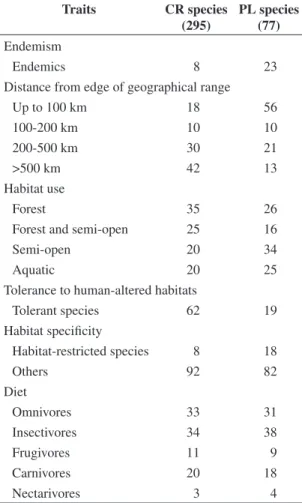
The rates of endemic/non endemic species were significantly different for the CR and PL bird spe-cies groups (Chi-square = 14.2; DF = 1; P < 0.0001); endemic species are more likely to become extinct, as they were better represented in the PL group (Table 1). Regarding the position of the UPR in relation to the edge of species’ range, there was a significant difference in the proportions of species in classes of distance (up to 100 km, 100-200 km, 200-500 km, and over 500 km) comparing CR and PL species (Chi-square = 52.8; DF = 3; P < 0.0001). Bird species close to the edge of their geographical range (up to 100 km) seem to be more extinction prone. In contrast, those that are far from their range limit (>500 km) seem more likely to persist in the UPR landscape (Table 1).
The distribution of species within habitat categories differed between PL and CR groups (Chi-square = 9.36; DF = 3; P = 0.025). Species associated to semi-open habitats seem to be the ones more negatively affected by landscape alteration in the UPR; a higher propor-tion of species in this category was observed in the PL group (Table 1). The rates of species that are tolerant/ not tolerant to human-altered habitats were also differ-ent between the PL and RC groups (Chi-square = 43.7; DF = 1; P < 0.0001). The PL group was composed mostly of not tolerant species while the CR group had a greater proportion of species that are tolerant to altered habitats (Table 1). Similarly, habitat specificity differed between PL and CR groups (Chi-square = 6.72; DF = 1; P < 0.01), with a greater proportion of habitat restricted species being observed in the former group (Table 1). The only ecological trait that did not show a significant difference between the two groups of species was diet (Chi-square = 0.838; DF = 4; P = 0.93). Similar propor-tions of frugivores, insectivores, carnivores, nectarivores and omnivores were observed in the PL and CR groups
Table 1. Proportion of species currently recorded (CR spe-cies) and potentially lost (PL spespe-cies) in the Upper Paraná River floodplain in categories of biogeographical and eco-logical traits.
Traits CR species
(295)
PL species (77)
Endemism
Endemics 8 23
Distance from edge of geographical range
Up to 100 km 18 56
100-200 km 10 10
200-500 km 30 21
>500 km 42 13
Habitat use
Forest 35 26
Forest and semi-open 25 16
Semi-open 20 34
Aquatic 20 25
Tolerance to human-altered habitats
Tolerant species 62 19
Habitat specificity
Habitat-restricted species 8 18
Others 92 82
Diet
Omnivores 33 31
Insectivores 34 38
Frugivores 11 9
Carnivores 20 18
(Table 1). These tendencies (tolerance to human-altered habitats, habitat specificity, and diet) were also observed for each class of habitat use (forest, forest to semi-open, semi-semi-open, and aquatic) individually (Chi-square; p < 0.05 for all tests).
Species that displayed at least two of the traits consid-ered in the present investigation (endemism, proximity to the edge of species’ range, low tolerance to human-altered habitats, and habitat specificity) were frequent in the PL group (60%; Appendix). Four species, Tinamus solitarius
(Vieillot, 1819), Philydor lichsteinsteini Cabanis and Heine, 1859, Charitospiza euscoma Oberholser, 1905, and
Geositta poiciloptera (Wied, 1830) displayed all four traits. Only 8% of species in the PL group did not show any of these traits. With the exception of Tachyphonus coronatus
(Vieillot, 1822), endemism was combined with other traits for all PL species: 61% of endemic birds analyzed were close to the edge of their ranges, 94% were considered not tolerant to human-altered habitats, 27% were habitat-restricted, and for 39%, endemism was combined with the first two traits. All habitat-restricted species and 81% of those found close to the edge of their ranges appeared to be not tolerant of human-altered habitats (Appendix).
4. Discussion
The present study has demonstrated that endemism, proximity to the edge of species’ geographic range, low tolerance to human-altered habitats and habitat spe-cificity are all traits associated to the potential loss of species in the UPR. These features are frequently men-tioned in the literature as being associated with increased extinction risk in birds (Stotz et al., 1996; Christiansen and Pitter, 1997; Goerk, 1997; Ribon et al., 2003; Gage et al., 2004; Kattan et al., 1994; Sodhi et al., 2004; Anjos, 2006; Lees and Peres, 2008). The fact that the study area is quite large makes it difficult to confirm extinction, par-ticularly for some bird species that are difficult to detect. However, we believe that the species listed in the present study are probably locally extinct, or had their popula-tions considerably reduced. Most species displayed at least two of the traits considered here; three of the four species that displayed all four traits (Tinamus solitarius, Charitospiza euscoma, and Geositta poiciloptera) are Near Threatened at the global level (IUCN, 2008).
Endemism can be used as a criterion for identifying species at risk. Moreover, areas with a high number of endemic species (e.g. Atlantic Forest) are often consid-ered priorities for conservation (Stotz at al., 1996; Myers et al., 2000; Silva et al., 2004; Bencke et al., 2006). Considering the fact that the UPR is in a transition zone between the Atlantic Forest and Cerrado, it is not a sur-prise that several species have range limits that are close to this region. This feature was shown to be an important factor in the group of PL species analyzed. Species at the edges of their ranges are likely more vulnerable to habi-tat loss and fragmenhabi-tation; populations may be at their physiological and ecological limits at their distributional
edge; they often present low densities, and thus could be particularly vulnerable to genetic and/or environmental stresses (Gaston, 2003; Sodhi et al., 2004).
Of the ecological features, habitat specificity was a frequent trait among the species in the PL group. Habitat loss and fragmentation are strong forces driv-ing to extinction, as have been argued by several au-thors (e.g. Debinski and Holt, 2000; Laurence, 2008), and species with narrow habitat requirements should be particularly sensitive to habitat loss and fragmenta-tion (Kattan, 1994; Goerk, 1997; Henle et al., 2004). Low tolerance to human-altered habitats decreases the chances of species survival (Stotz et al., 1996), possibly due to variations in resources, such as food availability and nest sites.
With regard to the four categories of habitat con-sidered in the present study, species associated to semi-open habitats seemed to be the most affected by land-scape modification in the UPR. The semi-open habitat was severely affected by the artificial lake of the Porto Primavera hydroelectric plant, which covered an exten-sive area of non-forested habitats. This could explain the high rate of semi-open species in the PL group. In addi-tion, of the semi-open habitat PL species, 27% are en-demic (all of them to the CSA zoogeographical region), 73% are close (up to 100 km) to edge of their geographic ranges, and 81% appear not to be tolerant to human-al-tered habitats.
Although some species are likely to have been lost in the region, the UPR still supports a rich avifauna, includ-ing species of conservation concern at the regional or global levels, such as Harpyhaliaetus coronatus (Vieillot, 1817) (Mikich and Bérnils, 2004; IUCN 2008). Also,
Crax fasciolata Spix, 1825, Anhima cornuta (Linnaeus, 1766), Ara ararauna (Linnaeus, 1758), and Ara chloropterus Gray, 1859, considered to be Endangered or Critically Endangered in the State of Paraná (Mikich and Bérnils, 2004) are currently found, in the mentioned State, mostly in the valley of the Paraná River.
Data presented here highlights the importance of UPR for the biodiversity of the region. It has been sug-gested that bird extinctions in the Atlantic Forest could be associated to the loss of floodplains and lowland for-ests (e.g. Ribon et al., 2003). Indeed, well-preserved ex-tensive river-floodplain environments such as the UPR are becoming scarcer in the Atlantic Forest region, and thus should be target of conservation efforts to pre-vent further loss of species and ecological processes. Moreover, where major zoogeographic zones meet, as occurs in the UPR where the Atlantic Forest and Central South America zones come into contact, diverse ecologi-cal communities can be found, and preserving such areas is a major global priority (Stotz et al., 1996).
References
AB’SÁBER, AZ., 2003. Os domínios de natureza no Brasil: potencialidades paisagistíticas. São Paulo: Ateliê Editorial. 160p.
AGOSTINHO, AA., 1997. Qualidade dos habitats e perspectivas para a conservação. In VAZZOLER, AEAM., AGOSTINHO, AA. and HAHN, NS. (Eds.). A planície de inundação do alto rio Paraná: aspectos físicos, biológicos e socioeconômicos. Maringá: Eduem. p. 455-460.
AGOSTINHO, AA., RODRIGUES, L., GOMES, LC., THOMAZ, SM. and MIRANDA, LE., 2004. Structure and functioning of the Paraná river and its floodplain. Maringá: Eduem. 275p.
ANJOS, L., 2006. Bird species sensitivity in a fragmented landscape of the Atlantic forest in southern Brazil. Biotropica, vol. 38, no. 2, p. 229-234.
BENCKE, GA., MAURICIO, GN., DEVELEY, PE. and GOERK, JM., 2006. Áreas importantes para a conservação das aves no Brasil: parte I – Estados do Domínio da Mata Atlântica. São Paulo: SAVE Brasil. 494p.
CAMPOS, JB. and SOUZA, MC., 1997. Vegetação. In VAZZOLER, AEAM., AGOSTINHO, AA. and HAHN, NS. (Eds.). A planície de inundação do alto rio Paraná: aspectos físicos, biológicos e socioeconômicos. Maringá: Eduem. p. 331-342.
Centrais Elétricas do Sul do Brasil – ELETROSUL, 1986. Ilha Grande: a vegetação da área de influência do reservatório da Usina Hidrelétrica de Ilha Grande (PR/MS). Florianópolis: ELETROSUL. Levantamento na escala 1:250.000. Relatório de pesquisa. 52p. Vol. 4.
CHRISTIANSEN, MB. and PITTER, E., 1997. Species loss in a forest bird community near Lagoa Santa in Southeastern Brazil. Biological Conservation, vol. 80, no. 1, p. 23-32. Comitê Brasileiro de Registros Ornitológicos – CBRO, 2007. Lista das aves do Brasil. [S.L.]: CBRO. Available from: <http:// www.cbro.org.br/CBRO/listabr.htm>. Access in: 25 de Junho de 2008.
DEBINSKI, DM. and HOLT, RD., 2000. A survey and overview of habitat fragmentation experiments. Conservation Biology, vol. 14, no. 2, p. 342-355.
Del HOYO, J., ELLIOTT, A. and SARGATAL, J., 1992-2005. Handbook of the birds of the world. Barcelona: Lynx Editions. Vol. 1-10.
FOWLER, J. and COHEN, L., 1986. Statistics for ornithologists. Thetford: British Trust for Ornithology. 176p.
GAGE, GS., BROOKE, ML., SYMONDS, MRE. and WEGE, D., 2004. Ecological correlates of the threat of extinction in Neotropical bird species. Animal Conservation, vol. 7, no. 2, p. 161-168.
GASTON, KJ., 2003. The structure and dynamics of geographic ranges. Oxford: Oxford University Press. 276p.
GIMENES, MR. and ANJOS, L., 2004. Spatial distribution of birds on three islands in the Upper River Paraná, southern Brazil. Ornitologia Neotropical, vol. 15, no. 1, p. 71-85. ______, 2006. Influence of lagoons size and prey availability on the wading birds (Ciconiiformes) in the Upper Paraná
River floodplain, Brazil. Brazilian Archives of Biology and Technology, vol. 49, no. 3, p. 463-473.
______, 2007. Variação sazonal na sociabilidade de forrageamento das garças Ardea alba (Linnaeus, 1758) e Egretta thula (Molina, 1782) (Aves: Ciconiiformes) na planície alagável do alto rio Paraná, Brasil. Revista Brasileira de Ornitologia, vol. 15, no. 3, p. 409-416.
GIMENES, MR., LOPES, EV., RIBEIRO, AL., MENDONÇA, LB. and ANJOS, L., 2007. Aves da planície alagável do alto rio Paraná. Maringá: Eduem. 281p.
GOERK, JM., 1997. Patterns of rarity in the birds of the
Atlantic forest of Brazil. Conservation Biology, vol. 11, no. 1, p. 112-118.
HENLE, K., DAVIES, KF., KLEYER, M., MARGULES, C. and SETTELE, J., 2004. Predictors of species sensitivity to fragmentation. Biodiversity and Conservation, vol. 13, no. 1, p. 207-251.
International Union for Conservation of Nature – IUCN, 2008. The IUCN red list of threatened species. [S.L.]: IUCN. Available from: <http://www.iucnredlist.org>. Access in: 20 de Fevereiro de 2009.
ISLER, ML. and ISLER, PR., 1999. The tanagers: natural history, distribution, and identification. Washington: Smithsonian Institution Press. 406p.
KATTAN, GH., ALVAREZ-LOPEZ, H. and GIRALDO, M., 1994. Forest fragmentation and bird extinctions: San Antonio eighty years later. Conservation Biology, vol. 8, no. 1, p. 138-146.
LAURENCE, WF., 2008. Theory meets reality: how habitat fragmentation research has transcended island biogeographic theory. Biological Conservation, vol. 141, no. 7, p. 1731-1744. LEES, AC. and PERES, CA., 2008. Avian life history determinants of local extinction risk in a fragmented neotropical forest landscape. Animal Conservation, vol. 11, no. 2, p. 128-137.
LOURES-RIBEIRO, A. and ANJOS, L., 2004. Ameaças aos senhores do ar. Ciência Hoje, vol. 35, no. 209, p. 66-69. ______, 2006. Falconiformes assemblages in a fragmented landscape of the Atlantic Forest in southern Brazil. Brazilian Archives of Biology and Technology, vol. 49, no. 1, p. 149-162. MARINI, MA. and GARCIA, FI., 2005. Bird Conservation in Brazil. Conservation Biology, vol. 19, no. 3, p. 665-671. MENDONÇA, LB. and ANJOS, L., 2006. Flower morphology, nectar features, and hummingbird visitation to Palicourea crocea (Rubiaceae) in the Upper Paraná River floodplain, Brazil. Anais da Academia Brasileira de Ciências, vol. 78, no. 1, p. 45-57. MENDONÇA, LB., GIMENES, MR. and ANJOS, L., 2004. Interactions between birds and other organisms in the Upper Paraná River floodplain, Brazil. In AGOSTINHO, AA., RODRIGUES, L., GOMES, LC., THOMAZ, SM. and MIRANDA, LE. (Eds.). Structure and functioning of the Paraná River and its floodplain. Maringá: Eduem. p. 215-220. MIKICH, SB. and BÉRNILS, RS., 2004. Livro vermelho da fauna ameaçada no Estado do Paraná. Curitiba: Instituto Ambiental do Paraná. 1 CD-ROM.
benefícios da biodiversidade brasileira. Brasília: Ministério do Meio Ambiente, Secretaria de Biodiversidade e Florestas, Projeto de Conservação e Utilização Sustentável da Diversidade Biológica Brasileira – PROBIO. 340p.
MYERS, NR., MITTERMEIER, A., MITTERMEIER, CG., FONSECA, GAB. and KENT, J., 2000. Biodiversity hotspots for conservation priorities. Nature, vol. 403, no. 6772, p. 853-858. PARKER III, TA., STOTZ, DF. and FITZPATRICK, JW., 1996. Ecological and distribution databases. In STOTZ, DF., FITZPATRICK, JW., PARKER III, TA. and MOSKOVITS, DK. (Eds.). Neotropical birds: ecology and conservation. Chicago: University of Chicago Press. p. 131-436.
PORZECANSKI, AL. and CRACRAFT, J., 2005. Cladistic analysis of distributions and endemism (CADE): using raw distributions of birds to unravel the biogeography of the South American aridlands. Journal of Biogeography, vol. 32, no. 2, p. 261-275.
RIBON, R., SIMON, JE. and MATTOS, GT., 2003. Bird extinctions in Atlantic forest fragments of the Viçosa region, southeastern Brazil. Conservation Biology, vol. 17, no. 6, p. 1827-1839.
RIDGELY, RS. and TUDOR, G., 1989. The birds of South America. Vol. 1. The oscine passerines. Austin: University of Texas Press. 562p.
______, 1994. The birds of South America. Vol. 2. The suboscine passerines. Oxford: Oxford University Press. 940p.
RIDGELY, RS., ALLNUTT, TF., BROOKS, T., McNICOL, DK., MEHLMAN, DW., YOUNG, BE. and ZOOK, JR., 2007. Digital distribution maps of the birds of the Western Hemisphere, version 2.1. Arlington: NatureServe.
SICK, H., 1997. Ornitologia brasileira. Rio de Janeiro: Nova Fronteira. 904p.
SILVA, JMC., SOUSA, MC. and CASTELLETTI, CHM., 2004. Areas of endemism for passerine birds in the Atlantic forest,
South América. Global Ecology and Biogeography, vol. 13, no. 1, p. 85-92.
SODHI, NS., LIOW, LH. and BAZZAZ, FA., 2004. Avian extinctions from tropical and subtropical forests. Annual Review of Ecology, Evolution and Systematics, vol. 35, p. 323-345. SOUZA, MC., ROMAGNOLO, MB. and KITA, KK., 2004. Riparian vegetation: ecotones and plant communities. In THOMAZ, SM., AGOSTINHO, AA. and HAHN, NS. (Eds.). The upper Paraná river and its floodplain: physical aspects, ecology and conservation. Leiden: Backhuys Publishers. p. 353-367.
STOTZ, DF., FITZPATRICK, JW., PARKER III, TA. and MOSKOVITS, DK. (Eds.), 1996. Neotropical birds: ecology and conservation. Chicago: University of Chicago Press. 478p.
STRAUBE, FC. and URBEN-FILHO, A., 2001. Análise do conhecimento ornitológico da região noroeste do Paraná e áreas adjacentes. In ALBUQUERQUE, JLB., CÂNDIDO Jr., JF., STRAUBE, FC. and ROOS, AL. (Eds.). Ornitologia e conservação: da ciência às estratégias. Tubarão: Unisul. p. 223-229.
STRAUBE, FC., BORNSCHEIN, MR. and SCHERER-NETO, P., 1996. Coletânea da avifauna da região Noroeste do Estado do Paraná e áreas limítrofes (Brasil). Arquivos de Biologia e Tecnologia, vol. 39, no. 1, p. 193-214.
SZTOLCMAN, J., 1926. Étude des collections ornithologiques de Paraná. Annales Zoologici Musei Polonici Historiae Naturalis, vol. 5, no. 3, p. 107-196.
TABARELLI, M. and GASCON, C., 2005. Lessons from fragmentation research: improving management and policy guidelines for biodiversity conservation. Conservation Biology, vol. 19, no. 3, p. 734-739.
Appendix. Bioeographical and ecological traits of possibly extinct species in the Upper Paraná River floodplain (UPR): en-demism, position of UPR in relation to the edge of species range (distance classes), habitat use, tolerance to habitat alteration (tolerance), habitat specificity, and diet. Species arranged according to their systematic and taxonomic position following the Brazilian Committee of Ornithological Records (CBRO 2008).
Taxa
Endemism
1
Distance classes
2
Habitat use
3
T
olerance
4
Habitat specificity
5
Diet
6
TINAMIDAE
Tinamus solitarius (Vieillot, 1819) ATL a Fo - x On
Crypturellus obsoletus (Temminck, 1815) - a Fo - - On
ANHIMIDAE
Chauna torquata (Oken, 1816) - b Aq - x On
ANATIDAE
Sarkidiornis sylvicola Ihering and Ihering, 1907 - d Aq - - On
Callonetta leucophrys (Vieillot, 1816) - a Aq - - On
Netta erythrophthalma (Wied, 1832) - a Aq - x On
Nomonyx dominica (Linnaeus, 1766) - d Aq - x On
CRACIDAE
Aburria jacutinga (Spix, 1825) ATL b Fo - - Fr
ODONTOPHORIDAE
Odontophorus capueira (Spix, 1825) ATL b Fo - - Fr
PODICIPEDIDAE
Tachybaptus dominicus (Linnaeus, 1766) - d Aq - - In
Podilymbus podiceps (Linnaeus, 1758) - d Aq - - Ca
ARDEIDAE
Tigrisoma fasciatum (Such, 1825) - a Aq - - Ca
Cochlearius cochlearius (Linnaeus, 1766) - b Aq - - Ca
THRESKIORNITHIDAE
Plegadis chihi (Vieillot, 1817) - c Aq - x Ca
ACCIPITRIDAE
Buteo swainsoni Bonaparte, 1838 - a Fo-So - - Ca
Spizaetus tyrannus (Wied, 1820) - a Fo-So - - Ca
FALCONIDAE
Ibycter americanus (Boddaert, 1783) - a Fo - - In
Falco peregrinus Tunstall, 1771 - d So - - Ca
RALLIDAE
Porzana flaviventer (Boddaert, 1783) - b Aq - x On
Pardirallus maculatus (Boddaert, 1783) - a Aq - x In
CHARADRIIDAE
Vanellus cayanus (Latham, 1790) - c Aq - x In
Charadrius semipalmatus Bonaparte, 1825 - a Aq - - Ca
SCOLOPACIDAE
Gallinago undulata (Boddaert, 1783) - c Aq - - Ca
Tringa melanoleuca (Gmelin, 1789) - d Aq x - In
Calidris melanotos (Vieillot, 1819) - d Aq - - Ca
CUCULIDAE
Micrococcyx cinereus (Vieillot, 1817) - c Fo-So - - In
STRIGIDAE
Megascops watsonii (Cassin, 1849) - a Fo - - Ca
Taxa
Endemism
1
Distance classes
2
Habitat use
3
T
olerance
4
Habitat specificity
5
Diet
6
CAPRIMULGIDAE
Chordeiles pusillus Gould, 1861 - a So - - In
TROCHILIDAE
Chrysolampis mosquitus (Linnaeus, 1758) - c So - - Ne
Amazilia versicolor (Vieillot, 1818) - c Fo-So x - Ne
Calliphlox amethystina (Boddaert, 1783) - c Fo-So - - Ne
ALCEDINIDAE
Chloroceryle aenea (Pallas, 1764) - a Aq - - Ca
Chloroceryle inda (Linnaeus, 1766) - a Aq - - Ca
BUCCONIDAE
Nystalus maculatus (Gmelin, 1788) - a So - - In
RAMPHASTIDAE
Ramphastos dicolorus Linnaeus, 1766 ATL b Fo - - Fr
Selenidera maculirostris (Lichtenstein, 1823) ATL a Fo - - Fr
Pteroglossus bailloni (Vieillot, 1819) ATL a Fo - - Fr
PICIDAE
Veniliornis mixtus (Boddaert, 1783) CSA a So - - In
MELANOPAREIIDAE
Melanopareia torquata (Wied, 1831) CSA a So - - In
THAMNOPHILIDAE
Thamnophilus torquatus Swainson, 1825 CSA a So - - In
Thamnophilus punctatus (Shaw, 1809) a Fo-So x - In
Herpsilochmus atricapillus Pelzeln, 1868 CSA b Fo - - In
SCLERURIDAE
Geositta poeciloptera (Wied, 1830) CSA a So - x In
FURNARIIDAE
Synallaxis albescens Temminck, 1823 - c So x - In
Synallaxis hypospodia Sclater, 1874 - a So x - In
Phacellodomus rufifrons (Wied, 1821) - a Fo-So x - In
Philydor lichtensteini Cabanis and Heine, 1859 ATL c Fo - x In
Philydor rufum (Vieillot, 1818) - c Fo - - In
TYRANNIDAE
Elaenia cristata Pelzeln, 1868 - a So - - On
Suiriri suiriri (Vieillot, 1818) - a So - - In
Sublegatus modestus (Wied, 1831) - a So - - In
Platyrinchus mystaceus Vieillot, 1818 - c Fo - - On
Onychorhynchus coronatus (Statius Muller, 1776) - a Fo - x In
Contopus cinereus (Spix, 1825) - c Fo-So x - In
Xolmis cinereus (Vieillot, 1816) - d So x - In
Philohydor lictor (Lichtenstein, 1823) - a So - - In
Tyrannus albogularis Burmeister, 1856 - a So - - In
PIPRIDAE
Neopelma pallescens (Lafresnaye, 1853) - a Fo - - On
Manacus manacus (Linnaeus, 1766) - a Fo x - Fr
Chiroxiphia caudata (Shaw and Nodder, 1793) ATL b Fo - - Fr
Taxa
Endemism
1
Distance classes
2
Habitat use
3
T
olerance
4
Habitat specificity
5
Diet
6
TITYRIDAE
Pachyramphus castaneus (Jardine and Selby, 1827) - c Fo x - In HIRUNDINIDAE
Alopochelidon fucata (Temminck, 1822) - d So - - In
POLIOPTILIDAE
Polioptila dumicola (Vieillot, 1817) - a So - - In
THRAUPIDAE
Neothraupis fasciata (Lichtenstein, 1823) CSA a Fo-So - x On
Cypsnagra hirundinacea (Lesson, 1831) CSA a So - - On
Tachyphonus coronatus (Vieillot, 1822) ATL c Fo-So x - On
Tachyphonus rufus (Boddaert, 1783) - a So x - On
EMBERIZIDAE
Embernagra platensis (Gmelin, 1789) - a So - - On
Sporophila plumbea (Wied, 1830) - c So - - On
Sporophila maximiliani (Cabanis, 1851) - a So x - On
Arremon taciturnus (Hermann, 1783) - a Fo - x On
Charitospiza eucosma Oberholser, 1905 CSA a So - x On
CARDINALIDAE
Saltator atricollis Vieillot, 1817 CSA a So - - On
Cyanoloxia brissonii (Lichtenstein, 1823) - d So - - On
ICTERIDAE
Procacicus solitarius (Vieillot, 1816) - a Fo x - On
Cacicus cela (Linnaeus, 1758) - a Fo-So x - On
Abbreviations: 1ATL, species endemic to the Atlantic Forest; CSA, endemic to the Central South America; 2Abbreviations:
a, up to 100 km; b, 100-200 km; c, 200-500 km; d, more than 500 km; 3Abbreviations: Fo, forest; Fo-So, forest to
semi-open; So, semi-semi-open; Aq, aquatic; 4An x indicates a species that can occur in human altered habitats (habitats F15, N13 and
N14 sensu Parker III et al., 1996); 5An x indicates a habitat-restricted species (i.e. that occur in only one habitat type
ac-cording to Parker III et al., 1996); and 6Abbreviations: On, omnivores; In, insectivores; Ca, carnivores; Ne, nectarivores.