Mattis Dementia Rating Scale (DRS)
Normative data for the Brazilian
middle-age and elderly populations
Maria Paula Foss1, Viviane Amaral de Carvalho2, Thais Helena Machado3,
Geraldo Cássio dos Reis4, Vitor Tumas5, Paulo Caramelli6,
Ricardo Nitrini7, Cláudia Sellitto Porto8
ABSTRACT. Objective: To expand norms for the Mattis Dementia Rating Scale (DRS) for the Brazilian middle-age and elderly populations. Methods: The DRS was administered to 502 individuals without cognitive deficits, 312 women and 190 men, aged 50 years or over and with educational level ranging from 0 to 13 years or more. The sample was composed of subjects who participated in other studies, from Caeté (Minas Gerais state), Ribeirão Preto (São Paulo state) and São Paulo (São Paulo state). Participants were divided into four schooling groups (illiterate, 1 to 4 years, 5 to 12 years and 13 years or more). The subjects were divided into four groups according to age (50 to 60, 61 to 70, 71 to 80, and 80 years or over). Results: Normative data for DRS scores are expressed as percentile values. The group with lowest schooling and subjects older than 80 years had the worst scores. Conclusion: As expected, age and education were strongly correlated with DRS scores. Illiterates and older old individuals performed worse than the other groups. These data might help to improve the accuracy of the diagnosis of cognitive impairment and dementia in Brazilian middle-age and elderly populations.
Key words: DRS, illiterates, elderly, schooling, neuropsychological assessment.
MATTIS DEMENTIA RATING SCALE (DRS): DADOS NORMATIVOS PARA AS POPULAÇÕES BRASILEIRAS DE MEIA-IDADE E IDOSOS RESUMO. Objetivo: Expandir normas para o Mattis Dementia Rating Scale (MDRS) na população brasileira de meia idade e idosa. Métodos: A MDRS foi aplicada em 502 indivíduos, 312 mulheres e 190 homens, com idade de 50 anos ou mais e escolaridade de 0 a 13 anos ou mais anos. A amostra foi composta de sujeitos que participaram de outros estudos: Caeté (Minas Gerais), Ribeirão Preto (São Paulo) e São Paulo (São Paulo). Participantes foram divididos em quatro grupos de escolaridade (analfabetos, 1 a 4 anos, 5 a 12 anos e 13 anos ou mais). Os sujeitos foram divididos em quatro grupos de idade (50 a 60, 61 a 70, 71 a 80 e acima de 80 anos). Resultados: Dados normativos dos escores da MDRS são apresentados em percentis. O grupo com menos escolaridade e sujeitos acima de 80 anos apresentaram escores mais baixos. Conclusão: Como esperado, idade e escolaridade foram fortemente correlacionados aos escores da MDRS. Analfabetos e indivíduos muito idosos apresentaram pior desempenho que os outros grupos. Os dados podem ajudar a melhorar a acurácia para o diagnóstico de prejuízo cognitivo e demência na população brasileira de meia-idade e idosos. Palavras-chave: DRS, analfabetos, idosos, escolaridade, avaliação neuropsicológica.
INTRODUCTION
T
he Mattis Dementia Rating Scale (DRS)1was originally created for the diagnosis
of Alzheimer’s disease (AD), but it has also been utilized for early detection of dementia, diferential diagnosis between AD and other
1Psicóloga do Setor de Distúrbios do Movimento e Neurologia Comportamental do Hospital das Clínicas da Faculdade de Medicina de Ribeirão Preto da USP,
Doutora em Ciências Médicas (Neurociências) da FMRP-USP, Ribeirão Preto SP, Brazil. 2Psicóloga, Neurologia Cognitiva e do Comportamento da Faculdade de
Medicina da Universidade Federal de Minas Gerais, Belo Horizonte MG, Brazil. 3Fonoaudióloga, Doutora em Linguística pela UFMG, Pesquisadora no Ambulatório
de Neurologia Cognitiva e do Comportamento do Hospital das Clínicas da UFMG, Belo Horizonte MG, Brazil. 4Estatístico do Departamento de Neurociências e
Ciências do Comportamento da FMRP-USP, Ribeirão Preto SP, Brazil. 5Médico, Faculdade de Medicina de Ribeirão Preto - FMRP-USP, Ribeirão Preto SP, Brazil. 6Professor do Departamento de Clínica Médica da Faculdade de Medicina da UFMG; Coordenador do Ambulatório de Neurologia Cognitiva e do Comportamento
do Hospital das Clínicas da UFMG, Belo Horizonte MG, Brazil. 7Diretor da Disciplina de Neurologia da Faculdade de Medicina da Universidade de São Paulo, São
Paulo SP, Brazil. 8Psicóloga do Grupo de Neurologia Cognitiva do Comportamento da Clínica Neurológica do Hospital das Clínicas da FMUSP, Doutora em Ciências
pela FMUSP, São Paulo SP, Brazil.
Maria Paula Foss. Av. Bandeirantes, 3900 – 14049-900 Ribeirão Preto SP – Brasil. E-mail: [email protected] Disclosure: The authors report no conflicts of interest.
dementias, and dementia staging.2-6 he scale tasks are
grouped into ive subscales, each evaluating diferent cog-nitive areas, namely, Attention, Initiation/Perseveration (I/P), Construction, Conceptualization and Memory.
In the Brazilian population, Porto et al.7 have
dem-onstrated the value of the DRS in diferentiating 41 mild AD patients from 60 cognitively healthy controls and have shown the importance of establishing norms for this scale. To analyze the efects of age and schooling on the performance of the tests, patients and controls were separated into three age groups and three levels of schooling. In this sample population, the efects of education were more evident than the efects of age. he cut-of for total score was 122, yielding 91.7% sensitiv-ity and 87.8% speciicsensitiv-ity.
Foss et al.8 analyzed the inluence of low schooling
and illiteracy on DRS performance in a group of cogni-tively healthy elderly with a broad distribution of edu-cational level. he inluence of schooling was studied in 62 controls and the total sample was divided into ive groups of schooling: illiterates; 4 years; 8 to 9 years; 11 to 12 years and 15 to 16 years. Education interfered with individual performance on the DRS and illiteracy was a determinant factor of lower DRS scores.
As the previous studies were based on small sam-ples, the generalization of these normative data is very limited. Hence, the aim of the present study was to ex-pand the norms for the Mattis Dementia Rating Scale (MDRS) for the Brazilian population.
METHODS
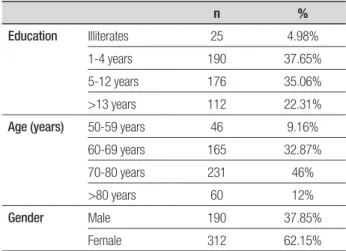
Overall, 502 individuals participated in these study, consisting of 312 women and 190 men, aged 50 years to 93 years old and with a wide distribution of educational level attained. he sample comprised healthy individu-als who participated in other studies conducted in Caeté (Minas Gerais state), Ribeirão Preto (São Paulo state) and São Paulo (São Paulo state). Exclusion and inclusion criteria were described in previous studies.7-10
In order to investigate the inluence of schooling on DRS performance, individuals were divided into four schooling groups: illiterates, 1 to 4 years of schooling (sch 1), 5 to 12 years of schooling (sch 2), and an above 13 years of schooling (sch 3). To be classiied as illiter-ate the subject must have never been to school and be unable to read the sentence “Close your eyes” from the Mini-Mental State Examination (MMSE). In order to analyze the interference of age on test performance, this variable was divided into four groups: Group 1 from 50 to 60 years, Group 2 from 61 to 70 years, Group 3 from 71 to 80 years and Group 4 over 80 years.
he DRS was applied to all subjects in a single in-dividual session and in the order recommended by the author. It should be noted that DRS tasks are presented in a ixed order, and only the Attention tests are not grouped in a sequence, as they also serve as distractors for the Memory subscale. Within each subscale, the most diicult tests are presented in irst and second place and, if performed well, subsequent items in the subscale are credited as being performed correctly. he advantage of this procedure is that it allows shortening of the total testing time for individuals whose cognitive function is better preserved.
he number of points credited for the correct re-sponse varies in accordance with the tasks and the to-tal points in each subscale score provide a partial score for that subscale. he partial scores are Attention, 37 points; Initiation/Perseveration (I/P), 37 points; Con-struction, 6 points; Conceptualization, 39 points; and Memory, 25 points. he maximum total possible score is 144 points.
All participants signed a written informant con-sent form and the study was approved by the respec-tive Research Ethics Committees of the Hospital das Clínicas of the University of São Paulo School of Medi-cine, the Hospital das Clínicas of University of São Paulo at Ribeirão Preto, and of the Federal University of Minas Gerais.
Data analyses. he statistical analyses were conducted with the SPSS statistical software package version 17.0 for Windows and p-values of 0.05 or less were consid-ered statistically signiicant.
Demographic variables (age, education and gender) were correlated to DRS scores (subscales and total score) using Pearson’s tests (r). Also, the demographic vari-ables (age and education) were compared to DRS scores (subscales and total score) by the independent samples test for multiple comparisons (ANOVA) and Tukey’s post hoc test. DRS scores were transformed into percen-tiles and z-scores and subsequently into T-scores.
RESULTS
Correlation of DRS scores and demographic data are shown in Table 2. Age and education were more strongly related to DRS scores than gender. Nonetheless, in the Attention subscale a signiicant correlation between gender and DRS scores was observed, with women per-forming worse than men.
Analyses of DRS scores according to educational level yielded signiicant diferences on the Attention subscale (illiterates < sch1 < sch2 < sch3); Initiation/ Perseveration subscale (illiterates < sch1 < sch2 < sch3); Construction (illiterates < sch1 < sch2 and sch3); Con-ceptualization subscale (illiterates < sch1 < sch2 < sch3); Memory subscale (illiterates < sch1 < sch2 < sch3); and in total score (illiterates < sch1 < sch2 < sch3). As ex-pected, groups with higher education had better scores than the other groups.
he age groups showed signiicant diferences in the DRS scores for the Attention subscale (group age 1 > group age 3, group age 1 > group age 4, and group age 2 > group age 4), for the Initiation/ Perseveration sub-scale (group age 1 > group age 3, group age 1 > group age 4, and group age 2 > group age 4), for the Construction subscale (group age 1 > groups 3 and 4), for the Con-ceptualization (group age 1 > groups age 2, 3 and 4), for the Memory (groups age 1 and 2 > group age 4) sub-scales and for total DRS score (group age 1 > group age 3, group age 1 > group age 4, and group age 2 > group age 4). In conclusion, group age 1 (youngest individu-als) had higher scores than all the remaining groups, with group age 4 (oldest individuals) showing the worst scores.
Since the main purpose of the study was to expand DRS normative data for Brazil, the amount of people in each group according to age and education was strati-ied according to their signiicance so as to represent the population and its clinical relevance for Brazilian standards (education standards). However, other analy-ses were performed yielding interesting results, such as signiicant diferences in the total DRS score between ages (> 85 years < 66 to 70 years < 56 to 60 years), but no signiicant diferences between 75 to 85 years and 61 to 65 years, suggesting more diferences for age division decades, in accordance with our tables.
In relation to schooling, illiterates performed signii-cantly worse than their literate counterparts. Additional diferences were observed for 1 and 2 years < 3 and 4 years < 11 and 12 years < 15 and 16 years < 16+ years of schooling). here were no signiicant diferences be-tween the groups with 5 to 10 years of education.
Normative data for DRS scores in the Brazilian older population are expressed as percentile values in
Tables 3 to 5 for persons with 1-4 years of schooling (for those with other educational levels, the data are given in Tables 6 to 15, available at www.demneuropsy.com. br. Mean scores for the whole sample (n=502) were 35.04±1.95 for the Attention subscale, 34.19±3.52 for Initiation/Perseveration, 5.58±1.05 for Construc-tion, 33.98±4.83 for ConceptualizaConstruc-tion, 22.89±2.65 for Memory and, inally, 131.7±10.99 for total score. How-ever, in accordance with the large variation in age and education, the data are better represented by years of schooling and age.
DRS scores decreased with age and in those indi-viduals with fewer years of schooling. (Tables 3 to 14). Illiterates presented worse results than all the educated groups (p<0.001) and their results should therefore be separated from the others as part of these Brazilian norms (Table 15). Due to the small number of illiterates in this sample it was not possible to allocate them into age groups as was done for individuals with the other educational levels.
Table 1. Demographic data (n=502).
n %
Education Illiterates 25 4.98%
1-4 years 190 37.65%
5-12 years 176 35.06%
>13 years 112 22.31%
Age (years) 50-59 years 46 9.16%
60-69 years 165 32.87%
70-80 years 231 46%
>80 years 60 12%
Gender Male 190 37.85%
Female 312 62.15%
Table 2. Correlations of DRS subscales and total score with demographic
variables.
Age r
Gender r
Education r
Attention –0.16 ** –0.095* 0.44**
Initiation / Perseveration –0.26** 0.074 0.46**
Construction –0.15** –0.059 0.37**
Conceptualization –0.23** –0.053 0.56**
Memory –0.20** 0.010 0.36**
Total score –0.28** –0.017 0.59**
DISCUSSION
Normative data for Brazilian elderly is necessary to characterize this population without neurological
im-pairment and to avoid misdiagnoses. Previous studies with the DRS were conducted in Brazil7,8 on small
nor-mative samples. Notably, there are no robust nornor-mative
Table 3. Percentiles for subjects with 1-4 years of schooling and 50 to 60 years of age (n=16).
Percentile Attention I/P Construction Conceptualization Memory Total
1 33 28 6 27 19 125
5 33 28 6 27 19 125
10 33.7 30.1 6 29.8 19 126.4
25 34.25 32 6 34 21.25 130.2
50 35 35 6 37 24 134
75 36 36 6 37 24.75 137.7
90 36 37 6 39 25 138.3
Mean 35 34 6 35.6 22.87 133.7
SD 0.93 2.6 0 3.24 2.125 4.38
Table 4. Percentiles for subjects with 1-4 years of schooling and 61 to 70 years of age (n=57).
Percentile Attention I/P Construction Conceptualization Memory Total
1 29 19 0 16 14 95
5 29 24 3.55 25 17.65 104
10 31 29 4 27 20 117
25 33 31 5 29 21 124
50 34.5 35 6 32.5 23 129
75 36 36.25 6 36 24 135.25
90 36.9 37 6 38 25 138
Mean 34.1 33.36 5.36 32.26 22.58 127.9
SD 2.02 3.949 1.12 4.54 2.37 9.77
Table 5. Percentiles for subjects with 1-4 years of schooling and 71 to 80 years of age ( n=107).
Percentile Attention I/P Construction Conceptualization Memory Total
1 27 21 1 17 17 101
5 31.7 25.85 3 22 19 108.85
10 33 27 3.7 24.7 20 117
25 34 30 5 29.25 22 123
50 35 33 6 32 23 129
75 36 36 6 35 25 134
90 37 37 6 37 25 138
Mean 34.82 32.75 5.46 31.79 23 127.8
data for the Mattis Dementia Rating Scale (MDRS) in the Brazilian population, justifying this study’s objec-tive of expanding preliminary data.
Age and education were correlated with DRS scores conirming the results of previous studies7,8,11-13 and the
importance of these variables to these scores. hese variables afected the performance on the DRS total score and all subscales, suggesting the adjustment of scores by age and education to improve diagnostic ac-curacy. Gender correlated only with scores on the Atten-tion subscale with worse performances for women.
Monsch et al.16 also failed to encounter any
signii-cant diferences in DRS scores for gender, but this was not true for age and education. Bank et al.17 obtained
correlation of DRS total score with all demographic data, including gender, age, education and race, a vari-able not assessed in our study. Rilling et al.18 found
cor-relation and shared variance of DRS scores with gender accounting for 3% of the variance, age (7%) and educa-tion (17%) among African Americans, emphasizing the higher efect of education on these scores. In the study by Pedraza et al.,13 age and education were signiicantly
associated with DRS total score and subscales. Gender was associated with the Construction subscale. Mean Construction scores difered signiicantly for men and women only between the ages of 80 and 84.
In the study by Rosselli et al.,14 the efect of education
and gender on total MMSE scores was analyzed using the “serial 7’s” (attention) and the “backward spelling” (work-ing memory) items. Women scored signiicantly lower than men on the MMSE “serial 7’s”. In another study em-ploying the MMSE,15 women with less than 3 years of
edu-cation scored signiicantly lower than men with the same educational level whereas no gender diferences were observed in the groups with higher levels of schooling. Education also accounted for signiicant diferences between illiterate and literate subjects. In our study, in-dividuals with higher education had better performance than all the other groups. Literacy is signiicantly associ-ated with virtually all neuropsychological measures and the impact of literacy is relected in diferent spheres of cognitive functioning. Learning to read reinforces and modiies certain fundamental abilities, such as verbal and visual memory, phonological awareness, and visuo-spatial and motor skills.19 Ostrosky-Solis et al.20
ana-lyzed the performance of 64 illiterate normal subjects on neuropsychological tests and the largest educational efect was noted in constructional abilities, language, phonological verbal luency and conceptual functions.
In a study conducted in Brazil with the DRS,8 62
controls without neuropsychiatric disorders aged 65 to 75 years were distributed into ive groups according to schooling level . he irst group was composed of illiter-ates, followed by 4 years, 8 to 9 years, 11 to 12 years and 15 to 16 years of schooling. Illiterates had the worst scores compared with all the other literate groups whose scores rose with increased years of education. Illiteracy and low education were determinant factors for worse DRS scores, where this was also the case in the present study. For total DRS scores, a tendency toward stability was observed for 5 to 10 years of education.
Total and subscale scores showed diferences in re-lation to age, with worse performances associated with older ages. For DRS total score, a tendency of diference in score between decades was observed. Bennett et al.21
showed, in a sample of 82 nondemented nursing home residents aged 80 to 99 with a mean educational level of 11 years, that a large percentage performed in the im-paired range on the DRS, particularly on the Initiation/ Perseveration and Conceptualization subscales and also on total score. In the study of Ostrosky-Solis et al.,20 the
aging efect was noted in visuoperceptual and memory scores.
In conclusion, for the elderly Brazilian population, education represents a determinant factor for DRS scores. As the validity of a normative group will depend on the similarity between the examinee and the demo-graphic features of the normative sample, it is preferable to present normative samples in relation to age and ed-ucation rather than by only one of these variables. his is necessary since the Brazilian population has a large variation in socioeducational and demographic data.
he present normative data expands and integrates diferent studies with the DRS for the elderly Brazilian population. It is now necessary to include other regions of this large country to render this more representa-tive of the entire middle-age and elderly populations. Also, further work should include more participants in the age ranges of 50 to 60 years and over 80 years, in-crementing our indings. As evidenced, there are some limitations to our study and practitioners must there-fore also rely on their clinical judgment when analyzing DRS results.
REFERENCES
1. Mattis S. Dementia Rating Scale. Professional Manual. Florida: Psycho-logical Assessment Resources; 1988.
2. Lukatela K, Cohen R, Kessler H, et al. Dementia Rating Scale perfor-mance: a comparison of vascular and Alzheimer’s dementia. J Clin Ex-per Neuropsychol 2000;22:445-454.
3. Paolo AM, Trostr AI, Glatt SL, Hubble JP, Koller WCJ. Differentiation of the dementias of Alzheimer’s and Parkinson’s disease with the demen-tia rating scale. J Geriatr Psychiatry Neurol 1995;8:184-188.
4. Paulsen JS, Butters N, Sadek JR, et al. Distinct cognitive profiles of cortical and subcortical dementia in advanced illness. Neurology 1995; 45:951-956.
5. Rascovsky K, Salmon DP, Ho GJ, et al. Cognitive profiles differ in au-topsy-confirmed Lewy body variant vs pure Alzheimer’s disease. Arch Neurol 1998;55:994-1000.
6. Salmon DP, Thomas RG, Pay MM, et al. Alzheimer’s disease can be ac-curately diagnosed in very mildly impaired individuals. Neurology 2002; 59:1022-1028.
7. Porto CS, Fichman HC, Caramelli P, Bahia VS, Nitrini R. Brazilian ver-sion of the Mattis Dementia Rating Scale. Diagnosis of mild dementia in Alzheimer’s Disease. Arq Neuropsiquiatr 2003;61:339-345.
8. Foss MP, Valle F de A, Speciali JG. Influence of education on the neu-ropsychological assessment of the elderly: application and analysis of the results from the Mattis Dementia Rating Scale (MDRS). Arq Neurop-siquiatr 2005;63:119-126.
9. Caramelli P, Barbosa MT, Sakurai E, et al. The Pietà Study. Epidemio-logical investigation on successful brain aging in Caeté (MG), Brazil. Methods and baseline cohort characteristics. Arq Neuropsiquiatr 2011; 69:579-584.
10. Porto CS. A escala de avaliação de demência (DRS) no diagnóstico de comprometimento cognitivo leve e doença de Alzheimer. Tese, Facul-dade de Medicina da USP, Departamento de Neurologia, 2006. 11. Schmidt R, Freidl W, Fazekas F, et al. The Mattis Dementia Rating Scale:
normative data from 1,001 healthy volunteers. Neurology 1994;44: 964-966.
12. Lucas JA, Ivnik RJ, Smith GE, et al. Normative data for the Mattis De-mentia Rating Scale. J Clin Exp Neuropsychol 1998;20:536-547. 13. Pedraza O, Lucas JA, Smith GE, Petersen R, Graff-Radford NR, Ivnik
RJ. Robust and Expanded Norms for the Dementia Rating Scale. Arch Clin Neuropsychol 2010;25:347-358.
14. Rosselli M, Tappen R, Williams C, Salvatierra J. The relation of educa-tion and gender on the atteneduca-tion items of the Mini-Mental State Ex-amination in Spanish speaking Hispanic elders. Arch Clin Neuropsychol 2006;21:677-686.
15. Rosselli D, Ardila A, Pradella G, et al. El Examen Mental abreviado (Mini-Mental State Examination) como prueba de selección para El di-agnóstico de demência: Estudio poblacional colombiano. Rev Neurol 2000;30:428-432.
16. Monsch AU, Bondi MW, Salmon DP, et al. Clinical validity of the Mattis Dementia Rating Scale in detecting dementia of the Alzheimer type. A double cross-validation and application to a community-dwelling sam-ple. Arch Neurol 1995;52:899-904.
17. Bank AL, Yochim BP, McNeill SE, Lichtenberg PA. Expanded normative data for the Mattis Dementia Rating Scale for use with urban, elderly medical patients. Clin Neuropsychol 2000;14:149-156.
18. Rilling LM, Lucas JA, Ivnik RJ, et al. Mayo’s Older African American Normative Studies: norms for the Mattis Dementia Rating Scale. Clin Neuropsychol 2005;19:229-242.
19. Ardilla A, Bertollucci PH, Braga LW, et al. Illiteracy: the neuropsychol-ogy of cognition without reading. Arch Clin Neuropsychol 2010;25:689- 712.
20. Ostrsky-Solis F, Ardilla A, Rosselli M, Lopez-Arango G, Uriel-Mendoza V. Neuropsychological test performance in illiterate subjects. Arch Clin Neuropsychol 1998;13:645-660.