TEMAS LIVRES FREE THEMES
1 Departamento de Parasitologia, Instituto de Ciências Biomédicas, Universidade de São Paulo. Av. Prof. Lineu Prestes 1374/131. Laboratório 40, Butantã. 05508-900 São Paulo SP Brasil. [email protected]
Effectiveness of the Live Births Information System
in the Far-Western Brazilian Amazon
Eficácia do Sistema de Informação de Nascidos Vivos
na Amazônia Extremo-Ocidental Brasileira
Resumo O Sistema de Informação de Nascidos Vivos (SINASC) foi implantado no ano de 1990 com o objetivo de fornecer dados sobre as carac-terísticas de nascidos vivos para o estabelecimento de indicadores de saúde específicos. Objetivo: O presente trabalho avalia a qualidade da infor-mação do SINASC quanto à incompletude dos seus dados e da cobertura para cinco municípios do estado do Acre nos anos de 2005 e 2010. Méto-dos: Foi calculada a incompletude (definida como dados em branco/ignorado) de cada variável, assim como a cobertura desse sistema através da comparação com as estatísticas do Registro Civil, segundo município de residência da mãe. Resul-tados: Observou-se um aumento da incomple-tude da maioria das variáveis e uma diminuição da cobertura de 2005 para 2010 no conjunto dos municípios avaliados, destoando dos resultados obtidos na maioria dos estudos que utilizam o SI-NASC como fonte de dados. Conclusões: Os resul-tados deste trabalho apontam para a importância da contínua capacitação e também para o incen-tivo ao preenchimento dos dados de forma correta e completa, bem como a conscientização da im-portância do SINASC para as políticas públicas de saúde.
Palavras-chave Sistemas de informação, Nasci-dos vivos, Declaração de Nascimento
Abstract The Live Birth Information System (SINASC) was implemented in 1990 for the pur-pose of providing information about the live-birth characteristics for the establishment of specific health indicators. This work evaluates the infor-mation quality of SINASC in relation to its data completeness and coverage for five municipalities from the State of Acre from 2005 to 2010. Lack of information (not filled out or stated as “un-known”) was estimated for each variable. Cov-erage was estimated comparing the Civil Register office statistics in accordance with the mother’s municipality of residence. An increase in incom-pleteness of the majority of variables was ob-served, and also a decrease in coverage between 2005 and 2010 in these municipalities. These findings do not tally with results from the major-ity of studies that use SINASC as a data source. The results of this work highlight the relevance of continuous capacity building and the incentive for accurate and complete data inclusion, as well as awareness of the importance of SINASC for public health policies.
Key words Information systems, Live births, Birth certificates
Jamille Gregório Dombrowski 1
Ricardo Ataíde 1
Paola Marchesini 1
Rodrigo Medeiros de Souza 1
D
o
mb
ro
w
Introduction
In 1990, the Brazilian Ministry of Health creat-ed and implementcreat-ed the Live Births Information System (SINASC), based on the Live Birth Noti-fication (DNV in Portuguese). The main goal of this system is to provide information about the live-birth characteristics that are essential for the establishment of specific health indicators1. The
SINASC has unique characteristics, not present in many countries around the world, like nation-al coverage and an online repository for sending and collecting data2. All the flow, routines and
protocols regarding the filling out and processing of the data are defined by the Ministry of Health and are available in a manual on how to fill the
DNV1, as well as in the SINASC procedures
man-ual3.
The DNV is a nationwide standard document of compulsory use in Brazil. This document is printed in a unique numerical sequence and in groups of three equal forms. The issuance and distribution of these forms to the State Health Secretaries is a responsibility only of the
Min-istry of Health1. Only the health professionals
and midwives (when recognized and linked to health units) that are responsible for the delivery or the care of the newborn can fill out the DNV. For data entry into the DNV, priority should be given to the information provided by the moth-er and the health professionals who attended the birth, as well as information contained in all the relevant documents, such as medical charts and other important notes1.
In addition to the number of births, the SI-NASC holds information on the epidemiological characteristics of the mother, the pregnancy, the
delivery and the newborn4.This makes it a very
important source of information on health, de-mographic and epidemiologic indicators often used to guide decision-making within the mu-nicipalities5-7. Furthermore, it is an important
source for estimation of live births with low birth weight, mothers with four or more antenatal care visits, caesarian deliveries, place of delivery, congenital diseases and other characteristics4.
For this it is necessary for the SINASC to have a good quality of data coverage, filling, typing, coding and correction. The quality of these vital statistics can be evaluated at various stages of the process, from data collection, through the per-centage of blank or “ignored” information, to the accuracy and consistency of these data8.
Implementation of the SINASC has been done in a decentralized manner. Periodic
evalu-ations are necessary, at both the municipal and state levels, to assess the ability of obtaining in-formation on births – in quantitative and qual-itative terms – as well as on other demographic
and epidemiological data from the DNV9. This
analysis is necessary and important in order to understand the system’s limitations and short-comings, in addition to ensure that the indica-tors estimated will reflect the actual profile of the population10.
The evaluation of the degree of coverage of a database can be performed through comparison with another database considered reliable11. This
coverage is related to the ability of obtaining all the events that happened in a particular region in a defined period of time12. According to Paiva et
al.13, only one study in northern Brazil used the
SINASC as a data source. This fact highlights the need for more studies covering this region to as-sess the quality of the SINASC.
Due to the geographic and demographic characteristics of the Vale Juruá region, in the State of Acre, its municipalities use the four flows of the DNV defined in the Ordinance nº 116 of February 11, 200914 (Figure 1). So, the
ob-jective of this study is to analyze the SINASC in the Far-Western Brazilian Amazon, investigating whether there was a change, between 2005 and 2010, regarding the coverage and incompleteness of data in five municipalities within the State of Acre. These five municipalities are called the Alto Juruá region: Cruzeiro do Sul, Mâncio Lima, Marechal Thaumaturgo, Porto Walter and Ro-drigues Alves.
Methods
The data analyzed correspond to the DNV re-corded in the SINASC from five municipalities in the Vale do Juruá region: Cruzeiro do Sul, Mân-cio Lima, Marechal Thaumaturgo, Porto Walter and Rodrigues Alves in the years 2005 (3,744 births) and 2010 (3,275 births). 2010 was the last year available from the Health Surveillance De-partment until the completion of this study.
The SINASC database is available on the website of the Department of Information and Computing from the Health Unique System (Datasus)15. For comparison and analysis of the
coverage of the SINASC, data from the Civil Reg-istry of the Brazilian Institute of Geography and Statistics (IBGE)16. The inclusion criterion for
e C
ole
tiv
a,
20(4):1245-1254,
2015
From all the variables available for tabulation (Chart 1), we have chosen to analyze maternal variables (age, marital status, education, occu-pation), pregnancy and delivery variables (place of birth, length of gestation, type of pregnancy, type of delivery and number of prenatal visits) and newborn variables (sex, race/colour, Apgar scores at 1 and 5 minutes, weight and congenital anomalies).
The coverage analysis was performed by com-paring the data from the SINASC with that from the Civil Registry from 2005 and 2010. Statistics from the Civil Registry are used by the Federal Government to count the number of births, and despite the limitations already discussed by oth-er authors10, are very useful for comparison. We
measured the quantitative relationship between the live births reported in the SINASC and the ones registered in the Civil Registry, reflecting the coverage of the information system (see calcula-tion method below). Results above 100 indicate that data from the Civil Registry were lower than the data from the SINASC records; a value below 100 indicates the reverse. A scale was defined to classify the degree of coverage of the SINASC: ex-cellent (equal to or greater than 100), good (85 to less than 100), fair (70 to less than 85) and poor (less than 70).
Coverage = (Number of SINASC cer-tificates by year and mother´s place of res-idence)/(Number of civil registry by year and mother´s place of residence) × 100 Figure 1. Analysis of the proportion of “not declared” from all the variables classified as fair, bad or very bad; stratified by municipality.
Source: SINASC. Percentages represent the incompleteness attributed to each municipality in the Alto do Juruá region.
100%
80%
60%
40%
20%
0%
Occupation
2005 Occupation 2010
100%
80%
60%
40%
20%
0%
Color/race
2005 Color/race 2010
100%
80%
60%
40%
20%
0%
Weight
2005 Weight 2010
100%
80%
60%
40%
20%
0%
Apgar 1º min
2005 Apgar 1º min 2010
100%
80%
60%
40%
20%
0%
Apgar 5º min
2005 Apgar 5º min2010
Rodrigues Alves Porto Walter
D
o
mb
ro
w
Chart 1. Available variables for data tabulation.
SEQ.
1
2
3
4
5
6
7
8
9
10
NAME
LOCNASC
CODMUNNASC
IDADEMAE
ESTCIVMAE
ESCMAE
CODOCUPMAE
QTDFILVIVO
QTDFILMORT
CODMUNRES
PREGNANCY
Description
Birth place, according table:
9: Ignored 1: Hospital
2: Other Health Facility 3: At home
4: Others
Code of occurrence municipality.
Mother age in years.
Marital status: 1: Single 2: Married 3: Widowed
4: Separated/divorced 9: Ignored
Obs.: until 2005 there was the option “consensual marriage”
Schooling, in number of finished study years: 1: Any
2: 1 to 3 years 3: 4 to 7 years 4: 8 to 11 years 5: 12 and more 9: Ignored
Occupation, according Brazilian Occupation Classification (CBO-2002).
Number of living children.
Number of deceased children.
Municipality of mother´s residence.
Weeks of pregnancy: 9: Ignored
1: Less than 22 weeks 2: 22 to 27 weeks 3: 28 to 31 weeks 4: 32 to 36 weeks 5: 37 to 41 weeks 6: 42 weeks and more
SEQ.
11
12
13
14
15
16
17
18
19
20
NAME
PREGNANCY
DELIVERY
ANTENATAL VISITS
SEX
APGAR 1
APGAR 5
RACACOR
PESO
IDANOMAL
CODANOMAL
Description
Type of pregnancy: 9: Ignored 1: Single 2: Double 3: Triple or more
Type of delivery: 9: Ignored 1: Vaginal 2: Caesarian
Number of antenatal care visits:
1: Any 2: 1 to 3 3: 4 to 6 4: 7 or more 9: Ignored
Sex: 0: Ignored 1: Male 2: Female
Apgar first minute 00 to 10
Apgar fifth minute 00 to 10
Race/Colour: 1:White 2:Black 3:Yellow 4: Mixed 5: Indigenous
Weight at birth, in grams.
Congenital anomaly: 9: Ignored
1: Yes 2: No
e C
ole
tiv
a,
20(4):1245-1254,
2015
We have assigned a value of “not declared” to all the values in the database that were marked as “ignored” plus “unfilled” (blank). To assess the quality of the SINASC data concerning incom-pleteness, we used the grading scale created by
Romero and Cunha17: excellent (less than 5%),
good (5 to 10%), regular/fair (10 to 20%), poor (20 to 50%) and very poor (50% or more).
Data quality from the SINASC, regarding its incompleteness in the Alto do Juruá region, was first analyzed for the group of five municipalities together, through absolute and relative frequen-cy of “not declared” for each year and variable. Then, the variables that showed percentages of “not declared” classified as fair, poor or very poor, in both years, were selected for review at the municipal level in a stratified manner toeval-uate the profile of each city.
Data were analyzed using STATA® version 9.2, using the chi-square test to identify whether changes in the proportions were significant.
Results
Coverage
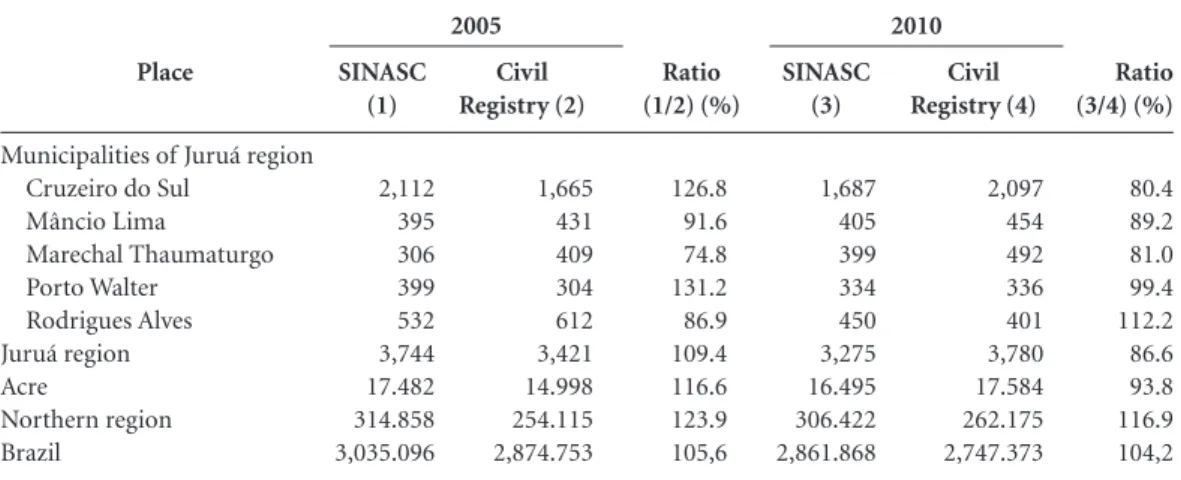
Analysis of the coverage of the SINASC, relative to the Civil Registry, showed that there was a decrease in four of the five municipalities, demonstrating under reporting in this informa-tion system (Table 1). As can be observed in Ta-ble 1, in 2005 only the municipality of Marechal
Thaumaturgo was classified as having regular/fair coverage (74.8%). All the other municipalities analyzed had excellent or good coverage, ranking the SINASC coverage in the Alto do Juruá region as excellent (109.4%) for 2005. However, Vale do Juruá’s coverage in 2010 has been classified as good (86.6%) only because of Rodrigues Alves municipality had an excellent coverage (112.2%) while the others were good or regular/fair.
In order to understand if the reduction in coverage from the SINASC was a local phenome-non, we analyzed data from Acre State, the North region of Brazil. We observed that, from 2005 to 2010, there was a general reduction of the cover-age of the SINASC relative to the Civil Registry, which was more pronounced in Acre state, de-creasing from 116.6% in 2005 to 93.8% in 2010 (Table 1).
Incompleteness
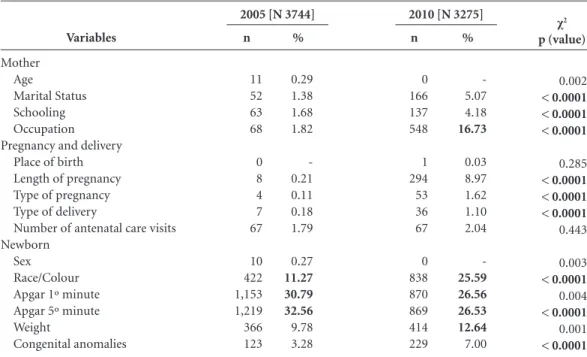
Table 2 shows the percentage of “not declared” from the SINASC variables analyzed for the Alto do Juruá region. In general, we could observe an increase in incompleteness for most variables from 2005 to 2010. Maternal variables, with the exception of age, ranged between good and reg-ular, with an emphasis on occupation variable that has the most significant increase of “not de-clared”, from 1.82% in 2005 to 16.73% in 2010 (p < 0,0001). Regarding variables related to preg-nancy and delivery, they all showed an increase in incompleteness in 2010 relative to 2005, with
Place
Municipalities of Juruá region Cruzeiro do Sul
Mâncio Lima
Marechal Thaumaturgo Porto Walter
Rodrigues Alves Juruá region Acre
Northern region Brazil
SINASC (1)
2,112 395 306 399 532 3,744 17.482 314.858 3,035.096
Table 1. Number of live births by source of information, year of registration and the ratio of coverage between 2005 and 2010.
Ratio (1/2) (%)
126.8 91.6 74.8 131.2 86.9 109.4 116.6 123.9 105,6
Civil Registry (2)
1,665 431 409 304 612 3,421 14.998 254.115 2,874.753
SINASC (3)
1,687 405 399 334 450 3,275 16.495 306.422 2,861.868
Civil Registry (4)
2,097 454 492 336 401 3,780 17.584 262.175 2,747.373
Ratio (3/4) (%)
80.4 89.2 81.0 99.4 112.2 86.6 93.8 116.9 104,2
Sources: SINASC (raw data) and IBGE (www.ibge.gov.br). Classification scale: Excellent ≥ 100%; good 85% to 100%; fair 70% to 85%; bad < 70%.
D
o
mb
ro
w
that increase being higher for the variable length of pregnancy, which increased from 0.21% to 8.97% (p < 0,0001). All these variables remained between the quality levels of excellent and good. Variables related to the newborn showed a great-er variation, ranging from excellent to poor. The variables race/colour, Apgar score at 1 minute, Apgar score at 5 minutes and weight showed the highest levels of “not declared” in 2005 and 2010, although the variables Apgar score at 1 minute and Apgar score at 5 minutes showed a very small reduction from the year 2005 to the year 2010. No variable was classified as having very bad quality (Table 2).
For the stratified analysis, five variables that had a rating of either fair, poor or very poor were selected: occupation, race/colour, Apgar score at 1 minute, Apgar score at 5 minutes and weight. For the variable occupation, there was an in-crease in “not declared” in the municipalities of Rodrigues Alves and Porto Walter, while for Mâncio Lima and Cruzeiro do Sul there was a reduction. For the variable race/colour, there was an increase in the number of “not declared” in all municipalities except Porto Walter. The vari-ables Apgar score at 1 minute and Apgar score at 5 minutes behaved similarly, with an increase
of ”not declared” in the municipalities of Machal Thaumaturgo and Cruzeiro do Sul and a re-duction in the municipalities of Rodrigues Alves and Porto Walter. The variable weight showed an increase of “not declared” in Cruzeiro do Sul and a reduction in Porto Walter (Figure 2).
Discussion
The results of this study show a decrease in coverage of the SINASC, relative to the Civil Registry, in the Alto do Juruá region from the year 2005 to 2010, as well as an increase in the percentage of incom-pleteness in the SINASC data in that same period. Like in Brazil, documents similar to the DNV are also in use in the United States and in many Euro-pean countries, where they are called birth certif-icates and live births notifications, respectively2,18.
They are widely used to monitor demographic and clinical characteristics18, and are also used
as a data source for epidemiological surveillance
programmes2. The SINAS Chas characteristics
that are of the utmost importance for monitoring maternal and child health status, such as nation-wide coverage, availability of disaggregated infor-mation, and a digital and standardized system. Variables
Mother Age
Marital Status Schooling Occupation Pregnancy and delivery
Place of birth Length of pregnancy Type of pregnancy Type of delivery
Number of antenatal care visits Newborn
Sex Race/Colour Apgar 1º minute Apgar 5º minute Weight
Congenital anomalies
n
11 52 63 68
0 8 4 7 67
10 422 1,153 1,219 366 123
Table 2. Absolute and relative frequency of “not declared” in the SINASC for all the variables evaluated. Alto do Juruá region – 2005 and 2010.
%
0.29 1.38 1.68 1.82
-0.21 0.11 0.18 1.79
0.27
11.27 30.79 32.56
9.78 3.28
n
0 166 137 548
1 294 53 36 67
0 838 870 869 414 229
%
-5.07 4.18
16.73
0.03 8.97 1.62 1.10 2.04
-25.59 26.56 26.53 12.64
7.00
χ2
p (value)
0.002
< 0.0001 < 0.0001 < 0.0001
0.285
< 0.0001 < 0.0001 < 0.0001
0.443
0.003
< 0.0001
0.004
< 0.0001
0.001
< 0.0001
Source: SINASC (raw data). Classification Scale: Excellent < 5%; good 5% to 10%; fair 10% to 20%; bad 20% to 50%; very bad > 50%. N is the total number of registered births. n is the absolute number of incompleteness. Percentage of incompleteness of variables (%). Qui-quadrado test (χ2). In bold the values are classified as fair, bad or very bad.
e C
ole
tiv
a,
20(4):1245-1254,
2015
A DNV can contain as many as four flows, depending on the characteristics of the region
where the delivery occurred1 and the
profession-als should fill three copies (white, yellow and Figure 2. Flows of the DNV in accordance with Articles 30 to 33 of Ordinance 116 MS/SVS 11/02/09.
Source: SINASC. Percentages represent the incompleteness attributed to each municipality in the Alto do Juruá region.
1st copy
Responsible file in Health Establishments Until collected by staff of the
Municipal Health
FLOW 1: Health worker who assisted the hospital birth (fill the 3-way)
2nd copy
Parent or legal guardian
Used in obtaining the birth certificate issued by the Civil Registry
3rd copy
Responsible file in Health Establishments Kept in the mother’s
medical record
1st copy
Person who assisted the delivery
To be forwarded to the Municipal health Secretariat or the Indigenous Health
FLOW 2: Health worker or traditional midwife assisted home birth (fill the 3-way)
2nd copy
Parent or legal guardian
Used in obtaining the birth certificate issued by the Civil Registry
3rd copy
Parent or legal guardian
To be presented at the first appointment
at the Health Unit
1st copy
Official registry
Kept in the Registry until collected by staff of the Municipal Health Secretariat
FLOW 3: Homebirth unassisted Official Registry (fill the 3-way)
2nd copy
Official registry
To be kept in the Registry after the issuance of Birth Certificate
3rd copy
Parent or legal guardian
To be presented at the first appointment
at the Health Unit
1st copy
Person assisted the delivery
To be forwarded to the Special Indigenous Sanitary District
FLOW 4: Health worker or traditional midwife assisted home birth indigenous (fill the 3-way)
2nd copy
Parent or legal guardian
Used in obtaining the birth certificate issued
by the Civil Registry
3rd copy
Parent or legal guardian
To be presented at the first appointment
at the Health Unit
Municipal Health Secretariat
Keeps 1st copy
Civil Registry
Keeps 1st copy
FOR ALL FLOWS
Health Establishments
D
o
mb
ro
w
pink), in accordance with Articles 30 to 33 of
Or-dinance Nº 116-MS/SVS of 11/02/200914. In the
Alto do Juruá region, all the municipalities are separated from each other by waterways, a fact that makes it difficult for the population to access the urban centers. Also, there are still numerous indigenous communities and a strong culture of delivering babies at home. All these characteris-tics justify the use of the four flows of the DNV in this region (Figure 1). This task is often del-egated to the technical-administrative personnel of the health establishment18, or to professionals
who are not familiar with the medical terminol-ogy or who have restricted access to the medical records2. In addition, it is assumed that variables
are left blank as a result of lack of attention or lack of commitment by the professional respon-sible for the DNV when filling the form11.Those
variables recorded as “ignored” are usually con-sequences of several deficiencies (e.g. lack of information in the records)19. Other difficulties
arise due to a lack of understanding on how to fill this form and a lack of methodological clarity
in the DNV manual11. One should also consider
the fact that the mother or her partner may not know, or simply refuse, to provide information. Some studies suggest awareness5 and professional
training11,17-21 as tools to improve the quality of
completion of this document, plus an active fol-low-up and feedback in places where the form is filled in order to correct the data collected20.
The quality of the information provided and whether it reflects the real conditions of a local context – to avoid wrong conclusions – are the main concerns with regard to an information system and are crucial for those who will use the data available19. Thus, the correct and complete
filling of the DNV is essential for the quality and reliability of the information collected by the sys-tem.
There are several methodologies to analyze and estimate the SINASC coverage. These in-clude comparison with data from the Civil Reg-istry; comparison with the number of live births estimated by the IBGE through demographic projections; the use of active search methods for the DNV in hospitals, notaries, other healthcare facilities and home visits; and even the use of the Information System for Primary Care (SIAB) in municipalities with good coverage of the
Fami-ly Health Program10. The comparison with data
from the Civil Registry of the IBGE was selected due to the impossibility of performing an active search and because there is no data from demo-graphic projections by municipality that allowed
the method used by the Interagency Network for Health Information (RIPSA). It is known that the Civil Registry is traditionally the most import-ant source for obtaining data on the number of births in the country, but there are doubts with regard to the reliability of the information the to-tal coverage of the events8.
It is known that one of the purposes of the SINASC was to address the shortcomings of the Civil Registry, where it is hoped that the number of live births in the SINASC was equal or superior to registry10. We would expect that the number of
live births recorded in the SINASC would always be superior to that recorded in the Civil Registry. This is due to the high proportion of underre-porting, since there is a significant proportion of births that are never recorded9. Another limiting
factor is the existence of a considerable number of births that are recorded in later years (late birth registration), making the registration of births in one year incongruous with the total births in that particular year8.
The methodological approach adopted in this study follows the pattern of other studies that addressed the incompleteness of the SINA-SC data5,7,10,17,19,22-24, by using “blank” and
“ig-nored’ variables as an analysis starting-point. If the trend revealed in those other studies was maintained, we would be expected to report a decrease in the amount of not declared infor-mation. Studies conducted in the Northeast region19,24, Southeast region7,18,22 and South
re-gion5,25, as well nation-wide studies10,17, showed
that there is a significant improvement in the SINASC, especially with regard to the incom-pleteness of the data. However, this is not what we have observed for the Alto do Juruá region in the State of Acre, when comparing the years of 2005 and 2010. Out of the 15 variables studied, 11 showed increased incompleteness, especial-ly the variables regarding the newborn, nameespecial-ly race/colour, Apgar score at 1 minute, Apgar score at 5 minutes and weight. The variable occupation of the mother also showed a significant increase of underreporting, which is in agreement with the published data.
Mello Jorge et al.11 stated that when
consid-ering only the live births registered in one year, the SINASC data is always higher. They say that because from 1998 to 2004 the coverage of the SINASC was at least 90% of that registered in the notaries11. This was not observed in our study, in
e C
ole
tiv
a,
20(4):1245-1254,
2015
Collaborations
JG Dombrowski, R Ataíde and RM Souza partic-ipated in the planning of the study, data collec-tion, statistical analysis, interpretation of results, drafting of the article and design and final text. JG Dombrowski coordinated the analyses and prepared all drafts of the paper, incorporating comments by coauthors. P Marchesini and CRF Marinho participated in the planning of the study, interpretation of results, and design and final text.
Acknowledgments
This work was supported by Fundação de Ampa-ro à Pesquisa do Estado de São Paulo (Fapesp), Coordenação de Aperfeiçoamento de Pessoal de Nível Superior (Capes) and Conselho Nacional de Desenvolvimento Científico e Tecnológico (CNPq).
are raised to justify or explain this fact, like the discontinuity of awareness raising and training of professionals, both for those responsible for fill the DNV and those that feed the system; the high turnover and/or hiring of new personnel, as well as the diversity of professionals that fill the DNV; devaluation of the document as important for the formulation of health statistics; lack of in-centives; and public policies and supervision by managers, among many others. Despite the many justifications, solutions and interventions to re-verse this situation are needed.
Final considerations
The decrease in quality concerning the two pa-rameters used in this study, incompleteness and coverage, shows that the SINASC needs much more investment and incentives. This is the first
study that evaluated municipalities in the north-ern region of Brazil. It is believed that this work provides information to improve the quality of the SINASC data and also serves to stimulate re-search in the region.
There is no doubt that the SINASC is one of the most important health databases in Brazil, but it is not without flaws. Quality assessment is needed to identify both its strengths and weak-nesses, so that its information can be more reli-able, complete and with good coverage. This will allow for the monitoring of maternal and child health as well as provide a better standpoint from where to elaborate public policies.
D
o
mb
ro
w
Brasil. Ministério da Saúde (MS). Departamento de Informática do SUS (Datasus). Sistema de Informações sobre Nascidos Vivos (SINASC). [cited 2013 Jan 25]. Available from: http://www.datasus.gov.br
Instituto Brasileiro de Geografia e Estatística (IBGE). Sistema de Informações sobre Nascidos Vivos (SINASC). [cited 2013 Jan 30]. Available from: http://www.ibge. gov.br
Romero DE, Cunha CB. Avaliação da qualidade das variáveis epidemiológicas e demográficas do Sistema de Informações sobre Nascidos Vivos, 2002. Cad Saude Publica 2007; 23(3):701-714.
Nhoncanse GC, Melo DG. Confiabilidade da Declaração de Nascido Vivo como fonte de informação sobre os de-feitos congênitos no Município de São Carlos, São Pau-lo, Brasil. Cien Saude Colet 2012; 17(4):955-963. Costa JMB da S, Frias PG. Avaliação da completitude das variáveis da Declaração de Nascido Vivo de resi-dentes em Pernambuco, Brasil, 1996 a 2005. Cad Saude Publica 2009; 25(3):613-624.
Ferreira JSA, Vilela MBR, Aragão PS, Oliveira RA, Tiné RF. Avaliação da qualidade da informação: linkage en-tre SIM e SINASC em Jaboatão dos Guararapes (PE). Cien Saude Colet 2011; 16(1):1241-1246.
Silva CF, Leite ÁJM, Almeida NMGS. Linkage entre bancos de dados de nascidos vivos e óbitos infan-tis em município do Nordeste do Brasil: qualidade dos sistemas de informação. Cad Saude Publica 2009; 25(7):1552-1558.
Almeida M, Alencar G, França Jr I, Novaes H, Siquei-ra A, Schoeps D, Campbell O, Rodrigues LC. Validade das informações das declarações de nascidos vivos com base em estudo de caso-controle. Cad Saude Publica 2006; 22(3):643-652.
Paes NA, Santos CSA. As estatísticas de nascimento e os fatores maternos e da criança nas microrregiões do Nordeste brasileiro: uma investigação usando análise fatorial. Cad Saude Publica 2010; 26(2):311-322. Mascarenhas MDM, Gomes KRO. Confiabilidade dos dados do Sistema de Informações sobre Nascidos Vivos em Teresina, Estado do Piauí, Brasil - 2002. Cien Saude Colet 2011; 16(1):1233-1239.
Predebon KM, Mathias TAF, Aidar T, Rodrigues AL. Desigualdade sócio-espacial expressa por indicadores do Sistema de Informações sobre Nascidos Vivos (SI-NASC). Cad Saude Publica 2010; 26(8):1583-1594.
Article submitted on 04/08/2014 Approved on 16/09/2014
Final version submitted on 23/09/2014 15.
16.
17.
18.
19.
20.
21.
22.
23.
24.
25. References
Brasil. Ministério da Saúde (MS). Manual de Instruções para o preenchimento da Declaração de Nascido Vivo. 4ª Ed. Brasília: MS; 2010.
Luquetti DV, Koifman RJ. Qualidade da notificação de anomalias congênitas pelo Sistema de Informações so-bre Nascidos Vivos (SINASC): estudo comparativo nos anos 2004 e 2007. Cad Saude Publica 2010; 26(9):1756-1765.
Brasil. Ministério da Saúde (MS). Manual de Procedi-mentos do Sistema de Informações sobre Nascidos Vivos. Brasília: MS; 2001.
Silva GF, Aidar T, Mathias TAF. Qualidade do Siste-ma de InforSiste-mações de Nascidos Vivos no Estado do Paraná, 2000 a 2005. Rev Esc Enfermagem-USP 2011; 45(1):79-86.
Silveira MF, Santos IS, Matijasevich A, Malta DC, Du-arte EC. Nascimentos pré-termo no Brasil entre 1994 e 2005 conforme o Sistema de Informações sobre Nascidos Vivos (SINASC). Cad Saude Publica 2009; 25(6):1267-1275.
Frias PG, Pereira PMH, Andrade CLT, Lira PIC, Sz-warcwald CL. Avaliação da adequação das informações de mortalidade e nascidos vivos no Estado de Pernam-buco, Brasil. Cad Saude Publica 2010; 26(4):671-681. Guimarães EAA, Loyola Filho AI, Hartz ZMA, Meira AJ, Luz ZMP. A descentralização do SINASC e a com-pletitude das variáveis da declaração de nascido vivo em municípios mineiros de 1998 a 2005. Rev Bras Crescimento Desenvolv Hum 2011; 21(3):832-840. Mello Jorge MHP, Gotlieb SLD, Soboll MLMS, Almei-da MF, Latorre MRDO. Avaliação do Sistema de Infor-mação sobre Nascidos Vivos e o uso de seus dados em epidemiologia e estatística de saúde. Rev Saude Publica 1993; 27(Supl. 6):1-46.
Barbosa L. Avaliação da qualidade das informações so-bre fecundidade provenientes do SINASC no Nordeste, 2000. Rev Bras Est Pop 2005; 22(1):141-158.
Theme Filha MM, Gama SGN, Cunha CB, Leal MC. Confiabilidade do Sistema de Informações sobre Nasci-dos Vivos Hospitalares no Município do Rio de Janeiro, 1999-2001. Cad Saude Publica 2004; 20(1):1999-2001. Mello Jorge MHP, Laurenti R, Gotlieb SLD. Análise da qualidade das estatísticas vitais brasileiras: a experiên-cia de implantação do SIM e do SINASC. Cien Saude Colet 2007; 12(3):643-654.
Pedraza DF. Qualidade do Sistema de Informações so-bre Nascidos Vivos (Sinasc): análise crítica da literatu-ra. Cien Saude Colet 2012; 17(10):2729-2737. Paiva NS, Coeli CM, Moreno AB, Guimarães RM, Ca-margo Júnior KR. Sistema de informações sobre nasci-dos vivos: um estudo de revisão. Cien Saude Colet 2011; 16(1):1211-1220.
Brasil. Ministério da Saúde (MS). Portaria nº 116, de 11 de fevereiro de 2009. Regulamentando a coleta de dados, fluxo e periodicidade do envio de informações sobre óbitos e nascidos vivos, para os Sistemas de In-formações em Saúde. Diário Oficial da União 2009; 30 out.
1.
2.
3.
4.
5.
6.
7.
8.
9.
10.
11.
12.
13.