127
CLINICS 60(2):127-130, 2005
From the Department of Pediatrics,1,2 and Department of Biochemistry and
Immunology,3,4 School of Medicine of Ribeirão Preto, University of São
Paulo - Ribeirão Preto/SP Brazil. E-mail: [email protected]
Received for publication on December 06, 2004. Accepted for publication on December 13, 2004.
ORIGINAL RESEARCH
COMPLEMENT LEVELS IN BRAZILIAN CHILDREN
DURING AND AFTER MENINGOCOCCAL
MENINGITIS
Pérsio Roxo Júnior1, Virgínia Paes Leme Ferriani2, José Eduardo Teixeira3, and José Elpídio Barbosa4
ROXO Jr. P et al. Complement levels in Brazilian children during and after meningococcal meningitis. CLINICS 60 (2):127-130, 2005.
PURPOSE: To evaluate the functional activity of the classical and alternative pathways of the complement system and the levels of C3, C4, and factor B during the first episode of meningococcal infection and during the convalescence period.
PATIENTS AND METHODS: Ten Brazilian children ranging in age from 8 months to 8 years, admitted from 1991 to 1993 with a clinical-laboratory diagnosis of meningococcal meningitis, were studied during acute infection (up to 7 days from diagnosis) and during the convalescence period (1 to 6 months after the acute episode). C3, C4, and Factor B were measured using nephelometry, and the lytic activity of classical and alternative pathways were evaluated by a kinetic method and expressed as the time needed to lyse 50% of an erythrocyte suspension (T1/2, expressed in seconds). Low T1/ 2 values for classical and alternative pathways correlate with high activities of the classical and alternative complement pathways, respectively.
RESULTS: A significant difference was observed between the alternative pathway lytic activity during infection and the convalescence period (282 vs 238 seconds, respectively, P = .01). No differences were detected in the other complement parameters analyzed.
CONCLUSIONS: In the presence of meningococcal meningitis, the alternative pathway is preferentially activated. This is probably due to the greater ability of the meningococcal endotoxin to activate this pathway in vivo.
KEYWORDS: Complement. Classical pathway. Alternative pathway. Lytic activity. Meningococcal meningitis.
Activation of complement by gram-negative bacteria can occur via the classical (CP) or the alternative pathway (AP).1
Complement levels are often abnormal in patients with an acute meningococcal infection.2 Activation of the CP or low
levels of C3 during meningococcal meningitis have been reported in different countries including Nigeria3, Brazil,4
and the United States.5 Moreover, a significant depression
in functional activity of the CP and of C3 and factor B lev-els has been reported in children with severe meningococ-cal infection, suggesting that activation of both the CP and
the AP occurs in this particular setting.2 Activation of AP
in patients with gram-negative bacteriemia and shock has been demonstrated.6 In the present study, we measured the
lytic activity of the CP and AP, as well as the levels of C3, C4, and factor B in Brazilian children during and after the first episode of meningococcal meningitis in order to as-sess the activation of both complement pathways in this disease.
METHODS
128
CLINICS 60(2):127-130, 2005 Complement levels in brazilian children during and after meningococcal meningitis
Roxo Jr. P et al.
from diagnosis) and during the convalescence period (be-tween 1 and 6 months after the cure). The inclusion criteria were clinical signs of meningococcal infection, absence of autoimmunity and other infectious diseases, and normal nutritional status. All of the participants were from Ribeirão Preto and were diagnosed between 1991 and 1993. The di-agnosis of meningococcal infection was based on clinical signs and confirmed by bacteriologic exams. Blood sam-ples were collected by venipuncture from patients and left to clot at room temperature for 90 minutes. Serum was ob-tained by centrifugation at 4ºC, pooled, sampled, frozen in liquid nitrogen, and stored at -70ºC until analysis in 1994. The lytic complement activity of CP and AP was measured by means of a kinetic assay, as previously described, with minor modifications.7,8 Briefly, the time required to lyse
50% of an erythrocyte suspension was measured (T1/2). Low T1/2 values for CP and AP correlate with high CP and AP complement activities, respectively. For the CP assay, a suspension of sensitized sheep red blood cells (SRBC) in triethanolamine-buffered saline containing 0.1% gelatin, 0.5 mM Mg++, and 0.15 mM Ca++ (TBS Mg++ Ca++) was
standardized at concentrations sufficient to reach an opti-cal density of 1.5 units at 700 nm when mixed with the diluted serum sample. For the AP assay, uncoated rabbit erythrocytes (RaBC) in triethanolamine-buffered saline con-taining 0.1% gelatin, 2 mM Mg++, and 8 mM
ethylene-gly-col-bis (b-aminoethyl ether) N, N, N’, N’, -tetraacetic acid (TBS-Mg++EGTA) were standardized as described for the
sheep erythrocytes. The final serum dilution of the samples was 1:38 for the CP and 1:6 for the AP experiments. The concentrations of C3, C4, and factor B were assayed by ki-netic nephelometry with an Immunochemistry Analyzer ICS II (Beckman Instruments Inc. Diagnostic System Group, Galway, Ireland).
Statistical analysis using the Student paired t test was performed to compare complement levels during infection and the convalescence period.
RESULTS
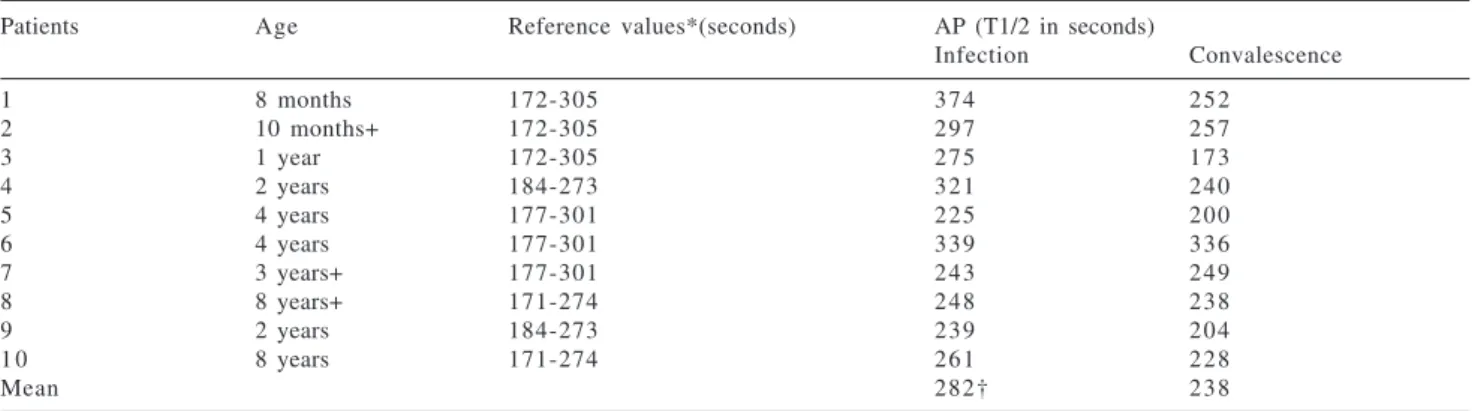
The individualvalues obtained for CP lytic activity dur-ing the acute phase of mendur-ingitis and after infection were within the normal estimated range for age-matched Brazil-ian children. No significant differences were found between the arithmetic means of CP activity during (143 seconds) and after (149 seconds) meningococcal meningitis (Table 1). On the other hand, 3 out of 10 children studied (30%) had higher AP T1/2 values during acute meningitis than the upper limit estimated for their age, indicating a lower AP activity in these children (Table 2). One child main-tained high AP T1/2 times during the convalescence period. Unfortunately, we could not contact this child afterwards to complete the investigation. The AP activity during acute infection was significantly lower compared to that observed after infection (Table 2). Concentrations of C3, C4, and fac-tor B during the acute phase were higher than the upper limit of age-matched Brazilian children in 66.7%, 44.5%, and 55.5% of the patients, respectively (data not shown). No significant differences were found in the levels of C3, C4, or factor B during or after meningitis.
DISCUSSION
Systemic inflammation by activated complement and cytokines is important in the pathogenesis of meningoccocal disease.9
Our results suggest that AP activation occurs during acute meningococcal meningitis, since we have observed
Table 1 - Classical pathway (CP) hemolytic activity, expressed as T1/2 (in seconds), during and after meningococcal
meningitis.
Patients Age Reference values*(seconds) CP (T1/2 in seconds)
Infection Convalescence
1 8 months 108-255 1 9 3 1 7 0
2 10 months+ 108-255 1 9 8 1 2 7
3 1 year 108-255 1 2 7 2 0 1
4 2 years 121-218 1 2 0 1 0 5
5 4 years 104-300 1 4 0 1 3 3
6 4 years 104-300 8 9 1 2 0
7 3 years+ 104-300 1 2 8 1 4 7
8 8 years+ 107-306 1 5 5 1 8 4
9 2 years 121-218 1 1 6 1 2 0
1 0 8 years 107-306 1 6 1 1 8 0
Mean 143† 1 4 9
(*) Reference values according to age as established by Ferriani, Barbosa & Carvalho.7
129
CLINICS 60(2):127-130, 2005 Complement levels in brazilian children during and after meningococcal meningitis Roxo Jr. P et al.
significantly decreased AP hemolytic activity in the acute phase of this infection, as compared to the convalescence period. This is in accordance with the known ability of the meningococcal endotoxin to activate the AP in vivo.10 We
did not find evidence of activation of the CP in these pa-tients, since the T1/2 times were similar for both periods. In another Brazilian study, investigators used the CH50 as-say for total complement (CH50 levels) and an asas-say for C3 levels in 25 patients, including 8 children, with menin-gococcal meningitis.4 Although they reported significantly
reduced CH50 levels in the patients when compared to nor-mal adults, all 8 children studied presented CH50 levels within the normal range for adults. These results are not in accordance with those reported in yet another study,2 in
which normal AP50 and decreased CH50 levels in children with meningococcal infection compared to normal adults was found. However, these investigators did not compare the values during and after the infection. They also found significantly lower complement levels, particularly regard-ing the CH50 assay, C3, and factor B, in more severely af-fected children, including those who developed septicemia. In a case report, 36-year-old patient with meningoccocal meningitis had undetectable levels of C7 and total com-plement as revealed by the CH50 assay. So it appears that the best screen for complement deficiencies or significant activation is the CH50 assay.11 Complete non-response in
the CH50 assay associated with normal C3 levels is a strong indication for complement deficiency and should be fol-lowed up with further tests.12 In spite of our limited number
of cases, it is worth mentioning that 3 out of 10 children studied presented meningococcemia, and their AP and CP activity levels were not different from those estimated for normal age-matched Brazilian children. One of the patients (# 6) maintained a higher than normal AP T1/2 during the
convalescence period. Since we were not able to contact this patient afterwards, we could not establish whether this child presented a transient alteration or a partial deficiency of properdin or of factor D. Properdin deficiency has been associated with severe meningoccocal disease. In a study in 3 generations of a large Swiss family, the concentration of circulating properdin in affected males was <0.1 mg/L, indicating properdin deficiency type I, and 2 of the 9 properdin-deficient males in the family had survived men-ingitis caused by Neisseria meningitidis serogroup B with-out sequelae.13
No significant differences occurred between the mean levels of C3, C4, and factor B during and after meningococ-cal meningitis. Some of the children showed a non-signifi-cant trend towards increased levels of factor B, C3, and C4 as compared to normal controls, suggesting that these com-ponents were acting as acute phase proteins, as previously reported in many infectious conditions.14 These results
sug-gest that in the presence of an infectious episode, the alter-native pathway is preferentially activated, probably due to the greater capacity of the meningococcal endotoxin to ac-tivate this pathway in vivo. The assessment of properdin lev-els and of more sensitive markers of complement activation, such as C3a, C3d, C5a, Ba, and soluble C5b-9 complex dur-ing and after mendur-ingococcal infection are needed to better understand the role of complement in meningitis.
ACKNOWLEDGEMENTS
We would like to thank Prof. Luis de Souza for helping with the statistical analysis. The study was supported by grants from the Fundação de Amparo à Pesquisa do Estado de São Paulo (FAPESP) and the Fundação Coordenação de Aperfeiçoamento de Pessoal de Nível Superior (CAPES).
Table 2 - Alternative pathway (AP) hemolytic activity, expressed as T1/2 (in seconds), during and after menigococcal
meningitis.
Patients Age Reference values*(seconds) AP (T1/2 in seconds)
Infection Convalescence
1 8 months 172-305 3 7 4 2 5 2
2 10 months+ 172-305 2 9 7 2 5 7
3 1 year 172-305 2 7 5 1 7 3
4 2 years 184-273 3 2 1 2 4 0
5 4 years 177-301 2 2 5 2 0 0
6 4 years 177-301 3 3 9 3 3 6
7 3 years+ 177-301 2 4 3 2 4 9
8 8 years+ 171-274 2 4 8 2 3 8
9 2 years 184-273 2 3 9 2 0 4
1 0 8 years 171-274 2 6 1 2 2 8
Mean 282† 2 3 8
(*) Reference values according to age as established by Ferriani, Barbosa & Carvalho.7
130
CLINICS 60(2):127-130, 2005 Complement levels in brazilian children during and after meningococcal meningitis
Roxo Jr. P et al.
RESUMO
ROXO Jr. P e col. Níveis de complemento em crianças bra-sileiras durante e após meningite meningocócica.
CLINICS 60(2):127-130, 2005.
OBJETIVO: Avaliar a atividade funcional das vias clás-sica e alternativa do sistema complemento e os níveis de C3, C4 e fator B durante o primeiro episódio de infecção meningocócica e durante a convalescença.
PACIENTES E MÉTODOS: Dez crianças brasileiras
com idades entre 8 meses e 8 anos, admitidas de 1991 a 1993, com diagnóstico clínico-laboratorial de meningite meningocócica, foram estudadas durante infecção aguda (até 7 dias do diagnóstico) e no período de convalescença (entre 1 e 6 meses após). C3, C4 e fator B foram quanti-ficados por nefelometria e a atividade lítica das vias clássi-ca e alternativa foi avaliada por método cinético e expres-sa como tempo necessário para liexpres-sar 50% de uma
suspen-são de eritrócitos (T1/2, expresso em segundos). Baixos va-lores de T1/2 das vias clássica e alternativa se correlacionam com elevadas atividades de via clássica e via alternativa, respectivamente.
RESULTADOS: Observaram-se diferenças significativas
entre a atividade lítica da via alternativa durante a infec-ção e no período de convalescença (282 e 238 segundos, respectivamente, P= .01). Nenhuma diferença foi detectada nos outros parâmetros analisados.
CONCLUSÕES: Na presença de meningite
menin-gocócica a via alternativa é preferencialmente ativada, pro-vavelmente devido à maior capacidade da endotoxina meningocócica para ativar esta via, in vivo.
UNITERMOS: Complemento. Via clássica. Via
alter-nativa. Atividade lítica. Meningite meningocócica.
REFERENCES
1 . Taylor PW. Bactericidal and bacteriolytic activity of serum against Gram-negative bacteria. Microbiol Rev 1983;47:46-83. 2 . Beatty DW, Ryder CR, De V Heese H. Complement abnormalities
during an epidemic of Group B meningococcal infection in children. Clin Exp Immunol 1986;64:465-70.
3 . Greenwood BM, Onyewotu II, Whittle HC. Complement and meningococcal infection. Br Med J 1976;1:797-9.
4 . Ribeiro MG, Fava-Netto C, Dos Santos MP. Determinação do complemento hemolítico total e do componente C3 em pacientes de meningite meningocócica. Rev Inst Med Trop São Paulo 1981;23:185-87.
5 . Hoffman TA, Edwards EA. Group-specific polyssacharide antigen and humoral antibody response in disease due to Neisseria menigitidis. J Infect Dis 1972;126:636-44.
6 . Fearon DT, Ruddy S, Schur PH, McCabe WR. Activation of the properdin pathway of complement in patients with gram-negative bacteremia. N Engl J Med 1975;292:937-40. 7 . Ferriani VL, Barbosa JE, Carvalho IF - Serum hemolytic classical
and alternative pathways of complement in infancy: age-related changes. Acta Paediatr Scand 1990;79:322-27.
8 . Ferriani VPL, Barbosa JE, Carvalho IF. Complement haemolytic activity (classical and alternative pathways), C3, C4 and factor B titres in healthy children. Acta Paediatr 1999; 88:1062-6.
9 . Sprong T, Moller AS, Bjerre A, Wedege E, Kierulf P, van der Meer JW, et al. Complement activation and complement-dependent inflammation by Neisseria meningitidis are independent of lipopolysaccharide. Infect Immunol 2004;72:3344-9. 10. Ross SC, Densen P. Complement deficiency states and infection:
Epidemiology, pathogenesis, and consequences of neisserial and other infections in an immune deficiency. Medicine 1984;63:243-73.
11. Corvini M, Randolph C, Aronin SI – Complement C7 deficiency presenting as recurrent aseptic meningitis. Ann Allergy Asthma Immunol 2004;93:200-5.
12. Fremeaux-Bacchi V, Dragon-Durey MA, Blouin J, Mouthon L, Fridman WH. Investigation of the complement system in clinical practice. Ann Med Interne 2003;154:529-40.
13. Spath PJ, Sjoholm AG, Fredrikson GN, Misiano G, Scherz R, Schaad UB, et al. Properdin deficiency in a large Swiss family: identification of a stop codon in the properdin gene and association of meningococcal disease with lack of the IgG2 allotype marker G2m (n). Clin Exp Immunol 1999;118:278-84.