Recebido em 19/junho/2013 Aprovado em 27/setembro/2014
Sistema de Avaliação: Double Blind Review Editor Cientíico: Nicolau Reinhard DOI: 10.5700/rausp1182
Os autores agradecem à Associação Brasileira de
Franchising (ABF) pela contribuição à pesquisa apresentada neste artigo. Agradecem também às contribuições de dois avaliadores cujos comentários foram muito importantes para a versão inal deste estudo.
RESUMO
Pedro Lucas de Resende Melo, Doutor em Administração pela Faculdade de Economia, Administração e Contabilidade da Universidade de São Paulo, é Professor Titular do Mestrado em Administração da Universidade Paulista (CEP 04026-002 – São Paulo/SP, Brasil) e Professor de Administração da Pontifícia Universidade Católica de São Paulo.
E-mail: [email protected] Endereço:
Universidade Paulista
Programa de Mestrado em Administração Rua Dr. Bacelar, 1212 – 4°andar 04026-002 – São Paulo – SP
Felipe Mendes Borini, Doutor em Administração pela Faculdade de Economia, Administração e Contabilidade da Universidade de São Paulo, é Professor da Escola Superior de Propaganda e Marketing e Professor do Departamento de Administração da Faculdade de Economia, Administração e Contabilidade da Universidade de São Paulo (CEP 05508-010 – São Paulo/SP, Brasil). E-mail:[email protected]
Moacir de Miranda Oliveira Junior, Mestre, Doutor e Livre Docente em Administração pela Faculdade de Economia, Administração e Contabilidade da Universidade de São Paulo, é Professor Associado e Coordenador do PPGA – Programa de Pós-Graduação em Administração do Departamento de Administração da Faculdade de Economia, Administração e Contabilidade da Universidade de São Paulo (CEP 05508-010 – São Paulo/SP, Brasil). E-mail: [email protected]
Ronaldo Couto Parente, Doutor em Administração pela Temple University, é Professor Associado de Estratégia e Negócios Internacionais e Coordenador do Programa de Doutorado da Florida International University em Miami, Florida (ZC 33629 – Miami/FL, Estados Unidos) e Professor Colaborador da Escola Brasileira de Administração Pública e de Empresas da Fundação Getulio Vargas.
E-mail: [email protected]
International analysis of the countries where
Brazilian franchise chains operate
Pedro Lucas de Resende Melo
Universidade Paulista – São Paulo/SP, Brasil
Felipe Mendes Borini
Universidade de São Paulo – São Paulo/SP, Brasil
Moacir de Miranda Oliveira Junior
Universidade de São Paulo – São Paulo/SP, Brasil
Ronaldo Couto Parente
Florida International University – Miami/FL, Estados Unidos
Análise internacional dos países de operação das redes de franquias brasileiras
Neste artigo, tem-se como objetivo demonstrar que fatores do ambiente externo estão envolvidos no compromisso internacional das redes de franquias brasileiras. Os objetivos nesta pesquisa re-sidem em entender quais as características dos países de operação
das redes de franquias brasileiras, e veriicar a inluência de tais características no compromisso das redes de franquias em cada país onde operam. O banco de dados possui 54 redes de franquias bra-sileiras com operações internacionais em 26 países, o que implica em 157 franquias com operação no exterior. Em relação aos fatores do ambiente externo, as variáveis independentes formam um grupo
dividido em oportunidade de mercado e eiciência do negócio – a
coniança e a facilidade para fazer negócios. Os resultados dos três grupos distintos mostram como a oportunidade de mercado e
a eiciência empresarial (coniança e facilidade em fazer negócios) trabalham como motores para a operação internacional das redes de franquias brasileiras. O trabalho mostra que as redes de franquias que operam nos Estados Unidos (grupo 3) têm um compromisso internacional inferior em comparação com as franquias que ope-ram em países desenvolvidos e em pequenos países da América Latina (grupo 2). Também é possível notar um grande número de franquias que operam em países subdesenvolvidos da América Latina e África (grupo 1) com pior eiciência do negócio, devido à vantagem de aprender como operar em um país que poderia ter algumas semelhanças com o Brasil.
1. INTRODUCTION
In Brazil, the franchising segment has gained prominence in the last decade due to its increased representation in the Brazilian economy. There are approximately 2,426 franchise chains operating in Brazil. Comprising approximately 104.543 franchised units, it has reported a 12% growth in comparison with the previous year. Sector revenues stand at US$ 43 billion per year, with a growth rate of 14% compared with 2011 (ABF, 2013).
This growth is beneficial institutionally for the entity representing the franchising sector, Associação Brasileira de Franchising (ABF – Brazilian Franchising Association), which has been increasingly representing a sector of major relevance for the Brazilian economy. Thus, topics such as internationalization of franchises are now part of the agenda of activities at ABF, which is promoting the internationalization process of Brazilian franchises. For that, partnerships have been established at the federal level with Agência Brasileira de Promoção de Exportação e Investimentos (APEX – Export Promotion Agency) aiming to increase the disclosure of Brazilian franchises in the international market and, consequently, the development of these operations abroad (Macedo, 2011; Simões, 2011).
Even though only 4.7% of Brazilian franchise chains have international operations, the process of internationalization of Brazilian franchise chains reported a growth of 300% in the last decade (Macedo, 2011; Simões, 2011). Currently, approximately 110 Brazilian franchise chains operate in all continents (Basílio, 2013). Nevertheless, little is known about the commitment of international Brazilian franchise chains as
well as their operations in foreign countries. In order to ill this
gap, this paper aims to demonstrate which external environment factors are involved in the international commitment of Brazilian
franchise chains. More speciically, our objectives herein are
(i) to understand which external country characteristics lead to international franchising operations and (ii) to ascertain the
inluence of such characteristics in the commitment of franchise
chains in each country they operate.
For sake of deinitions, international commitment is herein
understood as the number of franchise units abroad; external
factors are, in turn, deined as the responsible elements for
creating institutional conditions that enable enterprises to operate (Ghemawat, 2001; Peng, 2002; Berry, Guillén, &
Zhou, 2010). More speciically, these factors are expressed by
the market opportunity (economic and demographic factors)
and the business eficiency – trust and ease to doing business
(political, legal and administrative factors) –, which are
commonly researched in the ield of international business
as well as in international franchising studies (Eroglu, 1992; Burton & Cross, 1995; Arthur Andersen, 1996; Vicent, 1998; Alon & McKee, 1999; Aliouche & Schlentrich, 2009; Alon & Shoham, 2010; Gámez-González, Rondan-Cataluña,
Diez-de--Castro, & Navarro-Garcia, 2010; Kerkovic, 2010; Aliouche & Schlentrich, 2011).
By analyzing the external factors of countries in which
Brazilian franchise chains operate, we expect to ind different
sets of countries with similar institutional characteristics. Therefore, once the group formed by countries sharing similar characteristics is set, our next step is to verify the existence of
signiicant differences among the international commitment
of the franchise chains belonging to each one of these groups. Thus, it is intended herein to comprehend the differences in the international commitment of franchise chains, taking into consideration the external environment characteristics of the countries in which the franchises operate.
Our research contributes to the field of international business and more specifically to the understanding of internationalization of franchises in three ways. First, by adding to the literature since only a small number of papers on the internationalization of franchises can be found in the literature nowadays (Melo & Andreassi, 2010).Then, by illing a theoretical gap within the internationalization of Brazilian franchises where we present the formulation and analyses of environmental characteristics of the clusters formed by the countries in which Brazilian franchises operate. Up to now, the most relevant papers published in academic journals and conference abstracts on Brazilian franchise chains can
be classiied into two different categories: (i) exploratory
and quantitative researches on internationalization drivers (Marques, Merlo, & Nagano, 2009; Aguiar, Consoni, & Bernardes, 2013), as well as on the comparative organizational characteristics among internationalized and domestic chains (Melo, Parente, Oliveira Jr., & Borini, 2012), and (ii) case studies which analyze the management of franchises abroad (Ribeiro & Melo, 2007; Borini, Souza, Biskamp, Coelho, & Sadzinski, 2013).
Finally, regarding research involving the internationalization
of Brazilian franchise chains, there are only ive exploratory
researches conducted but they all have a sampling limitation, covering 14 chains (Rocha, Borini, Spers, Khauaja, & Camargo, 2012); 15 chains (Fundação Dom Cabral, 2011; Marques, 2006); 16 chains (Fundação Dom Cabral, 2013) and 20 chains (Borini, Rocha & Spears, 2012). The research that involved the largest number of internationalized Brazilian franchises corresponded to 33 chains (Barbosa & Mariotto, 2012). It is therefore intended to present herein a study with a larger sample size, involving 54 Brazilian franchise chains and 157 units operating abroad in order to comprehend the international commitment of a large number of Brazilian chains operating abroad.
have some international experience. The contributions made herein are based on the variables “market opportunity” and
“business eficiency – trust and ease in doing business”, both
of which directly support the researches accomplished by Aliouche and Schlentrich, 2009 e 2011, and Alon and Shoham, 2010.
Moreover, the managerial contributions of this paper lie in helping the selection of destination countries according to the characteristics of the external environment of these markets, through a framework that considers the demographic, economic, political and government, corporate and legal factors. The grouping of countries into clusters can contribute to franchisors in the management of markets with similar institutional characteristics, assisting in the definition of policies of regional business.
In addition, this analysis may help Brazilian franchise chains not yet internationalized to identify international opportunities based on the experience of Brazilian franchise chains that already have international experience. It also contributes to the internationalized Brazilian franchise chains, providing the analysis by international markets yet unexplored.
The managerial contribution of this paper is implied in the assumption that once the two proposed vectors are found, it becomes possible for managers to understand how the international commitment in a country can be more or less related to market opportunities and to trust and ease in doing business. This understanding implies in knowing beforehand the degree of intensity of the international expansion in each country and also in determining if the barriers or advantages from this expansion derive from the market opportunity or/and
from the business eficiency.
The rest of the paper is organized as follows: In the
following section the theoretical framework will be presented, where studies on franchise internationalization will be analyzed, as well as studies which analyze the external environment of the chains’ international strategy. Then the methodology section presents the indicators related to external environment factors and to the international commitment of franchises, whose information were obtained from secondary data. Next, the results present the outcomes from the exploratory factor analyses containing external environment indicators; the clusters result from the obtained factors conjunction and the relationship between the group of countries in which the franchises operate and their international commitment. Finally, by discussing the results and implications found in this research, some explanations and suppositions will be presented along
with the inal conclusion and considerations.
2. LITERATURE REVIEW AND THEORETICAL FRAMEWORK
The scientiic publication in international journals regarding
international commitment of franchise chains dates from the
1990s. This literature has focused on understanding how the processes of internationalization of franchise chains happen and the reasons why these chains start operating abroad (Altinay & Miles, 2006; Aliouche & Schlentrich, 2011).
In the 2000s, however, many scholars studying franchising started to focus on the devastating consequences that international expansion plans caused to the enterprises, which did not take into account the international environment of the countries of destination (Han & Diekman, 2001; Aliouche & Schlentrich, 2009). Before this, many academic papers that started to focus on countries where franchise chains installed operational units, gained more academic relevance (Aliouche & Schlentrich, 2009, 2011; Alon & Shoham, 2010).
The first empirical study about environmental factors in internationalizing franchises involved the franchisee’s investment risk analysis when choosing a country to operate in. Aliouche and Schlentrich’s (2009) proposal is focused on the analysis of European countries aiming to identify and assess risks in these countries.
Aliouche and Schlentrich (2009) aimed to develop a model to assist franchisors by selecting countries to invest in. The analysis and data categories include political and economic risk (Country Risk Index), legal and regulatory risk (Ease of Doing Business), market potential (population and gross domestic product [GDP] per capita) and cultural distance (Hofstede). The main purpose of the study was to develop an international index of countries for investment regarding American franchise
chains. The authors focused on analyzing the proile of the
countries of the European Union (EU), given the political risk, economic strength and culture proximity among EU countries. The main contribution of these authors was, therefore, to create an instrument for choosing international markets by franchise chains, which aimed to expand to all 25 European countries. Despite the discussion on the relevance of internal resources of franchise chains and the entry procedures as variables, which could complement the choice made by countries to expand internationally, these approaches were not empirically tested in this model.
Aliouche and Schlentrich (2011) continued to improve the model elaborated in 2009 and created a global index involving the analysis of 143 countries for investment. The prerogative of the authors is that the improved model is the most comprehensive instrument towards the choice of countries for investment involving franchise chains. The environmental variables and the data sources involve political and economic risks (Country Risk Index); legal and regulatory risks (Ease of Doing Business); cultural and geographic distance (Hofstede); and market opportunity (population and GDP per capita). The authors emphasize the relevance of this study by pointing out
that even large franchise chains have human resources, inancial
into consideration before analyzing the characteristics of the external environment (Aliouche & Schlentrich, 2011).
Finally, Alon and Shoham (2010) argue that the creation of country clusters is useful because it brings up facilitators to manage franchise chains. The franchisors can therefore select countries that have similar environmental characteristics to the countries of their own, which facilitate the choice of
countries for expansion. The indings of this study indicated
eight clusters, which involved 56 countries, whereby the economic, demographic, cultural and political environment were analyzed. These analyses were based on the following
indicators: Gini, service percentage of the economy,
population, Ease of Doing Business Index, percentage upper-middle class, urbanization, economic freedom, political risk and culture distance.
Based on the indicators of the external environment that were used in the studies above mentioned, we propose the following framework to be empirically tested (see Figure 1).
The indicators, presented in our theoretical framework, were divided into two groups a priori: one group is related to
the market opportunity, which involves indicators regarding population size and purchasing power of consumers i.e., demographic and economic factors; the second one is associated to the business efficiency – trust and ease in doing business – in a determined country, which involves indicators regarding political and legal stability, as well as the administrative conditions necessary for doing business such as less bureaucracy and corruption i.e., political, legal and administrative factors.
3. METHODOLOGY
3.1. Data collection
The selection of the sample relied on an oficial database
exclusively released by the Brazilian Franchising Association, being all the information gathered from April 2012. The list obtained from the database includes 62 franchise chains with international operations and, after a statistic treatment which excluded the outliers and chains with considerable number of incomplete information, 54 Brazilian franchise chains with international operations in 26 countries were selected, which implies in 157 franchises operating abroad; this is, therefore, the absolute number of the sample.
To all 157 franchises selected there are neither missing data related to their external environment nor to their international commitment. The 157 franchise units from the 54 franchise
chains vary considerably: some chains have only one unit
abroad while others have more than 16. The number of units showed in Table 1 consists of the international commitment indicator, which is the dependent variable of the model presented in Figure 1. It is important to emphasize that the aim of this research is to know if the international commitment differs according to characteristics of the external environment of the group of countries in which Brazilian franchises operate.
Table 2 shows that these numbers relect the data obtained
from ABF, demonstrating the internationalization of Brazilian franchises prominently to countries like Portugal, United States, Paraguay, Argentina, Angola and Spain.
Table 1
Brazilian Franchise Chains – Units Abroad
Franchise Chain Units Abroad Franchise Chain Units Abroad
American Brazilian Center 2 Jacques Janine 1
Arezzo 4 Jet Chicken 1
Astral 1 Jin Jin 1
Au Au Lanches 1 Lilica & Tigor 2
Bob’s 2 Localiza 6
Cantão-Redley 4 Lupa Lupa 1
Capodarte 1 M.Oficer 2
Carmem Steffens 13 MazCalçados 4
Cartório Postal 1 Microcamp 2
CCAA 10 Morana 2
Chilli Beans 3 Mr. Pretzels 9
Closet & Cia 3 Mundo Verde 1
Costura do Futuro 1 Nobel 2
Darling 1 O Boticário 6
Depyl Action 1 Pelo Zero Depilação 1
Dumond 5 Puket 1
Emagrecentro 1 Roasted Potato 1
Fábrica di Chocolate 3 Santa Lolla 1
Fisk 6 Sapataria do Futuro 1
Franquia Imoveis 1 Spoleto 3
Funclick 1 Supera 1
Giraffas 2 Tostare Café 1
Green by Missako 1 Via Uno 16
Hering 4 Vivenda do Camarão 2
Hoken 3 Werner Coiffeur 1
Hope 3 Wizard 5
Igui 4 Yes ! Cursos de Idiomas 1
Total 157
Regarding external environment factors, the independent variables form a group divided into (i) market opportunity
and (ii) business eficiency – trust and ease to doing business.
Note that “market opportunity” is divided into demographic and economic factors. With regard to demographic factors, one needs to highlight the importance of analyzing the population of a country as well as its level of urbanization. Choosing countries with high rates of urbanization implies the presence of shopping centers and shopping malls, a retail environment favorable to franchises (Yavas, 1988; Arthur Andersen, 1996; Aliouche & Schlentrich, 2009, 2011; Alon
In turn, factors related to business eficiency – trust and
ease in doing business (Eroglu, 1992; Alon and McKee, 1999; Aliouche & Schlentrich, 2009, 2011; Alon and Shoham, 2010) – are indicators of the political and legal system, especially regarding the trust in the governmental system and in the legal and regulatory systems of the country. These data were obtained from the International Country Risk [ICR] (PRS Group) and vary from 0 to 1, given that the higher the score, the higher the level of trust in the governmental, regulatory and legal system. The indicators related to bureaucratic matters serve as
Table 2
Country Operation by the Brazilian Franchise Chains
Country Number
of Chains Country
Number of Chains
Portugal 20 Australia 4
United States 20 Costa Rica 4
Paraguay 16 South Africa 4
Angola 9 Canada 3
Argentina 9 Dominican
Republic 3
Spain 9
Bolivia 8 England 3
Venezuela 7 Italy 3
Chile 5 Peru 3
Colombia 5 Ecuador 2
France 5 Israel 2
Japan 5 Uruguay 2
Mexico 5 Mozambique 1
Table 3
Correlation Between Variables
Variable N Mean Std. Dev. 1 2 3 4 5 6 7
1 Population (pop) 157 67830.0 98279.7 1.000
2 Urban population (popurb) 157 54975.7 81670.2 0.999 1.000
3 Consumer power (igdpcap) 157 20362.4 14193.0 0.763 0.768 1.000
4 Government risk (irisk-respogov) 157 0.732 0.253 0.231 0.230 0.621 1.000
5 Regulatory risk (irisk-ambregu) 157 0.760 0.242 0.413 0.405 0.683 0.666 1.000
6 Corruption (cpi) 157 4.9 2.2 0.434 0.443 0.821 0.784 0.786 1.000
7 Bureaucratic level (idoing) 157 68.5 56.0 -0.510 -0.509 -0.740 -0.739 -0.854 -0.840 1.000
Note:all sig < 0.05.
an instrument that measures the ease to doing business and the level of corruption in the country. These data were collected from Ease of Doing Business [EDB] (World Bank) and Corruption Perceptions Index [CPI] (International Transparency).
The data related to the ease of doing business in the country were obtained from the ranking Doing Business, given that the lower the rate, the easier it is to do business. Since these data are inverse to the other ones, it is expected that the factor analysis indicate opposite results in comparison with the other business
eficiency variables. The corruption data vary from 0 to 10: the
higher the rate, the lower the level of corruption in the country. Figure 2 summarizes the variables involved in the analysis of the Brazilian franchise chains with operations abroad.
Given the fact that all variables, descriptive statistics and correlations have been presented, the following session aims to indicate through an exploratory factor analysis in how many factors the external environment indicators can be reduced. After obtaining the factors, a cluster analysis will be conducted aiming to determine the different groups of countries in which the franchises operate. Finally, an analysis of variance will be performed in order to verify if there is any difference among the average number of units abroad in each of the groups found in the cluster analysis.
4. ANALYSIS AND RESULTS
Table 3 shows the independent variables, their means and standard deviation and the existing correlation. There are no missing data in the selected sample. Two observations have to
be nevertheless made: the irst one is that the correlation of the
Analysis Variable Description Purpose Source Edition
Demographic Factors
Population of the country
Urban and rural population of a country (million inhabitants)
Overall size of the
market WUP 2011
Urban population
Urban population of a country (million inhabitants)
Size of the potential
market WUP 2011
Economic Factors
Purchasing power parity per capita
Power of consumption per capita through the analysis of over 1,000 goods and services (US$)
Power of consumption
and cost of living ICP 2008
Political and Governmental Factors
Government and Regulatory risk index
Consisting of dimensions: governmental responsibility, regulatory environment
Political stability and ability of governments to comply with their commitments
ICR 2010
Bureaucratic Factors
Corruption perception index
Includes data coming from 10 international non-governmental institutions, and these data seek to measure the extent of corruption (frequency and/or size of bribes) in both public and private institutions
Transparency and austerity by governments
CPI 2011
Ease of doing business index
Includes the following corporate actions: opening a business, building permits, employing workers, property records, obtaining credit, laws for investor protection, taxation, import and export negotiations, execution of agreements and termination of a business
Level of bureaucracy and processes for legalized business activity
EDB 2012
Figure 2: Composition of the Variables
(above 0.8) in both groups: “market opportunity” (population
of the country, urban population and purchasing power parity)
and “business eficiency – trust and ease to doing business”
(governmental and regulatory risks, corruption and ease in doing business). The one exception is the variable “purchasing power parity”, which has a strong correlation to the variable “corruption perception”. This outcome may indicate an association between purchasing power parity and a determined
business eficiency group.
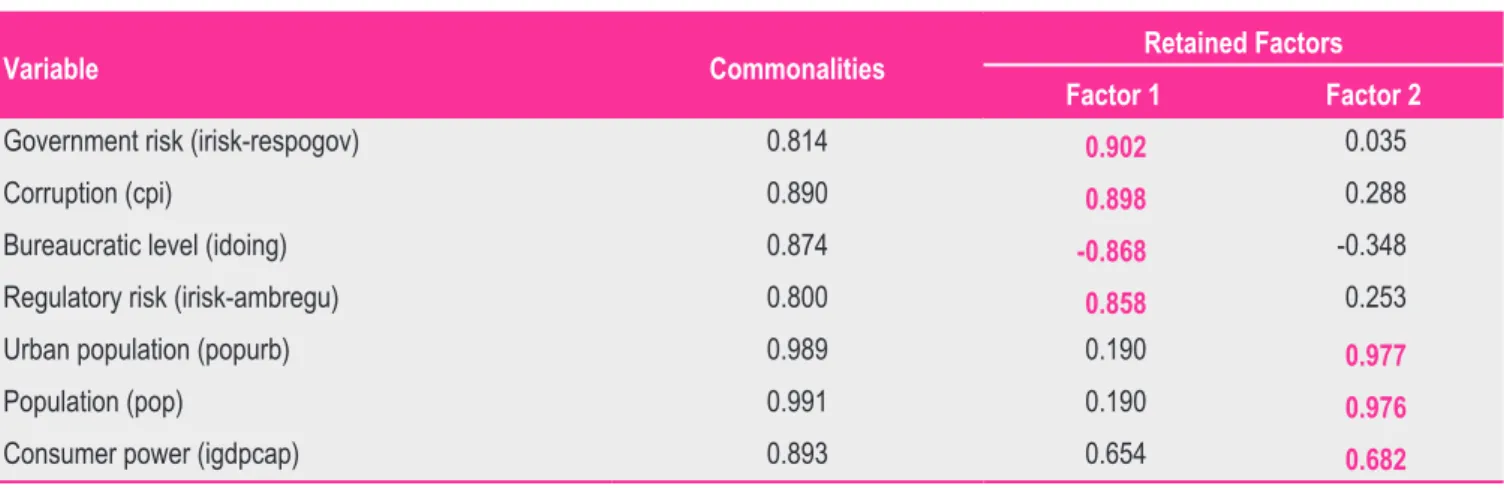
Factor analysis was used to check whether the variables composed two expected or more representative factor of the external environment aspect. The factor analysis is exploratory and it was carried out with eigenvalues greater than 1. The rotation method used was the “varimax” (Hair, Black, Babin, Anderson, & Tatham, 2006).
In the case of factor analysis, the KMO statistics showed results at 0.734, signaling the appropriateness of the construct (Corrar, 2007). In turn, all Bartlett’s Test of Sphericity (BTS)
indicate p<0.050 (sig.), conirming the required assumption
for the analysis (Hair et al., 2006; Corrar, 2007). In Table 4, it is possible to observe a high level of commonalities, since the
results are superior to 0.800 (Fávero, Beliore, Silva, & Chan,
2009). In this table, the factor loadings and the total variance explained are also represented.
In Table 4, it is also possible to observe that two factors were
retained: factor 1, representing “business eficiency – trust and
ease in doing business”; and factor 2, represented by “market opportunity”. Note that the purchasing power parity showed a low loading regarding the other factors; it remained however in the factor 2 “market opportunity”.
Given both retained factors, the second part of the statistical test consists of the grouping of countries in which Brazilian franchises operate. Firstly, a hierarchical cluster analysis was performed using the method between groups and the farthest
neighbor, aiming to ind an approximate number of clusters
into which the sample could be divided. This number was
three clusters, according to the standard of the coeficients of
homogeneity (between groups) and the Pearson correlation (farthest neighbor). Assuming a solution with three clusters, we performed a Kmeans Cluster analysis, coming to a combination of three clusters as the most suitable to explain the sample (p <0.01). Figure 3 shows the components of each cluster and Table 5 shows the results of the clusters based on the characteristics of the external environment.
The results show that cluster 3, containing 20 franchises, which have the United States as a host country, is the one that presents the better market opportunities (p<0.05, check Table
Table 4
Retained Factors
Variable Commonalities Retained Factors
Factor 1 Factor 2
Government risk (irisk-respogov) 0.814 0.902 0.035
Corruption (cpi) 0.890 0.898 0.288
Bureaucratic level (idoing) 0.874 -0.868 -0.348
Regulatory risk (irisk-ambregu) 0.800 0.858 0.253
Urban population (popurb) 0.989 0.190 0.977
Population (pop) 0.991 0.190 0.976
Consumer power (igdpcap) 0.893 0.654 0.682
Cluster 1 Cluster 2 Cluster 3
Arezzo
Au Au Lanches
Bob’s
Cantão-Redley
Carmem Steffens
CCAA
Chilli Beans
Closet & Cia
Costura do Futuro
Depyl Action
Dumond
Emagrecentro
Fisk
Giraffas
Green by Missako
Hering
Hoken
Hope
Igui
Jet Chicken
Jin Jin
LilicaTigor
Localiza
Mr. Pretzels
O Boticário
Puket
Sapataria do
Futuro
Spoleto
Tostare Café
Via Uno
Vivenda do
Camarão
Werner Coiffeur
Wizard
ABC – American
Brazilian Center
Arezzo
Astral
Bob’s
Cantão-Redley
Capodarte
Carmem Steffens
Cartório Postal
CCAA
Chilli Beans
Closet & Camp
Darling
Dumond
Fábrica di Chocolate
Fisk
Hering
Hoken
Hope
Igui
Lilica Tigor
Localiza M.Oficer MazCalçados
Microcamp
Morana
Mr. Pretzels
Mundo Verde Nobel
O Boticário
Pelo Zero
Roasted Potato
Spoleto
Supera – Ginástica
para o Cérebro
Via Uno
Wizard
ABC – American Brazilian Center
Cantão-Redley
Carmem Steffens
CCAA
Chilli Beans
Fisk
Franquia Imoveis
Funclick
Giraffas
Jacques Janine
Lupa Lupa M.Oficer
MazCalçados
Microcamp
Morana
Mr. Pretzels
O Boticário
Santa Lolla
Wizard
Yes ! Cursos de Idiomas
Table 5
Clusters
Cluster 1 Cluster 2 Cluster 3
Units 65 72 20
Business Eficiency -1.048 0.850 0.348
Market Opportunity -0.216 -0.489 2.461
Countries
Angola Argentina
Bolivia Colombia Dominican Republic
Ecuador Mexico Paraguay Venezuela
Canada Chile Costa Rica
England France
Japan Israel Italy Peru Portugal South Africa
Spain Uruguay
United States
Main Proile Underdeveloped countries from Latin America and Africa Developed countries and small Latin American countries United States
Table 6
ANOVA and Clusters Differences
N Mean Cluster Number
of Case
Cluster Number of Case
Mean
Difference Sig
Business Eficiency
Cluster 1 65 -1.048 1 2 -1.89783648
* 0.000
3 -1.39591137* 0.000
Cluster 2 72 0.850 2 1 1.89783648
* 0.000
3 0.50192512* 0.000
Cluster 3 20 0.348 3 1 1.39591137
* 0.000
2 -0.50192512* 0.000
Total 157 0.000 F = 320.888
Market Opportunity
Cluster 1 65 -0.216 1 2 0.27259044
* 0.000
3 -2.67675514* 0.000
Cluster 2 72 -0.489 2 1 -0.27259044
* 0.000
3 -2.94934558* 0.000
Cluster 3 20 2.461 3 1 2.67675514
* 0.000
2 2.94934558* 0.000
trust and ease in doing business – cluster 3 is the second most attractive one (p<0.05). Cluster 2, represented by 72 franchises, has the lowest market opportunity (p<0.05) due to the low population density. On the other hand, cluster 2 is the one that
presents the best conditions of business eficiency – trust and
ease in doing business (p<0.05). Finally, cluster 1 is the one that
presents the worst business eficiency conditions [trust and ease
in doing business (p<0.05)]. In terms of market opportunity,
however, it is signiicantly superior to cluster 2 (p<0.05).
Table 7, shows the test used to verify the main objective of this paper i.e., if there is any difference in the international commitment of the franchises, which operate in each one of these clusters. It is important to emphasize that some franchises are placed in one cluster whilst other ones are placed in more than one – some franchises, like CCAA and Carmen Steffens, are placed in the three clusters. This sort of placement doesn’t interfere in the results because what one can observe in Table 7 is the mean of the international commitment of each franchise. Therefore, if the mean of a certain franchise is expressed by “n”, then “n” will have the same weight to all clusters the franchise is inserted to.
The result shows that the average international commitment of the chains, which are inserted in cluster 1, is approximately
seven international franchises, which doesn’t differ signiicantly
from the nine international franchises in cluster 2. There is however a significant difference (p<0.05) between the franchises of cluster 2 (eight franchises) and cluster 3 (four franchises). This difference indicates that in the mean the international commitment of the franchises operating in the United States (cluster 1) is smaller than the one of the franchises that predominantly operate in developed countries and in small Latin American countries (cluster 2). Figure 4 shows the dispersion of these clusters.
5. DISCUSSION AND IMPLICATIONS
Our findings suggest that in cluster 1, formed by underdeveloped countries in Latin America and Africa, the
Brazilian franchises seek market opportunity, even though
operating in countries with low business eficiency indicators
(trust and ease to doing business). The explanation for this behavior lies in a higher ability developed by companies arising from emerging countries, like Brazilian franchise,
in dealing with the external dificulties in their countries of
origin. These difficulties involve contractual limitations,
underdeveloped market regulations, ineficient judicial system,
and high bureaucracy, among others. The ability to manage these scenarios can be reproduced in other emerging countries through similar problems. Thus, the disadvantage of operating in home countries with weak external aspects becomes a competitive advantage when operating in other emerging countries (Khanna & Palepu, 1997; Ghemawat & Khanna, 1998; Cuervo-Cazurra, 2006; Cuervo-Cazurra & Genc, 2008). Furthermore for Latin American and Portuguese language
countries, this proximity is beneicial to companies arising
from developing markets, making it easier to transfer resources and coordinate these markets (Cuervo-Cazurra & Genc, 2008). This gets even more evident when comparing to the franchises of cluster 3, which operate in the United States and are also seeking for market opportunity. However, it is possible to notice in the mean that the international commitment of the franchises belonging to this cluster is smaller than the other ones.
On one hand, the North American market is shaped by superior conditions in comparison to cluster 1, both in terms
of market opportunity and in terms of business eficiency
(trust and ease in doing business); on the other hand, Brazilian franchises operate in a highly competitive market in which it is harder to establish/conquer an immediate competitive position.
In cluster 2, consisted of developed countries and small
Latin American countries, the business eficiency (trust and
ease in doing business) conditions are the main attractiveness to open up a franchise, since in terms of market opportunity this cluster is the worst among the three analyzed ones.
As there is a signiicant difference in the international commitment in clusters 2 and 3, the business eficiency (trust and
Table 7
International Commitment
N Mean Cluster Number of Case Cluster Number of Case Mean Difference Sig
Cluster 1 65 7.29 1 2 -1.263 0.513
3 2.992 0.190
Cluster 2 72 8.56 2 3 4.256
* 0.034
3 4.256* 0.034
Cluster 3 20 4.30 3 1 -2.992 0.190
2 -4.256* 0.034
Figure 4: Clusters Dispersion
ease in doing business) together with market opportunity creates an extremely competitive environment, which is attractive but also demands certain caution for committing internationally. It is therefore possible to infer that the international commitment
is mainly driven by business eficiency (trust and ease in doing
business) instead of market opportunity.
6. CONCLUSION
This paper has demonstrated that the market opportunity and
the business eficiency (trust and ease in doing business) were
the two factors related to the external environment, which can explain the international commitment of Brazilian franchises. The paper shows that the franchise chains operating in the United States (cluster 3) have an inferior international commitment in comparison to the franchises, which operate in developed countries and in small Latin American countries (cluster 2). It is also possible to notice a large number of franchises that
operate in countries (cluster 1) with worse business eficiency
due to the advantage of learning how to operate in a country that could have some similarities with Brazil.
This paper presents a research involving the largest number of Brazilian franchise chains operating abroad. Unless
regarding to external factors and international commitment, this
is the largest representation ever studied. This is the irst paper
in Brazil that establishes and determines how external factors explain the different strategic behavior of the international commitment of Brazilian franchises. Finally, the result of the three distinct clusters show how the market opportunity and
the business eficiency (trust and ease in doing business) work
as drivers to the international operation of Brazilian franchises. In the end, this paper contributes to the existing literature by presenting the external environment relevant factors of the countries where the Brazilian franchises chains operate. Other studies had already been conducted with a focus of analysis on the international environment for North American franchising chains, through the creation of indexes for choosing the markets (Aliouche & Schlentrich, 2009, 2011). As well as the creation of clusters involving countries included in the Globe Study (Alon & Shoham, 2010). However, the studies were not exclusively focused on the behavior of franchise chains coming from
emerging countries, speciically Brazil.
two groups of factors in the external environment. It is primarily a matter for each franchise chain to analyze which attributes of the international environment considered in detail herein are the most relevant ones to its international operations, given their internal needs and competencies. Another contribution to the executive environment refers to the assistance in the management of these markets, aiming at establishing regional business policies based on markets with similar characteristics.
Thus, this research is beneicial for both Brazilian franchise
chains wishing to start operations abroad, as Brazilian franchise chains that already have international operations.
In turn, it is important to highlight the limitations of the study that can be set up as opportunity for future research, in particular, those related to the analysis of the external environment, which refer to the selection of indicators. Even though we chose indicators edited by credible international institutions, the formation of the external environment factors were limited to the variables selected. The deepening of the variables can express more accurately the behavior of these factors.
Even though the indicator “cultural distance” shows up in some studies analyzed in the theoretical framework (Alon &
Soham 2010; Aliouche & Schlentrich, 2011), this indicator will
not be used in this paper. The irst reason for this choice is that
the authors above mentioned use Hofstede’s index to measure distance; if the same index were used herein, the sample would have been severely reduced due to missing data. The other reason is that, even though the GLOBE indicator could have been used, the cultural indicator only measures cultural distance, whereas all the other indicators measure country’s absolute data.
In addition, this research only included countries where Brazilian franchise chains have some kind of international operations. Thus, it did not include other potential markets for Brazilian franchise chains. Other researchers can deepen this research by demonstrating the impact of environmental characteristics and the success of franchise chains that operate in each one of the three clusters. Other relevant research topics
that could be explored relate to the following questions: in
which cluster are the Brazilian franchise chains more successful
and which environmental aspects inluence such success?
These research topics can contribute to the continuity and improvement of the empirical knowledge of the theoretical framework proposed in this paper.
Aguiar, H., Consoni, F., & Bernardes, R. (2013). Franquias brasileiras: estudo sobre motivações e estratégias da internacionalização conduzida. Anais do Encontro de Estudos em Estratégia, Bento Gonçalves, RS, Brasil, 6.
Aliouche, E., & Schlentrich, U. (2009). International franchise assessment model: Entry and expansion in the European Union. Entrepreneurial Business Law Journal, 3(2), 517-537.
Aliouche, E., & Schlentrich, U. (2011). Toward a strategic model of global franchise expansion. Journal of Retailing, 87(3), 345-365.
DOI: 10.1016/j.jretai.2011.01.004
Alon, I. (2006).Executive insight: Evaluating the market size for service franchising in emerging markets. International Journal of Emerging Markets, 1(1), 9-20.
DOI: 10.1108/17468800610644979
Alon, I., & McKee, D. (1999). Toward a macro environmental model of international franchising. Multinational Business Review, 7(1), 76-82.
Alon, I., & Shoham, A. (2010). Clustering for international market selection. In I. Alon (Ed.), Franchise globally: Innovation, learning and imitation (pp. 73-90). London: Palgrave Macmillan.
DOI: 10.1057/9780230289857
Altinay, L., & Miles, S. (2006). International franchising decision-making: An application of stakeholder theory. Service Industries, 26(4), 421-436.
DOI: 10.1080/02642060600621613
Arthur Andersen. (1996). International expansion by U.S. franchisors. Arthur Andersen LLP, in cooperation with the International Franchise Association.
Associação Brasileira de Franchising (ABF). (2013). Evolução do setor 2002-2012. Retrieved December 20, 2013, from www.portaldofranchising.com.br/numeros-do- -franchising/evolucao-do-setor-de-franchising
Barbosa, J., & Mariotto, F. (2012). Aspectos determinantes para a internacionalização no franchising: Um estudo com franquias brasileiras. In P. Melo & T. Andreassi (Eds.), Franquias brasileiras: estratégia, empreendedorismo, inovação e internacionalização (pp. 89-106). São Paulo, Cengage.
Basílio, P. (2013, April 1st). Angola abriga 14% das franquias brasileiras que estão no exterior. IG Economia. Retrieved January 6, 2014, from www.economia.ig.com.br/inancas/ seunegocio/2013-04-01/angola-abriga-14-das-franquias-brasileiras-que-estao-no-exterior.html
Berry, H., Guillén, M., & Zhou, N. (2010). An institutional approach to cross-national distance. Journal of International Business Studies, 41(1), 1460-1480.
DOI:10.1057/jibs.2010.28
Borini, F., Rocha, T., & Spers, E. (2012). Desaios para a internacionalização das franquias brasileiras: Um survey com franquias internacionalizadas. In P. Melo & T. Andreassi (Eds.), Franquias brasileiras: estratégia, empreendedorismo, inovação e internacionalização (pp. 71-87). São Paulo, Cengage.
Borini, F., Souza, M., Biskamp, S., Coelho, F., & Sadzinski, A. (2013, janeiro/junho). A inluência dos traços da cultura brasileira no processo de internacionalização das franquias nacionais. Gestão Contemporânea, Porto Alegre, ano 10(13), 313-338.
Burton, F., & Cross, A. Franchising and foreign market entry. (1995). In S. Paliwoda & J. Ryans (Eds.), International Marketing Reader (pp. 35-48). London: Routledge.
Corrar, L. J. (2007). Análise multivariada. São Paulo, SP: Atlas.
Corruption Perceptions Index. Corruption Perceptions Index Report. Retrieved April 7, 2011, from www.transparency. org/publications/publications/other/corruption_perceptions_ index_2011
Cuervo-Cazurra, A. (2006). Who cares about corruption? Journal of International Business Studies, 37(6), 803-822. DOI: 10.1057/palgrave.jibs.8400223
Cuervo-Cazurra, A., & Genc, M. (2008). Transforming disadvantages into advantages: developing-country MNEs in the least developed countries. Journal of International Business Studies, 39(1), 957-979.
DOI: 10.1057/palgrave.jibs.8400390
Easy Doing Business. Easy Doing Business Report. Retrieved April 7, 2012, from www.doingbusiness.org/ reports/global-reports/doing-business-2012
Eroglu, S. (1992). The internationalization process of franchise systems: A conceptual model. International Marketing Review, 9(5), 19-30.
DOI: 10.1108/02651339210020277
Fávero, L., Beliore, P., Silva, F., & Chan, B. (2009). Análise
de dados: Modelagem multivariada para tomada de decisões. Rio de Janeiro: Elsevier.
Fundação Dom Cabral. (2011). Ranking das transnacionais brasileiras 2011: Edição especial franquias. Belo Horizonte: Fundação Dom Cabral.
Fundação Dom Cabral. (2013). Ranking das multinacionais brasileiras 2013: Edição especial franquias. Belo Horizonte: Fundação Dom Cabral.
Gámez-González, J., Rondan-Cataluña, F.J., Diez-De
Castro, E.C., & Navarro-Garcia, A. (2010). Toward an
international code of franchising. Management Decision, 48(10), 1568-1595.
DOI: 10.1108/00251741011090333
Ghemawat, P. (2001). Distance still matters. Harvard Business Review, 79(8), 137-145.
Ghemawat, P., & Khanna, T. (1998). The nature of diversiied business groups: A research design and two case studies. Journal of Industrial Economics, 46(1), 35-61.
DOI: 10.1111/1467-6451.00060
Hair, J., Black, W., Babin, B., Anderson, R., & Tatham, R. (2006). Análise multivariada de dados. Porto Alegre, RS: Bookman.
Han, S., & Diekman, J. (2001). Approaches for making risk-based go/no-go. Decision for International Projects, 127(4), 300-308.
International Comparison Program. International
Compararison Program Report. Retrieved October 29, 2010, from http://siteresources.worldbank.org/ICPEXT/Resources/ ICP_2011.html
International Country Risk. International Country Risk Guide. Retrieved October 29, 2010, from www.prsgroup.com/ CountryData.aspx
Kerkovic, T. (2010). The main directions in comparative franchising regulation: Unidroit initiative an its inluence. European Research Studies, 8(1), 103-118.
Khanna, T., & Palepu, L. (1997). Why focused strategies may be wrong for emerging markets. Harvard Business Review, 75(4), 41-51.
MACEDO, T. A Globalização do Franchising Brasileiro. Revista Franquia & Negócios, v.39. Lamonica, 2011.
Marques, D. (2006). Internacionalização de franquias: Um mapeamento sobre a presença de redes brasileiras no exterior Dissertação de Mestrado, Faculdade de Economia, Administração e Contabilidade, Universidade de São Paulo, São Paulo, SP, Brasil.
Marques, D. S. P., Merlo, E. M., & Nagano, M. S. (2009). Uma análise sobre internacionalização de franquias brasileiras. REAd: revista eletrônica de administração. Porto Alegre. Edição 62, 15(1).
Melo, P., & Andreassi, T. (2010). Publicação cientíica nacional e internacional sobre franchising: Levantamento e análise do período 1998-2007. Revista de Administração Contemporânea, Curitiba, 14(2), 268-288.
DOI: 10.1590/S1415-65552010000200006
Melo, P. L. R., Parente, R. C., Oliveira Jr., M. M., & Borini, F. M. (2012). Internationalization of Franchises in Emerging Markets. EIBA – European International Business Academy, Brighton (ENG), 38.
Peng, M. W. (2002). Towards an institution-based view of business strategy. Asia Paciic Journal of Management, 19(2/3), 251-267.
DOI: 10.1023/A:1016291702714
Ribeiro, F., & Melo, P. (2007). O processo de
internacionalização da rede de franquias “O Boticário” no mercado norte-americano. Facef Pesquisa,
10(3), 299-308.
Rocha, T., Borini, F., Spers, E., Khauaja, D., & Camargo, A. (2012). Aspectos mercadológicos e estratégicos da internacionalização das franquias brasileiras. Relatório Final
de Projeto de Pesquisa. Escola Superior de Propaganda e Marketing.
Simões, K. (2011, April 29). Franquias somam 700 unidades no exterior. Jornal Valor Econômico.
Vincent, W. (1998). Encroachment: Legal restrictions on retail franchise expansion. Journal of Business Venturing, 13(1), 29-42.
DOI: 10.1016/S0883-9026(97)00039-6
World Development Indicators. World Development Indicators Report. Retrieved October 30, 2010, from
http://data.worldbank.org/data-catalog/world-development-indicators/wdi-2010
World Urbanization Prospects. World Urbanization Prospects Report. Retrieved April 7, 2012, from http://esa.un.org/unpd/wup/CD-ROM/Urban-Rural- -Population.htm
Yavas, B. (1988). The role of economic-demographic factors in US international restaurant franchising: An empirical investigation. Journal of Global Marketing, 2(1) 57-72. DOI: 10.1300/J042v02n01_04
International analysis of the countries where Brazilian franchise chains operate in
This paper aims to demonstrate which external environment factors are involved in the international commitment of Brazilian franchise chains. Our objectives herein are to understand which external country characteristics lead to
in-ternational franchising operations and to ascertain the inluence of such characteristics in the commitment of franchise
chains in each country they operate in. The database has 54 Brazilian franchise chains with international operations in 26 countries, which implies in 157 franchises operating abroad. Regarding external environment factors, the
in-dependent variables form a group divided into market opportunity and business eficiency – trust and ease to doing business. The result of the three distinct clusters show how the market opportunity and the business eficiency (trust
and ease in doing business) work as drivers to the international operation of Brazilian franchises. The paper shows that the franchise chains operating in the USA (cluster 3) have an inferior international commitment in comparison with the franchises which operate in developed countries and in small Latin American countries (cluster 2). It is also possible to notice a large number of franchises that operate in underdeveloped countries from Latin America and
Africa (cluster 1) with worse business eficiency due to the advantage of learning how to operate in a country that
could have some similarities with Brazil
Keywords: franchise chains, franchising, Brazilian franchise chains, international business, entrepreneurship.
Análisis internacional de los países en que operan las cadenas de franquicias brasileñas
El objetivo en este estudio es demostrar que factores ambientales externos están involucrados en el compromiso
in-ternacional de las cadenas de franquicias brasileñas. Se busca entender las características especíicas de los países de operación de las cadenas de franquicias brasileñas, y determinar la inluencia de esas características en el compromiso
de las cadenas de franquicias en cada país en que operan. La base de datos cuenta con 54 cadenas de franquicias bra-sileñas con operaciones internacionales en 26 países, lo que resulta en 157 franquicias en el extranjero. Con relación a los factores ambientales externos, las variables independientes forman un grupo dividido en oportunidad de mercado
y eiciencia del negocio – la conianza y la facilidad para hacer negocios. Los resultados de los tres grupos distintos muestran cómo la oportunidad de mercado y la eiciencia de las empresas (la conianza y la facilidad para hacer ne -gocios) trabajan como conductores de la operación internacional de franquicias brasileñas. El estudio indica que las cadenas de franquicias que operan en EE.UU. (grupo 3) tienen un compromiso internacional inferior en comparación con las franquicias que operan en países desarrollados y en pequeños países de América Latina (grupo 2). Asimismo, es posible observar un gran número de franquicias que operan en países subdesarrollados de América Latina y África
(grupo 1) que presentan una peor eiciencia de las empresas, debido a la ventaja de aprender cómo operar en un país
que podría tener algunas similitudes con Brasil.
Palabras clave: cadenas de franquicias, franquicia, cadenas de franquicias brasileñas, negocios internacionales, emprendedurismo.