Revista
de
Administração
http://rausp.usp.br/ RevistadeAdministração52(2017)15–25
Marketing
Brand
priming
effect
on
consumers’
financial
risk
taking
behavior
Efeito
do
priming
de
marca
sobre
a
propensão
ao
risco
financeiro
do
consumidor
Efecto
del
priming
de
marca
en
la
propensión
al
riesgo
financiero
para
el
consumidor
Danielle
Mantovani
∗,
Fábio
Henrique
Silva
Galvão
UniversidadeFederaldoParaná–Curitiba/PR,Brazil
Received1June2015;accepted1August2016 Availableonline10October2016
Abstract
Takingtheperspectiveofbrandprimingtheory,this studyproposesthatbrandsassociatedwithanaudaciouspersonalitytraitmayinfluence consumerstobetakemorerisksinmakingsubsequentdecisions.Twoexperiments,runinsportbrandscontexts,showedthatindividualsexposed tobrandswithhigh(vs.low)audacitytraitsdemonstratedahigherrateofrisktakinginfinancialdecisions.Thestudiesalsoshowedthatthis effectismoderatedbyindividuals’experiencewiththefinancialmarket.Thismoderationsuggeststhattherewasanactivationofagoalnotjust semanticactivation,butthroughthebrandpriming.Thisresearchprovidesinsightsintohowtoday’sconsumersdealwithbrandprimingeffectsin riskychoicesettings.Fromamanagerialperspective,itcanhelpmanagerstounderstandthelikelyeffectsofbrandprimingonbehaviorandbetter predicttheprobabilityofriskaversionorriskseekingoutcomes.
©2016DepartamentodeAdministrac¸˜ao,FaculdadedeEconomia,Administrac¸˜aoeContabilidadedaUniversidadedeS˜aoPaulo–FEA/USP. PublishedbyElsevierEditoraLtda.ThisisanopenaccessarticleundertheCCBYlicense(http://creativecommons.org/licenses/by/4.0/).
Keywords:Brand;Priming;Risktaking;NonconsciousBehavior
Resumo
Combasenaperspectivateóricadoprimingdemarca,nesteestudo,sepropõequemarcasassociadasàpersonalidadedeaudáciapodeminfluenciar osconsumidoresatomaremdecisõesmaisarriscadasemsituac¸õessubsequentes.Doisexperimentos,realizadosnocontextodemarcasesportivas, mostramqueosindivíduosexpostosamarcascomalta(vs.baixa)audáciademonstrarammaiorpropensãoaoriscoemdecisõesfinanceiras.Esses estudostambémmostramqueesseefeitoémoderadopelaexperiênciadoindivíduocomomercadofinanceiro.Essamoderac¸ãosugerequehouve aativac¸ãodeumametapormeiodoprimingdamarcaequenãohouveapenasumaativac¸ãosemântica.Essapesquisaapresentaalgunscaminhos sobrecomoosconsumidoreslidamcomoprimingdemarcaeseusefeitossobreasescolhas.Sobaóticagerencial,osresultadospodemajudaros gestoresaentenderosefeitosprováveisdoprimingdemarcasobreocomportamentoeassimpreveraprobabilidadedemaioraversãooupropensão aorisco.
©2016DepartamentodeAdministrac¸˜ao,FaculdadedeEconomia,Administrac¸˜aoeContabilidadedaUniversidadedeS˜aoPaulo–FEA/USP. PublicadoporElsevierEditoraLtda.Este ´eumartigoOpenAccesssobumalicenc¸aCCBY(http://creativecommons.org/licenses/by/4.0/).
Palavras-chave:Marca;Priming;Propensãoaorisco;Comportamentonãoconsciente
Resumen
Conbaseenlaperspectivateóricadelprimingdemarca,enesteestudiosesugierequelasmarcasasociadasconlapersonalidadosadaoaudaz puedeninfluirenlaconductadelconsumidoryllevarloatomardecisionesmásarriesgadasensituacionesposteriores.Dosexperimentos,llevadosa caboenelcontextodemarcasdeportivas,muestranquelosindividuosexpuestosamarcasconalta(vs.baja)osadíademostraronmayorpropensión
∗Correspondingauthorat:AvenidaLotharioMeissner,632,2◦andar,80210-170Curitiba/PR,Brazil.
E-mail:[email protected](D.Mantovani).
PeerReviewundertheresponsibilityofDepartamentodeAdministrac¸ão,FaculdadedeEconomia,Administrac¸ãoeContabilidadedaUniversidadedeSãoPaulo –FEA/USP.
http://dx.doi.org/10.1016/j.rausp.2016.09.002
alriesgoenlasdecisionesfinancieras.Losestudiostambiénmuestranquetalefectoesmoderadoporlaexperienciadelindividuoconelmercado financiero.Esamoderaciónsugierequehubolaactivacióndeunametapormediodelprimingdelamarcaynosolounaactivaciónsemántica. Esteestudioindicaalgunoscaminosparaentendercómolosconsumidoresserelacionanconelprimingdemarcaysuefectoenlaselecciones. Desdelaperspectivadelagestión,losresultadospuedenayudaralosgerentesenlacomprensióndelosefectosprobablesdelprimingdemarca enelcomportamientoy,así,podránpredecirlaprobabilidaddeunamayoraversiónopropensiónalriesgo.
©2016DepartamentodeAdministrac¸˜ao,FaculdadedeEconomia,Administrac¸˜aoeContabilidadedaUniversidadedeS˜aoPaulo–FEA/USP. PublicadoporElsevierEditoraLtda.Esteesunart´ıculoOpenAccessbajolalicenciaCCBY(http://creativecommons.org/licenses/by/4.0/).
Palabrasclave: Marca;Priming;Propensiónalriesgo;Comportamientonoconsciente
Introduction
Manyeverydayactionsoccurspontaneousorautomatically,
andwithoutanyregardforwhoisaffectedbythem.Barghand
Chartrand(1999)arguethatmostofaperson’sdayisnot deter-minedbyconsciousintentions,butbymentalprocessestriggered
byenvironmentcharacterisctics andtheoperation of
noncon-sciousbehavior.
Sela and Shiv (2009) explain these automatic processes
andprimingeffects.Automaticprocessesarecharacterizedby
actionswithouttheneedofaconsciousmonitoring.Basically, thisconceptisaboutinternalizedknowledgeandacquired
expe-riences that will be used whenever needed, but without any
consciouseffortonthepartoftheindividul.Thecurrentresearch
extendsthestudyofnonconsciousbehaviorbyfocusingonthe
influenceofbrandprimingonconsumers’risktakingbehavior
inthecontextoffinancialdecisionmaking.
Priming is defined as the way experiences create future
actions, without individuals’ conscious knowledge (Bargh & Chartrand,2000).Primingisanincidentalactivationof knowl-edgestructuresprocess,involvingqualitiessuchaspersonality andstereotypestraits.Thisactivationofmentalstructureswill
beresponsibleforsubsequentbehaviorbeyondconsciousness.
Theprimingeffectworksasamanipulationoffutureactions,
meaning that itpowerfully triggerssubsequent actions andis
capable of influencing consumption atitudes, behaviors and
decisionsinanonconscious way(Aarts, Custer,&Veltkamp, 2008;Brasel&Gips,2011;Chartrand,Huber,Shiv,&Tanner, 2008; Friedman & Elliot, 2008; Fitzsimons, Chartrand, & Fitzsimons,2008;Pickering,McLean,&Krayeva,2015;Sela &Shiv,2009).
Accordingly, personality and human characteristics are
usedasabrandpositioningstrategy.Subsequentconsumption
actions, attitude behavior or decisions are a consequence of
theperceptionandimportancethesebrandstakeinconsumers’
minds,basedinhowtheyidentifyandwishtohavean interac-tionwiththebrandpersonalitycharacteristics(Cesario,Plaks,& Higgins,2006;Yang,Cutright,Chartrand,&Fitzsimons,2014).
Recentresearchdemonstrateshowbrandpriminginfluences
consumer behavior (Brasel & Gips, 2011; Fitzsimons et al., 2008).Withthisresearch,weattempttodetermineifthevisual exposuretoasportlogobrand,withahighaudacity personal-itycharacteristic,canprimeconsumerstohaveanonconscious
risk takingbehaviorinsubsequent decisions.Thesedecisions
arenotnecessarilyrelatedtosportsactivities.Inthisstudy,we investigatetherisktakinginfinancialdecisionmaking.
Our theoretical contribution is to demonstrate that brands
with more salient personality characteristics cantrigger sub-sequentactionsrelatedtothesecharacterisctics.Theseactions donotnecessarilyinvolveasituationinwhichthebrandis con-sumed.Inthisstudy,risktakingbehaviorismeasuredisacontext notrelatedtothepracticeofsports,buttothefinancialmarket.
Wealsodemonstratethattheprimingeffectonsubsequent
behaviorcomesfromconsumers’goals.Thegoalpriming
the-ory(Aartsetal.,2008;Bargh&Chartrand,2000)positsthata goalcannotbeactivatedthroughaprimingmanipulationifitis notintrinsictotheindividual’sgoals.Therefore,thisresearch showsthatriskybehaviorwillonlybeprimedbyabrandifthe individualhasexperiencewiththeriskysituation.Otherwise,the brandwillnothaveanyeffectonindividuals’behaviorbecause
thegoaldoesnotexist.Therefore,weshowhowmuch
experi-ence participantsshouldhaveforthebrandprimingtoimpact
thelikelihoodofariskychoice.
Primingtheory
Theprimingcanaffecttheactionofanindividualinapurely
cognitive way, wherethe semantic content drives the action.
Forexample,peopleexposedtothestereotypeofelderlypeople
walkedslowlywhencomparedtopeoplethatwerenotexposed
tothesamestereotype(Bargh,Chen,&Burrows,1996).Agroup of individualsexposedtoaviolentsport(boxing)presenteda
higher tendencyto choose hostile activitiesand also tohave
hostilebehaviorwhencomparedtoagroupofpeopleexposed
toanon-violentsport(Wann&Branscombe,1990).Similarly,
participantsprimedwithhelpfulnesswords,demonstrated
bet-tercommunicativequalityinnarratives,ascomparedtothose
primedwithunhelpfulwords(Pickeringetal.,2015).
Social influence is also a significant source of behavior
priming.Recentresearchshowsthatimplicitactivationofa sig-nificantother(e.g.onewhosharespersonalvalues,ideologyor religiousbeliefs)indirectlyactivatestheworldviewsharedwith thesignificantother,leadingtoitsactivepursuit,validation,and protection(Przybylinski&Andersen,2015).
Also, exposure to a prime that activates a stereotype can
leadtostereotype-consistentbehavior.Forinstance,Campbell, Manning,Leonard,andManning(2016)investigatedwhether stereotypeprimingeffectsonchildren’sfoodconsumption.
Chil-drenfrom 6 to14 yearsoldwereexposedtoeither anormal
weightoroverweightcartooncharacterprime.Theresultsshow
that overweight cartoon character primes activated the
intake.However, whenchildren’s own healthknowledgewas activatedpriortoexposuretotheprime,theoverweightcartoon
didnotincreaseconsumption.
In a similarstereotype priming investigation, Dijksterhuis and Knippenberg (1998) argue that it is possible to have
improvedintelligenceby thesimple exposuretoastereotype
thatsuggestsintelligence.Toconfirmthisprediction,theauthors
exposedagroup of peopletoa professorstereotype,another
groupwasexposedtoasecretarystereotypeandacontrolgroup
not exposedtoany stereotype. Afterexposure, anactivity to
measurethe participants intelligencewas proposed andfrom
statisticalanalysisitwasprovedthegroupexposedtoprofessor figuresobtainedbetterperformancewhencomparedtotheother groups.
Thesesituationsaresemantic,immediateandwithno
moti-vationalaspect.Thissemanticprimingisknownastrait-based priming(Barghetal.,1996;Dijksterhuis&Knippenberg,1998; Fitzsimonsetal.,2008).Theactiontriggedbyprimingoccurs immediatelyafterexposureanddissipatesovertimeandmainly
withaccomplishmentoftheprimedaction.
Ontheotherhand,dependingonthekindofexposureand
stimulationcontent,theprimingcaninfluencegoalpursuit.In thiscasethemotivationalcomponentisveryconsistent.Itiswhat literaturecallsgoal-basedpriming(Chartrandetal.,2008).To
understandhowthisprimingmechanismworksitisnecessary
tounderstandthemotivationalaspectsof goalpursuit. There-foreFitzsimons,Chartrand,andFitzsimons(2008)demonstrate
hownonconsciousgoalsareactivatedbyprimingmanipulation.
Thesegoalscanbeactivatedbysituationalfactorsandoperate automaticallytoinfluencebehavior.
Goalsarementallyrepresentedasmindstatesandthese
rep-resentations canbe activated ina nonconscious waybecause
theypre-existintheindividual’smind.Thesegoalsthatalready exist,arepartofaknowledgestructurekeptinmemory,created bytheindividual’slife(Aarts &Dikjsterhuis,2000;Bargh & Gollwitzer,1994).
Aartsetal.(2008)statethatthepursuitofnonconsciousgoal canoccurwhenapre-existingandwishedforgoalisactivated. Howevertheauthorssuggestastrengthener(ormoderator)role ofpositiveeffectinthisprocess.Forinstance,apersonthathas agoaltosavemoney,whenexposedtoastimulationwithstrong relationtolowprice andsaving, canhavethisgoalactivated andthe person’sattitudeswillbeinduced tosatisfythisgoal.
Chartrandetal.(2008)demonstratedthattheconsumers,when
exposedto a brand withstrong low price andmoney-saving
appeal (WALMART), had the goal activated andwere more
inclinedtochooseandbuycheaperclotheswhencomparedto
peopleexposedtomoreprestigiousbrands.
Someauthors(Aartsetal.,2008;Stajkovic,Locke,&Blair, 2006)suggestbehaviorchangesafterprimingexposure,as con-sequenceoftheactivationofagoalthatuntilthenwas“asleep” insidetheindividual’smind.Thegoalhadalreadyexisted,but onlyafterexposuretothepriming,thegoalwasactivated,which wouldinturn,triggerfutureactionstoachievethisgoal.
Therefore,itisunlikelythatthepriming,byitself,isstrong
enoughtogeneratesomeactionorbehaviorchange.Itismore
likelythat these motivationsare internalized andwould only
emergeafterexposureofsomethingthatwouldremindan
indi-vidualofthegoal,inspiteofanyconsciousawareness.Eitam andHiggins(2010)arguethatitisnotpossibletocreateanew motivationalstatethroughpriming,anditwillonlybeactivated iftherearepre-existentmentalrepresentations.
Ifthereisagoal,theprimingeffectshouldnotdissipateover time,butcouldincreaseuntilthegoalissatisfied.Howeverif onlyonebehaviortraitwasactivated,probablytheeffectwill dissipateinashortperiodoftime,immediatelyafterexposure (Sela&Shiv,2009).
Priming can also work, however, by influencing the
indi-vidualtoavoidthe behaviorassociated tothepriming.Laran, Dalton, and Andrade (2011), demonstrate that brands cause priming effects (i.e., behavioral effects consistent withthose
implied by the brand), whereas slogans cause reverse
prim-ing effects (i.e., behavioral effects opposite tothose implied bytheslogan).Theauthorsshowthatexposuretotheretailer
brandname“Walmart,”typicallyassociatedwithsavingmoney,
reducessubsequentspending,whereasexposuretotheWalmart
slogan,“Savemoney.Livebetter,”increasesit.Sloganscause reverseprimingeffectsandbrandscauseprimingeffectsbecause peopleperceiveslogans,butnotbrands,aspersuasiontactics.
Laran et al.(2011) suggest that priming effects are reversed
when consumers perceive a marketing tactic as a source of
persuasion.
Brands and logotypes can be used as priming
manipula-tion (Brasel & Gips, 2011; Fitzsimons et al., 2008). Brands
are important tools in this process because of their
natu-ral tendency to embody concepts, meanings, atitudes and
personality.
Brandpriming
Theuseofbrandstoinfluencesubsequentactivitieshasbeen studied inthe recentyears. Fitzsimonsetal.(2008) used the Applebrandanditscreativepersonality,constrictingitwiththe
IBMbrand.AgroupofpeoplewasexposedtoApple(word
com-posingashuffledsentence) whereasanothergroupwasgiven
brand IBM. In asecond step, participantswere given a task
involving creativity. The authors found that the Apple group
reachedabetterperformanceinthecreativitytask,when
com-paredtotheIBMgroup.
BraselandGips(2011)usedtheimageofthebrandprintedon racingcars.Thecontextofthestudywasavirtualcarracegame. Thepaintjobsonthecarswereusedasvisualstimulus,withthe logosoftheselectedbrandsprintedonthecars.Oneofthebrands wasRedBull,whichhasspeedandperformanceappeal.The ini-tialhypothesiswasthatparticipantswhoplayedthegamewith
theRedBullcarwouldpresentthebestracetimewhen
com-pared to the participants exposed to other brands(Guinness,
Coca-ColaandTropicana).However,theauthorsfoundthatthe
performanceof Red Bullgroup wasin a“U” format,
mean-ingtheywereinboththefasterandslowergroups.Thereason
isthatwhen RedBullcarswereused,themotivationfor best
chancestomakemistakesduringtherouteincreasedbecauseof thespeed,andthesemistakescausedasignificantlossoftime inthecarracinggame.
Thesepreviousstudiesdemonstratethat brandsmay
influ-enceinsubsequentactions.Inmanycases,thetriggedactions willbesemantic,whereintheindividualperceivesastrongtrait inbrandandbehavesinasimilarmanner.However,brandshave
longbeen associatedwithhumantraits, whichinfluencesnot
onlysemanticchanges,butalsobehavior.Thereasonfor this
goal-basedprimingisthatconsumersgetinvolvedwiththebrand personalitytraits(Aaker,1997;Ferraro,Bettman,&Chartrand, 2009).Thispersonalityrepresentationstriggerconsumers’ per-ceptionsof brandsaslivingentitieswiththeirownhumanlike motivations,characteristics,consciouswill,emotions,and inten-tions(Puzakova,Kwak,&Rocereto,2013).
Beyond thepriming effect, the placeboeffectthe brand is
capableofgeneratingmustbeconsidered.Forinstance,Amar,
Ariely,Bar-Hillel,Carmon,andOfir(2011)developedan
activ-ity to measure reading skills in an environment under high
brightness.Inordertodiminishluminosityeffectsandimprove visualcapacity,sunglassesweregiventotheparticipants.The firstgroupusedglassesprintedwithabrandthatcarriesahigh qualityappeal(RayBan),whereastheothergroupusedtheexact sameglasseswhichhadbeenprintedwithalowerqualitybrand (Mango).Theresultsdemonstratedthatactivitieswerecarried outinamoreefficientwaybythegroupthatusedtheglasses
printedwiththehighqualityperceptionbrandwhencompared
withtheparticipantsthatusedthesameglasses,butprintedwith thelowqualitybrand.
It is not recent that brands are capable to influence
con-sumers decisions in favor of the products they represent.
The perception of the product quality is more of a reflex
reactiontothebrandthan,infact,theproduct’sfeatures
them-selves. This was demonstrated in the classic blind beer test,
by AllisonandUhl (1964), inwhichthe authorsproved that
withoutalabelonthebottle,whenconsumerstastedthe
bev-erage, they could not distinguish the beer that, according to
them at the beginning of the experiment, was their favorite
one.
Inmostofthestudiesonbrandpriming,theactionsof indi-vidualsfollowingbrandexpositionhadahighfit withbuilt-in characteristicsofthebrands.WallMartismuchalignedto sav-ingmoneyandlowprices(Chartrandetal.,2008;Laranetal., 2011).Also,elderlypeoplearewiselyfragileandslow(Bargh etal.,1996).
Theassociationsmaybesimilarforsomesportsbrands.
Com-munication strategiesmake directassociation of thesebrands
toperformanceinsport.Thiseffectcanoccurasaresult ofa brandplaceboeffect,eitherbecauseofthepurposeofthe prod-uctstampedbythebrandorpersonality traitsassociatedwith thebrands.
Exposuretothesebrandscanmakeconsumersfeelmore
con-fident,saferorevenmoredaringand,consequently,leadtomore risktakinginsubsequentdecisions.Brandsassociatedwithan
audaciouspersonalitymayinfluenceconsumerstobemorerisk
takinginsubsequentdecisions.Therefore,thefirsthypothesis suggests:
H1. Individualsexposedtoimagesofbrandswithpersonality
traits related to audacity will be more risk taking in
subse-quentconsumptionsituations,comparedtoindividualsexposed
toimagesofbrandswhichtheaudacitytraitislesssalient.
However,brandprimingwillonlyaffectsubsequentbehavior ifthereisanimplicitgoalrelatedtothebehavioractivatedbythe brandpriming(Aartsetal.,2008;Stajkovicetal.,2006;Yang etal.,2014).Theprimingof abrandthatconveysanaudacity
idea, will onlyinduce an audaciousbehavior insituations in
whichtheconsumerhasasalientrelatedgoal.Thebrandpriming willoccurifthemotivationalstatealreadyexists,ifthereissome sortofmentalpre-existentrepresentation.
Therefore,theeffectproposedinthefirsthypothesisis
mod-erated by individuals’ experience with the primed situation.
Followingthislogic,whentheaudacityprimedbythebrandis salient,peoplewithexperienceintakingrisksinsomesituations becomemorerisktakingintheirsubsequentdecisions.Because
the priming effect should be consistent with the consumer’s
implicitgoals,weproposethat:
H2. Theimpactofbrandsthatconveyaudacityonsubsequent
risktakingbehaviorismoderatedbyconsumers’experiencein
dealingwiththeserisktakingsituations.
Overviewofthestudies
In two experiments, we test whether brand priming with
audacitytraitenhancerisktakingbehavior.Inbothstudieswe test the initialhypothesisthat brands associatedto an audac-itypersonalitymayinfluenceconsumerstobemorerisktaking
insubsequent decisions.Wealsodemonstrate themoderating
effect of consumers’experience in dealingwith risky taking
situations.
Before the experiments,we runa pre-testtoverify which
personalitytraitswereassociatedwitheachbrandthatwewere
going touseinthe brand primingmanipulations instudies1
and2.Wechosesportsbrandsforthepre-testbecausetheyare generallyassociatedwithaudacitypersonalitytraits.
Participants were students of business administration and
economicscourses.Studentsfromsportsrelatedcoursesdidnot participateinthecurrentstudies.
Pre-test
Comparingsimilarbrands,thatareactiveinthesame
mar-ketsegment,withsimilarproductportfoliocanbedifficult.To identify ifsportbrandsarereallynoticedasthemostinclined
to take risks, a pre-test was taken using abrand personality
scale proposed by Muniz and Marchetti (2012), adapted to
theBraziliancontextandoriginallyproposedbyAaker(1997). Thescalehasfivepersonalitydimensions,butforthispre-test
onlythedimension“audacity”wasanalyzed,composedbythe
Table1
Audacitydimensionofbrandpersonalitytraits.
Brands
NIKE (n=17)
ADIDAS (n=14)
TOPPER (n=17)
REEBOK (n=18)
Dimension Trait M s M s M s M s F p ηp2
Audacity Boldness 4.1a 0.6 3.6a 0.9 2.7b 1.1 2.8b 1.0 7.58 0.000 0.28
Modern 4.4a 0.7 4.2a 0.9 3.0b 1.0 3.5b 0.9 7.19 0.000 0.17
Update 4.5a 0.7 4.2a 0.7 3.2b 0.7 3.6b 0.6 10.7 0.000 0.16
Creative 4.1a 0.7 3.7a 0.8 2.8b 0.8 3.3b 0.8 6.26 0.001 0.11
Brave 4.3a 0.9 4.0ab 0.7 3.6b 0.7 3.4c 0.9 4.13 0.010 0.13
Young 4.2a 0.7 4.1a 0.8 3.3b 0.7 3.7bc 0.8 3.45 0.020 0.16
MEAN 4.3a 0.7 3.9a 0.8 3.1b 0.8 3.4b 0.8 6.55 0.000 0.27
Note:s,standarddeviation;meansthatdonotsharesubscriptsdifferbyp<0.05accordingtoBonferroniposthoc.ηp2,estimatesofeffectsize.
Participantsanddesign
Sixty-sixundergraduatestudents(55.2%women,meanage:
23.4yearsold)participatedinthispre-testinexchangeforcourse
credit.The pre-testwas computer based andwas run on the
Qualtricsplatform.
Using a five-point scale (1=not at all descriptive;
5=extremelydescriptive),subjectswereaskedtoratetheextend
towhich the six personality traits describeeach brand.Four
brandswererated:Nike,Adidas,ReebokandTopper.Tocontrol forcomparisonseffectwithinthebrands,weadopteda
single-factorbetweensubjectsdesignandeachparticipantrandomly
ratedonlyonebrand.
Results
Becausetheobjectiveofthisstagewastoidentifytheaudacity personalitytraitsthatweremoreassociatedwitheachbrand,an Anovawasperformed.TheresultsarepresentedinTable1.
Nikewasthebrandwiththehigherratedmeansforallthe
traits.Therefore,we describethe differences fromthisbrand relativetothe others.Forthe trait“boldness”,Nike (M=4.1;
σ=0.6)presentedasignificantdifferencefromReebok(M=2.8; σ=1.0)andalsofromTopper(M=2.7;σ=1.1);F(3,62)=7.58;
p=0.000,ηp2=0.28.Nikewasalsoconsideredmore“modern” (M=4.4;σ=0.7)than Topper (M=3.0; σ=1.0) and Reebok
(M=3.5; σ=0.9); F(3,62)=7.19; p=0.000, ηp2=0.17. For the trait “update”, Nike (M=4.5; σ=0.7) is also different
fromReebok(M=3.6;σ=0.6)andTopper(M=3.2;σ=0.7);
F(3,62)=10.72;p=0.000,ηp2=0.16.
And for the “creative” trait, there was a significant
dif-ferencebetweenNike(M=4.1;σ=0.7)andTopper (M=2.8; σ=0.8)andNikeandReebok(M=3.3;σ=0.8),F(3,62)=6.26,
p=0.001, ηp2=0.11. For the “brave” trait, Nike (M=4.3;
σ=0.9)wasdifferentfromTopper(M=3.6;σ=0,7)andReebok
(M=3.4;σ=0.9),F(3,62)=4.13,p=0.010,ηp2=0.13.Thetrait
“young” also presented significant differences between Nike
(M=4.2;σ=0.7)andTopper(M=3.3;σ=0.7),F(3,62)=3.45,
p=0.020, ηp2=0.16. The audacity dimension (alpha=0.88), indicatedthatNikescorewasstatisticallydifferentfromTopper andReebok,F(3,62)=6.55,p=0.000,ηp2=0.27.
Thepre-testresultsshowedNikeandAdidasdidnotdiffer
inanyofthetraits,butNikedemonstratedthelargestdifference
fromtheotherbrands.NikeandTopperwerethemostdiscrepant inalltheaudacitytraits.ThenNikeisprobablythebrandthat cantriggertheaudacityprimingand,consequently,inducerisk takinginsubsequentdecisions,whereas,Topperistheleastone.
For the experiments Nike andTopper will be the brandsfor
primingmanipulation.
Experiment1
The goalofexperiment 1was toinvestigatetheimpactof
brandprimingonrisktakinginsubsequentdecisions.Basedon the pre-testresults,we expectedthat Nikewill haveahigher primingeffectonrisktaking,comparedtoTopper.Wealsotest themoderationeffectofexperienceintherelationshipbetween
brandpriming andconsumers’risk takinginsubsequent
situ-ations of consumption. Respondents in experiment1 did not
participateagaininexperiment2.
Participantsanddesign
Eighty-twoundergraduatestudents(57.1%men,meanage:
21yearsold)participatedinthisstudyinexchangeforcourse credit.
Thestudydesignwasasingle-factorbetweensubjectswith
twoprimingconditions(Nikevs.Topper)randomlyallocatedto
oneofthetwoconditions.Theexperimentwascomputerbased
andwas run onthe Qualtrics platform. Allparticipants were
seatedatindividualworkstations.
Procedure
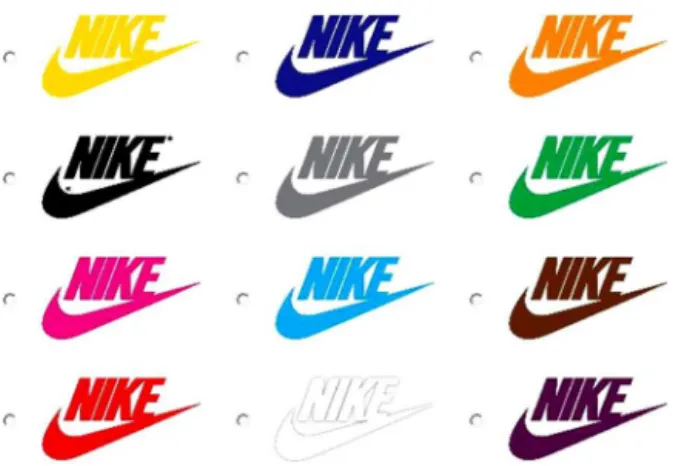
Thefirstmanipulationwasthebrandprimingstimulus,which wasnothingmorethanasimplevisuallogoexposure.This expo-sure, inspiredby Fitzsimonset al.(2008) study, consistedin exposingexactlythesamebrandimageintwelvedifferentcolor optionsand,fromthere,theparticipantswereaskedtochoose onlyoneoptionofcolorthatbestsuitedthebrand.
In theNikebrandgroup,participantswereexposedtotwo
Fig.1.Brandprimingmanipulation.
suspicionregardingthisfirststage’spurpose.Thesetwoother
brandswereSadiaandHavaianas.Fig.1showsanexampleof
thestimulusforthebrandprimingmanipulation:
Participantshadfreetimetodothechoices.Afterthelogo
choicefor each brand,participantswere askedtoexplainthe
reasonforthespecificcolorchoiceforthelogo.Therefore,they wouldbemoreinvolvedwiththetaskandgetevenmoreexposed tothebrandpriming.Afterthistask,participantswere imme-diately invited to participate in another, supposed unrelated, research.
Participants were directed toa second stage of the study,
in whicha risk taking behavior was evaluated. The scenario
wasbasedonAtalay(2007)study,alsorunwithundergraduate
students.Tomeasurerisk,twochoiceoptionswereoffered.The followingcoverstorywaspresented:
“Yourfamilyestablishedatrustfundinyournamewhenyou
were aninfant. The money in the fund is being managed
bythebankuntilthetrustagreementexpiresonyour25th
birthday.Themoneyinyour trustfundwillswitchtoyour
managementafteryour25thbirthday.Thebank,withyour
family’spermission,isinterestedinunderstandingyour pre-ferenceswhenitcomestomakinginvestmentdecisions.The
bankmanagertellsyouthathehasresearchedsomeoptions
forinvestingandcomeupwithtwoinvestmentoptionsthat
seemreasonable.Hewantsyoutoreviewtheseoptionsand
indicatewhichoneyouwouldprefertoinvestinifyouwere investing$5000.”
Thentheoptionswerepresented:OptionA:Thefirst
invest-mentoption isaninvestmentportfolio witha60%chance of
gaining 20% on your investment, and a40% chance of
los-ing20%ofyourinvestment.OptionB:Thesecondinvestment
optionisaninvestmentportfoliowitha70%chanceofgaining
10%onyourinvestment,anda30%chanceof losing10%of
yourinvestment.OptionAwasthemostriskyone.
Aftertheseinformationanalysis,allparticipantswereasked
to point out their preferences in a 8-point scale, where
1=“stronglypreferoptionA” and8=“stronglypreferoption B”.Fordataanalysis,scaleswereinverted,makingdata inter-pretationeasier,sothehigherthemean,thehighertherisktaking behavior.
After the investment option, participants indicated their
investing experienceinmakinginvestments(“Iusuallyinvest
mymoneyinthefinancialmarket”),measuredina7-pointscale (1=“completelydisagree”and7=“completelyagree”).
Inthemanipulationcheckfortheriskmanipulationscenario, respondentsindicatedwhichofthe2optionswerethemostrisky one.
Results
Manipulation check. The majority of the respondents in fact foundoption AriskierthanoptionB,withnosignificant
dif-ferencesamongtheotherbrandprimingmanipulationgroups.
A chi-square test indicated that there is no significant
asso-ciation between the primed brand and risk perception, χ2(1,
n=82)=0.00,p=1.00,phi=−0.02,as93%of thegroup
par-ticipantsexposedtoNikeindicatedthisoptionAasmostrisky
andwithinthegroupexposedtoTopper,94%consideredoption
AriskiertakingthanoptionB.
In ordertorule out differencesin overallexperience with
the financial market investment across the groups of brand
priming,anIndependentsamplest-testwasconducted.Results
showedthattherewasnodifferenceinparticipantsexperience withthefinancialmarketinvestment(MNike=2.91,SDNike=1.6 vs.MTopper=2.70,SDTopper=1.4;t(80)=0.62,p=0.53),which
means that the Nike groupdid not present aprevious higher
experience withthefinancialmarket,comparedtotheTopper
group.Eventhoughtheundergraduatestudentsdonothavehigh experiencewiththefinancialmarket,theyareawareoftherisks involvedinthisdecisionbecausetheyconfirmedthatoptionAis substantiallyriskierthanB.Also,theuseoffinancialdecisionsas ameasureofrisktakingisoftenusedinstudieswith undergrad-uatestudents.SeeforinstanceDuclos,Wan,andJiang(2013).
The authorsrunfourstudieswithundergraduatestudents.All
thestudieswererelatedtofinancialrisktakingbehavior.
Hypothesis test. Weexpectedthat participantsexposedtothe
Nike logos would be more inclined tochoose option A, the
riskiestone,toinvesttheir money.Beyondthat,itisexpected thiseffectismoderatedbyindividualsexperienceininvestingin thefinancialmarket,becauseagoalcannotbeactivatedthrough aprimingifitisnotalreadypresent(Aartsetal.,2008;Chartrand etal.,2008).Primingonlyactivatesagoaltheconsumeralready possesses.
Totestifriskbehaviorismoderatedbyexperiencein
invest-inginthefinancialmarket,wefollowedtherecommendations
ofHayes(2013),inwhichtheindependentvariableeffectover
the dependentvariableoccursindirectlythrough amoderator.
Hayes(2013)explainsthatforthisanalysis,boththedirectand indirecteffectsoftheindependentvariableoverthedependent variableshouldbeconsidered.
For the moderating role of experience in investing in the
financial market,we conductedaregressionanalysiswiththe
investmentchoiceasthedependentvariable,brandprimingand theinteractionofexperienceandbrandprimingasthe indepen-dentvariables.
The modelcompared exposuretoNikeversus exposureto
significancecalculationarebytheconfidenceinterval,generated throughbootstrapping.Thebootstrappingtechniqueisbasedon theassessmentofthedirectandinteractionpathspresentedinthe moderationmodel.Howeveritprovidesthesignificancecalculus of the effects withnormal distribution(significant coefficient “p”)andnon-normaldistribution(CIsuperiorandinferior),for
valuesof −1 D.P.,average and +1D.P. of the moderator M
(Prado,Korelo,&Silva,2014).Besidesthis,themodelcanbe
calculatedwithscriptPROCESS,developedbytheHayes(2013)
for SPSS andfreely available.For each dataset, a bootstrap
sampleofncasesisgeneratedbydrawingfromthesamplewith replacement,andeachpath(e.g.,“a”and“b”)iscalculatedin eachbootstrapsample.Thisprocessisrepeatedatotalof5000
times for each data set, yielding 5000bootstrapestimates of
the“ab”(Hayes&Scharkow,2013).Theprocedurealsooffers
optionsfortestingmorethanonemoderatorandprovidesdata
forgeneratingthemoderationfunctiongraphic,whichmayhelp inthevisualizationoftheinteractioneffects.
Therefore,wedonotrelyonthe“p”valueforsignificance
evaluation.In thiscaseHayes(2013)recommends evaluation
ofthe confidenceintervalof 95%,wherecannotexistsignals
changesbetweensuperiorandinferiorlimits,whichwouldbe
thepresenceofnulleffect.
Themoderationanalysiswasconductedusingprocess
mod-uleinSPSSwith5.000samples(Hayes,2013),runningmodel
1,whichrepresentsthesimplemoderation.Themodelwas
sig-nificant,withaR2=0.35,p<0.05.Therewasasignificantdirect effect of brand priming on risk taking (coeff=3.20, t=2.52,
p<0.05).Therewasalsoamaineffectofinvestingexperience (coeff=0.32,t=2.46,p<0.05).Asexpectedwefounda signifi-cantinteractioneffectofbrandprimingandinvestingexperience (coeff=0.42,t=2.07,p<0.05).
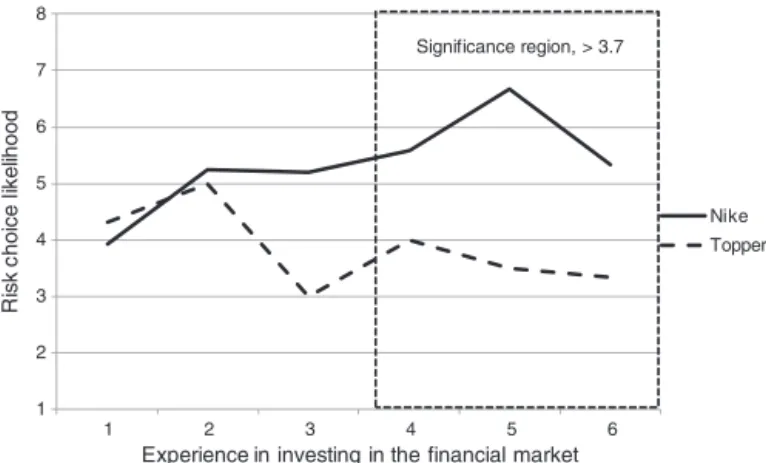
Theresultsshowtheparticipantswithahabittoinvestaverage fromM=3.70(coeff=0.75,95%C.I.=[0.00,1.49])regarding financialmarketinvestinghabittookariskieroptionafter expo-suretoNike(vs.Topper).Participantswithlowhabittoinvest didnot presentsignificative differencesinrisk tendency. The natureofthisinteractionispresentedinFig.1.
Toinvestigateatwhatlevelsofexperienceininvestinginthe financialmarketledtodifferencesinriskyinvestmentchoice,
weusedJohnson–Neymantechniquetoidentifythesignificance
region(Hayes, 2013; Preacher, Curran, &Bauer, 2006).The
Johnson–Neymantechniqueprimarycontributionisthe
deter-minationof significance of differences ingroup performance
(Johnson&Fay,1950).With theJohnson-Neyman technique theanalysisoftheproblemiscarriedfurther,inthata“regionof significance”isestablished.Ifthisregionofsignificanceisfound toexistinaparticularproblem,itbecomespossibletospecify
allthe systems of valuesof the basic charactersof matching
forwhichthenullhypothesisinvolvingsuchsystemswouldbe
rejected(Hayes,2013).
Our results revealed that participants with approximately
M=3.70(coeff=0.75,95%C.I.=[0.00,1.49])experiencewith thefinancial marketchosethe riskierinvestment.Participants
withlowexperience inthefinancial market didnot haveany
significantdifferencesintheinvestmentchoicelikelihood.The natureofthisinteractionisalsodisplayedinFig.2.
1 2 3 4 5 6 7 8
6 5 4 3 2 1
Ri
s
k
c
h
o
ice
li
k
e
lih
oo
d
Experience in investing in the financial market
Nike Topper Significance region, > 3.7
Fig.2.Brandpriming×experienceinteractiononinvestmentriskchoice like-lihood(Study1).
Discussion
Study1establishesthatconsumersbehaveinamanner
con-sistent with that implied by a brand (a priming effect). The
centralhypothesisofthisstudyisthatpeopleexposedtoabrand imagewithcharacteristicsofaudacitywillbemorerisktaking
insubsequentdecisionscomparedtothoseexposedtoabrand
imagenotassociatedwithaudacitytraits.Theresultsconfirmed
thispremises.TherewasamaineffectofNikebrandpriming
on financial risk choice likelihood. The moderator effectfor
financial market investingexperience shows when thiseffect
occurs.
Previousstudieshavedemonstratedthatbrandsandlogotypes can be used as priming manipulation (Brasel & Gips, 2011; Chartrandetal.,2008;Fitzsimonsetal.,2008).
Although theseresults support hypothesis1 and 2, a few
concernsmustbehighlighted.Themainconcernisthatweneed
todemonstratethattheprimingwasgoal-basedandnotjusta
trait-basedpriming.Primingmanipulationthat activatesgoals willhaveastrongereffectalongthetimeorwhilethegoalis not achieved(Bargh etal., 1996).If participantshadanother
unrelatedtasktospendafewminutesbeforebeingexposedto
the risk choice scenario, andafter that the priming effect on likelihoodriskchoicedisappears,thenweprobablydonothave agoal-basedpriming,butonlyatrait-basedprimingbased.
Anotherlimitation isthat wedonot haveacontrolgroup.
Therefore,itisnotcleariftheprimingeffectisaconsequence
of the Nike prime increasing risk taking choices or Topper
primedecreasingthisriskbehaviorlikelihood.Theseissuesare addressedinexperiment2.
Experiment2
ThemainpurposeofExperiment2wastoreplicatethe find-ingsobtainedinthefirststudywhileaddressingthetwomain concernsemphasizedpreviously.Precisely,thisexperimentuses (a)adifferentprimingmanipulationand(b)acontrolgroupwas included.
Participantsanddesign
Atotalofonehundredandforty-fiveundergraduatestudents
for course credit. The design was a single factor between
subjects, with three priming conditions (Nike vs. Topper vs.
Control),randomlyallocatedtooneofthethreeconditions.The
experimentwascomputerbasedandwasrunontheQualtrics
platform.
Procedure
Brandprimingmanipulationfollowedthesameproceduresof
thepreviousstudy.Theonlydifferencehereisthatweincludeda controlgroup,whichdidnotreceiveanyprimingstimulus.After that,participantswereaskedtoresolveacrosswordpuzzleand
theyhadthreeminutes tofind as many words as theycould.
ThisprocedurewasadoptedbyChartrandetal.(2008)between
priming exposureandthedependent variablemeasuring.The
purposeofthisnonrelatedtaskwastoverify ifbrandpriming hadonlyasemantic oragoalactivation.Ifthesecondoption wastrue,thebrandprimingeffectwouldnotdissipateaftersome minutesandadifferentactivity.
The third and final part of the study was the risk taking
behavior.Thesameproceduresofexperiment1weretakenin
study2.
Results
Manipulation check. Again, the majority of the respondents foundoptionAriskier thanoptionB,withno significant
dif-ferences among the brand priming manipulation groups. A
chi-square test indicated that there is no significant
associ-ation between the primed brand and risk perception, χ2(1,
n=145)=0.07,p=0.9,phi=−0.04,as90%ofthegroup
partic-ipantsexposedtoNikeindicatedthisoptionAasmostriskyand
withinthegroupexposedtoTopper,94%consideredoptionA
morerisktakingthanoptionB.Withinthecontrolgroup,88%
choseoptionAastheriskiestone.
AnAnovashowedtherewasnosignificantdifferenceamong
the groups regarding the average number of words found
in the crossword puzzle task (MNike=6.4, SDNike=2.6 vs.
MTopper=6.1, SDTopper=2.3vs.MControl=5.6, SDControl=2.3; (F(2,142)=1.52,p=0.22),asexpected.
There were no differences in overall experience with the
financialmarketinvestmentacrossthegroups.Resultsindicated nosignificant difference infinancial market investing experi-ence(MNike=2.8,SDNike=2.1vs.MTopper=2.7,SDTopper=2.0 vs.MControl=2.0,SDControl=1.9;(F(2,142)=1.05,p=0.38).
Hypothesis test. Anova analysis showed that the groups dif-ferentiatedinfinancialinvestmentrisklikelihood(MNike=5.2, DPNike=2.3vs.MTopper=4.0,DPTopper=2.3vs.MControl=4.3, DPControl=2.4; (F(2,142)=3.59, p<0.05, ηp2=0.12). The groupexposedtotheNikelogoexpressedthehigherintentionof choosingtheriskiestinvestmentoption.Posthocconstrasts indi-catedtherewasasignificantdifferenceonlybetweenNikeand Topper(p<0.05).Thisresultdemonstratesthat Nikepriming increasedrisktakingbehaviorinsubsequentdecision.
Forthemoderationeffectofexperience ininvestinginthe financialmarket,thesametestsmentionedintheprevious
exper-imentweredone,followingHayes(2013)predictions.However,
aswehadthreegroups,threemodelsweretested.Thefirstone 1 2 3 4 5 6 7 8
6 5 4 3 2 1
Ri
s
k
ch
o
ice
li
k
e
lih
ood
Experience in investing in the financial market
Nike Topper Significance region, > 3.4
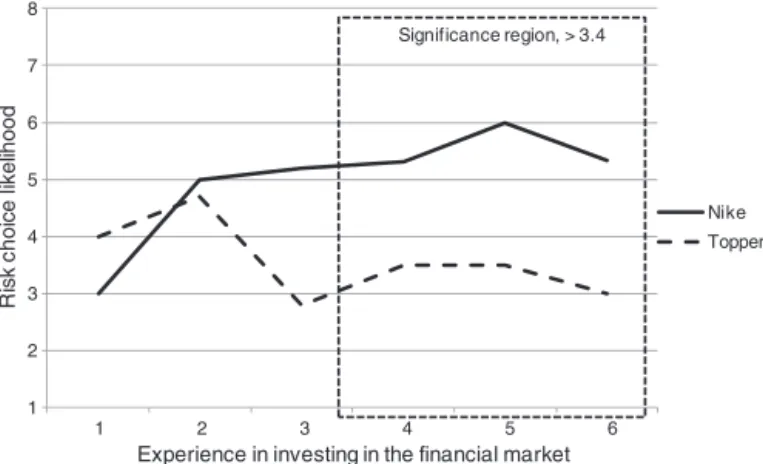
Fig.3.Brandpriming×experienceinteractiononinvestmentriskchoice like-lihood(Study2).
comparedexposuretoNikeversusexposuretoTopper,codedas
“1”and“0”respectively.Thesecondmodelcomparedthegroup
exposedtoNikeandthecontrolgroup,alsocodedas“1”and“0”
respectively.ThethirdmodelcomparedthegroupsTopperand
Control,codedforthisanalysisas“1”and“0”respectively.For alltheanalysiswerunmodel1(Hayes,2013),whichrepresents
thesimplemoderation.
For the Nike vs. Topper analysis, the model was
signif-icant, with a R2=0.29, p<0.05. There was no significant direct effect of brand priming on risk taking (coeff=−0.94,
t=−1.15, p=0.25). However, the expectedinteraction effect
of brand priming and investing experience on investment
risk choice likelihood was significant (coeff=0.55, t=2.33,
p<0.05).
Toinvestigateatwhatlevelsofexperienceininvestinginthe financial marketledtodifferencesinriskyinvestmentchoice,
weusedJohnson-Neymantechniquetoidentifythesignificance
region(Hayes,2013).Resultsrevealedthatparticipantswithan approximatelymeanof3.4experiencewiththefinancialmarket chosetheriskierinvestment.Participantswithlowexperiencein thefinancialmarketdidnothaveanysignificantdifferencesin theinvestmentchoicelikelihood.Thenatureofthisinteraction isdisplayedinFig.3.
The analysis for Nike brand priming moderation vs.
con-trolgroup,themodelwassignificant,withaR2=0.27,p<0.05. Also,theresultsshowedanotsignificantdirecteffectofbrand exposure on risk choice (coeff=−0.46, t=−0.61, p=0.54),
and no direct effect of the experience (coeff=0.01, t=0.03,
p=0.97). However the interaction effect of brand priming
andinvestingexperienceoninvestmentrisk choicelikelihood
wasmarginallysignificant(coeff=0.50,t=1.91,p=0.06).The
Johnson-Neyman test showed the participants with
approxi-matelymeanof2.88experiencewiththefinancialmarketchose theriskierinvestmentafterexposuretoNikewhencomparedto participantsinthecontrolgroup.
Asexpected,themoderationanalysisforToppervs.Control
on risk choicelikelihood did not show any significant direct
Discussion
The results of experiment 2 properly replicated those of
experiment 1. Nike brand priming effect increases risk
tak-inginsubsequentdecisions.Wedemonstratedthiseffectwith
investment risk choice likelihood situation. Beyond that, the
moderation effect of experience with the financial market
showed consistent results. Comparing to the control group,
resultsshowtheeffectreallycomesfromexposuretotheNike
logo,because Toppercondition didnot differentiatefromthe
controlgroup.
Severalstudies(e.g.,Aarts&Dikjsterhuis,2000;Aartsetal., 2008;Bargh&Gollwitzer,1994;Stajkovicetal.,2006)showed thatagoalcanonlybeactivated,eitherthroughabrand prim-ingoranyotherincentive,ifthegoalisalreadyintrinsicinthe individuals’mind.Foranindividualthatdoesnotinvestinthe financial market, itwould be difficult for abrand priming to changehisbehavior.
Inthisstudyitwaspossibletotestthepossibility thatrisk choice likelihood, for some participants, is part of a list of implicitgoals, andexpositiontothebrandawakensthisgoal. Similareffectwasobservedinotherstudies(e.g.,Aartsetal., 2008;Chartrandetal.,2008; Stajkovicetal.,2006).Another aspectthat contributesinthisdirectionwasthe insertionof a
task (crossword puzzle) between the brand priming
manipu-lationandthesubsequent dependentvariablemeasure.Aswe
replicatedthefindingsof experiment1,wedemonstratedthat
theprimingeffectreallyactivatedagoal.
Conclusion
Thefindingsreportedhereraisequestionsofinterestto
con-sumerresearchers and to marketing practitioners. This work
highlightsthebrandprimingeffectonconsumers’subsequent
decisions,specificallyinthe domainof risktaking.Itisnota recentdevelopmentthatconsumerbehaviorliteraturehas inves-tigatedtheantecedentsandconsequencesofrisktakingbehavior.
Weshowevidencethat brandsperceived withaudacious
per-sonality traits can trigger subsequent risk taking in decision making.
Another theoretical contribution is the demonstration that
predictedbehaviorisnotonlyaconsequenceofsemantic prim-ing.Earlierresearchshowedthatsemanticprimescanfacilitate the processing of conceptually related visual stimuli (Brasel &Gips, 2011;Ferraro, Bettman, &Chartrand, 2009). Going
beyond these observations, the present studies highlight that
visualexposuretobrandlogosthathavenopre-existing mean-ingfulassociationwiththebrandinquestion(e.g.,asportbrand andafinancialdecision)caninfluencesubsequentbehavior.
On a practical front, marketing managers have long been
aware of the complex factors underlyingconsumer behavior.
Brandimageandpersonalityarequiteconnectedtotheimages
associatedwiththem.Consumersaremorewillingtohavecloser relationshipwiththeir favoritebrands.Nowadays, itis
possi-ble to“talk” toabrand through social networks, andbrands
arealwaysinteractingwithconsumersaboutinterestingtopics, suchassports,politics,socialevents,andsoon.Giventhatthe mostpartofourinformationprocessingisunconscious,itisnot
surprisingthat thisincreasinginteractionbetweenbrandsand
consumerswillhavepsychologicalconsequencesforconsumer
behavior.Understanding how consumersconstruetheir brand
interactions can help managers todevelop brand positioning
strategies.
Recently, Nike launched an advertising campaign named
“RiskEverything”,gatheringthe bestsoccerplayerstospeak
aboutthebrand’sconceptanditsessence.Inaninterview,those responsibleforthecampaignexplainedthemainpurposeofthis
ad:“Thefilmwantstoshowhowsomeoftheworld’sbest
soc-cerplayershaveaccesstosuccessdealingwithsuchpressure, duetotheirwillingnesstoriskeverything”.Thiscampaignisa pictureofhowtoinsertmeaningtoincreasetheconstructionof astrongbrandimage.
The observed findings may also have direct managerial
implications concerning risk taking behavior in consumption
situation. Under many circumstances, consumers can either
become more or less risk seeking during the browsing and
purchasingprocesses.Identifyingthesemomentscanhelp
com-panies tofind the message frame that best fits the situation. Thecurrentworkshowsthatfinancialinvestmentsaredirectly affectedbyverytemporarybrandpriming.Indeed,therelevance offinancialmanagementforwell-beingisnotdenied.Giventhe
number of consumption situations demanding somemode of
balancingbetweenrisk andfinancial reward(e.g.investingin stockmarket,savingforthefuture,etc.),itismanagerially sig-nificanttounderstandwhenconsumersaremorewillingtotrade riskforreward.
However,financialdecisionisnottheonlytypeofriskona dailybasis.Probably,theimpactofbrandprimingexposureis likelytoinfluenceavarietyofriskychoicesettings.For market-ingmanagers,understandingtheimpactofbrandprimingonthe choicesoftheircustomersisimportanttopotentiallyincrease itseffectsonsales(Atalay,2007).Managersthatexposebrands associatedtorisktakingmayincreasetheirsalesinother prod-uctcategories.Thisbrandexposurecan,forinstance,increase
newproductadoption,whichisalsoriskyconsumerbehavior.
Limitationsandfutureresearch
Consumers see many brands during the course of a day
butoftenpayvery littleattention tohowsuch exposureswill influencetheirsubsequentdecisions.Futureresearchcould
ana-lyze brand priming effect in stores,supermarkets andonline
shopping, so brand priming theory would increase external
validity.
Recently,astudyfromYangetal.(2014)analyzedtheeffect ofexposuretoagroupofsimilarversusdissimilarbrandsover consumersevaluation.Besidesthat,futurestudiesthatevaluate groupsofbrandsstillrequirefurtherinvestigation.Itispossible thatconsumersdonotformperceptionsofabrand’straitsand characteristics inisolation,butinsteadusethe context,which couldincludeanotherbrandorthecontextinwhichthebrandis presented,toformtheirimpressionsandjudgments.
thatotherbrandsthatraiseconsumers’confidenceand perfor-mance.Futurestudiescouldreplicatethepreviousfindingswith differentbrands.
It isimportant tohighlightthat the scenarioof afinancial investmenttomeasurerisktakinglikelihoodwaschosenbecause itisasituationwhereriskiseasilynoticed.However,otherrisk takingdecisionmeasurescouldbeusedasdependentvariable.
One potential limitationof the current paper isthat it did notuseabrandpriminginareallocalsituation.Abrand
prim-ingmanipulationoutside ofthe labwould haveincreasedthe
external validity of the study. However,because of the
diffi-cultyincontrollingpossibleconfoundingsources,weadopted
amanipulationsimilartothatadoptedinpreviousstudies(e.g.,
Chartrand,Huber,Shiv,&Tanner,2008;Fitzsimonsetal.,2008; Laranetal.,2011).
Althoughthetwostudiesinvolvedfinancialdecision-making,
it is not the only decision domainwhere risk taking plays a
significant role.Forinstance,BraselandGips(2011)
investi-gatedthebrandpriming onriskydrivingbehavior.Therefore,
otherconsumptionsituationscouldbetestedinfutureresearch,
such as the willingness to adopt a new product or a new
brand.
Ourresultsmayalsobelimitedbytheconvenientsampleof undergraduatestudents.Futurestudiescouldresearchdifferent
samples to determinewhether the results are consistent with
thoseprovidedbyourstudy.
Conflictsofinterest
Theauthorsdeclarenoconflictsofinterest.
References
Aaker, J. (1997). Dimensions of brand personality. Journal of Marketing Research,34(3),347–356.http://dx.doi.org/10.2307/3151897
Aarts,H.,&Dikjsterhuis,A.(2000).Habitsasknowledgestructures: Auto-maticityingoaldirectedbehavior.JournalPersonalitySocialPsychology,
78(1),53-63.doi:10.1037/0022-3514.78.1.53.
Aarts,H.,Custers,R.,&Veltkamp,M.(2008).Goalprimingandthe affective-motivationalroutetononconsciousgoalpursuit.SocialCognition,26(5), 555–577.http://dx.doi.org/10.1521/soco.2008.26.5.555
Allison,R.I.,&Uhl,K.(1964).Influenceofbeerbrandidentificationontaste perception.JournalofMarketingResearch,1(3),36–39.
Amar,M.,Ariely,D.,Bar-Hillel,M.,Carmon,Z.,&Ofir,C.(2011).Brand namesactlikemarketingplacebos.TheHebrewUniversityofJerusalem. Centerforthestudyofrationality.DiscussionPaper,566,1–8.
Atalay,A.(2007,May).Mortalitysalienceandconsumerrisktaking:Strivingfor personalcontrolandself-esteem.DoctoralDissertation.ThePennsylvania StateUniversity,Pennsylvania,USA.
Bargh,J.A.,&Chartrand,T.L.(2000).Themindinthemiddle:Apractical guidetoprimingandautomaticityresearch.InH.T.Reis,&C.M.Judd (Eds.),Handbookofresearchmethodsinsocialandpersonalitypsychology
(p.235085).NewYork:CambridgeUniversityPress.
Bargh, J.,& Chartrand,T. (1999). Theunbearable automaticity of being.
American Psychologist, 54(7), 462–479. http://dx.doi.org/10.1037/0003-066X.54.7.462
Bargh,J.,&Gollwitzer,P.(1994).Environmentalcontrolofgoal-directedaction: Automatic andstrategic contingenciesbetween situationsand behavior. InW.D.Spaulding(Ed.),NebraskaSymposiumonMotivation(41)(pp. 71–124).Lincoln:UniversityofNebraskaPress.
Bargh,J.,Chen,M.,&Burrows,L.(1996).Automaticityofsocialbehavior: Directeffectsoftraitconstructandstereotypeactivationonaction.Journal ofPersonalityandSocialPsychology,71(2),230–244,doi:10.1.1.318.3898. Brasel,S.,&Gips,J.(2011).RedBullgivesyouwingsforbetterorworse: A double-edged impact of brand exposure on consumer performance.
Journal of Consumer Psychology, 21,57–64. http://dx.doi.org/10.1016/ j.jcps.2010.09.008
Campbell, M.C.,Manning,K.C.,Leonard,B.,&Manning,H.M.(2016). Kids, cartoons, and cookies: Stereotype priming effects on children’s food consumption. Journal of Consumer Psychology, 26(2), 257–264. http://dx.doi.org/10.1016/j.jcps.2015.06.003
Cesario,J.,Plaks,J.,&Higgins,E.(2006).Automaticsocialbehavioras moti-vatedpreparationtointeract.JournalofPersonalityandSocialPsychology,
90(6),893–910.http://dx.doi.org/10.1037/0022-3514.90.6.893
Chartrand,T.L.,Huber,J.,Shiv,B.,&Tanner,R.J.(2008).Nonconscious goalsandconsumerchoice.JournalofConsumerResearch,35(2),189–201. http://dx.doi.org/10.1086/588685
Dijksterhuis,A.,&Knippenberg,A.(1998).Therelationbetweenperception andbehavior,orhowtowinagameoftrivialpursuit.Journalof Personal-ityandSocialPsychology,74(4),865–877. http://dx.doi.org/10.1037/0022-3514.74.4.865
Duclos,R.,Wan,E.W.,&Jiang,Y.(2013).ShowMetheHoney!Effectsof socialexclusiononfinancialrisk-taking.JournalofConsumerResearch,
40(1),122–135.http://dx.doi.org/10.1086/668900
Eitam,B.,&Higgins,E.T.(2010).Motivationinmentalaccessibility: Rel-evanceofarepresentation(ROAR)asanewframework.Personalityand Social Psychology Compass, 4(10), 951–967. http://dx.doi.org/10.1111/ j.1751-9004.2010.00309.x
Ferraro,R.,Bettman,J.R.,&Chartrand,T.L.(2009).Thepowerofstrangers: Theeffectofincidentalconsumer-brandencountersonbrandchoice.Journal ofConsumerResearch,35(5),729–741.http://dx.doi.org/10.1086/592944 Fitzsimons, G. M., Chartrand, T. L., & Fitzsimons, G. J. (2008).
Auto-mated effects of brand exposure on motivated behavior: How Apple makesyouthinkdifferent.JournalofConsumerResearch,35(1),21–35. http://dx.doi.org/10.1086/527269
Friedman,R.,&Elliot,A.J.(2008).Exploringtheinfluenceofsportsdrink exposureonphysicalendurance.PsychologyofSportsandExercise.,9(6), 749–759.http://dx.doi.org/10.1016/j.psychsport.2007.12.001
Hayes,A.F.(2013).Introductiontomediation,moderation,andconditional processanalysis.NewYork:TheGuilfordPress.
Hayes,A.F.,&Scharkow,M.(2013).therelativetrustworthinessofinferential testsoftheindirecteffectinstatisticalmediationanalysis:Doesmethod reallymatter?PsychologicalScience,24(10),1918–1927.http://dx.doi.org/ 10.1177/0956797613480187
Johnson,P.O.,&Fay,L.C.(1950).TheJohnson–Neymantechnique,itstheory andapplication.Psychometrika,14(4),349–367.http://dx.doi.org/10.1007/ BF02288864
Laran, J., Dalton,A.,& Andrade, E. (2011).The curious caseof behav-ioralbacklash:Whybrandsproduceprimingeffectsandslogansproduce reverse primingeffects.Journal of ConsumerResearch, 37,999–1014. http://dx.doi.org/10.1086/656577
Muniz, K., & Marchetti, R. (2012). Brand personality dimensions in the Brazilian context. Brazilian AdministrationReview, 9(2), 168–188. http://dx.doi.org/10.1590/S1807-76922012000200004
Pickering,M.J.,McLean,J.F.,&Krayeva,M.(2015).Nonconsciouspriming ofcommunication.JournalofExperimentalSocialPsychology,58,77–81. http://dx.doi.org/10.1016/j.jesp.2014.12.007
Prado,P.H.M.,Korelo,J.C.,&Silva,D.M.L.(2014).Mediation,moderation andconditionalprocessanalysis.RevistaBrasileiradeMarketing,13(4), 4–24.http://dx.doi.org/10.5585/remark.v13i4.2739
Preacher,K.J.,Curran,P.J.,&Bauer,D.J.(2006).Computationaltoolsfor probinginteractioneffectsinmultiplelinearregression,multilevelmodeling, andlatentcurveanalysis.JournalofEducationalandBehavioralStatistics,
31(4),437–448.http://dx.doi.org/10.3102/10769986031004437
Puzakova, M., Kwak, H., & Rocereto, J. (2013). When humanizing brandsgoeswrong:Thedetrimental effectofbrand anthropomorphiza-tionamid product wrongdoings. Journal of Marketing, 77(3),81–100. http://dx.doi.org/10.1509/jm.11.0510
Sela,A.,&Shiv,B.(2009).Unravelingpriming:Whendoesthesameprime activateagoalversusatrait?JournalofConsumerResearch,36(3),418–433. http://dx.doi.org/10.1086/598612
Stajkovic,A.,Locke,E.,&Blair,E.(2006).Afirstexaminationofthe rela-tionshipsbetweenprimedsubconsciousgoals,assignedconsciousgoals,
andtaskperformance.JournalofAppliedPsychology,91(5),1172–1180. http://dx.doi.org/10.1037/0021-9010.91.5.1172
Wann, D.,& Branscombe,N. (1990). Personperception when aggressive ornonaggressivesportsareprimed.AggressiveBehavior,16(1),27–32. http://dx.doi.org/10.1002/1098-2337