Telmo Mota RonzaniI
Daniela Cristina Belchior MotaII Isabel Cristina Weiss de SouzaIII
I Departamento de Psicologia. Universidade Federal de Juiz de Fora (UFJF). Juiz de Fora, MG, Brasil
II Programa de Pós-Graduação em Psicologia. UFJF. Juiz de Fora, MG, Brasil
III Programa de Pós-Graduação em Saúde Coletiva. UFJF. Juiz de Fora, MG, Brasil Correspondence:
Telmo Mota Ronzani Instituto de Ciências Humanas Rua José Lourenço Kelmer, s/n Campus Universitário – Martelos 36036-900 Juiz de Fora, MG, Brasil E-mail: [email protected] Received: 11/19/2008
Revised: 05/07/2009 Approved: 06/04/2009
Alcohol prevention within
primary care in municipalities
in the state of Minas Gerais,
Southeastern Brazil
ABSTRACT
OBJECTIVE: To evaluate the effectiveness of implementing screening strategies associated with brief interventions for prevention of alcohol abuse, within primary healthcare.
METHODS: This evaluation study was conducted among 113 primary healthcare professionals and managers in three municipalities in the
Zona da Mata of Minas Gerais, Southeastern Brazil, in 2007. The health
professionals participated in a training to perform screening associated with brief interventions for alcohol use prevention. Six months after this training, a follow-up evaluation was carried out. The qualitative assessment involved participant observation, interviews with managers before the training and during the follow-up, and focus groups with healthcare professionals during the follow-up. The content analysis technique was applied. The following instruments were used for the quantitative assessment: Objective Knowledge Questionnaire, Moralization Scale for Alcohol Use, Perception Model for Alcohol Use Questionnaire and Preventive Practices for Alcohol Use Questionnaire. The municipalities were compared before the training and during the follow-up, and longitudinal evaluations were performed in each municipality, using descriptive and inferential statistics.
RESULTS: Participation by the managers and integration among the health professionals regarding the practices of screening and brief intervention were associated with greater effectiveness of implementation. This occurred in one of the municipalities, in which there was a signifi cant decrease in the degree to which alcohol use was moralized by the healthcare professionals, in comparison with the other municipalities. In the other municipalities, the effects of the implementation process for the project indicated that the frequency of performing preventive practices against alcohol use increased, along with the health professionals’ knowledge, although not enough to indicate effective implementation.
CONCLUSIONS: Effectiveness in implementing alcohol prevention strategies in primary healthcare services is associated with managers’ engagement in the implementation process for these strategies.
DESCRIPTORS: Alcohol Drinking, prevention & control. Mass
Screening. Health Human Resource Training. Health Services. Primary Health Care.
INTRODUCTION
12.3%a and 91% of hospitalizations due to dependence
are associated with this problem.b In addition to
depen-dence, most of the damage relating to alcohol can be attributed to a broader group of users whose patterns of use are risky or harmful.3 Risky use of alcohol is a
consumption pattern that increases the risk of dangerous consequences for such users and for people around them, but does not yet presuppose damage to the individual. Harmful use refers to a consumption pattern that results in physical and mental damage to the individual’s health, along with consequences at the social level.6
Thus, early detection of abusive alcohol consumption is fundamental for preventing social and health conse-quences in the general population. One important tool for defi ning prevention strategies is screening instruments. Currently, the main screening instrument for alcohol use is the Alcohol Use Disorders Identifi cation Test (AUDIT), a self-reporting instrument that was developed for identifying different patterns of alcohol use. It is easy to apply and correct, with transcultural validation, and was created for actions to prevent risky use.6
Brief interventions can be linked to applications of AUDIT. These are strategies based on motivational approaches for primary or secondary prevention. The focus of the brief intervention is on changing the patient’s behavior through attendance provided for a limited time. It can be implemented by professionals with different types of educational background.7,8
These interventions have a low cost and have been shown to be effective for alcohol-related problems. Thus, they have been found to be useful for preventive approaches among individuals who make abusive use of alcohol and they constitute an appropriate means for referring proven cases of dependence for special-ized treatment.5
Because primary healthcare reaches the majority of the population, this would be a strategic level of care for applying AUDIT and performing brief interventions. This could be used to diminish the alcohol-related prob-lems among patients at these services.1,16 In small-sized
municipalities, the impact of these strategies might be even greater, given that primary care is the main, if not the only form of public health service provision. In such municipalities, the care network does not have a specifi c service for attending to alcohol users, and thus their patients need to be referred to other municipalities. Despite the evidence that screening associated with brief interventions is effective for detecting and reducing alcohol consumption, several studies have indicated difficulties in implementing screening with brief
a Carlini EA, Galduróz JCF, Noto AR, Fonseca AM, Carlini CM, Oliveira LG, et al. Levantamento domiciliar sobre o uso de drogas no Brasil. São Paulo: Centro Brasileiro de Informações sobre Drogas Psicotrópicas; 2001.
b Galduróz JCF. Epidemiologia do uso de substâncias psicoativas no Brasil: peculiaridades regionais e populações específi cas. In: Sistema para detecção de uso abusivo e dependência de substâncias psicoativas. Brasília: Secretaria Nacional Antidrogas (Senad); 2006. p. 13-24.
interventions within primary care.1,2,16 Healthcare
profes-sionals have insuffi cient training to carry out preventive measures against alcohol use10,15 and their attitude is
to place moral blame on alcohol abusers.8 In the light
of these defi ciencies in their training, capacitation for healthcare professionals is essential for them to be able to implement screening with brief interventions within primary care. Monitoring the process of implementing screening with brief interventions within primary care, following such capacitation, has been correlated with increased effectiveness of the implementation.12,14
The present study had the aim of analyzing the effec-tiveness of implementing screening strategies associ-ated with brief interventions for preventing alcohol use, at primary healthcare services in small-sized municipalities.
METHODS
The criteria for selecting the municipalities for partici-pation in this study were that they should be located in the Zona da Mata (“Forest Zone”) of the State of
Minas Gerais, Southeastern Brazil, have a popula-tion of less than 100,000 inhabitants and have teams from the Programa Saúde da Família (PSF – Family
Health Program) available to participate. For ethical reasons, it was decided not to reveal the names of the municipalities.
Municipality A has around 9,750 inhabitants and three PSF teams; B has around 48,137 inhabitants and eight PSF teams; and C has around 3,846 inhabitants and one PSF team. In view of the small number of PSF teams in municipality C, and because this municipality is infl uenced by the healthcare network of municipality B, these two municipalities were grouped for the data analysis.
a Palm J. Moral concerns: treatment staff and user perspectives on alcohol and drug problems [doctoral thesis]. Stockholm: University of Stockholm; 2006.
participants from municipality A was 37 years, and 92.5% were female. In the other two municipalities, the mean age was 30 years and 71.2% were females. An initial contact was made with the managers, to investigate whether the municipalities would join in the projection for implementing strategies to prevent alcohol use. Subsequently, for the present study, a capacitation course on prevention of excessive alcohol use was proposed for the 113 participating healthcare professionals. The duration of the capacitation course was eight hours and it covered the following previously defi ned subjects: theoretical notions about alcohol use; the importance of practices to prevent risky alcohol use; application of AUDIT and a brief intervention through role-playing techniques; and videos on how to perform screening with brief interventions. During the fi rst month following the capacitation, weekly meetings were held with the PSF teams, along with meetings with the managers. These meetings had the purpose of monitoring the implementation of the project in the healthcare services. Later on, meetings were held monthly until a follow-up assessment was conducted, which took place six months after the capacitation. In the qualitative investigation, the following proce-dures were adopted:
• Semistructured interviews with managers in the municipalities were held at the time of the initial contact, in order to identify attitudes and perspec-tives for work relating to the project.
• Observation of the participants during the six months following the capacitation, at meetings held until the time of the follow-up assessment, through practical learning activities and process evaluation. The researchers were active players during the implementation of the project, and the data observed were recorded in a fi eld diary in order to make systematic reports.
• Semistructured follow-up assessment interviews with the managers, in order to identify factors that facilitated or added diffi culties to the implementa-tion of the project.
• Focus groups conducted in each municipality to evaluate the implementation of the project. In municipality A, three community health agents and two nurses participated in the focus groups. In the other two municipalities, one of the focus groups was composed of fi ve community health agents and the other of seven community health agents and four nurses.
The same topics were used for the guidelines of the interviews and focus groups. To evaluate the health
professionals who participated in the capacitation, the following instruments was used:
• Objective Knowledge Questionnaire (OKQ)16
– answered before and immediately after the capacitation. This evaluates professionals’ technical knowledge on the prevention of risky alcohol use by means of questions with structured responses, including questions on the defi nitions of moderate drinking and standard doses, circumstances in which patients should abstain from alcohol consumption, percentage of the population that is considered to present risky drinking and the actions of primary care professionals for reducing alcohol consumption.
The instruments presented below were answered during the pre-capacitation and the follow-up assessments. • Moralization Scale for Alcohol Use (MSAU) – this
comes from the Marcus Scale and was developed to evaluate beliefs and stereotypes about alcohol users.4 It has fi ve items that present stereotypical
propositions such as: “Alcoholism is a sign of weakness of character”, with responses on a Likert-like scale, ranging from 1 (totally disagree) to 7 (totally agree). The overall score for the scale ranges from 5 to 35.
• Questionnaire on Perception Models for Alcohol Use (QPMAU) – this is based on the Brickman model.13,a It evaluates the responsibility attributed
to patients in relation to the appearance and solu-tion of alcoholism, and it classifi es percepsolu-tions about alcohol use into four models: moral, in which patients are attributed with high responsibility for the cause and solution of alcoholism; medical, in which patients are considered minimally responsible for either the cause or the solution of this problem; compensatory, in which patients are attributed with low responsibility for the cause of alcoholism and high responsibility for the solution; and illumi-nated, in which patients are attributed with high responsibility for the cause of alcoholism and low responsibility for the solution. Although the proce-dures of translation, back-translation and semantic adaptation have been used in relation to MSAU and QPMAU, there is no transcultural validation for these instruments. Both of them were used in view of the need to evaluate the degree of moralization by the healthcare professionals regarding alcohol use, which could infl uence the practices implemented for preventing alcohol use.
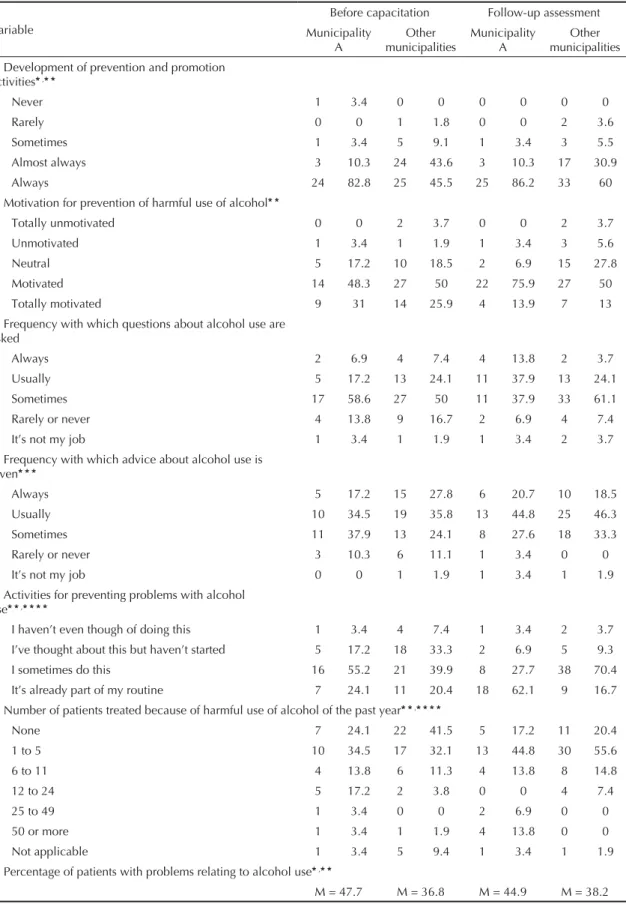
with which healthcare professionals carry out prevention practices in relation to alcohol use. One of these questions requires a discursive answer, while the remainder are in the format of a Likert-like scale (Table 3).
The effectiveness of implementation of the project was also evaluated in terms of the quantity of AUDIT applied and number of brief interventions performed per healthcare professional, at the end of the imple-mentation period.
All the interviews were recorded on electronic media for subsequent transcription and organization of the data. Content analysis of structural and thematic type was performed.9 The data from the questionnaires
were organized and analyzed using the SPSS statistical software, version 15.0. Descriptive statistics such as frequencies (n), relative frequencies (%), means (M) and standard deviations (SD) were used. The chi-square test for nominal variables was used in order to obtain a comparison between the samples formed by municipality A and by the other two municipalities, and to perform a longitudinal analysis on each of the samples. For quantitative variables, Student’s t test or the Mann-Whitney test was used to compare between municipalities. The paired t test or Wilcoxon’s test was used for longitudinal analysis in municipality A and in the other two municipalities. In the statistical analyses, the signifi cance level was set at 5%.
This study was approved by the Research Ethics Committee of the Universidade Federal de São Paulo
(0419/06). All the participants in the study signed a free and informed consent statement that was in conformity with the institution’s norms.
RESULTS
Interviews conducted before the capacitation
The main reason given by the interviewees for their participation in the project was the high prevalence of alcohol use among the population and the need to prevent damage of greater severity among alcohol abusers.
Regarding expectations from the project, the profes-sionals from municipality A hoped to make alcohol abusers aware of the treatments and actions of the PSF relating to alcoholism. The PSF professionals from the other two municipalities emphasized capacitation for practices to prevent alcohol use.
The main strategy indicated by the managers for imple-menting the project was to publicize it through talks. The interviewees from municipality A also mentioned that the strategies had not been defi ned.
Concerning the criteria for evaluating whether the objec-tives of the project would be reached, the interviewees from municipality A highlighted the participation of healthcare professionals in the project and feedback from the population. The interviewees from the other two municipalities emphasized reductions in the damage due to alcohol use and in the costs of alcoholism. With regard to the obstacles expected, the intervie-wees from municipality A emphasized that not all of the professionals were participating in the project. The interviewees from the other two municipalities mentioned patient resistance towards discussing their alcohol consumption and obstacles that were taken as inherent to how the PSF functioned: excess of capaci-tation required, overloading of tasks and shortage of time. Because of the possibility of changes in political positions, implementation of long-term projects was considered to be an obstacle by the interviewees in all the municipalities.
When asked about incorporating the project into the health service routine, the interviewees from munici-pality A said that they believed that the project was appropriate, taking into consideration the need to construct measures relating to alcohol consumption in the municipality. The interviewees from the other two municipalities said that incorporating the project into the routine would be backed through its coherence with the PSF (prevention work) and managerial support. Regarding the diffi culties in implementing the project within the routine, the interviewees from municipality A mentioned that if the nurses were not engaged in it, there would be diffi culty in incorporating the project into the routine, since they provided the internal coordination for the PSF teams. In addition, factors that could appear over the long term were mentioned, such as uncertainty regarding the support from future managers and the job rotation among healthcare professionals. The intervie-wees from the other two municipalities said that they did not anticipate any obstacles in implementing the project within the routine.
With the main focus of preventing alcoholism, all of the interviewees expressed support for implementing the project and recognized the importance of dealing with alcohol use within primary care. However, there were no indications of any prior structuring for the imple-mentation, in terms of planning or ways of surmounting the expected obstacles.
Interviews and focus groups conducted for the follow-up assessment
alcoholics and non-alcoholics. They started to include the notion of patterns of risky use and harmful use. It was seen that screening with brief interventions was mainly associated with the activities of the community health agents. The participation of the PSF coordinator was considered fundamental for the effectiveness of implementation, in that it enabled project management among the professionals.
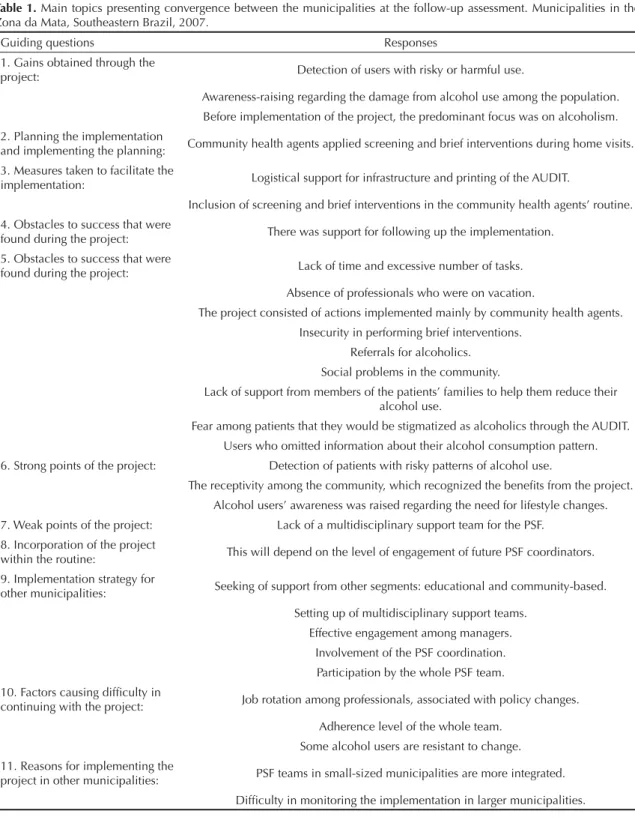
In view of the communities’ socioeconomic problems and the diffi culties encountered in referring alcohol abusers to specialized services, the notion in the munici-palities at the end of the implementation was that the PSF could not act alone. Intersectoral action would be needed in order to consolidate the prevention of alcohol use. Other similar points between the municipalities are presented in Table 1.
Table 1. Main topics presenting convergence between the municipalities at the follow-up assessment. Municipalities in the Zona da Mata, Southeastern Brazil, 2007.
Guiding questions Responses
1. Gains obtained through the
project: Detection of users with risky or harmful use.
Awareness-raising regarding the damage from alcohol use among the population. Before implementation of the project, the predominant focus was on alcoholism. 2. Planning the implementation
and implementing the planning: Community health agents applied screening and brief interventions during home visits.
3. Measures taken to facilitate the
implementation: Logistical support for infrastructure and printing of the AUDIT.
Inclusion of screening and brief interventions in the community health agents’ routine. 4. Obstacles to success that were
found during the project: There was support for following up the implementation.
5. Obstacles to success that were
found during the project: Lack of time and excessive number of tasks.
Absence of professionals who were on vacation.
The project consisted of actions implemented mainly by community health agents. Insecurity in performing brief interventions.
Referrals for alcoholics. Social problems in the community.
Lack of support from members of the patients’ families to help them reduce their alcohol use.
Fear among patients that they would be stigmatized as alcoholics through the AUDIT. Users who omitted information about their alcohol consumption pattern.
6. Strong points of the project: Detection of patients with risky patterns of alcohol use.
The receptivity among the community, which recognized the benefi ts from the project. Alcohol users’ awareness was raised regarding the need for lifestyle changes.
7. Weak points of the project: Lack of a multidisciplinary support team for the PSF.
8. Incorporation of the project
within the routine: This will depend on the level of engagement of future PSF coordinators.
9. Implementation strategy for
other municipalities: Seeking of support from other segments: educational and community-based.
Setting up of multidisciplinary support teams. Effective engagement among managers.
Involvement of the PSF coordination. Participation by the whole PSF team. 10. Factors causing diffi culty in
continuing with the project: Job rotation among professionals, associated with policy changes.
Adherence level of the whole team. Some alcohol users are resistant to change. 11. Reasons for implementing the
project in other municipalities: PSF teams in small-sized municipalities are more integrated.
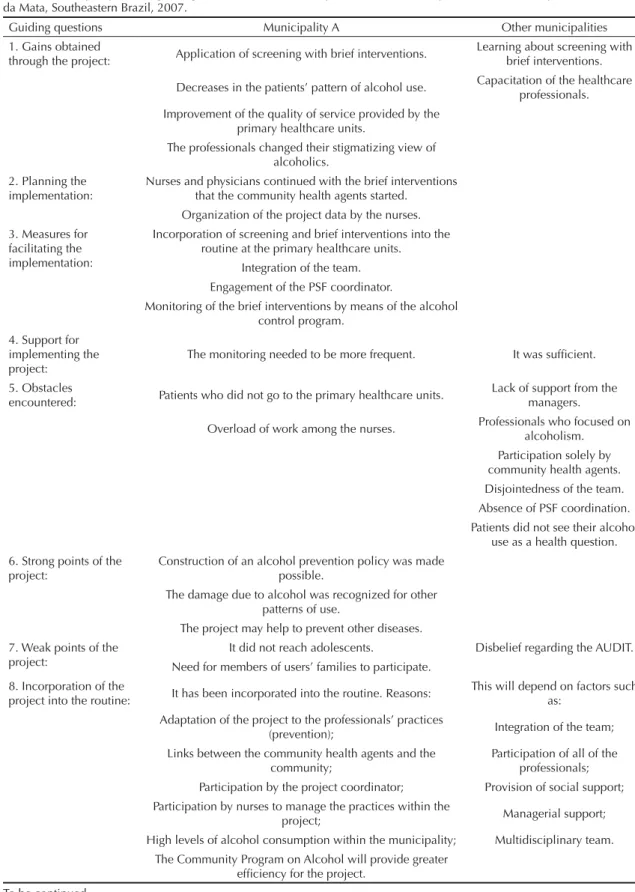
The main points of divergence between the intervie-wees from municipality A and those from the other two municipalities were related to factors such as the
participation of the PSF coordinator in managing the project and the integration among the professionals of the PSF teams for the practices of screening and brief
Table 2. Main topics presenting divergence between the municipalities at the follow-up assessment. Municipalities in the Zona da Mata, Southeastern Brazil, 2007.
Guiding questions Municipality A Other municipalities
1. Gains obtained
through the project: Application of screening with brief interventions.
Learning about screening with brief interventions.
Decreases in the patients’ pattern of alcohol use. Capacitation of the healthcare
professionals. Improvement of the quality of service provided by the
primary healthcare units.
The professionals changed their stigmatizing view of alcoholics.
2. Planning the implementation:
Nurses and physicians continued with the brief interventions that the community health agents started.
Organization of the project data by the nurses. 3. Measures for
facilitating the implementation:
Incorporation of screening and brief interventions into the routine at the primary healthcare units.
Integration of the team. Engagement of the PSF coordinator.
Monitoring of the brief interventions by means of the alcohol control program.
4. Support for implementing the project:
The monitoring needed to be more frequent. It was suffi cient.
5. Obstacles
encountered: Patients who did not go to the primary healthcare units.
Lack of support from the managers.
Overload of work among the nurses. Professionals who focused on
alcoholism. Participation solely by community health agents. Disjointedness of the team. Absence of PSF coordination. Patients did not see their alcohol
use as a health question. 6. Strong points of the
project:
Construction of an alcohol prevention policy was made possible.
The damage due to alcohol was recognized for other patterns of use.
The project may help to prevent other diseases. 7. Weak points of the
project:
It did not reach adolescents. Disbelief regarding the AUDIT.
Need for members of users’ families to participate. 8. Incorporation of the
project into the routine: It has been incorporated into the routine. Reasons:
This will depend on factors such as:
Adaptation of the project to the professionals’ practices
(prevention); Integration of the team;
Links between the community health agents and the community;
Participation of all of the professionals;
Participation by the project coordinator; Provision of social support;
Participation by nurses to manage the practices within the
project; Managerial support;
High levels of alcohol consumption within the municipality; Multidisciplinary team.
The Community Program on Alcohol will provide greater effi ciency for the project.
interventions. While the presence of these factors in municipality A enabled greater effectiveness of imple-mentation, these factors were indicated as obstacles in the other two municipalities, in relation to incor-poration of the project into the primary care routine. Table 2 describes the points of divergence between the municipalities.
Quantitative evaluation
Through applying the OKQ, it was found that there was signifi cantly greater prior objective knowledge among the primary care professionals from municipality A who participated in the capacitation (M = 5.06; SD = 1.93) than among the professionals from the other two municipalities (M = 3.63; SD = 1.40; t = 4.08; p = 0.001, using Student’s t test). However, it was found from the assessment after the capacitation that a leveling of the technical knowledge among all of the professionals had occurred. There was no statistical difference between the municipalities, although the healthcare professionals from municipality A continued to present a higher mean (M = 5.48; SD = 1.78) than that of the other two municipalities (M = 4.93; SD = 1.62). Comparing the means before and after the capacitation, only municipalities B and C presented a statistically signifi cant increase in technical knowledge (t = 5.19; p = 0.001, in the paired t test).
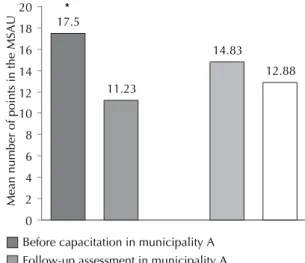
Figure 1 presents the mean number of points obtained in the MSAU.
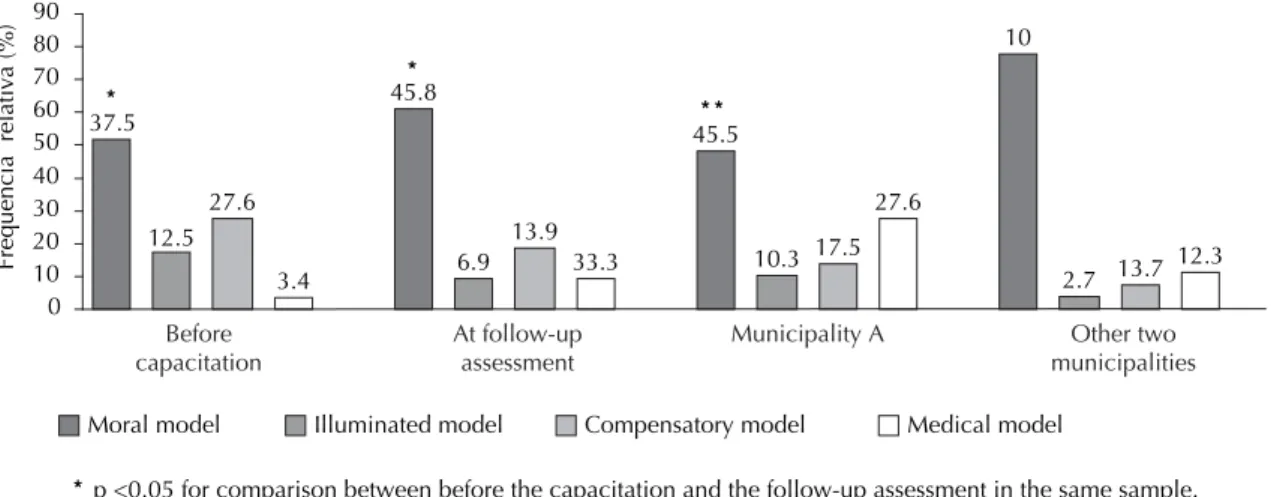
The classification of perception models regarding alcohol use according to the QPMAU is presented in Figure 2. The longitudinal analysis showed that the healthcare professionals from municipality presented increased attribution of the medical model (X2 = 17.49;
df = 9; p = 0.02). Among the healthcare professionals from the other two municipalities, there was an increase in the moral model (X2 = 21.80; df = 9; p = 0.01). In
the follow-up assessment, the greater frequency of
the moral model and lower frequency of the medical model in municipalities B and C, in comparison with A, showed that holding the alcohol abuser responsible for the appearance and solution of his problem was considerably more common in municipalities B and C (X2 = 7.95; df = 3; p = 0.04).
Before the capacitation and at the follow-up assessment, the QPPAU results for municipality A were signifi -cantly higher than those for the other two municipali-ties. QPPAU also showed that there was a signifi cant increase in the frequency of practices for preventing alcohol use in the longitudinal evaluations for all three municipalities, but that increase was greater in munici-palities B and C (Table 3).
Table 2 continuation
Guiding questions Municipality A Other municipalities
9. Diffi culties in continuing with the project:
Lack of management for the project.
Lack of support from the managers. Healthcare professionals performed screening and brief interventions because of follow-up from researchers after the
capacitation. 10. Reasons for
implementing the project in other municipalities:
Low cost. Link between community health
agents and the community. Applicability of screening and brief interventions.
Alcohol use as a health problem.
17.5*
11.23
14.83
12.88
0 2 4 6 8 10 12 14 16 18 20
Before capacitation in municipality A Follow-up assessment in municipality A
Before the capacitation in the other two municipalities Follow-up assessment in the other two municipalities
Mean number of points in the MSAU
* p < 0.05 for comparison between before
the capacitation and the follow-up
Figure 1. Scoring on the Moralization Scale for Alcohol Use
(MSAU). Municipalities of the Zona da Mata, Southeastern
Table 3. Comparison of the results between the different municipalities and longitudinal analysis of the results between before
the capacitation and the follow-up assessment. Municipalities of the Zona da Mata, Southeastern Brazil, 2007.
Variable
Before capacitation Follow-up assessment
Municipality A
Other municipalities
Municipality A
Other municipalities
1. Development of prevention and promotion
activities*,* *
Never 1 3.4 0 0 0 0 0 0
Rarely 0 0 1 1.8 0 0 2 3.6
Sometimes 1 3.4 5 9.1 1 3.4 3 5.5
Almost always 3 10.3 24 43.6 3 10.3 17 30.9
Always 24 82.8 25 45.5 25 86.2 33 60
2. Motivation for prevention of harmful use of alcohol* *
Totally unmotivated 0 0 2 3.7 0 0 2 3.7
Unmotivated 1 3.4 1 1.9 1 3.4 3 5.6
Neutral 5 17.2 10 18.5 2 6.9 15 27.8
Motivated 14 48.3 27 50 22 75.9 27 50
Totally motivated 9 31 14 25.9 4 13.9 7 13
3. Frequency with which questions about alcohol use are asked
Always 2 6.9 4 7.4 4 13.8 2 3.7
Usually 5 17.2 13 24.1 11 37.9 13 24.1
Sometimes 17 58.6 27 50 11 37.9 33 61.1
Rarely or never 4 13.8 9 16.7 2 6.9 4 7.4
It’s not my job 1 3.4 1 1.9 1 3.4 2 3.7
4. Frequency with which advice about alcohol use is
given* * *
Always 5 17.2 15 27.8 6 20.7 10 18.5
Usually 10 34.5 19 35.8 13 44.8 25 46.3
Sometimes 11 37.9 13 24.1 8 27.6 18 33.3
Rarely or never 3 10.3 6 11.1 1 3.4 0 0
It’s not my job 0 0 1 1.9 1 3.4 1 1.9
5. Activities for preventing problems with alcohol use* *,* * * *
I haven’t even though of doing this 1 3.4 4 7.4 1 3.4 2 3.7
I’ve thought about this but haven’t started 5 17.2 18 33.3 2 6.9 5 9.3
I sometimes do this 16 55.2 21 39.9 8 27.7 38 70.4
It’s already part of my routine 7 24.1 11 20.4 18 62.1 9 16.7
6. Number of patients treated because of harmful use of alcohol of the past year* *,* * * *
None 7 24.1 22 41.5 5 17.2 11 20.4
1 to 5 10 34.5 17 32.1 13 44.8 30 55.6
6 to 11 4 13.8 6 11.3 4 13.8 8 14.8
12 to 24 5 17.2 2 3.8 0 0 4 7.4
25 to 49 1 3.4 0 0 2 6.9 0 0
50 or more 1 3.4 1 1.9 4 13.8 0 0
Not applicable 1 3.4 5 9.4 1 3.4 1 1.9
7. Percentage of patients with problems relating to alcohol use*,* *
M = 47.7 M = 36.8 M = 44.9 M = 38.2
* p < 0.05: A versus B and C before the capacitation.
* * p < 0.05: A versus B and C at the follow-up assessment.
* * * p < 0.05: Before the capacitation versus follow-up assessment in municipality A.
The mean numbers of AUDITs and brief interven-tions applied per healthcare professional capacitated during the intervention period were respectively 28 and 16 in municipality A, and 6 and 5 in the other two municipalities. Thus, there was a signifi cant differ-ence in the number of AUDITs applied (p = 0.001). There was no signifi cant difference in comparing the means for the numbers of brief interventions among the interviewees.
DISCUSSION
Managers have the task of constructing strategic actions aimed at linking together the actions of healthcare professionals.18 Teamwork is inherent to the PSF.17, 19
In municipality A, the leadership provided by the PSF coordinator contributed towards greater effectiveness of implementation for the project. Firstly, this promoted adherence among the healthcare professionals with regard to conducting screening and brief interventions. Secondly, this constructed strategies for integrating professionals into the PSF teams, such as mobilization of nurses to manage the project and create the alcohol control program, in order to systematize the practices of brief interventions. These factors made it possible for the healthcare professionals in municipality A to seek to incorporate screening and brief interventions into their routines. Thus, the healthcare professionals in municipality A carried out strategies for prevention of alcohol use more frequently than did those of the other two municipalities. This may also have given rise to the higher QPPAU results for municipality A, compared with the other two municipalities, at the follow-up assessment.
As reported by other studies, there is a moral connota-tion in relaconnota-tion to alcohol that makes it diffi cult for healthcare professionals to take an adequately close approach towards users.11,a One other effect from
implementing the project in municipality A was that the healthcare professionals diminished their moralization regarding alcohol use, according to the MSAU results. This may also have contributed towards the effective-ness of the implementation.
In municipalities B and C, the significant results from the longitudinal QPPAU analysis showed that the process of implementing the project contributed towards favorable changes to the healthcare profes-sionals’ practices regarding prevention of risky alcohol use. However, the lack of support from the managers and the lack of linkage between the healthcare profes-sionals for implementing the project made it diffi cult for there to be changes that would be substantial enough to characterize routine application of screening with brief interventions. It can be suggested that the lower motivation among the healthcare professionals in municipalities B and C regarding prevention of harmful alcohol use that was seen in the longitudinal QPPAU analysis was connected with the obstacles that they reported during the implementation period. These consisted mainly of the isolated way in which the community health agents operated and the lack of managerial support.
At the follow-up assessment on municipalities B and C, the increased use of a moral model and the lack of decrease in moralization regarding alcohol use that the MSAU indicated showed that the healthcare profes-sionals maintained negative attitudes towards their
12.3 10
0 10 20 30 40 50 60 70 80 90
Moral model Illuminated model Compensatory model Medical model
Freqüência relativa (%)
* p <0.05 for comparison between before the capacitation and the follow-up assessment in the same sample.
* * p <0.05 for comparison between A and the other municipalities at the follow-up assessment.
27.6
3.4 10.3
27.6
13.7 2.7 17.5
45.5
33.3 13.9 6.9 45.8
12.5
37.5*
*
* *
Before capacitation
At follow-up assessment
Municipality A Other two
municipalities
Figure 2. Frequency of perception models regarding alcohol use. Municipalities of the Zona da Mata, Southeastern Brazil, 2007.
patients regarding alcohol-related problems. The notion among healthcare professionals that the damage caused by improper use of alcohol is a matter of patients’ own responsibility is an obstacle to practices for preventing alcohol use.2
It is concluded that the project implementation meth-odology adopted for the present study functioned as a precondition for changing the healthcare professionals’ practices, through providing knowledge and developing their abilities to carry out preventive measures against risky use of alcohol, thereby converging with other reports.10,21 However, this acquisition of knowledge and
abilities among healthcare professionals was shown to be insuffi cient for effective implementation of the project within the primary healthcare service routine. Thus, the fi ndings from this study indicate that, within primary care in small-sized municipalities, there is an association between greater effectiveness in imple-menting practices for prevention of risky use of alcohol and the engagement shown by managers regarding the implementation of the project, and particularly by the PSF coordinator. Another factor that may be associ-ated with the effectiveness of the implementation is decreased moralization by healthcare professionals regarding alcohol use, as observed among the profes-sionals in municipality A.
Vilasbôas & Paim20 (2008) showed that the actions
undertaken by managers seem to be more based on shared values relating to what they consider fair in terms of service provision, rather than on criteria for prioritizing damage and risks to health. Further studies may be directed towards evaluating managers’ beliefs and attitudes relating to alcohol use, since their involvement may determine whether this work proposal is successful.
Because of the centrality of municipal administration regarding the effectiveness of implementation, the main limitations of the present study relate to the need for longer follow-up, in order to evaluate whether any change in administration in municipality A would make it impossible for the primary healthcare profes-sionals to continue to perform screening with brief interventions.
ACKNOWLEDGEMENTS
1. Aalto M, Pekuri P, Seppä K. Primary health care professionals’ activity in intervening in patients’ alcohol drinking during a 3-year brief
intervention implementation project. Drug Alcohol
Depend. 2003;69(1):9-14. DOI: 10.1016/S0376-8716(02)00228-4
2. Aira M, Kauhanen J, Larivaara P, Rautio P. Factors infl uencing inquiry about patients’ alcohol consumption by primary health care physicians:
qualitative semi-structured interview study. Fam Pract.
2003;20(3):270-5. DOI: 10.1093/fampra/cmg307
3. Anderson P. Alcohol as a key area.
BMJ.1991;303(6805):766-9. DOI: 10.1136/
bmj.303.6805.766
4. Babor TF, Hesselbrock M, Radouco-Thomas S, Feguer L, Ferrant JP, Choquette K. Concepts of alcoholism among American, French-Canadian, and French
alcoholics. Ann N Y Acad Sci. 1986;472:98-109. DOI:
10.1111/j.1749-6632.1986.tb29613.x
5. Babor TF, Higgins-Biddle JC. Alcohol screening and brief intervention: dissemination strategies for medical
practice and public health. Addiction.
2000;95(5):677-86. DOI: 10.1046/j.1360-0443.2000.9556773.x
6. Babor TF, Higgins-Biddle JC, Saunders JB, Monteiro MG. AUDIT: the alcohol use disorders identifi cation test: guidelines for use in primary care. Geneva: World Health Organization; 2001.
7. Babor TF, Higgins-Biddle JC. Brief intervention for harzardous and harmful drinking. Geneva: World Health Organization; 2001.
8. Babor TF, McRee GB, Kassebaum MA, Grimaldi PL, Ahmed K, Bray J. Screening, Brief Intervention, and Referral to Treatment (SBIRT): toward a public health
approach to the management substance abuse. Subst
Abuse. 2007;28(3):7-30. DOI: 10.1300/J465v28n03_03
9. Bardin L. Análise de conteúdo. Lisboa: Edições 70; 1977.
10. Bendtsen P, Akerlind I. Changes in attitudes and practices in primary health care with regard to early
intervention for problem drinkers. Alcohol Alcohol.
1999;34(5):795-800. DOI: 10.1093/alcalc/34.5.795
11. Fortney J, Mukherjee S, Curran G, Fortney S, Han X, Booth BM. Factors associated with perceived stigma
for alcohol use and treatment among at-risk drinkers. J
Behav Health Serv Res. 2004;31(4):418-29.
12. Gomel MK, Wutzke SE, Hardcastle DM, Lapsley H, Reznik RB. Cost-effectiveness of strategies to market and train primary health care physicians in brief
intervention techniques for hazardous alcohol use. Soc
Sci Med. 1998;47(2):203-11. DOI: 10.1016/S0277-9536(98)00063-X
13. Kloss JD, Lisman SA. Clinician attributions and disease model perspectives of mentally Ill, chemically
addicted patients: a preliminary investigation. Subst
Use Misuse. 2003;38(14):2097-107. DOI: 10.1081/JA-120025127
14. Nilsen P, Aalto M, Bendtsen P, Seppä K. Effectiveness of strategies to implement brief alcohol intervention in primary healthcare. A systematic review. Scand J Prim Health Care. 2006;24(1):5-15. DOI: 10.1080/02813430500475282
15. Roche AM, Freeman T. Brief interventions: good in theory but weak in practice. Drug Alcohol Rev. 2004;23(1):11-8. DOI: 10.1080/09595230410001645510
16. Ronzani TM, Ribeiro MS, Amaral MB, Formigoni MLOS. Implantação de rotinas de rastreamento do uso de risco de álcool e de uma intervenção breve na atenção primária à saúde: difi culdades a serem
superadas. Cad Saude Publica. 2005;21(3):852-61.
DOI: 10.1590/S0102-311X2005000300019
17. Ronzani TM, Silva CM. O Programa Saúde da Família segundo profi ssionais de saúde, gestores e usuários. Cienc saude coletiva. 2008;13(1):23-34. DOI: 10.1590/S1413-81232008000100007
18. Schraiber LB, Peduzzi M, Sala A, Nemes MIB, Castanhera ERL, Kon R. Planejamento, gestão e
avaliação em saúde: identifi cando problemas. Cienc
Saude Coletiva. 1999;4(2):221-42. DOI: 10.1590/ S1413-81231999000200002
19. Vieira ET, Borges MJL, Pinheiro RSM, Nuto SAS. O programa de saúde da família sob o enfoque dos
profi ssionais de saúde. RBPS. 2004;17(3):119-26.
20. Vilasbôas ALQ, Paim JS. Práticas de planejamento e
implementação depolíticas no âmbito municipal. Cad
Saude Publica. 2008;24(6):1239-50. DOI: 10.1590/ S0102-311X2008000600005
21. Walsh RA, Sanson-Fisher RW, Low A, Roche AM. Teaching medical students alcohol intervention skills:
results of a controlled trial. Med Educ.
1999;33(8):559-65. DOI: 10.1046/j.1365-2923.1999.00378.x
REFERENCES
Research funded by the Ministério da Saúde (Brazilian Ministry of Health) and Conselho Nacional de Desenvolvimento
Científi co e Tecnológico (CNPq – Proc. nº 408753/2006-4).
This article underwent the peer review process adopted for any other manuscript submitted to this journal, with anonymity guaranteed for both authors and reviewers. Editors and reviewers declare that there are no confl icts of interest that could affect their judgment with respect to this article.