Original article
Prevalence of scoliosis among school students
in a town in southern Brazil
Prevalência de escoliose em escolares em uma cidade do sul do Brasil
Lenice Sberse Nery
I, Ricardo Halpern
II, Paulo César Nery
III, Karin Passos Nehme
IV, Aírton Tetelbom Stein
VUniversidade Luterana do Brasil (Ulbra), Canoas, Rio Grande do Sul, Brazil
IMSc. Nurse. Specialist Public Health teacher, Campanha Nacional de Escolas da Comunidade (CNEC) and municipal employee in Bento Gonçalves, Rio Grande do Sul, Brazil. IIMD, PhD. Professor of Public Health, Universidade Luterana do Brasil (Ulbra) and Universidade Federal of Ciências da Saúde de Porto Alegre (UFCSPA), Porto Alegre, Rio Grande do
Sul, Brazil.
IIIMD. Orthopedist in Carlos Barbosa, Rio Grande do Sul, Brazil. IVPhysiotherapist in Carlos Barbosa, Rio Grande do Sul, Brazil.
VMD, PhD. Professor of Public Health, Universidade Luterana do Brasil (Ulbra) and Universidade Federal em Ciências da Saúde de Porto Alegre (UFCSPA); care protocol coordinator of
Grupo Hospitalar Conceição (GHC), Porto Alegre, Rio Grande do Sul, Brazil.
ABSTRACT
CONTEXT AND OBJECTIVE: Scoliosis is not a diagnosis, but a description of a structural alteration that occurs in a variety of conditions. Progression of the curvature during periods of rapid growth may result in severe deformity, which may be accompanied by cardiopulmonary compromise. This study had the aims of measuring the prevalence of scoliosis among students in the ifth to eighth school years and investigating possible associations between the presence of scoliosis, body overweight and the weight of school materials.
DESIGN AND SETTING: Analytical cross-sectional study developed in the municipality of Carlos Barbosa, Rio Grande do Sul, Brazil.
METHODS: A total of 1340 students were evaluated. The variables studied were the prevalence of scoliosis, type of school, location of the school, age, school year, sex, body weight, prevalence of excessive school material weight, height, body mass index (BMI) and spinal alignment measurements.
RESULTS: The prevalence of scoliosis was 1.4%; shoulder and scapula asymmetry, 6.6%; forearm and trunk asymmetry, 4.0%; spinal misalignment, 1.9%; Thales triangle asymmetry, 6.4%; body overweight, 19.8%; and carrying of excessively heavy school materials, 27%. The study did not ind any statistically signiicant association between scoliosis and body overweight, or between scoliosis and excessive weight of school materials.
CONCLUSIONS: The prevalence of scoliosis in this school-based sample was low. No correlation was found between this clinical condition and the other variables.
RESUMO
CONTEXTO E OBJETIVO: A escoliose não é um diagnóstico, e sim uma descrição de uma alteração estrutural que ocorre numa variedade de condições. Progressão da curvatura durante o período de rápido crescimento pode resultar numa deformidade grave, a qual pode ser acompanhada por comprometimento cardiopulmonar. O objetivo do estudo foi medir a prevalência de escoliose entre escolares da quinta a oitava série e veriicar a possível associação entre a presença de escoliose, o sobrepeso corporal e o peso do material escolar.
TIPO DE ESTUDO E LOCAL: Estudo transversal analítico realizado no município de Carlos Barbosa, Rio Grande do Sul, Brasil.
MÉTODOS: Foram avaliados 1.340 escolares. As variáveis estudadas foram a prevalência de escoliose, tipo de escola, local da escola, idade, série, sexo, peso corporal, prevalência de peso excessivo do material escolar, altura, índice de massa corporal (IMC) e medidas de alinhamento da coluna vertebral.
RESULTADOS: A prevalência de escoliose foi de 1,4%; de assimetria de ombros e escápula, 6,6%; de assimetria antebraço e tronco, 4,0%; desalinhamento da coluna vertebral, 1,9%; assimetria do triângulo de Tales, 6,4%; o sobrepeso corporal, 19,8%; e carregar material escolar com peso excessivo, 27%. O estudo não encontrou associação estatisticamente signiicativa entre a escoliose e o sobrepeso corporal e a escoliose e o excesso de peso do material escolar.
CONCLUSÕES: A prevalência de escoliose com base escolar mostrou-se baixa. Não foi encontrada correlação entre essa condição clínica e as outras variáveis.
KEY WORDS: Scoliosis. Spine. Primary prevention. Students. Triage.
PALAVRAS-CHAVE:
INTRODUCTION
Scoliosis is a public health problem with a prevalence of 0.5% to 3% among the school population.1 It has the capacity to create initial
asymptomatic deformities that may remain unnoticed by parents and teachers and it has an undesirable prognosis.
Postural problems relating to the spine originate during childhood and adolescence through physical development.2,3 Moreover, during
these periods, individuals are likely to present risky behavior in relation to the spine.4,5 Back asymmetry often occurs in the adolescent
popula-tion because of body posture abnormalities. In turn, such abnormalities can be explained by the fact that many body postures in daily use are inadequate for the anatomical structures, thereby increasing the total stress on body elements, and especially on the spine.6,7
One common occurrence among adolescents is trunk asymmetry, which can be considered to be the clinical expression of scoliosis. Ado-lescents and children only seek care when the deformity is visible and therefore represents a serious problem. For this reason, many studies have investigated risk factors for the spine.3
Studies carried out in Sweden, the United States, Italy and Bra-zil have indicated that backpacks cause the body’s center of gravity to shift backwards. he heavier the bag is, the greater the shift will be. he imbalance thus caused is compensated by bending the body forward, which can cause spinal deviation.8
Several studies have shown that children and adolescents carry large quantities of school materials in their backpacks.9-12 he greatest
con-cern in this respect relates to the consequences that this daily routine can have for musculoskeletal structures, over the medium and long term, given that these individuals are in the midst of skeletal development.
Geographical diferences give rise to several scoliosis rates among school students.13 Screening is a presupposition within the primary care
model. herefore, low-cost and high-sensitivity procedures directed to-wards conditions for which there are early and efective interventions, need to be adopted as practices in the healthcare system. From the point of view of primary healthcare, postural assessments provide an opportu-nity to correct inadequate behavior, thereby making it possible to mini-mize the consequences from the deformity, while the treatment is un-derway.
OBJECTIVE
he present study had the aims of measuring the prevalence of sco-liosis among students in the ifth to eighth school years in a town in southern Brazil and investigating possible associations between the pres-ence of scoliosis, body overweight and the weight of school materials.
MATERIALS AND METHODS
his was a school-basedanalytical cross-sectional study carried out among a population of 1340 students of both sexes, who were in the ifth, sixth, seventh and eighth school years in schools in the munici-pality of Carlos Barbosa, Rio Grande do Sul. he total school student population in the year 2008, as estimated by the Municipal Education
Department of Carlos Barbosa, was 1402. his population was divided into 12 schools: nine within the urban area and three in the rural area. here were 11 public schools and one private school. his study was car-ried out in February, March, April and May 2008.
Scoliosis was measured using the Adams test,14 which consisted of
positioning the student orthostatically, looking forwards in an inspec-tionposition, and then asking the student to lean forwardwith the up-per limbs in a relaxed position and the palms of the hands facing each other.he test was considered positive when there was a diference be-tween the right and left rib cages,with the presence of gibbosity.14,15 A
physical examination on the trunk was carried out to investigate asym-metries, by viewing the midline of the body (the spine) and comparing the right and left sides.
All the school materials carried by the school students, which con-sisted basically of books, notebooks and pencil cases, were weighed on the assessment day. he weight was considered excessive if it exceeded 10% of the students’ own weight.10,11 In addition, other variables such
as weight, height, body mass index (BMI), sex, age, school year, type of school and school location were investigated.
To gather data, a structured questionnaire asking about socioeco-nomic, demographic, anthropometric and behavioral factors was used, along with physical examination of the posterior part of the trunk (Ap-pendix A). he students’ body mass index (BMI) was measured and stratiied by age as recommended by the Ministry of Health. Over-weight was deined according to the BMI cutof points for sex and age. To measure weights and heights, a Walmy digital scale of precision 100 g was used. he same scale was used to weigh the school materials car-ried by the students. he examination was carcar-ried out by trained inter-viewers (the authors: nurses, MD and physiotherapist). he reliability among the examiners was measured in order to ensure the quality of the examinations, and a kappa coeicient greater than 0.9 was obtained.
he data were stored in a database in the EpiData16 software. he
SPSS/PC 10.0 software was used for the statistical analysis. To describe the distribution of the variables, central trend measurements were used, such as the mean, median, mode and minimum and maximum of the amplitude range. To investigate associations between asymmetries, the weight of school materials and scoliosis, the chi-square test was used. he signiicance level was taken to be P < 0.05. he sample size was large enough to ensure an explanation power of at least 90% with an alpha error of about 2%.
RESULTS
Out of the 1402 students attending the school years considered in this study, 1340 were assessed. Losses and refusals amounted to 4.43% (n = 62), including school students who missed the assessment, those whose parents or other adults responsible for them refused to allow par-ticipation and those who said they did not want to participate at the time of the assessment.
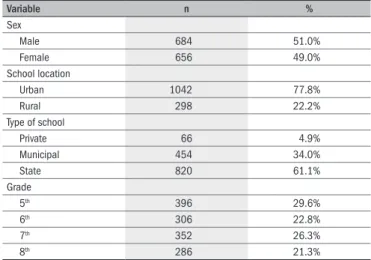
he study population included 684 boys (51%), the mean age was 12.7 years and the mean BMI was 19.8 kg. he distribution according to school year was that 29.6% of the school students were in the ifth year, 22.8% were in the sixth year, 26.3% were in the seventh year and 21.3% were in the eighth year.
Regarding the type of school, 4.92% were studying in a private school, 33.88% were in municipal schools and 61.19% were in state schools; 21.49% were in schools in the rural zone of the municipality and 78.51% were in schools in the urban zone, as shown in Table 1. he frequency of scoliosis was 1.4% (n = 19), and it was more preva-lent among girls, with a frequency of 1.98% (n = 13). he frequency of shoulder and scapula asymmetry was 6.6% (n = 89); forearm and trunk asymmetry, 10.4% (n = 140); spinal asymmetry, 1.9% (n = 25); and sca-lene muscle asymmetry, 6.4% (n = 86), as shown in Table 2.
he prevalence of excessive weight of school materials was found to be 27%. i.e. 41%, 29% and 18% in private, municipal and state schools, respectively, as shown in Table 3. he study indicated that among the students who did not have scoliosis, the weight of the school materials was 3.7 kg, with a body weight of 48 kg. However, among the students with scoliosis, the weight of the school materials was 4.4 kg, with a body weight of 47.9 kg.
he study found a marginal statistical association between presence of scoliosis and the weight of the school materials (P = 0.08), as shown
in Table 4. In this association, the students carrying excessive weight
in their backpacks presented an estimated risk (prevalence rate, PR) of 2.13, with a 95% conidence interval (CI) of 0.8-5.2, compared with students who did not carry excessive weight.
he prevalence of shoulder and scapula asymmetry and excessive weight of school materials was found to be 44% in the private school, 5.0% in the municipal schools and 4.0% in the state schools, as can be seen in Table 5.
he frequency of body overweight was 19.8%. When the sub-jects were assessed regarding the possible association of body
over-Table 1. Sociodemographic characteristics of ifth to eighth-year school students in the municipality of Carlos Barbosa (2008)
Variable n %
Sex
Male 684 51.0%
Female 656 49.0%
School location
Urban 1042 77.8%
Rural 298 22.2%
Type of school
Private 66 4.9%
Municipal 454 34.0%
State 820 61.1%
Grade
5th 396 29.6%
6th 306 22.8%
7th 352 26.3%
8th 286 21.3%
Table 2. Frequency of scoliosis and asymmetries among ifth to eighth-year school students in the municipality of Carlos Barbosa (2008)
Asymmetries n %
Scoliosis 19 1.4
Shoulder and scapula asymmetry 89 6.6
Spine asymmetry 25 1.9
Forearm and trunk asymmetry 140 10.4
Thales triangle asymmetry 86 6.4
Table 3. Student distribution according to excessive weight of school materials, in relation to type of school, in the municipality of Carlos Barbosa (2008)
Private Municipal State
Excess 28 239 82
No excess 38 581 372
Total 66 820 454
weight with scoliosis, no statistically signiicant association was found between these two study variables. However, there was a statistically signiicant association between body overweight and scalene muscle asymmetry (P = 0.00).
DISCUSSION
he prevalence of scoliosis among school students between 10 and 14 years of age, of both sexes, who were attending the ifth, sixth,
sev-Table 4. Sample distribution according to asymmetries, in relation to excessive weight of school materials and body overweight, in the municipality of Carlos Barbosa (2008)
Asymmetries
Excessive weight of school materials Body overweight
yes no total P yes no total P
n % n % n % n % n % n %
Scoliosis yes 8 42 11 58 19 100 0.08 3 16 16 84 19 100 0.50
no 333 25 987 75 1320 100 254 19 1066 81 1320 100
Shoulder and scapula yes 23 25 66 75 89 100 0.50 22 25 67 75 89 100 0.20
no 318 25 932 75 1250 100 236 19 1014 100 1250 100
Forearm and trunk yes 5 9.2 49 90.8 336 26 0.02 10 18.5 44 81.5 54 100 1.00
no 336 26 949 74 1003 100 247 19 1038 81 1285 100
Thales triangle yes 20 15 73 75 86 100 1.00 28 33 58 67 86 100 0.00
enth and eighth years in schools in the municipality of Carlos Barbosa was 1.4% (n = 19). his prevalence is in accordance with the prevalence found in previous studies, which has ranged from 1% to 13% world-wide among the general population.17 Among school populations, the
prevalence has ranged from 0.5% to 3%.1
he present study found similarities with the results from a study in São Paulo that examined 4,037 students using the Adams method. he teachers mentioned a prevalence of 19.8%, the physician men-tioned 2.4% and the radiographic examination showed a prevalence of 1.8%.18
Regarding the diferences in the prevalence of scoliosis, it is possi-ble that behavioral factors are strongly associated with this deformity. A study in Sobral (Ceará, Brazil) stated that children and adolescents were in the habit of sleeping in hammocks,24 while a study in southern
Bra-zil found associations between scoliosis and the number of hours on the computer and between scoliosis and body overweight.8 Another study
in Santa Catarina, Brazil, associated the problem with backpack over-weight and with inadequate school furniture.8,9
Another factor that may have an inluence on establishing scoliosis is the method used to identify it. here would be a possibility of inding a higher prevalence of scoliosis using the Adams test than using radio-graphic examinations. It is possible that the inter-examiner assessment method provides a more precise measurement for identifying the defor-mity. A second assessment to conirm the deformity may also help in obtaining the prevalence measurement.
Another study had indings similar to those of the present study. Soucacos et al.,19 in Greece, analyzed students between 9 and 15 years
of age and found a prevalence of 1.7%. Andrade Barcia and Andrade Barcia20 carried out a study on primary and secondary school students
in Ecuador and found a prevalence of 0.88%, i.e. smaller than in the present study.
he prevalence of scoliosis in countries such as Argentina21 and
Greece19 was less than 2%, whereas in Brazil, Rocha and Pedreira
ob-served a prevalence of 7.32%.22 Vernengo Lezica21 carried out a study
on students between 10 and 15 years of age in Buenos Aires, Argenti-na. Over a three-year period, this author assessed 9,429 students in 140 schools and found that 126 of them had scoliosis (2.6%).
In other similar studies, Ferriani et al.23 found a prevalence of
scolio-sis of 23.5% using the Adams test in Ribeirão Preto, São Paulo, where-as Tavares et al.24 found a prevalence of scoliosis of 4.8% in Sobral,
Ceará.
he present study showed a prevalence of 1.98% (n = 13) among girls and 0.8% among boys, with proportions of 2.4 per 1. It is possible this diference occurred because the peak body growth among females occurs during the age range studied, thus making it easier to view the deformity. Among males, the growth peak occurs later on.
In a study at Pedro Ernesto University Hospital, Universidade do Estado do Rio de Janeiro (UERJ), with the aim of diagnosing early sco-liosis among adolescents, Elias and Texeira25 assessed a total of 4,750
adolescents. Among the 85 individuals (1.78%) who presented positive clinical signs, 54 underwent a radiological assessment and the diagnosis was conirmed in the cases of 49 of them (1.03%). he female sex was the most afected, in proportions of 2:1.
No statistically signiicant association between scoliosis and exces-sive weight of school materials was found, and one possible explanation for the marginal association may have been the low prevalence of sco-liosis. his difered from the indings of Alvarez Núñez and Oquendo Vázquez,26 who carried out a study among 2,000 school students in
Ma-tanzas, Cuba, to investigate the incidence of scoliosis and analyze the school-based factors that might give rise to risks to the spine, and ob-served that scoliosis was present in 10.4% of the students. hey stated that the weight of school materials was a risk factor.
In spite of the marginal signiicance that we obtained for the rela-tionship between the excessive weight carried by the school students and shoulder and scapula asymmetries, we noticed that in the private school, where the weight of school materials was greater, the frequency of this asymmetry was also greater, which may be a contributory factor for the presence of scoliosis curves.
In the same way, the excessive weight of school materials presented a statistically signiicant association with forearm and trunk asymmetry (P = 0.02), thus suggesting that excessive weight carried may be connected with asymmetry. herefore, the forearm and trunk asymmetry and the scalene muscle asymmetry (P = 0.00), which presented a statistically sig-niicant association with scoliosis, showed that such asymmetries may be a source of concern, since they may indicate future problems.
he present study presents limitations inherent to cross-sectional studies. he school materials were only weighed on the assessment day, for reasons of operational convenience. A weekly average might be more accurate with regard to the students’ habits, thereby minimizing the possible efect of dispersion of the weight of school materials over the weekly curricular schedule. In addition, no radiographic examinations of a more speciic conirmatory nature were carried out.
CONCLUSION
his study demonstrated that body overweight may be associated with shoulder and scapula asymmetries and with scalene muscle asymme-tries and suggests that there is a need for preventive action regarding body weight care and control. Excessive weight carried by school students seems to have an association with forearm and trunk asymmetry and suggests that there is a need for intervention to maintain trunk balance.
herefore, routine trunk assessment actions in schools are very important, because they can lead to intervention in the process of ab-normality formation, through early corrections, since such asymme-tries are easy for examiners to see and are noninvasive. he time taken to perform the examination is short and the cost is low. Health and education professionals need to be involved in the scoliosis screening process for students and the guidance for reducing the risk needs to be emphasized.
Table 5. Student distribution according to shoulder and scapula asymmetry, in relation to type of school, in the municipality of Carlos Barbosa (2008)
Private Municipal State
Excess 29 39 20
No excess 37 781 434
REFERENCES
1. Rocha LE, Santili C, Carrera EF, et al. Escolioses idiopáticas. In: Sociedade Brasileira de Or-topedia e Traumatologia. OrOr-topedia pediátrica. Rio de Janeiro: Revinter; 2004. p. 115-30. 2. Bunnell WP. Selective screening for scoliosis. Clin Orthop Relat Res. 2005;(434):40-5. 3. Nissinen MJ, Heliövaara MM, Seitsamo JT, Könönen MH, Hurmerinta KA, Poussa MS.
Deve-lopment of trunk asymmetry in a cohort of children ages 11 to 22 years. Spine (Phila Pa 1976). 2000;25(5):570-4.
4. Shehab DK, Al-Jarallah KF. Nonspeciic low-back pain in Kuwaiti children and adolescents: associated factors. J Adolesc Health. 2005;36(1):32-5.
5. Detsch C, Luz AMH, Candotti CT, et al. Prevalência de alterações posturais em escolares do ensino médio em uma cidade no Sul do Brasil [Prevalence of postural changes in high school students in a city in southern Brazil]. Rev Panam Salud Pública = Pan Am J Public Health. 2007;21(4):231-8.
6. Hakala P, Rimpelä A, Salminen JJ, Virtanen SM, Rimpelä M. Back, neck, and shoulder pain in Finnish adolescents: national cross sectional surveys. BMJ. 2002;325(7367):743. 7. Gross J, Fetto J, Rosen E. Exame musculoesquelético. Porto Alegre: Artmed; 2000. 8. Perez V. A inluência do mobiliário e da mochila escolares nos distúrbios
músculo-esque-léticos em crianças e adolescentes. [dissertation]. Florianópolis: Universidade Federal de Santa Catarina; 2002. Available from: http://www.educacaoisica.com.br/download. asp?tp=biblioteca&id=1737. Accessed in 2010 (Feb 3).
9. Rebelatto JR, Caldas MAJ, Vitta A. Inluência do transporte do material escolar sobre a ocorrência de desvios posturais em estudantes [Inluence of schoolar material transport on postural deviations occurrence in students]. Rev Bras Ortop. 1991;26(11/12):403-10. 10. De Vitta A, Madrigal C, Sales VS. Peso corporal e peso do material escolar transportado
por crianças em idade escolar [Corporal weight and school material weight transported by children in school age]. Fisioter Mov. 2003;16(2):55-60.
11. Negrini S, Carabalona R, Sibilla P. Backpack as a daily load for schoolchildren. Lancet. 1999;354(9194):1974.
12. Negrini S, Carabalona R. Backpacks on! Schoolchildren’s perceptions of load, associations with back pain and factors determining the load. Spine (Phila Pa 1976). 2002;27(2):187-95. 13. World Health Organization. The World Health Report, 2002. Reducing risks, promoting
he-althy life. Geneva: World Health Organization. Available from: http://epsl.asu.edu/ceru/ Documents/whr_overview_eng.pdf. Accessed in 2010 (Feb 3).
14. Adams W. Lectures on the pathology and treatment of lateral and other forms of curvature of the spine. London: John Churchill and Sons; 1865.
15. Ferreira R. Avaliação ortopédica para a coluna vertebral em crianças. Sociedade Brasileira de Ortopedia e Traumatologia; 2008.
16. Lauritsen JM, Bruus M. EpiData Entry (version 3). A comprehensive tool for validated entry and documentation of data. The Epidata Associaton, Odense, Denmark. 2003-2004. Avai-lable from: http://www.epidata.dk/credit.htm. Accessed in 2010 (Feb 3).
17. Brooks HL, Azen SP, Gerberg E, Brooks R, Chan L. Scoliosis: A prospective epidemiological study. J Bone Joint Surg Am. 1975;57(7):968-72.
18. Martini Filho S, Ortiz J. Avaliação escolar de escoliose: uso de cartaz educativo [School evaluation of scoliosis: use of educational poster]. Rev Bras Ortop. 1993;28(3):129-32. 19. Soucacos PN, Soucacos PK, Zacharis KC, Beris AE, Xenakis TA. School-screening for
scolio-sis. A prospective epidemiological study in northwestern and central Greece. J Bone Joint Surg Am. 1997;79(10):1498-503.
20. Andrade Barcia A, Andrade Barcia J. Escoliosis estructural idiopática y otras alteraciones esqueléticas en escolares de los niveles primario y secundario de la ciudad de portoviejo. Educ Méd Contin. 1996;(53):17-24, dic.
21. Vernengo Lezica A. Detección precoz de deformidades de columna en escolares de 10 a 15 años. Rev Asoc Argent Ortop Traumatol. 1994;59(4):386-91.
22. Rocha EST, Pedreira ACS. Problemas ortopédicos comuns na adolescência [Common ortho-pedic problems in adolescence]. J Pediatr (Rio J). 2001;77(Supl. 2):S225-S233. 23. Ferriani MGC, Cano MAT, Candido GT, Kanchina AS. Levantamento epidemiológico dos
es-colares portadores de escoliose da rede pública de ensino de 1o grau no município de
Ribeirão Preto. Revista Eletrônica de Enfermagem. 2000;2(1). Available from: http://www. fen.ufg.br/revista/revista2_1/28.05.2008/Levanta.html. Accessed in 2010 (Feb 3). 24. Tavares ARA, Feitosa EL, Bezerra LMM. Proposta de implantação do isioterapeuta na escola
face a alterações posturais. Revista Coluna Fisioterápica. 2001;1(1):18-21. Available from: http://www.escoliose.fst.br/Nova%20pasta/Revista1.pdf. Accessed in 2010 (Feb 3). 25. Elias N, Teixeira JCM. Escoliose idiopática do adolescente: diagnóstico precoce através do
exame ortopédico rotineiro [Idiopathic scoliosis of the adolescent: early diagnosis by routi-ne orthopedic examination]. Rev Bras Ortop. 1992;27(4):275-7.
26. Alvarez Núñez R, Oquendo Vázquez P. Factores escolares predisponentes en la escolio-sis idiopática [Predisposing school factors in idiopathic scolioescolio-sis]. Rev Cuba Pediatr. 1988;60(5):708-19.
Sources of funding: Not declared
Conlict of interest: Not declared
Date of irst submission: June 16, 2009
Last received: April 7, 2010
Accepted: April 8, 2010
Address for correspondence: Lenice Sberse Nery Av. Presidente Kennedy, 1.621 Carlos Barbosa (RS) — Brasil CEP 95185-000
Tel. (+55 54) 3461-5757 Cel. (+55 54) 9118-0982 E-mail: [email protected]
Appendix A. Questionnaire to gather data on the study variables
Name:
School: Phone number:
1. Student’s date of birth DB
2. Sex 1. male 2. female SEX
3. Body weight _________ kg BW
4. School year 5th 6th G
7th 8th
5. School location 1. urban
2. rural SLOC
6. Type of school 1. Public
2. Private KS
7. Height H
8. Body mass index BMI
9. Weight of school materials kg WSS
10. Shoulder and scapula symmetry 1. Yes 2. No SBS
11. Forearm and trunk symmetry 1. Yes 2. No FTS
12. Spinal alignment 1. Yes 2. No SA
13. Thales triangle symmetry 1. Yes 2. No SMS
14. Presence of gibbosity 1. Yes 2. No PG