RETURN ON
ENTREPRENEURIAL
PASSION
A study of funding success
and timely delivery in
crowdfunding
MASTER THESIS
Maastricht University and NOVA SBE
M.Sc. International Business / M.Sc. Management
Author:
Randolf Luttner
E-Mail: [email protected]
Supervisor UM:
Dr. Dominik Mahr
CLEARANCE CERTIFICATE
With this statement, I declare that
1. the thesis with the topic
“Return on Entrepreneurial Passion: A study of funding success and timely delivery in crowdfunding” is exclusively the work of Randolf Luttner;
2. quotations from literature, findings and thoughts of other authors and any additional information sources have been referenced within the corresponding paragraphs of the thesis;
3. neither the thesis nor parts of the thesis have been presented to any other board of examination.
_____________________ ______________________
ABSTRACT
Entrepreneurship is fundamental to innovation and economic growth. As new ventures are in need of outside capital and traditional sources such as VCs, banks and business angels are scarce, some entrepreneurs directly “tap” the crowd of consumers instead. Crowdfunding
entrepreneurs make use of the ongoing extension of the consumer’s role, which by now also
includes being project financiers. Many consumers are enthusiastic about the projects to which they financially and otherwise contribute. Passion is also most central to entrepreneurship. Passionate entrepreneurs create better performing ventures and are able to attract more outside capital from traditional sources of new venture funding. Drawing on publicly available data of 255 Kickstarter projects with an aggregated investment sum of over $8 m, I investigated whether passion influences a project’s odds to deliver promised rewards
to investors on time, and whether investors looked for signs of passion when making investment decisions. I differentiated between signs of affective and cognitive passion. Results are intriguing. They show that cognitive, not affective passion is significantly related to funding success, while the interaction between cognitive passion expressed through early updates and entrepreneurial experience is linked to timely delivery. In general, the results
support the idea of the “wisdom of the crowd”: Crowdfunding investors appear to be rational
TABLE OF CONTENTS
TABLE OF CONTENTS ... III
LIST OF FIGURES ... V
LIST OF TABLES ... V
LIST OF ABBREVIATIONS ... VI
1
INTRODUCTION ... 1
1.1
M
OTIVATION AND RESEARCH OBJECTIVE... 1
1.2
R
ESEARCH QUESTIONS AND CONTRIBUTIONS... 3
1.3
O
UTLINE... 4
2
THEORETICAL BACKGROUND AND HYPOTHESES DEVELOPMENT ... 4
2.1
C
ROWDFUNDING... 4
2.1.1 Defining crowdfunding ... 5
2.1.2 Other forms of entrepreneurial finance ... 8
2.1.3 Current crowdfunding models ... 10
2.1.4 The parties involved in crowdfunding ... 11
2.2
E
NTREPRENEURIAL PASSION IN CROWDFUNDING... 14
2.2.1 Defining entrepreneurial passion ... 15
2.2.2 Entrepreneurial passion, new venture performance and delivery ... 16
2.2.3 Entrepreneurial passion and funding success ... 19
2.2.4 Conceptual model... 22
3
RESEARCH DESIGN ... 23
3.1
M
ETHODOLOGY... 23
3.2
R
ESEARCH SETTING AND SAMPLE CHOICE... 24
3.4
V
ARIABLES,
MEASURES AND SAMPLE STATISTICS... 26
4
DATA ANALYSIS AND RESULTS ... 31
4.1
C
ONTROL VARIABLES... 31
4.2
D
ATA PREPARATION... 32
4.3
R
ESULTS:
T
IMELY DELIVERY... 34
4.4
R
ESULTS:
F
UNDING SUCCESS... 37
5
DISCUSSION ... 38
5.1
P
ASSION AND TIMELY DELIVERY...40
5.2
P
ASSION AND FUNDING SUCCESS... 43
6
CONCLUSION ... 45
6.1
T
HEORETICAL CONTRIBUTIONS... 45
6.2
M
ANAGERIAL IMPLICATIONS... 47
6.3
L
IMITATIONS AND SUGGESTIONS FOR FURTHER RESEARCH... 49
BIBLIOGRAPHY ...VII
APPENDIX ... XVII
A.1
C
ROWDFUNDING LITERATURE OVERVIEW... XVII
A.2
I
LLUSTRATIVEK
ICKSTARTER PROJECT... XIX
A.3
E
XTENDED RESULTS:
T
IMELY DELIVERY... XX
A.4
E
XTENDED RESULTS:
F
UNDING SUCCESS... XXI
LIST OF FIGURES
Figure 1 - Conceptual model ... 23
Figure 2 - Interaction plot: Timely delivery... 36
Figure 3 - Results: Significant relationships... 39
Figure 4 - Data collection on Kickstarter: Ouya ... XIX
LIST OF TABLES
Table 1 - Means, standard deviations and correlations: Timely delivery ... 33Table 2 - Means, standard deviations and correlations: Funding success ... 34
Table 3 - Logistic regression: Timely delivery ... 35
LIST OF ABBREVIATIONS
Bn Billion
JOBS Jumpstart Our Business Startups
K Thousand
LIWC Linguistic Inquiry and Word Count
M Million
SD Standard deviation
USD United States Dollar
1
INTRODUCTION
1.1
Motivation and research objective
“[…] entrepreneurs […] play a critical role in expanding our economy and creating jobs” –
Barack Obama, President of the United States of America
It is a widely held belief that entrepreneurship is beneficial for economic development (e.g. Schumpeter, 1961; Wennekers & Thurik, 1999). Fostering entrepreneurship and innovation is therefore a priority on many political agendas (e.g. OECD, 2004; The White House, 2011). One of the strongest barriers entrepreneurs and new ventures face is the access to funding, despite the existence of dedicated investors such as Venture Capitalists (VCs), banks or business angels (Cassar, 2004; Cosh, Cumming, & Hughes, 2009). Crowdfunding has recently established itself as a viable alternative source to funding (Schwienbacher & Larralde, 2012). Instead of relying on traditional sources of new venture finance, crowdfunding builds upon contributions of a large group of individuals. By means of crowdfunding over $1 bn were raised in 2011, a number expected to have doubled in 2012 (Massolution, 2013). This development is facilitated by the rise of online crowdfunding platforms such as Kickstarter or Indiegogo. Through Kickstarter alone, over $900 m have been invested since its launch in 2009. Recognizing the potential of crowdfunding, the US government has signed the Jumpstart Our Business Startups (JOBS) act legalizing equity crowdfunding, a hitherto exclusive domain of traditional investors (Chautin, 2013).
literature so far has focused particularly on the entrepreneur behind a crowdfunding project. This is surprising, considering that traditional investors, such as VCs, base a great part of their investment decision making on the personal aspects of the entrepreneur proposing a new venture (Chen, Yao, & Kotha, 2009; MacMillan, Siegel, & Narasimha, 1985). In addition, only Mollick investigated whether crowdfunding projects actually deliver, i.e. only he investigated whether crowdfunding is effective in identifying high quality new ventures.
Regarding entrepreneurial traits, passion is one of the most central aspects of entrepreneurship (Smilor, 1997). Passion can also be observed in crowdfunding: Passionate entrepreneurs trying to fund their dreams and passionate investors giving money to a cause without expecting any financial return. Entrepreneurial passion has been linked to several performance indicators of new ventures such as profits, revenue and employee growth (R. A. Baron & Tang, 2009; Baum & Locke, 2004; Smith, Baum, & Locke, 2001). To achieve their goals, passionate entrepreneurs work harder and can rely on enhanced resources such as a bigger network, motivated employees and higher creativity (R. A. Baron, 2008; R. A. Baron & Tang, 2011; Cardon, 2008; Foo, Uy, & Baron, 2009). Due to that, passion has also been shown to have a positive influence on the attraction of funding. However, passion has multiple components, such as affective, cognitive or behavioral passion, and each one can have a different effect on investors. Especially cognitive passion, also labeled preparedness, has been shown to benefit VC and business angels’ evaluations of funding potential (Chen et al., 2009; Mitteness, Sudek, & Cardon, 2012).Despite the obvious importance of passion in entrepreneurship, no academic literature has specifically investigated its role in a crowdfunding context.
external funding. Investors giving donations are likely to act like regular donors. Peer-to-peer lending resembles bank lending while equity-based crowdfunding compares to angel and VC funding. Therefore, this work will limit itself mainly to reward-based crowdfunding.
By means of a primary, explanatory research based on the currently most dominant reward-based crowdfunding platform Kickstarter.com I aim to address these research gaps.
1.2
Research questions and contributions
Consequently, I intend to find out what role entrepreneurial passion plays in crowdfunding, especially regarding funding success and timely delivery. The two research questions are therefore:
I) Is entrepreneurial passion related to funding success in reward-based
crowdfunding?
II) Is entrepreneurial passion related to timely delivery of reward-based
crowdfunded projects?
To be able to effectively and satisfyingly answer these research questions, I will address the following sub-questions:
(1) Does entrepreneurial passion influence timely delivery?
(2) Does entrepreneurial experience support the link between entrepreneurial passion and
timely delivery?
(3) Does affective entrepreneurial passion influence funding success?
(4) Does cognitive entrepreneurial passion influence funding success?
(5) Is affective or cognitive passion more relevant for investors in a crowdfunding
context?
(Ward & Ramachandran, 2010). Investors will learn whether they should look for passionate entrepreneurs when timely delivery is important. And last but not least, crowdfunding platforms benefit financially from a rising number of successfully funded projects. Therefore, recommendations on how to design the platform to express more clearly and explicitly the traits that investors look for can potentially benefit their bottom line by increasing the
number of successfully funding projects and enhance the platform’s reputation of providing high quality projects.
1.3
Outline
The thesis is structured as follows: In Chapter 2, crowdfunding will first be presented and discussed. Then, entrepreneurial passion will be introduced and linked to crowdfunding through hypotheses. In Chapter 3 the research design will be detailed, including the methodology, research setting, sample choice, data collection, measures as well as sample statistics. Based on the process outlined in Chapter 3, Chapter 4 reports the results of data analysis regarding hypotheses. These results will then be discussed in Chapter 5. Finally, the thesis will close with a presentation of theoretical and practical contributions as well as limitations and suggestions for future research.
2
THEORETICAL BACKGROUND AND HYPOTHESES DEVELOPMENT
In this chapter a theoretical background to the phenomenon of crowdfunding is given. To lay the basis and ensure common understanding the term crowdfunding is defined and subsequently compared to other forms of entrepreneurial finance. Then, current implementations of crowdfunding are presented followed by a description of the three main parties involved in its process. The last part of the chapter is dedicated to hypotheses development, drawing from on entrepreneurial trait literature, particularly on passion, and entrepreneurial finance literature.
2.1
Crowdfunding
as new ventures regularly face an internal funding gap due to lacking cash flows and are subsequently in need to attract outside capital. Crowdfunding is a relatively new and creative approach to attract outside capital.
Crowdfunding basically refers to the funding of a project or venture through a large group of individuals, the “crowd”, instead of professional investors such as VCs, banks, or business angels. Entrepreneurs thus “tap the crowd” (Schwienbacher & Larralde, 2012, p. 371) directly without any standard financial intermediary making investment decisions on their behalf. Rubinton (2011) refers to this as disintermediation, the complete decentralization of decision making.
It is not historically unprecedented that people “tap the crowd” to collect small
amounts of money from a larger number of people. For instance, Mozart and Beethoven collected money from patrons to create concerts and compositions and New York’s Statue of
Liberty was financed by small donations of American and French people (Kuppuswamy & Bayus, 2013). However, the crowdfunding phenomenon extends these examples as individuals that give money often expect a return. These returns are mostly tangible such as physical rewards or money, but can also be intangible such as preferred treatment, identification, and social esteem (Ordanini et al., 2011). In contrast to these extrinsic returns, crowdfunding investors can also be intrinsically motivated, for instance, when an individual enjoys the involvement in a certain project or is enthusiastic about a cause (Schwienbacher & Larralde, 2012).
2.1.1 Defining crowdfunding
Jeff Howe coined the term “crowdsourcing” in his 2006’s Wired article, The Rise of
Crowdsourcing (Howe, 2006), obviously deriving the name from “outsourcing”. Kleemann
et al. speak of the emergence of the “working consumer”. They state that instead of being passive kings to be waited upon “[c]onsumers have become more like co-workers, who take over specific parts of a production process that ultimately remains under the control of a
commercial enterprise” (2008, p. 7). A famous example of the rise of the working consumer is IKEA and its innovation to let consumers construct furniture at home instead of selling it fully assembled. In that way, the consumer is integrated in the value chain, leading to
“economies of integration” (Piller, Moeslein, & Stotko, 2004). Crowdfunding extends the
concept of crowdsourcing as crowdfunding investors not only “contribute knowledge and
effort but also [have] to play promotional and investment roles in support of the initiatives being crowd-funded” (Ordanini et al., 2011, p. 447).
Being a rather recent phenomenon, the nascent academic literature regarding crowdfunding including its conceptions and definitions is limited and in evolution (Mollick, 2013). Table 5 (see Appendix A.1) provides an overview of the most relevant literature on crowdfunding. Kappel (2009) differentiates between “ex post facto crowdfunding”, where
funding is given after the completion of a project, and “ex ante crowdfunding”, where
funding is provided before the project is completed. The latter case is the more interesting
one for this research. Only in this case a project’s realization is dependent on the crowdfunding success.
Building upon the definition of crowdsourcing given by Kleemann et al. (2008) Belleflamme et al. (2013) define crowdfunding as “an open call, mostly through the Internet, for the provision of financial resources either in form of donation or in exchange for the future product or some form of reward to support initiatives for specific purposes” (p. 8). Mollick (2013) points out that even such a broad definition does not capture all the examples that have been identified as “crowdfunding” such as fundraising initiatives started by
initiatives that promise equity in return for funding (Ahlers, Cumming, Guenther, & Schweizer, 2012).
As the establishment of a comprehensive definition of crowdfunding including all past and potential future examples appears to be elusive, Mollick (2013) suggests a narrow definition for an entrepreneurial context in which crowdfunding is of special importance. He
defines crowdfunding as “the efforts by entrepreneurial individuals and groups – cultural, social, and for-profit – to fund their ventures by drawing on relatively small contributions from a relatively large number of individuals using the internet, without standard financial
intermediaries”. The latter definition explicitly leaves out the goals of both the initiative and
the investors. The goals are among the most important aspects of crowdfunding, but also the ones that are subject to the highest level of divergence. Crowdfunding entrepreneurs often expect more from crowdfunding investors then merely the provision of funds. Similarly, the motivations of crowdfunding investors range from obtaining control, over rent seeking to emotional satisfaction and involvement in activities they are passionate about. The different motivations of both the initiative and the investors will be detailed at a later point in this thesis.
Mollick’s definition deliberately does not specify the threshold for when a crowd is
big enough for the initiative to be considered crowdfunding, nor when the individual amount given is small enough. Indeed, such a definition would be arbitrary. There are cases of crowdfunding where the initiatives were funded by as little as seven investors1. At the same
time there are cases where individual investors pledged more than $10,0002. It becomes
clear that neither the number of investors nor the size of their individual contributions can
1 My data set contained two projects on the crowdfunding platform Kickstarter.com that were funded
by only 7 investors. They can be reached via the following URLs:
http://www.kickstarter.com/projects/1649648893/a-year-of-handmade-cards-for-men http://www.kickstarter.com/projects/792562084/snap-watch
2 Another example from Kickstarter.com, accessible via:
serve as a firm basis for definition. What is more important than the eventual number of
investors is the potential number that is created through the “open call” mentioned by
Belleflamme and his colleagues.
Noteworthy is that both definitions highlight the importance of the internet. Many authors regard the development of Web 2.0 as a prerequisite to crowdsourcing (Andriole, 2010; Estelles-Arolas & Gonzalez-Ladron-de-Guevara, 2012; Kleemann et al., 2008) as it enables the creation of social networks through openness and offers the possibility for everyone to participate and collaborate easily by creating and sharing content (Lee, DeWester, & Park, 2008). Consequently, the Web 2.0 can also be regarded as the enabler for crowdfunding.
Based on this discussion, I have developed the following definition of crowdfunding in an entrepreneurial context. Crowdfunding refers to “the efforts by entrepreneurial individuals and groups – cultural, social, and for-profit – to fund their ventures through an open call, mostly using the internet, without standard financial intermediaries”. This definition acknowledges the openness of crowdfunding as well as the diversity of goals and motivations both of the founders and investors of crowdfunding initiatives. In addition, it highlights the importance of the internet as an enabler of crowdfunding. I adopted Mollick’s
entrepreneurial context as it reflects the perspective of this research, viewing crowdfunding as an alternative form of entrepreneurial finance.
2.1.2 Other forms of entrepreneurial finance
To better understand crowdfunding in this perspective, it is useful to compare it to the relevant traditional forms of entrepreneurial finance, specifically bootstrapping, angel investing and VC funding. New ventures tend to prefer internal over external funding such as debt or equity financing (Myers & Majluf, 1984). A standard approach to internal financing is
bootstrapping which is extensively used by entrepreneurial initiatives (Ebben & Johnson, 2006; Van Auken & Neeley, 1996; Winborg & Landstrom, 2001). Bootstrap finance refers to
different sources of funding as possible. While crowdfunding seeks external sources of funding, bootstrapping relies mainly on internal sources and cash management (Schwienbacher & Larralde, 2012).
At a first glance, business angel finance shares similarities to crowdfunding. Driven by financial, altruistic and hedonic motives (Sullivan & Miller, 1996) business angels are usually wealthy and experienced individuals that fund entrepreneurial ventures without being institutionalized investors (Freear, Sohl, & Wetzel, 1994). Although there is a tendency toward syndication among business angels their number as investors for a single venture is usually small (Paul & Whittam, 2010). This contrasts them to most crowdfunding investors. Business angels are small in number, rather experienced and provide larger sums.
Venture Capitalists are specialized firms usually targeting markets with strong information asymmetries, where their deep industry knowledge helps them identifying profitable investment opportunities (Amit, Brander, & Zott, 1998). VC firms finance privately held new ventures, often in combination with the provision of managerial expertise and professionalization (Amit et al., 1998; Hellmann & Puri, 2002). Compared to banks, VCs usually demand equity instead of collateral making them especially useful for very young ventures that have not acquired many assets yet (Ueda, 2004). Due to the acquisition of managerial and industry expertise VC-backed new ventures outperform their peers (Bottazzi & Da Rin, 2002; Keuschnigg, 2004). Comparable to business angels, VCs are small in number, provide large sums and are very experienced, contrasting them to crowdfunding investors.
2.1.3 Current crowdfunding models
At the moment there are four broad crowdfunding models observable in action. They are donation-based or patronage crowdfunding, reward-based crowdfunding, peer-to-peer lending and equity-based crowdfunding.
Donation-based or patronage crowdfunding offers no financial or other
tangible rewards to crowdfunding investors and are often found in art or humanitarian projects (Mollick, 2013). This model makes up around 20% of crowdfunding (Schwienbacher & Larralde, 2012). Interestingly enough, due to the possible community benefits in crowdfunding or the expectation to become consumers, crowdfunding investors also donate to for-profit organizations (Belleflamme et al., 2013).
According to a recent industry report reward-based crowdfunding is the most prevalent form of crowdfunding (Crowdsourcing.org, 2012). In this model investors expect a reward for their investment, which is non-monetary, but usually tangible such as a supporter T-shirt. In some cases the reward will be intangible, such as a day at the set of a crowdfunded movie. A very common model of reward-based crowdfunding is pre-ordering the product or service to be created through the crowdfunding initiative (Belleflamme et al., 2013).
In peer-to-peer lending the “investor” offers a loan to a peer. In some cases, especially in microfinance peer-to-peer lending (e.g. Kiva.org), the individuals might be more altruistically or philanthropically rather than financially motivated, making peer-to-peer lending comparable to patronage crowdfunding (Mollick, 2013). Overall, this model resembles classical bank loans, although loans are given by individuals instead of institutions.
equity through crowdfunding (Chautin, 2013). A strong rise of this form of crowdfunding can therefore be expected.
It becomes obvious that reward-based crowdfunding is very distinct from traditional forms of external financing. While the other three models all have comparable traditional financing pendants, reward-based crowdfunding is rather exceptional. In addition, it is currently the most dominant form of crowdfunding. Therefore, this research will mainly limit itself to reward-based crowdfunding.
2.1.4 The parties involved in crowdfunding
In most crowdfunding projects there are three parties involved. The initiator (or entrepreneur) behind the project, the crowdfunding investors and an online platform that connects the other two parties. In this chapter these parties will be presented.
2.1.4.1 Crowdfunding entrepreneurs: Goals of crowdfunding campaigns
The foremost goal of crowdfunding usually is to secure financing. Often, the amount sought is small, for instance to initiate a one-time project, but crowdfunding is establishing itself as a viable alternative to traditional seed and new venture funding (Schwienbacher & Larralde, 2012).
This can increase the future demand for a project and help find traditional investors or collaborators such as game developers for OUYA, a crowdfunded game console.
Just like entrepreneurs relying on conventional sources of entrepreneurial finance, crowdfunding entrepreneurs have individual traits. For traditional investors, these traits are central to their investment decision making (Cardon, Sudek, & Mitteness, 2009). Passion, possibly the most important trait in entrepreneurship (Smilor, 1997), will be closer investigated in the course of this research.
2.1.4.2 Crowdfunding investors: Their motivation, roles and behavior
The second party involved is the crowd of supporters that choose to financially, and maybe also otherwise, support a project. They are characterized by various motivations, roles and behaviors. Often, crowdfunding initiatives are funded by a large number of rather inexperienced investors compared to traditional entrepreneurial finance sources such as VCs and business angels (Schwienbacher & Larralde, 2012).
or appears as a character in a crowdfunded comic. Preferred treatment, such as when crowdfunding investors are offered a limited, special version of the product or are promised to receive the product before regular customers is another example of extrinsic, intangible motivation.
In accordance with the goals of crowdfunding entrepreneurs, investors can take on several roles. They range from passive and silent providers of money to actively involved and entrepreneurial decision-makers (Ordanini et al., 2011). Despite their relative inexperience
as investors the “wisdom of the crowd” can benefit crowdfunding initiatives (Schwienbacher & Larralde, 2012). Investors can also serve as promoters of a crowdfunding initiative, either because they hope for a higher financial return or because they are enthusiastic about the cause or goal of a project.
A large portion of the extant literature has focused on crowdfunding investor behavior. It has been established that crowdfunding investors are rational investors who base their decisions on signs of quality as well as on social information, such as peer behavior
and an entrepreneur’s displayed social capital (Burtch et al., 2013; Kuppuswamy & Bayus,
2013; Lin & Viswanathan, 2013; Mollick, 2013; Zhang & Liu, 2012). Investor behavior and social information is a strong predictor of funding success (Etter, Grossglauser, & Thiran, 2013).
2.1.4.3 The third party: Crowdfunding platforms
originally Amsterdam-based music crowdfunding site, dates back to 2006 (Agrawal et al., 2011). The earliest reward-based and currently most successful crowdfunding platform is Kickstarter.com, having raised over $800 million since its launch in 2009. All forms of crowdfunding have dedicated online platforms. This work will conduct its study on Kickstarter.com, as will be discussed in the Methodology section.
As can be seen from this introduction, the extant literature has focused mainly on the investor-related factors of crowdfunded projects such as peer effects, external factors such as geography and descriptive statistics (see also Table 5 in Appendix A.1). To my best knowledge none of the literature has focused particularly on the entrepreneur behind a crowdfunding project. This is surprising as traditional investors, such as VCs base a great deal of their investment decision making on the personal aspects of the entrepreneur proposing a new venture (Chen et al., 2009; MacMillan et al., 1985). In addition, only Mollick investigated whether crowdfunding projects actually deliver. It is therefore the aim of this study to investigate the influence of entrepreneurial traits on crowdfunding success and delivery.
2.2
Entrepreneurial passion in crowdfunding
“I invest in people, not ideas. If you find good people, if they’re wrong about the product, they’ll make a switch, so what good is it to understand the product that they’re talking about in the first place?” –Arthur Rock, legendary Silicon Valley VC
(Cardon, Zietsma, Saparito, Matherne, & Davis, 2005, p. 23). Also in other contexts passion plays an important role. In corporate new product development product champions promote new ideas with enthusiasm (Howell & Boies, 2004) and in a non-profit environment passion might be even more crucial as donors cannot expect any financial returns (Chen et al., 2009). Passion is also central to crowdfunding. Many crowdfunding initiatives are built on the enthusiastic and passionate support of their investors, especially in cultural and social settings. However, passion is not limited to projects funded by donations or for non-profit causes. Many crowdfunding investors are also passionate about new, innovative products. Sometimes this passion is rather affective, sometimes it is more cognitive. Either way, it starts with the founder of an initiative - in the context of this research - with the crowdfunding entrepreneur and is then conveyed to potential investors.
Despite its obvious popularity, literature on entrepreneurial passion is in a developmental state (Cardon et al., 2013; Cardon, Wincent, Singh, & Drnovsek, 2009) and, to my best knowledge, there exists no literature on entrepreneurial passion in a crowdfunding context yet.
2.2.1 Defining entrepreneurial passion
Vallerand et al. defined passion as “a strong inclination toward an activity that people like,
that they find important, and in which they invest time and energy” (2003, p. 756). This
exemplary definition highlights three components of passion, i.e. affection, cognition, and behavior. Affective passion is often referred to as enthusiasm, cognitive passion as preparedness and behavioral passion as commitment (Cardon, Sudek, et al., 2009).
Definitions from the entrepreneurship literature especially highlight passion’s
affective component recognizing that “Schumpeter himself says, creation is inherently emotional” (Goss, 2005, p. 209). It has been labeled “love” for work (Baum & Locke, 2004, p. 588), “selfish love of work” (Shane, Locke, & Collins, 2003, p. 268) “enthusiasm, joy, and even zeal” (Smilor, 1997, p. 342) and the entrepreneurial process has been compared to
associated with roles that are meaningful and salient to the self-identity of the entrepreneur”
(Cardon, Wincent, et al., 2009, p. 517). It is therefore a positive, intense and ongoing rather than a temporary feeling. It is linked to the entrepreneur’s venture (domain specificity) and is profoundly meaningful to the entrepreneur.
Instead of focusing on the entrepreneur’s experience of passion, I will focus on the
display of passion. Displayed or expressed passion might be as important as experienced passion, or even more so in situations when an entrepreneur needs to convince investors and clients or motivate employees (Cardon, Wincent, et al., 2009). Chen et al. defined
entrepreneurial passion “as an entrepreneur’s intense affective state accompanied by
cognitive and behavioral manifestations of high personal value” (2009, p. 201). The authors note that passion is a multidimensional construct. In this work, however, I will focus on an
entrepreneur’s affective and cognitive passion as it is expressed and observable by others on the online platform Kickstarter.com.
2.2.2Entrepreneurial passion, new venture performance and delivery
An important question is whether new ventures perform, i.e. whether they deliver on their promises. Mollick’s study showed that they largely do. However, 75% of projects deliver later than promised to investors at project inception. Given the significance of this figure, the subsequent question arises: What influences the probability of timely delivery of a crowdfunded project? A look at an entrepreneur’s passion might yield answers.
Passionate entrepreneurs are more committed to their ventures. Successful entrepreneurs usually “love the process of building an organization and making it profitable”
(Shane et al., 2003, p. 269), because “it’s so hard (to build a company) that if you don’t have
a passion, you’ll give up” (Steve Jobs as cited in Chen et al., 2009, p. 199). They often refer to
As a result, passionate entrepreneurs are more successful at growing their ventures (Baum & Locke, 2004; Smith et al., 2001). Passion has been linked to venture growth because passionate entrepreneurs are better at a range of activities and attributes central to entrepreneurship. An entrepreneur’s positive affect predicts the additional effort that he puts into his venture, beyond what is immediately required (Foo et al., 2009). Positive affect also enhances an entrepreneur’s creativity increasing the innovativeness of the venture (R. A. Baron & Tang, 2011). R. A. Baron (2008) argued that the positive affect of an entrepreneur also increases his persuasiveness and the breadth of his social networks. In addition, he argued that positively affective entrepreneurs are better in developing strategies to respond
to highly dynamic environments. He concluded that an entrepreneur’s positive affect should
increase venture success.
Also employee performance is influenced by an entrepreneur’s passion. “When employees are passionate about their work, their organizations thrive” (Chang, 2001, p. 110).
Cardon (2008) proposed that entrepreneurial passion is contagious resulting in passionate employees. In support of this proposition Breugst, Domurath, Patzelt, and Klaukien (2012) found that an entrepreneur’s passion for developing and inventing increased employee commitment. J. N. Baron and Hannan (2002) showed that ventures whose founders base
their employee attachment mainly on “love” for the venture enjoy the lowest likelihood of organizational failure.
Ultimately, passion yields financial returns. An entrepreneur’s expressiveness (the
ability to express feelings and reactions clearly and openly) is related his financial success (R. A. Baron & Markman, 2000, 2003) and to several success measures of new venture performance such as sales, profit and employee growth rate (R. A. Baron & Tang, 2009).
with dynamic environments further enhancing their ability to overcome obstacles threatening timely delivery. In addition, many crowdfunding projects have a team rather than just the entrepreneur working toward its success. The contagiousness of entrepreneurial passion leads to increased employee commitment. This increases the likelihood that barriers to a timely delivery are overcome as employees are more willing to work overtime. The ability of passionate entrepreneurs to effectively solve problems is further supported by their success regarding financial return and venture growth. Therefore, I propose:
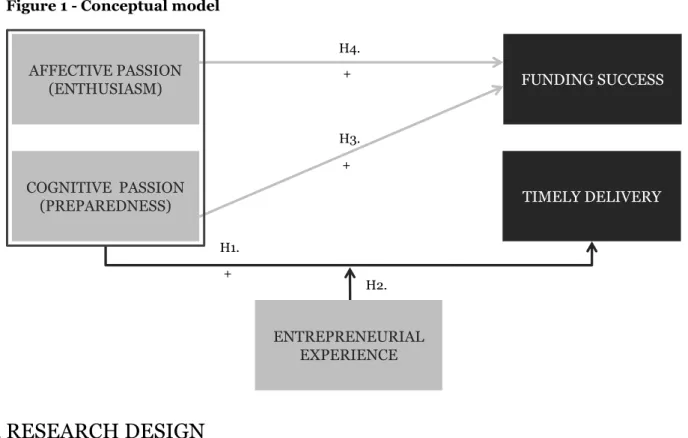
H1. Higher (affective and cognitive) entrepreneurial passion is positively related to timely
delivery.
Many entrepreneurs found more than one venture and many project founders on Kickstarter.com initiate more than one project. Experience gathered through founding ventures creates learning for the entrepreneur (Cope, 2005; Corbett, 2005). Often, subsequent ventures benefit from previous entrepreneurial experience. The entrepreneur has had the opportunity to learn from mistakes he made in the past and can thus try to avoid them in the future (MacMillan, 1986). As a consequence, an entrepreneur’s previous
Having had the opportunity to learn from past mistakes, more experienced entrepreneurs are likely to be better able to translate their passion into the right action which increases their chances of delivering on time. They do so by either being better able to overcome challenges faced, or by avoiding them in the first place. Therefore, I propose the following interaction effect between entrepreneurial experience and entrepreneurial passion.
H2. Entrepreneurial experience moderates the relationship between (affective and cognitive)
entrepreneurial passion and performance such that the link is stronger for high levels of
entrepreneurial experience.
2.2.3Entrepreneurial passion and funding success
Investors base their investment decisions on the attributes of the entrepreneur, the management team and the business opportunity (Cardon, Sudek, et al., 2009). Regarding the attributes of the entrepreneur, the literature has established a link between passion and funding success. This is not surprising, considering the strong correlations identified
between an entrepreneur’s passion and several performance criteria, such as venture growth
and financial metrics. In addition, “passion is often critical to convince the targeted
individuals to invest their money, time, and effort in the new venture” (Chen et al., 2009, p.
199).
Passion is one of the top criteria angel investors look for when evaluating the funding potential of new ventures (Mitteness et al., 2012; Sudek, 2006). In accordance, VCs acknowledge that the difference between successful and unsuccessful ventures, ceteris
paribus, is the entrepreneurs’ capacity for sustained and intense effort, in other words, their passion (MacMillan, Zemann, & SubbaNarasimha, 1987).
during the actual investment phase. Chen et al. report that cognitive passion and not affective passion is positively related to funding success in the context of business plan presentations to VCs. Kirsch and his colleagues support this finding by observing that the cognitive effort that entrepreneurs undertake is more important than the content they produce when it comes to the submission of planning documents to VCs. Mollick’s results show a link between preparedness and funding success in a crowdfunding context.
The literature presented above has shown that sophisticated investors such as VCs and angel investors are aware of the positive link between an entrepreneur’s passion and his
success. Consequently, they include entrepreneurial passion in their investment decision making. In studies that differentiated between the affective and cognitive passion, the cognitive component was more relevant – in some instances more relevant to the point that affective passion even became insignificant. Crowdfunding investors are rational investors as they are able to identify high quality projects (Mollick, 2013). It is therefore reasonable to assume that they, too, will be affected by an entrepreneur’s preparedness. If they are, then it
is consequently quite likely the social process described above as Matthew effect will be set in motion, strongly increasing the likelihood of successful funding.
Conclusively, I state the following hypothesis:
H3. Higher entrepreneurial cognitive passion (preparedness) is positively related to funding
success.
Chen et al., surprised by their finding that affective passion was insignificant, speculated that their sample choice played a role here. The VCs making the funding decisions were all highly educated and experienced individuals trained in public speaking. Therefore they might have been aware of the danger of over-emphasizing positive emotional expression. As VCs are professional investors they might be less impressed by an
entrepreneur’s expression of affective passion and enthusiasm (sometimes also labeled
In addition, as Kickstarter.com employs a donation- and reward-based model of crowdfunding, investors might behave more similar to consumers. Emotions and enthusiasm for a cause play a significant role when it comes to donations (Bradshaw, 1980; Chen et al., 2009). In a crowdfunding model based on rewards and especially pre-ordering, the call for funding strongly resembles a sales pitch directed at consumers. As the return investors aim for when contributing to crowdfunding is either a reward connected to the intended outcome of the project (such as a fan T-shirt) or the outcome itself (i.e. the product or service to be created) they practically buy these rewards or outcomes. Consequently, entrepreneurs try to sell their product and the respective rewards. They do so not by highlighting the financial returns their project is going to generate, which would be of high importance for traditional investors, but by highlighting the benefits of the product or service they are going to create.
For consumers, expressed emotions can serve as organizational attributes (Sutton & Rafaeli, 1988). Since potential investors usually do not meet the crowdfunding entrepreneurs in person they have to rely on other cues. Passion expressed through positively affective project descriptions can therefore influence the image investors have of the venture and its team they are potentially investing in.
Expressed emotions have monetary significance. Smiling waitresses receive more tips and smiling nuns more donations (Bradshaw, 1980; Tidd & Lockard, 1978). Goff, Boles, Bellenger, and Stojack (1997) argue that a consumer’s persuasion is enhanced when a
salesperson demonstrates positive affect as opposed to negative affect and R. A. Baron (2008) proposed that passion increased an entrepreneur’s persuasiveness. As
entrepreneurial passion is contagious for employees (Cardon, 2008) the same might be true for consumers and investors.
pitches they are very likely to behave differently to traditional investors. Not being used to hearing entrepreneurs passionately presenting their ideas might likely lead to crowdfunding investors being influenced and impressed by enthusiasm. In turn, this would start off a Matthew effect rendering enthusiasm a predictor of funding success. I hypothesize the following relationship:
H4. Higher entrepreneurial affective passion (enthusiasm/positive affectivity) is positively
related to funding success.
This study is conducted in a donation- and reward-based crowdfunding context. Affective passion is likely to be more relevant than cognitive passion when it comes to asking for donations. In a reward-based and especially pre-ordering crowdfunding model the funding process resembles more a sales pitch than a traditional funding pitch. As traditional investors do not seem to highly rank enthusiasm in their decision process, yet consumers do, I further propose:
H5. Affective passion will be more predictive of funding success than cognitive passion.
I have to note that projects are not necessarily limited to one entrepreneur but can also be driven by a team. However, for the traits expressed on Kickstarter and consequently for what potential investors can perceive, this does not matter. As Sutton and Rafaeli (1988) have argued, displayed emotions can serve as organizational attributes. The question is, do investors look for these traits and use them in their funding decision?
2.2.4Conceptual model
Figure 1 - Conceptual model
3
RESEARCH DESIGN
3.1
Methodology
To answer the research question and related sub-questions an explanatory, causal ex-post facto study design was implemented. The study is cross-sectional, in the sense that data for each case was collected at one point in time and as each crowdfunding campaign in the sample was completed. The study builds upon primary data collected directly from the sampled crowdfunding platform, Kickstarter.com. Hierarchical logistic regression was applied for both binary dependent variables, timely delivery and funding success. Logistic regression helps understand what factors influence whether the funding of a project will be successful and whether the project will deliver on time. The hierarchical approach allows assessing whether a block of predictive variables performs better in explaining the variance of the binary dependent variable than the control variables alone. All of the variables were derived directly from information accessible online. The only exception is positive affectivity, which is assessed through the thesaurus-based Linguistic Inquiry and Word Count (LIWC) program.
COGNITIVE PASSION (PREPAREDNESS)
FUNDING SUCCESS
TIMELY DELIVERY
AFFECTIVE PASSION (ENTHUSIASM)
H4.
H3. +
+
H1. +
H2.
3.2
Research setting and sample choice
This research is based on the crowdfunding platform Kickstarter.com, which, due to its success in igniting entrepreneurship, has also been the inspiration for the JOBS act in the U.S. (Franzen, 2012). It is currently the largest and most dominant of all crowdfunding platforms having raised over $900 million and funded over 55,000 projects since its launch in April 2009. On Kickstarter, reward- and donation-based crowdfunding is used to finance creative and entrepreneurial projects grouped into 13 categories: Art, Comics, Dance, Design, Fashion, Film & Video, Food, Games, Music, Photography, Publishing, Technology, and Theater. For tax purposes, Kickstarter requires project founders to be based in the US or UK, but poses no geographical restrictions on investors. Appendix A.2 displays an illustrative Kickstarter project highlighting major elements.
Creators (as Kickstarter refers to its project initiators) are almost free to propose any project they want. Kickstarter only imposes a small number of restrictions, one of them being that the crowdfunding initiative needs to be a project with explicitly specified goals, start and end dates. Excluded are crowdfunding for charities, causes and general business expenses. Founders can choose the funding goal they wish to secure and the funding period, which usually ranges from 30-60 days. Founders are encouraged to write a thorough project description and to provide videos, pictures and frequent updates throughout the funding period. In addition, founders define different reward categories. For a certain amount an investor contributes he receives a pre-defined reward, which can range from a simple recognition as a backer, over tangibles such as a fan t-shirt or the product to be created, to special versions of that product combined with preferred treatment and involvement in the
product’s design. Founders need to choose the funding goal wisely as the fundraising model is “all or nothing” (Etter et al., 2013). Once the deadline is reached the funding goal has to be achieved, otherwise the project is considered a failure and no money is exchanged. If the
amount pledged is at least as high as the funding goal, all of the investors’ money including
Kickstarter provides an ideal setting for this research and the related research questions. Although it includes elements of donation-based crowdfunding, on Kickstarter investors are largely remunerated with tangible, non-financial rewards. In addition, the setup of the Kickstarter platform captures the conceptual model and grants access to the necessary data (see Section 3.4). Of all categories, Kickstarter’s Design projects are an especially attractive sample with regard to this study for two main reasons. Firstly, in the Design category tangible products are to be created. Kickstarter therefore requires founders to commit to a delivery date before the launch of their crowdfunding campaign. Once the project is finished it is usually possible to assess whether the founder was able to deliver as promised, or whether delivery was delayed. Secondly, design projects are attractive because they minimize the importance of donations and focus mostly on pre-ordering as a reward form. It is therefore as close as possible to pure reward-based crowdfunding, the crowdfunding model this research aims to investigate. I chose to limit my sample to projects of the Design category that ended between 29th August and 30th September 2013 which
provided a list of 255 projects, once I deleted a project that was created as a test from the sample. For projects that ended at the 30th of September at the latest, there was a high
chance that their promised delivery date had already passed at the date of data collection allowing me to assess whether any delays had occurred.
3.3
Data collection
function to gather the original Kickstarter project URLs for each Design project, both successful and unsuccessful, that ended between 29th August and 30th September 2013.
I used the web scraping software Helium Scraper to collect most of the required information directly from the Kickstarter website. Some information was collected and coded manually. After having identified the founders with multiple projects I manually collected and coded previous experiences that each founder had. After that, I gathered the information whether the successful projects were delivered on time as planned and promised. By considering information available in updates and comments I tried to assess whether successful projects delivered on time. This was possible for most of the successful projects. I also used Helium Scraper to download the text of the project descriptions, which was then analyzed using Linguistic Inquiry and Word Count (LIWC).
3.4
Variables, measures and sample statistics
Compared to traditional investors, crowdfunding investors usually do not get to meet the project founders personally. They have to rely upon signals of passion visible on Kickstarter.com. These are mainly the language and style used to present the project, the effort displayed by posting many updates, etc. While these sources enable the expression of affective and cognitive passion they do not allow for the observation of behavioral passion (commitment) of entrepreneurs. Thus, the variables regarding passion are based on expressed passion, which has to be differentiated from the passion experienced by the entrepreneur and passion, as it is actually perceived by investors. I have to note that, even though passion is assessed through information created at the beginning of the project, it is likely to stay the same throughout the project, as passion is stable rather than temporary (Cardon, Wincent, et al., 2009). Following, I will present the variables used in the analyses testing my hypotheses.
Funding goal
achieved completely and no money is transferred. If set too low, the money raised might not be enough to ensure effective implementation of the project resulting in delay or non-delivery. Since part of the projects were from UK-based founders I had to convert the currency to USD using the exchange rate of 1 British pound = $1.6207. The average funding goal was at about $25,000 and ranged from $162 to $300.000.
Funding duration
The funding duration is the timeframe during which investors can pledge money to a project. Kickstarter allows durations from 1 to 60 days, but recommends 30 days. A shorter funding duration might increase pressure on potential investors and influence funding success (Kuppuswamy & Bayus, 2013). Funding duration averaged 35 days.
Funding success
Basically, there are two ways to measure funding success: Either as a binary variable, indicating whether the predefined funding goal was reached, or as the ratio between the achieved funding and the funding goal.
Funding success ratio
The funding success ratio measures how much of the funding goal has been achieved and ranges from 0% to well above 3,000% in my sample. On average the success ratio was at 179% for all projects, 380% for successful and 16% for non-successful ones. Especially the funding success ratio of successful projects is in stark contrast to what has been found before. Kuppuswamy and Bayus (2013) report that more than half of the successful projects remained within 110% of their initial funding goal. Mollick (2013) reports statistics by category, showing that on average Design projects tend to have a significantly higher funding success ratio. This high rate of over-funding might be explained by the pre-ordering nature of most Design projects. In other categories, overfunding might not benefit the investor as much as it does in pre-ordering. In a crowdfunded movie, for instance, the movie will be produced whether the funding is successful at 100% or 300%. There is no difference for the investors, i.e. there is no incentive for over-funding. If investors are pre-ordering products, they are incentivized to invest as much as is necessary to buy the product. If many investors want to buy the product, over-funding is likely to happen.
Timely delivery
In Kickstarter’s Design category, project founders need to commit to an estimated calendar
month in which they promise to deliver rewards. Each reward category can have a different delivery date. Founders have to define the estimated delivery date at the inception of the project and it cannot be changed later. The binary variable timely delivery measures whether a project delivered as promised or not. For some projects the delivery date lay in the future, and some projects did not show a clear indication as to whether delivery was as scheduled, which resulted in a number of missing values. Of all 90 projects that I was able to code 54% delivered late –a figure considerable lower than Mollick’s reported 75%.
Affective entrepreneurial passion/enthusiasm
positive emotions. This score is derived through the ratio between total word count of the text and words that are linked to positive emotions (Pennebaker, Francis, & Booth, 2001; Tausczik & Pennebaker, 2010). It ranges from 0% to theoretically 100%. Positive emotions measures the use of words related to positive emotions and expresses the degree of immersion (Holmes et al., 2007; Tausczik & Pennebaker, 2010). It therefore reflects well the positive affectivity related to affective passion. An average project description contained 3.9% words expressing positive emotions.
Cognitive entrepreneurial passion/preparedness
Early updates
A founder’s preparedness can easily be perceived through the number of early updates he provides to (potential) investors. Kickstarter encourages project founders to post project updates soon after the launch as they are a clear signal of a prepared founder. The majority of investors tend to pledge money in later stages of the funding process (Kuppuswamy & Bayus, 2013), thus there is no conflict of causality.
Early updates have been defined as project updates posted by the founder within the first 10% of the funding duration time. For an update to be classified as an early update in a project with 60 days of funding it therefore has to have been posted within the first 6 days. 116 of the 255 projects provided early updates, with an average of .74 per project and a maximum of 6.
Risk analysis
Therefore, the word count of the Risks and Challenges section on Kickstarter.com serves as a proxy to the due diligence of risk analysis and management.
Pictures
Next to providing a video, which 90% of projects do, entrepreneurs can also include pictures into their project description. There is no limit as to how many images can be uploaded into the project description. Pictures can be photographs, e.g. of product prototypes, rendered images, e.g. of how the project could look like in the end, drawings, e.g. sketches of the product, tables, e.g. to graphically depict the project plan, or small images to increase the visual attractiveness of the project description. The provision of a picture signals preparedness and cognitive passion. Either, the entrepreneur creates the pictures himself, e.g. by taking a photograph or by digitally rendering an image. To do so, the entrepreneur has to think about what he wants to display, how he wants to display it and then create the image. Obviously, there is cognitive effort involved. Instead of creating an image himself, the entrepreneur can also use existing ones. Also in that case, cognitive effort is involved as the entrepreneur needs to define what he wants to depict, search for adequate images, decide among multiple options, etc. The more images an entrepreneur includes, the more cognitive effort is involved and the higher his cognitive passion and preparedness appears to be. In total, 96% of projects used pictures with an average of 13 pictures per project and a maximum of 68.
Entrepreneurial experience
Social network size
Kickstarter’s platform provides founders with the option to connect a Facebook account to
their Kickstarter account. Since social networks play an important role in funding new ventures it is not surprising that the size of a founder’s Facebook network, measured as
number of friends, helps predict his success (Mollick, 2013). 144 projects were connected to a Facebook account, with an average of 433 friends.
Reward categories
The rewards serve as a non-monetary payback to investors. The number of different rewards promised to investors, represented by the number of reward categories, is an interesting variable. With a rising number of rewards investors can choose from their interest might be influenced. Simultaneously, complexity might increase challenging delivery. The average project offered 9 different rewards to its investors, ranging 1 from to 51.
4
DATA ANALYSIS AND RESULTS
4.1
Control variables
The focus of this research is entrepreneurial passion and how it is related to funding success and timely delivery. Therefore, I controlled for a number of other effects that potentially play a role for both dependent variables. Regarding delivery, it has been shown that chances for
being on schedule get reduced the larger the project is, represented by the project’s funding
goal. This effect is mainly due to the rising complexity of bigger projects (Mollick, 2013). Following the same logic, an increasing funding success ratio diminishes the probability of timely delivery. When a project is highly overfunded, the number of rewards the project founder has to deliver rises strongly compared to what he anticipated at project inception. I also controlled for the number of reward categories as it is likely that the increasing complexity of having to deliver many different rewards diminishes chances of a punctual delivery.
experience. Not surprisingly, previous research has shown that a higher funding goal diminishes chances of successful funding (Kuppuswamy & Bayus, 2013). Owing to social effects among backers, the funding duration also has an influence on success probability (Ibid.). In addition, it has been shown that a larger social network of the founder increases his odds of securing the required funding (Mollick, 2013). Further, the number of reward
categories that investors can choose from can influence a project’s attractiveness
(Kuppuswamy & Bayus, 2013). Finally, I also controlled for entrepreneurial experience, as past success is likely to be predictive of future success.
4.2
Data preparation
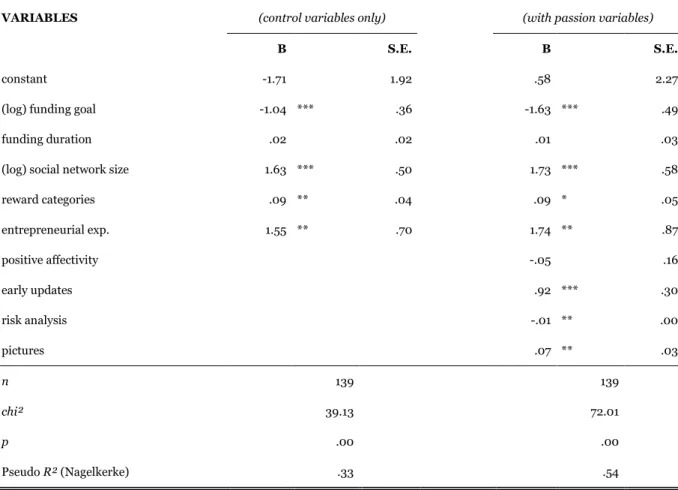
Prior to analysis, the relevant variables funding success, timely delivery, funding goal, funding duration, social network size, reward categories, entrepreneurial experience, positive affectivity, early updates, risk analysis and pictures were examined for accuracy of data entry, missing values, and fit between their distributions and the assumptions of multivariate analysis, specifically logistic regression.
cases-predictors ratio of 11.4:1, satisfying the recommended minimum of 10:1. The ratio between valid cases and predictor variables is at 15.4:1 for the models relating to funding success.
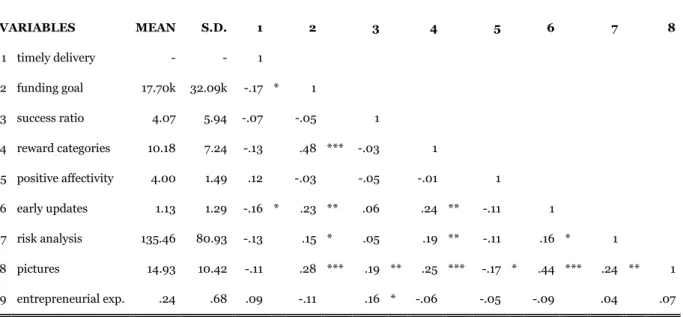
Table 1 - Means, standard deviations and correlations: Timely delivery
VARIABLES MEAN S.D. 1 2 3 4 5 6 7 8
1 timely delivery - - 1
2 funding goal 17.70k 32.09k -.17 * 1
3 success ratio 4.07 5.94 -.07 -.05 1
4 reward categories 10.18 7.24 -.13 .48 *** -.03 1
5 positive affectivity 4.00 1.49 .12 -.03 -.05 -.01 1
6 early updates 1.13 1.29 -.16 * .23 ** .06 .24 ** -.11 1
7 risk analysis 135.46 80.93 -.13 .15 * .05 .19 ** -.11 .16 * 1
8 pictures 14.93 10.42 -.11 .28 *** .19 ** .25 *** -.17 * .44 *** .24 ** 1
9 entrepreneurial exp. .24 .68 .09 -.11 .16 * -.06 -.05 -.09 .04 .07
n = 91;*p<.1; **p<.05; ***p<.01
The search for univariate outliers, defined as at least three standard deviations away
from the mean (z value
≥
3), delivered 41 values, which upon closer inspection wereconfirmed as genuine observations as no data entry or measurement errors were responsible. In a sample of 255 cases and multiple variables 41 potential outliers represent less than 2% of total values. In logistic regression analysis the detection of influential cases is more appropriate than the detection of outliers (Jennings, 1986). Therefore, the decision was made to keep them in the sample. To identify influential cases and multivariate outliers,
Cook’s Distance and the standardized residuals were calculated for each case. None of the
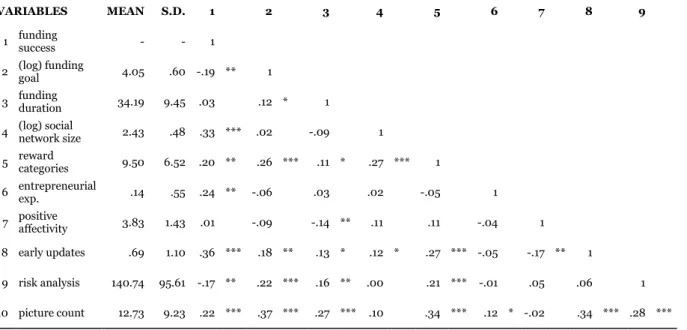
Table 2 - Means, standard deviations and correlations: Funding success
VARIABLES MEAN S.D. 1 2 3 4 5 6 7 8 9
1 funding success - - 1
2 (log) funding goal 4.05 .60 -.19 ** 1
3 funding duration 34.19 9.45 .03 .12 * 1
4 (log) social network size 2.43 .48 .33 *** .02 -.09 1
5 reward categories 9.50 6.52 .20 ** .26 *** .11 * .27 *** 1
6 entrepreneurial exp. .14 .55 .24 ** -.06 .03 .02 -.05 1
7 positive affectivity 3.83 1.43 .01 -.09 -.14 ** .11 .11 -.04 1
8 early updates .69 1.10 .36 *** .18 ** .13 * .12 * .27 *** -.05 -.17 ** 1
9 risk analysis 140.74 95.61 -.17 ** .22 *** .16 ** .00 .21 *** -.01 .05 .06 1
10 picture count 12.73 9.23 .22 *** .37 *** .27 *** .10 .34 *** .12 * -.02 .34 *** .28 ***
n = 139; *p<.1; **p<.05; ***p<.01
Further, the Box-Tidwell procedure was performed to test the linearity assumption of logistic regression analysis (Box & Tidwell, 1962). The results indicated that funding goal and social network size were not linearly related to the logit of funding success. Subsequently, logistic transformation was performed on both variables. As a consequence, all variables fulfilled the requirements of linearity and homoscedasticity. As logistic regression, contrary to linear or multiple regression, does not require multivariate normally distributed predictor variables, this was of no concern. Logistic regression further assumes the absence of multicollinearity among predictors. To test for that, I ran collinearity diagnostics and checked the respective correlation tables (see Table 1 and 2). None of the independent variables show a correlation larger than .7, indicating that multicollinearity is not present.
4.3
Results: Timely delivery
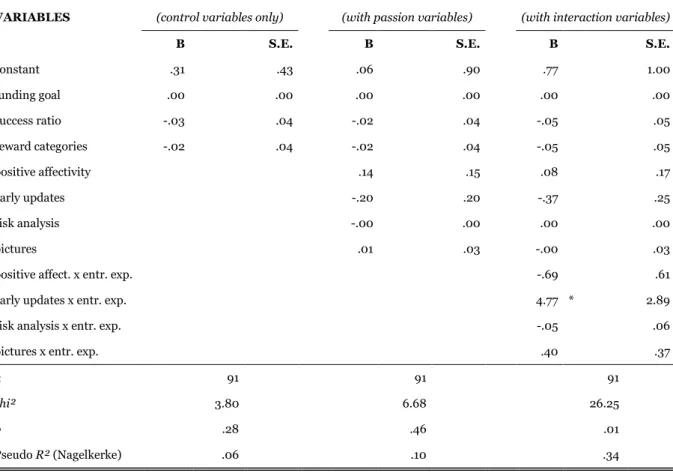
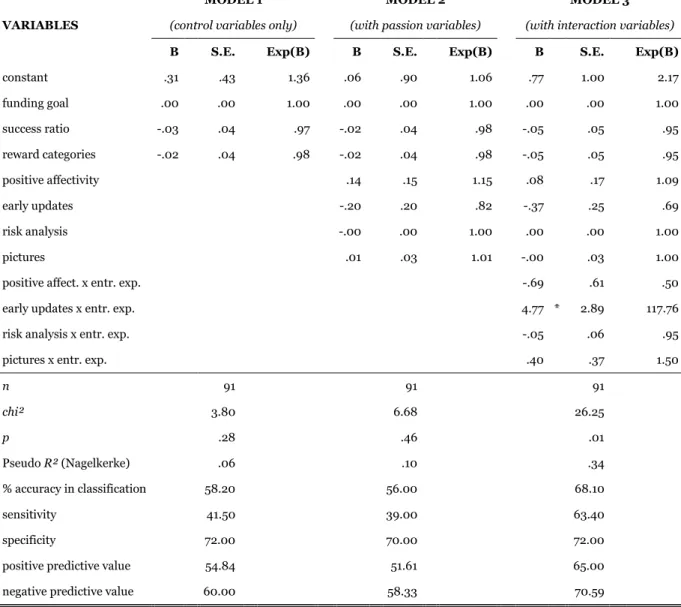
First, I only included the control variables funding goal, funding success ratio and reward categories (Model 1). Neither of the control variables nor the model in total was significant (funding goal: B = .00; p > .1; funding success ratio: B = -.03; p > .1; reward
categories: B = -.02; p > .1; Model 1: χ2(3) = 3.796, p > .1). Model 1 explained 5.5%
(Nagelkerke R2) of the total variance. Next, the predictor variables positive affectivity, early
updates, risk analysis and pictures were added to the regression (Model 2). Hypothesis H1 was not supported as neither of them was significant for explaining the variance in timely delivery (H1: positive affectivity: B = .14; p > .1; early updates: B = -.20; p > .1; risk analysis:
B = -.00; p > .1; pictures: B = .01; p > .1). Also, this model was not significant (Model 2: χ2(7)
= 6.675, p > .1) and explained 9.5% (Nagelkerke R2) of the variance in timely delivery.
Table 3 - Logistic regression: Timely delivery
MODEL 1 MODEL 2 MODEL 3
VARIABLES (control variables only) (with passion variables) (with interaction variables)
B S.E. B S.E. B S.E.
constant .31 .43 .06 .90 .77 1.00
funding goal .00 .00 .00 .00 .00 .00
success ratio -.03 .04 -.02 .04 -.05 .05
reward categories -.02 .04 -.02 .04 -.05 .05
positive affectivity .14 .15 .08 .17
early updates -.20 .20 -.37 .25
risk analysis -.00 .00 .00 .00
pictures .01 .03 -.00 .03
positive affect. x entr. exp. -.69 .61
early updates x entr. exp. 4.77 * 2.89
risk analysis x entr. exp. -.05 .06
pictures x entr. exp. .40 .37
n 91 91 91
chi² 3.80 6.68 26.25
p .28 .46 .01
Pseudo R² (Nagelkerke) .06 .10 .34
*p<.1; **p<.05; ***p<.01
Finally, I added the variables that related to the interaction of the four predictor variables and entrepreneurial experience (Model 3). This model was significant (Model 3: