Fisioter. Mov., Curitiba, v. , n. , p. - , Jan./Mar. Licenciado sob uma Licença Creative Commons DO): http://dx.doi.org/ . / - . . .AO
[T]
Effects of non-invasive ventilatory support in tolerance
to the effort of patients with hemodialysis
Suporte ventilatório não invasivo na tolerância
ao esforço de pacientes hemodialisados
Nathalie Cortez Bezerra de Medeiros[a], Joelson dos Santos Silva[a], Nayara Priscila Dantas de Oliveira[a], Ananília Regina Silva Cavalcante[a], Carolina Taveira Gonçalves[a], Karla Luciana Magnani[a, b]*
[a] Universidade Federal do Rio Grande do Norte, Faculdade de Ciências da Saúde do Trairi FAC)SA/UFRN , Santa Cruz, RN, Brazil
[b] Universidade Estadual Paulista UNESP , São Paulo, SP, Brazil
Abstract
Introducti on: The kidney system is responsible for the maintenance of homeostasis and in patients with
Chronic Kidney Disease the kidney functions changes, contributing for the development of various complica-tions that will have adverse effects in tolerance to the physical exercise and in Quality of Life of this patients.
Objective : To evaluate the Effects of non-invasive ventilatory support in tolerance to the patients’
physi-cal exercise in dialysis. Methods: Th e patient s performed two -minute walk tests, following an adapted
protocol for treadmill, one of them without the use of non-invasive ventilatory support and the other with non-invasive ventilatory support during the walk. Besides, th e patients answered a questionnaire of quality of life and the KDQOL-SFTM speci ic for the population under study. Results: )t was noti ced that there was
not statistical difference in the distance recorded during the -minute walk tests. Regarding t he quality of life, the greater impact of the disease was in relation to Professional Activity . Conclusion: )n conclusion , a
non-invasive ventilatory support did not cause signi icant effects in tolerance to the exercise of this popula-tion. (owever, we should take into consideration the limitations suffered during the research development.
Keywords: Chronic Kidney Failure. Quality of Life. Tolerance to the Exercise.
* NCBM: Master Student, e-mail: nath isio @gmail.com JSS: BS, e-mail: [email protected] NPDO: MS, e-mail: nayoliveira. [email protected] ARSC: BS, e-mail: [email protected]
Resumo
Introdução: O sistema renal é responsável pela manutenção da homeostasia do corpo e, em pacientes com Doença Renal Crônica a função dos rins se altera, contribuindo para o desenvolvimento de várias complicações que inϔluenciarão negativamente na tolerância ao exercício ϔísico e na qualidade de vida destes pacientes. Objetivo: Avaliar os efeitos do uso da ventilação mecânica não invasiva na tolerância ao exercício ϔísico de pacientes em tratamento dialítico. Métodos: Os pacientes realizaram dois testes de caminhada de seis minutos, seguindo um protocolo adaptado para esteira, sendo um teste sem o uso da ventilação não invasiva e outro teste com ventilação não invasiva durante a caminhada. Além disso, os pacientes responderam um questioná-rio de qualidade de vida o KDQOL-SFTM especíϔico para a população estudada. Resultados: Foi observado que não houve diferença estatística na distância percorrida durante os testes de caminhada em esteira. Em relação à qualidade de vida, o maior impacto da doença foi em relação à “Atividade Proϔissional”. Conclusão: Em con-clusão, a ventilação não invasiva, não causou efeitos signiϔicativos na tolerância ao exercício desta população, porém, devem-se levar em consideração as limitações sofridas durante o desenvolvimento da pesquisa.
Palavras-Chave: Falência Renal Crônica. Qualidade de Vida. Tolerância ao Exercício.
Introduction
The Chronic Kidney Disease CKD is determined by the loss of glomerular, tubular and endocrine func-tion of kidneys in a progressive and irreversible way
, . With its progression, kidneys become unable to maintain the normal functioning of body systems , requiring the treatment of renal replacement .
The number of patients on dialysis and served by SUS in the country has grown in the past few years, con-tributing to characterize this disease as a public health problem . According to Census from Brazilian Society of Nephrology BSN , currently there are . Brazilians on dialysis per year, considering that . % of services are carried out by SUS .
The kidney system is responsible for the mainte-nance of homeostasis, removing toxic substances and wastes, and for the hormone production. With its func-tion changed by CKD, patients are more prone to sys-temic arterial hypertension, water retention, anemia
and musculoskeletal disorders , including the respiratory musculature . Patients may develop a generalized muscle weakness, affecting negatively on the tolerance to physical exercise and on the quality of life QL of patients , .
The functional capacity of these individuals is pre-carious, damaging both the performance of physical activities and the development of their daily life activi-ties . One way to measure the functional status of patients is to perform a -minute walk test WT , in addition to providing information regarding cardiore-spiratory responses to the exercise . This test can
be performed on a treadmill tread WT when there is no runner available or the necessity of a more speci ic monitoring of the patient .
The utilization of non-invasive ventilatory support N)V can improve tolerance to the exercise, as it im-proves the cardiorespiratory response during the exer-cise . The usage of this therapeutic modality is in-dicated in acute respiratory failure, chronic obstructive pulmonary disease COPD , acute pulmonary edema, congestive heart failure C(F , among other situa-tions. (owever, there are no studies regarding the usage of N)V in patients with CKD. )n this sense, this study aims to estimate the usage effects of non-invasive ventilatory support in the tolerance to the effort in the treadmill -minute walk test of patients in dialysis. Furthermore, this study proposes an evaluation of pulmonary function and the quality of life in patients with CKD in dialysis.
Methods
Study description, population and sample
153 best curves respected the description of the method proposed by Neder et al. .
Experimental protocol
After performed the initial evaluation, patients un-derwent two tread WT. Tests occurred in every other day and their order was drawn for each patient. Each test occurred as follows:
Test tread WT without N)V : )nitially, the follow-ing were measured: systemic arterial pressure AP at rest, peripheral heart rate (R at rest, respiratory rate R at rest, oxygen peripheral saturation O Ps at rest and the sensation of effort through the noticed effort scale of BORG . Afterwards, a tread WT was ac-complished. During the test, parameters AP, (R, R and O Ps and Borg were monitored. )n the second, fourth and sixth minutes. After ive minutes from the end of the tread WT, the same variables were measured again, in order to verify the return of vital signs to pre-test values.
Test N)V during the tread WT : This phase was similar to phase — the only modi ication was the use of N)V by positive pressure of two levels bilevel during the tread WT.
The AP at rest, during and at the end of tests was measured indirectly through the aneroid sphygmoma-nometer and Premium® stethoscope. The (R and O Ps at rest, during and after the test, were measured using a digital pulse oximeter Solmedica® MD C . An evalu-ator measured the R during the Test , with the hand placed next to the nose of the individual and, during the Test that was obtained through the device of N)V.
The device used to generate the non-invasive ventilatory support was the B)PAP® Synchrony )) — Respironics. The inspiratory positive airway pressure )PAP was the minimum that guaranteed the patient a tidal volume of - ml/Kg; the expiatory positive air-way pressure EPAP was the minimum that guaranteed an O Ps of - %.
Analysis of Quality of Life
)n order to evaluate the QL of patients, the Kidney Disease and Quality-of-Life Short-Form KDQOL-SFTM . was used, which is a speci ic tool that evaluates individuals with CKD, applicable to patients undergoing some kind of dialysis program. By including issues relat-ed to generic and speci ic aspects of the kidney disease, it can be considered the most complete questionnaire available nowadays to evaluate the QL of patients with Committee in Research from the Federal University of
Rio Grande do Norte, under the number . / , following the guidelines of the Resolution / , from the National (ealth Council.
)nclusion criteria were established: individuals of both sexes, with diagnosis of CKD, in dialysis and with medical permission for executing the research protocol provided by the cardiologist participant in the research. Patients with cognitive impairment, presenting any kind of limitation orthopedic, musculoskeletal, rheuma-tologic, cardiopulmonary or neurological that could prevent tests accomplishment, and other clinical condi-tions that could be exacerbated by physical effort were excluded from the sample.
Procedure for data collection
)nitially, all patients signed an )nformed Consent Document )CD , attesting to be aware and in agreement of procedures performed during the study. Moreover, indi-viduals underwent a cardiac evaluation, so that they could be released to perform tests suggested in the protocol.
The research occurred in three distinct phases, performed every other day. The irst phase is the ex-ecution of an assessment anamnesis and physical exam and pulmonary function tests spirometry and manovacuometry . The other two phases consisted in the execution of a tread WT in two distinct situations, following the protocol suggested by Camargo et al. . The initial speed was km/h, and may be increased by km/h every seconds, depending on the patient tol-erance, reaching a maximum of km/h, or if requested to be reduced, this would be done in , km/h in every request. Tests in a treadmill was performed without inclination. )n order to obtain the value of the forecasted traveled distance for each patient, a formula proposed by )wama et al. was used. Phases were executed always at the same time and the room temperature was kept always in ºC.
Pulmonary function tests were obtained through the device Koko Legend Spirometer — Nspire, fol-lowing the recommendations of Pereira and Silva et al. . Predicted values were calculated according to the reference of normality established by Pereira et al. .
CKD. Thr KDQOL-SFTM consists of items, divided into dimensions and, includes the SF- more items related to CKD .
The score of each item of this tool varies from zero to , with the higher values as a re lection of a better QL .
Statistical Analysis
Obtained data were analyzed through descriptive and inferential statistic, using the SPSS v. for Windows as a program. The statistic relevance will be considered for p-with a value of less than or equal to , . A general-ized estimating equation GEE was performed.
Results
Six patients with CKD in dialysis composed the inal sample of this study. The majority were women . % and the age average was . years-old ± . . Fifteen individuals did not participate in the re-search because they were framed in some of the exclu-sion criteria, refusal or death Table . All patients were treated by hemodialysis and the average time of dialysis, in months, was . ± . .
Table 1 - General Characteristics of the Sample Studied
Characteristics n %
Sample
Initial Sample 21 100
Final Sample 6 28.57
Sex Men 2 33.33
Women 4 66.67
Reasons of the sample loss
Death 1 6.67
Refusal 8 53.34
Physical Limitation 5 33.34
Other (Severe Anemia) 1 6.67
The variables of spirometry, max)P and maxEP were analyzed using descriptive statistic in order to charac-terize the pulmonary function of the sample and the results are shown in Table .
Table 2 - Sample Characterization according to Pulmonary Function
Pulmonary Function n %
Spirometry
Restrictive Ventilatory Disorder 3 60
Normal Spirometry 2 40
Respiratory Muscle Strength maxIP
Normal 2 33.33
Reduced 4 66.67
maxEP
Normal 4 66.67
Reduced 2 33.33
Note: maxIP (Maximum Inspiratory Pressure ); maxEP (Maximum Expiratory Pressure).
The distance traveled in the tread WT had an aver-age of . m ± . m , however, but none of the patients in this study were able to reach the individual expected distance for the tread WT. There was no sig-ni icant statistic difference between distances traveled and in the tread WT without N)V and with N)V, as de-scribed in Table .
Table 3 - Distance traveled in tread6WT and comparative analysis of both tests
Treatment Average EstimativeStandard
Error p -value CI 95%
Without NIV x With NIV
- -28.0608 14.86753 0.118
-Tread6WT
Without
NIV 390.5125 - 6.45413
-378.0653 : 403.3694
With NIV 362.4517 - 8.46944
-346.2263 : 379.4375
Note: p-value = 0,05; CI (Confi dence Interval).
155 The )PAP of each patient was the minimum to
guar-antee a tidal volume TV of - ml/kg, the average of pressures used in this sample was cm( O. The EPAP of each individual was to guarantee a SpO of - %, the average of pressures used in this study was cm( O.
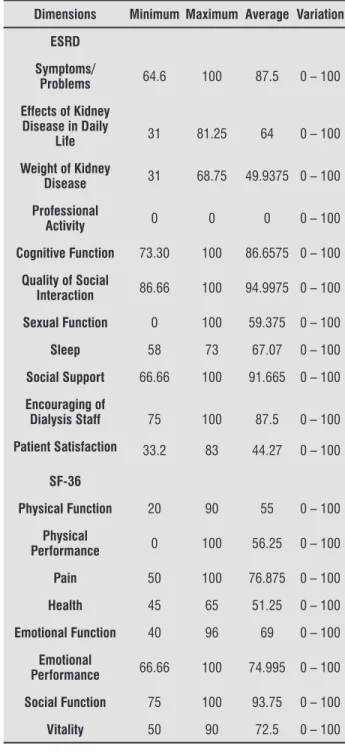
Tabela 4 - Descriptive Evaluation of Quality of Life of the sample studied
Dimensions Minimum Maximum Average Variation
ESRD
Symptoms/
Problems 64.6 100 87.5 0 – 100
Effects of Kidney Disease in Daily
Life 31 81.25 64 0 – 100
Weight of Kidney
Disease 31 68.75 49.9375 0 – 100
Professional
Activity 0 0 0 0 – 100
Cognitive Function 73.30 100 86.6575 0 – 100
Quality of Social
Interaction 86.66 100 94.9975 0 – 100
Sexual Function 0 100 59.375 0 – 100
Sleep 58 73 67.07 0 – 100
Social Support 66.66 100 91.665 0 – 100
Encouraging of
Dialysis Staff 75 100 87.5 0 – 100
Patient Satisfaction 33.2 83 44.27 0 – 100
SF-36
Physical Function 20 90 55 0 – 100
Physical
Performance 0 100 56.25 0 – 100
Pain 50 100 76.875 0 – 100
Health 45 65 51.25 0 – 100
Emotional Function 40 96 69 0 – 100
Emotional
Performance 66.66 100 74.995 0 – 100
Social Function 75 100 93.75 0 – 100
Vitality 50 90 72.5 0 – 100
Note: ESRD (Scales Related to Kidney Disease); SF-36 (Short Form Health Survey).
Discussion
During this study, a treadmill walk test protocol was adopted, proposed by Camargo et al. . An ergometer was used to perform the test because the N)V device available was not portable, making impossible to per-form a conventional walk test.
Patients with CKD develop changes in several body systems, characterizing the uremic syndrome. Among these changes, we can ind atrophy and weakness of skeletal muscles, which are clinical manifestations of uremic myopathy. The muscles responsible for breath-ing may have their strength and resistance decreased during the myopathy, once these muscles are classi ied as skeletal , - .
)n this study, it was veri ied that max)P was re-duced in most of the sample . % . )t was also ob-served that maxEP was reduced in a part of the sample
. % . These results are similar to those found by Cury et al. , which compared the max)P and maxEP among dialyzed patients DG , transplanted TG and one control group CG . When the DG was compared with the CG, it was observed a reduction in both max)P and maxEP. When comparing the DG with the CG, it was observed a reduction in both max)P and maxEP. When comparing DG with the TG, the max)P of the DG also presented a reduction, and compared with the CG, the TG presented a disposition for low max)P and maxEP. Dipp et al. , evaluated individuals and found a reduction in maxEP of . % in relation to predicted values. (owever, the max)P presented no statistical dif-ference. )n the study of Kovelis , it was analyzed patients with CKD and authors observed no signi icant alteration in max)P and maxEP, which is different from the indings of this study.
This change of strength regarding musculature af-fects the function of the respiratory system and contrib-utes to the reduction of pulmonary capacity . Besides, the de icient pulmonary function of these patients can be a direct result of the increase of uremic toxins cir-culation, or can be indirectly affected by the volume overload, anemia, immunosuppression, heterotopic calci ication, malnutrition, electrolytic disorders and acid-basic unbalance .
modality improves the performance of patients, as shown by Lima et al. , in a sample of patients with C(F, the use of N)V through the CPAP increased the dis-tance traveled in the WT when compared to the control group that made no use of N)V. Costa et al. studied the use of N)V through the do Bipap® in patients with COPD and observed an increase in the distance traveled in the WT after the use of this therapeutic modality.
Conclusion
)t can be observed that patients with CKD pres-ent pulmonary disorders and reduction of their QL. Alterations in the pulmonary system of patients in this sample were discreet, but contribute directly for the reduction of their functional capacity, as well as the low QL presented by them.
The use of N)V through the Bipap® during the tread-WT cased no signi icant effects in the tolerance to the physical exercise of patients with CKD. Some study limi-tations may have contributed to these results: reduced sample size, patients’ familiarity with the ergometer used and clinical pro ile insigni icant cardiorespira-tory limitations . Furthermore, this was the irst study regarding effects of N)V in tolerance to the exercise in patients with CKD.
)n this sense, it is suggested to perform other studies with larger samples, and composed by patients with different compromising levels of functional capacity, in order to investigate the effects of N)V in patients with CKD, and to observe there is any impact in pulmonary function and QL of individuals.
References
. Cury JL, Brunetto AF, Aydos RD. Efeitos negativos da insuficiência renal crônica sobre a função pul-monar e a capacidade funcional. Braz J Phys Ther.
; : - .
. Morsch C, Veronese FJV. Doença renal crônica: de i-nição e complicações. Rev (CPA. ; : - . . National Kidney Foundation. Sobre )nsu iciência
Re-nal Crônica. Guia para Pacientes e Familiares. [cited Sep ]. Available from: http://tinyurl. com/hmx env.
MVD . Cury et al. showed that in the group of in-dividuals undergoing dialysis, individual presented a MVD and were classi ied as presenting a RVD, in the group of transplanted only individual presented a RVD and the sample remaining presented no alteration in the spirometry.
The dialysis routine of patients with CKD has im-pact in the QL, mainly harming physical capacity and performance of daily activities, increasing sedentary habits and thus increasing the risk of mortality , .
)n this study, best results in the QL question-naire were observed in the ield of Quality of Social )nteraction , Social Support and Social Function . Similar to the indings of this research, the results found by Coutinho et al. and Fahur et al. . Schardong et al. , through the analysis of QL from patients with CKD, found that the worst scores in the KDQOL-SFTM questionnaire were seen in the ield of Overload of Kidney Disease and Professional Role , which supports the indings of this research that, in his evaluation, found that the ield with lower score in the same questionnaire was to Professional Role . Some studies describe this same result regarding Professional Role - .
The reduction of functional capacity is related to a number of factors such as cardiopulmonary and musculoskeletal changes, among others. These factors characterized the uremic syndrome and leads to dys-pnea, fatigue, anemia, muscular weakness among other alterations , .
When evaluated the functional capacity of patients with CKD through the tread WT, it was observed that none of them reached the expected value of the indi-vidual distance traveled. Lima et al. , evaluated pa-tients with CKD before and after the program during the tread WT. Regarding their functional capacity, it was observed that values obtained in the WT were signi icantly lower than the predicted values for this population. Cury et al. observed that there is a ten-dency for individuals with CKD to obtain lower results in comparing the expected with the general population. Faria et al noticed that only one individual from the sample, after the WT, presented a lower result than the expected in the walk test, and the other patients achieved the expected values.
157
. Pezzini CA, Zanata J, Maraschin R, Mortari DM, Scapi-ni K, Leguisamo CP. Repercussão da hemodiálise na função pulmonar e força muscular ventilatória em pacientes com doença renal crônica terminal. Fisioter Bras. ; : - .
. Sociedade Brasileira de Nefrologia. Censo de diálise SBN [cited Sep ]. Available from: http:// tinyurl.com/zjwrx g.
. Marchesan M, Krug RR, Moreira PR, Krug MR. Efei-tos do treinamento de força muscular respiratória na capacidade funcional de pacientes com insu iciência renal crônica. Revista Digital Buenos Aires . [cited Sep ]. Available from: http://tinyurl. com/jtrvrrj.
. Medeiros R(, Pinent CEC, Meyer F. Aptidão ísica de indivíduo com doença renal crônica. J Bras Nefrol.
; : - .
. American Thoracic Society. ATS Statement: Guidelines for the Six-Minute Walk Test. Am J Respir Crit Care Med. ; : - .
. Camargo VM, Martins BCS, Jardim C, Fernandes CJC, (ovnanian A, Souza R. Validação de um protocolo para o teste de caminhada de seis minutos em esteira para avaliação de pacientes com hipertensão arterial pul-monar. J Bras Pneumol. ; : - .
. Lima ES, Cruz CG, Santos FC, Gomes-Neto M, Bit-tencourt (S, Reis FJFB, et al. Suporte Ventilatório na Capacidade Funcional de Pacientes com )nsu i-ciência Cardíaca: Estudo Piloto. Arq Bras Cardiol.
; : - .
. Ferreira (C, Santos FB. Aspectos gerais da Ven-tilação não-invasiva. Revista Cientí ica do (CE.
; : - .
. )wana AM, Andrade GN, Shima P, Tanni SE, Godoy ), Dourado VZ. The six-minute walk test and body weight-walk distance product in healthy Brazilian subjects. Braz J Med Biol Res. ; : - . . Pereira CAC. Espirometria. J Pneumol. ; Supl
:S -S .
. Silva LCC, Rubin AS, Silva LMC, Fernandes JC. Espirometria na prática médica. Rev AMR)GS.
; : - .
. Pereira CAC, Sato T, Rodrigues SC. Novos valores de referência para espirometria forçada em adultos bran-cos no Brasil. J Bras Pneumol. ; : - .
. Souza RB. Pressões respiratórias estáticas máxi-mas. J Pneumol. ; Supl :S -S . . Neder JA, Andreoni S, Lerario MC, Nery LE. Reference
values for lung function tests. )). Maximal respiratory pressures and voluntary ventilation. Braz J Med Biol Res. ; : - .
. Coelho CC, Aquino ES, Lara KL, Peres TM, Barja PR, Lima EM. Consequences of chronic renal insuf iciency on the exercise capacity, nutritional status, pulmonary function and respiratory musculature of children and adolescents. Braz J Phys Ther. ; : - . . Duarte OS, Miyazaki MCOS, Ciconelli RM, Sesso R.
Tradução e adaptação cultural do instrumento de avaliação de qualidade de vida para pacientes re-nais crônicos KDQOL-SFTM. Rev Assoc Med Bras.
; : - .
. Schardong TJ, Lukra ka JL Garcia VD. Avaliação da função pulmonar e da qualidade de vida em pacientes com doença renal crônica submetidos à hemodiáli-se. J Bras Nefrol. ; : - .
. Faria RS, Silva VSA, Reboredo MM, Fernandes NMS, Bastos MG, Cabral LF. Avaliação da função respiratória, capacidade ísica e qualidade de vida de pacientes com doença renal crônica pré-dialítica. J Bras Nefrol.
; : - .
. Bianchi PDA, Barreto SSM, Thomé FS, Klein AB. Re-percussão da hemodiálise na função pulmonar de pacientes com doença renal crônica terminal. J Bras Nefrol. ; : - .
. Dipp T, Silva AMV, Signori LU, Strimban TM, Nicolodi G, Scruzzi G, et al. Força muscular respiratória e capa-cidade funcional na insu iciência renal terminal. Rev Bras Med Esporte. ; : - .
. Kovelis D, Pitta F, Probst VS, Peres CPA, Del ino VDA, Mocelin AJ et al. Função pulmonar e força muscular respiratória em pacientes com doença renal crôni-ca submetidos à hemodiálise. J Bras Pneumol. ;
: - .
. Jatobá JPC, Amaro WF, Andrade APA, Cardoso FPF, Monteiro AM(, Oliveira MAM. Avaliação da função pulmonar, força muscular respiratória e teste de ca-minhada de seis minutos em pacientes portadores de doença renal crônica em hemodiálise. J Bras Nefrol.
. Coutinho NPS, Vasconcelos GM, Lopes ML(, Wadie, WCA, Tavares MC(. Qualidade de vida de pacientes renais crônicos em hemodiálise. Rev Pesqui Saude.
; : - .
. Fahur BS, Yen LS, Ferrari GNB, Padulla SAT, Miranda, RCV. Avaliação da qualidade de vida com instrumento KDQOL-SF em pacientes que realizam hemodiálise. Qolloquium Vitae. ; : - .
. Oliveira MP, Kusumota L, Marques S, Ribeiro RC(M, Rodrigues RAP, (aas VJ. Trabalho e qualidade de vida relacionada à saúde de pacientes em diálise perito-neal. Acta Paul Enferm. ; : - .
. Lima FF, Miranda RCV, Silva RCR, Monteiro (L, Yen LS, Fahur BS, et al. Avaliação funcional pré e pós-progra-ma de exercício ísico de pacientes em hemodiálise. Medicina Ribeirão Preto . ; : - . . Costa D, Toledo A, Borghi-Silva A, Sampaio LMM.
)n luência da ventilação não invasiva por meio do Bipap® sobre a tolerância ao exercício ísico e
for-ça muscular respiratória em pacientes com doenfor-ça pulmonar obstrutiva crônica DPOC . Rev Latino-Am Enferm. ; : - .
Received in / / Recebido em / /