DOI: 10.1590/1807-57622015.0274
Assessment of professionalism in students of health-related courses: a systematic
review
Erica Toledo de Mendonça(a)
Rosângela Minardi Mitre Cotta(b)
Vicente de Paula Lelis(c)
Paulo Marcondes Carvalho Junior(d)
(a) Departamento de Medicina e Enfermagem, Universidade Federal de Viçosa (UFV). Avenida PH Rolphs, s/n, campus Universitário. Viçosa, MG, Brasil. 36570-900. [email protected]
(b) Departamento de Nutrição e Saúde, UFV. Viçosa, MG, Brasil. [email protected] (c) Pró-Reitoria de Ensino, UFV. Viçosa, MG, Brasil. [email protected]
(d) Faculdade de Medicina de Marília. Marília, SP, Brasil. marcondes.paulo@ gmail.com
Professionalism has been intensely debated in the last decade on the global stage and especially in the
USA, and has been recognized as a skill that should be developed by all health professionals.
Objective: The aim of the present study was to assess professionalism among graduates of
health-related courses on a worldwide scale. Methods: Systematic review following the recommendations of
the Preferred Reporting Items for Systematic Reviews and Meta-Analyses (PRISMA). Results: The review
found seven studies that included an assessment of professionalism. Of these seven articles, two were
close to the levels of “Knows” and “Knows how” on Miller’s adapted pyramid for assessing
professionalism. The other five studies were more related to the levels of “Shows” and “Does”,
demonstrating a practical dimension for the assessment. Evaluating professionalism is a great
challenge. Further studies are required to measure other, more global aspects of professionalism.
Introduction
The contemporary tendencies of health care practices became the focus of debates
and reflection as we moved into the 21
stcentury. The inequality of health found within and
between nations, in terms of scientific, technological, social and educational factors, must be
reexamined, interconnecting the challenges of local and global health, as well as concepts
related to full citizenship, globalization, social responsibility and professionalism,
engendering possible roles to overcome existing challenges
1,2.
In this context, debates about the teaching and learning process in the area of health
demonstrate professional training that focuses on the quality of the healthcare provided,
with special emphasis on scientific and technical abilities, the importance of ethical and
humanistic competencies and healthcare guided by ethical and humanistic values, as well as
dedication to the wellbeing of patients, even at the expense of personal interests
2.
Scientific evidence related to medical practices highlights a moment of collapse, in
which technicism and economic interests have often taken priority in healthcare decisions, at
the expense of the real needs of individuals, families and communities
3,4. According to
Goldie
5, the relationship between the medical class and society has become very tense in
recent years and is characterized by unprofessional behavior, which lacks the fundamental
values and character of ethical standards.
Discussions of “professionalism” have become more common in this context and it
has become a cornerstone of the social contract between the medical professional and the
general public. Professionalism appeared in a context of the urgent need to renew the
teaching methods of practical medicine. It was defined as a set of skills associated with the
judicious use of communication, knowledge, technical skills, clinical reasoning, emotions,
values, ethics and reflections in daily practice, for the benefit of the individual and the
This theme became a component of the formal curricula of Medicine courses and can
still be developed in the daily practices of health teaching through hidden curricula
4.
Discussions of the importance of its inclusion in curricula and practice have been ongoing
for some time, especially since 2002.
When European and American medical communities began to discuss the demands of
the health profession, culminating in the creation of a missive that contained the principles
of professionalism: a new competence that was added to the set of medical skills
6.
Among these principles are: the principle of primacy of welfare patient, understood
as an action that takes into account the interests of patient; principle of patient autonomy,
which means that professionals should be honest with their patients, empowering them for
making informed decisions; it's the principle of social justice, and the medical profession
responsible for fair distribution of care resources to health
7.
Thus, professionalism appeared as an essential skill for health professionals around
the world and was part of the debate about what was required in good medical practice
7. It is
reflected in the attitudes, behavior, character and standards of adequate practice and
personified by familiarity with the codes of ethics and standards established by institutional
medical organizations
8-10. Therefore, professionalism was recognized as an ideal to be
followed by professionals and established as a commitment on behalf of professionals to
attain high quality levels of healthcare
1,11.
Nevertheless, there remains the question of how to teach/practice/assess
professionalism in a responsible manner, prioritizing the principle of justice and thereby
giving individuals a professional ethos that combines technical/scientific skills with human
abilities
8,12.
Very few studies in the scientific literature have focused on assessing professionalism
in health students and determining how this competence has been managed by professors
and learned by students worldwide.
Corroborating the numerous aforementioned dimensions that make up the concept
of professionalism, evidenced by Rego
7,
Pearson and Hoagland
13defined professionalism as
measure professionalism but there is a prevalence of very subjective and unreliable
assessments that focus on judging teachers and specialists.
However, some objective instruments have been used for this purpose, in order to
capture some of professionalism dimensions14. It is known that professionalism should be
assessed longitudinally and combine different approaches to collect the personal,
interpersonal, institutional and social characteristics of the individual assessed, which is an
international challenge15. Faced with this question, it stands yet the importance of
qualitative evaluation of the attributes of professionalism, in view the concept of complexity
and its practical application
4,16.
Based on these considerations, the following guiding question was defined for the
present study: how has the theme of assessing the professionalism of graduate students in
health courses been approached in the scientific literature?
Therefore, the aim of the present study was to analyze how the professionalism of
graduate students in health courses has been assessed around the world.
Methods
Study Design: This systematic literature review was performed following the
recommendations of the adapted Preferred Reporting Items for Systematic Reviews and
Meta-Analyses (PRISMA) guide adapted. The main focus of the review was to identify studies
that assessed professionalism among graduate students of health courses around the
world
17,18.
Search Strategy: The following databases were consulted: LILACS (Literatura
Latino-americana e do Caribe); Medline (Medical Literature Analysis and Retrieval System Online);
Scielo (Scientific Electronic Library Online); Biblioteca Virtual em Saúde (BVS); Eric (Institute of
Education Sciences) and Pubmed.
The keyword professionalism, education and health (and their equivalents in
Portuguese and Spanish) were used. Complete articles in English, Portuguese and Spanish
were selected and their titles and abstracts were read. The trigger question that motivated
theme was as follows: What has been published about the theme of professionalism in the
literature of the world? After analyzing the data found using this question, the data were
thematically organized. The central theme of the article was defined as the assessment of
professionalism among graduate students, with the definition of other inclusion criteria.
The time frame established for article selection was between 2002 and 2014. This
decision was based on the fact that in 2002, European federations and medical organizations
conducted a broad discussion about the theme of professionalism and subsequently created
a missive that listed the fundamental principles and main responsibilities/commitments of
professionals in order to exercise this competence.
Inclusion Criteria: Articles were included if: they contained the theme of assessing
professionalism; their target public was graduate students in health courses; they addressed
longitudinal assessments of the attitudes/ abilities associated with professionalism; they
conducted at least two assessments before and after interventions that addressed the theme
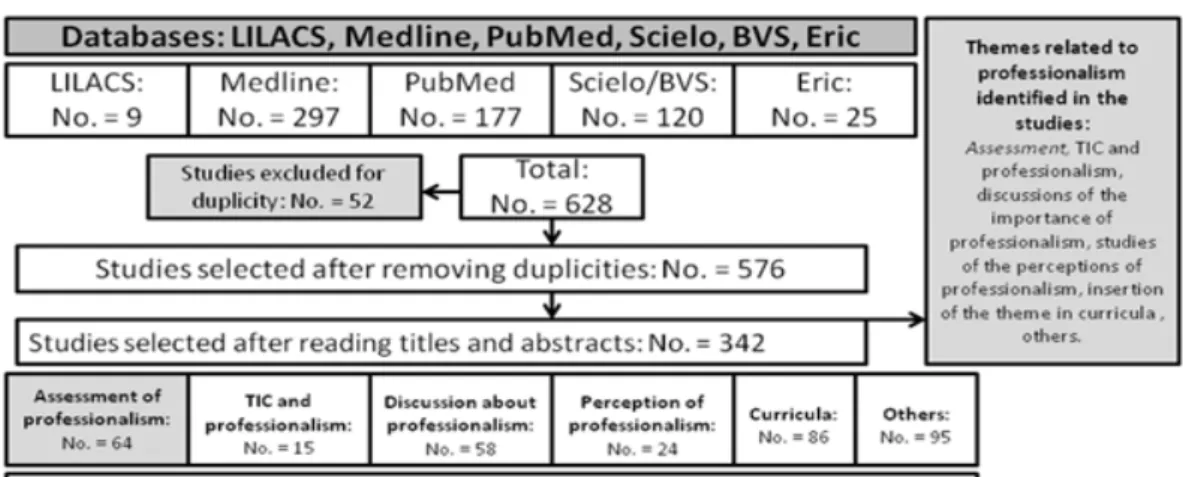
of professionalism; the students were registered between 2002 and 2014. Figure 1 displays
the fluxogram of identification and selection of articles for the systematic review.
Figure 1. Fluxogram of the identification and selection of articles for a systematic review of the theme of professionalism
A study by Consorti et al.
15, which included the adaptation of Miller’s pyramid model
to assess professionalism (Figure 2), was used as a theoretical reference to discuss the
Figure 2. The adaptation of the pyramid of Miller model to assess professionalism. (A) Examples of objectives relevant to progressive levels of professional competence.
(B) Examples of pertinent assessment tools. Abbreviations: HC (health care); MCQs (multiple-choice questions); P-MEX (Professionalism Mini Evaluation Exercise)
Results
The database search resulted in an initial identification of 628 articles. Subsequently,
52 articles were excluded due to duplicity, resulting in a new total of 576 articles. The titles
and abstracts of these articles were read and 234 studies were eliminated because they did
not address the theme of professionalism. At this stage of the review, 342 studies remained.
These articles were subjected to thematic categorization: 64 articles were found to address
the assessment of professionalism; 15 studies linked Information and Communication
Technologies
(ICT) with professionalism; 58 articles included debates, opinions and
discussions about the importance of professionalism in health education; 24 studies
addressed the perception of professionalism reported by students, professional and users of
healthcare services; 86 studies dealt with attempts to include professionalism in curricula
and associated didactic-methodological strategies; and 95 studies involved different
After this phase, the objective of the study and the discussion of articles that
assessed professionalism were defined, based on the abovementioned inclusion criteria.
Ultimately, seven articles were included in the present systematic review. These were read in
Author (s)
Period of
the study
Location
Population
Objective
Assessment method
used
Main results
Biagioli et al
2011
2007-2010
USA
Medicine
students
performing the
surgery
internship
(N= 2034).
To determine whether a
brief student survey can
differentiate amongst
third-year clerkship
student’s professionalism
experiences and whether
sharing specific feedback
with surgery faculty and
residents can lead to
improvements.
Likert scale which
evaluated: Excellence,
Honor/Integrity and
Altruism/Respect.
The scores of students who were
performing their surgery internship
were lower (for the items Excellence
Altruism/Respect) than for students
from other medical specialties, such as
internal medicine, family medicine and
rural medicine. For all specialties, the
sub-group Altruism/Respect received
the lowest scores. After the specific
interventions the scores improved
significantly.
Huntoon et al
2012
2011 USA
Medicine
students (N=
158).
To evaluate the impact of
a single, practical
advocacy experience on
the attitudes and
perspectives of
physicians-in-training in
Likert scale applied
before and after an
experience of
legislative defense in
health. In the
post-defense experience,
The results the improvements in skills
and attitudes after the advocacy in
health, received a high score, thereby
demonstrating that the training
developed important skills associated
the context of a growing
recognition of the need
for advocacy training.
another scale
containing questions
was applied.
students assessed.
Chaytor et al
2012
2006-2009
United
Kingdom
Three cohorts of
Medicine
students from
years 1 and 2 of
the course.
There was no explicitness
in relation to the
objective. A key question
is whether
professionalism is a fixed
characteristic or whether
it can be promoted over
time.
The Conscientiousness
Index (CI) was used.
Variables evaluated:
obedience, discipline,
organized and integral
behavior while
performing their tasks
and during academic
activities.
The CI scores were generally high in the
three cohorts of students (more than
90% for both years 1 and 2), suggesting
that these groups were highly aware. No
significant difference between the first
and second years of the study,
suggesting that it is a stable
characteristic and it is not modified by
education and clinical exposure.
Redwood and
Townsend,
2011
2009 and
2010
Australia Two
cohorts
(N=67 in 2009;
N= 70 in 2010)
of students from
the second year
of the graduate
course in
To investigate changes in
dental students’
perceptions of
professionalism,
knowledge and emotion
over the period of
dissection in a human
Skills assessed (Likert
scale):
Professionalism,
Knowledge and
Emotion before and
after the head and
neck dissection course
The evaluations revealed different
scores for each question asked, with
some attributes that evaluated more
Dentistry anatomy
course. in the discipline of
Anatomy, which lasted
from 8 to 10 weeks.
Papageorgiou
et al 2011
2006-2007
United
Kingdom
Students of
Medicine from
years 1, 2, 3, 4
and 5
(N= 2.519).
To evaluate medical
students' perceptions of
the consultation skills
teaching sessions on a
five year undergraduate
MB/BS (Degree of
Bachelor of Medicine and
Bachelor of Surgery)
program at a new medical
school.
The study in question
was longitudinal, a
quantitative section
(Likert scale) and a
qualitative section,
that were applied at
the end of each
teaching session that
addressed the theme
of consultation.
The survey revealed that there was
learning professionalism by students:
improving communication skills with
the patient (verbal and nonverbal),
proper management of emotions,
teamwork and balance of interests of
the physician and the patient.
Brehm et al.,
2006
Not
provided in
the study.
USA Students
from
different areas of
health.
To provide
interdisciplinary
structured activities in
academic and clinical
settings and introduce
the concept of
The research
developed in two
phases:
interdisciplinary
guidance on the
professionalism and
≥
91% students found that learning/
awareness of the professionalism
benefited their professional activities
(respect for patients and colleagues,
responsibility, flexibility, reliability,
professionalism to health
students.
field experience.
Evaluation: Likert
Scale.
secrecy, honesty and trust).
Zink, Halaas
and Brooks,
2009
2004 and
2005
USA Third
year
Medicine
students (N=95).
To examine the
components that are part
of developing
professionalism during
the Rural Physician
Associate Program
experience, a 9-month
rotation in a rural
community during the
third year of medical
school.
Study qualitative,
longitudinal study (9
months) that evaluates
the development of
professionalism in
students during the
rural health practices.
The research confirmed that the
experience promoted a positive model
of behavior among students, associated
with all of the domains of
professionalism, from good example of
preceptors, attitudes towards the
patient and their illness, compassion
and respect for diversity.
Chart 1. Results of the main assessments of professionalism conducted together with graduate students from the area of health, according to the international
The 7 articles were published between 2006 and 2012 and were conducted in the
USA (Biagiole et al.
19; Huntoon et al.
20; Brehm et al.
12; Zink, Hallas and Brooks
4); the UK
(Chaytor et al.
21; Papageorgiou et al.
16) and Australia (Redwood and Townsend
22). Thus, the
majority were published in the United States after the year 2011, which further highlights the
fact that the debate about assessments of professionalism has gained importance in recent
years.
The characterization of the studies revealed that most of them involved students of
Medicine (n=5), Dentistry (n=1), Pharmacy, Nursing and other disciplines (n=1). Four of the
studies analyzed used the results of surveys that assessed professionalism quantitatively
using Likert scales and the “student behavior measurements” of Biagioli et al.
19and Chaytor
et al.
21(knowledge, emotion, excellence, honor/integrity and altruism/respect; another
study assessed professionalism in terms of obedience, discipline, organization and the
performance of academic tasks). The studies also included “assessments related to the
application of teaching experiences seeking to develop professionalism” (training in defense
legislation in health; course of anatomical dissection; teaching consultation skills using the
Calgary-Cambridge method; one survey addressed guidance related to the theme of
professionalism and a field experience; as well as an assessment of the clinical experience of
students during the rural internship).
Based on these considerations, it was clear that the studies conducted by Biagioli et
al.
19and Chaytor et al.
21assessed professionalism from the point of view of competencies.
The former addressed human competencies linked to personal values developed by
students, which were assessed using closed scales, in order to confirm the student’s
attitudes during the surgery internship. In the latter study, the approach was centered on the
use of the Conscientiousness Index (CI), which is one of the existing validated tools that are
used to assess professionalism in terms of professional conduct and ethics (organization,
responsibility, discipline, performance of tasks, among others). Both studies come close to
the “Knows” and “Knows how” levels of Miller’s adapted pyramid, as used to assess
professionalism in the study by Consorti et al.
15.
The other studies (Papageorgiou et al.
16; Redwood et al.
22; Huntoon et al.
20; Brehm et
practical experiences and the application of health teaching strategies, thereby
demonstrating a dimension of doing/simulating. These studies reached the “Shows” and
“Does” levels of the pyramid represented in Figure 2 of the present study, revealing a
dimension of the research in the practical field.
Based on these results, it is possible to deduce that the studies presented in this
review assessed a number of aspects of professionalism but did not address its development
from a more global perspective or associate personal, interpersonal, social and institutional
dimensions, which is important in any assessment of professionalism.
Discussion
The results of the present study demonstrated that the processes of assessing
professionalism are still poor around the world. It is only taught in health education facilities
in some developed countries and others that have reached their maximal degree of crisis in
practical medicine education, due to the primarily biologically-centered and medicalized
nature of these practices, as in the case of the USA.
Professionalism is a theme that has emerged and gained importance in the last 10
years, although studies related to professionalism are still focused on discussions about its
significance and inclusion in curricula. It is essential to recognize that the theme of
assessing professionalism, focusing on the tools and methods used, is a contemporary
question and the central motto has been defined by the period of training that should be
included and what roles are performed in this process.
Chart 1 revealed that professionalism was only assessed in terms of behavioral
aspects (personal, assessed by the students themselves) and its development in the practical
field, which denotes restricted aspects in this subject. Goldie
5reported that professional
behavior is also influenced by situational and contextual factors that arise during the
learning and practical processes.
Thus, an assessment of professionalism should include an assessment of colleagues,
health professionals or patients, thereby addressing individual, interpersonal, social and
The same author recognized that no tool in isolation is capable of measuring the
performance of an individual in all of the abovementioned dimensions, particularly when
referring to multi-dimensional constructions such as professionalism. However, special
attention should be paid to the expertise of the assessor, the validity of the tools used and
adequate sampling of the participants. To do so, a triangulation of different assessment
methods has been suggested, as well as training those involved.
Currently, the most commonly used methods/tools to measure professionalism are
pair assessments, observations by faculty members (using standardized confirmation lists),
reflective portfolios developed by students and discussions of ethical dilemmas. However,
more complete assessment methods should include contextual and social aspects and need
greater development
5.
As well as this more global aspect of the assessment, it is also extremely important
that the assessment is always accompanied by feedback in order to improve the performance
of teams and to stimulate reflection about the attitudes involved. The aim of the assessment
and its development and longitudinal monitoring should be explained and it is important to
clarify if it is summative or formative. Goldie
5recommended the use of tools that enable
descriptive and interesting comments. An assessment of professionalism should also include
situations that involve conflicts and the proposal of solutions for the dilemma.
Biagioli et al.
19demonstrated that the evaluative scores for professional behavior by
students during the surgery internship significantly improved after meetings to discuss the
first assessment and provide feedback about unprofessional behavior that needed to
improve (excellence and altruism/respect), thereby showing that the technique should be an
important component of assessment processes. It is important to note that the scores for
these questions were lower for surgery students than for those involved in family, internal
and rural medicine.
Chaytor et al.
21demonstrated that students in years 1 and 2 of the Medicine course
exhibited great knowledge and awareness of their professional roles (levels 1 and 2 on
Miller’s pyramid - Figure 1). This could be associated with the professional ideal that the
the context, practices and behavioral models that professional exhibited and could have
influenced the vision of the students positively or negatively.
It is known that factors such as the resources available and the structure of health
services have a significant effect on the attitudes and behavior of doctors. Teachers of
medicine who studied how to develop professional attitudes and behavior among medicine
students and residents stated that the characteristics of professional behavior (professional
model/example, with virtuous attitudes) are the most effective methods of instilling
professional behavior in students
2. It seems that placing students in practical situations with
a professional model is a great strategy for developing their professionalism.
With regards to the five studies classified in the “Show” and Does” domains of Miller’s
pyramid (Papageorgiou et al.
16; Redwood et al.
22; Huntoon et al.
20; Brehm et al.
12; Zink,
Halaas and Books
4), there was a notably positive assessment of professionalism after the
interventions and/or field experiences, with improvements in the ability to communicate
with the patient, health education, respect for the inter-disciplinary team, secrecy and
attitudes such as compassion and respect for diversity. Furthermore, in a number of studies,
the students stressed the importance of including professionalism in health education and
stated that the discussions provided a greater awareness of the subject.
According to Daaleman et al.
23, the basis of an understanding of professionalism is
the habits and attitudes demonstrated by individuals through good examples and intrinsic
values, which are incorporated into learning environments.
Recently, five important themes were classified in relation to measuring
professionalism, which can be summarized as follows: adherence to the ethical principles of
the practice; effective interaction with patients and their significant others; effective
interaction with other health professionals; reliability and commitment to competence
14. This
study also highlighted the lack of clarity about the fact that professionalism is acquired or
learned as a developing concept or competence.
Using these five themes, it is possible to consider that a global assessment of
professionalism would involve aspects of the four levels of Miller’s pyramid, using tools and
methods that observe and measure the interaction between subjects
knowledge), which are essential to medical practices that are guided by ethical principles
and the benefit for patients.
Final Considerations
The results of the present study provide evidence that goes against the literature
studied. Assessing professionalism in graduate students of health courses is a great
challenge, given that its effectiveness demands the measurement of more global aspects,
such as personal, interpersonal, institutional and social dimensions.
This process is often hindered by a lack of knowledge on behalf of the subjects
involved in relation to reliable assessment tools, the concept of professionalism, the
importance of its inclusion in formal curricula (as well as hidden curricula), and the time
involved in this (longitudinal) process.
Thus, the importance of expanding this theme is clear, with a view to including it in
professional health training and minimizing the effects of the crisis that health practices
have been experiencing due to unprofessional behavior, which is compromised from a moral
and ethical perspective.
Studies of professionalism and scientific production of this theme indicate the need
to review traditional educational paradigms (rigid models) and create a process that enables
a renewal of thoughts and behavior, recognizing professionalism as a complex challenge
that demands new methods of teaching and learning.
Therefore, there is a need for innovative teaching strategies that allow students to
develop professionalism and legitimately engage in issues related to ethics, citizenship and
social responsibility.
Collaborators
All authors participated in the research stages, construction and revision of the article.
1.Huddle TS. The limits of social justice as an aspect of medical professionalism. J Med Philos. 2013;
38(4):369-87.
2. Bernat JL. Restoring medical professionalism. Neurolology. 2012; 79(8): 820-7.
3. Glenn JE. The eroding principle of justice in teaching medical professionalism. HEC Forum. 2012;
24(4):293-305.
4. Zink T, Halaas GW, Brooks KD. Learning professionalism during the third year of medical school in a
9-month-clinical rotation in rural Minnesota. Med Teach. 2009; 31(11):1001-6.
5. Goldie G. Assessment of professionalism: a consolidation of current thinking. Med Teach. 2013;
35(2):952-6.
6. Miles PV, Conway PH, Pawlson LG. Physician professionalism and accountability: the role of
collaborative improvement networks. Pediatrics. 2013; 131(4):204-9.
7. Rego S. O profissionalismo e a formação médica. Rev Bras Educ Med [Internet]. 2012 [acesso 2014
Set 10]; 36(4):445-6. Disponível em: http://www.scielo.br/pdf/rbem/ v36n4/01.pdf
8. Kaohsiung J. A framework for enhancing and assessing cultural competency training. J Med Sci.
2009; 25(9):486-92.
9. Mossop LH. Is a time to define veterinary professionalism? J Vet Med Educ. 2012; 39(1):93-100.
10. Gill D, Griffin A. Good medical practice: what are we trying trying to say? Textual analysis using tag
clouds. Med Educ. 2010; 44(3):316-22.
11. Hultman CS, Halvorson EG, Kaye D, Helgans R, Meyers MO, Rowland PA, et al. Sometimes you can’t
make it on your own: the impact of a professionalism curriculum on the attitudes, knowledge, and
behaviors of an academic plastic surgery practice. Surg Res. 2013; 180(1):8-14.
12. Brehm B, Breen P, Brown B, Long L, Smith R, Wall A, et al. An interdisciplinary approach to
introducing professionalism. Am J Pharm Educ. 2006; 70(4):1-5.
13. Pearson WG, Hoagland TM. Measuring change in professionalism attitudes during the gross
14. Tiffin PA, Finn GM, McLachlan JC. Evaluating professionalism in medical undergraduates using
selected response questions: findings from an item response modelling study. BMC Med Educ. 2011;
11(43):1-9.
15. Consorti F, Notarangelo M, Potasso L, Toscano E. Developing professionalism in Italian medical
students: na educational framework. Adv Med Educ Pract. 2012; 2012(3):55-60.
16. Papageorgiou A, Miles S, Fromage M, Kemmy J, Leinster SJ. Cross-sectional evaluation of a
longitudinal consultation skills course at a new UK medical school. BMC Med Educ. 2011; 11(55):1-8.
17. Silva LS, Cotta RMM, Rosa COB. Estratégias de promoção da saúde e prevenção primária para
enfrentamento das doenças crônicas: revisão sistemática. Rev Panam Salud Publica. 2013;
34(5):343-50.
18. Moher D, Liberati A, Tetzlaff J, Altman DG. PRISMA Group. Preferred reporting items for systematic
reviews and meta-analyses: the PRISMA statement. Ann Intern Med. 2009; 151(4):264-9.
19. Biagioli FE, Rdesinski RE, Elliot DL, Chappelle KG, Kwong KL, Toffler WL. Surgery clerkship
evaluations drive improved professionalism. J Surg Educ. 2013; 70(1):149-55.
20. Huntoon KM, McCluney JC, Wiley EA, Scannell CA, Bruno R, Stull MJ. Self-reported evaluation of
competencies and attitudes by physicians-in-trainning before and after a single day legislative
advocacy experience. BMC Med Educ. 2012; 12(47): 1-8.
21. Chaytor AT, Spence J, Armstrong A, McLachlan JC. Do students learn to be more conscientious at
medical school? BMC Med Educ. 2012; 12(54):1-7.
22. Redwood CJ, Townsend GC. The dead center of the dental curriculum: changing attitudes of dental
students during dissection. J Dent Educ. 2011; 75(10):1333-44.
23. Daaleman TP, Kinghorn WA, Newton WP, Meador KG. Rethinking professionalism in medical