Efeito da mitomicina C na infiltração de leucócitos polimorfonucleares
após lesão epitelial em córnea de camundongo
Trabalho realizado no Department of Ophthalmology, Columbia University - New York (NY) - USA.
1Medical Doctor, Altino Ventura Foundation and Per-nambuco Eye Hospital and ex-postdoctoral research fellow at Columbia University - New York (NY) - USA. 2PhD, Department of Ophthalmology, Columbia
Uni-versity - New York (NY) - USA.
3PhD, Department of Ophthalmology, Columbia Uni-versity - New York (NY) - USA.
4Medical Doctor, Director of Refractive Surgery and Laser Vision Correction at Columbia University - New York (NY) - USA.
Endereço para Correspondência: Ana Cecília Souza
Leão Escarião. Rua da Soledade, 170 - Recife (PE) CEP 50070-040
E-mail: [email protected]
Recebido para publicação em 22.08.2007 Última versão recebida em 10.08.2008 Aprovação em 18.08.2008
Ana Cecília Souza Leão Escarião1 Takayuki Nagasaki2
Jin Zhao3
Richard Braunstein4
of polymorphonuclear leukocytes after
epithelial scrape injury in the mouse cornea
Keywords: Mitomycin C/therapeutic use; Mitomycin C/administration & dosage; Leukocyte;
Cornea; Keratomileusis, laser in situ; Photorefractive keratectomy; Models, animal
Purpose: To determine whether mitomycin C (MMC) alters appearance
and disappearance of polymorphonuclear leucocytes (PMN) in the cornea stroma, using an epithelial scrape injury in eye mouse model.
Methods: Twenty-mice underwent mechanical epithelium debridement
in the central cornea using 20% ethanol. After the scrape, the right eye received 0.02% MMC for one minute, while the left eye received phy-siological saline. The animals were sacrificed on days 1, 2, 5, and 14 after surgery, and corneal whole mounts were prepared for histology. PMN distribution was analyzed in digitized microscope images. Cell division in the cornea was determined by immunohistochemical detection of bromodeoxyuridine (BrdU), which was injected intraperitoneally before the mice were sacrificed. Results: Epithelial scrape injury triggered infiltration of PMNs into the corneal stroma. An analysis of PMN distribution revealed that there was no difference between eyes treated with and without MMC at all time points. BrdU labeling showed that 0.02% MMC for one minute blocked keratocyte proliferation completely.
Conclusion: MMC treatment regimen, which is common in clinical
practice, inhibits keratocyte proliferation during wound healing, but when used at 0.02% for one minute, it does not affect PMN infiltration into the corneal stroma, and subsequent movement toward the injury site, or the disappearance of PMNs from the stroma, in the mouse epithelial injury model.
ABSTRACT
INTRODUCTION
Photorefractive keratectomy (PRK) and laser in situ keratomileusis (LASIK) are the most common surgeries performed for the treatment of refractive disorders. After these procedures, there is a corneal wound healing and stimulation of a fibrotic response, usually stronger with PRK than LASIK(1), specially in the treatment for high myopia patients and may lead to
haze development, compromising visual acuity and contrast sensitivity(2-3).
The corneal epithelium removal induces a loss of keratocyte by apop-tosis, migration of inflammatory cells and proliferation of keratocytes in the underlying stroma, followed by remodeling of collagen matrices(1,4). It
Figure 1 - Appearance of epithelial scrape injury in the cornea in a live mouse. Denuded area was stained with a drop of sulforhodamine 101 in saline, while areas of intact epithelium were protected from the dye.
Bar, 1 mm.
Mitomycin C (MMC) is a systemic chemotherapeutic drug derived from Streptomyces caespitosus, which suppresses the proliferation of rapidlygrowing cells by inhibiting DNA synthe-sis, secondary to alkylation(6). MMC has been used with
in-creasing frequency in eye surgery. It has improved the results of glaucoma surgery(7), pterygium excision(8), treatment of
con-junctival and corneal intraepithelial neoplasia(9) and refractive
surgery(10).
In PRK, MMC prevents corneal haze after treatment of high myopia, especially in patients whose corneal thicknesses are inadequate for laser in situ keratomileusis(10). The effect of
MMC on wound healing has been documented by inhibiting keratocyte proliferation, and activation, and consequently blockage of myofibroblast differentiation(1,11). It is not clear,
however, whether and how MMC affects inflammatory activi-ties, such as infiltration of leukocytes and their actions. An inhibitory effect of MMC on leukocyte chemotaxis has been suggested in gastric cancer(12), but no report seems to exist
regarding ocular inflammation.
The purpose of this study was to evaluate the effects of MMC on the inflammatory response during the early stages of wound healing, using an epithelial scrape injury model of the mouse cornea.
METHODS
An experimental prospective study was performed on a mouse cornea in the research department of Ophthalmology at Columbia University. Twenty mice were used in this study.
Animals
Animal study adhered to the Association for Research in Vision and Ophthalmology Statement for the Use of Animals in Ophthalmic and Vision Research, and approved by the ins-titutional animal care and use committee. The GFPU mice were obtained from the Jackson Laboratory (Bar Harbor, ME) and maintained in house. Only male mice were used in this study. Both eyes were used, a contralateral eye was used as the control to eliminate variations in inflammatory reactions among different animals. The injury was mild and the animals were never at risk of vision loss.
Surgery
The animals were anesthetized by an intraperitoneal injection of ketamine (100 mg/kg) and xylazine (10 mg/kg). The mechanical epithelial scrape injury was created after a circular mark using an about 1.2-mm diameter trephine. One filter paper (0.9 mm diameter) soaked with 20% ethanol was placed on the central cornea for one minute before performing a circular injury (1.2 mm diameter) in the center of the cornea (Figure 1). This injury was created with a blunt tip of a #12 blade under a dissection microscope. Both eyes were used; the right eye received 0.02% MMC for one minute, whereas the left eye received physiological saline after the scrape injury. Both eyes
were irrigated extensively with balanced salt solution, and received erythromycin ointment.
Histology
Statistical analyses
The unpaired t-test was used to compare the number of PMNs in MMC eyes and control eyes. Statistical significance was accepted at a P<0.05 level.
RESULTS
Stroma cell division
BrdU labeling demonstrated that stroma cell division was apparent in the injury area at 5 days but not at 2 days. This keratocyte division at 5 days was nearly completely inhibited by the MMC treatment, demonstrating the effectiveness of MMC treatment (Figure 3).
Leukocytes in the tears
No PMNs were found in the tears 24 and 48 hours after the injury.
PMN infiltration
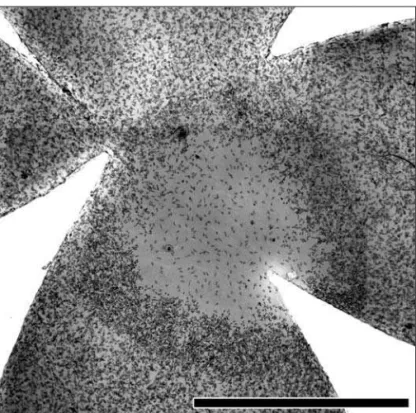
Epithelial scrape injury triggered infiltration of PMNs into the corneal stroma. The PMNs accumulated into the anterior stroma of the injury site within 24 hours (Figure 4), by which time the epithelial opening was closed 80-100%. At this time point, keratocytes were absent in the anterior stroma beneath the epithelial injury where PMNs accu-mulated. Most of the PMNs disappeared from the cornea by five days after the trauma. At two weeks, the level of PMNs was nearly identical to that of the untouched cornea. A comparison of corneas treated with saline and MMC revea-led that there was no significant difference in the numbers of PMNs in these corneas at examined all time points (P>0.05) (Table 1).
Figure 2 - PMNs were identified and differentiated from keratocy-tes by their unique donut-shaped nuclei in the corneal stroma. Bar,
100 µm.
Figure 3 - Effect of MMC on keratocyte proliferation after epithelial scrape injury. Keratocyte proliferation was determined by BrdU
incorporation.
Figure 4 - PMN distribution in the MMC treated cornea at 24 hours after epithelial scrape. Bar, 1 mm.
Table 1. A comparison of the numbers of PMNs at all time points of corneas treated with MMC and saline
Time PMN MD ± SD PMN MD ± SD t-test
point MMC Control
24 h 1215.50± 238.29 1094.00 ± 63.64 0.6706
48 h 174.67± 34.79 187.67 ± 72.01 0.6386
5 d 55.00± 7.07 44.50 ± 7.78 0.5000
14 d 3.50± 0.71 3.00 ± 1.41 0.7952
DISCUSSION
The cornea wound healing cascade is complex and media-ted by cytokines, growth factors and chemokines(13-14). PMNs
are the first cells that migrate into tissues in response to insults(15). It has been shown that the presence of leukocytes
stimulates the epithelial healing to some extent after alkali injury(16). The early presence of leukocytes may act via
cyto-kines to initiate migration of keratocytes. Proliferation may likewise be influenced by leukocytes from the limbal side(17).
Previous studies have been performed to block the infiltration of PMNs in the wound healing(18), but long-term clinical
im-pact has not been determined.
PRK and LASIK are the most common refractive surgeries performed for the correction of myopia, hyperopia and astig-matism. Clinical outcomes with these procedures are in large part dependent on the cornea wound healing response. Cor-neal haze is more common after PRK than after LASIK, be-cause the corneal wound healing response and the stimulus for the fibrotic response are stronger(1).
Many substances have been used to prevent haze for-mation in PRK: amniotic membrane, vitamins A and E, colla-genase inhibitors, and ubiquinone Q10(19-22), but no
con-trolled clinical trials have been reported, except for mitomi-cin C(23).
MMC is a drug that has been used frequently to reduce haze formation owing, presumably, to its inhibition of proli-feration of activated keratocytes(1). Despite the importance
of PMNs in wound healing and the prevalence of MMC use in corneal surgery, effects of MMC on PMNs have not been reported, to the best of our knowledge. MMC has been reported to decrease the chemotaxis of PMNs in patients with gastric cancer(12), but its relevance to the corneal wound
healing is not clear. This study with mouse eyes showed that MMC has no measurable effect in the migration of PMNs during early stages of corneal wound healing. This supports the idea that MMC effect on haze reduction is solely due to its inhibition of keratocytes, and not PMNs. Perhaps this is so because MMC action is short-lived and no longer effective by the time PMNs appear in the cornea after injury, and thus MMC has no effect on PMN activi-ties. Since the study addressed only the movement of PMNs, it will be important to investigate other activities of PMNs such as a release of oxidative enzymes and agents and also their phagocytic activity. This will ensure that side effects of MMC are fully understood when used in corneal surgery.
CONCLUSION
MMC at 0.02% for one minute has no measurable effect on appearance, migration, and disappearance of corneal PMNs during early stages of corneal wound healing after epithelial scrape injury in the mouse eye model.
RESUMO
Objetivo: O objetivo do estudo foi determinar se a mitomicina
C (MMC) altera o aparecimento dos leucócitos polimorfonu-cleares (PMN) no estroma corneano após abrasão epitelial central, utilizando olhos de camundongo como modelo.
Méto-dos: Vinte camundongos foram submetidos à abrasão epitelial
em córnea central utilizando etanol a 20%. Após a lesão, o olho direito recebeu MMC a 0,02% por 1 minuto, enquanto o olho esquerdo recebeu solução salina. Os animais foram sacri-ficados em 1, 2, 5 e 14 dias após a cirurgia e a córnea foi preparada para histologia. A distribuição dos PMN foi anali-sada e digitalizada em imagens microscópicas. A divisão celu-lar na córnea foi detectada pela imuno-histoquímica da bromo-deoxirudina (BrdU), injetada intraperitonialmente duas horas antes dos animais serem secrificados. Resultados: A lesão epitelial gerou infiltração de PMN no estroma da córnea. A análise da distribuição dos PMNs revelou que não houve diferença estatisticamente significante entre os olhos tratados e não tratados com MMC, em todos os tempos estudados. O estudo com BrdU mostrou que a MMC quando utilizada a 0,02% por um minuto bloqueou completamente a proliferação de ceratócitos. Conclusão: O tratamento com MMC, que é utilizada comumente na prática clínica, inibe a proliferação dos ceratócitos durante a cicatrização corneana, porém quando utilizada a 0,02% por um minuto, não altera a infiltração dos PMNs dentro do estroma corneano após lesão epitelial em córneas de camundongos.
Descritores: Mitomicina C/uso terapêutico; Mitomicina C/
administração & dosagem; Leucócito; Córnea; Ceratomileuse assistida por excimer laser in situ; Ceratectomia fotorrefrativa; Modelos animais
REFERENCES
1. Netto MV, Mohan RR, Ambrósio R Jr, Hutcheon AE, Zieske JD, Wilson SE. Wound healing in the cornea: a review of refractive surgery complications and new prospects for therapy. Cornea. 2005;24(5):509-22.
2. Amm M, Wertzel W, Winter M, Uthoff D, Duncker GI. Histopathological comparison of photorefractive keratectomy and laser in situ keratomileusis in rabbits. J Refract Surg. 1996;12(7):758-66.
3. Wachtlin J, Laugenbeck K, Schründer S, Zhang EP, Hoffmann F. Immunohisto-logy of corneal wound healing after photorefractive keratectomy and laser in situ keratomileusis. [email protected]. J Refract Surg. 1999;15(4):451-8. 4. Kuo IC. Corneal wound healing. Curr Opin Ophthalmol. 2004;15(4):311-5.
Review.
5. Choi YS, Kim JY, Wee WR, Lee JH. Effect of the application of human amniotic membrane on rabbit corneal wound healing after excimer laser pho-torefractive keratectomy. Cornea. 1998;17(4):389-95.
6. Calabresi P, Chabner BA. Antineoplastic agents. In: Goodman LS, Gilman A, Gilman AG, editors. Pharmacological basis of therapeutics. 8th ed. New York:
Pergamon Press; c1990. p.1247-8.
7. Maquet JA, Dios E, Aragón J, Bailez C, Ussa F, Laguna N. Protocol for mitomycin C use in glaucoma surgery. Acta Ophthalmol Scand. 2005;83(2): 196-200.
9. Prabhasawat P, Tarinvorakup P, Tesavibul N, Uiprasertkul M, Kosrirukvongs P, Booranapong W, Srivannaboon S. Topical 0.002% mitomycin C for the treatment of conjunctival-corneal intraepithelial neoplasia and squamous cell carcinoma. Cornea. 2005;24(4):443-8.
10. Hashemi H, Taheri SM, Fotouhi A, Kheiltash A. Evaluation of the prophylactic use of mitomycin-C to inhibit haze formation after photorefractive keratectomy in high myopia: prospective clinical study. BMC Ophthalmol. 2004;4:12. 11. Xu H, Liu S, Xia X, Huang P, Wang P, Wu X. Mitomycin C reduces haze
formation in rabbits after excimer laser photorefractive keratectomy. J Refract Surg. 2001;17(3):342-9.
12. Hirano T. Changes in polymorphonuclear leukocyte motility under agarose and luminol-dependent chemiluminescence response in patients with gastric cancer. Gastroenterol Jpn. 1984;19(5):447-56.
13. Tuli S, Goldstein M, Schultz GS. Modulation of corneal wound healing. In: Krachmer JH, Mannis MJ, Holland EJ, editors. Cornea. 2nd ed. Philadelphia:
Elsevier Mosby; 2005. p.133-50.
14. Wilson SE, Liu JJ, Mohan RR. Stromal-epithelial interactions in the cornea. Prog Retin Eye Res. 1999;18(3):293-309. Review.
15. Hong JW, Liu JJ, Lee JS, Mohan RR, Mohan RR, Woods DJ, et al. Proinflammatory chemokine induction in keratocytes and inflammatory cell infiltration into the cornea. Invest Ophthalmol Vis Sci. 2001;42(12):2795-803 16. Gan L, Fagerholm P, Kim HJ. Effect of leukocytes on corneal cellular pro-liferation and wound healing. Invest Ophthalmol Vis Sci. 1999;40(3):575-81.
17. Gan L, Hamberg-Nyström H, Fagerholm P, Van Setten G. Cellular proliferation and leukocyte infiltration in the rabbit cornea after photorefractive keratectomy. Acta Ophthalmol Scand. 2001;79(5):488-92
18. Bilgihan A, Bilgihan K, Yis O, Sezer C, Akyol G, Hasanreisoglu B. Effects of topical vitamin E on corneal superoxide dismutase, glutathione peroxidase activities and polymorphonuclear leucocyte infiltration after photorefractive kera-tectomy. Acta Ophthalmol Scand. 2003;81(2):177-80.
19. Brancato R, Schiavone N, Siano S, Lapucci A, Papucci L, Donnini M, et al. Prevention of corneal keratocyte apoptosis after argon fluoride excimer laser irradiation with the free radical scavenger ubiquinone Q10. Eur J Ophthalmol. 2000;10(1):32-8.
20. Wang MX, Gray TB, Park WC, Prabhasawat P, Culbertson W, Forster R, et al. Reduction in corneal haze and apoptosis by amniotic membrane matrix in excimer laser photoablation in rabbits. J Cataract Refract Surg. 2001;27(2):310-9. 21. Vetrugno M, Maino A, Cardia G, Quaranta GM, Cardia L. A randomised, double
masked, clinical trial of high dose vitamin A and vitamin E supplementation after photorefractive keratectomy. Br J Ophthalmol. 2001;85(5):537-9.
22. Corbett MC, O’Brart DP, Patmore AL, Marshall J. Effect of collagenase inhibitors on corneal haze after PRK. Exp Eye Res. 2001;72(3):253-9. 23. Bedei A, Marabotti A, Giannecchini I, Ferretti C, Montagnani M, Martinucci