Arq Neuropsiquiatr 2010;68(3):452-454
452
Letter
Motor neuropathy with multiple
conduction blocks associated
with tnf-alpha antagonist
Paulo Eduardo Mestrinelli Carrilho1, Allan César Faria Araújo2, Orival Alves1, Paulo Gustavo Kotze3
Correspondence
Paulo Eduardo Mestrinelli Carrilho Rua Santa Catarina 925 - Neuroclínica 85801-040 Cascavel PR - Brasil E-mail: [email protected]
Received 20 April 2009 Received in final form 27 July 2009 Accepted 11 August 2009
NEUROPATIA MOTORA COM MÚLTIPLOS BLOQUEIOS DE CONDUÇÃO ASSOCIADA A ANTAGONISTA DE TNF-ALFA
1Professor da Disciplina de Neurologia e Neurocirurgia do Curso de Medicina da Universidade Estadual do Oeste do Paraná
- UNIOESTE, Paraná, Brasil; 2Professor da Disciplina de Clínica Cirúrgica do Curso de Medicina da Universidade Estadual do
Oeste do Paraná - UNIOESTE, Paraná, Brasil; 3Chefe do Serviço de Coloproctologia do Hospital Universitário Cajuru - PUCPR,
Paraná, Brasil.
Inliximab, eternecept and adalimum-ab are tumour necrosis alpha factor (TNF-alpha) antagonists which recently became part of several auto-immune diseases ther-apeutic arsenal, mainly in rheumatoid ar-thritis, ankylosing spondilitis, psoriat-ic arthritis, as well as inlammatory bow-el diseases1,2. TNF-alpha plays a crucial
role in many aspects of immune system development, immune-response regula-tion and T-cell-mediated tissue injury. It is a cytokine with both pro-inlammato-ry and immunoregulatopro-inlammato-ry properties and is involved in normal inflammation and immune responses. TNF-alpha is an im-portant growth factor for prothymocytes and thimocytes, and thereby influences the generation of the T-cell repertoire. In the peripheral immune system, TNF-al-pha participates in antigen-presenting cell-function and in regulating apoptosis of po-tentially auto-reactive T- cells. So that, im-munological complications with drugs that antagonize TNF-alpha receptors were ex-pected to occur. Demyelinating peripher-al motor neuropathy is one of them, but it is relatively uncommon3-9.
We report a patient who had a severe form of Crohn’s disease, who developed a peripheral neuropathy with multiple mo-tor conduction blocks at atypical sites, with axonal damage signs, probably asso-ciated with inliximab treatment.
Case
The present report was written after patient information and with her
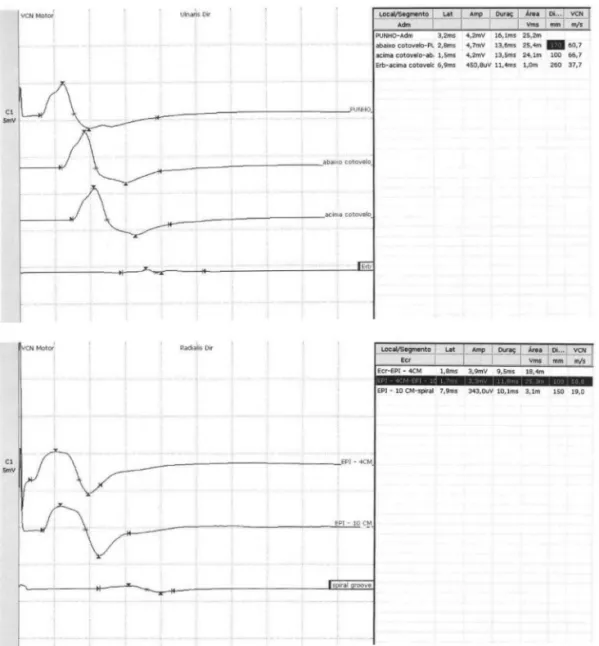
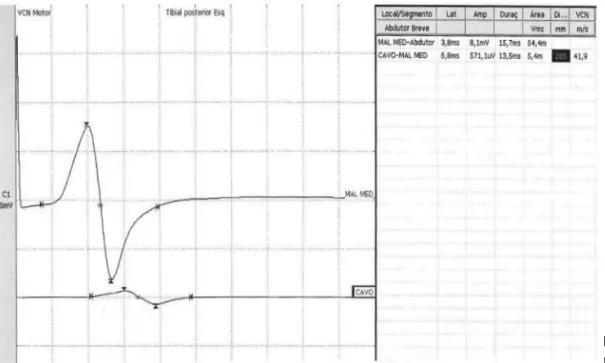
agree-ment with the data publication. She is a 64-year-old woman with a severe histo-logicaly defined Crohn’s disease start-ed to be treatstart-ed with infliximab (5 mg/ Kg) with improvement of all symptoms after the first infusion. Almost immedi-ately after the overall ifth dose of inlix-imab, she developed right radial, right ul-nar and left posterior tibial nerve palsies. Electroneuromyography (Figs 1 and 2) dis-closed a predominant motor neuropathy in the nerves described above with multi-ple motor conduction blocks pattern, also associated with ibrilations and reduction of motor unit recruitment in the muscles innervated by those nerves. Non-signii-cant amplitude decrease of sensory poten-tials was noticed. he rest of laboratory in-vestigation was unremarkable, and includ-ed FAN, ANA, P-anca, C-anca, anti-DNA, anti-GM1, thyreoid hormones, blood glu-cosis, renal and hepatic functions, HIV1 and 2, HBV and HCV serology, vitamine B12. Inliximab infusions were interrupted and the patient obtained a gradual, but in-complete, recovery. After 6 months of fol-low-up, the patient still had a slight radi-al and ulnar nerves paresis, but an radi-almost complete clinical improvement was ob-served in the left posterior tibial nerve.
DIsCUssION
Arq Neuropsiquiatr 2010;68(3)
453
Motor neuropathy Carrilho et al.
for TNF-alpha (p55 and p75) exist naturally as monomer-ic molecules on cell surfaces and in soluble forms. Bio-logical activity of TNF-alpha is dependent upon bind-ing to either cell surface receptor10. Nowadays, two
dif-ferent groups of anti-TNF-alpha are available: the eter-necept group and monoclonal antibodies group. he for-mer is a soluble, difor-meric fusion protein of the human p75 TNF receptor linked to the Fc portion of human IgG1. he second group is composed by inliximab and adali-mumab. Adverse events are commonly slight, generally injection site inlammatory reaction, lu-like symptoms and headache4. Collateral efects secondary to inadequate
immune system modulation are quite rare, but drug-in-duced lupus and demyelinating syndromes are described4.
Such reactions are expected to occur in about 233 sub-jects per million of treated patients3,4. Central nervous
system autoimmune demyelinating disorders include an-terior and posan-terior optic neuritis and worsening of mul-tiple sclerosis4. Peripheral nervous disorders include
Guil-lain-Barré and Miller-Fischer syndromes, chronic
inlam-matory demyelinating polyradiculoneuropathy, monon-euritis simplex and multiplex, axonal sensory-motor po-lineuropathy and even motor neuropathy with multiple conduction blocks4-8. Two explanations about these
an-ti-TNF-alpha collateral efects are discussed in the liter-ature4: a direct toxic drug aggression or a speciic
auto-antibody production and T cell immune system derange-ment induced by this group of agents. he real cause of such undesirable events is obscure, but the second hy-pothesis is well accepted. It is logical to argue that patho-genesis of such type of neuropathy should include a my-elin aggression both by inadequate T-cell dependent im-mune system activation and a humoral antibody produc-tion. Also, an ischemic damage from vasculitis and hibition of axon support signals are suspected to be in-volved4. It is important to know that TNF-alpha
proba-bly has a pro-inlammatory function in the pathogene-sis of Guillain-Barré syndrome4,10 (serum levels correlate
with disease activity and severity). TNF-alpha deiciency leads to failed regression of myelin-speciic T-cell
Arq Neuropsiquiatr 2010;68(3)
454
Motor neuropathy Carrilho et al.
tivity and prolonged survival of activated T cells. When endogenous TNF-alpha is blocked by repeated injections of a TNF-alpha antagonist, T-cell-proliferative respons-es and cytokine production are enhanced. he prolonged administration of TNF-alpha antagonists is thought to enhance autoimmune responses by altering antigen-pre-senting cell function, potentiating T-cell receptor signal-ing, and decreasing apoptosis of auto-reactive T cells.
According to proposed criteria11, an illness, like
neu-ropathy, can be considered as drug-induced or environ-mentally associated based on: [1] temporal closed associ-ation; [2] lack of likely alternative explanations; [3] stabi-lization or improvement by interrupting exposure to the presumed inciting agent; [4] rechallenge; [5] biological plausibility; [6] analogy; [7] dose responsiveness; [8] spec-iicity. To report indings of a possible causal relationship between exposure and clinical syndrome, at least 4 of the 8 attribution elements should be present. Based on these criteria, the motor neuropathy described in the present article is probably very well correlated with inliximab.
Paradoxically, it is interesting to report that prelimi-nary observations of a single retrospective uncontrolled study suggested possible eicacy of etanercept (Enbrel®) treatment in selected patients with CIDP, or its variants, who were refractory to or intolerant of conventional ther-apies12. In another case report13, mononeuritis multiplex
(demyelinating and axonal) complicated active Crohn’s disease and was treated with a series of inliximab infu-sions. he manifestations of neuropathy improved clinical-ly after the irst infusion, and after 22 weeks, the electro-physiological studies returned to normal. he present case difers from that, once the symptoms of intestinal disease
improved markedly with inliximab and the neuropathy developed only after repeated series of infusions. Eventu-ally, Crohn’s disease may predispose such type of compli-cation with anti-TNF-alpha agents, once this entity is also rarely associated with mononeuritis multiplex by itself.
ReFeReNCes
1. Feagan BG, Enns R, Fedorak RN, et al. Inliximab for the treatment of Crohn’s disease:eicacy, safety and pharmacoeconomics. Can J Clin Pharmacol 2001; 8:188-198.
2. Hamilton K, Clair EW. Tumor necrosis factor alpha blockade: a new era for the efective management of rheumatoid arthritis. Expert Opin Pharmaco-ther 2000;1:1041-1052.
3. Rodriguez-Escalera C, Belzunegui J, Lopez-Dominguez L, Gonzalez C, Figueroa M. Multifocal motor neuropathy with conduction block in a patient with rheumatoid arthritis on inliximab therapy. Rheumatology 2005;44:132-133. 4. Stübgen JP. Tumor necrosis factor-alpha antagonists and neuropathy.
Mus-cle Nerve 2008;37:281-292.
5. Singer OC, Otto B, Steinmetz H, Ziemann U. Acute neuropathy with multi-ple conduction blocks after TNF-alpha monoclonal antibody therapy. Neu-rology 2004;63:1754.
6. Shin I-S J, Baer AN, Kwon HJ, Papadopoulos EJ, Siegel JN. Guillain-Barré and Miller-Fisher syndromes occurring with tumor necrosis factor alpha antago-nist therapy. Arthritis Rheum 2006;54:1429-1434.
7. Richez C, Blanco P, Lagueny A, Schaeverbeke T, Dehais J. Neuropathy resem-bling CIDP in patients receiving tumor necrosis factor-alpha blockers. Neu-rology 2005;64:1468-1470.
8. Richette P, Dieudé P, Damiano J, et al. Sensory neuropathy revealing necrotiz-ing vasculitis durnecrotiz-ing inliximab therapy for rheumatoid arthritis. J Rheumatol 2004;31:2079-2081.
9. Jarand J, Zochodne DW, Martin LO, Voll C. Neurological complications of in-liximab. J Rheumatol 2006;33:1018-1020.
10. Liu J, Marino MW, Wong G. TNF is a potent anti-inlammatory cytokine in au-toimmune-mediated demyelination. Nat Med 1998;4:78-83.
11. Miller FW, Hess EV, Claw DJ, et al. Approaches for identifying and deining envi-ronmentally associated rheumatic disorders. Arthritis Rheum 2000;43:243-249. 12. Latov N, Sherman WH. Improvement with etanercept (Enbrel) in chronic
in-lammatory demyelinating polyneuropathy. Ann Neurol 2000;48:473. 13. Rodinò S, Saccà N, D’Amico T, Fragomeni A, Giglio A. Severe polyneuropathy
complicating active Crohn’s disease: rapid response to inliximab. GUT 2003; 52:1070.