HbA1c levels in individuals heterozygous for hemoglobin variants
RICARDO SILVA TAVARES1, FÁBIO OLIVEIRADE SOUZA1*, ISABEL CRISTINA CARVALHO MEDEIROS FRANCESCANTONIO2,
WESLLEY CARVALHO SOARES1, MAURO MEIRA MESQUITA3
1Undergraduate Degree in Biomedicine from Pontifícia Universidade Católica de Goiás (PUC Goiás), Goiânia, GO, Brazil 2MD and PhD Professor at the School of Medical, Pharmaceutical and Biomedical Sciences, PUC Goiás, Goiânia, GO, Brazil 3MSc Professor at the School of Medical, Pharmaceutical and Biomedical Sciences, PUC Goiás, Goiânia, GO, Brazil
S
UMMARYStudy conducted at Laboratório Clínico da Pontifícia Universidade Católica de Goiás (PUC Goiás), Goiânia, GO, Brazil
Article received: 7/28/2016
Accepted for publication: 10/17/2016
*Correspondence:
Laboratório Clínico da Pontifícia Universidade Católica de Goiás (PUC Goiás) Address: Av. Universitária, 1.440,
Setor Universitário Goiânia, GO – Brazil Postal code: 74605-010 [email protected]
http://dx.doi.org/10.1590/1806-9282.63.04.341
Objective: To evaluate the levels of glycated hemoglobin (HbA1c) in patients heterozygous for hemoglobin variants and compare the results of this test with those of a control group.
Method: This was an experimental study based on the comparison of HbA1c tests in two different populations, with a test group represented by individuals heterozygous for hemoglobin variants (AS and AC) and a control group consisting of people with electrophoretic profile AA. The two populations were required to meet the following inclusion criteria: Normal levels of fasting glucose, hemoglobin, urea and triglycerides, bilirubin > 20 mg/dL and non-use of acetylsalicylic acid. 50 heterozygous subjects and 50 controls were evaluated between August 2013 and May 2014. The comparison of HbA1c levels between heterozygous individuals and control subjects was performed based on standard deviation, mean and G-Test. Results: The study assessed a test group and a control group, both with 39 adults and 11 children. The mean among heterozygous adults for HbA1c was 5.0%, while the control group showed a rate of 5.74%. Heterozygous children presented mean HbA1c at 5.11%, while the controls were at 5.78%. G-Test yielded p=0.93 for children and p=0.89 for adults.
Conclusion: Our study evaluated HbA1c using ion exchange chromatography resins, and the patients heterozygous for hemoglobin variants showed no significant difference from the control group.
Keywords: glycated hemoglobin A, ion exchange chromatography, hemoglobins.
I
NTRODUCTIONGlycated hemoglobin (HbA1c) is used to assess the effica-cy of diabetes treatment and is a paramount control for better quality of life among patients. The test reveals the mean blood glucose in the last four months before the test, based on the turnover of hemoglobin, which lasts 120 days.1 Clinical data show that the mean level of blood glucose in the 20 to 30 days preceding blood sampling contributes around 50% of the end result of HbA1c, while the mean level in the prior 90 to 120 days contributes only 10%. Thus, this method can detect large variations in blood glucose.2,3
HbA1c was defined as a diagnostic method for dia-betes mellitus,with a threshold of 6.5% for adults. The test should be performed using a method that is certified by the National Glycohemoglobin Standardization
Pro-gram (NGSP) and standardized or traceable to the Dia-betes Control and Complications Trial (DCCT) reference.4 For the measurement of HbA1c, it is desirable that laboratories use NGSP certified methods, and it is impor-tant to note that high-performance liquid chromatogra-phy (HPLC) is not the only method available for the mea-surement of HbA1c. Several other diagnostic sets that use non-HPLC methods are also certified. The following methods were also evaluated by the NGSP: turbidimetric immunoassay, electrophoresis, ion exchange chromatog-raphy and enzymatic assay.5-8
For a reliable HbA1c result, some possible interferers must be considered, including the labile fraction and sam-ple preservation.9,10 In addition to the variables mentioned above, some factors such as hyperbilirubinemia, hypertri-glyceridemia, hyperuremia, chronic alcoholism, chronic ingestion of salicylates and opiate dependence can signifi-cantly alter HbA1c results, producing falsely increased results.2 False-low results are observed in the presence of large amounts of vitamins C and E, which are described as inhibitory factors for hemoglobin glycation.2,6,7,9,11,12
Hemoglobinopathies and hemoglobin variants are also interfering factors, the latter being characterized by changes in hemoglobin structure caused by differences in the amino acid sequence of globin chains.2,7,9
Hemoglobin (Hb) is a spheroidal molecule, which is located inside the red blood cells and whose main func-tion is the transport of oxygen to the tissues.13 Its structure is composed of four subunits formed by two pairs of identical polypeptide chains, called globins, each bound to a heme group. The hemoglobin profile of a normal adult contains about 97% of HbA (two α-globin chains and two β-globin chains, represented as α2β2), 2% of HbA2 (α22) and 1% of fetal Hb (HbF, represented as α2γ2), which is the predominant Hb during intrauterine life.10
HbA1c is a subtype derived from the binding of HbA1 by means of an irreversible non-enzymatic reaction be-tween blood glucose and the N-terminal amino acid valine of the beta chain.14
The change in hemoglobin levels observed in hetero-zygous individuals may interfere with test results, which is the case of HbA1c.15 Thus, our objective in the present study was to verify A1c levels in patients heterozygous for hemoglobin variants.
M
ETHODThis is an experimental study, based on the comparison of HbA1c test results from two different populations: a test group represented by individuals heterozygous for hemoglobin variants (AS and AC) and a control group consisting of people with electrophoretic profile AA con-firmed by hemoglobin electrophoresis at alkaline pH. Both populations were required to meet the inclusion criteria: Normal levels of fasting glucose, hemoglobin, urea and triglycerides, bilirubin > 20 mg/dL, and non-use of acetylsalicylic acid (ASA). All of the above factors, if changed, can trigger falsely high or low results.2,6,7,9,11,12
In addition to the HbA1c test, other tests were performed in the two populations to contribute to the interpretation of HbA1c, such as: fasting blood glucose and blood counts, as well as tests to identify possible interferers: urea and
triglycerides. Still assessing interferences, we checked if the samples were icteric, as bilirubin levels above 20 mg/dL can cause falsely high HbA1c results. We paid special attention to ascorbic acid, which influences the assessment of HbA1c. It is a volatile compound and, after gathering sampling, requires a period of 90 minutes to be separated from the rest of the blood sample and proceed to dosing.2,7,9
The heterozygous participants were selected from the Clinical Laboratory (LAC, in the Portuguese acronym) database at Pontifícia Universidade Católica de Goiás (PUC Goiás), and invited to participate in the research. A Free and Informed Consent Form with the Code of Approval by the Ethics Committee (no. 4.1.1.00-0 PUC Goiás) was promptly presented to them.
Whole blood samples were collected in three tubes stored and distributed as follows: a tube containing EDTA (ethyl-enediaminetetraacetic acid) for blood counts and HbA1c; a fluoride tube for blood glucose dosing; and a tube for serum separation and dosing of triglycerides and urea.
HbA1c was measured using a column method of ion--exchange resins to separate HbA1c, which was subsequent-ly read on a CELM (Cia. Equipadora de Laboratórios Mo-dernos) spectrophotometer, with the aid of the HbA1c dosing kit Gold Analisa Diagnóstica Ltda© (Lot: 30031).
HbA1c levels read by column chromatography are equivalent to those obtained with HPLC, which is certified by the NGSP, and can be converted to standard HPLC method from the International Federation of Clinical Chemistry (IFCC) using the formula: IFCC=(10.93 × NGSP)-23.50.16,17
Blood glucose levels were measured using a glucose oxidase method, ELITechGroup© (Lot: 13-0096), while the blood counts were assessed with Sysmex© XE-2100 automated hematology analyzer.
To eliminate the interferers from the HbA1c test, urea, triglycerides and bilirubin were dosed in the patients’ se-rum. An enzymatic colorimetric test was used to estimate serum urea and bilirubin, and peroxidase-oxidase for the analysis of triglycerides, whose dosages were measured using Selectra® XL – Vitalab. In order to validate the fast-ing blood glucose, urea, triglycerides and bilirubin tests, three control sera were used, namely positive and normal controls branded ELITechGroup© (Lot: 5564 A and Lot: 3575 B, respectively) and the control serum of the Na-tional Program of Quality Control (PNCQ) (Lot: 3575).
The study divided groups by age group according to Ministry of Health criteria: children and adolescents aged < 20 years, adults aged 20 to 60 years.18
Data were tabulated using statistical software, Mi-crosoft Excel® and GraphPad Software, Inc., version Prisma 6. Comparison of HbA1c levels between individu-als heterozygous for hemoglobin variants and controls with no change in hemoglobin structure was performed based on standard deviation, mean and G-Test.
R
ESULTSWe analyzed 50 patients heterozygous for hemoglobin variants with normal blood glucose levels, of which 23 were male, representing 46% of the study population, and 27 were female, totaling 54%. Of the total 50, 16% are AC and the remaining 84% are AS.
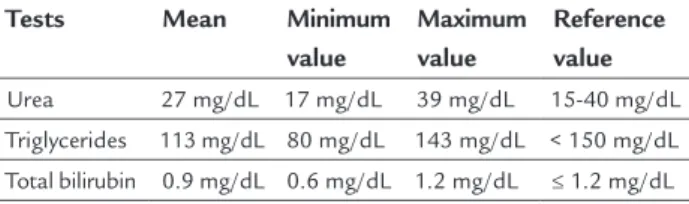
Dividing the group by age, we found 39 adults with a mean age of 34.6 years (21 ± 38 years) and 11 children and adolescents with a mean age of 5.9 years, ranging from 1 to 13 years. In this group, no interferer was ob-served, as described in Table 1.
TABLE 1 Assessment of interferers in a heterozygous population.
Tests Mean Minimum value
Maximum value
Reference value
Urea 27 mg/dL 17 mg/dL 39 mg/dL 15-40 mg/dL Triglycerides 113 mg/dL 80 mg/dL 143 mg/dL < 150 mg/dL Total bilirubin 0.9 mg/dL 0.6 mg/dL 1.2 mg/dL ≤ 1.2 mg/dL
Source: Clinical Laboratory at PUC Goiás.
The mean values of HbA1c in heterozygous children were at 5.11%, with a minimum of 3.9% and maximum of 5.97%. The mean fasting glucose in this group was 89.56 mg/dL, ranging from a minimum of 75 mg/dL to a maximum of 97 mg/dL, while mean hemoglobin was 12.9 g/dL, rang-ing from 12.1 g/dL and 14 g/dL.
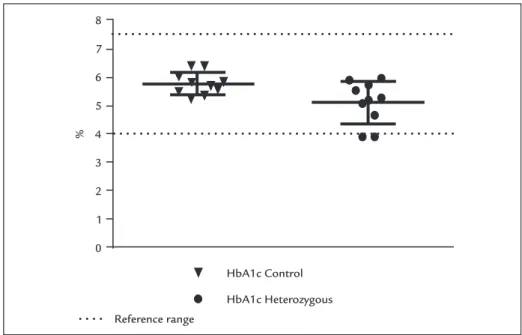
The mean A1c of heterozygous adults was close to the values found for children, at 5.0%, ranging from a mini-mum of 3.1% to a maximini-mum of 6.9%. As for mean fasting blood glucose, the adult population presented 84 mg/dL, ranging from a minimum of 69 mg/dL to a maximum of 97 mg/dL. Mean hemoglobin was at 13.8 g/dL, ranging from 12.3 g/dL to 15.8 g/dL.
In order to compare the data, we analyzed the same tests in 50 patients without heterozygosity for hemoglo-binopathies, with normal glycemic levels, of which 71.4% were female. This group included 11 children and adoles-cents, with a mean age of 10 years (6 ± 14 years). The fol-lowing results were found in this class: HbA1c 5.78%, fast-ing blood glucose 78.8 mg/dL and hemoglobin 14 g/dL.
With regard to the adult control population, 39 people with mean age of 45 years (22 ± 37 years) were analyzed. We
found in this group the following mean test results: HbA1c 5.84%, ranging from 4.1% to a maximum of 6.9%, fasting blood glucose at 89.3 mg/dL, ranging from 60 mg/dL to 99 mg/dL, and mean hemoglobin at 13.6 g/dL, ranging from a minimum of 12 g/dL to a maximum of 15.7 g/dL.
HbA1c standard deviation of the children was then calculated, reaching the result of 0.40 in the control group and 0.75 in the test group. The standard deviation from the adult test population was also calculated, which was 1.09 and the control was 0.57.
The value of the G-test was also determined, repre-senting the result of HbA1c in the normal group compared to the altered group, reaching p=0.93 for children and p=0.89 for adults (Figures 1 and 2).
Of the 50 heterozygous individuals, ten had results below the lower limit of 4%. Of these, eight were adults and two were children, of whom nine were female. The electrophoretic pattern of this group was verified and eight fit the AS profile, while two were AC.
D
ISCUSSIONThis study showed significant similarity with the findings of Menezes et al.,19 whose comparative inferential analy-sis of HbA1c was: AA, AS, AC and SS obtained from blood samples from 150 participants, including diabetics, was not significant, the same being observed in our study with 100 subjects who had normal glycemic levels.
Yedla, Kuchay and Mithal20 evaluated the levels of fasting blood glucose, postprandial blood glucose, fruc-tosamine and HbA1c (immunoassay technique) of a dia-betic patient, resulting in higher levels of fasting blood glucose, postprandial blood glucose and fructosamine, but not HbA1c, which remained normal. They concluded that the result was underestimated, and a different tech-nique should be performed for this type of examination. According to the study, ion exchange chromatography (HPLC) as a method used to measure HbA1c is not influ-enced by heterozygous hemoglobinopathies, as Copeland et al.21 report that some methodologies may have interfer-ence from heterozygous hemoglobins.
In a study by Camargo and Gross,22 the authors ana-lyzed more than 25,000 samples and found patients het-erozygous for HbS, HbC or HbD, noting that the presence of a hemoglobin variant may yield lower (false) results. However, anemia is also a source of negative interference. The hematological status should be considered for the correct interpretation of GHb results.
FIGURE 1 HbA1c comparison between control and heterozygous children.
FIGURE 2 HbA1c comparison between control and heterozygous adults.
HbA1c Control
HbA1c Heterozygous Reference range
8
7
6
5
4
3
2
1
0
%
HbA1c Control HbA1c Heterozygous Reference range
8
7
6
5
4
3
2
1
0
%
when the hemoglobin variant or its glycosylated form cannot be separated from hemoglobin A or HbA1c.23,24 In contrast, heterozygous hemoglobin S and C samples did not affect the assay.25
Not only hemoglobinopathies, including thalassemia syndromes, but also factors that affect red blood cell sur-vival, age, uremia, hyperbilirubinemia and iron deficiency can affect the results of HbA1c tests. Racial and ethnic differences, genetic variation in hemoglobin glycation and assay methodology may also influence the results.26
New methods are being developed, such as mass spec-trometry, which is based on the suppression of fluores-cence of a boron eosin in acid solution, and shows mini-mal interference of the hemoglobin variants.27-30 Despite these valuable attributes, cost of equipment and complex-ity of the operation limit its use.31
Dosage of HbA1c does not apply in homozygous conditions to anomalous hemoglobins under any meth-od, because, in these cases, hemoglobin A is practically absent. However, when an interfering hemoglobin variant is visualized or suspected, samples should be analyzed using an alternative method. In such cases, tests such as fructosamine and/or glycated albumin may be useful.2,21,31
Bouzid et al.32 suggest that laboratory professionals add a footnote that reads: “Quantification of HbA1c was not possible using this method due to the presence of ho-mozygous HbS or HbC variants or heterozygous SC com-pounds. We suggest fructosamine or another alternative.” This would provide the physician with the information needed to properly manage these diabetic patients.
Lower levels of hemoglobin affect A1c measurement and, since women have lower hemoglobin levels than men, the A1c result will suffer interference and the reference value should be different.33
C
ONCLUSIONOur study evaluated HbA1c using ion exchange chroma-tography, and the patients heterozygous for hemoglobin variants did not present a significant difference compared to the control group.
Based on the results of this study, members of the medical community should consider an assessment of laboratory results due to the differences in method em-ployed for diagnostic support. When assessing labora-tory results, the interpretation must include patient his-tory, which may contain data related to the ethnic and socioeconomic characteristics of that specific population.
R
ESUMODosagem de hemoglobina glicada em heterozigotos para hemoglobinas variantes
Objetivo: Avaliar os níveis de hemoglobina glicada em pacientes heterozigotos para hemoglobinas variantes e comparar os resultados deste exame com grupo controle. Método: Trata-se de um estudo experimental, baseado na comparação do exame de hemoglobina glicada de duas populações diferentes, sendo um grupo teste, represen-tado por indivíduos heterozigóticos para hemoglobinas variantes (AS e AC) e um grupo controle, constituído por pessoas com perfil eletroforético AA. As duas populações verificadas devem obedecer ao critério de inclusão: glice-mia de jejum, hemoglobina, ureia e triglicérides normais, bilirrubina > 20 mg/dL e não fazer uso de ácido acetilsa-licílico. Foram avaliados 50 indivíduos heterozigotos e
50 controles no período de agosto de 2013 a maio de 2014. A comparação dos valores de hemoglobina glicada entre
indivíduos heterozigóticos e controle foi realizada por meio do desvio padrão, média e teste G.
Resultados: O estudo analisou um grupo teste e um grupo controle, ambos com 39 adultos e 11 crianças. A média dos adultos heterozigotos para HbA1c foi de 5,0%, o grupo controle apresentou índice de 5,7%. Já as crian-ças heterozigóticas obtiveram média de HbA1c de 5,11%, enquanto as normais apresentaram valores médios de 5,78%. O valor do teste G foi de p=0,9 para crianças e p=0,89 para adultos.
Conclusão: Este estudo avaliou HbA1c pela metodolo-gia de cromatografia de coluna com resinas de troca iônica, em que pacientes com heterozigoses para hemo-globinas variantes não apresentaram uma diferença significativa em relação ao grupo controle.
Palavras-chave: hemoglobina A glicosilada, cromatogra-fia por troca iônica, hemoglobinas.
R
EFERENCES1. Suso K, Engroff P, Luísa E, Moriguchi Y, Carli G, Marrone FB. Prevalência de diabetes mellitus e correlação entre testes de glicemia em pacientes idosos atendidos no ambulatório do Instituto de Geriatria e Gerontologia. Rev Bras Anal Clin. 2011; 43(2):155-9.
2. Pimazoni Netto A, Andriolo A, Fraige Filho IF, Tambascia M, Gomes MB, Melo M, et al. Atualização sobre hemoglobina glicada (HbA1c) para avaliação do controle glicêmico e para diagnóstico do diabetes: aspectos clínicos e laboratoriais. J Bras Patol Med Lab. 2009; 45(1):31-48.
3. Camargo JL, Gross JL. Glico-hemoglobina (HbA1c): aspectos clínicos e analíticos. Arq Bras Endocrinol Metab. 2004; 48(4):451-63.
4. American Diabetes Association (ADA). Standards of medical care in diabetes - 2014. Diabetes Care. 2014; 37(Suppl 1):S14-80.
5. Grupo Interdisciplinar de Padronização da Hemoglobina Glicada (A1C). He-moglobina glicada. Posicionamento Oficial (versão 2003). A importância da he-moglobina glicada (A1C) para a avaliação do controle glicêmico em pacientes com diabetes mellitus: aspectos clínicos e laboratoriais [cited 2008 Nov 21]. Avai-lable from: http://www.sbpc.org.br/profissional/noticia.diverso.php?id=8&tp=3. 6. Grupo Interdisciplinar de Padronização da Hemoglobina Glicada (A1C).
Posicionamento Oficial (versão 2009). Atualização sobre hemoglobina glicada (A1C) para avaliação do controle glicêmico e para diagnóstico do diabetes: aspectos clínicos e laboratoriais [cited 2016 Jun 30]. Available from: www.sbpc.org.br/upload/conteudo/320110603170201.pdf.
7. National Glycohemoglobin Standardization Program. IFCC Padronização de HbA1c. 2010 [cited 2016 Jun 30]. Available from: http://www.ngsp.org/ifcc.asp. 8. Khuu HM, Robinson CA, Goolsby K, Hardy RW, Konrad RJ. Evaluation of a fully automated high-performace liquid chromatography assay for hemoglobin A1C. Arch Pathol Lab Med. 1999; 123(9):763-7.
9. Sacks DB, Bruns DE, Goldstein DE, Maclaren NK, McDonald JM, Parrott M. Guidelines and recomendations for laboratopry analysis in the diagnosis and management of diabetes mellitus. Clin Chem J. 2002; 48(3):436-72. 10. Sacks DB, Burtis CA, Ashwood ER, Bruns DE. Textbook of clinical chemistry
and molecular diagnostics. St Louis: Elsevier Saunders; 2006. p. 837-901. 11. Sumita NM, Andriolo A. Importância da hemoglobina glicada no controle
do diabetes mellitus e na avaliação de risco das complicações crônicas. J Bras Patol Med Lab. 2008; 44(3):169-74.
13. Schechter A. Hemoglobin research and the origins of molecular medicine. Blood. 2008; 112(10):3927-38.
14. Tran H, Silva D, Petrovsky N. Case study: potential pitfalls of using hemoglobin Alc as the sole measure of glycemic control. Clin Diabetes. 2004; 22(3):141-3.
15. Sacks DB, Burtis CA, Ashwood ER, editors. Tietz textbook of clinical chemistry. Philadelphia: W. B. Saunders; 1999. p. 750-808.
16. Hanas R, John WG; International HbA1c Consensus Committee. 2013 Update on the worldwide standardization of the hemoglobin A1c measurement. Pediatr Diabetes. 2014; 15(3):e1-2.
17. Hoelzel W, Weykamp C, Jeppsson J, Miedema K, Barr JR, Goodall I, et al.; IFCC Working Group on HbA1c Standardization. IFCC reference system for measurement of hemoglobin A1c in human blood and the national stan-dardization schemes in the United States, Japan, and Sweden: a method--comparison study. Clin Chem. 2004; 50(1):166-74.
18. Secretaria de Atenção à Saude, Departamento de Atenção. Orientações para a coleta e análise de dados antropométricos em serviços de saúde. Brasília; 2011. p. 76.
19. Menezes MGS, Couto FD, Junior LSS, Adôrno EV, Barbosa CG, Gonçalves MS, et al. Determinação de HbA1c por CLAE: interferência de variantes de hemoglobinas S e C e alta concentração de HbF. J Bras Patol Med Lab. 2012; 48(5):337-44.
20. Yedla N, Kuchay MS, Mithal A. Hemoglobin E disease and glycosylated hemoglobin. Indian J Endocrinol Metab. 2015; 19(5):683-5.
21. Copeland KC, Silverstein J, Moore KR, Prazar GE, Raymer T, Shiffman RN, et al. Al E. Management of newly diagnosed type 2 diabetes mellitus (T2DM) in children and adolescents. Pediatrics. 2013; 131(2):364-82.
22. Camargo JL, Gross JL. Conditions associated with very low values of glycohaemoglobin measured by an HPLC method. J Clin Pathol. 2004; 57(4):346-9.
23. Saw S, Loh TP, Yin C, Sethi SK. Identification of hemoglobin variants in samples received for glycated hemoglobin testing. Clin Chim Acta. 2013; 415:173-5. 24. Bry L, Chen PC, Sacks DB. Effects of hemoglobin variants and chemically
modified derivatives on assays for glycohemoglobin. Clin Chem. 2001; 47(2):153-63.
25. Behan KJ, Storey NM, Lee HK. Reporting variant hemoglobins discovered during hemoglobin A1c analysis — common practices in clinical laboratories. Clin Chim Acta. 2009; 406(1-2):124-8.
26. Herman WH, Cohen RM. Racial and ethnic differences in the relationship between HbA1c and blood glucose: implications for the diagnosis of diabetes. J Clin Endocrinol Metab. 2012; 97(4):1067-72.
27. American Diabetes Association (ADA). Standards of medical care in diabetes--2011. Diabetes Care. 2011; 34(Suppl 1):S11-61.
28. Nakanishi T, Miyazaki A, Iguchi K, Shimizu A. Effect of hemoglobin variants on routine glycohemoglobin measurements assessed by a mass spectrometric method. Clin Chem. 2000; 46(10):1689-92.
29. Blincko S, Anzetse J, Edwards R. Measurement of glycated haemoglobin in whole blood by a novel fluorescence quenching assay. Ann Clin Biochem. 2000; 37(Pt 4):492-7.
30. Schnedl WJ, Liebminger A, Roller RE, Lipp RW, Krejs GJ. Hemoglobin variants and determination of glycated hemoglobin (HbA1c). Diabetes Metab Res Rev. 2001; 17(2):94-8.
31. Sacks DB, Burtis CA, Ashwood ER, Bruns DE, editors. Tietz textbook of clinical chemistry and molecular diagnostics. St. Louis: Elsevier; 2012. p. 1415-56. 32. Bouzid K, Ahmed HB, Kalai E, Blibeche S, Couque N, Khiari K, et al.
Prevalence of hemoglobin variants in a diabetic population at high risk of hemoglobinopathies and optimization of HbA1c monitoring by incorporating HPLC in the laboratory workup. Libyan J Med. 2014; 9:25768.