ALVESAND OLIVEIRA
332 REV ASSOC MED BRAS 2017; 63(4):332-335
ORIGINAL ARTICLE
Should azoospermic patients with varicocele disease undergo
surgery to recover fertility?
LEONARDODE SOUZA ALVES1*, FRANCISCO BATISTADE OLIVEIRA2
1MD, Urologist, Faculdade de Ciências Médicas de Minas Gerais (FCM-MG). Director of Procriar – Instituto de Urologia e Andrologia. Full Member of the Sociedade Brasileira de Urologia (SBU), the American Urological
Association (AUA), and the American Confederation of Urology (CAU). Full Member of the Colégio Brasileiro de Cirurgiões (CBC), Belo Horizonte, MG, Brazil
2MD, Gynecologist, Endocrinologist, FCM-MG, Belo Horizonte, MG, Brazil
S
UMMARYStudy conducted at Procriar – Instituto de Urologia e Andrologia, Belo Horizonte, MG, Brazil
Article received: 8/18/2016
Accepted for publication: 10/19/2016
*Correspondence:
Address: Rua da Bahia, 2.696, sala 1.303 Belo Horizonte, MG – Brazil Postal code: 30160-012 [email protected]
http://dx.doi.org/10.1590/1806-9282.63.04.332
Introduction: Varicocele disease is well-known cause of infertility in men. The presence of spermatic varices veins create a hostile environment to spermatogenesis. It results in reduced quality of the sperm production and in some cases can determine a total absence of sperm. The varicocelectomy procedure in patients with non-obstructive azoospermia (NOA) can raise the rates of sperm in the semen analysis. A positive rate for sperm, even if very low, may be sufficient to enable the capture of sperm intended for in-vitro fertilization without the use of donor sperm.
Objetive: To evaluate the raise of sperm in NOA patients with varicocele disease who were submitted to a bilateral procedure to recovery sperm production.
Method: We analized the sperm results of 25 NOA patients who undergone to a bilateral varicocelectomy procedure.
Results: From a total of 25 patients, three (12%) recovered sperm count four months after procedure. One year after the procedure, five (20%) patients reco-vered sperm production.
Conclusion: Patients with varicocele disease and azoospermia, without genetic changes or obstruction of the spermatic tract, should undergo surgical procedure to recover sperm.
Keywords: azoospermia, infertility, varicocele, surgery.
I
NTRODUCTIONShould azoospermic patients with varicocele be operated? In cases of marital male infertility evaluation, absence of sperm on a sperm test is often a frustrating and de-vastating result for the couple. The azoospermic “couple” is referred to an assisted reproductive program many times already condemned to resort to the use of a sperm donor. However, something else can be offered to these patients. An etiological diagnosis should be performed and, depending on the cause, treatment options can be offered. The diagnosis of varicocele disease in an azoos-permic patient justifies the ressection of espermatic veins to improve spermatogenesis.
O
BJECTIVETo evaluate patients with non-obstructive azoospermia (NOA) and varicocele undergoing bilateral surgical cor-rection for recovery of sperm production.
M
ETHODSHOULDAZOOSPERMICPATIENTSWITHVARICOCELEDISEASEUNDERGOSURGERYTORECOVERFERTILITY?
REV ASSOC MED BRAS 2017; 63(4):332-335 333
first sperm count was conducted 60 days after surgery, and subsequently repeated every 60 days.
R
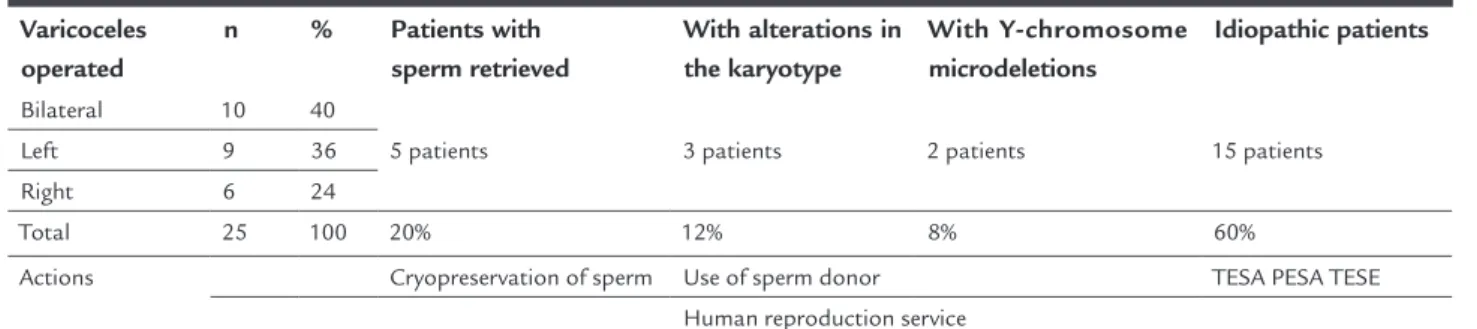
ESULTSOf the 25 patients, 10 (40%) presented bilateral varicocele on physical examination. Left varicocele was identified in nine (36%) patients, and six (24%) had right-sided varicocele only. Sperm was found in three (12%) patients treated sur-gically, four months after the procedure. Six months af-ter surgery, sperm was identified in five (20%) patients. After one year of follow-up, only five (20%) patients had sperm in the ejaculate (Table 1). None of the five patients presented testicular volume reduction in pre-op. The concentration of sperm in the patients operated reached 0.5 to 12 million/mL (Vr > 20 million/mL). Out of the total of 25 patients, three (12%) had changes in karyo-type, and two (8%) had Y-chromosome microdeletions.
D
ISCUSSIONThe male factor is responsible for about 40% of cases of marital infertility. A diagnosis of azoospermia is made in up to 15% of infertile men.1,2,4,6,7 Non-identification of sperm
in the semen should always be investigated. A differential diagnosis between obstructive and non-obstructive azoos-permia is fundamentally important for the treatment and prognosis of patients.1,2,4,8 FSH, LH, total testosterone and
estradiol levels combined can demonstrate the testicular function. Last but not least, measuring the level of fructo-se in fructo-semen offers evidence for obstructive diagnosis.1,2,4,6,8
Researching the medical history is crucial and can guide the diagnosis:
1. history of cryptorchidism in childhood and if and when it was corrected;
2. history of sexually transmitted diseases;
3. previous contact with gonadal-toxic agents or the use of exogenous androgen, very common in the absence of sperm;
4. story of retrograde ejaculation (in diabetics, patients with bladder voiding disorders, changes in patients undergoing prostatic surgeries) will identify patients with sperm in post-ejaculation urine analysis.
Karyotype analysis showed 15% of changes in azo-ospermic patients in the studied group. Regarding changes in karyotype, Klinefelter syndrome is one of the most frequent genetic alterations in azoospermic patients.1,5-7,12,13 Y-chromosome microdeletions can be
expected in approximately 15 to 20% of patients with NOA. The Y-chromosome is responsible for determin-ing the male gender and features three regions known as AZFa, AZFb, AZFc. That is where the information for the production and maturation of sperm cells can be found.1,5-7,12 This evaluation is truly important
be-cause patients referred for assisted reproduction can transmit genetic disorders in the absence of genetic counseling. These patients are unlikely to benefit from varicocelectomy.4,6,8,11-13
On physical examination, identification of the vas deferens is fundamental. The presence of ectopic testicles or testicles with reduced volumes can be indicative of testicular failure or poor response to surgical procedure. These patients have a poorer prognosis.1,3,4,9
Until recently, the presence of varicocele was not ac-knowledged in these patients. Varicocele repair should not be considered in obstructive seminiferous tubules. It has a prevalence of 15% in the general population and occurs in 30 to 40% of infertile patients.1-4
A diagnosis is made during the physical exam with the patient being brought to a standing position, at room temperature. Doppler ultrasound can be used as a supple-mentary method.1-3
Varicocele is a vascular disease that affects testicular veins. Its presence causes an inappropriate environment
for the production and development of sperm.1-4 The
disease can change the concentration, motility, morphol-ogy and structure of sperm DNA.1-4
Pathological sperm vein reflux leads to the accumula-tion of CO2 and free radicals, lowering local concentrations
of O2, which affects the functioning of Leydig cells and
Sertoli cells. These cells are responsible for the production of testosterone and sperm, respectively. The varicocele can cause atrophy and calcification, hindering cell devel-opment and espermatogenesis.1-3,5,6,11-13
TABLE 1 Results of the sperm analysis after varicocelectomy.
Varicocele Cases treated surgically % Sperm positive 4th month Sperm positive 6th month Sperm positive 12th month
Bilateral 10 40
3 patients 5 patients 5 patients
Left 9 36
Right 6 24
Total 25 100 12% 20% 20%
ALVESAND OLIVEIRA
334 REV ASSOC MED BRAS 2017; 63(4):332-335
In the studied group, 25 patients underwent bilateral procedure, although only ten presented bilateral varicocele veins. Out of 25 patients operated, five (20%) benefited from varicocelectomy. Despite not reaching a minimum concentration of sperm, i.e. 20 million/mL, the recovery of spermatogenesis allowed the use of the patient’s own semen for assisted fertilization techniques.5,6,8-10,13
Semen cryopreservation was suggested to five patients. None of the patients who recovered some production presented testicular volume reduction, noting that tes-ticular volume reduction can be a prognostic of poorer
results.1,8,9 Patients with no sperm found in the sperm
control exam were referred to a human assisted reproduc-tion service.
The five patients with genetic changes were advised of the possibility of choosing a sperm donor.
The other 15 patients with a diagnosis of idiopathic azoospermia were advised to undergo TESE, micro-TESE, TESA and PESA. These techniques are used to collect sperm from the testicle or epididymis. The sperm sample could be used for cryopreservation or assisted reproduc-tive procedures (Table 2).1,7-9,12-16
TABLE 2 Findings and actions after one year of varicocelectomy.
Varicoceles operated
n % Patients with
sperm retrieved
With alterations in the karyotype
With Y-chromosome microdeletions
Idiopathic patients
Bilateral 10 40
5 patients 3 patients 2 patients 15 patients
Left 9 36
Right 6 24
Total 25 100 20% 12% 8% 60%
Actions Cryopreservation of sperm Use of sperm donor TESA PESA TESE Human reproduction service
Note that 1/5 of the operated patients can use their own sperm.
C
ONCLUSIONPatients with varicocele and azoospermia and without genetic changes or obstruction should be treated surgically with varicocelectomy.
Although small, the postoperative recovery of sperm would allow the couple to undergo assisted reproductive procedures without the need of a sperm donor. Thus, patients with NOA associated with varicocele veins should be made aware of the small chance of success in recovering sperm production after surgery, and of the purpose of surgery.7-13,16
C
ONFLICT OF INTERESTThe authors declare no conflict of interest.
R
ESUMOPacientes com azoospermia e varicocele devem ser sub-metidos à cirurgia para recuperar a fertilidade?
Introdução: A varicocele é sabidamente uma das causas de infertilidade nos homens. A presença de veias espermá-ticas dilatadas pode criar um ambiente hostil para a esper-matogênese. Isso é causa de baixa qualidade e quantidade da produção do esperma; em alguns casos, pode
determi-nar uma ausência total de espermatozoides. O procedi-mento de varicocelectomia em pacientes com azoospermia não obstrutiva pode aumentar as taxas de espermatozoides na análise do sêmen. Uma taxa positiva para o esperma, mesmo se muito baixa, pode ser suficiente para permitir a coleta e destinar-se ao processo de fertilização in vitro. Isso
sem a necessidade de usar esperma de doador.
Objetivo: Avaliar o aumento de espermatozoides em pacientes com varicocele associada à azoospermia não obstrutiva.
Método: Foram analisados os espermas de 25 pacientes azoospêrmicos não obstrutivos submetidos a procedi-mento de varicocelectomia bilateral com magnificação microcirúrgica.
Resultados: De um total de 25 pacientes, em três (12%) ocorreu recuperação da contagem de espermatozoides quatro meses após o procedimento. Após um ano de pro-cedimento, em cinco (20%) ocorreu a recuperação.
Conclusão: Pacientes com ausência de espermatozoides e varicocele, sem alterações genéticas, devem ser subme-tidos a tratamento cirúrgico a fim de recuperar a produ-ção de espermatozoides.
SHOULDAZOOSPERMICPATIENTSWITHVARICOCELEDISEASEUNDERGOSURGERYTORECOVERFERTILITY?
REV ASSOC MED BRAS 2017; 63(4):332-335 335
R
EFERENCES1. Mulhall JP, Stalh PJ, Stember D. Varicocele. Clinical cares pathways in andrology. Philadelphia: Springer; 2013. p. 165-70.
2. Cozzolino DJ, Lipshultz Li. Varicocele as a progressive lesion: positive effect of varicocele repair. Hum Reprod Update. 2001; 7(1):55-8.
3. Fretz PC, Sandlow JI. Varicocele: current concepts in pathophysiology, diagnosis, and treatment. Urol Clin North Am. 2002; 29(4):921-37. 4. Male Infertility Best Practice Policy Committee of the American Urological
Association; Practice Committee of the American Society for Reproductive Medicine. Report on varicocele and infertility. Fertil Steril. 2004; 82(Suppl 1):S142-5.
5. Inci K, Hascicek M, Kara O, Dikmen AV, Gürgan T, Ergen A. Sperm retrieval and intracytoplasmic regions sperm injection in men with nonobstructive azoosper-mia, and treated and untreated varicocele. J Urol. 2009; 182(4):1500-5. 6. Esteves SC, Glina S. Recovery of spermatogenesis after microsurgical
subinguinal varicocele repair in azoospermic men based on testicular histology. Int Braz J Urol. 2005; 31(6):541-8.
7. Smit M, Romijn JC, Widhagen MF, Veldhoven JL, Weber RF, Dohle GR. Decrease sperm DNA fragmentation after surgical varicocelectomy is associated with increase pregnancy rate. J Urol. 2010; 183(1):270-4. 8. Abdel-Meguid T. Predictors of sperm recovery and azoospermia relapse in
men with nonobstructive azoospermia after varicocele repair. J Urol. 2012; 187(1):222-6.
9. Lee JS, Park HJ, Seo JT. What is the indication of varicocelectomy in men with nonobstructive azoospermia? Urology. 2007; 69(2):352-55. 10. Pasqualotto F, Sobreiro BP, Hallak J, Pasqualotto EB, Lucon AM. Induction
of spermatogenesis in azoospermic men after varicocelectomy repair: an update. Fertil Steril. 2006; 85(3):635-9.
11. Esteves SC, Miyaoka R, Roque M, Agarwal A. Outcome of varicocele repair in men with nonobstructive azoospermia: systematic review and meta--analysis. Asian J Androl. 2016; 18(2):246-53.
12. Dai RL, Hou Y, Li FB, Yue JM, Xi Q, Liu RZ. Varicocele and male infertility in Northeast China: Y chromosome microdeletion as an underlying cause. Genet Mol Res. 2015; 14(2):6583-90.
13. Tiseo BC, Russell PH, Tanrikut C. Surgical management of nonobstructive azoospermia. Asian J Urol. 2015; 2(2):85-91.
14. Franco G, Scarselli F, Casciani V, De Nunzio C, Dente D, Leonardo C, et al. A novel stepwise micro-TESE approach in non obstructive azoospermia. BMC Urol. 2016; 16:20.
15. Saccà A, Pastore AL, Roscigno M, Naspro R, Pellucchi F, Fuschi A, et al. Conventional testicular sperm extraction (TESE) and non-obstructive azoospermia: is there still a chance in the era of microdissection TESE? Results from a single non-academic community hospital. Andrology. 2016; 4(3):425-9.