2013 Nov.-Dec.;21(6):1212-9 DOI: 10.1590/0104-1169.2957.2356 www.eerp.usp.br/rlae
Copyright © 2013 Revista Latino-Americana de Enfermagem
This is an Open Access article distributed under the terms of the Creative Commons Attribution Non-Commercial License (CC BY-NC).
This license lets others distribute, remix, tweak, and build upon your work non-commercially, and although their new works must also acknowledge you and be non-commercial, they don’t have to license their derivative works on the same terms.
Corresponding Author: Juliana Rizzo Gnatta
Universidade de São Paulo. Hospital Universitário Av. Prof. Lineu Prestes, 2565
Bairro: Butantã
CEP: 05508-000, São Paulo, SP, Brasil E-mail: [email protected]
Juliana Rizzo Gnatta
2Flávia Morais Gomes Pinto
3Camila Quartim de Moraes Bruna
3Rafael Queiroz de Souza
3Kazuko Uchikawa Graziano
4Maria Julia Paes da Silva
41 Supported by Fundação de Amparo à Pesquisa do Estado de São Paulo (FAPESP), process # 2011/18448-2. 2 MSc, RN, Hospital Universitário, Universidade de São Paulo, São Paulo, SP, Brazil.
3 Doctoral students, Escola de Enfermagem, Universidade de São Paulo, São Paulo, SP, Brazil. 4 PhD, Full Professor, Escola de Enfermagem, Universidade de São Paulo, São Paulo, SP, Brazil.
Objective: this study aimed to evaluate the efficacy of hand hygiene performed with two different
soap formulations: 0.3% Melaleuca alternifolia essential oil versus 0.5% triclosan, and to compare
them with two reference hygiene procedures: the official methodology procedure (soft soap)
versus the draft version of the procedure (soft soap + propan-2-ol). Method: using the European
EN 1499 method, logarithmic reduction factors were determined for the number of colony forming
units of Escherichia coli K12 before and after hand hygiene of 15 volunteer subjects, and compared
using the one-tailed Wilcoxon test. Results: referring to the soft soap, there was no difference
between the performance of soap with 0.3% M. alternifolia and soap containing 0.5% triclosan.
The soft soap + propan-2-ol proved to be more effective than the other hand hygiene procedures.
Conclusion: studies to verify the therapeutic efficacy of essential oil in hand hygiene can improve
adherence to this practice.
Descriptors: Hand Desinfection; Tea Tree Oil; Triclosan; Infection Control; Nursing.
Comparison of hand hygiene antimicrobial efficacy:
Melaleuca
Introduction
Hand hygiene is the single most ancient and eficient,
simple and less costly measure to prevent the spread of
healthcare associated infections (HAIs)(1). Effective hand
hygiene is that which, in addition to its primary purpose of
microbial reduction by means of sanitizing agents, does not
cause a negative impact on skin condition, but preserves
it. It is recommended that hand hygiene products are
well accepted, well tolerated, and formulated with the
guarantee to avoid any possible irritation(2).
Essential oils are highly volatile substances
extracted from plants and have active ingredients due
to their complex chemical composition. The therapeutic
use of essential oils in order to improve the physical,
mental or emotional well-being of an individual is called
aromatherapy. Although the mechanism of physiological
action of aromatherapy is not well established, it is
inferred that it produces a stimulus that results in the
release of neurotransmitters, such as endorphins and
enkephalins, which have an analgesic effect and produce
feelings of well-being and relaxation(3). The number of
studies on the antimicrobial effects of essential oils
has been increasing in the literature(4), among which
the essential oil of Melaleuca alternifolia (Tea Tree
oil – TTO) has become known for its antiseptic properties.
Publications report that this essential oil presents
antimicrobial activities, among them antibacterial(5),
including the decolonization of methicillin-resistant
Staphylococcus aureus (MRSA)(6), antifungal(7-8) and antiviral(9) activities, as well as anti-inlammatory
effects(10).
With regard to the antibacterial property of TTO,
studies have shown this activity on a broad range of
Gram-positive and Gram-negative bacteria, fungi and
viruses(5). The effect of TTO on the development of
antibiotic resistance in S. aureus and Escherichia coli
has already been examined, indicating that this oil and
terpinen-4-ol, its main active component, have little
impact on the development of antimicrobial resistance(11).
Australian researchers demonstrated in vitro actions of
TTO to determine the minimal inhibitory and bactericidal
concentrations for several strains of microorganisms
present in the microlora of the skin(12). The results obtained were satisfactory with a concentration of TTO
ranging from 0.06% to 5.00% for the vast majority of
microorganisms. The minimal inhibitory and bactericidal
concentrations were the same for each of the
Gram-negatives tested; while for the Gram-positives, they
were variable(12). This study further suggests a possible
residual effect against transient microlora and that
preparations containing TTO for hand washing should be
investigated for their eficacy. These results suggest that
the use of potentially antiseptic essential oils, such as
TTO, may represent an eficient resource in the practice
of hand hygiene, both due to their the antimicrobial
action and due to being a natural alternative to the
synthetic antiseptics on the market, improving the
adherence of the healthcare professionals.
Since the 1980s healthcare professionals have
reported damage to the integrity of the skin caused
by products recommended by the infection control
programs, such as triclosan or chlorhexidine based
soaps(13). The selection of hand hygiene products with
good acceptability while simultaneously being effective
is a key component for the promotion and increase of the
adherence to the practice(14). Thus, the purpose of this
study was to verify whether a liquid soap with a natural
active ingredient – 0.3% essential oil of M. alternifolia
– would be able to provide antimicrobial eficacy and be
an alternative to conventional antiseptic soap containing
0.5% triclosan. The non-inferiority hypothesis assumed
was that the formulation of a liquid soap containing TTO
can surpass the reduction of the microbial load of soap
with triclosan.
The present study aimed to evaluate and compare
the eficacy of antimicrobial liquid soap containing 0.3%
TTO and liquid soap with 0.5% triclosan in reducing
the microbial load present on artiicially contaminated hands; and to compare the antimicrobial eficacy of the
tested products with those of reference indicated in the
methodology, which used the reference soap (soft soap)
followed or not by the use of 60% propan-2-ol.
Methods
Design and study site
This double-blind (subject and statistician)
crossover study was developed in the Microbiological
Testing Laboratory (LEM) of the Department of
Medical-Surgical Nursing of the University of São Paulo School
of Nursing.
Ethical aspects
The study followed the recommendations of
Resolution 196/1996 of the National Health Council
regarding research with human beings. The study was
initiated after the acceptance of the Research Ethics
Committee of the University of São Paulo School of
Rev. Latino-Am. Enfermagem 2013 Nov.-Dec.;21(6):1212-9.
institution under process No. 1069/2011CEP-EEUSP –
SISNEP CAAE – 0082.0.196.000-11.
The criteria for inclusion of the subjects in the
sample were: to be between 18 and 55 years of age
(since there are changes in the composition of the skin
microbiota after age 60); to have had no contact with a
residual effect antiseptic within the previous 48 hours;
to not present apparent signs of dryness of the hands
or injuries, to have clean, short and unpolished nails
at the time of data collection, and to be willing to sign
the Terms of Free Prior Informed Consent (TFPIC). The
criteria for exclusion of the subjects from the sample
were: to have prior knowledge regarding allergy to any
of the substances to be used in the experiment, to be
pregnant, or to refuse to take part in the study.
Study protocol
Before starting the experiment, the negative
microbiological control was performed for the soaps
containing TTO (Doctornatu® liquid soap from Higinatu,
Brazil) and triclosan (Rioderme® soap from Rioquímica,
Brazil), following the recommendations of Resolution
481/99 of Anvisa(15). The analysis methods were in
accordance with the ABNT NBR ISO 21149, ABNT
NBR ISO 21150, ABNT NBR ISO 22717 and ABNT
NBR ISO 22718 standards, which are described in
the Brazilian Pharmacopoeia(16). This step aimed to
verify the absence of previous contamination of the
products tested.
To seek consistent and plausible evidence, a
European methodology was used(17) proposed by the
European Committee for Standardization – European
Standard in force since 1997 with the addition of some
considerations existing in its draft version(18), proposed
in April 2011, which is still under evaluation. Such
considerations were related to the use of the medium for
the strain recovery test using Tryptone Soya Selective
Agar – TSSA (DIFCO®, BD®, Sparks, USA) and the
reference procedure for hand hygiene that uses soft
soap followed by the addition of propan-2-ol.
Prior to the experiment, an appropriate neutralizer
for each of the products was validated for the purposes
of 1) not presenting any toxic effect on the Escherichia
coli K12 strain, and 2) presenting neutralizing action on the formulation of the product under test, ensuring that
the bactericidal and/or residual bacteriostatic activity
of the active antiseptic ingredients were neutralized or
suppressed. The neutralizers validated were tryptone
soya broth – TSB (DIFCO®, BD®, Sparks, USA) for the
0.3% TTO soap, the propan-2-ol and the soft soap. For
the soap containing 0.5% triclosan, D/E Neutralizing
Broth (DIFCO®, BD®, Sparks, USA) was validated.
For the experiment, the hands of all the subjects
were prepared by a simple wash lasting 60 seconds
using 5ml of soft soap, then rinsing with mineral water
for 15 seconds and drying with a paper towel. All the
participants were trained to perform the simple hand
hygiene technique immediately before starting the data
collection and they performed the procedures under
the supervision of a monitor. The ingertips were then
immersed in a Petri dish containing 10ml TSB for one
minute, to obtain the initial bacterial count value
(pre-values). Next, artiicial contamination of the hands of
volunteers was carried out using a suspension containing
2x10⁸ to 2x10⁹ colony forming units per ml (CFUs/ml) of
the test microorganism, in this case, E. coli K12 (strain
used in this study: ATCC 14948; contamination luid
with 5x10⁸CFU/ml). Both hands of each subject were
immersed in the contaminated luid for ive seconds to the metacarpals, with the ingers spread, in a sterile
stainless steel bowl. The same suspension was used for
all test subjects over a maximum period of three hours
after the exposure of the hands of the irst subject(17). After drying (three minutes) in ambient air,
maintaining the hands in a horizontal position and making
rotation movements with the ists to avoid the formation
of droplets, the initial value of the bacterial count
(pre-values) was obtained for each of the subject from the
smear of the ingertips of each hand for one minute
on the bottom of a Petri plate containing 10ml of TSB.
Then, the hygiene reference procedure was performed
(with use of 5ml of soft soap for 60 seconds or the use
of 5ml of soft soap for 60 seconds, followed by rinsing
and the use of 3ml propan-2-ol for 30 seconds, two
consecutive times, followed by rinsing) or the procedure
with 1.5 ml of the product under test, according to the
group in which the subject was randomly inserted, and
the post-values were collected. The post-values were
obtained from the smear of the ingertips in a Petri dish containing 10 ml of neutralizer speciic for the respective
products that were used in the hand hygiene.
The sample consisted of 15 volunteer participants,
who were randomized into four groups, identiied by
the Roman numerals I, II, III and IV, who had the
sequence of use of the products designated using a
Latin square. It should be noted that all the subjects
performed the hand hygiene with the four products
under evaluation, varying only the order of use. The
plates were incubated for 18 to 24 hours at 37°C and
then reincubated for 24 hours to detect the growth of
new colonies.
Analysis of the results and statistics
To obtain the data the mean number of colonies
of the right and left hands were calculated and the
logarithmic reduction factor (RF) was determined by
calculating the difference between the inal and initial
values of E. coli CFUs. As indicated in the methodology,
the log reduction was calculated for each of the sampling
luid dilution stages using the weighted mean of the
number of pre-value and post-value CFUs/ml.
For the test to be valid, the RF of the mean of the
log obtained for the test products should be statistically
higher than that found for the reference soap, for at
least twelve subjects, and the total logarithmic mean of
the “pre-values” for the procedures with the reference
product. Furthermore, the results of the procedure
with test products should be at least 5 log. The data
were entered into a Microsoft Excel® spreadsheet and
processed using the R 2.14.1 program for the statistical
analysis. Descriptive statistics (mean and standard
deviation) were calculated, with the comparison
of the groups made using the Wilcoxon paired
nonparametric test (the test recommended by the EN
1499 methodology(17)). The level of signiicance was
established as p=0.01 one-tailed. The adjustment of the
test is able to detect a difference of 0.5 log with a power
of 80 to 90%. To verify if there was a difference between
the pre-values and the evaluation of the Latin squared
design, ANOVA was applied (signiicance level of 5%)
and to verify the correlation of the contamination of the
hands before and after the procedures of hand hygiene,
Pearson’s Correlation was used.
Results
The results of the microbiological analysis of the
test soaps indicated that microbial contamination
of products was absent. Of the 15 volunteers who
participated in the trial, 11 were female (73.4%)
and four male (26.6%). The minimum age was 23
years and maximum 50 years (mean = 31 years;
median = 30 years; standard deviation = 7.67). Twelve
subjects were registered nurses, two were 4th year
Nursing undergraduate students, and one performed
administrative activities.
The ANOVA was used to evaluate the effect of
the Latin square model (Table 1). It was observed that
there was no signiicant difference for the position
that individual occupied in the group (p=0.81) or for
the sequence of procedures performed (p=0.31), i.e.,
there was no column or group effect. However, there
were differences in the treatment (p<0.001) which,
in this case, was caused exclusively by the different
procedures.
Table 1 - ANOVA for the evaluation of the group, column
and treatment effects of the Latin Square model. São
Paulo, SP, Brazil, 2012
Table 2 - Correlations between the mean contamination of the left and right hands of the subjects before (pre-values)
and after (post-values) the hand hygiene procedure. São Paulo, SP, Brazil, 2012
Factor Degrees of freedom p-value
Treatment 3 <0.001
Group 3 0.31
Column 3 0.81
Treatment
Moment
Pre-value Post-value
Dilution Mean
CFUs
Dilution Mean
CFUs
10-3 10-4 10-5 100 10-1 10-2
Soft Soap 0.981 0.986 0.999 5.63 0.535 0.697 0.598 1.76
Soap with 0.3% TTO 0.774 0.817 0.892 5.98 0.565 0.356 0.792 2.10
Soap with 0.5% triclosan 0.763 0.986 0.934 6.38 0.343 0.805 0.750 2.79
Soft soap + propan-2-ol 0.830 0.917 0.916 6.29 0.359 0.386 0.445 1.40
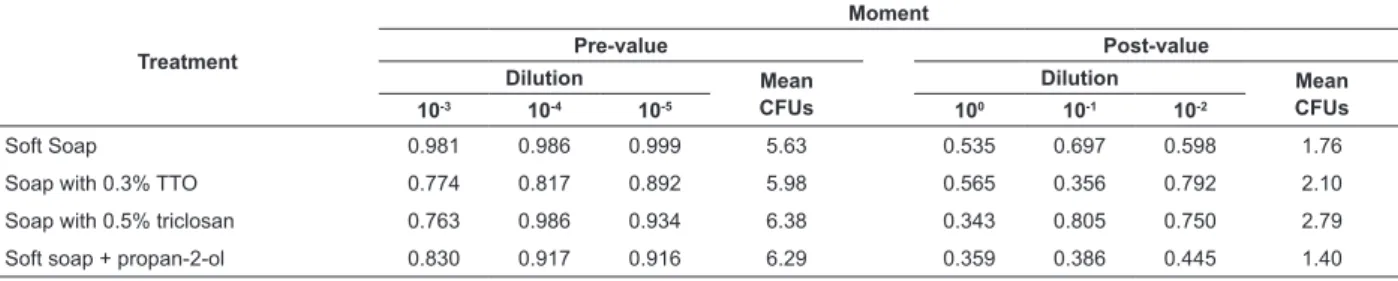
The contamination of the hands with the microbial
suspension of the study was successful. The ANOVA
showed no statistical difference between the
pre-values for each of the four products used as treatment
(p-value=0.2804; established signiicance level
p-value=0.05). Table 2 shows the correlations between
the contamination of the left and right hands of the
subjects before (pre-values) and after (post-values)
the hand hygiene procedure, by means of Pearson’s
Rev. Latino-Am. Enfermagem 2013 Nov.-Dec.;21(6):1212-9.
Table 3 - Logarithms related to pre- and post-values and logarithmic reduction factor (RF) for each of the hand
hygiene procedures for each subject, according to the group. São Paulo, SP, Brazil, 2012
Table 4 - Application of the Wilcoxon test on the logarithmic reduction factors (RF) for each one of the test products
in relation to the reference procedure with soft soap + propan-2-ol. São Paulo, SP, Brazil, 2012 By applying Pearson’s correlation, it was observed
that the values were more correlated among themselves
in the pre-values (closer to +1 in the dilutions of 10-3 to
10-5) indicating that the luid contaminated both hands
similarly, than in the post-values (dilutions from 100 to
10-2 – values less close to +1).
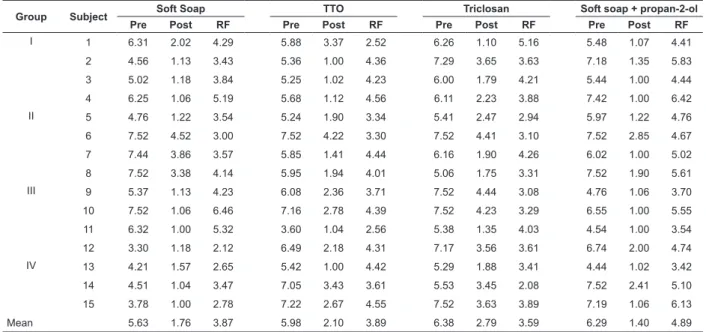
Table 3 presents the pre-values (logarithms of
E. coli present on the hands of the subjects before the hygiene procedure), post-values (logarithms of E.
coli present on the hands of the individuals after the
hygiene procedure) and the logarithmic reduction factor
(RF = pre-value – post-value) for the study subject, after
the calculation indicated by the methodology(17), according
to the hand hygiene procedure. It can be observed that
all the logarithmic means of the pre-values for the four
hand hygiene procedures were greater than 5, itting the
aforementioned necessary requirements for the trial to
be considered valid (mean = 5.63 for soft soap; 5.98 for
the soap containing TTO, 6.38 for the soap containing
triclosan; 6.29 for soft soap + propan-2-ol).
Group Subject Soft Soap TTO Triclosan Soft soap + propan-2-ol
Pre Post RF Pre Post RF Pre Post RF Pre Post RF
I 1 6.31 2.02 4.29 5.88 3.37 2.52 6.26 1.10 5.16 5.48 1.07 4.41
2 4.56 1.13 3.43 5.36 1.00 4.36 7.29 3.65 3.63 7.18 1.35 5.83
3 5.02 1.18 3.84 5.25 1.02 4.23 6.00 1.79 4.21 5.44 1.00 4.44
4 6.25 1.06 5.19 5.68 1.12 4.56 6.11 2.23 3.88 7.42 1.00 6.42
II 5 4.76 1.22 3.54 5.24 1.90 3.34 5.41 2.47 2.94 5.97 1.22 4.76
6 7.52 4.52 3.00 7.52 4.22 3.30 7.52 4.41 3.10 7.52 2.85 4.67
7 7.44 3.86 3.57 5.85 1.41 4.44 6.16 1.90 4.26 6.02 1.00 5.02
8 7.52 3.38 4.14 5.95 1.94 4.01 5.06 1.75 3.31 7.52 1.90 5.61
III 9 5.37 1.13 4.23 6.08 2.36 3.71 7.52 4.44 3.08 4.76 1.06 3.70
10 7.52 1.06 6.46 7.16 2.78 4.39 7.52 4.23 3.29 6.55 1.00 5.55
11 6.32 1.00 5.32 3.60 1.04 2.56 5.38 1.35 4.03 4.54 1.00 3.54
12 3.30 1.18 2.12 6.49 2.18 4.31 7.17 3.56 3.61 6.74 2.00 4.74
IV 13 4.21 1.57 2.65 5.42 1.00 4.42 5.29 1.88 3.41 4.44 1.02 3.42
14 4.51 1.04 3.47 7.05 3.43 3.61 5.53 3.45 2.08 7.52 2.41 5.10
15 3.78 1.00 2.78 7.22 2.67 4.55 7.52 3.63 3.89 7.19 1.06 6.13
Mean 5.63 1.76 3.87 5.98 2.10 3.89 6.38 2.79 3.59 6.29 1.40 4.89
The Wilcoxon test was used to verify whether there
was a statistically signiicant difference in the microbial
reduction provided by the products, (Tables 4 and 5).
Two Wilcoxon tests were performed, one with the soft
soap + propan-2-ol reference product (draft version
of the reference procedure(18) – Table 4) and the other
comparing the test products with the soft soap (oficial
version of the reference procedure(17) – Table 5).
Product Mean log Reduction Factors Wilcoxon
Pre-value Post-value p-value
Soft Soap 5.63 (1.46) 1.76 (1.17) 3.87 (1.13) 0.0065
0.3% TTO 5.98 (1.01) 2.10 (1.03) 3.89 (0.69) 0.0010
0.5% Triclosan 6.38 (0.95) 2.79 (1.16) 3.59 (0.71) 0.0001
Soft soap + propan-2-ol 6.29 (1.14) 1.40 (0.60) 4.89 (0.91)
-In Table 4 it can be observed that the performance
of the procedure carried out using soft soap +
propan-2-ol was superior to the other test products, as the p-value
Table 5 - Application of the Wilcoxon test on the logarithmic reduction factors (RF) for each of the test products in
relation to the reference procedure with soft soap. São Paulo, SP, Brazil, 2012
Product Mean log Reduction Factors Wilcoxon
Pre-value Post-value p-value
Soft soap + propan-2-ol 6.29 (1.14) 1.40 (0.60) 4.89 (0.91) 0.0065
0.3% TTO 5.98 (1.01) 2.10 (1.03) 3.89 (0.69) 0.2470
0.5% Triclosan 6.38 (0.95) 2.79 (1.16) 3.59 (0.71) 0.2975
Soft Soap 5.63 (1.46) 1.76 (1.17) 3.87 (1.13)
-It can be veriied in Table 5 that when the soft
soap is adopted as the reference product, there is no
statistically signiicant difference between it and the
performance of the 0.3% TTO soap (p=0.2470) or the
0.5% triclosan soap (p=0.2975). There were signiicant
differences in relation to the soft soap + propan-2-ol,
which presented a greater antimicrobial eficacy. For
a test product to be considered conforming, following
the standardization, its mean RF should be signiicantly
greater than that obtained by the reference procedure(17).
There were no statistically signiicant differences in any
of the Wilcoxon tests performed (Table 4 and 5), the
0.3% TTO and 0.5% triclosan soaps were considered
non-conforming for the antimicrobial reduction in hand hygiene according to this standard.
Discussion
The results encountered with the performance
of the proposed trial showed no signiicant difference
in microbial load after hand hygiene performed with
soap containing 0.3% TTO or soap containing 0.5%
triclosan. In addition, neither of the products evaluated
outperformed the two reference procedures (hand
washing with soft soap or soft soap + propan-2-ol).
The choice of the concentrations of the antimicrobial
agents present in the soaps studied is justiied because
they are products already circulating in the consumer
market, in addition to being registered by Anvisa. This
ensured that there was a low health risk for the subjects
who were willing to participate in the trial, as well as
allowing a check to be made regarding the results
obtained by formulations that are already used in the
healthcare settings, as in the case of triclosan, and are
commercially available for use, as in the case of the
soap with TTO. It is emphasized that the commercially
available TTO formulation has a concentration well
below that considered to be safe for human use without
causing allergic effects(19).
The results obtained with the hand hygiene
reference procedures demonstrated that the use of soft
soap associated with propan-2-ol resulted in a greater
log reduction (4.89 log) than the use of soft soap alone
(3.87 log), which was expected due to the synergistic
action of propan-2-ol. The incorporation of alcohol to
the reference procedure of the method, as proposed in
the draft version(18), is therefore understood to ensure
greater methodological rigor.
A logarithmic reduction of CFUs of E. coli present
on the hands of individuals, provided by soap containing
0.5% triclosan (3.59 log), was higher in this study
than that found in another study that assessed hand
hygiene with the same antimicrobial agent, however, at
a lower concentration of 0.1% (2.8 log)(20). Furthermore,
the present trial conirms the results obtained in other
studies, which found that the logarithmic reductions with
triclosan were lower compared to other antimicrobial
hand hygiene products(2,21).
The results for the soap containing 0.3% TTO
showed that there were no signiicant differences in the eficacy of the hand hygiene performed with soft
soap or soap containing TTO or triclosan, (Tables 4
and 5), and therefore these products under test were not
endorsed by the methodology. However, it is important
to note that, based on the scientiic literature, although
studies emphasize the potential antimicrobial activity of
TTO(5-9,11-12), there is still no standardization determining
the minimum effective concentration, time of application,
or best way to use TTO. There is evidence that a
concentration of 5% in a hygiene formulation, using the
same methodology applied in this trial (EN 1499), is
possibly effective(22). Therefore, the development of new
studies applying TTO in higher concentrations with hand
hygiene products represents a vast ield to be explored,
subject to a limit of up to 10% of essential oil due to
possible allergic reactions(19).
It is important to emphasize that all the results
obtained in the logarithmic reductions were due to the
hand hygiene procedures with a duration of 60 seconds,
a fact that is not commonplace in healthcare practice.
One study veriied that, in the care context, healthcare
Rev. Latino-Am. Enfermagem 2013 Nov.-Dec.;21(6):1212-9.
and that a realistic expectation would be a duration of
15 seconds(23). In this case, a product that provides a
pleasurable sensation during the procedure may possibly
help to increase adherence, especially regarding the
time required to adequately perform the technique.
One issue that is included in the acceptability of
a product for hand hygiene is the aroma. During the
collection, several volunteers made reference to the
characteristic smell of the product containing TTO,
saying it was very pleasant. This fact was only observed
by the monitors, who did not interfere during the
exposure of the ideas of the subjects, however, such
statements lead to the inference that the pleasant aroma
of the TTO can improve the hand hygiene adherence of
healthcare professionals. Thus, soap with essential oil
could contribute as a “facilitator” for infection control,
aiming at the prevention and control of infection within
the healthcare services, as suggested by a study that
evaluated the impact of strategies to encourage hand
hygiene adherence(24).
The selection of a hand hygiene product should be
made based on good acceptability and eficacy, since
both are factors that contribute to the promotion and
increase of the adherence to the practice(2,14). Although
it was not the object of study of this research, the
data collection showed that the use of this essential oil
contributes to encourage the use of the product due to
its pleasant aroma, which is possibly also applicable
to the aromas of other essential oils. The stimulation
of the olfactory system when using an essential oil is
inevitable, therefore it is not possible to separate the
aromatherapy effect from the physical effect caused
by an oil, which could be exploited in future studies.
In this sense, the use of a product containing essential
oil in hand hygiene, with therapeutic eficacy associated
with the pleasurable experience of its use, can assist
in increasing adherence to this essential practice in the
prevention and control of HAIs, both by the nursing
team and by the multidisciplinary healthcare team.
Conclusions
Regarding the antimicrobial eficacy, there was
no difference between hand hygiene performed with
soap containing 0.3% TTO and hand hygiene with soap
containing 0.5% triclosan. Neither soaps outperformed
either of the two reference procedures (soft soap or
soft soap + propan-2-ol), although both products are
approved by Anvisa. Finally, the hand hygiene reference
procedure using soft soap + propan-2-ol, proposed
in the draft version, proved to be more effective than
the isolated use of soft soap, described in the oficial
methodology.
Final considerations
Studies should be developed to evaluate the
antimicrobial eficacy of new formulations of soap with
higher concentrations of TTO, within dosages considered
safe in the scientiic literature (between 5% and 10%).
Subsequently, studies should be conducted to verify the
acceptability of the product and to compare the hand
hygiene adherence between formulations containing the
essential oil and those made with products traditionally
used in healthcare settings.
References
1. Agência Nacional de Vigilância Sanitária (BR).
Higienização das mãos em serviços de saúde [Internet].
[acesso 24 ago 2012]. 2007. Disponível em: http://
bvsms.saude.gov.br/bvs/publicacoes/higienizacao_
maos.pdf
2. Centers for Disease Control and Prevention (USA).
Guideline for hand hygiene in health-care settings:
recommendations of the Health Care Infection Control
Practices Advisory Committee and the HICPAC/SHEA/
APIC/IDSA Hand Hygiene Task Force. 2002 [Internet].
[acesso 27 ago 2012] Disponível em: http://www.cdc.
gov/mmwr/preview/mmwrhtml/rr5116a1.htm
3. Potts J. Aromatherapy in nursing practice. Aust Nurs
J. 2009;16(11):55.
4. Kunicka-Styczynska A, Sikora M, Kalemba D.
Lavender, tea tree and lemon oils as antimicrobials in
washing liquids and soft body balms. Int J Cosmetic Sci.
2011;33(1):53–61.
5. Carson CF, Hammer KA, Riley TV. Melaleuca alternifolia
(Tea Tree) Oil: a review of antimicrobial and other medicinal
properties. Clin Microbiol Rev. 2006;19(1):50-62.
6. Dryden MS, Dailly S, Crouch M. A randomized,
controlled trial of tea tree topical preparations versus
a standard topical regimen for the clearance of MRSA
colonization. J Hosp Infect. 2004;56(4):283-6.
7. Hammer KA, Carson CF, Riley TV. Antifungal activity
of the components of Melaleuca alternifolia (tea tree)
oil. J Appl Microbiol. 2003;95(4):853-900.
8. Noumi E, Snoussi M, Hajlaoui H, Trabelsi N, Ksouri
R, Valentin E, et al. Chemical composition, antioxidant
and antifungal potential of Melaleuca alternifolia (Tea
Tree) and Eucalyptus globulus essential oils against oral
Received: Oct. 14th 2012
Accepted: Aug. 5th 2013 9. Garozzo A, Timpanaro R, Bisignano B, Furneri PM,
Bisignano G, Castro A. In vitro antiviral activity of
Melaleuca alternifolia essential oil. Lett Appl Microbiol. 2009;49(6):806-8.
10. Brand C, Ferrante A, Prager RH, Riley TV, Carson
CF, Finlay-Jones JJ, et al. The water soluble components
of the essential oil of Melaleuca alternifolia (tea tree
oil) suppress the production of superoxide by human
monocytes, but not neutrophils, activated in vitro.
Inflamm Res. 2001;50(4):213-9.
11. Hammer KA, Carson CF, Rileya TV, Rileya TV.
Effects of Melaleuca alternifolia (tea tree) essential oil
and the major monoterpene component terpinen-4-ol
on the development of single- and multistep antibiotic
resistance and antimicrobial susceptibility. Antimicrob
Agents Chemother. 2012;56(2):909-15.
12. Hammer KA, Carson CF, Riley TV. Susceptibility of
transient and commensal skin flora to the essential oil of
Melaleuca alternifolia (Tea Tree oil). Am J Infect Control. 1996;24(3):186-9.
13. Seitz JC, Newman JL. Factors affecting skin
condition in two nursing populations: implications for
current handwashing protocols. Am J Infect Control.
1988;16(2):46-53.
14. Larson E, Girard R, Silva CLP, Boyce J, Donaldson
L, Pittet D. Skin reactions related to hand hygiene and
selection of hand hygiene products. Am J Infect Control.
2006;34(10):627-35.
15. Agência Nacional de Vigilância Sanitária (BR).
Resolução nº 481, de 23 de setembro de 1999.
Estabelece os parâmetros de controle microbiológico
para os produtos de higiene pessoal, cosméticos e
perfumes conforme o anexo desta resolução. Diário
Oficial da União. 27 set 1999. Brasília; 1999.
16. Farmacopéia brasileira. 5 ed. São Paulo: Atheneu; 2010.
17. European Committee for Standartization. Chemical
disinfectants and antiseptics – hygienic handwash – test
method and requirements (phase2/step2) [European
standard EN 1499]. Brussels, Belgium: Central
Secretariat; 1997.
18. European Committee for Standartization. Chemical
disinfectants and antiseptics – hygienic handwash – test
method and requirements (phase2/step2) [European
standard EN 1499]. [Internet]; Brussels, Belgium
[acesso 18 abr 2012]. Disponível em: https://www.
astandis.at/shopV5/Preview.action;jsessionid=9678A87
F9CB216A588CBFF40AFBD5E8A?preview=&dokkey=39
3356&selectedLocale=en
19. Rutherford T, Nixon R, Tam M, Tate B. Allergy to tea
tree oil: retrospective review of 41 cases with positive
patch tests over 4.5 years. Australas J Dermatol.
2007;48(2):83-7.
20. Rotter ML. Hand washing and hand disinfection. In:
Mayhall CG, editor. Hospital Epidemiology and Infection
Control. Baltimore: Williams & Wilkins; 2004. p. 1727-46.
21. World Health Organization.World Alliance for Patient
Safety. Forward Programme 2006-2007.[Internet];
Geneva [acesso 28 ago 2012]. Disponível em: http://
www.who.int/patientsafety/information_centre/WHO_
EIP_HDS_PSP_2006.1.pdf
22. Messager A, Hammer KA, Carson CF, Riley TV.
Effectiveness of hand-cleansing formulations containing
Tea Tree oil assessed ex vivo on human skin and in vivo
with volunteers using European standard EN 1499. J
Hosp Infect. 2005;59(3):220-8.
23. Boyce JM, Pittet D. Guideline for hand hygiene
in health-care settings. Recommendations of the
Healthcare Infection Control Practices Advisory
Committee and the HICPAC/SHEA/APIC/IDSA hand
hygiene task force. MMWR Recomm Rep. 2002;51(RR–
16):1-45 [quiz: CE1–4].
24. Neves ZCP, Tipple AFV, Souza ACS, Pereira MS, Melo
DS, Ferreira LR. Hand hygiene: the impact of incentive
strategies on adherence among healthcare workers
from a newborn intensive care unit. Rev. Latino-Am.