Revista Gaúcha
de Enfermagem
Infrastructure for hand hygiene in a teaching hospital
Infraestrutura para higienização das mãos em um hospital universitário Infraestructura para higienización de manos en un hospital universitario
Tânia Solange Bosi de Souza Magnagoa Juliana Dal Ongaroa Patrícia Bittencourt Toscani Grecob Taís Carpes Lanesa Caroline Zottelec Naiane Glaciele Gonçalvesa Rafaela Andolhea
ABSTRACT
Objective: To evaluate the hospital infrastructure and the knowledge of the coordinators about the unit structure for hand hygiene.
Methods: Descriptive cross-sectional design study carried out in a teaching hospital in the South of Brazil, in the period between December 2016 and January 2017. Eighteen inpatient care units were evaluated, and 16 coordinators were interviewed. We used the questionnaire of the World Health Organization multimodal strategy on the structure of the units for hand hygiene. It was used descriptive statistics.
Results: All the units had alcohol-based sanitizers, and 93.8% of the dispensers were substituted when they got empty. The diffi-culties observed were the lack of illustrating posters, the location of sinks and dispensers of alcohol-based hand sanitizers in some nursing infirmarys, and the fact that there were few dispensers at hand reach near the patient’s bed.
Conclusions: We concluded that there were protocols for hand hygiene, and professionals were instructed about it. There were gaps in the inpatient units, such as the presence of inadequate sinks and taps.
Keywords: Patient safety. Hand hygiene. Health services. Structure of services. Nursing.
RESUMO
Objetivo: Avaliar a infraestrutura hospitalar e o conhecimento dos coordenadores sobre a estrutura da unidade para à higienização das mãos.
Método: Estudo transversal descritivo realizado em um hospital universitário no Sul do Brasil, entre dezembro de 2016 e janeiro de 2017. Foram avaliadas 18 unidades de internação e entrevistados 16 coordenadores. Utilizou-se o questionário sobre estrutura da unidade para a higienização das mãos da estratégia multimodal da Organização Mundial de Saúde. Utilizou-se a estatística descritiva.
Resultados: Todas as unidades possuíam preparações alcóolicas, e 93,8% dos dispensadores eram substituídos quando vazios. Observaram-se falta de cartazes ilustrativos, dispensadores de álcool gel, pias em algumas enfermarias, e pouca disponibilidade de dispensadores ao alcance das mãos próximos ao leito/maca do paciente.
Conclusões: Constatou-se que os profissionais recebiam instruções para a higienização das mãos e a existência de protocolos. Lacu-nas foram observadas na infraestrutura das unidades, como a presença de pias e torneiras não adequadas.
Palavras-chave: Segurança do paciente. Higiene das mãos. Serviços de saúde. Estrutura dos serviços. Enfermagem.
RESUMEN
Objetivo: Evaluar la infraestructura hospitalaria y el conocimiento de los coordinadores sobre la estructura de la unidad para la higienización de las manos.
Método: Estudio transversal descriptivo realizado en un hospital universitario en el Sur de Brasil, entre diciembre de 2016 y enero de 2017. Se evaluaron 18 unidades de internación y 16 coordinadores han sido entrevistados. Se utilizó la encuesta sobre la estructu-ración de las unidades hospitalarias para la higienización de las manos de la estrategia multimodal de la Organización Mundial de la Salud y se utilizó la estadística descriptiva.
Resultados: Todas las unidades poseían preparados alcohólicos y el 93,8% de los dispensadores eran reemplazados cuando queda-ban vacíos. Se observaron falta de carteles ilustrativos, de dispensadores de alcohol gel, de lavabos en algunas enfermerías, y de poca disponibilidad de dispensadores al alcance de las manos cerca del lecho/ maca del paciente.
Conclusiones: Se constató que los profesionales recibían instrucciones para la higienización de las manos y que había protocolos para esta práctica. Se observaron algunas fallas en la infraestructura de las unidades, además de la inadecuación de algunos lavabos y grifos.
Palabras clave: Seguridad del paciente. Higiene de las manos. Servicios de salud. Estructura de los servicios. Enfermería.
How to cite this article:
Magnago TSBS, Dal Ongaro J, Greco PBT, Lanes TC, Zottele C, Gonçalves NG, et al. Infrastructure for hand hygiene in a teaching hospital. Rev Gaúcha Enferm. 2019;40(esp):e20180193. doi: https://doi.org/10.1590/1983-1447.2019.20180193.
a Universidade Federal de Santa Maria (UFSM), Departamento de Enfermagem, Programa de Pós- Graduação em Enfermagem. Santa Maria, RS, Brasil. b Universidade Regional Integrada do Alto Uruguai e das Missões (URI), Departamento de Enfermagem. Santiago, RS, Brasil.
INTRODUCTION
Hand hygiene (HH) in the hospital environment is es-sential to prevent health care related damages. It is a basic action, which still lacks greater commitment on the part of all the people involved. For it to be effective, it is very important that there is adequate infrastructure, manag-ers’ evaluation of the structure conditions (sinks, faucets, dispensers and supplies), knowledge and the attitudes of professionals regarding the HH practice. The inclusion of patients and companions in this practice is also important.
Faced with the problem regarding this action, the World Health Organization (WHO) launched the first global chal-lenge entitled “Clean Care is a Safer Care”, aiming to guaran-tee the control of the Infections related to the Health Care (IRAS – “Infecções Relacionadas à Assistência à Saúde”, in Portuguese language)(1). The key action of this challenge was the promotion of HH to raise awareness among health professionals, managers and authorities in the area, to im-prove HH practices and to reduce IRAS(1).
The WHO has also developed the multimodal strate-gy as an auxiliary tool to improve adherence to HH(2). It can be applied in different scenarios, and its implementa-tion necessarily follows five steps: preparaimplementa-tion of the unit (including planning, material resources and institution-al support); basic assessment (professioninstitution-al experience, knowledge and physical structure of the location); im-plementation (development of planned activities accord-ing to the initial plannaccord-ing); evaluation of follow-up and return (periodic evaluations to verify the effectiveness of the strategy)(2).
One form of evaluation is the measurement of adher-ence to HH. In this regard, the National Agency of Sanitary Surveillance (ANVISA – “Agência Nacional de Vigilância Sanitária”, in Portuguese language) proposes to the Hospi-tal Infection Control Commissions (CCIH – “Comissões de Controle de Infecção Hospitalar”, in Portuguese language) some indicators. Among them, the consumption of alco-holic preparations, the consumption of soap for HH (vol-ume cons(vol-umed per 1000 patient-days) and adherence to HH (number of HH actions performed by health profes-sionals / number of opportunities occurred for HH multi-plied by 100)(3).
In the hospital setting it is known that normative instru-ments (protocols, standard operating procedures and flow-charts) reinforce the importance of the practice of HH as an action of prevention and control of IRAS. IRAS are defined as pathologies acquired after 72 hours of admission in the hospital environment, or even after discharge, when they are related to the hospitalization or hospital procedures(1).
Currently, IRAS are considered a public health problem, since they may be associated with a shortage of human resources, interlinking the inadequate physical structure of health services and ignorance of prevention and control measures, which has an impact on patient safety during care provision(4-5).
Among the factors related to the non-adherence to HH, there is lack of motivation and absence or inadequacy of infrastructure for adherence to this practice. The lack of sinks, dispensers of liquid soap and alcohol gel, and paper towels and trash cans near the place of care provision are examples of conditions unsuitable for HH(6).
National(7-9) (54.2%; 56%; 47.8%) and international stud-ies(10) (14.2%) evidenced low adherence rates to HH prac-tice in the hospital setting. However, there is a lack of eval-uation and availability of infrastructure for the HH practice at these locations.
In view of the above, the research questions are: “Do the hospitalization units have infrastructure for effective hand hygiene, according to the ANVISA regulations?” and, “What is the coordinators’ knowledge about the structure of the hospitalization units for the practice of hand hy-giene?” Thus, the purpose of this study is to evaluate the hospital infrastructure and the knowledge of the coordi-nators about the structure of the unit for the practice of hand hygiene.
METHODOLOGY
The present study refers to a completion of course work of the nursing graduation course(11). It is an observational study with a descriptive cross-sectional design, developed at a Teaching Hospital in the South of Brazil, specifically in the hospitalization units. This hospital has 403 beds, distrib-uted in 18 hospitalization units, representing different spe-cialties (emergency, medical, surgical, pediatric, psychoso-cial care, Adult, Pediatric and Neonatal ICU). Two units are headed by the same nurse, so the hospital has 16 coordi-nating nurses.
The data were collected through the questionnaire
“Unit structure for hand hygiene” validated by WHO and inserted in the multimodal strategy. It is a valid indicator for assessing the units infrastructure for both practice
and adherence to HH in health services(2). The
Thus, the first part was answered by the coordinators of the hospitalization units (N=16) and the second part by a previously trained collector, avoiding the informa-tion bias. All the coordinators of the hospitalizainforma-tion units and all the units that had the care and treatment point were included. By care point, it is understood: the place that presents the three elements simultaneously (patient, health professional and care), involving the contact with the patient(2).
The data collection was performed between Decem-ber 2016 and January 2017. The study met the ethical pre-cepts of Resolution 466/2012 of the National Health
Coun-cil(12), obtaining a favorable opinion from the Research
Ethics Committee under CAAE: 62643716.0.0000.5346 on December 22, 2016. The coordinators were guided about the objective of the research and agreed, through the signing of the Free and Informed Consent Term in two copies.
The data were organized in the program Epi-info®, ver-sion 6.4, with double independent typing. After verifying typing errors and inconsistencies, the data was analyzed
in the PASW Statistics® program (Predictive Analytics Soft-ware, SPSS Inc., Chicago - USA) 18.0. Categorical variables were described using absolute (N) and relative (%) frequen-cies. For data analysis, which refers to the infrastructure for the practice of HH, it was considered:
- Rate of adjustment of the general structure: pres-ence of sinks with clean water, soap and paper towel per bed divided by the total beds of all hospitalization units.
- Usage rate of pocket bottles of alcohol gel:total of health professionals divided by the total of health profes-sionals found with bottle of alcoholic preparations in the pocket.
- Rate of types of faucets present in sinks:types of faucets divided by the total number of faucets present.
RESULTS
Of the total number of coordinators (N=16), all partic-ipated in the first stage of the research. It should be high-lighted that in Table 1 and 2 the data are organized accord-ing to the coordinators’ responses.
Table1 - Distribution of inputs and equipment available in the hospitalization units (N=16). Santa Maria, Rio Grande do Sul, Brazil, 2017
Questions Always Sometimes Rarely Never N % N % N % N %
Is water always available? 15 93.8 1 6.3 - - -
-Is there an alcoholic preparation for hand hygiene
available in the unit? 16 100.0 - - -
-If so, are the dispensers replaced when empty? 15 93.8 1 6.3 - - -
-If so, does each health care professional have easy
access to pocket bottles of alcoholic preparation? 3 18.8 2 12.5 3 18.8 7 43.8
Are procedure gloves available on this unit? 16 100.0 - - -
-Source: Research data, 2017.
More than half of the coordinators (62.5%, N=10) state that audits exist and are carried out on a monthly basis. As to the types of alcoholic preparations dispensers available in the units have been described: pocket bottles (6.3%; N=1), bottles attached to trolleys/trays (12.5%; N=2), bottles at-tached to the bed (6.3%; N=1) and on the wall (100%; N=16). Concerning the illustrative posters on the simple HH technique, seven coordinators (43.8%) report the non-ex-istence of these in the sinks, and one coordinator (6.3%) reported that there is a lack of exposure of posters close to the patient’s bed with regard to the technique for anti-septic hand rubbing, as well as indications for HH. Most of
the coordinators (93.8%; N=15) stated that HH promotion posters are available in the hospitalization units.
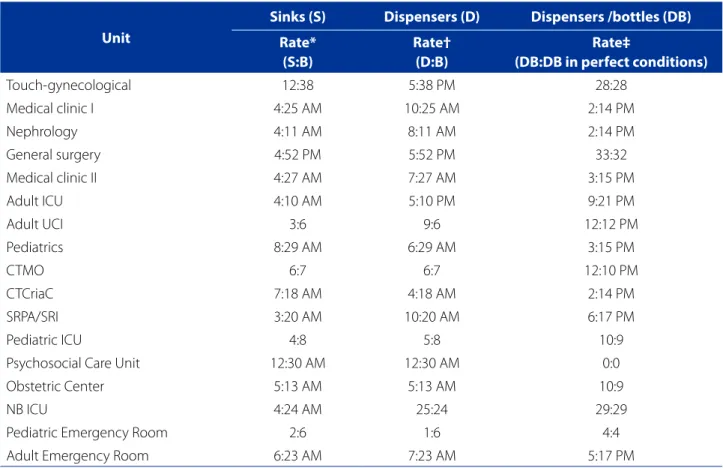
As for the second stage, of the 18 estimated units, all were duly observed by the collector. In this one, a total of 347 hospitalization beds, 118 health professionals were ap-proached, 213 sinks and taps, 154 alcohol gel dispensers and 112 bottles of soap were evaluated, so that it is easier to understand the rates in Table 3.
Table 2 - Availability and refill of the bedside dispenser, accessibility and specific instructions on HH protocols. (N=16). Santa Maria, Rio Grande do Sul, Brazil, 2017
Questions Yes No
N % N %
If all the dispensers are available, are they placed at hand close to the patient’s
bed? (N=15) 10 62.5 5 31.3
Is there a person indicated as responsible for refilling or changing the
dispensers? 16 100 -
-Is there a person indicated as responsible for refilling or changing the empty
bottles? 15 93.8 1 6.3
Are protocols with hand hygiene recommendations accessible on this unit? 16 100.0 -
-Is there stock of gloves stored in this unit? 16 100.0 -
-Have the nurses in this unit been given specific instruction on hand hygiene in
the past two years? 16 100.0 -
-Have health care professionals at this unit been given specific instruction on
hand hygiene in the last two years? 15 93.8 1 6.3
Source: Research data, 2017.
Table 3 - Distribution of sinks (S), dispensers (D) and dispensers/bottles (DB) available per unit searched, according to the number of beds (B) of the unit. Santa Maria, Rio Grande do Sul, Brazil, 2017
Unit
Sinks (S) Dispensers (D) Dispensers /bottles (DB) Rate*
(S:B)
Rate† (D:B)
Rate‡
(DB:DB in perfect conditions)
Touch-gynecological 12:38 5:38 PM 28:28
Medical clinic I 4:25 AM 10:25 AM 2:14 PM
Nephrology 4:11 AM 8:11 AM 2:14 PM
General surgery 4:52 PM 5:52 PM 33:32
Medical clinic II 4:27 AM 7:27 AM 3:15 PM
Adult ICU 4:10 AM 5:10 PM 9:21 PM
Adult UCI 3:6 9:6 12:12 PM
Pediatrics 8:29 AM 6:29 AM 3:15 PM
CTMO 6:7 6:7 12:10 PM
CTCriaC 7:18 AM 4:18 AM 2:14 PM
SRPA/SRI 3:20 AM 10:20 AM 6:17 PM
Pediatric ICU 4:8 5:8 10:9
Psychosocial Care Unit 12:30 AM 12:30 AM 0:0
Obstetric Center 5:13 AM 5:13 AM 10:9
NB ICU 4:24 AM 25:24 29:29
Pediatric Emergency Room 2:6 1:6 4:4
Adult Emergency Room 6:23 AM 7:23 AM 5:17 PM
Source: Research data, 2017.
The adequacy rate of the general structure for the HH practice was 26.2% (91:347), and the use of alcohol gel pocket bottles was 2.9% (118:4). Regarding the rate of types of faucets present in the sinks, faucets with automatic clos-ing (39.4%, 84:213) prevailed; followed by manual closure (35.7%, 76:213);faucets with a lever that allows the activa-tion/closing by the elbow (11.7%, 25:213); faucets operated by pedal (7.5%, 16:213) and sensor activated (5.6%, 12:213). The lack of posters illustrating the guidelines for the cor-rect practice of HH near some sinks and dispensers of alcohol gel in the infirmarys were some of the inadequacies found.
DISCUSSION
According to the coordinators, the hospitalization units have water available and clean. This data corroborates the study developed in a hospital in Africa, which mentions the
constant supply of running and clean water(13). However,
in Bangladesh it was shown that only two of the 12 HH stations had running water(14). The availability of water in health services and dispensers for alcoholic preparations at the care/health treatment point, including the replace-ment of these when empty, are critical to ensuring a quality HH practice.
In this study, all the coordinators mentioned availabil-ity of the alcoholic preparation and stated that they are replaced when empty. This shows management co-re-sponsibility as inputs are delivered uninterrupted and changed as needed. Different results were evidenced in a hospital in the northwest of Paraná. Of the 15 health care units evaluated, 13.3% (n=2) of them were always refilled when empty, and in 86.7% (n=13) they were replenished sporadically(15).
As for the alcohol gel dispensers at hand and close to the patient’s bed, the coordinators responded positively to their availability. During the data collection, it was ob-served that only the Adult ICU had bottles attached to the wall, at the bedside. There is evidence in the literature that infrastructure alone is not considered the greatest barrier to the practice of HH among health professionals. Trainings are also necessary, since despite the high percentage of running water (96%), liquid soap (72-96%) and alcohol gel (18% to 51%), of the 4676 HH opportunities observed, the rate of HH adherence with water and soap was 48%, and with alcohol was 2%(16).
Regarding the alcohol gel pocket bottles, about half of the coordinators highlighted difficulties in access. This
data corroborated the collections performed in loco,
where the rate corresponding to the number of health professionals found with pocket bottles was 2.9%. This
evidence was found in the Psychosocial Care Unit, where there are no available care points (sinks, dispensers of liq-uid soap and paper towels), due to the clinical history of the patients hospitalized in this unit (serious mental dis-orders or resulting from the use, abuse or dependence of alcohol and other drugs).
Health professionals are advised to have pocket bottles for antiseptic hand rubbing. This measure aims to reduce the microorganisms load in the absence of visible dirt, be-sides contributing to the prevention of IRAS, increasing the quality of care and patient safety(3). The use of pocket bot-tles to increase adherence to HH is considered a valid and successful intervention in institutions that do not have an adequate infrastructure(13). In this sense, the pocket bottles may be a strategy used by the institution to encourage health professionals to HH.
In this study, the coordinators reported that the pro-tocols with recommendations for HH are accessible in the units, and that they had been trained on them in the last two years. In a research from Paraná(15), it was observed that only seven of the 15 hospitalization units surveyed had HH manuals available for consultation. Other evidence from the study was the disparity in training in the last two years be-tween nurses and doctors (92% and 20%, respectively)(15). The low adherence to training was also observed in another study, with ICU nurses (33.3%) and technicians (51.8%)(17).
It is known that permanent education actions should be used by institutions and that they can contribute to the motivation of professionals. A study(13) showed an increase in the median score of 16 (interquartile range, 12-20) to 20 (interquartile range, 15-24) after an intervention with train-ing on the knowledge of HH performed with doctors, nurs-es, nursing technicians and medical students.
However, there are other factors that interfere with non-adherence to the HH practice. Among them: behav-ioral, institutional and material ones. Regarding the ma-terial factors, a study evidenced, through reports of pro-fessionals, inadequacies in the supply of supplies (paper towel, 70% alcohol and liquid soap) in adult, pediatric and emergency hospitalization units. These findings were cor-roborated during the observation(18). Therefore, it can be reflected that the low adherence of health professionals can be related to the deficiency in the structural conditions of the services, informative materials (posters, folders) and also, the lack of permanent education about HH. Institu-tions can play a key role in motivating professionals to de-velop appropriate HH practices(19).
(N 47) were located in the corridors of the unit and only one dispenser was attached near the patient’s bed(15). Inad-equacies were also found in another hospital in the south region of Brazil, where there were no antiseptic dispens-ers at the bedside of the patients(5). This lack of access can make it difficult for the HH practice of the professionals during the care provided to the patient, which may favor the development of IRAS.
The presence of illustrative posters for both the promo-tion of HH and the technique of simple hygiene with soap and water were evaluated as positive by the coordinators. They were exposed beside the sinks, both in the corridors and in the infirmaries. The presence of these can assist the companions and patients in the correct practice of HH. In the same way, it can favor so that the professionals can be constantly reminded of the HH technique. However, stud-ies conducted in the south region of Brazil(5,15) found lack of posters related to the technique and the promotion of HH attached in the units.
According to the coordinators surveyed, audits on the HH adherence in hospitalization units are performed monthly. On this, there is no consensus in the literature, while some institutions perform this measure(10), others do not(15). It should be emphasized that audits can be a posi-tive factor to increase the rate of adherence to HH among health professionals, since feedback from the follow-up can be provided from them.
In loco when assessing the physical structure, there were inadequacies such as: sinks that had rust and faucets spilling out of the sink when activated. In addition, it was identified the presence of liquid soap dispensers next to alcohol gel, which may cause inappropriate use of these inputs during the practice of HH. However, dispensers of liquid soap, alco-hol gel and paper towel were in perfect conditions, replen-ished and properly distributed by the units.
Regarding the types of faucets per sink, in relation to the institution researched, these are in accordance with RDC No. 50(20). It was observed that in 39.4% (84:213) the faucets had automatic closing; however, in 35.7% (76: 213) they had manual closure. According to this Resolution, sinks should have faucets that do not demand the contact of the hands for closure. When this is not possible, paper should be used, avoiding direct contact with the faucet(1, 20).
HH is an individual, simple and less costly measure to prevent IRAS. Therefore, in order for the HH practice to be performed, it is necessary, initially, that health institutions provide adequate infrastructure in the infirmaries, corridors and points of care/treatment. In addition, professionals also need to do their part by being proactive, co-responsible and positive influencers (role-model) regarding the HH practice.
CONCLUSION:
The infrastructure for the HH practice at the institution surveyed is in part in accordance with what governs the RDC 50. Some inadequate sinks and faucets, lack of illus-trative posters and gel dispensers near the patients’ beds were found in the infirmaries. However, in a positive way, it was observed that in the institution there is a refill and exchange of the appropriate empty dispensers/bottles, il-lustrative posters next to the dispensers located in the cor-ridors, as well as institutionalized protocols and provision of training on HH. The coordinators demonstrated adequate knowledge of the existing infrastructure.
A report with the results was prepared for the re-searched institution, which could serve as a basis for the implementation of measures that meet the standards rec-ommended by ANVISA. In order to encourage health pro-fessionals regarding the adherence to HH, it is suggested to plan actions with active methodologies, such as realistic simulations that contemplate the HH institutional protocol.
Regarding the limitations of the study, the following stand out: reduced population, despite being the totality of coordinators, making it difficult to generalize the find-ings; the impossibility of doing association analysis by ob-serving different variables (observation of the infrastruc-ture and the knowledge of the coordinators).
REFERENCES
1. Agência Nacional de Vigilância Sanitária (BR). Segurança do paciente em serviços de saúde: higienização das mãos. 1ª ed. Brasília: Anvisa; 2009 [cited 2018 May 12]. p.109. Available from: http://bvsms.saude.gov.br/bvs/publi-cacoes/seguranca_paciente_servicos_saude_higienizacao_maos.pdf. 2. Organização Pan-Americana da Saúde, Agência Nacional de Vigilância
Sani-tária (BR). Guia para implementação: um guia para implantação da estratégia multimodal da OMS para a melhoria da higienização das mãos. Brasília: OPAS/ ANVISA; 2008 [cited 2018 May 15]. Available from: https://www.paho.org/bra/ index.php?option=com_docman&view=download&alias=456-guia-pa- ra-a-implantacao-da-estrategia-multimodal-da-oms-para-a-melho- ria-da-higienizacao-das-maos-6&category_slug=seguranca-do-paci-ente-970&Itemid=965.
3. Ministério da Saúde (BR).. Anexo 1: Protocolo para a prática de higiene das mãos em serviços de saúde. Brasília: Ministério da Saúde, Anvisa/Fiocruz; 2013 [cited 2018 May 15]. p.15. Available from: https://proqualis.net/sites/proqualis.net/ files/000002347fQHsQg.pdf.
4. Moura PMM, Tristão FSA, Guanilo MEE, Porto AR. Evaluation of hospital infra-structure for hygienization of hands. Rev Enferm UFPE on line. 2017 Dec [cit-ed 2018 May 18];11(Supl. 12):5289-96. Available from: https://periodicos. ufpe.br/revistas/revistaenfermagem/article/view/22884/25479.
6. Coelho MS, Arruda CS, Simões SMF. Higiene de manos como estrategia funda-mental en el control de infección hospitalaria: un estudio cuantitativo. Enferm Glob. 2011 [citado 2018 maio 05];10(1):1-12. Disponible en: http://revistas. um.es/eglobal/article/view/115161/109081.
7. Zottele C, Magnago TSBS, Dullius AIS, Klankiewicz ACB, Ongaro JD. Hand hy-giene compliance of healthcare professionals in an emergency department. Rev Esc Enferm USP. 2017;51:e03242. doi: https://doi.org/10.1590/s1980-220x2016027303242.
8. Raimondi DC, Bernal SCZ, Souza VS, Oliveira JLC, Matsuda LM. Higienização das mãos: adesão da equipe de enfermagem de unidades de terapia inten-siva pediátricas. Rev Cuid. 2017;8(3):1839-48. doi: https://doi.org/10.15649/ cuidarte.v8i3.437.
9. Vasconcelos RO, Alves DCI, Fernandes LM, Oliveira JLC. Adhesión a la higiene de las manos por el equipo de enfermería en la unidad de cuidados intensivos. Enferm Glob. 2018 [citado 2018 maio 18];17(2):430-45. Disponible en: http:// revistas.um.es/eglobal/article/viewFile/284131/227831.
10. Deyneko A, Cordeiro F, Berlin L, Ben-David D, Perna S, Longtin Y. Impact of sink location on hand hygiene compliance after care of patients with Clostridium difficile infection: a cross-sectional study. BMC Infect Dis. 2016;16:203. doi: https://doi.org/10.1186/s12879-016-1535-x.
11. Ongaro JD. Infraestrutura para higienização das mãos em um hospital universi-tário do sul do Brasil [monografia]. Santa Maria (RS): Universidade Federal de Santa Maria; 2017.
12. Ministério da Saúde (BR), Conselho Nacional de Saúde. Resolução nº 466, de 12 de dezembro de 2012. Diretrizes e normas regulamentadoras de pesquisas envolvendo seres humanos. Diário Oficial da União [da] República Federativa do Brasil. 2013 jun 13;150(112 Seção 1):59-62.
13. Allegranzi B, Sax H, Bengaly L, Richet H, Minta DK, Chraiti ML, et al. Successful Implementation of the World Health Organization Hand Hygiene Improvement Strategy in a referral hospital in Mali, Africa. Infect Control Hosp Epidemiol. 2010;31(2):133-41. doi: https://doi.org/10.1086/649796.
14. Rimi NA, Sultana R, Luby SP, Islam MS, Uddin M, Hossain MJ, et al. Infrastructure and contamination of the physical environment in three Bangladeshi hospitals: putting infection control into context. PLoS One.2014;9(2):e89085. doi: https:// doi.org/10.1371/journal.pone.0089085.
15. Prado MF, Hartmann TPS, Teixeira Filho LA. Acessibilidade da estrutura física hos-pitalar para a prática da higienização das mãos. Esc Anna Nery. 2013;17(2):220-6. doi: https://doi.org/10.1590/S1414-81452013000200003.
16. Rousham EK. Hand hygiene infrastructure and behaviours in resource-lim-ited healthcare facilities. J Hosp Infect. 2016;94(3):284-5. doi: https://doi. org/10.1016/j.jhin.2016.08.015.
17. Vasconcelos RO, Alves DCI, Fernandes LM, Oliveira JLC. Adhesion to hand hy-giene by nursing team in intensive care unit. Enferm Glob. 2018 [cited 2018 May 05];17(50):462-76. Available from: http://revistas.um.es/eglobal/article/ view/284131/227851.
18. Santos TCR, Roseira CE, Piai-Morais TH, Figueiredo RM. Hand hygiene in hospital environments: use of conformity indicators. Rev Gaúcha Enferm. 2014;35(1):70-7. doi: https://doi.org/10.1590/1983-1442014;35(1):70-7.2014.01.40930.
19. Oliveira AC, Paula AO. Factors related to poor adherence to hand hygiene in healthcare delivery: a reflection. Cienc Cuid Saude. 2014 [cited 2018 May 05];13(1):185-90. Available from: http://www.periodicos.uem.br/ojs/index. php/CiencCuidSaude/article/view/13410/pdf_160.
20. Agência Nacional de Vigilância Sanitária (BR). RDC nº 50, de 21 de fevereiro de 2002. Dispõe sobre o Regulamento Técnico para planejamento, programação, elab-oração e avaliação de projetos físicos de estabelecimentos de saúde. Brasília, DF; 2002 [cited 2018 May 05]. Available from: https://www20.anvisa.gov.br/seguran-cadopaciente/index.php/legislacao/item/rdc-50-de-21-de-fevereiro-de-2002.
ACKNOWLEDGMENT
Work supported by PIBIC-CNPQ – Notice 2016-2017 and PROIC-HUSM – Notice 2017-2018.
Corresponding author:
Tânia Solange Bosi de Souza Magnago E-mail: [email protected]