Revista Gaúcha
de Enfermagem
How to cite this article: Costa TD, Salvador PTCO, Rodrigues CCFM, Alves KYA, Tourinho FSV, Santos VEP. Perception of nurses about patient safety in intensive care units. Rev Gaúcha Enferm. 2016 Sep;37(3):e61145. doi: http://dx.doi.org/10.1590/1983-1447.2016.03.61145.
doi: http://dx.doi.org/10.1590/1983-1447.2016.03.61145
Perception of nurses about patient
safety in intensive care units
Percepção de profi ssionais de enfermagem acerca de segurança do paciente em unidades de terapia intensiva Percepción de los profesionales de enfermería sobre seguridad del paciente en unidades de cuidados intensivos
a Universidade Federal do Rio Grande do Norte (UFRN), Escola de Saúde. Natal, Rio Grande do Norte, Brasil.
b Universidade Federal de Santa Catarina (UFSC), Departamento de Enfermagem, Programa de Pós-Graduação em Enfermagem. Florianópolis, Santa Catarina, Brasil.
c Universidade Federal do Rio Grande do Norte (UFRN), Departamento de Enfermagem, Programa de Pós-Graduação em Enfermagem. Natal, Rio Grande do Norte, Brasil.
Theo Duarte da Costaa Pétala Tuani Candido de Oliveira Salvadora Cláudia Cristiane Filgueira Martins Rodriguesa Kisna Yasmin Andrade Alvesa Francis Solange Vieira Tourinhob Viviane Euzébia Pereira Santosc
ABSTRACT
Objective: To understand the perception of nursing professionals in public hospital intensive therapy units regarding patient safety.
Methods: This is a descriptive study with a qualitative approach. Eighty nursing professionals who developed welfare activities in general intensive care units in Northeastern Brazil participated. Data were collected through semi-structured interviews, from May to June 2014. The textual content was submitted to the lexicographical textual analysis, and data analysis was based on the literature.
Results: Four classes were analyzed: need for change; actions before an adverse event; concepts of safe care; and actions that inte-grate safe care. It was revealed that patient safety is a consequence of the culture adopted by professionals.
Conclusions: Professionals understand patient safety as a set of strategies that minimize the risk of adverse events.
Keywords: Patient safety. Critical care. Nursing.
RESUMO
Objetivo: Compreender a percepção dos profi ssionais de enfermagem de unidades de terapia intensiva gerais de hospitais públicos acerca da segurança do paciente.
Métodos: Trata-se de estudo de natureza descritiva, com abordagem qualitativa. Participaram 80 profi ssionais de enfermagem que desenvolviam atividades assistenciais em unidades de terapia intensiva gerais do nordeste do Brasil. Os dados foram obtidos por meio de entrevistas semiestruturadas, no período de maio a junho de 2014. O conteúdo textual foi submetido à análise textual lexicográfi ca, e a análise dos dados foi realizada a partir de literatura pertinente.
Resultados: Quatro classes foram analisadas: necessidades de mudança; ações diante do evento adverso; concepções sobre cuidado seguro; e ações que integram o cuidado seguro. Revelou-se que a segurança do paciente é uma consequência da cultura adotada pelos profi ssionais.
Conclusões: Os profi ssionais compreenderam a segurança do paciente como um conjunto de estratégias que minimiza os riscos de eventos adversos.
Palavras-chave: Segurança do paciente. Cuidados críticos. Enfermagem.
RESUMEN
Objetivo: Comprender las percepciones de los profesionales de enfermería de unidades de cuidados intensivos de los hospitales públicos sobre la seguridad del paciente.
Métodos: Estudio descriptivo con un enfoque cualitativo. Participaron 80 profesionales de enfermería que desarrollan actividades de asistencia en unidades de cuidados intensivos. Los datos fueron recogidos a través de entrevistas semiestructuradas. El contenido textual de las entrevistas fue sometido a análisis textual con la ayuda del software IRAMUTEQ y el análisis de los datos fueron recogidos de la literatura relevante con respecto a la seguridad del paciente.
Resultados: Se reveló que la seguridad del paciente es el resultado de cultura adoptada por los profesionales, que permitan cambios en la estructura, el proceso de enfermería, la postura contra los eventos adversos, la adopción de conceptos y acciones seguras.
Conclusiones: Los profesionales entienden la seguridad del paciente como un conjunto de estrategias que minimizan los riesgos de eventos adversos.
INTRODUCTION
According to data from the World Health Organization (WHO), one in ten hospital patients are victims of adverse events caused by the care provided in hospitals, arising from the care process(1).
This has serious consequences: to the patient, caus-ing them damage, often disablcaus-ing; to the professionals involved in care, generating stress for these workers; and for health institutions, burdening a higher cost with these patients’ hospitalization(2).
This fact has made patient safety (SP) the subject of sev-eral studies in the health field, in order to lead assistance to care that is safe and free of damage. In the meantime, the current SP concept indicates that the shortcomings of a care system’s design, organization and operation are the main factors responsible for the occurrence of these events(2).
On the other hand, it is stressed that accountability of health professionals for any adverse event that may occur still prevails in health institutions, thereby prompting a pu-nitive culture, and individual accountability.
On this subject, studies show that lack of knowledge on SP and the consequences of the adverse event can gener-ate by those workers brings a fear of being punished, a fear of shame, a feeling of frustration and guilt to these profes-sionals, which are reflections of the reductionist view about the error(3-6).
The investigation on the SP focused organizational cul-ture found in health institutions has been disseminated as a means of approaching quality management, risk assess-ment and the capacity to learn from mistakes in order to overcome such an understanding.
Thus, in order for a patient safety culture to be consol-idated, it is necessary for professionals to first understand the error and its consequences, involving them in an ethi-cal commitment in the quest to improve the care provided, thereby overcoming the gap of unsafe care(2).
Thus, it is important to seek the understanding of how these workers visualize SP in their care practice to consoli-date it as a guiding principle of health care in different care scenarios. Because it is a complex environment involving various emergency situations and emergency patients at risk of imminent death, the Intensive Care unit (ICU) stands out among them in this study.
Furthermore, studies consider the ICU as one of the most vulnerable hospital departments to the occurrence of adverse events related to care, after all, there is a complexity of actions and interventions that are offered as emergency care by the health team involved, and any errors in this assis-tance entails immediate suffering to the patient(7-8).
It is important to consider that among the members of the health team involved in the care process are nursing professionals, who play a key role in the search for quali-ty by health care organizations, in view of the number of active workers and their responsibility towards the care provided to patients in the course of continuous 24 hours, which can stimulate an event or prevention of error(8).
In this sense, studies to understand the perception of nursing professionals on patient safety in specialized areas such as the ICU are relevant, and make it possible to know how these workers understand SP, as well as encourage them to reflect critically on this theme.
Thus, the following research question presents itself: what is the perception of nursing professionals in inten-sive care units on patient safety in general public hospitals in northeastern Brazil? To answer this question, the study aimed to: understand the perception that general ICU nurs-ing professionals in public hospitals had about patient safety.
METHODS
This is a study descriptive, with a qualitative approach(9). The study took place in the general ICUs of public hospitals in the metropolitan region of Natal (Rio Grande do Norte / Brazil), characterized as the extent of Natal’s capital which covers 10 municipalities in the Rio Grande do Norte state, forming the fourth largest conurbation in northeastern Bra-zil, and the 15th largest metropolitan area in the country.
In 2014, the state of Rio Grande do Norte had 23 pub-lic state funded hospitals and 10 of them offered intensive care services; of these, five were located in the metropoli-tan area, providing local study of this research.
The population of active nursing professionals in these hospitals’ ICUs was composed of 42 nurses and 178 nurse technicians. The model used was based on non-probabil-ity sampling by convenience and the selection process of sample elements occurred in a stratified manner. The sam-pling process sought to represent professionals of the five hospitals studied, in addition to the participation of both nurse technicians and nurses.
Therefore, eighty nursing professionals who developed welfare activities in general intensive care units in North-eastern Brazil participated.
As inclusion criteria, participants should be nursing pro-fessionals; employed by the hospitals; and inserted in the nursing professional shift of studied intensive care units. Exclusion criteria were the professionals who were on va-cation during the data collection period.
investigated: knowledge of patient safety, opinions on the safety of their procedures and actions, attitudes when deal-ing with failures and possible changes.
The interviews took place in participant-defined loca-tions and times, in order to not disrupt or inhibit sponta-neity. Before the interviews, participants had the opportu-nity to ask questions about the research content, as well as its ethical aspects, signing the Free and Informed Consent Form. To record the interviews, we used a voice recorder as a way to store them for later analysis.
The textual content resulting from the interviews was submitted to a lexicographical textual analysis performed with the aid of the R interface pour Analyses Multidimension-nelles of Textes et Questionneires (IRAMUTEQ) software.
The software is free and developed under the open
source approach, which categorizes the textual data based
on the assessment of the similarity of their vocabularies in order to support the understanding of words within a cer-tain environment and therefore indicate elements of repre-sentations regarding the study object(10).
The IRAMUTEQ is also indicated for the analysis of qual-itative data that consists of large amounts of textual vol-ume, as is the case of this study, which included the partic-ipation of 80 research subjects.
Therefore, we used Hierarchical Descending Classifi-cation and similarity analysis as data processing methods. Each text (n = 80) was characterized by variables of inter-est: professional category and hospital. The following were established as criteria for the inclusion of elements in their respective classes: a frequency greater than twice the aver-age of occurrences in the corpus and association with the class determined by chi-squared value equal to or more than 3.84, given that the calculation is defined according to degree of freedom 1 and significance of 95%(11).
The corpus analysis from the transcript of the 80
semi-structured interviews denoted 36,974 occurrences of words presented in 1,950 different ways, with the average frequency of 18 words for each form, which is the criterion used as cut-off point for the inclusion of elements in the dendrogram (twice the average rate, therefore, 36).
The IRAMUTEQ software considers the total content analyzed as the corpus – in this study, the 80 interviews granted by nursing professionals. The corpus therefore corresponds to the set of texts analyzed – in this research, each interview consolidated a text. To carry out the texts’ lexical analysis, the software analyzes them based on cuts made every 40 characters, therefore corresponding to the text segments analyzed.
The classes are generated by the software based on the word similarity analysis, which also occurs from a
multivar-iate analysis with the studied variables of interest (in this study – professional category and hospital).
However, emphasis is brought to the fact that the con-text of each class, showing the theoretical reflection about its content, occurs from the researcher’s analysis based on the recovery of the texts in which the typical words were used by the research subjects.
Thus, the interpretation and analysis of data was per-formed from the literature regarding patient safety.
The ethical principles involving human research were followed, according to Resolution no. 466, of Decem-ber 12, 2012. Data collection occurred after the project was approved by the Research Ethics Committee (CEP) of the Federal University of Rio Grande do Norte (UFRN), Certificate of Presentation for Ethics Assessment (CAAE) n. 19586813.2.0000.5537 and Opinion No. 461.246.
In order to preserve the anonymity of the participants, the subjects were identified by their professional catego-ry (nurse or nurse technician) and the hospital where they worked, which were named by letters from A to E.
RESULTS AND DISCUSSION
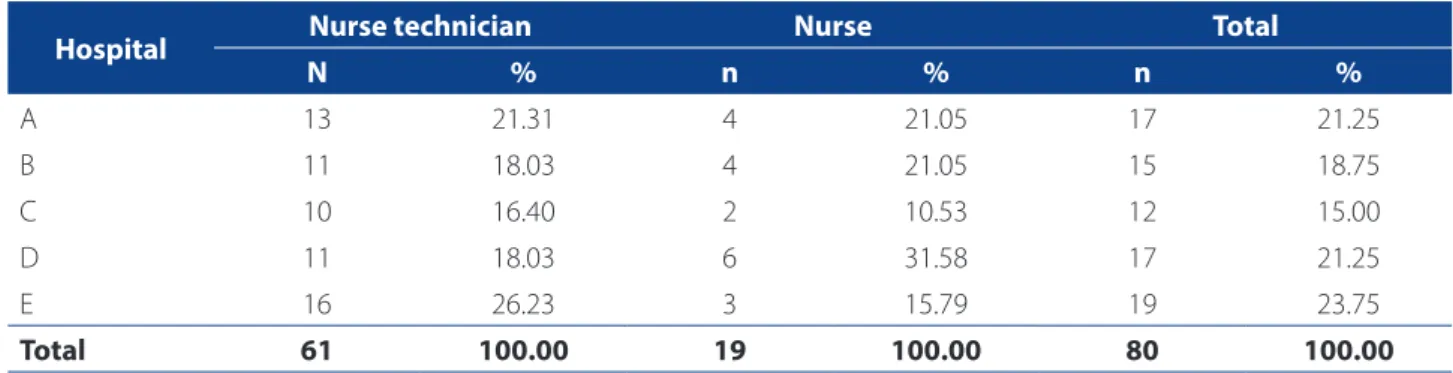
The perceptions of 80 nursing professionals about patient safety in intensive environments were analyzed, which formed the general intensive care unit teams of five public hospitals (Table 1).
In this research, through the Hierarchical Classification Seed, 1056 were analyzed text segments, retaining 71.05% of the total texts for elucidation of classes. In Figure 1, one can visualize the dendrogram which shows the four classes that result from the content partitions.
The typical class 1 vocabulary allowed the contextual-ization of the “Needs for change” to ensure patient safety, accounting for 21.01% of the text segments analyzed in the corpus.
The words “change”, “new” and “start” denote the con-ception of the professionals that improvements need to be implemented in their realities for safe care to be consol-idated, which pervade structural elements and the labor process, as can be seen in the following lines:
To ensure patient safety in this ICU today I would change the resources, for example here I see that there are beds that do not provide safety to patients. (Nurse technician, Hospital C)
So I would very much like it if there were these protocols for everyone to do their job properly, it’s not even a matter of changing everything, just some things that need to be organized. (Nurse, Hospital D)
On the other hand, the words “understand” and “want” show that nurse practitioners understand that such improvements pervade the conception they have of the subjects involved in the process to promote pa-tient safety. Furthermore, safe care implies, first, the consolidation of a safety culture, as evidenced by one respondent:
Management’s role in my view would be to start this ap-proach, it would be to start training, to put up an educa-tional poster, it would be to start actions in the field, just providing training and stopping at that gets you no where,
because then you only put it into practice if you want. (Nurse, Hospital D)
Class 2, “Actions in face of the adverse event”, represent-ed 26.47% of the analyzrepresent-ed text data and revealrepresent-ed antago-nistic conceptions of the actions when faced with an error.
The words “call”, “management”, “ask”, “help”, “guide”, “talk” and “improve”, all associated with significance to the class’ lexical conception (p <0.0001), denoted a positive under-standing, based on the guidance and learning in the face of failure, which can be observed in the following speech:
When something fails in patient safety, we usually report-ed it in an occurrence form, talk with the staff and if there is anything that can improve we go to management and the nursing management team also sees what we can im-prove. (Nurse, Hospital B)
Figure 1 – Descending Hierarchical Classification Dendrogram portraying the perception of nursing professionals about patient safety in intensive environments. Natal, Rio Grande do Norte, 2015
Source: Research data, 2015.
Perception of nursing professionals about patient safety in intensive care units
(71.05%)
Class 1 (21.01%)
Need for change
Word x2 %
Change 58.88 64.58 New 21.44 75.00 Understand 29.90 63.16 Begin 16.55 69.23 Want 12.55 44.44
Class 2 (26.47%)
Actions in face of the adverse event
Word x2 %
Happen 69.07 70.97 Failure 46.61 70.45 Call 42.56 100.00 Error 32.74 78.26 Management 29.33 61.36
Class 3 (27.17%)
Conceptions about safe care
Word x2 %
Safe 157.86 79.00 Consider 152.44 91.04 Possible 75.07 87.18 Maximum 31.63 80.95 Best 24.14 59.09
Class 4 (25.35%)
Actions that integrate safe care
Word x2 %
Medication 84.58 67.50 Bars 67.35 83.33 Bed 50.79 69.57 Restraint 50.69 87.50 Infection 49.66 94.74
Hospital Nurse technician Nurse Total
N % n % n %
A 13 21.31 4 21.05 17 21.25
B 11 18.03 4 21.05 15 18.75
C 10 16.40 2 10.53 12 15.00
D 11 18.03 6 31.58 17 21.25
E 16 26.23 3 15.79 19 23.75
Total 61 100.00 19 100.00 80 100.00
Table 1 – Distribution of participants according to professional category and hospital. Natal, Rio Grande do Norte, 2015
On the other hand, the words “punish”, “warn”, “punish-ment” and “warning” also associated with significance to the class (p <0.005), reveal the still present punishment cul-ture among health professionals, an aspect that is an ob-stacle to the consolidation of patient safety actions, since it denotes a Cartesian conception of error and therefore does not promote preventive and extended care actions safely.
Thus, the following excerpts show a conception that needs to be changed:
There are some that show you what happened and others trying to hide it because they are afraid of being punished. (Nurse, Hospital D)
We tell management about the problem and they call the person and try to apply punishment. (Nurse Technician, Hospital D)
Class 3 was entitled “Conceptions about safe care”, total-ing 27.17% of the analyzed corpus. Key words that emerged in that class were: “safe”, “consider”, “possible”, “maximum” and “best”. Other top words were “standard”, “correct”, “pro-tocols”, “continue”, “care for” and “protect”.
Through the lexical vocabulary of class 3, one finds the perception of nursing professionals about safe care in in-tensive environment, which pervades conceiving safety patient as a tool or set of strategies to ensure correct ac-tions in order to prevent damage.
Safe care is therefore understood as providing care with quality is there denoted, as highlighted in the following statement:
I consider patient safety as a series of behaviors that should be performed seeking the patient’s best condition, avoid-ing risk to the patient so that they do not suffer more dam-age than that inflicted by treatment. (Nurse, Hospital D)
Finally, Class 4, called “Actions that integrate safe care”, which comprised 25.35% of the textual segments, high-lighted the words “medication”, “bars”, ‘bed”, “restraint” and “infection”, revealing, therefore, elements of nursing care that professionals highlighted as actions to ensure pa-tient safety.
To ensure patient safety in relation to medication you have the the five “rights” of nursing, right dosage, right medication, right patient, right time, right access; in lation to the risk of falls, some beds have bars, patient re-straint to prevent them from falling out of bed; in relation to biological risks, we try as much as possible to perform
the procedures to ensure the patient’s integrity [...]. (Nurse Technician, Hospital D)
Other words with a significant association to the class were: “fall”, “bath”, “identification” and “Personal Protec-tive Equipment” (PPE). The words “welfare” and “records”, which appeared in 100% of text segments in Class 4 are also noteworthy.
It is therefore observed that the lexicographical analysis of class 4 denotes that nursing professionals understand actions that integrate the priority protocols listed by the National Program for Patient Safety as actions to promote patient safety elements.
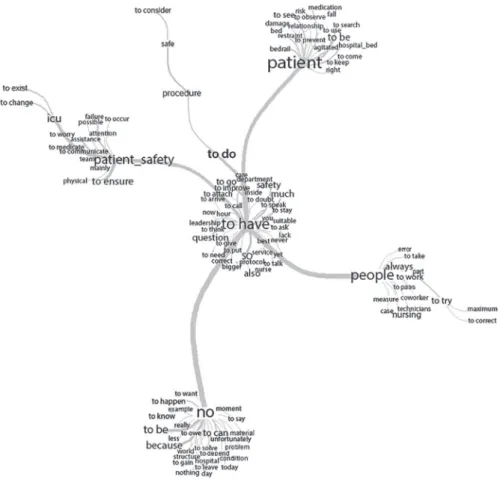
The similarity analysis summarizes the outstanding classes, in which the terms “patient safety”, “to have”, “ pa-tient”, “no” and “people” organize the nursing staff’s per-ception of patient safety in intensive care units, thus highlighting: what is sought (patient safety), how it can be reached (words related to have) through which ac-tions (vocabulary connected to the patient) by means of which resources (words organized by the word people) and which barriers still need to be overcome (words con-nected to no) (Figure 2).
Thus, perceptions of survey participants were in line with the idea that patient safety is a consequence of the culture adopted by professionals, which can enable chang-es in the nursing procchang-ess structure, in the posture adopted when faced with Adverse Events (AE), in the adoption of conceptions and in safe actions(2,7).
The safety culture stands out in this context, conceptu-alized as a product of attitudes, values, standards, individu-al and collective skills involved in safe care(2).
Trough Class 1, the professionals showed a systemic un-derstanding of patient safety that permeates organization-al, structural and relational elements in health services(12).
Needs for change were emphasized to ensure safe care and, therefore, educational interventions were high-lighted in order to reach a positive and safe culture in the study sites.
It is, therefore, the search for professional commitment with one’s self and the others(8), striving for identification, reporting and problem solution that enhance the poten-tial of AEs(13). These conceptions value a non-punitive ap-proach and reinforce the initiatives that prevent errors from understanding their chain.
This need is strengthened, especially when it deals with the care offered in the ICU, since the chances of an AE are more likely due to the clinical status of individuals admitted to that unit and the profile of the actions devel-oped by professionals(14).
The realization of this need for change, though covered positively in this research, is conceived as a challenge in the health scenario, as there are limitations with regard to understanding the multifactorial nature of the AE, the error susceptibility during care and fallibility of health systems(15).
On these aspects, the study aimed to assess the pa-tient’s level of safety in the context of the nursing and medical staff of neonatal ICUs found that, in face of an AE, there is an overvaluation of the exposed professional at the expense of the error’s trajectory. In addition, 60% of individuals surveyed reported that the presence an error may be a situation that will result in harm to their profes-sional practice(14).
Linked to this, with regard to the error notification, a study implemented in a teaching hospital in São Paulo
showed that 62% of nursing professionals find it difficult to “speak out” on the matter, since the workplace’s culture of choice does not facilitate such an attitude, or learning from AEs(15).
This scenario constitutes a disturbing fact, since it does not, for example, allow for the construction of reliable sta-tistics about the occurrence of adverse events, due to lack of reports. After all, if the team directly or indirectly adopts the punitive nature of the error, they will probably not be opened to revealing it(6).
Consequently, there will not be an educational culture and care will remain unsafe, even when faced, for exam-ple, with a satisfactory number of structural and materil resources.
With regard to the lexical conception of the term safe care, revealed in classes 3 and 4, it was identified that it is linked to the quality of care practices. Thus, minimizing AEs related to the words “medication”, “bars”, “bed”, “re-straint” and “identification” is an attitude that ensures safe nursing care.
Figure 2 – Similarity analysis on the corpus “perception of nursing professionals about patient safety in intensive environ-ment.” Natal, Rio Grande do Norte, 2015
Thus, it was identified that ensuring care that is guided by patient safety must be related to the environment and procedures that do not allow harm to service users(16).
Therefore, it denotes a systemic view of patient safe-ty, which can be contemplated in the statements of this study’s participants. It is understood that health organiza-tions are complex and the occurrence of AE is the result of a chain of systemic factors, which include the strategies of an organization, its culture, work practices, quality man-agement approach, risk estimations and the ability to learn from mistakes(12).
Thus, it is worth noting that these issues are priori-tized by the Ministry of Health and should be covered by validated protocols, manuals and guides aimed at patient safety(13).
In short, it is emphasized that patient safety, a strategic priority globally for the quality in health services, must be understood from a systemic view(17), which was evident in the speeches of this study’s subjects.
Therefore, the training of health professionals, skilled assistance at all health care levels and research need to be addressed as interdependent and key elements to provide safe care(18-20).
FINAL CONSIDERATIONS
Embedded in the desire to change, professionals shared perceptions that are consistent with the postulates of patient safety. They showed their concern about the is-sue and revealed a systemic view on how to achieve safe care, which runs through structural, organizational, rela-tional and training aspects.
Proximity to patient safety was therefore conceived as as a set of strategies that ensure the practices that min-imize the risk of AEs and ensure the well-being of users and staff.
Linked to this, the findings allow us to elucidate the patient safety consolidation process as dependent on the culture adopted by professionals. Thus, it is not possible to identify the error notification as an essential element to outline preventive goals if your understanding is focused on the negative idea, for example, an error that will bring harm to one’s professional career.
These results are a reflection of a local reality, making it impossible to generalize. As such, this aspect is seen as a limitation of this study. It is also a subjective issue, in-fluenced by the safety culture of the studied hospitals. It is important, therefore, to replicate this research in other locations, so that the results may be compared and thus expanded.
Therefore, we need new perspectives on the subject. It is believed that disseminating studies like this can broaden the discussion about patient safety in the field of educa-tion, assistance, management and research.
This is an emerging debate in the country and the safety culture begins to become a study focus in different health environments. The research is a contribution to this reflection process, because it is understood that the per-ception of professionals is an imperative aspect to be taken into consideration for the consolidation of a safe care.
The aim is to thereby contribute to the discussion about patient safety and promote new studies to critically clarify the aspects of this theme, with a view to contributing to the patient safety culture being consolidated in all nursing areas.
REFERENCES
1. Oliveira JR, Xavier RMF, Santos Junior AF. Eventos adversos notificados ao Sistema Nacional de Notificações para a Vigilância Sanitária (NOTIVISA): Brasil, estudo descritivo no período de 2006 a 2011. Epidemiol Serv Saúde. 2013;22(4):671-8. 2. Gama ZAS, Oliveira ACS, Hernández PJS. Cultura de seguridad del paciente y fac-tores asociados en una red de hospitales públicos españoles. Cad Saúde Pública. 2013;29(2):283-93.
3. Duarte SCM, Stipp MAC, Silva MM, Oliveira FT. Adverse events and safety in nursing care. Rev Bras Enferm. 2015;68(1):144-54.
4. Silva R, Amante LN. Checklist for the intrahospital transport of patients admitted to the intensive care unit. Texto Contexto Enferm. 2015;24(2):539-47. 5. Barbosa TP, Oliveira GAA, Lopes MNA, Poletti NAA, Beccaria LM. Care practices
for patient safety in an intensive care unit. Acta Paul Enferm. 2014;27(3):243-8. 6. Zhou P, Bundorf MK, Gu J, He X, Xue D. Survey on patient safety climate in public
hospitals in China. BMC Health Serv Res. 2015;3:53 PM.
7. Inoue KC, Matsuda LM. Patient safety: approaching an old issue. Cienc Cuid Saude. 2013;12(2):208-9.
8. Novati MCZ, Santos EV, Quiterio LM, Daud-Gallotti RM. Sobrecarga de trabalho da enfermagem e incidentes e eventos adversos em pacientes internados em UTI. Rev Bras Enferm. 2014;67(5):692-9.
9. Minayo MCS. O desafio do conhecimento: pesquisa qualitativa em saúde. 12. ed. São Paulo: Hucitec; 2010.
10. Camargo BV, Justo AM. IRAMUTEQ: um software gratuito para análise de dados textuais. Temas Psicol. 2013;21(2):513-8.
11. Marchand P, Ratinaud P. L’analyse de similitude appliqueé aux corpus textueles: les primaires socialistes pour l’election présidentielle française. In: Actes des 11eme Journées Internationales d’Analyse Statistique des Données Textuelles; 2011; Liège, Belgique. Liège; 2011. p. 687-99.
12. Aveling EL, Kayonga Y, Nega A, Dixon-Woods M. Why is patient safety so hard in low-income countries? a qualitative study of healthcare workers’ views in two African hospitals. Global Health. 2015;11:6.
13. Reis CT. Cultura em segurança do paciente. In: Sousa P, Mendes W. Segurança do paciente: criando organizações de saúde segura. Rio de Janeiro: Fiocruz; 2014. p. 75-99.
15. Tomazoni A, Rocha PK, Kusahara DM, Souza AIJ, Macedo TR. Avaliação da cultura de segurança do paciente em terapia intensiva neonatal. Texto Contexto Enferm. 2015;24(1):161-9.
16. Rigobello MCG, Carvalho REFL, Cassiani SHB, Galon T, Capucho HC, Deus NN. The climate of patient safety: perception of nursing professionals. Acta Paul Enferm. 2012;25(5):728-35.
17. Dias JD, Mekaro KS, Tibes CMS, Zem-Mascarenhas SH. The nurses’ understanding about patient safety and medication errors. Rev Min Enferm. 2014;18(4):866-73.
18. Yoshikawa JM, Sousa BEC, Peterlini MAS, Kusahara DM, Pedreira MLG, Avelar AFM. Compreensão de alunos de cursos de graduação em enfermagem e me-dicina sobre segurança do paciente. Acta Paul Enferm. 2013;26(1):21-9. 19. Uneke CJ, Ndukwe CD, Oyibo PG, Nwakpu KO, Nnabu RC, Prasopa-Plaizier N.
Promotion of hand hygiene strengthening initiative in a Nigerian teaching hos-pital: implication for improved patient safety in low-income health facilities. Braz J Infect Dis. 2014;18(1):21-7.
20. Monsivais MGM. Calidad y seguridad de la atención. Cienc Enferm. 2013;19(1):7-9.
Corresponding author:
Pétala Tuani Candido de Oliveira Salvador E-mail: [email protected]