368
PERSONAL AND INTERPERSONAL RISK FACTORS IN THE CONSUMPTION OF ILLICIT
DRUGS BY MARGINAL ADOLESCENTS AND YOUNG PEOPLE FROM JUVENILE GANGS
1Francisco Rafael Guzmán Facundo2 Luiz Jorge Pedrão3
Guzmán Facundo FR, Pedrão LJ. Personal and interpersonal risk factors in the consumption of illicit drugs by marginal adolescents and young people from juvenile gangs. Rev Latino-am Enfermagem 2008 maio-junho; 16(3):368-74.
Marginal populations are groups which are known to present higher risks of drug consumption. It is possible to identify adolescents and young people from juvenile gangs that constitute this group. The purpose of this study was to analyze the effect of personal and interpersonal risk factors of drug consumption in 175 marginal adolescents and young people who belong to juvenile gangs in Mexico. Results showed a significant effect of personal factors on drug use, with an estimated variation of 26.1%. The factors that presented the highest rates were: gender, age and mental problems. The interpersonal factors (relationships with friends who have maladaptive behaviors and inappropriate relationships with parents) showed an effect with an estimated variation of 15%. These results will allow for reflection and, in the future, the elaboration of adequate preventive programs aimed at this group of young people.
DESCRIPTORS: adolescent health; street groups; risk groups
FACTORES DE RIESGO PERSONALES E INTERPERSONALES EN EL CONSUMO DROGAS
ILÍCITAS EN ADOLESCENTES Y JÓVENES MARGINALES DE BANDAS JUVENILES
Grupos reconocidos con mayor riesgo para consumir drogas, son los marginales, dentro de estos podemos localizar a los adolescentes y jóvenes de bandas juveniles. El objetivo del estudio fue analizar el efecto de los factores de riesgo personales e interpersonales sobre el consumo de drogas, en 175 adolescentes y jóvenes margínales de bandas juveniles de México. Los resultados mostraron efecto significativo de los factores personales sobre el consumo de drogas, con una varianza explicada del 26.1%, los factores que mostraron una mayor contribución fueron; el sexo, edad y problemas de salud mental. Los factores interpersonales (relación con amigos con conductas mal adaptadas y relación inapropiada con padres) mostraron un efecto sobre el consumo de drogas, con una varianza explicada del 15%. Estos resultados posibilitarán la reflexión y en un futuro diseñar programas adecuados dirigidos a la prevención en este grupo de jóvenes.
DESCRIPTORES: salud del adolescente; drogas ilícitas; grupos vulnerables
FATORES DE RISCO PESSOAIS E INTERPESSOAIS NO CONSUMO DE DROGAS ILÍCITAS
EM ADOLESCENTES E JOVENS MARGINAIS DE BANDOS JUVENIS
Grupos reconhecidos com maior risco para o consumo de drogas, são os de populações marginais, e, dentro destas, podemos localizar os adolescentes que pertencem a bandos juvenis. O objetivo do presente estudo foi analisar o efeito dos fatores de risco pessoais e interpessoais sobre o consumo de drogas em 175 adolescentes e jovens marginais de bandos juvenis do México. Os resultados mostraram um efeito significativo dos fatores pessoais com uma variação estimada de 26,1%, sendo que os fatores que mostraram um índice maior foram: sexo, idade e problemas de saúde mental. Os fatores interpessoais: relação com amigos portadores de condutas mal adaptadas e relação e inapropriada com os pais, mostraram efeito com uma variação estimada de 15%. Estes resultados possibilitaram a reflexão e em um futuro desenhar programas adequados direcionados à prevenção neste grupo de jovens.
DESCRITORES: saúde de adolescente; drogas ilícitas; grupos de risco Artigo Original
Rev Latino-am Enfermagem 2008 maio-junho; 16(3):368-74 www.eerp.usp.br/rlae
1 Paper extracted from Doctoral Dissertation; 2 Faculty, School of Nursing, Autonomous University of Nuevo Leon, Mexico, e-mail: [email protected]; 3
Ph.D., Faculty, University of São Paulo at Ribeirão Preto College of Nursing, WHO Collaborating Centre for Nursing Research Development, Brazil, e-mail: [email protected]
INTRODUCTION
A
buse in the consumption of drugs constitutes a public health and social problem in mostcountries, due to the multiple negative consequences
it generates for the emotional and physical
development of people(1).Reports from the United
Nations show that drug use has increased all over the
world in the past few years. At least 200 million people
(5% of the world population from 15 to 64 years old)
consumed drugs in the last year(1). In Mexico, the consumption of drugs by adolescents and young
people is manifested in a distressing way – 3.16%
(215,634) of adolescents between 12 and 17 years
old have already consumed drugs once. The drug most
often consumed is marijuana, followed by inhalants
and cocaine(2).
For some adolescents and young people, the
experimental consumption of drugs is a ritual act to
go through their individualization stage. In fact, one
may say that most of these young people are
experimental users. However, for those young people
and adolescents who present complex personalities,
this may constitute the only alternative they have to
cope with personal problems, which makes them more
vulnerable to drug addiction. Groups that have been
recognized as facing higher risks for drug consumption
are the marginal or hidden populations(3). Adolescents and young people who belong to juvenile gangs are
part of these groups. Juvenile gangs are recognized
as members from the same neighborhood that
develop friendship relationships and whose main
purposes are: having fun and predominating over rival
groups from other neighborhoods, including violent
acts(4).
This kind of adolescents and young people is
often excluded from epidemiological surveys on the
consumption of drugs. Some national and local
publications report an increased number of
adolescents and young people who join juvenile gangs
in Monterrey, N.L., Mexico. On the other hand,
increased levels of violence and social problems
related to drug use by these marginal groups has
also been observed lately.
Juvenile gangs consist of 7 to 35 members,
who are between 10 and 29 years old. They are
predominantly male and most of them come from
poor neighborhoods, where drug consumption is
reportedly one of the main activities(5-7). Therefore, further studies are necessary to explain the risk
factors that encourage those adolescents and young
people to consume drugs.
Risk factors for using drugs consist of
conditions that expose the subjects or make them
more vulnerable to start consuming drugs(8). According
to national and international literature, personal risk
factors have been identified. One of the main factors
is gender, with men facing higher risks(9-10); age, i.e., as age increases, so does the probability of consuming
some kind of drug(5,11-12); low education(13); having a job(5,14); and presenting symptoms of mental problems(13,15).
Regarding interpersonal risk factors, literature
mentions the facts of having friends who consume
drugs or presenting maladaptive behaviors. Studies
report that people who have friends who consume
drugs are more likely to consume than those who do
not have drug-using friends(10,15-16). Inappropriate relationships with parents, such as lack of
communication and lack of supervision, are risk
factors for adolescents and young people reported
by literature(15), as well as having parents who use drugs(10).
In Mexico, the study of the drug consumption
phenomenon mainly looks at adolescent students and
young people. Despite the advances accomplished,
efficient solutions to face the problem have not been
found until this moment, and the review of the present
literature presented few studies on the problem of
drugs in adolescents and young people from juvenile
gangs. Thus, this study is highly relevant for nursing
professionals in the prevention of drug addiction,
analyzing the effects of personal and interpersonal
risk factors on drug consumption by marginal
adolescents and young people from juvenile gangs.
Along with the hypothesis that the interaction of
personal risk factors has an effect on drug consumption
by adolescents and young people from juvenile gangs,
the second hypothesis is that interpersonal risk factors
show a positive effect on this consumption.
METHODS
This study has a descriptive and explanatory
370
personal and interpersonal risk factors on drug
consumption. Study subjects were adolescents and
young people, both male and female, from 16 to 29
years old, which belonged to juvenile gangs in the
metropolitan area of Monterrey. The sample was
analyzed with the N Query Advisor package, version
4, for logistic regression with seven variables, potency at
.90 and relevance level at .05, for an estimated variation
of 20%(5). The total sample consisted of 175 subjects. Two instruments and a personal data card
were used. The first instrument, called POSIT
(Problem-Oriented Screening Instrument for
Teenagers), was validated in Mexico(17) and showed acceptable reliability rates (α=.82) for this study. The
present study considered only 45 questions, which
correspond to: symptoms of mental health problems,
inappropriate relationships with parents or guardians,
relationships with friends who present maladaptive
behaviors and low education. The minimum score for
the items was 0 and the maximum 45; the total scale
and subscales were converted to rates from 0 to 100
for statistical analysis, indicating that the higher the
score, the higher the risk factor. The second instrument
used was a History of Drug Use. This instrument addresses
the use of illicit drugs some time in life, in the past year, in
the past month, as well as the number of days when
consumption occurred over the past thirty days.
The project was reviewed and approved by
the Committee of Ethics and Research of the Nursing
and Obstetrics School at the University of Guanajuato
and by the Committee of Ethics and Research of the
Nursing School from the Autonomous University of
Nuevo León. Subjects were visited at the time and
place they meet for class, usually after 8 p.m.. In
order to approach the study subjects, urban marginal
colonies were visited, where groups of juvenile gangs
are observed. The detection of youth groups occurred
through key reference sources , such as neighbors.
After identifying the colony, the diagnosis of the
presence of juvenile gangs was verified, through
observations of youth groups and graffiti in the main
areas of each colony as indicators of the presence of
juvenile gangs, carried out during the day and at night.
When the subjects were contacted, the gang members
who wanted to participate in the study were required
to sign a consent term.
A workgroup was formed in order to collect
the study data. It consisted of five nursing professionals
who had received training on how to handle the
methodology and instruments, as well as how to solve
practical problems in the work field. Each researcher
was presented to the subjects who accepted to
participate. The professionals also tried to isolate them
from the rest of the group in order to have more
privacy, and explained the study purposes, as well as
the relevance of their participation, emphasizing that
the data they provided would be handled with absolute
confidentiality. Interviews were structured for the
face-to-face mode, taking between 15 and 20 minutes
each. The researcher read each question and the
participant answered, so that they could continue
reading the questions, which facilitated their answers.
Data analysis was carried out with the
statistical package SPSS version 12, using descriptive
statistics based on frequencies and proportions,
scoring assessment and central tendency measures.
In order to prove both hypotheses, the Logistic
Regression Model was applied and results were
presented in a chart.
RESULTS
The study participants’ personal data revealed
that most of them are male (93.7%); 82.8% said they
were single; 57.7% lived with both parents, and 61.7%
said they did not follow any religion. Regarding their
occupation, 30.8% were workers, followed by
construction workers (bricklayer [21.1%]), students
(12.6%) and unskilled workers (5.7%), such as car
washers, street vendors and street clowns. A quarter
of them said they did not have any occupation
(24.6%), while 61.7% said they had a job.
The average age of the study participants
was18.11 years, ranging from 16 to 29 years old
(SD = 3.32). Average time of education was 8.29
years (SD = 1.91), varying between two and twelve
years. Employed participants’ average monthly
income was $3,900, ranging from $600 to $7,200
(SD = $1368.8).
Regarding the consumption of illicit drugs, it
is worth mentioning that more than half of the
adolescents and young people who belong to a gang
said they had already consumed an illicit drug some
time in their life (58.9% [CI 95%; 51%-66%]); 32%
of these young people had consumed only one kind
Personal and interpersonal risk factors…
Guzmán Facundo FR, Pedrão LJ.
of drug, 38% two kinds and 30% have consumed
three or more kinds of drugs some time in their lives.
Table 1 indicates the consumption of illicit drugs. It
can be observed that the drug consumed most often
is marijuana, followed by inhalants and cocaine.
Table 1 – Consumption of illicit drugs by young people
who belong to juvenile gangs
n o i t p m u s n o C s g u r d f o e f i l n i e c n
O Inthepastyear Inthepastmonth
% CI95% % CI95% % CI95% n
i
m max min max min max g u r d t i c il l i n
A 58.9 51 66 46.3 38 53 40.0 32 47 a n a u j i r a
M 51.0 43 58 36.6 29 44 27.4 21 34 e n i a c o
C 29.1 22 36 14.9 9 20 9.7 5 14 s t n a l a h n
I 34.9 28 42 24.0 18 30 20.0 14 26
Source: HCD n = 175
Table 2 shows results related to the effect of
personal risk factors on the consumption of an illicit
drug. These results indicate that the model was
significant (χ2= 52.92, p<.001) with an estimated variation of 26.1%. By observing the contribution of
each variable in the model, it is possible to notice
that age, gender and mental health problems showed
a significant effect on the model.
Table 2 - Logistic Regression Model for the variables:
age, gender, years of education, having a job, mental
health problems and low educational towards the
consumption of illicit drugs
Source: CDP, POSIT and HCD n=175
R2=26.1%
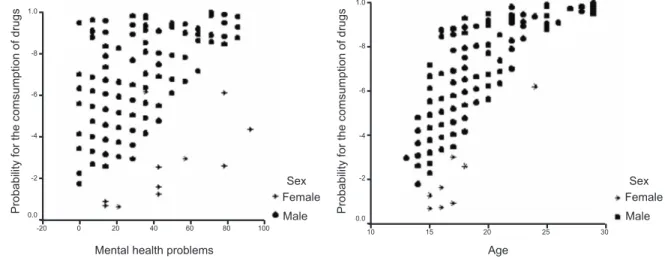
Figure 1 – The effect of mental health problems and age on the consumption of illicit drugs
Figure #1 shows the effect of age on the
consumption of an illicit drug (β = .319, p< .001). It
can be observed that, the higher the age, the higher
the probability for drug consumption. The same is
true for mental health problems, i.e. the higher the
level of these problems, the higher the probability for
the consumption of illicit drugs (β = .023, p = .027).
These probabilities are found to be higher for men (β
=-2.18, p< .020). Therefore, the results confirm the
first hypothesis.
The following data shows the results that prove
the second hypothesis. Table 3 presents results for
the effect of interpersonal risk factors on the
consumption of illicit drugs. Results show that the
model was significant (χ2= 28.14 p<.001), with an estimated variation of 14.9%.
Table 3 - Logistic Regression Model for the variables:
rates of relationship with friends and an inappropriate
relationship with parents towards the consumption of
an illicit drug
Sources: CDP, POSIT and HCD n=175
R2=14.9% n o i t a i r a V f o e c r u o
S B ES W gl Pvalue
e g
A .319 .078 16.75 1 .000 r
e d n e
G -2.18 .939 5.40 1 .020 n o i t a c u d e f o s r a e
Y -.124 .120 1.06 1 .303 b o j a g n i v a
H -.042 .400 0.01 1 .916 s m e l b o r p h tl a e h l a t n e
M .023 .011 4.88 1 .027 l e v e l n o i t a c u d e w o
L .020 .013 2.38 1 .122 t n a t s n o
C -.3.03 2.14 2.38 1
n o i t a i r a V f o e c r u o
S B ES W gl P
e u l a v s d n e i r f h t i w p i h s n o i t a l e
R .026 .008 10.75 1 .001 Inappropriaterelaitonshipwithparents .028 .009 8.79 1 .003
t n a t s n o
372
Figure #2 presents the effect of relationships
with friends who have maladaptive behaviors on the
consumption of illicit drugs (β = .026, p< .001). It can
be observed that, the higher the rate of relationship
with this kind of friends, the higher the probability of
consumption of illicit drugs. Likewise, the higher the
rate of inappropriate relationship with parents, the
higher the probability for consuming illicit drugs
(β=.028, p< .003). These results confirm the second
hypothesis of this study.
Figure 2 – The effect of a relationship with friends who present maladaptive behaviors and an inappropriate
relationship with parents on the consumption of drugs
DISCUSSION
The present study permittedthe analysis of
the predicting effect of some personal and
interpersonal risk factors in drug consumption by
adolescents and young people who belong to juvenile
gangs.
Around 60% of the study population had
already consumed illicit drugs; 32% of them three or
more kinds. Marijuana was found to be the most
consumed drug, followed by inhalants and cocaine.
These numbers are higher than in a previous study(5), which shows that drug consumption by this population
may be increasing. Drug consumption rates were
higher than those reported within the general
population(2) and within populations of adolescents and young people from school(12) and university(11) groups. Similarly, a study in the United States with young
people who belong to gangs or not reported that young
people who are members of juvenile gangs presented
higher rates of drug consumption(6). Unquestionably,
these results show that adolescents and young people
who belong to gangs have a higher risk of consuming
addictive substances than those who do not.
Thus, the study results support the first
hypothesis. Personal risk factors presented an effect
on drug consumption, and the factors that most
contributed to the model were gender, age and mental
health problems. Males presented a higher probability
for drug consumption than females. These results are
consistent with those reported in similar populations (5-6)
by the National Addiction Survey of 2002(2) and studies with adolescents and young people who do
not belong to gangs(10). These findings could be explained by the cultural roles of Mexican women.
Women tend to be much more aware of their health
and avoid risky behaviors, because of the maternity
function. This makes them more responsible and
careful with themselves than men. In addition, these
behaviors are culturally more permissible for men
than for women.
The higher the age, the higher the probability
for the consumption of drugs; these results agree with
Mexican(5) and international(9,14) studies. As adolescents and young people who belong to gangs grow older,
their interaction with other social networks probably
increases, and they are more likely to be offered these
substances. On the other hand, the economic factor
for buying drugs plays an important role, since most
of the older young people have a job, which allows
them to acquire these substances.
The consumption of drugs by minors is
alarming, which makes it evident that regulations on
this matter actually lack implementation in these
Personal and interpersonal risk factors…
Guzmán Facundo FR, Pedrão LJ.
marginal colonies. Nevertheless, it is known that most
drug consumers start before they are 20 years old(2), and these early starts predict higher consumption and
addiction levels(13). Consequently, for nursing and healthcare professionals, drug use control effort
should aim to prevent the start of consumption.
Another personal factor that was found to be
highly predictive for drug consumption was the risk
factor of mental health problems, since the higher
the rate of mental health problems, the higher the
probability for the consumption of drugs. These data
were in accordance with other Mexican(5,13) and international(15) studies. The relation between the consumption of drugs and symptoms of depression
or anxiety can be an indicator of comorbidity between
both conditions. Moreover, this relation may be
associated to how these adolescents and young people
who belong to juvenile gangs face the emotional
problems they experience, as a result of their
interactions.
According to the second hypothesis,
interpersonal risk factors (relationship with friends who
have maladaptive behaviors and inappropriate
relationships with parents) showed a positive effect
on the consumption of drugs. It was observed that,
as relationships with friends who have maladaptive
behavior increase, so does the probability for the
consumption of drugs. These results agree with
previous studies(10,15), and show that the relationship and interaction with friends who are consumers in
this group exert a stronger influence since, within the
internal dynamics of these groups, the use of drugs
is incorporated as the main activity. However, it seems
that this is not only the group that looks for the
adolescents, but also an element of personal decision,
aimed at belonging to the group and, then, trying
drugs.
This study found that, the higher the rate of
inappropriate relationship with parents, the higher the
probability for consuming drugs. These results are
compatible with literature, in which higher drug
consumption has been observed in adolescents with
parents who also use drugs(9-10). Likewise, it can be observed that lack of communication or having an
inappropriate relationship with parents is related to
drug consumption(12,15)
Drug consumption is one of the activities
performed in these groups of adolescents and young
people, and it works as a facilitator for social
relationships among them. This explains the fact that
the group of friends from the gang is the main indicator
for drug consumption. This probability increases when
the relationship with parents is not appropriate,
because the relationship with parents loses its
importance for the adolescents and young people who
enter gangs. They reinforce the vital value of gang to
the detriment of the family, leading to a stronger
positive or negative influence of their friends on their
behavior.
CONCLUSIONS
Personal risk factors showed they have an
effect on drug consumption, and the factors that most
contributed to the model were: gender, age and mental
health problems. Interpersonal risk factors, such as
relationships with friends who have maladaptive
behaviors and inappropriate relationships with parents
showed a positive effect on the consumption of drugs.
Nursing, as the science that deals with human
responses, is building an appropriate conceptual and
technological background for what it has been facing,
due to the drugs theme. The results of this study
contribute to knowledge in Nursing and other related
disciplines, with a view to a better understanding of
drug consumption by marginal adolescents and young
people from juvenile gangs, adding to the deficient
literature that exists about this population. Therefore,
the generation and confirmation of knowledge of risk
factors for the consumption of drugs by these
young people will allow for reflections and, in the
future, help design appropriate programs aimed
at preventing drug consumption. A significant part
of adolescents and young people from juvenile
g a n g s h a s n e v e r c o n s u m e d d r u g s , a n d i t i s
important to explore factors existing in these young
people in the future.
In order to define the range and limitations
of the present study, it should be mentioned that, as
a descriptive correlational study, these results only
permit the identification of personal and interpersonal
risk factors related to the use of drugs, whose
confirmation as risk factors would actually demand
the development of cross-section and prospective
374
REFERENCES
1. United Nations Office on Drugs and Crime [UNODC]. World Drug Report 2006; 1. [Acceso Septiembre 2006]. Disponible en: URL: http://www.unodc.org.
2. Consejo Nacional Contra las Adicciones – (MX) [CONADIC] (2003). Encuesta Nacional de Adicciones 2002. Secretaria de Salud, México: [Acceso septiembre 2003]. Disponible en: URL: http://www.salud.gob.mx/unidades/ conadic/.
3. Díaz A, Díaz R, Osornio A, Rascón M. La salud mental en el municipio de Querétaro: un modelo de intervención psiquiátrica en la comunidad. Gac Med Mex 2003; 139(2):101-7.
4. Ruble NM, Turner EL. A systemic analysis of the dynamics and organization of urban street gangs. Am J Fam Ther 2000; 28(2): 117-32.
5. Guzmán FR, Alonso MM, López KS. Factores de riesgo y consumo de drogas en bandas juveniles. Desarrollo Científico Enferm 2006; 14(1): 409-14.
6. Bennett T, Holloway K. Gang Membership, Drugs and Crime in the UK. British J Criminol 2004; 44(3): 305-23. 7. Coughlin B, Venkatesh SA. The urban street gang after 1970. Annual Sociol 2003(29): 41-65.
8. Moncada S. Factores de riesgo y de protección en el consumo de drogas. In: Plan Nacional sobre Drogas. Prevención de las drogodependencia; Análisis y propuestas de actuación. Madrid: Plan Nacional sobre Drogas; 1997. p. 8 5 - 1 0 1 .
9. Nyári TA, Herédi K, Parker L. Adictive behaviour of adolescnets in secondary schools in Hungary. Eur Adict Res 2005; 11: 38-43.
10. Paniagua H, García C, Castellano G, Sarralle R, Redondo C. Consumo de tabaco, alcohol y drogas no legales entre adolescentes y su relación con los hábitos de vida y el entorno. Anales Españolas de Pediatría 2001; 55: 121-8.
11. Rueda LV, Malbergier M, De Andrade V, Guerra A. Fatores associados ao consumo de álcool e drogas entre estudantes universitários. Revista Saúde Pública 2006; 40(2): 280-8. 12. Tavares BF, Béria JU, Silva M. Fatores asociados ao uso de drogas entre adolescentes escolares. Rev. Saúde Pública 2004; 38(6): 787-96.
13. Arrellanes JL, Díaz DB, Wagner F, Pérez V. Factores psicosociales asociados con el abuso y la dependencia de drogas entre adolescentes: Análisis bivariados de un estudio de casos y controles. Salud Mental 2004; 27(3): 54-64. 14. Wu L, Schlenger WE, Galvin DM. The relationship between employment and substance use among students aged 12 to 17. J Adolescent Health 2003; 32: 5-15.
15. Vitaro F, Brendgen M, Ladouceur R, Tremblay RE. Gambling, delinquency, and drug use during adolescence: mutual Influences and commun risk factor. Journal of Gambling Studies 2001; 17(3): 171-90.
16. Latimer W, Floyd LJ, Kariis T, Novotna G, Exnerova P, O’Brien M. Peer and sibling substance use: predictors of substance use among adolescents in Mexico. Rev Panam Salud Publica 2004;15(4):225–32.
17. Mariño MC, González FC, Andrade P, Medina ME. Validación de un cuestionario para detectar adolescentes con problemas por el uso de drogas. Salud Mental (México DF.)1998; 21(2): 27-39.
Recebido em: 25.7.2007 Aprovado em: 21.2.2008
Personal and interpersonal risk factors…
Guzmán Facundo FR, Pedrão LJ.