Official Journal of the Brazilian Psychiatric Association Volume 34 • Number 2 • June/2012
Psychiatry
Revista Brasileira de Psiquiatria
Abstract
Introduction: The prevalence of depressive disorders in HIV-infected patients ranges from 12% to 66% and is undiagnosed in 50% to 60% of these patients. Depression in HIV-infected individuals may
be associated with poor antiretroviral treatment (ART) outcomes, since it may direct inluence
compliance. Objective: To assess the presence of symptoms and risk factors for depression in patients on ART. Methods: Cross-sectional study. Certiied interviewers administered questionnaires
and the Beck Depression Inventory (BDI), and participants’ self-reported compliance to ART.
Clinical and laboratory variables were obtained from clinical records. Patients with BDI ≥ 12 were deined as depressed. Results: Out of the 250 patients invited to participate, 246 (98%) consented. Mean age was 41 ± 9.9 years; most were male (63%). Income ranged from 0-14 Brazilian minimum wages.AIDS (CDC stage C) had been diagnosed in 97%, and 81% were in stable immune status. One hundred ninety-one (78%) reported compliance, and 161 (68%) had undetectable viral loads. The prevalence of depressive symptoms was 32% (95% CI 26-40). In multivariate analysis,
depressive symptoms were signiicantly associated with income (prevalence ratio [PR] = 0.85; 95% CI 0.74-0.97; p = 0.02). Conclusions: Depressive symptoms are frequent in patients on ART, and are associated with low income.
Depressive symptoms in HIV-infected patients treated
with highly active antiretroviral therapy
Marysabel Pinto Telis Silveira,
1Marília Cruz Guttier,
2Cezar Arthur Tavares Pinheiro,
3Tatiana Vanessa Silveira Pereira,
4Ana Laura Sica Cruzeiro,
5Leila Beltrami Moreira
61 Pharmacy Course, Universidade Federal do Pampa, Uruguaiana, Brazil; Postgraduate Program in Medicine-Medical Sciences, Universidade Federal do Rio Grande do Sul (UFRGS), Brazil
2 Postgraduate Program in Medicine-Medical Sciences, Universidade Federal do Rio Grande do Sul (UFRGS), Brazil 3 Specialized Service for HIV/AIDS-SAE-Pelotas; Universidade Federal de Pelotas, Brazil
4 Pharmacist
5 Department of Psychology, Life and Health Science Center, Universidade Católica de Pelotas, Brazil 6 Department of Pharmacology, Universidade Federal do Rio Grande do Sul, Brazil
Received on June 29, 2011; accepted on October 12, 2011
DESCRIPTORS
AIDS;
CNS Depressants; Drug side effects - other; Epidemiology;
Other psychological issues.
ORIGINAL ARTICLE
Corresponding author: Marysabel Pinto Telis Silveira; Rua Dom Pedrito, 842, Laranjal, Pelotas, Rio Grande do Sul, Brazil; Phone: (+55 53) 30271927, (+55 53) 81176791; E-mail: [email protected]
Sintomas depressivos em pacientes infectados pelo HIV tratados por terapia antiretroviral altamente ativa
Resumo
Introdução: A prevalência de transtornos depressivos em pacientes infectados pelo HIV varia de 12% a 66% e não é diagnosticada em 50% a 60% desses pacientes. A depressão em indivíduos HIV positivo pode se associar a resultados fracos do tratamento antirretroviral (TAR)
porque pode inluenciar diretamente a aderência ao regime. Objetivo: Avaliar a presença de sintomas e de fatores de risco de depressão em pacientes em TAR. Métodos: Estudo em corte
transverso. Entrevistadores certiicados administraram questionários e o Beck Depression Inventory (BDI), e os participantes izeram o autorrelato da aderência ao TAR. Variáveis clínicas e laboratoriais foram obtidas dos prontuários clínicos. Os pacientes com escore ao BDI ≥ 12 foram deinidos como deprimidos. Resultados: Dos 250 pacientes convidados a participar, 246 (98%) concordaram. A média de idade foi de 41 ± 9,9 anos; a maioria dos pacientes era do sexo
masculino (63%). A renda variou de 0-14 salários mínimos brasileiros. A AIDS (estágio C dos CDC) havia sido diagnosticada em 97% e 81% estavam em estado imune estável. Dos pacientes, 191 (78%) relataram aderência e 161 (68%) tinham carga viral não detectável. A prevalência dos sintomas depressivos foi de 32% (IC 95% 26-40). Em análise multivariada, os sintomas depressivos se associaram signiicativamente à renda (razão de prevalência [RP] = 0,85, IC 95% 0,74-0,97; p = 0,02). Conclusões: Os sintomas depressivos são frequentes em pacientes em TAR e se associam a uma renda baixa.
DESCRITORES:
AIDS;
Depressores do SNC; Efeitos colaterais de drogas – outros; Epidemiologia; Outras questões psicológicas.
Introduction
The prevalence of depression in HIV-infected patients has been reported to range from 12% to 66%.1-7 Diagnosing and treating these symptoms is critical to improve patients’ quality of life; however, 50% to 60% of the cases are not diag-nosed.8 Psychological stress and progression of HIV infection have been associated with a lower quality of life.9 Moreover, depression has been associated with poorer adherence to antiretroviral treatment (ART).10
Little has been published on the epidemiology of depres-sion in patients with HIV/AIDS in lower- and middle-income countries. The reported prevalence of depressive symptoms in patients with HIV/AIDS in those countries range from 8% to 60%.11 Despite the variety of instruments used to identify depression, it seems to be a neglected public health issue in developing countries.11
The purpose of this study is to report the prevalence of depressive symptoms and to identify associated risk factors in patients on ART, treated in a specialized HIV/AIDS service in southern Brazil, with a particular emphasis on the associa-tion between depression and ART compliance.
Methods
Design
Cross-sectional study.
Setting
Reference center for HIV/AIDS-SAE-Pelotas, in Pelotas, Brazil.
Participants
The study population comprised all patients on ART cur-rently under care at the HIV/AIDS-SAE-Pelotas (N = 800). A sample size of 230 was estimated to measure a prevalence of depressive symptoms of 30 ± 5%, with 95% conidence interval (95%CI).
All patients who attended the clinic for consultation or in order to receive prescription drugs were invited to join the study. After signing a written informed consent, participants were interviewed. The study was approved by the Scientiic Commission of the Universidade Católica de Pelotas and by the Ethics Committee of the Universidade Federal do Rio Grande do Sul (number 2003164).
Trained interviewers administered questionnaires includ-ing sociodemographic variables and self-reported adherence, and administered BDI.12 Clinical and laboratory data were obtained from the clinical records.
Main variables of interest
Compliance was evaluated using participants’ self-reports on prescribed antiretrovirals taken in the last three days before the interview. A time sheet was used to help patients remember their routine activities (e.g., breakfast, lunch) and to report the medicines in use, doses and time of administra-tion. Individual drug compliance was computed dividing the number of tablets of each antiretroviral drug taken in three days by the number of tablets prescribed in the same days. Rate of regimen compliance was calculated by arithmetic mean for each drug. Participants were considered compliant if they reported taking ≥ 95% of the prescribed doses during the three days prior to the evaluation.13,14
Predictor variables
Sex, age, years on ART, household income (as a multiple of the Brazilian minimal monthly wage of R$ 350.00, which is equivalent to US$ 153.21), employment, receiving social security beneits and living situation. The most recent HIV plasma viral load prior to the interview was identiied from clinical records. The lower limit of detection was 50 cop-ies/mL.13 Other clinical data such as: HIV clinical stage as deined by the Centers for Disease Control and Prevention15 and modiied according to the criteria adopted in Rio de Janeiro and Caracas;13,15 the CD4 lymphocyte count closest to the interview; the ART regimen; and the duration of ART treatment were collected from clinical records.
Statistical analysis
Data were double-entered into EPI-INFO and analyzed in SPSS for Windows version 16.0 (SAS Institute, Cary, North Carolina, USA). Differences in proportions between patients with or
without depressive symptoms were tested by the chi-square test. Poisson regression analyses with depressive symptoms as the outcome variable were carried out to evaluate the individual role of risk factors associated with depressive symptoms. Variables with p < 0.3 in bivariate analysis were included in the multivariable model to estimate the adjusted prevalence ratio for depressive symptoms. Risk factors for non-compliance were evaluated through Poisson regression as well.
Results
Out of 250 patients invited to participate, 246 (98%) con-sented. Of these,154(63%) were male.The mean age was 41 ± 9.9 years (range, 18 to 73 years), and income ranged from 0 to 14 times the minimum wage (median, 1.90; 1 MW = R$ 350.00 or US$ 153.51). AIDS was the most preva-lent clinical stage (97%), and 81% had ≥ 200 CD4 cells/mm. One hundred sixty-six (68%) participants had undetectable viral load, and 191 (78%) reported being adherent to treat-ment. Duration of ART ranged from 4 to 139 months (mean 56.8 ± 34.05), and 55% of participants were using efavirenz (EFV). Table 1 presents sociodemographic characteristics of HIV-infected patients on ART with and without depressive symptoms.
The prevalence of depressive symptoms (BDI score ≥ 12) was 32% (95% CI 26%-40%). Overall, 14% classiied as having mild depressive symptoms, 14% as having moderate depres-sive symptoms and 4% as having severe depresdepres-sive symptoms (Figure 1). Fatigue (51.2%) and irritability (47.6%) were the most frequently reported symptoms. Predictors of depressive symptoms in HIV-infected patients on ART are presented in
Table 1 Sociodemographic characteristics of HIV-infected patients on ART with and without depressive symptoms and Relative Risk (RR), SAE-Pelotas, Brazil (N = 246)
All sample Depressive symptoms RR (CI = 95%) p¹
Yes (n = 79) No (n = 167)
Sex N (%)
Male 154 (62.6) 47 107 0.88 (0.61-1.27) 0.49
Female 92 (37.4) 32 60 1
Age Mean (SD) 41.0 (9.9) 79 167 1.00 (0.99-1.01) 0.68
Years of Study Mean (SD) 6.7 (3.8) 79 167 0.96 (0.92-1.01) 0.14
Income Mean (SD) * 2.1 (1.92) 79 167 0.82 (0.72-0.93) 0.002
Employment N (%)
No steady work 137 (55.7) 53 84 1.62 (1.09-2.41) 0.017
Steady work 109 (44.3) 26 83 1
Receiving any Beneits N (%)
NO 111 (45.1) 30 81 0.75 (0.51-1.09) 0.13
YES 135 (54.9) 49 86 1
Therapeutic regimen containing EFV N (%)
NO 112 (45.5) 29 83 0.69 (0.47-1.02) 0.061
YES 134 (54.5) 50 84 1
Such variation may be explained by the different instruments used to diagnose depression and by other methodological dif-ferences, such as the cutoff point used. Different BDI cut points have been used; even in their original paper, Beck et al.16 sug-gested that the choice of an adequate cutoff point depended on sample characteristics and study goals. We used 12 as a cutoff, which allowed us to identify the largest number of patients with symptoms of mild depression or worse.12
EFV is a drug that has been associated with a number of neuropsychological side effects and mood disorders.17-19 In a randomized clinical trial, Lochet et al.19 found that neuro-psychiatric adverse reactions associated with EFV occurred mainly during the irst month of therapy and often persisted thereafter. Gutierrez et al.20 studied predictive factors of neuropsychiatric adverse events associated with EFV and found that the only risk factor associated with central ner-vous system toxicity, after adjusting for body weight and hepatitis C virus co-infection, was EFV plasma concentration. Considering depressive symptoms, some authors have found no association18,21 while others found a high prevalence of depression associated with EFV use.19,22 In the present study, over half of studied patients were taking an ART regimen containing EFV. No association with depressive symptoms was found, although a statistically non-signiicant relative risk reduction of 28% for depressive symptoms among patients not using EFV was identiied. Despite the conlicting results in the literature, this inding is important for the evaluation of patients already in treatment, since depression may worsen adherence23 and contribute to treatment failure.
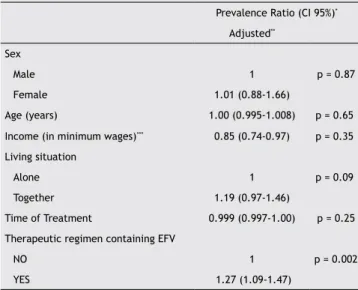
Participants were considered adherent if they reported taking ≥ 95% of the prescribed doses during the three days prior to the evaluation.13,14 Those patients under therapeu-tics regimen including efavirenz were 27% more likely to be
Figure 1 Distribution of the rate of depressive symptoms according to intensity (%).
Distribuition of the rate of depressive symptoms according the intensity (% )
Without Depressive Symptoms % p a ti e n ts Severe Symptoms Moderate Symptoms Mild Symptoms 67.9 80 70 60 50 40 30 20 10 0 14.2 13.8 4.1
Table 2 Multivariable predictors of depressive symptoms in HIV-infected patients on ART, SAE-Pelotas, Brazil (N = 246)
Prevalence Ratio (CI 95%)*
Adjusted** p
Sex
Male 0.93 (0.64-1.34) p = 0.68
Female 1
Age (years) 1.00 (0.99-1.02) p = 0.73
Years of Study 1.00 (0.95-1.05) p = 0.89
Income (in minimum wages)*** 0.85 (0.74-0.97) p = 0.02
Employment
No steady work 1.38 (0.91-2.11) p = 0.13
With steady work 1
Receiving any beneits
NO 0.72 (0.55-1.2) p = 0.29
YES 1
Therapeutic regimen containing EFV
NO 0.72 (0.48-1.06) p = 0.1
YES 1
* Poisson Regression; ** Adjusted for sex, age, years of study, income, employment, receiving any beneit, and therapeutic regimen with efavirenz; *** Minimum wage = R$ 350.00 = US$ 153.51; US$ 1 = R$ 2.28; EFV: efavirenz; ART: antiretroviral therapy.
Table 3 Multivariable predictors of adherence in HIV-infected patients on ART, SAE-Pelotas, Brazil (N = 246)
Prevalence Ratio (CI 95%)*
Adjusted**
Sex
Male 1 p = 0.87
Female 1.01 (0.88-1.66)
Age (years) 1.00 (0.995-1.008) p = 0.65
Income (in minimum wages)*** 0.85 (0.74-0.97) p = 0.35
Living situation
Alone 1 p = 0.09
Together 1.19 (0.97-1.46)
Time of Treatment 0.999 (0.997-1.00) p = 0.25
Therapeutic regimen containing EFV
NO 1 p = 0.002
YES 1.27 (1.09-1.47)
* Poisson Regression; ** Adjusted for sex, age, income, employment, living situation, time of treatment and therapeutic regimen with efavirenz; *** Minimum wage = R$ 350.00 = US$ 153.51; US$ 1 = R$ 2.28; Patient was considered adherent if reported taking ≥ 95% of the prescribed dose during the three days of evaluation; EFV: efavirenz; ART: antiretroviral therapy.
Table 2. In multivariate analysis adjusted for sex, age, years of education, income, employment, receiving social security beneits and therapeutic regimen with efavirenz only income remained associated with depressive symptoms (RR = 0.85; 95% CI 0.74-0.97; p = 0.02).
Therapeutic regimen containing EFV was independently associated with adherence to ART (Table 3).
Discussion
compliant than patients not taking efavirenz regimen. This might be explained by the fewer tablets needed or lower fre-quency of doses in therapeutics regimen including efavirenz. The study has some limitations to be considered. The cross-sectional design did not allow us to establish a causal relationship between the potential risk factors and the pres-ence of depressive symptoms. Antidepressant drug use was not investigated and may have led to underestimation of depres-sive symptoms prevalence. Treatment length varied greatly, which may have contributed to absence of association between depression and clinical stage, since depression is more preva-lent immediately after the AIDS diagnosis.5 Another limitation is the fact that the study was conducted only with HIV-infected patients on ART, being most of them stage C (AIDS).
In conclusion, it was found that almost one in three patients on ART has depressive symptoms and participants presenting symptoms of depression are mostly low-income patients. It is suggested that clinicians carefully assess the possibility of depressive symptoms in their patients on ART, and especially those of lower income. Future studies with prospective design, starting at the moment of HIV diagnosis, should be able to more clearly explore the causal and tem-poral relationship between depression, compliance and ART.
Acknowledgments
We thank the staff and patients of the Specialized Service forHIV/AIDS–SAE–Pelotas, Universidade Federal de Pelotas, Pelotas, Brazil. We are also grateful to the students of the Pharmacy Course at, Universidade Católica de Pelotas
who have worked on this project and to the faculty of the University of California, San Francisco, the Universidade Federal da Bahia, and the Center for the Study of AIDS of Rio Grande do Sul in Porto Alegre, Brazil (CEARGS) for their assistance.
Name of the department and institution to which the study should be attributed: Pharmacy Course, Universidade Federal do Pampa, Uruguaiana, Brazil and Postgraduate Program in Medicine-Medical Sciences, Universidade Federal do Rio Grande do Sul, Porto Alegre, Brazil.
Disclosures
Marysabel Pinto Telis Silveira
Employment: Pharmacy Course, Universidade Federal do Pampa,
Uruguaiana, Brazil. Other: Postgraduate Program in Medicine-Medical
Sciences, Universidade Federal do Rio Grande do Sul (UFRGS), Brazil.
Marília Cruz Guttier
Employment: Pharmacist, Brazil. Other: Postgraduate Program in Medicine-Medical Sciences, Universidade Federal do Rio Grande do Sul (UFRGS), Brazil.
Cezar Arthur Tavares Pinheiro
Employment: Specialized Service for HIV/AIDS-SAE-Pelotas; Universidade Federal de Pelotas, Brazil.
Tatiana Vanessa Silveira Pereira Employment: Pharmacist, Brazil.
Ana Laura Sica Cruzeiro
Employment: Department of Psychology, Life and Health Science Center, Universidade Católica de Pelotas, Brazil.
Leila Beltrami Moreira
Employment: Department of Pharmacology, Universidade Federal do Rio Grande do Sul, Brazil.
This study was supported in part by a grant to the University of California, San Francisco from the U.S. National Institutes of Health, Fogarty International Center (International Clinical, Operational and Health Services Research Training Award, D43TW005799)., Brazil.
* Modest
** Signiicant
*** Signiicant: Amounts given to the author’s institution or to a colleague for
research in which the author has participation, not directly to the author.
References
1. Gibbie T, Mijch A, Ellen S, Hoy J, Hutchison C, Wright E, Chua P, Judd F. Depression and neurocognitive performance in individuals with HIV/AIDS: 2-year follow-up. Hiv Med. 2006;7:112-21.
2. Judd F, Komiti A, Chua P, Mijch A, Hoy J, Grech P, Street A, Lloyd J, Williams. Nature of depression in patients with HIV/ AIDS. Aust N Z J Psychiatry. 2005;39:826-32.
3. Judd FK, Cockram AM, Komiti A, Mijch AM, Hoy J, Bell R. Depressive symptoms reduced in individuals with HIV/AIDS treated with highly active antiretroviral therapy: a longitudinal study. Aust N Z J Psychiatry. 2000;34:1015-21.
4. Judd FK, Mijch AM. Depressive symptons in patients with HIV infection. Aust N Z J Psychiatry. 1996;30:104-09.
5. Lyketsos CG, Hoover DR, Guccione M, Dew MA, Wesch J, Bing EG, Treisman GJ. Depressive symptoms over the course of HIV infection before AIDS. Soc Psychiatry Psychiatr Epidemiol. 1996a;31:212-19.
6. Mello VA, Malbergier A. Depression in women infected with HIV. Rev Bras Psiquiatr. 2006;28(1):10-7.
7. Williams JB, Rabkin JG, Remien RH, Gorman JM, Ehrhardt AA. Multidisciplinary baseline assessment of homosexual men
with and without human immunodeiciency virus infection
II. Standardized clinical assessment of current and lifetime psychopathology. Arch Gen Psychiatry. 2001;48(2):124-30. 8. Malbergier A. Aids e Psiquiatria - um Guia para os Proissionais
de Saúde. Rio de Janeiro: Revinter; 2000.
9. Leserman J, Petitto JM, Golden RN, Gaynes BN, Gu HB, Perkins DO, Silva SG, Folds JD, Evans DL. Impact of stressful life events, depression, social support, coping, and cortisol on progression to AIDS. Am J Psychiatry. 2000;157:1221-8.
10. Macintyre RC, Holzemer WL, Philippek M. Complementary and alternative medicine and HIV/AIDS. Part II: Select literature review. J Assoc Nurses AIDS Care. 1997;8:25-38.
11. Fleischer NL, Fernald LC, Hubbard AE. Depressive Symptoms in Low-Income Women in Rural Mexico. Epidemiology. 2007;18:678-85.
12. Cunha JA. Manual da versão em português das escalas de Beck. Casa do Psicólogo Livraria e Editora Ltda; 2001.
13. Ministério da Saúde do Brasil. Recomendações para terapia anti-retroviral em adultos e adolescentes infectados pelo HIV-2006. Retrieved July 19, 2007, from: //www.aids.gov.br/assistencia/ concenso_brasileiro2007.doc.
14. Silveira MPT, Pinheiro CAT, Guttier MC, Pereira TVS, Moreira LB. Description of pharmaceutical care to assess their effectiveness on adherence to antirretroviral therapy – A randomized clinical trial. JMMS. 2010;1(5):171-177. Available online: http://www. interesjournals.org/JMMS.
15. Centers for Disease Control And Prevention Report of the NIH
panel to deine principles of therapy of HIV infection and
guideliness for the use of antiretroviral agents in HIV-infected adults and adolescents TM. US. Department of Health and Human Services. Atlanta: 2000.
16. Beck AT, Steer RA, Garbin MG. Psychometric properties of the
Beck Depression Inventory: Twenty-ive years of evaluation.
Clinical Psychology Review: Baltimore 1998 In: Castanha AR, Coutinho MPL, Saldanha AAW, Ribeiro CG. Psychosocial repercussions of depression in the context of AIDS. Psicologia:
ciência e proissão. 2006;26(1):70-81.
17. Boly L, Cafaro V, Dyner T. Depressive symptoms predict increased incidence of nuropsychiatric side effects in patients treated
with efavirenz. J Acquir Immune Deic Syndr. 2006;42(4):514-5.
19. Lochet P, Peyrière H, Lotthé A, Mauboussim JM, Delmas B, Reynes J. Long-term assessment of neuropsychiatric adverse reactions associated with efavirenz. HIV Med. 2003;4:62-6. 20. Gutierrez F, Navarro A, Padilha S, Anton R, Masia M, Borrás J,
Martín-Hidalgo A. Prediction of neuropsychiatric adverse events associated with long-term efavirenz therapy, using plasma drug level monitoring. Clin Infect Dis. 2005;41:1648-53.
21. Fumaz CR, Muñoz-Moreno JA, Moltó J, Negredo E, Ferrer MJ, Sirera G, Pérez-Alvarez N, Gómez G, Burger D, Clotet B. Long-term neuropsychiatric disorders on efavirenz-based approaches: quality of life, psychologic issues, and adherence. J Acquir
Immune Deic Syndr. 2005;38(5):560-5.
22. Spire B, Carrieri P, Garzot MA, L´Henaff M, Obadia Y. Factors associated with efavirenz discontinuation in a large community-based sample of patients. AIDS Care. 2004;16(5):558-64. 23. Starace S, Ammassari A, Trotta MP, De Longis P, Izzo C, Scalzini
A d’Arminio Monforte A, Wu AW, Antinori A; AdICoNA Study Group; NeuroICoNA Study Group. Depression is a risk factor forsuboptimal adherence to highly active antiretroviral therapy.