ORIGINAL ARTICLE
Postural evaluation, pain and fitness of hydrogymnastics practitioners*
Avaliação postural, dor e aptidão física de praticantes de hidroginástica
Iane Marcela Scherer Colpo1, Luciane Sanchotene Etchepare Daronco2, Laércio André Gassen Balsan3
* Received from the Center of Studies in Physical Education Measurements and Evaluation, Federal University of Santa Maria (UFSM). Santa Maria, RS.
RESUMO
JUSTIFICATIVA E OBJETIVOS: A hidroginástica pode ser praticada por indivíduos de diversas faixas etárias, pois proporcio-na baixo impacto, sendo uma alterproporcio-nativa para melhorar a qualidade de vida e a saúde de indivíduos que estão impossibilitados de re-alizar atividades de impacto. Desse modo, o objetivo deste estudo foi analisar os efeitos de 12 semanas de prática de hidroginástica sobre a percepção subjetiva da dor e sua inluência nas atividades da vida diária, veriicar a postura e a aptidão física de praticantes de hidroginástica.
MÉTODO: Participaram da pesquisa 20 mulheres, com idade entre 30 e 50 anos. As mesmas passaram por uma avaliação ini-cial para mensurar a lexibilidade e resistência muscular localizada. Também foram feitas mensurações antropométricas, como massa corporal, estatura, circunferência da cintura e do quadril, para esti-mar o índice de massa corpórea (IMC) e a relação cintura quadril (RCQ). Além disso, responderam dois questionários para avaliar a dor. Após 12 semanas do pré-teste, realizou-se a avaliação inal. RESULTADOS: Encontrou-se diferença estatística signiicante na circunferência da cintura e na RCQ, houve diminuição da sensação subjetiva da dor nos locais face e pé esquerdo. As dores passaram a interferir menos na realização de atividades gerais, no humor e no sono. Em relação à postura, não houve modiicações entre o início e o inal do estudo.
CONCLUSÃO: A hidroginástica, num período de 12 semanas, foi eicaz na melhoria de alguns itens da aptidão física e na diminuição da dor, porém, não em relação à postura de mulheres que já prati-cam essa modalidade.
Descritores: Aptidão física, Dor, Postura.
INTRODUCTION
Pain is complex and subjective1. Reason for numerous problems, pain may become the major focus of attention of individuals, limiting their daily activities and afecting their and their fami-lies’ quality of life (QL). Factors such as depression, physical and functional incapacity, social withdrawal, family dynamics changes and economic unbalance, direct and limit people’s decisions and behaviors2.
Another problem afecting general population is poor posture, which is the lack of relationship among the several body parts, leading to increased overload of body supporting structures, which 1. Graduated in Physical Education (Full Degree). Federal University of Santa
Ma-ria (UFSM). Center of Studies in Physical Education Measurements and Evaluation (NEMAEF). Santa Maria, RS, Brazil.
2. Doctor in Human Movement Science. Associate Professor of the Federal University of Santa Maria (UFSM). Coordinator of the Center of Studies in Physical Education Measure-ments and Evaluation (NEMAEF). Santa Maria, RS, Brazil.
3. Graduated in Physical Education. Master in Administration. Federal University of Santa Maria (UFSM). Center of Studies in Physical Education Measurements and Evaluation (NEMAEF). Santa Maria, RS, Brazil.
Submitted in June 15, 2012.
Accepted for publication in February 28, 2013.
Correspondence to:
Luciane Sanchotene Etchepare Daronco, M.D. Rua Quintino Bocaiúva, 366/902 – Bairro Centro 97010-400 Santa Maria, RS.
E-mail: [email protected]
Rev Dor. São Paulo, 2013 jan-mar;14(1):35-8
35
Sociedade Brasileira para o Estudo da Dor c
ABSTRACT
BACKGROUND AND OBJECTIVES: Hydrogymnastics may
be practiced by people of diferent ages because it provides low impact, being an alternative to improve quality of life and health of people unable to practice impact activities. his study aimed at analyzing the efects of 12 weeks of hydrogymnastics on subjective pain perception and their inluence on daily life activities, in ad-dition to evaluating posture and itness of hydrogymnastics prac-titioners.
METHOD: Participated in this study 20 females aged from 30 to 50 years who went through a baseline evaluation to measure lexibility and localized muscle resistance. Anthropometric measures were body mass, height, waist and hip circumference to estimate body mass index (BMI) and waist / hip ratio (WHR). In addition, they have answered two questionnaires to evaluate pain. Twelve weeks ater the pre-test, inal evaluation was performed.
RESULTS: here has been statistical diference in waist circumference and WHR, in addition to decreased subjective pain sensation on face and let foot. Pain started to interfere less with general activi-ties, mood and sleep. With regard to posture, there has been no change between the beginning and the end of the study.
CONCLUSION: Hydrogymnastics for 12 weeks was efective to improve some itness items and to decrease pain; however it has not changed posture of females practicing such modality.
may also result in pain3. In this context, an increasing number of evidences are starting to show that physical activity provides better QL4 an even promotes analgesia5.
Hydrogymnastics is a physical exercise modality which promotes global physical itness improvement, and may contribute to im-prove QL. For being an activity performed in water, it may be practiced by diferent age groups6.
his study aimed at evaluating the efects of 12 weeks of hydro-gymnastics on subjective pain perception and its inluence on daily life activities, posture and skills.
METHOD
his was an exploratory and quantitative research. Case study was used as research strategy.
Sample was made up of 23 females practitioners of hydrogymnas-tics, students of the Sports Association of the Federal University of Santa Maria (ADUFSM).
Inclusion criteria were: a) age between 30 and 50 years; b) be hydrogymnastics practitioner for at least three uninterrupted months, with minimum frequency of twice a week and signing the Free and Informed Consent Term (FICT). Exclusion criteria were: a) practicing physical activity diferent from hydrogymnas-tics; b) miss more than 12 of a total of 24 lessons.
he following pieces of equipment were used to collect physical itness data: digital scale of the brand Acqua, metric tapes, Wells bench and mats. he following tools were used to evaluate pain: McGill Pain Questionnaire and Wisconsin Pain Inventory, both adapted. To evaluate posture, an evaluation card based on the ob-servation of the subject standing up in the frontal and lateral plane was used.
Sample subjects went through a baseline evaluation (pre-test), where the following tests were applied: “Sit and Reach”7 to mea-sure posterior legs, hips and lumbar spine lexibility, and “Abdomi-nal 1 minute”, to quantify localized muscle resistance. Anthropo-metric data were also collected, such as body mass and height to estimate body mass index (BMI), waist and hip circumference to estimate waist-hip relationship (WHR).
In addition, participants have answered two pain evaluation ques-tionnaires.
In the McGill Pain Questionnaire, participants have marked on a table body sites where they felt pain and the level of perceived pain. Pain level is represented by a scale from zero (no pain) to
10 (unbearable pain). For spatial pain location, the questionnaire has human body sketches, one in anterior plane and the other in posterior plane8.
In Wisconsin Pain Inventory, participants have circled a number which would describe how pain interfered with the following as-pects of their lives: general activity, mood, walking ability, work, relationship with other people, sleep, enjoy life. Numbers are on a scale from zero (no interference) to 10 (total interference)8. Another procedure was postural evaluation through observation, using as reference point a posture grid, or “posturógrafo”, placed behind de person. Subjects were evaluated in swimsuits and with bare feet, in frontal planes with anterior, posterior views and sagi-tal with proile view.
Ater baseline evaluation, subjects constituting the sample of this research have normally participated in hydrogymnastics lessons. Twelve weeks ater pre-test, inal evaluation was performed (post-test), where all initial tests were repeated. Only participants who had not missed more than 12 lessons were evaluated. Due to exces-sive absences, three females had to be excluded from the study and the post-test was applied to 20 students.
Data were collected by trained students, participants of the Center of Studies on Physical Education Measurements and Evaluation (NEMAEF) CEDF/UFSM.
Student’s t test was used for pre and post-test data analysis, with the statistical package SPSS 8.0 for Windows and considering sta-tistically signiicant p < 0.05.
his study was approved by the Research Ethics Committee, Federal University of Santa Maria (opinion 23081.008796/2009-38).
RESULTS
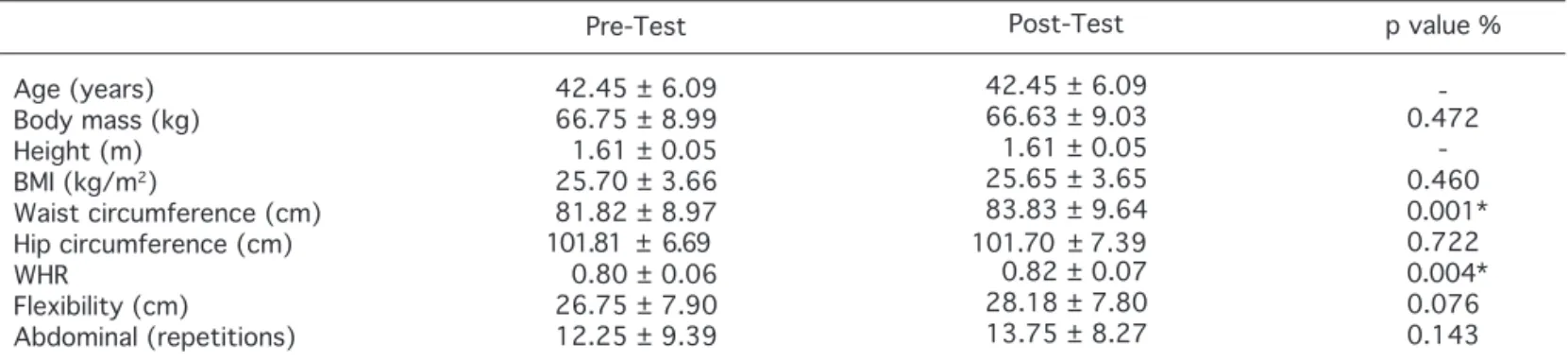
Pre and post-test mean and standard deviation of age, body mass, height, body mass index (BMI), waist circumference, hip circum-ference, WHR, lexibility and abdominal are shown in table 1. As it can be seen, only waist circumference and WHR variables had statistically signiicant diferences (p < 0.05).
For postural evaluation, cervical, dorsal and lumbar spine regions were observed to check whether they had normal alignment, recti-ication, inversion or hyperlordosis in cervical and lumbar regions, or even hyperkyphosis in dorsal region. We have also observed whether individuals had or not scoliosis, which was observed in 100% of cases. here has been no change between baseline and inal evaluations. Table 2 shows the percentage of the sample with
-36
Colpo, Daronco and Balsan
BMI = body mass index; WHR = waist-hip relationship.
*Signiicant diferences for p < 0.05.
Table 1 – Descriptive values of physical itness variables.
Age (years) Body mass (kg) Height (m) BMI (kg/m2)
Waist circumference (cm) Hip circumference (cm) WHR
Flexibility (cm)
Abdominal (repetitions)
Pre-Test
42.45 ± 6.09 66.75 ± 8.99 1.61 ± 0.05 25.70 ± 3.66 81.82 ± 8.97
0.80 ± 0.06 26.75 ± 7.90 12.25 ± 9.39
Post-Test
42.45 ± 6.09 66.63 ± 9.03 1.61 ± 0.05 25.65 ± 3.65 83.83 ± 9.64
0.82 ± 0.07 28.18 ± 7.80 13.75 ± 8.27
p value %
0.472
0.460 0.001*
0.722 0.004*
0.076 0.143
± 6.69
101.81 101.70 ± 7.39
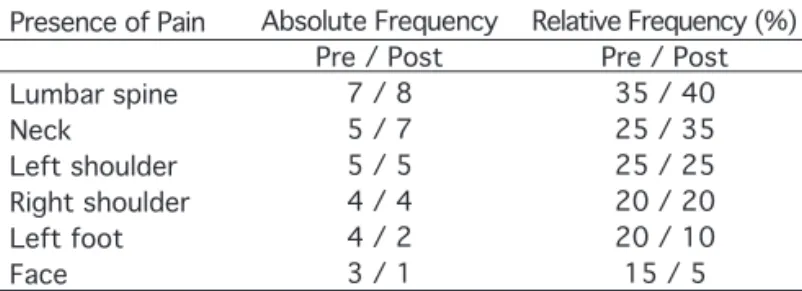
McGill Pain questionnaire has shown major sites afected by moderate to unbearable pain. According to data, lumbar region was most oten mentioned, present in 35% of questionnaires, followed by neck, let shoulder, right shoulder, let foot and face. Pre and post-test values are better seen in table 3, where it is possible to observe that only let foot and face had 10% decrease in the percentage of the sample referring pain in those regions.
According to the protocol, Wisconsin’s Pain Inventory was able to detect whether pain interfered or not with the following aspects of the lives of hydrogymnastics practitioners: general activity, mood, walking ability, work, relationship with other people, sleep and en-joy life. According to pre-test data, it could be observed that 65% of the sample have reported that pain interferes with general activi-ties, 55% reported interfering with mood and sleep, and 50% with work and walking ability.
Comparing inal with baseline data, it is possible to observe that there has been 5% decrease in reports that pain interferes with general activities, 10% decrease with regard to mood and 20% with regard to sleep. he item work had no change with regard to pre-test. In walking ability, there has been 10% increase, showing the interfer-ence of pain with this aspect (Graph 1).
DISCUSSION
Ater analyzing physical itness tests results (localized muscle resis-tance, lexibility, body mass index and WHR), statistically signii-cant diferences between pre and post-test were found only in waist circumference and WHR. hese diferences point to a result which is diferent from what has been observed by a study evaluating the ef-fects of hydrogymnastics on physical itness of the elderly. Ater three months of practice, subjects have presented improvements in all evaluated physical itness components (upper and lower limbs strength and resistance, lexibility, localized muscle resistance)9. his diference may be explained by the fact that the elderly par-ticipating in the experiment did not practice any regular physical exercise whereas the subjects of our research were already hydro
gymnastics practitioners for more than three months10. his fact may be explained because, in fact, strength gains, for example, pre-sented during the irst weeks of training by otherwise sedentary individuals, occur as a function of neural factors11.
In a diferent study with the elderly10 results were similar to our study. Authors have also observed signiicant decreases in waist pe-rimeter ater sometime training with hydrogymnastics.
With regard to postural evaluation, it was possible to detect that most incident deviation of the participants of this study were sco-liosis, followed by hyperlordosis, present in 100% and 90% of the sample, respectively.
Observing data, there has been no change in posture in any evalu-ated region; inal percentages were equal to baseline percentages. he reason might have been that no speciic work was proposed to treat such deviations.
In studies involving speciic groups, such as Olympic ight ighters12 or classic ballerinas13, one of the most incident postural deviations was lumbar spine hyperlordosis, as it was seen in this study. A study evaluating 12 sedentary female university students, aim-ing at observaim-ing possible postural changes as a consequence of 16 weeks of against resistance training, has observed postural im-provement only in head/neck, heels and abdomen. hey have also not obtained signiicant responses for lumbar and dorsal regions, similarly to our study14.
According to McGill Pain protocol, major moderate to severe pain sites were detected in hydrogymnastics practitioners. Lum-bar spine was most oten mentioned, being present in 35% of the sample, followed by neck, let shoulder, right shoulder, let foot and face. In the post-test, these percentages had 10% decrease for let foot and face.
Still with regard to pain evaluation according to answers to the
37
Postural evaluation, pain and itness of hydrogymnastics practitioners
Table 3 – Distribution of sample frequency according to pain location.
Presence of Pain
Lumbar spine Neck Left shoulder Right shoulder Left foot Face
Absolute Frequency Pre / Post
7 / 8 5 / 7 5 / 5
4 / 4 4 / 2 3 / 1
Relative Frequency (%) Pre / Post
35 / 40 25 / 35 25 / 25 20 / 20 20 / 10 15 / 5
Table 2 – Pre-test and post-test percentage values of postural evaluation.
Cervical spine Dorsal spine Lumbar spine
Normal
100 / 100 50 / 50 10 / 10
Pre-Test / Post-Test
Hyperlordosis
0 / 0
-90 / -90
Hyperkyphosis
-15 / -15
-Rectiication
0 / 0 35 / 35
0 / 0
Inversion
0 / 0 0 / 0 0 / 0
0.472
0.460 0.001*
0.722 0.004*
0.076 0.143
Graph 1 – Percentage of sample referring pain during daily activities.
General Activities
Pre-test Post-test
Mood Sleep Work Walking Ability Wisconsin’s Pain Inventory
Wisconsin’s Pain Inventory, it was observed that pain interferes with general activities for 65% of the sample, with mood and sleep for 55%, with work and walking ability for 50% of the students. In the post-test there has been decrease of these percentages in the items general activities, mood and sleep, of 5%, 10% and 20%, re-spectively, as compared to baseline evaluation. hese results are in line with other studies carried out on this subject, because such studies have also had the lumbar region as the major pain site, being also mentioned neck and shoulders, and resulting in limitations to perform daily activities10.
Among the limitations of this study, one may mention lack of con-trol and planning of hydrogymnastics lessons, because they were ministered by diferent teachers, each one in his/her own way. Participants’ diet has also not been controlled, which may have af-fected the inal results of this study.
CONCLUSION
Hydrogymnastics for 12 weeks has improved waist circum-ference and WHR, however there have been no significant changes in flexibility, body mass index, and localized muscle resistance, possible due to the relatively short training time and because nutritional follow up was not performed. There has been pain decrease in sites such as face and left foot, which has interfered less with general daily activities, mood and sleep.
REFERENCES
1. Silva MS, Pinto MA, Gomes LMX, et al. Dor na criança internada: a percepção da equipe de enfermagem. Rev Dor. 2011;12(4):314-20.
2. Walsh IAP, Corral S, Franco RN, et al. Capacidade para o trabalho em indivíduos com lesões músculo-esqueléticas crônicas. Rev Saúde Pública. 2004;38(2):149-56.
3. Zapater AR, Silveira DM, Vitta A, et al. Postura sentada: a eicácia de um programa de educação para escolares. Ciências Saúde Coletiva. 2004;9(1):191-9.
4. Lana AC, Paulino CA, Gonçalves ID. Efeitos dos exercícios físicos sobre o edema inla-matório agudo em ratos Wistar. Rev Bras Med Esporte. 2008;14(1):33-7.
5. Hua S, Cabot PJ. Mechanisms of peripheral immune-cell-mediated analgesia in inlam-mation: clinical and therapeutic implications. Trends Pharmacol Sci. 2010;31(9): 427-33. 6. Rossi Junior H, Costa RS, Cunha PF. Força muscular e qualidade de vida de idosas
pratican-tes e não-praticante de hidroginástica. ConScientiae Saúde. 2009;8(4):635-40. 7. Dore BF, Guerra RO. Sintomatologia dolorosa e fatores associados em bailarinos proissionais.
Rev Bras Med Esporte. 2007;13(2):77-80.
8. Dore BF, Guerra RO. Sintomatologia dolorosa e fatores associados em bailarinos prois-sionais. Rev Bras Med Esporte. 2007;13(2):77-80.
9. Alves RV, Mota J, Costa MC, et al. Aptidão física relacionada à saúde de idosos: inluência da hidroginástica. Rev Bras Med Esporte. 2004;10(1):31-7.
10. Gubiani GL, Pires Neto CS, Petroski EL, et al. Efeitos da hidroginástica sobre indicadores antropométricos de mulheres entre 60 e 80 anos de idade. Revista Brasileira de Cineantro-pometria e Desempenho Humano. 2001;3(1):34-41.
11. Maior AS, Alves AA contribuição dos fatores neurais em fases iniciais do treinamento de força muscular: uma revisão bibliográica. Motriz. 2003;9(3):161-8.
12. Dezan VH, Sarraf TA, Rodacki ALF. Alterações posturais, desequilíbrios musculares e lom-balgias em atletas de luta olímpica. Rev Bras Ciênc Mov. 2004;12(1):35-8.
13. Simas JPN, Melo SIL. Padrão postural de bailarinas clássicas. Revista da Educação Física / UEM. 2000;11(1):51-7.
14. Paccini MK, Cyrino ES, Glaner MF. Efeito de exercícios contra-resistência na postura de mulheres. Revista da Educação Física / UEM. 2007;18(2):169-75.
38
Colpo, Daronco and Balsan