ABSTRACT
BACKGROUND AND OBJECTIVES: Non-pharmacological therapy is important and complements the pharmacological treatment to relieve the pain and anxiety in many patients, and it is also classiied as complementary and integrative therapy. he objective of this study was to describe the nurses’ role in non-pharmacological pain management in cancer patients.
CONTENTS: Integrative literature review. Scientiic publica-tions indexed in the Medline, Integrated Building Environmen-tal Communications System, LILACS and Nursing databases, accessed through the Virtual Health Library in October 2016, were evaluated. Following the inclusion criteria, seven studies were selected, published between 2006 and 2016. Data were subjected to content analysis. Based on this analysis, the articles were described in three categories: 1) the perception of nurses; 2) the perception of the patient, and 3) nursing actions.
CONCLUSION: It was evident the fundamental and important role of the nursing staf in the non-pharmacological pain man-agement in cancer patients. Both patients and family members should actively participate in the treatment. It is recommended the development of reliable and efective communication links, in addition to the implementation of educational actions involv-ing the triad patient-family-team.
Keywords: Neoplasia, Nursing care, Pain management, Percep-tion of pain.
RESUMO
JUSTIFICATIVA E OBJETIVOS: A terapia não farmacológica é importante e complementa o tratamento farmacológico no alívio da dor e da ansiedade em muitos pacientes, e também é classiicada como terapia complementar e integrativa. O objetivo deste estudo foi descrever o papel da enfermagem no manuseio não farmacológico da dor de pacientes oncológicos.
Nurses’ role in the non-pharmacological pain treatment in cancer patients
O papel da enfermagem no tratamento não farmacológico da dor de pacientes oncológicos
Nery José de Oliveira Junior1, Sandra Beatriz Silva de Oliveira1, Eliana Rustick Migowski1, Fernando Riegel1
1. Centro Universitário FADERGS, Porto Alegre, RS, Brasil.
Submitted in June 25, 2017.
Accepted for publication in July 31, 2017. Conlict of interests: none – Sponsoring sources: none.
Correspondence to: Rua Luiz Afonso, 84
90050-310 Porto Alegre, RS, Brasil. E-mail: [email protected]
© Sociedade Brasileira para o Estudo da Dor
CONTEÚDO: Revisão integrativa da literatura. Foram avali-adas publicações cientíicas indexavali-adas nas bases de dados Med-line, Integrated Building Environmental Communications System, LILACS e Base de Dados em Enfermagem, acessadas por meio da Biblioteca Virtual em Saúde, em outubro de 2016. Seguindo os critérios de inclusão, selecionaram-se sete estudos com publi-cações entre 2006 e 2016. Os dados foram submetidos à análise de conteúdo temática. Com base nessa análise, os artigos foram descritos em três categorias: 1) a percepção do enfermeiro; 2) a percepção do paciente; e 3) as ações de enfermagem.
CONCLUSÃO: Evidenciou-se o fundamental e importante pa-pel da equipe de enfermagem no manuseio não farmacológico da dor do paciente oncológico. Tanto pacientes quanto familiares devem participar de forma ativa do tratamento. Recomenda-se o desenvolvimento de vínculos de coniança e eicaz comunicação, além da implementação de ações educativas envolvendo a tríade paciente-família-equipe.
Descritores: Cuidados de enfermagem, Manuseio da dor, Neo-plasias, Percepção da dor.
INTRODUCTION
Cancer can be deined as the uncontrolled growth of cells that can reach diferent regions of the body. he disease represents one of the leading causes of death in the world population. About 8.2 million people die every year due to the disease, ac-counting for 13% of global deaths. In addition, it is estimated a 70% increase in cancer cases over the next two decades1.
here are more than 100 types of cancer that require speciic diagnoses and treatments. he areas most commonly afected in men are the lungs, prostate, intestine (colorectal region), stomach and liver; and in women, breast, intestine (colorectal region), lungs, uterus and stomach1.
In Brazil, the Instituto Nacional de Câncer José Alencar Gomes da Silva (INCA) estimated an increase of almost 600,000 new cancer cases in 2016. According to the Institute, this can be attributed partly to an increase in life expectancy, urbaniza-tion, and globalization. Regarding the types of cancer in the country, the highest incidences are those of non-melanoma, prostate and breast2.
Pain prevalence in cancer patients increases with the progres-sion of the disease. Pain is present in about 30% of cancer cases during treatment; and in cases where the disease has spread, around 60 to 90% of the patients have pain. On the other hand, in about 80 to 90% of the cases, pain can be com-pletely relieved, and an acceptable relief level can be achieved in most other cases3.
Living with cancer brings with it important daily changes that require personal and family reorganization in the social, or-ganic, emotional and spiritual spheres. In this context, nurs-ing is inserted in these patients care, aimnurs-ing at visualiznurs-ing this population needs, as well as rethinking a care program directed to the current problem4.
Pain control and relief are a multidisciplinary team attri-bution. As the nursing team is the professional class who remain most of the time close to the patient, being respon-sible for their care, it is clear their important role in pain evaluation and management of the cancer patient, especially non-pharmacological management5. It was considered as
a research question: do nurses have knowledge about pain management with non-pharmacological measures? Thus, it is evident the importance of adequate pain management in this class of patients.
h purpose of this study was to describe the nursing role in the non-pharmacological pain management in cancer patients.
CONTENTS
his is an integrative review of the literature, with a quali-tative approach to identify scientiic papers on the nursing role in the non-pharmacological pain management in cancer patients. To conduct the study, the six steps for integrative review were followed, namely: selection of the research ques-tion; inclusion criteria deinition of studies and samples selec-tion; table format representation of selected studies; critical analysis of the results, identiication of diferences and con-licts; clear interpretation of the results to be reported, the evidence found.
For the selection of the studies, we searched the publications indexed in Medline (Medical Literature and Retrieval System on Line), IBECS (Integrated Building Environmental Com-munications System), LILACS (Latin American and Carib-bean Health Sciences) and the Nursing Databases (BDENF), accessed through the Virtual Health Library (VHL), in Oc-tober 2016.
To search for the articles in the databases, the following Health Science Descriptors (DeCS) were used: “Nursing Assessment,” “Nursing Care,” “Pain,” “Pain Measurement,” “Pain Perception,” “Pain Management,” “Neoplasms,” “Can-cerism”.
he following inclusion criteria were considered: studies in-volving cancer patients, including the evaluation of the nurs-ing role in the non-pharmacological management of can-cer; including only adult patients, all study designs, such as randomized clinical trials, observational studies, qualitative studies, case-control, cross-sectional studies, case reports, systematic reviews and meta-analyzes, and literature reviews, published between 2006 and 2016, in Portuguese. As for the exclusion criteria, books chapters, dissertations, thesis and publications with duplicate data were considered illegible for the study. For the potentially eligible studies, the full texts were searched for a thorough examination. Studies that met the previously established eligibility criteria were included.
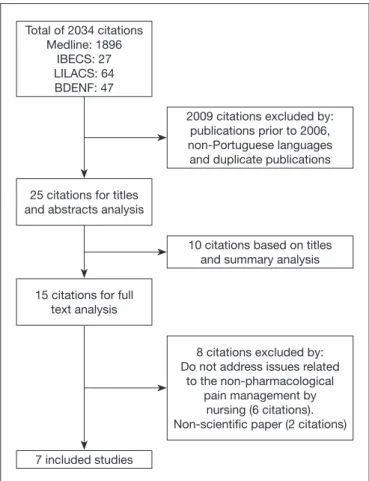
For the data extraction of the selected articles, we used an in-strument designed for this purpose, with title, authors, jour-nal and year of publication, type of research, place of research, objective, methods, main results and conclusion. he mate-rial was grouped and compared by content similarity. hree analysis categories were constructed: the nurse’s perception, the patient’s perception, and the nursing actions. he searches conducted in the electronic databases resulted in 2034 cita-tions, which included studies related to pain, not only in the nursing ield or addressing non-pharmacological treatment. Of the 2034 articles, 61 were published between 2006 and 2016 in the Portuguese language. Of those, 36 were duplicate texts, remaining 25 citations for titles and abstracts analysis. Of the 25 studies, 10 were excluded because they did not meet the eligibility criteria, remaining 15 articles for the full text analysis. Among them, seven met the eligibility criteria previously deined and were included in this study (Figure 1). he seven articles included were published between 2008 and 2015 and used a qualitative methodology, one of which is a literature review6. Participants included nurses as well as
can-cer patients. Such information, as well as each study purpose and location, are shown in table 1.
As previously described, based on the results of these studies, three categories were organized: the nurse’s perception, the patient’s perception, and the nursing actions. Table 2
sum-Figure 1. Study selection lowchart
Source: authors.
Total of 2034 citations Medline: 1896
IBECS: 27 LILACS: 64 BDENF: 47
25 citations for titles and abstracts analysis
2009 citations excluded by: publications prior to 2006, non-Portuguese languages and duplicate publications
15 citations for full text analysis
10 citations based on titles and summary analysis
7 included studies
8 citations excluded by: Do not address issues related
to the non-pharmacological pain management by
marizes the articles distribution identiied in the categories, followed by the description of the indings in each of them.
Table 2. Articles distribution identiied in the categories Category
order
Category name Included articles
Category 1 The nurse’s percep-tion
Stübe et al.7
Fernandes et al.10
Waterkemper e Reibnitz11
Nobre13
Category 2 The patient’s per-ception
Rennó e Campos8
Category 3 The nursing actions Stübe et al.7
Macedo, Romanek e Avelar9
Waterkemper e Reibnitz11
Leal et al.12
THE NURSE’S PERCEPTION
he pain experienced by the cancer patient goes beyond the physiological scope, extending to the psychological and social dimensions and is perceived by the nurses through verbal re-ports, facial expression and through the eyes7,11. Emotional
pain, also called soul pain, psychological or emotional or spiritual pain, is also often mentioned by nurses. his is an immeasurable aspect, which can be manifested through de-nial mechanisms regarding diagnosis and treatment. In this context, the perception of the nursing team regarding the cancer patient’s attitudes is of great importance, since it can
contribute to the planning of fast and adequate actions, tak-ing into account individuality, uniqueness, lifestyle, beliefs and cultural values7.
With regard to terminal cancer patient pain relief, nurses re-ported pain and sufering relief to improve the patient’s qual-ity of life. Palliative care promotes comprehensive, humanized and multidisciplinary care and aims to minimize the patient and family’s longings and provide therapeutic support. In this con-text, communication seems to be a highly relevant tool in pallia-tive care, because it promotes adequate assistance so that the pa-tient reaches his inal destination with dignity10. In addition, it is
important to emphasize that pain is understood as a stress agent not only for the patient but also for the team and the family7.
THE PACIENT’S PERCEPTION
For the cancer patient, the importance of communication seems to be a consensus in order to promote comfort, calm, alleviate symptoms, diminish distress and provide balance. In this sense, inadequate or noisy communication with the pa-tient can cause distress, fears, anxiety, among other negative feelings, and may cause interference in the assistance8.
THE NURSING ACTIONS
In order to minimize the cancer patient pain, the nurse must be able to perform the appropriate patient assessment in order to identify the pain causes and possible nursing behaviors. Stübe et al.7 identiied as the most common conducts the
administra-Table 1. Characteristics of the studies included
Authors Purposes Studies design Locations Participants
Stübe et al.7 Apprehending the nurses’ perception who works in
Oncology, referring to the patient’s pain and knowing the actions for their handling.
Descriptive, qualita-tive study.
Oncologic clinic, chemothe-rapeutic and radiothechemothe-rapeutic units of a general hospital in Rio Grande do Sul.
7 nurses
Rennó e Campos8
Analyzing the patients’ perception of an oncology ambulatory about professional-patient interpersonal communication.
Exploratory qualita-tive case study.
High complexity Oncology unit from south of Minas Ge-rais.
13 oncologic patients
Macedo, Romanek e Avelar9
Relecting on the pain management in the immediate postoperative period of cancer patients by the perio-perative nursing team.
Descriptive, qualita-tive study. Literature review.
NA NA
Fernandes et al.10
Knowing the nurse’s perception of the cancer patient under palliative care.
Exploratory qualita-tive study.
Hospital treating cancer pa-tients under palliative care in the city of João Pessoa, Pa-raíba.
9 nurses
Waterkemper e Reibnitz11
Revealing the nurses’ conceptions and contributions on the pain evaluation in cancer patients under pallia-tive care, through an education at work proposal ba-sed on the problematic education presuppositions of Paulo Freire.
Qualitative research of convergent-as-sistance type.
Palliative Care Unit of the On-cology Research Center, in Florianópolis, Santa Catarina.
6 nurses
Leal et al.12 Knowing and analyzing the evaluation and register
means performed by nurses in the pain context of cancer patients.
Qualitative research.
Nobre13 Identifying how nurses perceive chronic pain in cancer
patients and analyzing nursing care for these patients.
tion of analgesics, especially opioids, as well as care regarding dosage, indications, schedules, especially at the patient’s home and guidelines to the nursing team. In the same study, other conducts were also mentioned, such as heat application, decu-bitus changes and walking stimulus; besides care, individual-ized care, comfort measures and proximity to the patient7.
In addition, the importance of the work in a multidisciplinary team is emphasized, favoring patient’s integral assistance, as well as educational actions with this team and family integra-tion in the care of cancer patients7. A dialogical relationship
that aims to listen to the patient and his family is reinforced by the bond and trust between the professional and the pa-tient/family9,11.
Regarding the ways to evaluate pain, one study by Waterkem-per and Reibnitz11 did not identify any speciic instrument to
evaluate pain in cancer patients among the nurses interviewed; in addition, the items identiied in the nursing records were considered as low-comprehensive. herefore, pain evaluation occurs in an individualized and unsystematic way, subjectiv-ity being pointed out as the major obstacle11. Macedo,
Ro-manek and Avelar9 identiied, through a literature review, the
need to use speciic instruments for pain evaluation in order to guide the treatment. However, it does not provide descrip-tions of what instruments should be used. Regarding pain management in the postoperative period in cancer patients, it was found that sensitivity and perception of the nursing team are fundamental9.
he pain experienced by the patient with cancer extends be-yond the physiological pain to the psychological, social and spiritual spheres. he implementation of appropriate nurs-ing approches depends on the sensitivity and acumen for the correct pain assessment, which involves pharmacological and non-pharmacological actions.
In the context of pharmacological actions to relieve cancer pain, the nursing team should be able to manipulate drugs, especially opioids. Proper management of drugs and materials is extremely important and can directly inluence the patient’s clinical outcomes, reduce hospital stay and costs9,14.
However, adequate pain control involves multiple interven-tions in order to act on the various pain components. Non-pharmacological interventions include a range of educational, physical, emotional, behavioral, and spiritual measures. In general, they are inexpensive and simple to use measures that can be taught to patients and caregivers. However, it is the nursing assignment to choose the interventions for each pa-tient, based on an adequate evaluation15.
In the context of pain evaluation, the absence of standards by the nursing teams for the adequate assessment of patient pain was evidenced in this study. It is considered that these actions can be improved more speciically with the use of the Sistem-atização da Assistência de Enfermagem (SAE) (Systematization of Nursing Care)7. he nursing process is systematic, once
it consists of ive steps: investigation, diagnosis, planning, implementation, and evaluation16.
It is known that pain assessment is complex, as it is a subjec-tive symptom, inluenced not only by the
pathophysiologi-cal process but also by emotion and culture. In this context, international organizations such as the Joint Commission Accreditation of Healthcare Organizations (JCAHO), the American Pain Society (APS) and the World Health Orga-nization (WHO) propose assessment and treatment policies based on the need of a systematic implementation of pain assessment and recording routines in health institutions. APS suggests the incorporation of pain assessment in the routine of vital signs check, thus creating the expression “Pain: 5th
Vital Sign”, in an attempt to make health professionals aware of the importance of assessing this parameter16.
he role of educational actions together with the multidisci-plinary team is also highlighted, through the awareness of the importance to identify the causes that generate noise, exces-sive light, and parallel conversations, which may intensify the patient’s discomfort and pain in the hospital environment17.
he signiicant role of communication to manage the pain in cancer patients was also evidenced in this study. Communica-tion can be deined as a process of understanding and sharing messages that can interfere with the behavior of the people involved. It is a fundamental interpersonal competence in the context of nursing care, which will allow the adequate atten-dance of the patient’s needs8. From the patient’s perspective,
the balance in the health-disease process and the humaniza-tion in interpersonal relahumaniza-tionships were achieved when the communication was established8. Many times, pain is
inad-equately managed due to the diiculty of hearing the patient’s complaint11.
he patient-family-team triad needs to be built with con-idence and bond for the treatment success. In the face of the complexity and variability of the problems arising from cancer treatment, the clinical, social, psychological, spiritual and economic aspects associated with cancer should be con-sidered, as well as family members care7. he family
integra-tion into the cancer patient’s care is of extreme importance in several initiatives aimed at minimizing pain, including educational actions regarding home care. he nursing team should encourage the family to be present and be active in the process of caring and in the confrontation of the disease18.
CONCLUSION
REFERENCES
1. Cancer [Internet]. World Health Organization. [mentioned in 2016 Jul 29]. Available at: http://www.who.int/cancer/en/.
2. Ministério da Saúde. Instituto Nacional de Câncer José Alencar Gomes da Silva. Esti-mativa 2016. Incidência de câncer no Brasil. [mentioned in 2016 Jul 29]. Available at: http://www.inca.gov.br/estimativa/2016/estimativa-2016-v11.pdf.
3. Ministério da Saúde. Instituto Nacional de Câncer. Cuidados paliativos oncológicos. Controle da dor. [mentioned in 2016 Jul 29]. Available at: http://www.inca.gov.br/ publicacoes/manual_dor.pdf.
4. Salci MA, Marcon SS. Enfrentamento do câncer em família. Texto Contexto Enferm. 2011;20(n. spe):178-86.
5. Biasi PT, Zago VL, Paini JF, De Biasi LS. Manejo da dor no paciente oncológico. Pers-pectiva. 2011,35(129):157-66. Disponível em: http://www.uricer.edu.br/site/pdfs/ perspectiva/129_163.pdf.
6. Mendes KD, Silveira RC, Galvão CM. Integrative literature review: a research me-thod to incorporate evidence in health care and nursing. Texto Contexto Enferm. 2008;17(4):758-64.
7. Stübe M, Cruz CT, Benetti ER, Stumm EM. Percepções de enfermeiros e manejo da dor de pacientes oncológicos. REME - Rev Min Enferm. 2015;19(3):696-710. 8. Rennó CS, Campos CJ. Comunicação interpessoal: valorização pelo paciente
oncoló-gico em uma unidade de alta complexidade em oncologia. REME - Rev Min Enferm. 2014;18(1):106-15.
9. Macedo AC, Romanek FA, Avelar MC. Gerenciamento da dor no pós-operatório de pacientes com câncer pela enfermagem. Rev Dor. 2013;14(2):133-6.
10. Fernandes MA, Evangelista CB, Platel IC, Agra G, Lopes MS, Rodrigues FA. Per-cepção dos enfermeiros sobre o signiicado dos cuidados paliativos em pacientes com câncer terminal. Ciên Saude Colet. 2013;18(9):2589-96.
11. Waterkemper R, Reibnitz KS. Cuidados paliativos: a avaliação da dor na percepção de enfermeiras. Rev Gaúcha Enferm. 2010;31(1):84-91.
12. Leal TR, Melo MC, Salimena AM, Souza IE. Dor e dignidade: o cotidiano da enfer-meira na avaliação da dor oncológica. Nursing (Säo Paulo). 2008;10(117):75-80. 13. Nobre CF. O doente oncológico com dor crónica. Uma abordagem sobre o cuidar na
perspectiva de enfermagem. Servir. 2008;56(3-4):133-9.
14. Gomes ME, Evangelista PE, Mendes FF. Inluência da criação de um serviço de trata-mento da dor aguda nos custos e no consumo de drogas anestésicas na sala de recupe-ração pós-anestésica. Rev Bras Anestesiol. 2003;53(6):808-13.
15. Fontes KB, Jaques AE. O papel da enfermagem frente ao monitoramento da dor como quinto sinal vital. Ciênc Cuid Saude. 2007;6(Supl 2):481-7.
16. Pinto LS, Casa EC. Sistematização da assistência de enfermagem no tratamento da dor oncológica. Rev Enferm UNISA. 2005;6:64-9.
17. Duarte ST, Matos M, Tozo TC, Tozo LC, Tomiasi AA, Duarte PA. Praticando o silên-cio: intervenção educativa para a redução do ruído em Unidade de Terapia Intensiva. Rev Bras Enferm. 2012;65(2):285-90.