117
ABSTRACT
BACKGROUND AND OBJECTIVES: his study aimed at evaluating postoperative analgesia with ropivacaine instillation inside the peritoneal cavity in videolaparoscopic cholecystectomy. METHODS: his is a randomized clinical trial with 60 patients. he intervention group (RP, n = 30) received 0.5% ropivacaine instillation in right and left subdiaphragmatic regions and in gallbladder bed in equal volumes of 10 mL. he control group (SS, n = 30) received 0.9% saline solution instillation. Patients of both groups received multimodal analgesia. Scores of abdominal pain and referred pain in shoulder were evaluated at emergence and after 1, 2, 4, 12 and 24 hours, in addition to the need for rescue analgesia, opioid consumption and adverse events, con-sidering statistically signiicant p<0.05.
RESULTS: here has been no statistical diference between groups with regard to demographic data and anesthetic-surgical time. he intervention group had lower and statistically sig-niicant pain scores as compared to control group at emergence (p=0.001), 1 (p=0.019) and 2 (p=0.04) postoperative hours, in addition to lower opioid consumption at emergence (p=0.022) and in total in the irst 24 hours (p=0.001). Time for irst re-quest for rescue analgesia was longer in the intervention group (p=0.001).
CONCLUSION: Ropivacaine instillation inside the peritoneal cavity has decreased pain scores in the irst 2 hours and postop-erative opioid consumption.
Keywords: Analgesia, Laparoscopic cholecystectomy, Local an-esthetics, Postoperative pain, Ropivacaine.
Evaluation of postoperative analgesia with intraperitoneal ropivacaine
instillation in videolaparoscopic cholecystectomy
Avaliação da analgesia pós-operatória com instilação de ropivacaína intraperitoneal em
colecistectomia videolaparoscópica
Thiago Lucena César de Albuquerque1, Monique Ferro Bezerra1, Cíntia Cibelly Paz Zuzu Schots1, Ana Karla Arraes Von Sohsten2, Jane
Auxiliadora Amorim2, Otávio Damázio Filho2
1. Universidade de Pernambuco, Recife, PE, Brasil.
2. Hospital da Restauração, Hospital Getúlio Vargas, Hospital Universitário Oswaldo Cruz, Recife, PE, Brasil.
Submitted in February 15, 2016. Accepted for publication in May 27, 2016. Conlict of interests: none – Sponsoring sources: none.
Correspondence to:
Rua Arnóbio Marquês, 310 - Santo Amaro 50100-130 Recife, PE, Brasil. E-mail: [email protected]
© Sociedade Brasileira para o Estudo da Dor
RESUMO
JUSTIFICATIVA E OBJETIVOS: O objetivo deste estudo foi avaliar a analgesia pós-operatória com instilação de solução de ropivacaína dentro da cavidade peritoneal em colecistectomia videolaparoscópica.
MÉTODOS: Trata-se de um ensaio clinico randomizado com 60 pacientes. No grupo intervenção (RP, n=30) foi realizada instilação de solução de ropivacaína a 0,5% nas regiões subdi-afragmáticas direita e esquerda e no leito da vesícula biliar em iguais volumes de 10 mL. No grupo controle (SF, n =30) foi realizada instilação de solução isiológica a 0,9%. Os pacientes de ambos os grupos receberam analgesia multimodal. No período pós-operatório foram avaliados os escores de dor abdominal e referida no ombro ao despertar e após 1, 2, 4, 6, 12 e 24 horas, além da necessidade de analgesia de resgate, consumo de opioide e eventos adversos. Foi considerado estatisticamente signiicativo o valor de p<0,05.
RESULTADOS: Não houve diferença estatística entre os grupos em relação a dados demográicos e tempo anestésico-cirúrgico. O grupo intervenção apresentou escores de dor menores e estatisti-camente signiicativos comparado ao grupo controle ao despertar (p=0,001), com 1 hora (p=0,019) e 2 horas (p=0,04) de pós-operatório, bem como menor consumo de opioide ao despertar (p=0,022) e no total nas primeiras 24 horas (p=0,001). O tempo para necessidade da primeira analgesia de resgate foi maior no grupo intervenção (p=0,001).
CONCLUSÃO: A instilação de ropivacaína dentro da cavidade peritoneal reduziu os escores de dor nas primeiras duas horas e o consumo de opioide no pós-operatório.
Descritores: Analgesia, Anestésicos locais, Colecistectomia lapa-roscópica, Dor pós-operatória, Ropivacaína.
INTRODUCTION
Videolaparoscopic cholecystectomy (VC) is the golden stan-dard for gallbladder removal and the laparoscopic procedure more performed worldwide1. According to Datasus, 58,663 surgeries were performed in Brazil in 20142.
For being a minimally invasive procedure, laparoscopy in-duces the wrong perception that it is also minimally painful; however pain has been mentioned as major complaint and a reason for delayed postoperative recovery.
Post-VC pain has three components: incisional, visceral and
Rev Dor. São Paulo, 2016 apr-jun;17(2):117-20 ORIGINAL ARTICLE
118
Albuquerque TL, Bezerra MF, Schots CC, Sohsten AK, Amorim JA and Damázio Filho O Rev Dor. São Paulo, 2016 apr-jun;17(2):117-20
referred, the latter in general in the shoulder3. In addition to discomfort and postoperative physiological repercussions, such as respiratory restriction, tachycardia and hypertension, pain delays early ambulation and hospital discharge4,5. Multimodal analgesia has been used to minimize post-VC pain, including the perioperative use of non-steroid anti-in-lammatory drugs (NSAIDs), opioids, N-methyl D-aspartate receptor inhibitors (NMDA), anticonvulsants and local an-esthetic iniltration in the surgical wound. In this context, intraperitoneal ropivacaine instillation has been suggested by some authors as a feasible and easy resource to control post-videolaparoscopic cholecystectomy pain6-9.
his study aimed at evaluating postoperative analgesia with intraperitoneal ropivacaine instillation for VC.
METHODS
Participated in this analytical, randomized and double-blind study 60 patients of both genders, aged 18 years or above, physical status ASA I, II and III, according to the Ameri-can Society of Anesthesiology, submitted to elective VC un-der balanced general anesthesia in the Hospital Universitário Oswaldo Cruz (HUOC), Recife, PE, between July and Sep-tember 2015. Exclusion criteria were patients weighing less than 50kg, with acute pancreatitis, preoperative abdominal or shoulder pain, being treated for chronic pain, in antiepileptic therapy, alcohol or drug addicts, with liver or kidney dysfunc-tion, allergy or sensitivity to drugs used in this study, cogni-tive deiciency, pregnant or breastfeeding women and when the surgical technique had to be changed to conventional. During preanesthetic evaluation and after signing the Free and Informed Consent Term (FICT), patients were divided in two groups of 30 individuals: Group RP (intervention), who received intraperitoneal instillation of 30mL of 0.5% ropiva-caine, and Group SS (control) who received 30mL of 0.9% saline solution. his was a convenience sample, considering the approximate number of available patients in the service in one time unit. We decided to use a minimum of 30 patients per group to allow the use of parametric tests.
All patients had venous access assured with 18G or 20G cath-eter, were hydrated with crystalloid solution with volume de-ined at the anesthesiologist’s judgment, were monitored with cardioscope, pulse oximeter, noninvasive blood pressure and capnograph and were sedated with intravenous midazolam (0.04mg/kg). After pre-oxygenation, anesthesia was induced with intravenous remifentanil (0,3µg/kg/min), lidocaine (1.5mg/kg), propofol (2mg/kg) and rocuronium (0.6mg/kg). All patients received parecoxib (40mg) and cefazolin (2g) be-fore surgical incision. To prevent nausea and vomiting, pa-tients have received dexamethasone (4mg) after anesthetic induction and ondansetron (8mg) at surgery completion. Anesthesia was maintained with 1.5-2.5 CAM sevolurane and remifentanil (0.1 to 0.3µg/kg/min). Ventilation was con-trolled and PETCO2 levels were maintained between 30 and 40 mmHg. In the beginning of the surgical procedure, all patients received iniltration of 20mL of 0.25% ropivacaine
at trocars insertion site, being 6mL in the umbilical incision, 6mL in the epigastric incision and 4mL in both working por-tals. Surgery was performed by the technique consisting in the umbilical insertion of a 10mm trocar in the epigastric region and two 5mm trocars in the right abdomen. Pneumoperito-neum was assured with non-moistened and non-heated CO2, maintaining abdominal pressure between 12 and 14 mmHg. After gallbladder resection, however before its removal from the abdominal cavity, 0.5% ropivacaine (group RP) or 0.9% saline solution (group SS) were instilled inside the perito-neum in three volumes of 10mL each in a total of 30mL. First instillation was administered in right subdiaphragmatic region, the second in the gallbladder bed and the third in left subdiaphragmatic region. Patients remained in Trendenlem-burg position for 5 minutes after instillation.
All patients received dipirone (30mg/kg) immediately after gallbladder removal from its anatomic bed and at surgery completion residual neuromuscular block was reverted with intravenous neostigmine (0.04mg/kg) and atropine (0.02mg/ kg). Patients were referred to the post-anesthetic recovery unit (PACU) and afterward to the general surgery ward. Pain intensity was evaluated with the visual analog scale (VAS) at anesthetic emergence and at 1, 2, 4, 6, 12 and 24 postopera-tive hours, where zero meant no pain and 10 “the worst pain” felt by the patient.
Postoperative analgesia was maintained with dipirone (30mg/ kg) every 6h and ketoprofen (100mg) every 12 hours, both by venous route, in the irst 24 hours, due to easy availability of these drugs in the surgical ward. Patients referring abdominal or shoulder pain with VAS score equal to or higher than 4 in the PACU received intravenous morphine until reaching VAS equal to or less than 3, and in the ward, they received intra-venous tramadol. In this period, nausea, vomiting, dizziness, signs and symptoms of acute intoxication by local anesthetics were looked for.
Statistical analysis
Parametric and non-parametric tests were used for statistical anal-ysis according to necessary model assumptions. ANOVA analanal-ysis of parametric variance, non-parametric Kruskall-Wallis analysis of variance and Friedman non-parametric analysis of variance for corresponding data were used. Chi-square and Fisher Exact tests were used for independence tests between pairs of randomized variables, considering statistically signiicant p<0.05.
his study was approved by the institution’s Ethics Com-mittee (CAAE: 45524115.7.0000.5192) and complied with ethic criteria of the Declaration of Helsinki (2008).
RESULTS
119
Evaluation of postoperative analgesia with intraperitonealropivacaine instillation in videolaparoscopic cholecystectomy
Rev Dor. São Paulo, 2016 apr-jun;17(2):117-20
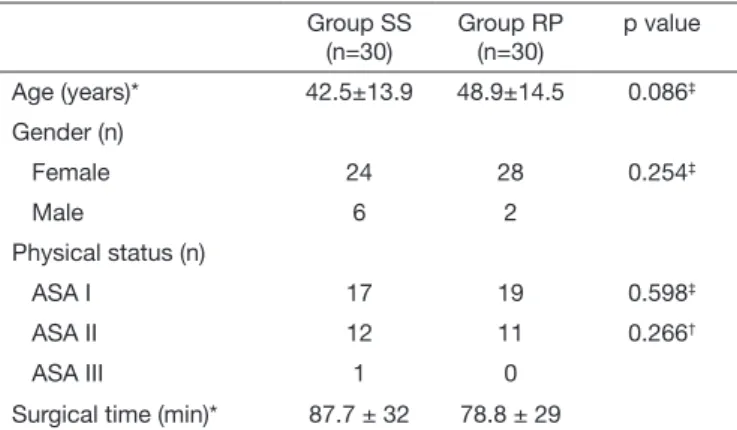
Table 1. Clinical characteristics of sample and surgical time Group SS
(n=30)
Group RP (n=30)
p value
Age (years)* 42.5±13.9 48.9±14.5 0.086‡
Gender (n)
Female 24 28 0.254‡
Male 6 2
Physical status (n)
ASA I 17 19 0.598‡
ASA II 12 11 0.266†
ASA III 1 0
Surgical time (min)* 87.7 ± 32 78.8 ± 29
ASA = American Society of Anesthesiology, Group SS = 0.9% saline solution; Group RP = ropivacaine. *Values in mean± standard deviation; n=number; † =
Student t test; ‡ = Fisher Exact test.
At abdominal pain evaluation, lower and statistically sig-niicant pain scores were found in the group RP at emer-gence (2.33 ± 2.97 vs. Group SS 4.83±3.10; p=0.001), in the irst hour (2.70±2.26 vs. Group SS 3.77±1.56; p=0.019) and in the second hour (1.47±1.61 vs. Group SS 2.53±1.33; p=0.004). here were no statistically signiicant diferences between groups in pain scores evaluated at 4, 6, 12 and 24 postoperative hours (Table 2).
Table 2. Abdominal pain scores in the irst 24 postoperative hours
Time (hour) Group SS
(n=30)
Group RP (n=30)
p value*
Emergence 4.83±3.10 2.33±2.97 0.001
1h 3.77±1.56 2.70±2.26 0.019
2h 2.53±1.33 1.47±1.61 0.004
4h 1.47±1.67 0.93±1.25 0.084
6h 0.97±1.77 0.47±0.86 0.085
12h 0.33±1.32 0.30±0.59 0.450
24h 0.40±1.30 0.23±0.62 0.265
Group SS = 0.9% saline solutions; Group RP = ropivacaine. Values in mean ±standard deviation; n = number of patients; * Student t test.
Six group RP patients have referred shoulder pain until the second postoperative hour, while 10 group SS patients had this complaint, among them seven in the 2nd hour, 2 in the 4th hour and just one in the 24th hour. Referred shoulder pain was more frequent in the irst two postoperative hours with-out signiicant diference between groups (Table 3). For the analysis of 4, 6, 12 and 24 hours after emergence, because values of one group were equal zero, it was not possible to test equality of variances or means.
Table 3. Referred shoulder pain scores in the irst two postoperative hours
Time (hour) Group SS
(n=30)
Group RP (n=30)
p value*
Emergence 0.30±1.64 0.30±1.64 0.500
1h 0.47±1.61 0.20±0.76 0.208
2h 0.37±1.25 0.17±0.53 0.211
Group SS = 0.9% saline solutions; Group RP = ropivacaine. Values in mean ±standard deviation; n = number of patients; * Student t test.
Opioid consumption was higher and statistically sig-niicant for the Group SS in two moments: at emergence (0.0540±0.03 vs group RP 0.0304±0.05; p=0.022) and when total consumption was calculated for 24 postoperative hours (0.0639±0.04 vs group RP 0.0301±0.04; p=0.001). here has been no opioid consumption after the 4th postoperative hour for both groups (Table 4).
Table 4. Opioid consumption (mg/kg) in the irst two postoperative hours
Time (hour) Groupo SS
(n=30)
Group RP (n=30)
p value
Emergence 0.0540±0.03 0.0304±0.05 0.022*
1h 0.0127±0.02 0.0077±0.01 0.171*
2h 0.0006 0.0000 - +
Consumo total 0.0639±0.04 0.0301±0.04 0.001*
Group SS = 0.9% saline solution; Group RP = ropivacaine. Values in mean±standard deviation; n = number of patients; * Student t test; + = because
one group had values equal zero, it was not possible to test equality of varian-ces or equality of means.
Rescue analgesia was less requested by the group RP (15 pa-tients vs SS 25 papa-tients; p=0.006). In addition, mean time in minutes for the irst rescue analgesia was shorter for group SS (7.32±9.34 min vs RP 23.67±20.66 min; p=0.0001).
With regard to postoperative adverse events, there has been no dependence association between having received ropiva-caine instillation and the incidence of nausea and vomiting (p=1.000) or of dizziness (p=0.670). here have been no cases with symptoms of tongue numbness, perioral paresthesia, vi-sual blur, tinnitus or seizure in both groups. Surgery time had no linear correlation with any other variable evaluated in this study. So, surgical time has not inluenced the evaluation of postoperative pain, opioid consumption or adverse events
DISCUSSION
120
Albuquerque TL, Bezerra MF, Schots CC, Sohsten AK, Amorim JA and Damázio Filho O Rev Dor. São Paulo, 2016 apr-jun;17(2):117-20
150mg of 0.75% ropivacaine.
hese authors have obtained morphine consumption decrease in all time intervals evaluated in the irst 24h, while in our study there has been decrease only at emergence and in total consumption. his diference might be due to several factors present in the study10, among them the use of epinephrine which might have delayed local anesthetic absorption; the diferent multimodal analgesia (fentanyl at anesthetic induc-tion and sodium diclofenac after intubainduc-tion) and opioid ad-ministration via PCA. PCA is the ideal method to adequately administer opioids and measure their consumption, as com-pared to the administration of analgesics according to de-mand by a trained team, as performed in our study.
Cha et al.6 have studied visceral, parietal and referred shoul-der pain in VC in 80 patients comparing surgical incision in-iltration and intraperitoneal ropivacaine nebulization to the administration of the same volume of saline solution. Visceral pain was signiicantly lower in the groups receiving intraperi-toneal ropivacaine, with additive efect to the surgical wound iniltration, and have decreased abdominal pain scores in up to 8 postoperative hours. Diferently from our study, preemp-tive ropivacaine nebulization at beginning of procedure may justify the longer postoperative pain scores reduction period. Pappas-Gogos et al.8 in a study with 120 patients, have com-pared ropivacaine (40mL at 0.2%) instillation and saline so-lution instillation at VC beginning and completion. Similarly to Cha et al.6, these authors have observed that local anes-thetic instillation in the beginning of cholecystectomy was able to decrease pain scores in up to 48 postoperative hours as compared to instillation at procedure completion. So, in our study, ropivacaine instillation at surgery completion may be seen as a factor responsible for pain scores reduction only until the 2nd postoperative hour.
Among pain components in this type o surgery, visceral pain is often mentioned as the most severe and the peak of highest discomfort is especially referred in the irst two hours after emergence6,7,11. Intraperitoneal ropivacaine instillation seems to be a promising method within the multimodal context of analgesia for VC procedures, however, new studies may clarify the ideal moment to instill this local anesthetic drug and time of postoperative analgesia obtained with this method. In our study, instillation at procedure completion has not interfered with surgical time and was a simple, fast and safe method to decrease pain in the period it is referred as more severe. Limitations of this study may be variation among pain scores
examiners, administration technique of postoperative rescue opioids and the lack of measurement of ropivacaine plasma concentration, although no adverse efects were reported.
CONCLUSION
Intraperitoneal ropivacaine instillation at elective videolapa-roscopy cholecystectomy completion as compared to saline solution instillation, has signiicantly decreased abdominal pain scores and morphine consumption in the irst postopera-tive hours, in addition to delaying the request for irst rescue analgesia, without evidences of adverse efects. So, it is a safe and easy practice to provide further comfort to patients in the period where the incidence of postoperative visceral pain is higher.
REFERENCES
1. Niknam F, Saxena A, Niles N, Budak UU, Mekisic A. Does irrigation of the subdia-phragmatic region with ropivacaine reduce the incidence of right shoulder tip pain af-ter laparoscopic cholecystectomy? A prospective randomized, double-blind, controlled study. Am Surg. 2014;80(1):E17-8.
2. Datasus – Portal da saúde. Informações de Saúde (TABNET). Notas técnicas [acesso em 01 mar 2015]. Disponível em: http://tabnet.datasus.gov.br/cgi/deftohtm.exe?sih/ cnv/qiuf.def
3. Ortiz J, Chang LC, Tolpin DA, Minard CG, Scott BG, Rivers JM. Randomized, controlled trial comparing the efects of anesthesia with propofol, isolurane, deslu-rane and sevoludeslu-rane on pain after laparoscopic cholecystectomy. Braz J Anesthesiol. 2014;64(3):145-51.
4. Apfelbaum JL, Chen C, Mehta SS, Gan TJ. Postoperative pain experience: results from a national survey suggest postoperative pain continues to be undermanaged. Anesth Analg. 2003;97(2):534.40.
5. Couceiro TC, Valença MM, Lima LC, de Menezes TC, Raposo MC. [Prevalence and inluence of gender, age, and type of surgery on postoperative pain]. Rev Bras Aneste-siol. 2009;59(3):314-20. English, Porgutuese.
6. Cha SM, Kang H, Baek CW, Jung YH, Koo GH, Kim BG, et al. Peritrocal and intra-peritoneal ropivacaine for laparoscopic cholecystectomy: a prospective, randomized, double-blind controlled trial. J Surg Res. 2012;175(2):251-8.
7. Shivhare P, Dugg P, Singh H, Mittal S, Kumar A, Munghate A. A prospective rando-mized trial to study the efect of intraperitoneal instillation of ropivacaine in posto-perative pain reduction in laparoscopic cholecystectomy. J Minim Invasive Surg Sci. 2014;3(4):1-4.
8. Pappas-Gogos G, Tsimogiannis KE, Zikos N, Nikas K, Manataki A, Tsimoyiannis EC. Preincisional and intraperitoneal ropivacaine plus normal saline infusion for pos-toperative pain relief after laparoscopic cholecystectomy: a randomized double-blind controlled trial. Surg Endosc. 2008;22(9):2036-45.
9. Ingelmo PM, Bucciero M, Somaini M, Sahillioglu E, Garbagnati A, Charton A, et al. Intraperitoneal nebulization of ropivacaine for pain control after laparoscopic cholecystectomy: a double-blind, randomized, placebo-controlled trial. Br J Anaesth. 2013;110(5):800-6.
10. Kucuk C, Kadiogullari N, Canoler O, Savli S. A placebo-controlled comparison of bupivacaine and ropivacaine instillation for preventing postoperative pain after lapa-roscopic cholecystectomy. Surg Today. 2007;37(5):396-400.