Genotyping of Kell, Duffy, Kidd and RHD in patients with
βββββ
Thalassemia
Li li an Casti lho1 Mari a Ri os2
Jordão Pellegri n o Jr1 Mari a H. M. Carvalho Fern an do L. Alberto1
Sara T.º Saad1
Fern an do F. Costa1
Determination of Rh, Kell, Duffy and Kidd phenotypes in addition to ABO is used to prevent the alloimmunization to red blood cells (RBCs) antigens and as part of the antibody identification process in patients with β Thalassemia. However, phenotyping in these patients can be time consuming and difficult to interpret. In these situations, it would be valuable to have an alternative to hemagglutin ation tests to determin e the patien t’s an tigen profile. We used PCR-RFLP to genotype such patients.
DNA was prepared from 50 pati en ts wi th β Thalassemi a who had been phenotyped by routine hemagglutination, and tested for Kell, Kidd, Duffy/ GATA mutation by PCR-RFLP. RHD/non-D was analysed by PCR product size associ ated to RHD gen e sequ en ce i n i n tr on 4 an d exon 10/3’UTR. The genotyping assays were performed without knowledge of phenotype results. For RHD/non-D, 47 were RhD+ and RHD+/RHCE+, and 3 were RhD- and RHD-/ RHCE+. For Kell, 48 kk were K2K2 and 2 Kk were K1K2. For Duffy, of 44 samples that had n or mal GATA box, 8 Fy(a+b-) wer e FYA/ FYA, 15 Fy(a+b+) were FYB/ FYB, and 19 Fy(a+b+) were FYA/ FYB; of the other 4 samples 3 were FYA/ FYB and heterozygous GATA mutation, and 1 Fy(a-b-) was FYB/ FYB, homozygous GATA mutati on . Two samples phen otyped as Fy(a+b-) that had normal GATA , presented the 265T/298A mutations and two samples phenotyped as Fy(a-b+) were genotyped was FYA/ FYB.. For Kidd , 15 Jk(a+b) were JKA/ JKA, 12 Jk(a-b+) were JKB/ JKB, and 20 Jk(a+b+) were JKA/ JKB. Three samples phenotyped as JK(a+b+) were genotyped as JKB/ JKB. Genotype is more accurate than phenotype for determination of blood groups in polytransfused patients with βThalassemia. Genotyping in these patients can be helpful to select antigen-negative RBCs for transfusion.
Rev.bras.hematol.hemoter., 2000, 22(2): 69-76
Key-wor ds: Gen otypi n g, blood groups, system
1 - Hemocen tro Un i camp, Campi n as, SP, Brasi l 2 - New York Blood Cen ter, New York, N.Y. USA
Cor r espondência par a: Li li an Casti lho casti lho@u n i camp.br
Prêmi o Oswaldo Mellon e de melhor trabalho em Hemoterapi a
do XXIV Con gresso Brasi lei ro de Hematologi a. Ri o de Jan ei ro, mai o de 2000 Arti go Especi al
I ntroduction
The incidence of alloimmunization to RBC antigens other than ABO and D is particularly high in patients with hemoglobinopathies (1), r each i n g u p t o 18% i n p at i en t s w i t h β Thalassemia who have received transfusion(s)
(2-4). Alloimmunization may cause a variety of problems and dilemmas in long-term medical and transfusional management (5, 6). Most of these problems pertain to finding appropriate anti gen-negati ve bl ood for transfusi on to alloimmunized patients.
RBC an t i gen s h av e b een d esi gn ed an d implemented to provide antigen-matched RBC transfusions to p atients w ith Thalassemia, particularly those who are alloimmunized and/ or in need of chronic transfusion support (7, 8). In addition to ABO, RBCs are phenotyped for Rh, Kell, Duffy and Kidd prior to transfusion aiming both to prevent the alloimmunization to these RBC antigens, and as part of the antibody identification process (9).
Cel l typ i ng i s essenti al i n sensi ti zed patients in order to confirm the identity of suspected alloantibodies, and to facilitate the identification of antibodies that may be formed in the future. How ever, accurate phenotyping o f RB Cs f r o m t r an sf u sed p at i en t s w i t h Thalassemia is a very complex process due to the presence of transfused donors RBCs in the circulation of the recipient. Thus, in these patients phenotyping can be time consuming and difficult to interpret. It is also complicated to type cells w hen a patient’s RBCs have a positive direct antiglobulin test and no direct agglutinating antibody is available.
T h e D N A t ech n o l o gy l ed t o t h e understanding of the molecular basis of many blood group antigens. The majority of blood group polymorphisms are associated w ith a single point mutation in the gene encoding the protein carrying the blood group antigen (10, 11). This know ledge allow s the use of D NA testi n g to p red i ct th e b l o o d gro u p antigen profile of na individual, and that can b e u sed to o v er co m e th e l i m i tati o n s o f hemagglutination assays.
Several assays for blood group genotyping of patients have recently been developed with the goal of reducing risk or helping in the assessment of the risk of hemolytic disease of the newborn. However, these assays have not been generally applied to the genotyping of patients who have received recent or chronic transfusion care.
The dilema of using DNA obtained from a transfused patients’ w hite blood cells (WBC) is that the donor leucocytes contained in the transfused units could, at least theoretically, interfere w ith genotyping results (12, 13, 14). How ever, studies performed w ith patient’s WBC samples have show n that these cells can
be used reliably to determine a blood group polymorphism by polymerase chain reaction (PCR)-based assays even w hen blood samples from recently transfused patients are used as th e so u rce o f D NA ( 15, 16) . Th i s stu d y demonstrates that p ost-transf usi on bl ood samples can be safely used for genotyping blood groups. That eliminates the need to use cu r r en t t i m e-co n su m i n g an d f r eq u en t l y ineffective methods that involve separation of patient reticulocytes from donor mature RBCs. We p erf o rm ed gen o typ e assays an d correlated the results with phenotype results for the blood groups RH D, KEL, JK and FY using WBCs from polytransfused patients w ith β Thalassemia. We also report here that WBCs can be reliably employed as source of DNA for PCR-based assays for blood group genotyping in transfused patients w ith β Thalassemia as compared against PCR results obtained from other cel l source of D NA. Moreover, w e observed that genotype is more accurate than phenotype for determination of blood groups in polytransfused patients with β Thalassemia.
Methods
Sa m pl es: Bl o o d sam p l es an d b u ccal epithelial cells were collected from each patient after informed consent was given to the health care physician or specialized nurse.
Blood sam ples: We studied samples from 50 patients w ith β Thalassemia w ho have been given transfusions of antigen-matched RBC uni ts at the H emocentro ( Uni camp , Campinas, Brazil). These patients had been transfused at least 3 occasions and their blood samples w ere phenotyped at the time of each transfusion. The most recent blood sample from each patient w as also genotyped for RHD, KEL, JK and FY. Blood samples from 100 normal bl ood donors w ho had been previously phenotyped for Rh, Kell, Kidd and Duffy w ere tested as controls.
Aggluti n ati on tests: At all times phenotypes w ere determined by hemagglutination in gel cards (Diamed AG, Morat, Switzerland) using two anti-sera sources.
DNA preparati on :DNA was extracted from b l o o d sam p l es u si n g ei th er th e p h en o l -chloroform method (17) or the Easy DNA Kit (Invitrogen, Carlsbad, CA) according to the manufacturer’s recommendations. DNA from buccal epithelial cells contained in the cotton wool swabs was extracted by the Easy DNA Kit according to manufacturer’s protocol #3.
Pol ym er a se ch a i n r ea ct i on ( PCR) ampli fi cati on : The primers and amplification conditions used, were the same as previously p ubl i shed ( 15, 16) . Bri efl y, the PCR w as
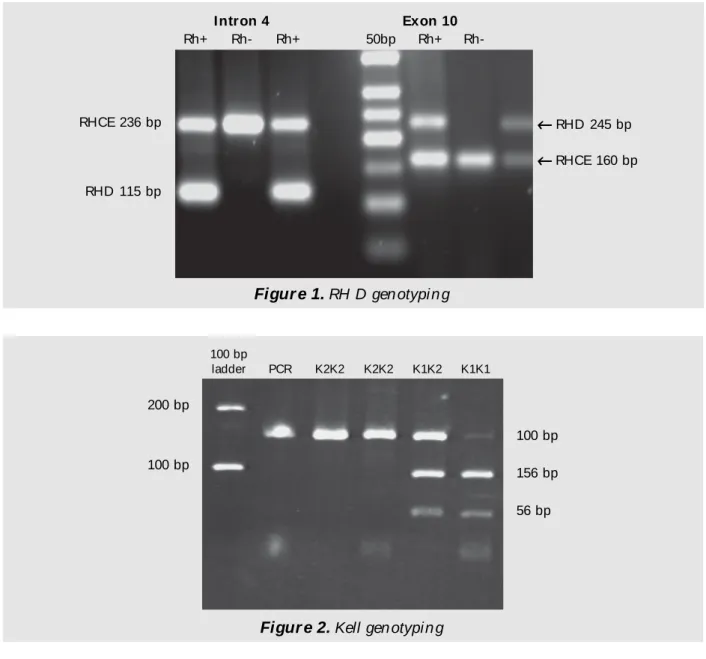
Figur e 1. RH D gen otypi n g
performed with 100-200 ng of DNA, 50 pmole of each primer, 2 nmole of each dNTP, 1.0 U Taq DNA polymerase and buffer in a final volume of 50 µl. The PCR analysis for the presence of RHD was performed in two genomic regions, intron 4 and exon 10, as previously described (16). For intron 4, three primers (RHI41, RHI42 and RHI43) yielded a product of 115 bp for RHD and 236 bp for RHCE. For exon 10, a common 5’primer (EX10F) was used for both RHD and RHCE. When paired w ith the RH D -sp eci f i c 3’-untransl ated regi on ( UT) primer (RHD3UT), it produced a product of 245 bp, and w hen paired w ith the RHCE-specific 3’-UTR (RHCE3UT), it yielded a product of 160 bp (Figure 1).
Figur e 2. Kell gen otypi n g
RHCE 236 bp
RHD 115 bp
← ← ← ←
← RHD 245 bp
← ← ← ←
← RHCE 160 bp
Intron 4 Exon 10
Rh+ Rh- Rh+ 50bp Rh+
Rh-200 bp
100 bp
100 bp
156 bp
56 bp 100 bp
RFLP a n a l y si s: T h e PCR am p l i f i ed products w ere digested overnight w ith the ap p r o p r i at e r est r i c t i o n en z y m es ( M B I Fermentas, Amherst, NY or New Engl and Biolab, Beverly, MA), in a final volume of 20ml using 10ml of amplified product and en z y m e i n 1x b u f f er ac c o r d i n g t o manufacturer’s instructions.
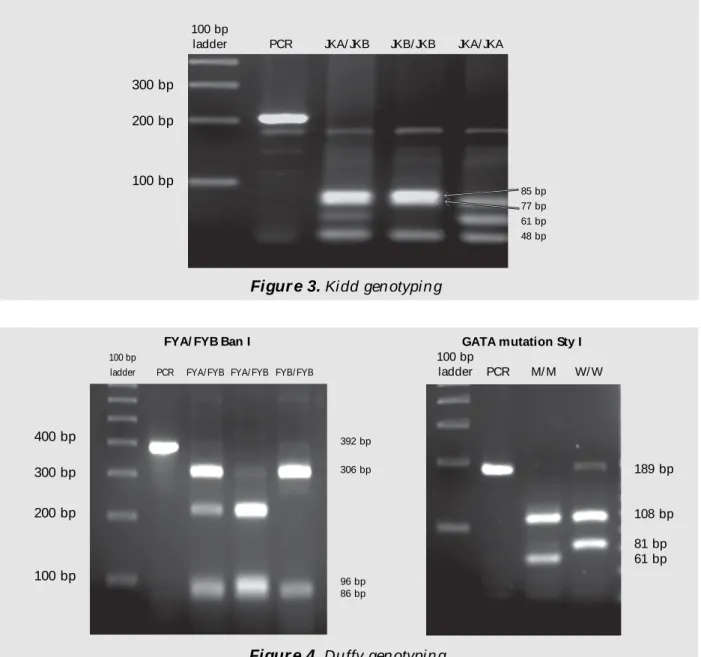
The enzymes Bsm I, Mn l I and Ban I w ere used to determine, respectively KEL 1/ KEL 2 (698C>T), JK A/JK B (838A>G) and FY A/ FY B (125 G>A) (18-22). (Figures 2, 3, 4) Furthermore, the Sty I enzyme w as used to di sti ngui sh betw een normal and mutated
GATA-1 binding motif (-33T>C), because the GATA-1 binding site is critical for expression of Fyb protein in the red cell membrane (23) (Figure 4).
Results
Co rrel ati o n b etw een p h en o typ e an d genotype of the 50 patients w ith β Thalassemia w ere as f o l l o w s f o r each b l o o d an ti gen studied: Phenotype and genotype results from the patients w ith β Thalassemia are show n in t ab l e 1. Am o n g t h e 50 p at i en t s, 5 h ad phenotype/ genotype discrepancies.
Figur e 3. Ki dd gen otypi n g
Figur e 4. Duffy gen otypi n g
300 bp
200 bp
100 bp
85 bp 77 bp 61 bp 48 bp 100 bp
ladder PCR JKA/ JKB JKB/ JKB JKA/ JKA
FYA/ FYB Ban I
100 bp
ladder PCR FYA/ FYB FYA/ FYB FYB/ FYB
GATA mutation Sty I
100 bp
ladder PCR M/ M W/ W
400 bp
300 bp
200 bp
100 bp
392 bp
306 bp
96 bp 86 bp
189 bp
108 bp
Presence or absence of RHD: 47 of the 50 samples were both phenotyped and genotyped as RhD-positive (had amplified product from both RHD and RHCE) and 3 samples phenotyped and genotyped as RhD-negative (had amplified product from RHCE but not from RHD).
Kel l : w e o b ser v ed 100% co r r el ati o n between phenotype and genotype results for Kell: 48 samples phenotyped as k / k w ere gen o t y p ed as K2 / K2 an d t w o sam p l es phenotyped as K/ k were genotyped as K1/K2. Kidd: phenotype/ genotype did not correlate in 3 of the 50 samples, as they phenotyped as Jk(a+b+) and genotyped as JKB/JKB.
Duffy: 44 samples had normal GATA box, 8 Fy(a+b–) were FYA/FYA, 15 Fy(a–b+) were FYB/FYB, 19 Fy(a+b+) were FYA/FYB and two samples phenotyped as Fy(a+b) were Fyx and, presented the 265T and 298Amutations. Of the other 4 samples 3 Fy(a+b–) were FYA/FYB and heterozygous GATA mutation, 1 Fy(a–b–) was FYB/FYB and homozygous GATA mutated. The two discrepant samples phenotyped as Fy(ab+) and were genotyped as FYA/FYB, homozygous GATA mutation.
Correlation between phenotype and genotype of the 100 volunteer blood donors control:
In this group was observed an agreement of 100% for all blood groups studied.
Gen otypes resu lts obtai n ed on DNA from buccal cells an d WBCs from the 6 pati en ts whom had phen otype/gen otype di screpan ci es:
In order to demonstrate the absence of microchimerism in discrepant results, all 5 patients with phenotype/ genotype discrepancies results had the DNA from buccal cells tested by PCR-RFLP, and the results were identical to those obtained when tests were performed using DNA from blood samples.
Discussion
Th i s st u d y sh o w s t h e r el ev an ce o f p er f o r m i n g m o l ecu l ar an al y si s f o r t h e determination of blood groups in transfusion dependent patients such as patients w ith β Thalassemia. By employing PCR-RFLP assays w e have show n that as expected there is m i st y p i n g w h en h em ag g l u t i n at i o n i s performed to determine the blood group of mu l ti tran sf u sed p ati en ts. As o b served i n genotype and phenotype results correlation o f t h e 50 t r an sf u sed p at i en t s st u d i ed , p h en o typ e/ gen o typ e d i screp an ci es w ere found in 5 cases.
We confirmed previous study observations th at D NA p rep ared f ro m b l o o d sam p l es collected from a patient w ho has recently
Table 1: Genotyping results for, RH, KEL, KIDD and DUFFY in samples from 50 patients with β Thalassemia
* Fyx 265T, 298A
Genotype Phenotype
Rh System RhD+
RhD-RHD+/RHCE+ 47 0
RHD–/ RHCE+ 0 3
Kell System K+k+ K-k+
K1K2 2 0
K2K2 0 48
Kidd System Jk(a+b–) Jk(a+b+) Jk(a–b+)
JKA/JKA 15 0 0
JKA/JKB 0 20 0
JKB/JKB 0 3 12
Duffy System Fy(a+b-) Fy(a+b+) Fy(a-b+) Fy(a-b-)
FYA/FYA (T/T) 8 0 0 0
FYA/FYB (T/T) 0 19 2 0
FYA/FYB (T/C) 3 0 0 0
FYB/FYB (T/T) 2* 0 15 0
received a transfusion, can be used for blood group genotyping w ithout risk of detecting microchimerism (16).
The relevance of performing molecular tests in transfusion dependent patients is w ell illustrated in the Duffy system. In the presence of nomal GATA-1 binding motif, phenotypes and genotypes agree, but w hen the GATA-1 moti f i s mutated a p seudo-di screp ancy i s observed. That is due to the absence of the FY gene exp ressi on i n the erythroi d l i neage. How ever, patients carrying such phenotypes do not need blood units of negative phenotype, once that this protein is expressed in other body tissues, thus recognized as self. This small change in blood type requirement increases the availability of special blood types for such patiens. GATA mutation in our population has only been associated w ith the FY B allele, how ever, it has been found associated w ith the FY A allele in population from Papua New Guinea (24). Our study also identified tw o true discrepant samples. Their hemagglutination results w ere Fy(a–b+) and their genotyp e results w ere FY A/ FY B. Accordingly, DNA samples obtained from buccal epithelial cells confirmed the genotype obtained from the blood sample. The phenotype performed in segmen ts o f th e tran sf u sed u n i ts f u rth er confirmed that the Fy(ab+) reflected the donor’s blood type. Three samples also presented discrepancy in the Kidd typing. All 3 samples phenotyped as Jk(a+b+) w ere genotyped as JKB/JKB. The absence of JK A w as confirmed by genotyping DNA samples obtained from buccal epithelial cells, and by performing phenotyping in segments of the transfused units, that the Jk(a+) reactivity w as due to donors RBCs in the patient’s circulation system. Th ese t h r ee p at i en t s co u l d h av e b een immunized for Jka antigen because they w ere receiving antigen-matched RBC units based in the phenotyping interpretation.
As previously discussed, the seriousness of the alloimmunization problem has led to r eco m m en d at i o n s t h at p at i en t s w i t h β Thalassemia be transfused with blood of donors w hose RBC antigens are more closely matched to those of the recipients (7-9). How ever, accurate antigen typing in transfused patients
is a major problem due to the presence of donor RBCs in patient’s circulation. Based on our results and under the test conditions w e established, w e recommend the addition of blood group genotyping for transfused patients to provide antigen-matched RBC transfusions. How ever, caution in performing these tests and interpreting results must be exercized, since t h e PCR- b ased t ech n i q u e i s p r o n e t o contamination, and the presence of a particular genotype may not be associated w ith that antigen expression on the RBC’s membrane. Such situations include, the detection of genes w ith a silencing mutation in a location other than that being analysed (e.g., point mutation in the GATA box), the detection of a gene that is silenced by na alteration of a gene encoding protein w ith a modifying effect (e.g. Rhmod, Rhnull), or the detection or nondetection of a hybrid gene (25-29).The possibility to have na alternative to hemmaglutination tests to determine the patient’s antigen profile should be considered for patients w ith β Thalassemia w ho need repeated transfusion therapy.
Genotipagem dos sistemas Kell, Duffy, Kidd e RHD em pacientes com β β β β β Talassemia
Li li an Casti lho, Mari a Ri os, Jordão Pellegri n o Jr, Maria H. M. Carvalho, Fern an do L. Alberto, Sara T.O. Saad, Fern an do F. Costa
Sumár io
A determinação dos fenótipos Rh, Kell, Duffy e Kidd, associada ao ABO é utilizada para prevenir a aloi mu n i zação a an tígen os er i tr oci tár i os e participam também no processo de identificação de anticorpos nos pacientes com β talassemia. Tod avi a, a fen oti pagem d esses paci en tes é tr abalhosa e de di fíci l i n ter pr etação. Nesta si tuação, deve ser avali ada uma altern ati va ao teste de hemaglu ti n ação par a deter mi n ar o padrão an ti gên i co dos paci en tes.
Os testes de gen oti pagem foram reali zados sem o con heci men to dos r esu ltados dos fen óti pos. Para os RHD/n ão-D, 47 foram RhD+ e RHD+/ RHCE+, e 3 foram RhD- e RHD-/RHCE+. Para o Kell, 48 kk foram K2K2 e 2 Kk foram K1K2. Para o Duffy, das 44 amostras que haviam sido normais, GATA box, 8 Fy(a+b-) foram FYA/FYA, 15 Fy(a+b-) foram FYB/FYB e 19 Fy(a+b+) foram FYA/FYB; das outras 4 amostras, 3 foram FYA/ FYB e heterozigoto GATA mutação, e 1 Fy(a-b-) era FYB/FYB, homozigoto GATA mutação. Duas amostras fen oti padas como Fy(a+b-), que eram normais GATA, apresentavam as mutações 265T/298A e 2 amostras fen oti padas como Fy(a-b+) havi am si do gen oti padas como FYA/FYB. Para o Kidd, 15 Jk(a+b-) foram JKA/JKA, 12 Jk(a-b+) foram JKB/JKB, e 20 Jk(a+Jk(a-b+) foram JKA/ JKB. Três amostras fen oti padas como JK(a+b+) havi am si do gen oti padas como JKB/JKB. A gen ot i pa gem é m a i s a cu r a d a qu e a fen oti pagem par a deter m i n ação de gr u pos sa n gü í n eos em pa ci en tes por ta d or es d e β talassemi a poli tr an sfu n di dos. A gen oti pagem n esses pa ci en tes pod e ser i m por ta n te pa r a seleci on ar hemáci as an ti gen i camen te n egati vas para tran sfusão de glóbulos vermelhos.
Rev.bras.hematol.hemoter., 2000, 22(2): 69-76
P a la vr a s-ch a ve: Gen ot i pa gem , gr u pos san guín i os, si stema
References
1. Blumberg N, Peck K, Ross K, Avila E. Immun e respon se to chron i c red blood cell tran sfusi on. Vox Sang. 1983. 44:212-7. 2. Economidou J, Constantoulakis M, Augoustaki
O, adinolfi M. Frequen cy of an tibodies to var i ou s an ti gen i c deter m i n an ts i n polytr an sfu sed pati en ts wi th homozygou s thalassemia in Greece. Vox Sang. 1971. 20:252. 3. Sirchia G, Zanella A, Parravicini A, Morelati F, Reb u l l a P, Maser a G. Red cel l alloan ti bodi es i n pati en ts wi th thalassemi a major . Resu lts of n a Itali an cooper ati ve stu dy. Transfusion. 1985. 25:110.
4. Spanos T, Karageorga M, Ladis V, Peristeri J, H atzi l i am i A, k attam i s C. Red cel l alloan ti bodi es i n pati en ts wi th thalassemi a.
Vox Sang. 1990. 58:50.
5. Greenw alt TJ, Zelenski KR. Tr an sfu si on su ppor t f or h em ogl obi n opa th i es. Cl i n . Haematol. 1984. 13:151-65.
6. Charache S. Problems in transfusion therapy (editorial). N. Engl. J. Med. 1990. 322: 1666-8. 7. Perkins HA. The safety of the blood supply: making decisions in transfusion medicine. In: Nance SJ, ed. Blood safety: cu r r en t ch a l l en ges. Beth esda: Am er i can Association of Blood Banks. 1992. 125-150. 8. Co l es SM , K l ei n H G , H o l l an d PV . Alloi mmu n i zati on i n two mu lti tr an sfu sed pati en t popu lati on s. Tr ansfusion. 1981. 21: 462-6.
9. Michail-Merianou V, Pamphili-Panouspoulou L, Piperi-Lowes L, Pelegrinis E, Karaklis A. Alloi mmu n i zati on to r ed cell an ti gen s i n thalassemi a: compar ati ve stu dy of u su al versus better-match transfusion programmes.
Vox sang. 1987. 52: 95.
10. Rei d ME, Yazdanbak hsh K. Mol ecu l ar i n si ghts i n to blood groups an d i mpli cati on s for blood tran sfusi on s. Current Opinion in Hematology. 1998. 5: 93-102.
11. Avent ND. Hu m an er ythr ocyte an ti gen expressi on : i ts molecular bases. Br. J. Biom. Sci. 1997. 54: 16-37.
12. Lee TH, Donegan E, Slichter S, Bush MP. Tr an si en t i n cr ease i n ci r cu lati n g don or leu cocytes after allogen ei c tr an sfu si on s i n Immu n ocompeten t r eci pi en ts compati ble wi th don or cell pr oli fer ati on. Blood. 1995. 85: 1207-14.
13. Adams PT, Davenport RD, Rcardon DA, Roth MS. Detecti on of ci rcu lati n g don or whi te blood cells i n pati en ts r ecei vi n g mu lti ple trasnfusions. Blood. 1992. 80: 551-5. 14. Lee T-H, Paglieroni T, Ohro H, Holland PV,
Bush MP. Longterm multi-lineage chimerism of don or leu cocytes i n tran sfu sed trau ma pati en ts. Blood. 1996 (abstr.). 88 (S): 265a. 15. Rios M, Cash K, Strupp A, Uehlinger J, Reid ME. DNA fr om u r i n e sedi men t or bu ccal cells can be u sed for blood grou p molecu lar gen otypi n g. I mmunehematology. 1999. 15: 61-65.
Transfusion. 2000. 40: 1-6.
17. Davies L, Dibner MD, Battey JF. Basic Methods i n Molecu lar Bi ology. Elsevier Science Publishing Co. Inc., 1986. New York. 18. Lee S, Wu X, Reid ME, Zelinski T, Redman
C. Molecular basis of the Kell (K1) phenotype.
Blood. 1995. 85: 912-6.
19. Olivès B, Merriman M, Bailly P, Bain S, Barnett A, Todd J, Cartron J-P, Merriman T. The molecular basi s of the Ki dd blood group polymor phi sm an d i ts lack of associ ati on wi th type 1 di abetes su scepti bi li ty. Hum. Mol. Genet. 1997. 6: 1017-20.
20. Chaudhuri A, Polyakova J, Zbrezezna V, Williams K, Gulati S, Pogo AO. Cloning of glycopr otei n D cDNA, whi ch en codes the major subunit of the Duffy blood group system and the receptor for the Plasmodium vivax malaria parasite. Proc. Natl. Acad. Sci. USA 90: 1993. 10793-97.
21. Iw amoto S, Omi T, Kajii E, Ikemoto S. Gen omi c or gan i zati on of the glycophor i n D gen e: D u f f y b l ood gr ou p Fya/ Fyb al l oan ti gen system i s associ ated wi th a polym or phi sm at the 44-am i n o r esi du e.
Blood. 1995. 85: 622-26.
22. Tournamille C, Collin Y, Cartron J-P, Le Van Kim C. Di sr u pti on of a GATA m oti f i n th e D u f f y gen e pr om otor a bol i sh es er y t h r oi d gen e ex pr essi on i n D u f f y -n ega t i ve i -n d i vi d u a l s. Natur e Gen et. 1995. 10: 224-28.
23. Rios M, Reid ME, Naime D, Chaudhuri A, Pogo AO, Bianco C. Importance of GATA box analysis in genotyping for the Duffy blood group system. Transfusion. 1997 (abstr.). 37(S):101S.
24. Zimmerman PA, Woolley I, Masinde GL, Miller SM, McNamara DT, Hazlett F, Mgone Alpers MP, Genton B, Boatin BA, Kazura JW . Em er gen ce of FY*A( n u l l ) i n a Plasmodium vivax-endemic region of Papua New Guinea.Proc Natl Acad Sci. USA. 1999 Nov 23; 96(24): 13973-7.
25. Olsson ML, Hansson C, Akesson IE, Avent ND, Daniels GL. Detecti on of the common alleles at the Du ffy blood gr ou p locu s by allele-speci fi c pr i mer PCR. Tr ansfusion. 1997 (abstr.). 37(S): 102S.
26. Cartron J-P, Bailly P, Le Van Kim C. In si ghts into the structure and function of membrane polypepti des carryi n g blood group an ti gen s.
Vox Sang. 1998. 74 (Supl 2): 29-64. 27. Huang CH. Molecular i n si ghts i n to the Rh
pr otei n fami ly an d associ ated an ti gen s.
Curr Opin Hematol. 1997. 4: 94-103. 28. Huang CH, Blumenfeld OO. MNSs blood
groups an d major glycophori n s: molecular basi s for alleli c vari ati on. In: cartron J-P, Pouger P, eds> Molecu lar basi s of major human blood group an ti gen s. New York:
Plenum Press. 1995. 153-83.