Ane Elisa Paim
I,II, Eliane Regina Pereira do Nascimento
I, Kátia Cilene Godinho Bertoncello
III, Karla
Gomes Sifroni
II, Nadia Chiodelli Salum
I, Keyla Cristiane do Nascimento
IVI Universidade Federal de Santa Catarina, Master’s Degree in Nursing Care Management. Florianópolis, Santa Catarina, Brazil. II Universidade Federal de Santa Catarina, Polydoro Ernani University Hospital of São Thiago, Surgical Center.
Florianópolis, Santa Catarina, Brazil.
III Universidade Federal de Santa Catarina, Postgratuate Program in Nursing. Florianópolis, Santa Catarina, Brazil. IV Universidade Federal de Santa Catarina, Department of Nursing. Florianópolis, Santa Catarina, Brazil.
How to cite this article:
Paim AE, Nascimento ERP, Bertoncello KCG, Sifroni KG, Salum NC, Nascimento KC. Validation of an instrument regarding nursing intervention in patients in vasoactive therapy. Rev Bras Enferm [Internet]. 2017;70(3):453-60. DOI: http://dx.doi.org/10.1590/0034-7167-2016-0254
Submission: 06-24-2016 Approval: 09-01-2016
ABSTRACT
Objective: to validate the content of a Standard Operational Procedure, regarding nursing interventions in emergency patients treated with vasoactive drugs. Method: methodological study, carried out from December 2015 to January 2016. Content validity was determined by 16 experts (13 nurses, 2 pharmacists and one biomedical scientist), who judged it through a four-point Likert scale. The items were evaluated in terms of: feasibility, objectivity, simplicity, clearness, pertinence and accuracy. The Content Validity Index was applied, accepting the value ≥ 0.90. Results: two rounds of evaluation were required to achieve the minimum index. The items were reviewed regarding writing, dilution, indication and replacement interval. The instrument was validated with 33 items and with total Content Validity Index of 0.99. Conclusion: the instrument was considered appropriate, fractionally and globally, for nursing care for the patient treated with vasoactive drugs in emergency, in a safe and reliable way.
Descriptors: Nursing Care; Validation Studies; Vasodilators; Emergency Medical Services; Method.
RESUMO
Objetivo: validar o conteúdo do Procedimento Operacional Padrão, para intervenção de enfermagem ao paciente em uso de fármacos vasoativos na emergência. Método: estudo metodológico, realizado de dezembro de 2015 a janeiro de 2016. A validação de conteúdo deu-se por 16 juízes, sendo 13 enfermeiros, dois farmacêuticos e um biomédico, que o julgaram por meio da escala tipo Likert de
quatro pontos. Os itens foram avaliados em: exequibilidade, objetividade, simplicidade, clareza, pertinência e precisão. Aplicou-se o Índice de Validade de Conteúdo, aceitando-se o valor ≥ 0,90. Resultados: foram necessárias duas rodadas de validação para atingir o índice. Os itens foram alterados: na redação, diluição, indicação, intervalo de troca. O instrumento foi validado com 33 itens e com Índice de Validade de Conteúdo total de 0,99. Conclusão: considerou-se adequado, separadamente, e de maneira global, para que o enfermeiro possa cuidar do paciente em uso de fármacos vasoativos na emergência, de forma segura e confi ável.
Descritores: Cuidados de Enfermagem; Estudos de Validação; Vasodilatadores; Serviços Médicos de Emergência; Método.
RESUMEN
Objetivo: validar el contenido del Procedimiento Operacional Estándar para la intervención de la enfermería en el paciente que usa fármacos vasoactivos en la emergencia. Método: estudio metodológico, realizado entre diciembre de 2015 y enero de 2016. La validación del contenido fue determinada mediante la escala tipo Likert de cuatro puntos por 16 jueces, de los cuales 13 eran enfermeros, dos farmacéuticos y uno biomédico. Los apartados se clasifi caron en: ejecutabilidad, objetividad, simplicidad, claridad, pertinencia y precisión. Se aplicó el Índice de Validez de Contenido con la aceptación del valor ≥ 0,90.
Resultados: se necesitaron dos rondas de validación para alcanzar el índice. Los apartados se alteraron en la redacción, la
Validation of an instrument regarding nursing
intervention in patients in vasoactive therapy
Validação de instrumento para intervenção de enfermagem ao paciente em terapia vasoativa
INTRODUCTION
Considerable advances in drug-related care have been achieved in recent decades. However, despite these advances, humans con-tinue to make mistakes(1). These human errors directly interfere
with patient safety, defined by the World Health Organization (WHO) as the reduction of the risk of unnecessary harm associ-ated with health care to an acceptable minimum(2). Hospitalized
patients and those who use multiple medications are more vulner-able to the risk of harm, especially if the drugs are vasoactive(3).
Vasoactive drugs are widely used, especially in patients in emergency and intensive care units. They are indicated as pharmacological support for critically ill patients and their ac-tion is based on short and medium-term optimizaac-tion of cardi-ac output and vascular tone, severely compromised by critical clinical conditions. They are important to reverse severe con-ditions, improving patients’ prognosis in critical situations(4).
Nevertheless, these drugs present high risk for adverse ef-fects if administered in a wrong way or dosage. Infusion of in-travenous vasoactive drugs presents a high potential for errors in administration, and these errors can often be fatal or cause irreversible damage to patients(2,5).
Currently, patient safety is a topic that has received special at-tention, aiming to ensure maximum quality of care and minimiz-ing the risk of harm. In this regard, an alternative for improvminimiz-ing patient care is the standardization of procedures and actions(1,4).
For this reason, among the strategies of the National Patient Safety Program, they highlight that the design and support for the implementation of patient safety protocols, guides and manuals and the promotion of a safety culture with emphasis on learning and on organizational improvement, professional engagement and prevention of accidents(3,6).
It was observed that, in emergency practice, nurses and staff presented difficulties handling an specific class of medi-cation, the vasoactive drugs, which are frequently used for treatment of the most severe patients and, for this reason, it should require meticulous attention.
Considering that no specific safety protocol for handling this class of drugs was found in literature, this research aimed to con-tribute to the development of a Standard Operating Procedure (SOP) regarding nursing care for the patient treated with vaso-active drugs in a public emergency service. The development phase was build based on the five most used vasoactive drugs: dobutamine hydrochloride, dopamine hydrochloride, nitroglyc-erin, sodium nitroprusside and norepinephrine hemitartrate.
The SOP describes every critical and sequential step that should be followed by the operator to guarantee the expected result. It is also related to the used techniques, a Greek word meaning the manner we do something with the guidance of a
true rule. In nursing, the SOPs appear in manuals, aiming to clarify doubts and guide actions execution, and they must be in accordance with the institution’s guidelines and standards, being updated whenever necessary, and being consistent with scientific principles that must be followed by all (physicians, nurses and nursing assistants) in a standardized way(4,7).
However, in order to ensure that the instrument developed is reliable, the following research question was elaborated: does the SOP designed to guide nursing interventions for patients un-dergoing vasoactive pharmacotherapy have content validity, in order to become a safe instrument for caring for adult patients in the emergency room of a public university hospital?
The use of these SOPs qualifies health professionals for the management of vasoactive therapy, minimizes the risks using these drugs and also helps training nurses and staff for the use of these drugs in the emergency practice. The objective of this research was to validate the content of a SOP for nursing interventions in emergency patients using vasoactive drugs, according to our expert opinions.
METHOD
Ethical aspects
The research project was approved by the Research Ethics Committee of the Federal University of Santa Catarina (UFSC) and registered in the National Information System on Ethics in Research involving Human Subjects (SISNEP).
Design, study site and period
Methodological study, with a quantitative approach, car-ried out from December 2015 to January 2016, focusing on content validity of a SOP referring to nursing interventions in patients undergoing vasoactive therapy, in the emergency of a public university hospital in southern Brazil.
Content validity refers to experts evaluation on the items of the instrument, verifying the representativeness and extension of each item in the validation of the phenomenon studied, as well as the dimension of each item within what is being investigated(5,8).
The study was developed in two phases. The first phase was the interview given by 25 nurses in practice, who provid-ed knowlprovid-edge to build the instrument. The 25 semi-structurprovid-ed interviews took place between May 7th and 28th, 2015. They
were scheduled and held in private locations, with an autho-rized audio recording through a Consent form, and had an average duration of 40 minutes.
The interviews initiated with the question: what kind of nursing care is necessary in the composition of an SOP regard-ing the provided for an emergency patient usregard-ing vasoactive drugs: dobutamine hydrochloride, dopamine hydrochloride,
Kátia Cilene Godinho Bertoncello E-mail: [email protected] CORRESPONDING AUTHOR
dilución, la indicación y el intervalo de cambio. El instrumento se validó con 33 tópicos y con Índice de Validez del Contenido total de 0,99. Conclusión: los resultados se consideran adecuados separadamente, y de manera global, para que el enfermero cuide del paciente usuario de fármacos vasoactivos de forma segura y confiable en la emergencia.
nitroglycerin, sodium nitroprusside and norepinephrine hemi-tartrate? The participants received the transcriptions via e-mail, in order to check, add or withdraw information.
In order to finish the first phase of the development of the instrument, scientific evidence for the 63 cares, which emerged during the interviews, was sought in the databases: Latin American and Caribbean Center on Health Sciences In-formation (LILACS), International Health Sciences Literature (MEDLINE), Brazilian Nursing Database (BDENF) and Scien-tific Electronic Library Online (SciELO). The following key words, in Portuguese, were used: cuidado de enfermagem; cloridrato de dobutamina, cloridrato de dopamina, nitroglic-erina, nitroprussiato de sódio e hemitartarato de norepinefri-na1. The inclusion criteria was that the full articles were
avail-able online free of charge, in Portuguese or in English, from January 2006 to December 2015.
All 63 items of the SOP contained scientific evidence in its construction, and each intervention was associated to an evi-dence level (I, II and III), according to the classification system called hierarchy of evidences(6,9).
The instrument developed was composed of 63 items select-ed by the 25 nurses, for the reason that, according to them, they were the most used in the emergency of the hospital where the research was being conducted. The items were divided in five parts, according to the five vasoactive drugs. Each part of the SOP contained intervention items for the drugs: dobutamine hydro-chloride, dopamine hydrohydro-chloride, nitroglycerin, sodium nitro-prusside and norepinephrine hemitartrate. It should be noted that the instrument, in its initial part, included five items to identify the experts, regarding: professional education; area; professional category; time in practice and time of professional education.
Population or sample; inclusion and exclusion criteria
During the second phase, the identification and selection of the target population to participate as experts occurred. The sam-ple was intentional and not probabilistic. 48 professionals were invited, using as inclusion criteria, professional experience in the area and degree of academic qualification, and as exclusion crite-ria having only undergraduate education and less than two years of professional experience. Thirteen nurses, two pharmacists and one biomedical scientist agreed to take part in the study, totaling sixteen experts, who were not part of the first phase of SOP de-velopment. No referential was adopted for choosing the experts.
Study protocol
After agreeing to participate in the research, the 16 experts received the instrument via e-mail to measure content validity, followed by a letter explaining the objectives of the research and the consent form. A thirty-day term for the first round of evaluation and a twenty-day term for the second were settled for the return of the analysis of the SOP.
The SOP was evaluated by individual items, and in a global way, considering six requirements: feasibility (measure is applicable),
objectivity (allows for on-time responses), simplicity (expresses a single idea), clearness (clear, simple and indubitable demonstra-tion), pertinence (does not imply discrepant attribute from what was defined) and accuracy (each assessment item is different from the others and allows regularity in the execution)(7,10). At the end of
each assessment item, the participants justified their responses and provided suggestions (open space) for the instrument.
For the analysis of the SOP items, the participants followed the Likert scale, with four levels: 1 (not relevant or not repre-sentative), 2 (item needs major revision to be reprerepre-sentative), 3 (item requires a small revision to be representative), and 4 (relevant or representative item)(8,11).
Results analysis and statistics
The Content Validity Index (CVI), which assesses agreement among the experts concerning the representativeness of the items in relation to the study object, was the index used. The index was calculated dividing the number of experts who evaluated the item as 3 (item requires a small revision to be representative) or 4 (rel-evant or representative item) by the total number of experts (evalu-ation by item), resulting in the proportion of experts who judged the item as valid. To calculate the general CVI of the instrument, the sum of all the CVIs was divided by the number of items(7,10).
The CVI result can range from 0 to 1, representing respec-tively 0% and 100% of agreement among the experts. The index considered acceptable for item evaluation and overall instrument evaluation was ≥0.90 (90% agreement among experts)(6,9).
Data were organized in an electronic data sheet and ex-ported to the statistical software Microsoft Excel (2010). After coding and tabulation, data were analyzed using descriptive statistics. The instrument was reformulated according to the experts’ suggestions on round 1 and 2.
RESULTS
Among the 16 experts, 13 were nurses, six were in hospital emergency, five were in the Intensive Care Unit (ICU) and two were professors in the nursing departments of different federal universities. The pharmacists worked in a pharmacy in a uni-versity hospital. The biomedical scientist was a professor at the Department of Pharmacology of a federal university.
Regarding time of professional education of the nurses, it ranged from 4 to 31 years old, with a mean of 12.9 years. These professional’s time in nursing practice also ranged from 4 to 31 years, with a mean of 12.8 years. The nurses acting in the ICU had time of practice in the area ranging from 4 to 12 years, with a mean of 6.9 years. The nurses acting in Emergency had time of practice in the area ranging from 2 to 10 years, with a mean of 4.6 years. One of the nurses working with teaching had 10 years of experience in emergency service and 5 years of experience in the ICU, and the other had 12 years of experience in a pediatric ICU.
Regarding professional education, 4 of the 13 nurse ex-perts had a PhD, 5 had a master’s degree, 3 had a specialist
title and one was studying a master’s degree. The two phar-macists participating had time of professional education ranging from 8 to 14 years. Their time of practice in pharma-cy ranged from 8 to 13 years, and time of practice in hospital pharmacy ranged from 3 to 8 years. One of the pharmacist had a master’s degree and the other had a specialist title. The biomedical scientist had a 30 years of professional educa-tion, 22 years of practice in teaching, and a PhD.
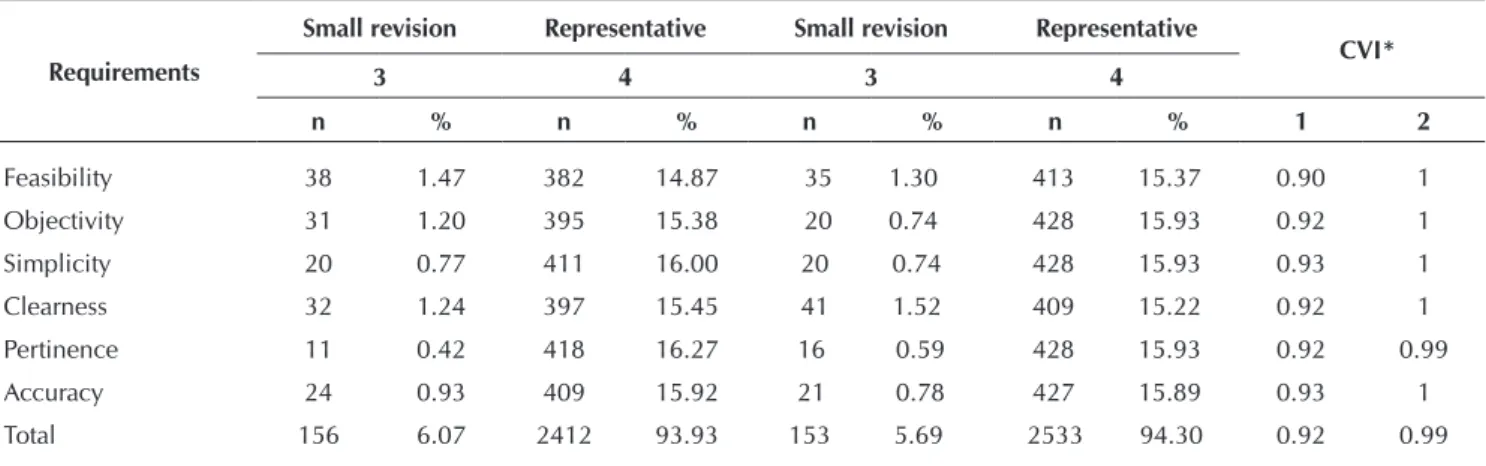
The CVI for each item in the first round ranged from a mini-mum of 0.73 to a maximini-mum of 1, which did not validate all items of the instrument. The general CVI of the first phase, calculated through the mean of all items, was 0.93, already validating the SOP as a whole.
In the first round of evaluations, the degree of agreement among the experts did not reach the minimum on some clear-ness-related items of the instrument. They brought as sugges-tions to correct these items, mainly, changes in writing of in-terventions. They also suggested: stipulating a time interval for interventions that recommended that an action should be performed “frequently”. They recommended: inserting drugs` full name, which were described as “dobutamine, dopamine, nitroglycerin, sodium nitroprusside and norepinephrine”. They also suggested adding information on the drug solution dilution and its indication and the interval for exchanging the solution.
All items which did not reach a CVI ≥0.90 in the first round of evaluation and those which had any suggestion or comment were reviewed. All suggestions with acceptable sci-entific evidence were included in the instrument.
In the first round of evaluation, the experts’ suggestion to add an initial block of identical nursing interventions for the five vasoactive drugs (6 items) in the SOP was adopted. This justifies the reduction of the instrument composed of 63 items to 33 items specific to each vasoactive drug.
After the reformulations, the instrument was sent to a second round of evaluation. The CVI was calculated again. For almost all items, CVI was 1, which represents a 100% agreement among the experts. Only the item “Protect from light: use a bottle of solution wrapped with a protective cover for photosensitive solutions and proper equipment for
photosensitive parenteral solutions” regarding the drug nor-epinephrine hemitartate had a different value of 0.98, since in the attribute of “pertinence” 15 experts assessed the item as 4 (relevant or representative) and one judge assessed it as 2 (needs major revision to be representative). In the overall SOP evaluation, the instrument CVI was 0.99, representing a 99% degree of agreement among the evaluators.
After the second round of evaluation, only minor changes in writing were done, according to experts’ suggestions. The CVI was considered satisfactory, thus, completing the content validity stage. There was no need for a new round of evalua-tion since all indexes reached the minimum acceptable.
The final version of the SOP validated for nursing intervention in emergency patients treated with vasoactive drugs is as follows.
Chart 1 – Presentation of the suggestion of the experts (N =
16) to create a common block of the nursing in-terventions for the five vasoactive drugs studied, Florianópolis, Santa Catarina, Brazil, 2016
Nursing interventions common to all five drugs
1. Infuse only through infusion pump and execute a strict flow control.
2. Assess the permeability of the intravenous catheter every three hours, checking the flow of the infused solution. 3. Perform continuous monitoring of heart rate and oxygen
saturation.
4. Check blood pressure every 15 minutes during dose ad-justment and every 30 minutes during maintenance dose. 5. Replace continuous solutions every 24 hours; prepare
so-lution immediately before completion and complete the replacement quickly.
6. Identify the solution with a label containing: patient name; name, concentration and quantity of the drug; solution di-lution, its concentration e quantity; route of administration; date e initial time; initial flow; and name of the profes-sional who prepared it.
Table 1 – Content validity by experts (N = 16) for the Standard Operational Procedure (SOP) of nursing intervention in emer-gency patients during vasoactive therapy, Florianópolis, Santa Catarina, Brazil, 2016
Requirements
Small revision Representative Small revision Representative
CVI*
3 4 3 4
n % n % n % n % 1 2
Feasibility 38 1.47 382 14.87 35 1.30 413 15.37 0.90 1 Objectivity 31 1.20 395 15.38 20 0.74 428 15.93 0.92 1 Simplicity 20 0.77 411 16.00 20 0.74 428 15.93 0.93 1 Clearness 32 1.24 397 15.45 41 1.52 409 15.22 0.92 1 Pertinence 11 0.42 418 16.27 16 0.59 428 15.93 0.92 0.99 Accuracy 24 0.93 409 15.92 21 0.78 427 15.89 0.93 1 Total 156 6.07 2412 93.93 153 5.69 2533 94.30 0.92 0.99
Chart 2 – Standard Operating Procedure (SOP) for nursing intervention in emergency patients treated with vasoactive drugs, Florianópolis, Santa Catarina, Brazil, 2016
Standard Operating Procedure (SOP) Title: nursing intervention in patients undergoing vasoactive pharmacotherapy
(dobutamine hydrochloride, dopamine hydrochloride, nitroglycerin, sodium nitroprusside and norepinephrine hemitartrate).
Nursing Interventions
Objective: contribute to the improvement of the quality of care to
severe patients undergoing vasoactive pharmacotherapy Agents: Nurse and nursing technician
Vasoactive drugs concept: a set of drugs that have expressive pharmacodynamic properties that result in great clinical usage, since they
can maintain the life of patients with serious pathologies.
Nursing interventions common to all five drugs
1. Infuse only through infusion pump and execute a strict flow control.
2. Assess the permeability of the intravenous catheter every three hours, checking the flow of the infused solution. 3. Perform continuous monitoring of heart rate and oxygen saturation.
4. Check blood pressure every 15 minutes during dose adjustment and every 30 minutes during maintenance dose.
5. Replace continuous solutions every 24 hours; prepare solution immediately before completion and complete the replacement quickly. 6. Identify the solution with a label containing: patient name; name, concentration and quantity of the drug; solution dilution, its
concentration e quantity; route of administration; date e initial time; initial flow; and name of the professional who prepared it.
Dobutamine hydrochloride
Indication: it is a powerful inotropic agent. It is used in chronic low debt heart failure and ventricular failure in the acute phase of
myocardial infarction.
Solution for dilution: 5% glucose or 10% glucose or 0.9% sodium chloride or lactated ringer.
1. Always infuse through intravenous catheter with a caliber diameter, preferably central
2. In an eventual use of a peripheral intravenous catheter, check for the presence of inflammatory signs in the catheter insertion. 3. Watch out for the appearance of arrhythmias such as supraventricular tachycardia, non-sustained ventricular tachycardia and atrial
fibrillation and assess hemodynamic repercussion (only nurse). 4. Perform strict control of infused and eliminated fluids.
5. Watch for signs of hypovolemia: hypotension, tachycardia, low output of urine, cold and moist skin.
6. Watch out for drug incompatibility: it should not be added to solutions containing sodium bicarbonate or other alkaline solutions (eg, aminophylline and phenytoin), hydrocortisone sodium succinate, cefazolin, cefamandol, cephalothin, penicillin, ethacrynic acid and heparin sodium. If any of these medications are prescribed, infuse through another lumen of the multi-lumen central catheter or another intravenous catheter.
Dopamine hydrochloride
Indication: it is a powerful inotropic agent. It is used in the treatment of various types of shock and severe hypotension after acute
myocardial infarction.
Solution for dilution: 5% glucose or 0.9% sodium chloride.
1. Always infuse through intravenous catheter with a caliber diameter, preferably central
2. In an eventual use of a peripheral intravenous catheter, check for the presence of inflammatory signs in the catheter insertion. 3. Constantly evaluate the peripheral perfusion.
4. Protect from light: use a bottle of solution wrapped with a protective cover for photosensitive solutions and proper equipment for photosensitive parenteral solutions.
5. Watch out for the appearance of arrhythmias such as ventricular tachycardia, ventricular and atrial fibrillation and assess hemodynamic repercussion (only nurse).
6. Perform strict control of infused and eliminated liquids.
7. Watch for signs of hypovolemia: hypotension, tachycardia, low output of urine, cold and moist skin.
8. Watch out for drug incompatibility: should not be added to solutions containing sodium bicarbonate or other alkaline solutions (eg, aminophylline and phenytoin), furosemide, thiopental sodium, insulin, ampicillin and amphotericin B; solution with gentamicin sulphate, cephalothin sodium and oxacillin sodium. If any of these medications are prescribed, infuse through another lumen of the multi-lumen central catheter or another intravenous catheter.
Nitroglycerin
Indication: it is a vasodilator agent, more intense at the venous level. Used in the treatment of acute heart failure, particularly if there is associated ischemic pain.
Solution for dilution: 5% glucose or 0.9% sodium chloride.
1. Infuse through intravenous catheter with a caliber diameter. 2. Be aware of headache and dizziness if the patient is conscious.
DISCUSSION
The presence of different professionals among the experts was adopted because each one could provide their contribution in a significant way and according to their professional category. There-fore, in order to provide not only nurses evaluation, but also evalu-ations from pharmacists and biomedical scientists, the knowledge of these professionals was brought, expanding and ensuring qual-ity in the judgment and new contributions to the instrument.
In a study with the objective of translating and adapting the Safety Attitudes Questionnaire/Operating Room Version to Portuguese the authors also used 12 multidisciplinary ex-perts and affirmed in their discussions that a content valida-tion performed by a multidisciplinary expert panel and the participation of a translator involved in the process, as recom-mended in the literature, enriches the discussion of the terms and broadens the nursing language(9,12).
The initial block of nursing interventions regarding the ones identic for the five vasoactive drugs, as suggested by the experts, was composed of six items. The process of medication in the emergency rooms has characteristics that can lead to errors, mainly related to drugs. Caution related to catecholamines must be seen as a necessity of the nursing professional who works with critically ill patients, since these drugs have many harm-ful effects, often more severe than its benefits(13). Therefore,
de-veloping an instrument to guide nursing care for the patient in vasoactive therapy is a way to minimize occurrence of errors.
It is important to emphasize that for patient safety, as well as for nurses, staff and undergraduate students safety, the vasoactive drugs must only be infused through infusion pumps. This tech-nological device, in use for more than 40 years, started being used by United Kingdom nurses in the 1970s. Nowadays, they
are common in emergency units and are essential to control drug flow and store the volume infused, which can be infused in the patient. These devices contain a range of alarms to alert nurses that infusions are nearing completion in time to plan its replace-ment, or that the route has intravenous flow problems, warning them to check the flow of the infused solution, thus, avoiding the risk of harm to hemodynamically unstable patients(10,14).
However, the use of infusion pumps is concerning for patient safety when not properly handled, being responsible for the ma-jority of errors associated with medication. Among the errors, we may cite inaccurate values, incorrect setting and forgetting to turn on the pump after interruption(15-16). Infusion pumps account
for 30-60% of all errors with intravenous medication, some of them requiring intervention for life maintenance(17).
Exchanging vasoactive solutions every 24 hours is a neces-sary intervention due to the instability of the drug after diluted and exposed to room temperature. According to an exploratory descriptive study, patients using vasoactive drugs may experi-ence vital functions instability in short periods of time, such as during the replacement of the solutions or the reprogramming of the infusion pump. Replacing the solution quickly is important so that the patient can remain stable and secure(11,18).
Identifying the solution with a label is an important strategy, as in order to fill it correctly, reading and transcribing the medi-cal prescription is necessary, with accurate and reliable informa-tion, avoiding any aggravating factors. A cross-sectional study was conducted observing a centralized and unique administra-tion of drugs, with a total of 373 observaadministra-tions of the process of administering and preparing medication carried out by 25 nurs-ing professionals. In the moment of preparation of the medica-tion, as a safety strategy, the professional transcribed the pre-scription to the label in 173 (90.6%) observations of injectable
Sodium nitroprusside
Indication: it is a veins and arteries fast action dilator. Used in hypertensive emergencies.
Solution for dilution: 5% glucose.
1. Infuse through intravenous catheter with a caliber diameter.
2. Watch for signs of hypovolemia: hypotension, tachycardia, low output of urine, cold and moist skin.
3. Protect from light: use a bottle of solution wrapped with a protective cover for photosensitive solutions and proper equipment for photosensitive parenteral solutions.
4. Watch out for drug incompatibility with atracurium besylate and levofloxacin. If any of these medications are prescribed, infuse through another lumen of the multi-lumen central catheter or another intravenous catheter.
Norepinephrine hemitartrate
Indication: it is a vasoconstrictor agent used in the emergency recovery of blood pressure in acute hypotensive states.
Solution for dilution: 5% glucose.
1. Always infuse through intravenous catheter with a caliber diameter, preferably central. 2. Often control peripheral perfusion, and skin color and temperature.
3. In an eventual use of a peripheral intravenous catheter, check for the presence of inflammatory signs in the catheter insertion. 4. Watch out for the appearance of arrhythmias such as ventricular tachycardia, ventricular and atrial fibrillation and assess
hemodynamic repercussion (only nurse).
5. Protect from light: use a bottle of solution wrapped with a protective cover for photosensitive solutions and proper equipment for photosensitive parenteral solutions.
6. Watch out for drug incompatibility with sodium bicarbonate or other alkaline solutions (aminophylline, phenytoin and etc.). If any of these medications are prescribed, infuse through another lumen of the multi-lumen central catheter or another intravenous catheter.
drug preparation and in 161 (88.5%) observations of oral medi-cation preparation. However, the full name of the patient ap-peared in only 10.7% of the labels, not following the five rules of medication administration and preparation(12,19).
For four of the five vasoactive drugs studied: dobutamine, do-pamine, sodium nitroprusside and norepinephrine, the validated SOP brings important knowledge regarding the pharmacological mechanism and the main risk factors for drug-drug interactions, and presents specific items, stating the incompatibilities these drugs have and including examples of what should be avoided.
However, if they are prescribed at the same time, the instru-ment recommends administration in different lumens, avoid-ing inactivity, optimizavoid-ing drug therapy, increasavoid-ing safety and effectiveness of the treatment and consequently preventing aggravations in the emergency patient.
The multicenter research has significantly contributed to nursing practice in critical care, presenting the profile of drug in-teractions in Brazil’s ICUs and representing an important tool for planning actions and improving patient safety in intensive care. In order to improve patient safety it is essential to implement strategies to help the health team identify potential interactions and implement preventive measures and monitor patients at risk of developing a harmful drug interaction before it is manifested. For these categories, the main preventive measures are related to strategies such as avoiding concomitant use, adjusting the dose of the drug and monitoring the patient for an early detection of adverse effects. Nurses’ actions can contribute to patient safety and prevent undesirable drug interactions(13,20).
The vasoactive drugs dopamine, sodium nitroprusside and norepinephrine are photosensitive, so they should be protected from light and heat through a protective layer and equipment. It should be noted that the packing of these drugs identifies them as photosensitive and carries strict instructions for their handling, which must always be followed so that the drug does not become inactive.
A study reveals that one of the causes for medication errors is a high staff turnover, which often happens in emergency units, and younger and less experienced professionals may forget or be unaware that they should protect photosensitive drugs. Howev-er, the authors suggest that these errors can be avoided if nurses assume their management role, implementing effective contin-ued education programs, with periodic training regarding vari-ous topics related to drug administration, proposing solutions and presenting updated content to the nursing team(14,21).
Taking responsibility for periodic and up-to-date training regarding medication administration is a mandatory attitude for nurses, in order to prevent harm and increase patient ben-efits. Transforming the practice of medication administration
is one of the strategies to involve the professionals in the topic of safety in drug therapy, always with the intention of mini-mizing factors that could cause error. In addition, as part of the nurses’ role, nurses should develop research and frequent consults to other health professionals and to literature(15,22-23).
As limitations of this study, we can point the construction of the SOP with only 25 emergency nurses of a hospital in the south of Brazil, the non-adoption of criteria for the selection of the 16 experts, thus restricting quantitative, geographical distribution and the effective evaluation of their knowledge about the subject. The clinical validation of this SOP has not been performed yet, and new studies are recommended for this to happen.
This instrument, built and validated, can be applied to sup-port the nursing team in daily practice, especially in emer-gency rooms, because it acts as a guide to the steps that pro-fessionals must follow to ensure minimum safety to patients using vasoactive drugs. It is believed that the SOP may be applied in the care of patients in the emergency who need the support of these vasoactive drugs.
CONCLUSION
This instrument required two rounds of evaluation by the 16 experts so that the minimum indexes for content validity were reached (≥0.90). After the second evaluation, the CVI was 1for almost all of the 31 items. Only the item “ “Protect from light: use a bottle of solution wrapped with a protective cover for pho-tosensitive solutions and proper equipment for phopho-tosensitive parenteral solutions” for the drug norepinephrine hemitartare, there was a different value of 0.98. In the overall evaluation the instrument achieved a 99.9% degree of agreement among the evaluators, meaning that this SOP is reliable.
This instrument should be continually improved and used in training and evaluation of future nurses. The validated instrument should be disseminated and used for the training and assessment of nurse students and by clinical practice fields, in continued edu-cation programs, with the purpose of promoting update and im-provement in the technical capacity of professional teams.
This study’s SOP provided guidance to nurses, nursing teams and nursing students to observe, document and evalu-ate emergency patients in vasoactive therapy, as well as to monitor the care provided. This validated instrument may be adapted to the characteristics of each service, in order to be more broadly applicable.
A safer medication process minimizing occurrence of er-rors can be promoted from instruments such as this SOP, en-abling continuous improvement in safety and quality of care provided to emergency patients in vasoactive therapy.
REFERENCES
1. Anderson P. Preventing high-alert medication errors in hospital patients. Am Nurse Today [Internet]. 2015 [cited 2016 Feb 28];10(5):18-23. Available from: https://americannursetoday.com/wp-content/uploads/2015/05/ant5-CE-421.pdf
3. Roque KE, Melo ECP. [Evaluation of adverse drug events in the hospital contexto]. Esc Anna Nery Rev Enferm [Internet]. 2012 [cited 2016 Aug 21];16(1):121-7. Available from: http://www.scielo.br/pdf/ean/v16n1/v16n1a16.pdf Portuguese.
4. Mitka M. Guideline stresses medical therapy for treating stable ischemic heart disease. JAMA [Internet]. 2013 [cited 2016 Feb 28];309(3):221-2. Available from: http://jama.jamanetwork.com/article.aspx?articleid=1557732
5. Coelho M, Costa ECA, Richter VC, Dessotte CAM, Ciol MA, Schmidt A, et al. Perceived health status and pharmacological adherence of patients who underwent percutaneous coronary intervention. Rev Gaúcha Enferm [Internet]. 2013 [cited 2016 Feb 28];34(3):86-94. Available from: http://dx.doi.org/10.1590/S1983-14472013000300011
6. Brasil. Ministério da Saúde. Portaria nº 529, de 1º de abril de 2013. Institui o Programa Nacional de Segurança do Paciente (PNSP). Diário Oficial da União [Internet]. Brasília (DF); 2 abr. 2013[cited 2016 Feb 28]. Seção I P. 43. Available from: http:// bvsms.saude.gov.br/bvs/saudelegis/gm/2013/prt0529_01_04_2013.html
7. Tibúrcio MP, Melo GSM, Balduíno LSC, Costa IKF, TYAF, Torres GV. Validation of an instrument for assessing the ability of blood pressure measurement. Rev Bras Enferm [Internet]. 2014 [cited 2016 May 15];67(4):581-7. Available from: http://www.scielo.br/ pdf/reben/v67n4/0034-7167-reben-67-04-0581.pdf
8. Guimarães PV, Haddad MCL, Martins EAP. Instrument validation for assessing critically ill patients on mechanical ventilation according to the ABCDE. Rev Eletr Enf [Internet]. 2015 [cited 2016 Feb 28];17(1):1-8. Available from: http://dx.doi.org/10.5216/ ree.v17i1.23178
9. Pasquali L. Psicometria: teoria dos testes na psicologia e na educação. 3° ed. Petrópolis (RJ): Vozes; 2009.
10. Vituri DW, Matsuda LM. Content validation of quality indicators for nursing care evaluation. Rev Esc Enferm USP [Internet]. 2009 [cited 2016 May 15];43(2):426-34. Available from: http://www.scielo.br/pdf/reeusp/v43n2/en_a24v43n2.pdf
11. Polit DF, Beck CT. Fundamentos de pesquisa em enfermagem: avaliação de evidências para a prática em enfermagem. 7° ed. Porto Alegre (RS): Artmed; 2011.
12. Lourenção DC, Tronchin DM. Patient safety in the surgical environment: translation and cross-cultural adaptation of validated instrument. Acta Paul Enferm [Internet]. 2016 [cited 2016 May 15];29(1):1-8. Available from: http://www.scielo.br/pdf/ape/v29n1/ en_1982-0194-ape-29-01-0001.pdf
13. Melo EM, Cavalcante HPO, Marques AM, Ferreira AMM, Abreu MAF, Lima VF, et al. Conhecimento do enfermeiro sobre as drogas vasoativas utilizadas em pacientes críticos. Rev Enferm UFPE [Internet]. 2016 [cited 2016 Aug 20];10(8):2948-55. Available from: http://www.revista.ufpe.br/revistaenfermagem/index.php/revista/article/view/9243/pdf_10800
14. Lee P. Infusion pump development and implications for nurses. Br J Nurs [Internet]. 2015 [cited 2016 May 15];24(19):S30-7. Available from: http://www.magonlinelibrary.com/doi/10.12968/bjon.2015.24.Sup19.S30
15. Ribeiro GSR, Silva RC, Ferreira MA, Silva GR. Slips, lapses and mistakes in the use of equipment by nurses in an intensive care unit. Rev Esc Enferm USP [Internet]. 2016 [cited 2016 Aug 21];50(3):419-26. Available from: http://www.scielo.br/pdf/reeusp/ v50n3/0080-6234-reeusp-50-03-0419.pdf
16. Duarte SCM, Bessa ATT, Büscher A, Andrade M, Stipp C. Caracterização de erros na assistência de enfermagem em terapia intensiva. Cogitare Enferm [Internet]. 2016 [cited 2016 Aug 21];21(5):1-8. Available from: http://revistas.ufpr.br/cogitare/article/ view/45502
17. Mattox E. Medical Devices and Patient Safety. Crit Care Nurse [Internet]. 2012 [cited 2016 Aug 21];32(4):60-8. Available from: http://ccn.aacnjournals.org/content/32/4/60.full.pdf+html
18. Inoue KC, Matsuda LM. Sizing the nursing staff in an Intensive Care Unit for adults. Acta Paul Enferm [Internet]. 2010 [cited 2016 May 15];23(3):379-84. Available from: http://www.scielo.br/pdf/ape/v23n3/en_v23n3a11.pdf
19. Souza S, Rocha PK, Cabral PF, Kusahara DM. Use of safety strategies to identify children for drug administration. Acta Paul Enferm [Internet]. 2014 [cited 2016 May 15];27(1):6-11. Available from: http://www.scielo.br/pdf/ape/v27n1/0103-2100-ape-27-01-00006.pdf 20. Carvalho REFL, Reis AMM, Faria LMP, Zago KSA, Cassiani SHB. Prevalence of drug interactions in intensive care units in Brazil.
Acta Paul Enferm [Internet]. 2013 [cited 2016 May 15];26(2):150-7. Available from: http://www.scielo.br/pdf/ape/v26n2/en_ v26n2a08.pdf
21. Camerini FG, Silva LD. Patient safety: analysing intravenous medication preparation in a sentinel network hospital in Brazil. Texto Contexto Enferm [Internet]. 2011 [cited 2016 May 15];20(1):41-9. Available from: http://www.index-f.com/ textocontexto/2011pdf/20-041.pdf
22. Mendonça LBA, Madeiro C, Lima A, Teixeira FE, Victor BI, Brito MEM, Cunha LGP. The use of catecholamines via continuous infusion in intensive care unit patients. Rev Enferm UFPE [Internet]. 2012 [cited 2016 Feb 28];6(1):26-31. Available from: http:// www.revista.ufpe.br/revistaenfermagem/index.php/revista/article/view/1915