Preference for Cute Infants Does Not Depend
on Their Ethnicity or Species: Evidence from
Hypothetical Adoption and Donation
Paradigms
Jessika Golle1,2,3, Fabian Probst1,2, Fred W. Mast1,2, Janek S. Lobmaier1,2*
1Department of Psychology, University of Bern, Bern, Switzerland,2Center for Cognition, Learning, and Memory, University of Bern, Bern, Switzerland,3Hector Research Institute of Education Sciences and Psychology, University of Tübingen, Tübingen, Germany
Abstract
Results of previous work suggest a preference of adult observers for cute compared to less cute infants. In Study 1 we investigated whether the preference for cute infants depends on the ethnicity and species of the infant. We simultaneously presented two faces (one cute and one less cute) and asked Caucasian participants to choose the infant to whom they would rather give a toy (Task 1) and which infant they would rather adopt (Task 2). The in-fants were Caucasian or African human babies or dog puppies. For all face categories and in both tasks we found a strong preference for cute infants. A possible reason for preferring cute infants may be that cute infants look healthier than less cute infants. To investigate whether cuteness is associated with the assessment of health we conducted Study 2. Faces of Caucasian and African infants and dog puppies were rated for cuteness and health. The findings revealed a significant relationship between health and cuteness evalu-ation across all stimuli. We suggest that one reason why cute infants are preferred might be because they are perceived as being healthier.
Introduction
Infants of many species are born helpless and depend on protection and care. According to Lo-renz [1], the Kindchenschema is an innate releasing mechanism for caretaking behavior and af-fective orientation toward infants. This schema is triggered by paedomorphic features such as a relatively large head compared to the size of the body, a relatively big cranium compared to the facial bones, large eyes that lie below the horizontal midline of the skull, a soft-elastic surface texture, and round protruding cheeks. Infants that conform to this“babyfacedness”are com-monly described as being cute [e.g.2,3]. These infants are not only perceived as looking cute, they are also rated as being likable, sociable, smart, competent, easy to care for, and good [4,5]. The association of cuteness with various positive attributes can be described by the
cute-is-OPEN ACCESS
Citation:Golle J, Probst F, Mast FW, Lobmaier JS
(2015) Preference for Cute Infants Does Not Depend on Their Ethnicity or Species: Evidence from Hypothetical Adoption and Donation Paradigms. PLoS ONE 10(4): e0121554. doi:10.1371/journal. pone.0121554
Received:February 22, 2014
Accepted:February 12, 2015
Published:April 6, 2015
Copyright:© 2015 Golle et al. This is an open
access article distributed under the terms of the
Creative Commons Attribution License, which permits unrestricted use, distribution, and reproduction in any medium, provided the original author and source are credited.
Funding:Jessika Golle was supported by a grant
from the ProDoc program of the Swiss National Science Foundation awarded to Fred W. Mast (PDFMP1_127238). Fabian Probst and Janek S. Lobmaier were supported by a grant from the Swiss National Science Foundation awarded to Janek S. Lobmaier (grant number PZ00P1_121622/1). The funders had no role in study design, data collection and analysis, decision to publish, or preparation of the manuscript.
Competing Interests:The authors have declared
good stereotype [5] derived from the beautiful-is-good stereotype [5,6]. The cute-is-good ste-reotype describes a general preference for cute infants: They are liked the best [7], motivation to care for them is higher [2], they experience more affectionate interactions with their mothers [8,9], get fewer punishments [10,11], and they probably get different treatments from nurses that positively affect infants’physical wellbeing [cf.12].
Lorenz originally described the features triggering the Kindchenschema in humans inde-pendent of species. As yet, empirical evidence of cross-species and cross-ethnicity effects of cuteness on observer preferences and behaviors is relatively scarce. Most of the existing studies investigated cuteness perception within one ethnicity [e.g.2,10,13–17] or did not consider ethnicity as a separate variable in their analyses [e.g.3,4,18,19,20].
Only a few studies focused on cross-ethnicity [21,22] and cross-species effects of facial cute-ness on observer preferences and behavior [23–27]. Empirical findings suggest that the same facial features are associated with cuteness across ethnicities. Chin et al. [21] found that infants with large eyes are perceived to be cuter than infants with small eyes, irrespective of the infants’
ethnicity. The attribution of positive traits on cute infants is also consistent across ethnicities [5,28]. Golle et al. [23] even found evidence that cuteness perception of different species in-volves at least some common coding mechanism. A further study found that babyish shape-re-lated features of a human infant alter the evaluation of cuteness of a cat [24]. Cuteness not only influences preference or the attribution of positive traits, it also alters behavior [25,26]. Both Nittono et al. [25] and Sherman et al. [26] found more careful behavior of human participants in an operation game after viewing pictures of baby animals compared to after viewing pictures of adult animals.
A possible explanation for these positve effects of cute infants across ethnicity and species on trait attributions and behavior is that cuteness implies reduced breeding costs because cute-ness might be associated with health and good genes [16,22,29–33]. Previous studies found that cues of Down’s syndrome, fetal alcohol syndrome [29,30], low body weight, and high body weight [33] alter facial cues and influence ratings of health and cuteness. Healthy infants need less care than infants that are sickly or seriously ill. To the best of our knowledge only few studies have investigated the relationship between perceived cuteness and health within and across faces of different ethnicities [16,22] and species [27]. These studies found a positive as-sociation between health and cuteness.
None of the above-mentioned studies compared cuteness preferences for faces of different ethnicities and species at the same time. Nor has any study analyzed the role of health percep-tion in cuteness evaluapercep-tions across infants of different ethnicities and species. In the current study we investigated whether male and female Caucasian observers of different ages generally prefer cute faces of African and Caucasian infants and dog puppies, and whether the percep-tion of cuteness is related to the perceppercep-tion of health status across infants of different ethnicities and species. In Study 1 we used a two alternative forced choice (2AFC) paradigm in which two faces were presented simultaneously (one cute and one less cute). We asked participants to choose the infant to whom they would rather give a toy (hypothetical donation task) and to choose the infant which they would rather adopt (hypothetical adoption paradigm: HAP [16,
30]). The stimuli consisted of either Caucasian or African infants, or dog puppies. By present-ing faces of different ethnicitiesandspecies we extend on previous studies [16,22,30] to fur-ther investigate whefur-ther Caucasian observers generally prefer cute over less cute infants of their own as well as of different ethnicity and species.
different ethnicity [22] and species [27], and we directly compared the association between cuteness and health for faces of all stimulus classes.
If cuteness is a universal concept that automatically triggers care-taking behavior, we expect that cute infants should be preferred over less cute infants regardless of ethnicity or species. Specifically, cute infants of all ethnicities and species should be more likely to receive a toy and more likely to be adopted. We further predict a negative association between perceived cute-ness and how often the infant might be ill, for Caucasian and African infants as well as for puppy faces.
Pre-Study: Cuteness Rating
In order to establish a set of cute and less cute infant faces for Study 1 we asked 24 Caucasian participants to rate the cuteness of African and Caucasian infant and dog puppy faces. Cute-ness ratings are a good indicator of perceived cuteCute-ness and observers highly agree on which faces they find cute [cf.15,23,34,35].
Methods
Participants. Twelve male and 12 female students of the University of Bern ranging in age between 20 and 29 years (M= 24,SD= 2.8) participated in this rating study. All perticipants re-ported to be of Caucasian descent. They gave verbal informed consent and they were told that they could abort the experiment at anytime without giving any reasons. The research and con-sent procedure was approved by the ethics committee of the Faculty of Human Sciences of the University of Bern and conformed with the“Ethical Principles of Psychologists and Code of Conduct”of the American Psychological Association [36].
Stimuli. Pictures of 100 Caucasian and 100 African infant and 100 dog puppy faces were collected from different sources (internet, personal collections) and showed natural, colored, non-manipulated infant faces with a neutral facial expression. Because many pictures were col-lected from the internet we do not have accurate age and sex information for all images. All sti-muli had a size of 400 x 400 pixels and appeared at a resolution of 124.75 PPI. Participants were seated 60 cm in front of a 12.1”computer screen with a resolution of 1280 x 800 pixel, subtending a visual angle of 7.8° x 7.9°.
Procedure. Pictures were presented in the center of the computer screen until the partici-pant responded. The task was to assess the cuteness of each infant face on a 7-point Likert-like rating scale (1 = not cute at all to 7 = very cute). Caucasian and African infant and dog puppy faces were presented block-wise per stimulus category. Block order was randomly assigned.
Results
The inter-rater reliability of these ratings was very high (Cronbach’s Alpha = 0.94, ICC = 0.93). Based on the rating scores of the pre-study, 40 stimuli (20 cute, 20 less cute) of each face cate-gory (African, Caucasian, dog puppies) were selected for Study 1. We paired a cute with a less cute face so that the two faces in each pair differed clearly in cuteness. This was done to en-hance the probability that the difference between cute and less cute infant faces could be easily perceived. The cuteness differences in the face pairs did not differ across categories. The mean cuteness scores of all stimuli as well as the mean cuteness score differences across all face pairs and their ranges (Min and Max) are shown inTable 1.
aggregating cuteness rating scores (commonly used in variance analysis procedures). The de-pendent variable was the cuteness rating score. To judge whether a multilevel model is war-ranted the random intercept model without any predictor was calculated and revealed significant between-subject variance, s2(β0t) 0.26,z= 3.07,SE= 0.09,p= .002. The intra class
correlation was 0.08, calculated with the following formula: s2(β0t) / s2(β0t) + s2(εit), s2(εit) = 3.25,z= 37.79,SE= 0.09,p<.001 [38,39]. Level 1 units are the stimuli and Level 2 units are
the participants. Thus, predictors on Level 1 are equivalent to within-subject factors (cf. vari-ance analysis strategies) and Level 2 predictors are equivalent to between-subject factors. In the pre- study only within-subject factors were relevant. In Model 1 the predictors were two Indi-cator variables (Dummy variables) reflecting whether the faces were Caucasian infants or not (I1it: African = 1, Caucasian = 0, dog puppies = 0;I2it: African = 0, Caucasian = 0, dog pup-pies = 1), cuteness category (Cit: 0 = less cute, 1 = cute), and interactions between cuteness cate-gory and the two Indicator variables (seeEquation 1).
Yit ¼b0tþb1tI1itþb2tI2itþb3tCitþb4tI1itCitþb5tI2itCitþit
8bjtðj¼0;. . .;3Þ:b
jt¼aj0þujt
ð1Þ
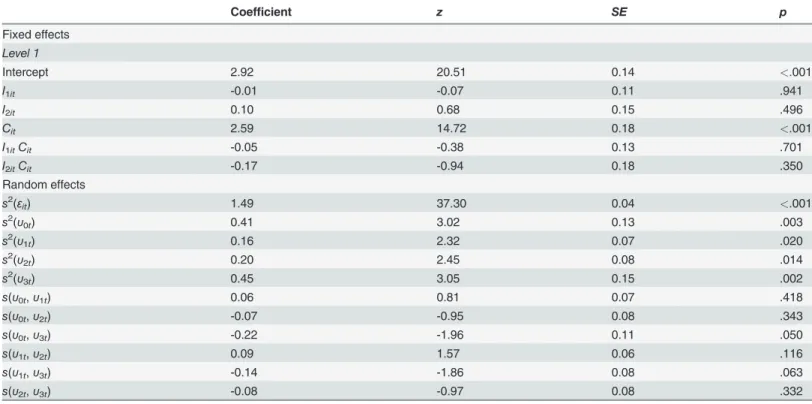
Because there were no significant interaction terms and no significant Indicator variables thefixed intercept indicates that the expected cuteness value for less cute infant faces was 2.92,
z= 20.51,p<.001. The significant cuteness category coefficient indicates that cute faces were assessed cuter than less cute faces (mean difference between cute and less cute faces = 2.59,
z= 14.72,p<.001). We found significant differences between cute and less cute infant and puppy faces and there was no differential effect for face category (African, Caucasian, dog pup-pies). SeeTable 2for more details.
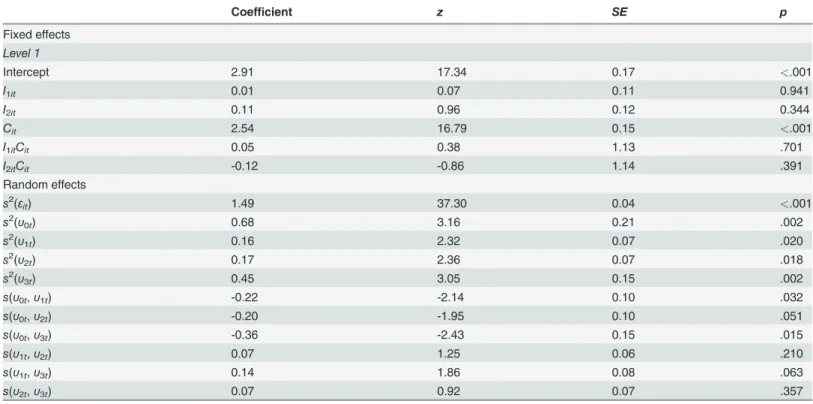
To test the difference in mean cuteness scores between African infant and dog puppy faces, we recoded the Dummy variables and calculated a second model. In Model 2 the predictors were two Indicator variables reflecting whether the faces were African infants or not (I1it: Afri-can = 0, Caucasian = 1, dog puppies = 0;I2it: African = 0, Caucasian = 0, dog puppies = 1), cute-ness category (Cit: 0 = less cute, 1 = cute), and interactions between cuteness category and the two Indicator variables (same Equation as for Model 1). As in Model 1, we found significant differences between cute and less cute infant and puppy faces and no effect for face category (African, Caucasian, dog puppies). SeeTable 3for more details. To further quantify the cute-ness of each infant face we applied a method described by Glocker et al. [2]. We measured head length (hl) face width (fw), forehead length (fol), face length (fal), eye width (ew), nose length (nl), nose width (nw), and mouth width (mw) to quantify the baby schema (seeTable 4). Inter-estingly, we found expected differences between cute and less cute faces only for
Caucasian infants.
Study 1: Preference for Cute Infants
The aim of Study 1 was to establish whether cute infants are preferred in a hypothetical adop-tion task and in a hypothetical donaadop-tion task. Using the face pairs determined in the pre-study Table 1. Mean cuteness scores of the stimuli used in Study 1.
cute less cute Mean cuteness difference Min Max
Caucasian infants 5.5 2.9 2.6 2.5 2.7
African infants 5.5 2.9 2.5 2.1 3.1
dog puppies 5.5 3.0 2.5 2.2 3.3
we expected that the faces that had received higher cuteness ratings would be chosen more often in the adoption and donation task. Based on Lorenz’[1] observations we expected that this should be true when choosing from African and Caucasian infants and dog puppies.
Methods
Participants. We investigated a sample of 180 volunteers (90 female, 90 male) ranging in age between 15 and 68 (M= 26,SD= 10.2). Data was collected as part of a guided research project in a methods class. Students were asked to test colleagues, friends, and family members (e.g., younger and older siblings, parents, aunts, and uncles). All perticipants reported to be of Caucasian descent. They gave verbal informed consent and for underage participants we addi-tionally obtained written informed consent from a parent or legal guardian. Students were in-structed to explain the procedure of the experiment and to ask the subjects whether they agree to participate. Participants were told that they could abort the experiment at anytime without giving any reasons. Participants were only tested if they had agreed to take part. Because the students tested family members and close friends we did not ask for written informed consent to ensure maximal anonymity. The research and consent procedure was approved by the ethics committee of the Faculty of Human Sciences of the University of Bern and conformed with the
“Ethical Principles of Psychologists and Code of Conduct”of the American Psychological As-sociation [36].
Table 2. Results of the pre-study (Model 1).
Coefficient z SE p
Fixed effects
Level 1
Intercept 2.92 20.51 0.14 <.001
I1it -0.01 -0.07 0.11 .941
I2it 0.10 0.68 0.15 .496
Cit 2.59 14.72 0.18 <.001
I1itCit -0.05 -0.38 0.13 .701
I2itCit -0.17 -0.94 0.18 .350
Random effects
s2(εit) 1.49 37.30 0.04 <.001
s2(υ0t) 0.41 3.02 0.13 .003
s2(υ
1t) 0.16 2.32 0.07 .020
s2(υ2t) 0.20 2.45 0.08 .014
s2(υ3t) 0.45 3.05 0.15 .002
s(υ0t,υ1t) 0.06 0.81 0.07 .418
s(υ0t,υ2t) -0.07 -0.95 0.08 .343
s(υ0t,υ3t) -0.22 -1.96 0.11 .050
s(υ1t,υ2t) 0.09 1.57 0.06 .116
s(υ1t,υ3t) -0.14 -1.86 0.08 .063
s(υ2t,υ3t) -0.08 -0.97 0.08 .332
I1itandI2itare Indicator or Dummy variables indicating the stimulus category (I1it: 1 = African infants, 0 = Caucasian infants;I2it: 1 = dog puppies,
0 = Caucasian infants).Citrepresents cuteness category (Cit: 0 = less cute, 1 = cute). Interactions areI1itCitandI2itCit. Robust estimators were used for statistical inference with respect tofixed effects and variance components to account for possible violations of model assumptions, such as normality of Level-2 residuals. Degrees of freedom were computed based on the Satterthwaite’s Approximation to account for the moderate sample size at Level 2 [46]. Therefore, the degrees of freedom were not necessarily integers and could vary across tests independent of the number of parameters.
Stimuli. We used 40 Caucasian and 40 African infant faces and 40 dog puppy faces taken from the pre-study. The 40 faces of each ethnicity/species were paired, each pair consisting of a cute and less cute face (see previous section andTable 1for more details). All stimuli had a size of 400 x 400 pixels and appeared at a resolution between 113.49 and 128.65 PPI. Students used their own laptops to collect the data and thus screen size and resolution varied.
Procedure. Participants saw either pairs of African or Caucasian infants or pairs of dog puppies, each pair consisting of one cute and one less cute face (seepre-study). Each subject underwent two experimental blocks in which they were asked to either choose the infant to whom they would rather give a toy (Task 1) or the infant which they would rather adopt (Task 2). The order of tasks was not counterbalanced, ensuring that every participant started with a less personal decision than an imagined adoption task. Each trial started with a fixation cross. After 1000 ms the fixation cross was replaced by a face pair consisting of one cute and one less cute face. The face pair remained visible until the participants chose the left or right infant face by pressing either the“F”or“J”key on a keyboard (“F”to choose the left face and“J”to choose the right face) with their respective index fingers. Each face was presented once per task. We balanced the side on which each face was presented across participants and used different face pairings in the first and the second block to ensure that each decision was a new one. We con-trolled for cuteness difference between face pairs. All participants saw the same pairs within one face type (Caucasian, African, or puppies) in order to keep possible pair effects constant across participants, but face pairs were counterbalanced across tasks.
Table 3. Results of the pre-study (Model 2).
Coefficient z SE p
Fixed effects
Level 1
Intercept 2.91 17.34 0.17 <.001
I1it 0.01 0.07 0.11 0.941
I2it 0.11 0.96 0.12 0.344
Cit 2.54 16.79 0.15 <.001
I1itCit 0.05 0.38 1.13 .701
I2itCit -0.12 -0.86 1.14 .391
Random effects
s2(εit) 1.49 37.30 0.04 <.001
s2(υ0t) 0.68 3.16 0.21 .002
s2(υ
1t) 0.16 2.32 0.07 .020
s2(υ2t) 0.17 2.36 0.07 .018
s2(υ3t) 0.45 3.05 0.15 .002
s(υ0t,υ1t) -0.22 -2.14 0.10 .032
s(υ0t,υ2t) -0.20 -1.95 0.10 .051
s(υ0t,υ3t) -0.36 -2.43 0.15 .015
s(υ1t,υ2t) 0.07 1.25 0.06 .210
s(υ1t,υ3t) 0.14 1.86 0.08 .063
s(υ2t,υ3t) 0.07 0.92 0.07 .357
I1itandI2itare Indicator or Dummy variables indicating the stimulus category (I1it: 1 = African infants, 0 = Caucasian infants;I2it: 1 = dog puppies,
0 = Caucasian infants).Crepresents cuteness category (Cit: 0 = less cute, 1 = cute). Robust estimators were used for statistical inference with respect to
fixed effects and variance components to account for possible violations of model assumptions, such as normality of Level-2 residuals. Degrees of freedom were computed based on the Satterthwaite’s Approximation to account for the moderate sample size at Level 2 [46]. Therefore, the degrees of freedom were not necessarily integers and could vary across tests independent of the number of parameters.
Results
We analyzed the data using binary multilevel regression analyses for repeated measurements [37], enabling us to analyze the response of each participant to each face pair instead of having to average the decisions and calculating proportion correct across face pairs. The dependent variable was the decision for either the cute or less cute face (1 = cute face was chosen, 0 = less cute face was chosen). For each task we analyzed the data in 3 steps. Firstly, the likelihood of the cute face being chosen was tested against 0.5 (chance level) across all conditions. Secondly, the probability of the cute face being chosen was tested against 0.5 for each face type (Cauca-sian, African, puppy). Finally, a complex model including face type, participants’sex and age were used to predict the probability of the cute face being chosen.
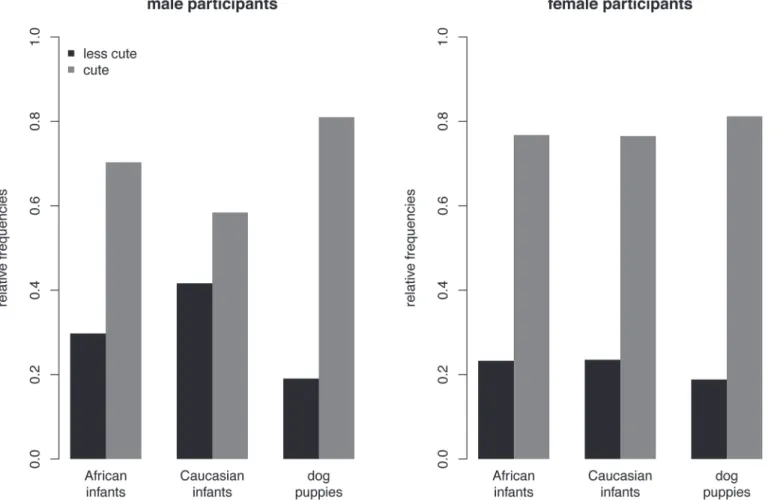
Toy-task. The descriptive statistics are shown inFig. 1. The random intercept model with-out predictors (null-model) revealed a significant proportion of inter-individual variance in de-cisions across all participants,s2(β0t) = 0.94,z= 6.97,SE= 0.13,p<.001. PseudoR2of inter-subject variance was. 22, calculated with the following formula:s2(β0t)/(s2(β0t)+π2/3) [38,39],
legitimating a multilevel regression analysis. The fixed intercept of the null-model was 1.18,
z= 14.09,SE= 0.08,p<.001, indicating that the probability of the cute face being chosen was
significantly larger compared to the probability of the less cute face being chosen across all con-ditions and participants (i.e., the probability of the cute face being chosen is larger than 0.5).
To test whether the probability of the cute face being chosen within each face type signifi-cantly differs from 0.5 we separately calculated a null model for Caucasian infants, African in-fants, and dog puppies. The fixed intercepts were 1.14 (Caucasian infants),z= 8.08,SE= 0.14,
p<.001, 0.84 (African infants),z= 5.38,SE= 0.16,p<.001, and 1.53 (dog puppies),z= 13.20, SE= 0.12,p<.001, indicating that the probability of the cute face being chosen was
Table 4. Objective measures of baby schema (cf. Glocker et al. [2]).
fw fol/fal ew/fw nl/hl nw/fw mw/fw
Caucasian infants
cute 337.42 1.49 0.19 0.16 0.24 0.28
mean 322.77 1.39 0.19 0.16 0.24 0.28
less cute 308.12 1.29 0.19 0.15 0.24 0.28
African infants
cute 331.43 1.37 0.21 0.14 0.27 0.33
mean 334.82 1.35 0.21 0.15 0.27 0.32
less cute 338.21 1.33 0.21 0.15 0.28 0.31
dog puppies
cute 282.39 1.06 0.15 0.36 0.24 0.24
mean 291.52 1.06 0.15 0.35 0.24 0.24
less cute 300.64 1.07 0.15 0.34 0.25 0.24
Following Glocker, Langleben, Ruparel, Loughead, Gur, et al. [2] we measured head length (hl) face width (fw), forehead length (fol), face length (fal), eye width (ew), nose length (nl), nose width (nw), and mouth width (mw) to quantify baby schema. According to Glocker, Langleben, Ruparel, Loughead, Gur, et al., the following facial parameters capture baby schema: face width as an absolute measure in pixels and 5 proportion indices representing the relative size of one facial measure to another (fol/fal, ew/fw, nl/hl, nw/fw, mw/fw). The table shows the 6 parameters for each face category and for cute and less cute faces as well as for the mean across cute and less cute faces within a face category. High baby schema faces have larger fw, fol/fal, and ew/fw than low baby schema faces. By means of simple regression analyses we tested whether cute and less cute infant faces significantly differ from each other in the 6 parameters. In our sample there were significant differences in the expected direction between cute and less cute infants for Caucasian faces in face width (p= .018) and the ratio of forehead length to face length (p= .014). No other differences between cute and less cute infant faces were significant.
significantly larger compared to the probability of the less cute face being chosen across all face types and participants.
The final model included no predictors on Level 1 (within-subject variables). The Level 2 predictors (between-subject variables) were two Indicator variables (Dummy variables) repre-senting African infants (I1t) and puppies (I2t) whereas Caucasian infant faces were assigned to the reference category. We used Caucasian infants as reference because we were interested in the effects of the own ethnicity compared to another ethnicity as well as the comparison be-tween the own and another species. Further predictors on Level 2 were participants’sex (St: 0 = male, 1 = female), grand-mean centered age (At), and all possible interactions between Level 2 predictors (seeEquation 2). Grand-mean centering of a variable is achieved by subtract-ing the mean of a variable from each individual value.
LogitðYitÞ ¼b0t
b0t¼a00þa01I1tþa02I2tþa03Stþa04Atþa05StAtþa06I1tStþa07I2tStþ
a08I1tAtþa09I2tAtþa010I1tStAtþa011I2tStAtþu0t
ð2Þ
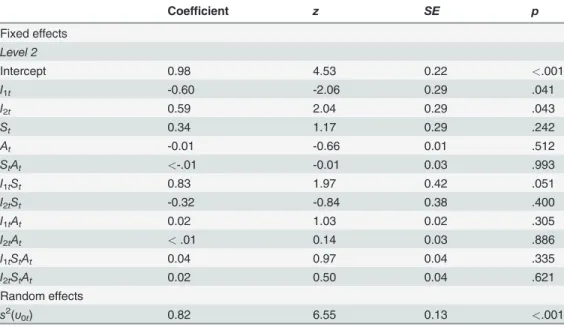
The results revealed that the probability of cute Caucasian faces being chosen was larger compared to the probability of less cute Caucasian faces being chosen for all participants, be-cause thefixed intercept differed significantly from 0,α00= 0.98,z= 4.53,p<.001.
Fig 1. Descriptive statistics of Study 1: Toy-Task.Relative frequencies are presented for cute and less cute faces being chosen for each stimulus category and separately for male and female participants.
Furthermore, the probability of the cute face being chosen differed between the three face types. The probability of the cute face being chosen was larger for puppies,α02= 0.60,z= 2.04,
p= .043, and lower for African infants’compared to Caucasian infants’faces,α01= -0.60,z=
-2.06,p= .041. Men and women did not differ in their decisions, neither for Caucasian faces,
α03= 0.34,z= 1.17,p= .242, nor for faces of a different ethnicity,α06= 0.83,z= 1.97,p= .051,
or species,α07= -0.32,z= -0.84,p= .400. Furthermore, participants’age had no influence on the probability of the cute face being chosen, allp’s. 305. The interactions between sex and age, and between sex, age, and the Dummy variables were also not significant, allp’s. 335. All results are displayed inTable 5.
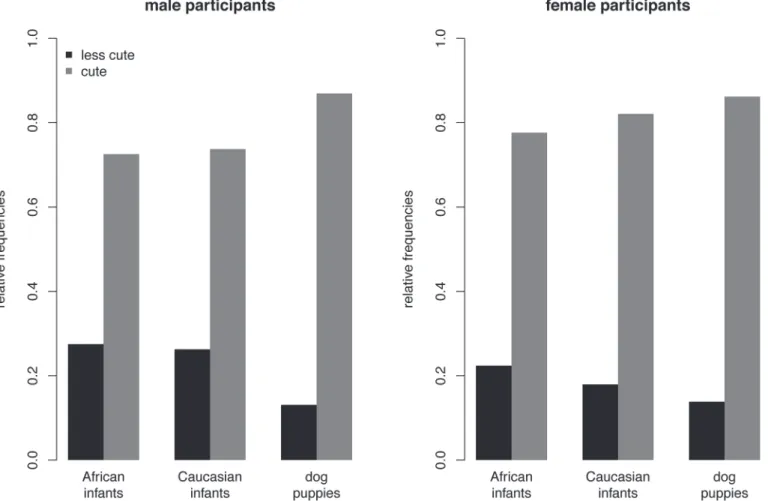
Adoption-task. The descriptive statistics are shown inFig. 2. The null-model revealed a significant proportion of inter-individual variance in decisions across all participants,s2(β0t) = 0.73,z= 6.39,SE= 0.11,p<.001. PseudoR2of subject variance was. 18. The fixed inter-cept of this model was 1.51, z = 19.33,SE= 0.08,p<.001, indicating that the probability of the
cute face being chosen was significantly larger compared to the probability of the less cute face being chosen across all face types (Caucasian, African, puppy) and participants.
In line with the analysis of Task 1 we separately calculated a null model for Caucasian infants, African infants, and dog puppies to test whether the probability of the cute face being chosen within each face type significantly differs from 0.5. The fixed intercepts were 1.22 (Caucasian in-fants),z= 9.09,SE= 0.13,p<.001, 1.36 (African infants),z= 10.79,SE= 0.13,p<.001, and
1.95 (dog puppies),z= 15.43,SE= 0.13,p<.001, indicating that the probability of the cute face
Table 5. Results of Study 1 (Toy-Task).
Coefficient z SE p
Fixed effects
Level 2
Intercept 0.98 4.53 0.22 <.001
I1t -0.60 -2.06 0.29 .041
I2t 0.59 2.04 0.29 .043
St 0.34 1.17 0.29 .242
At -0.01 -0.66 0.01 .512
StAt <-.01 -0.01 0.03 .993
I1tSt 0.83 1.97 0.42 .051
I2tSt -0.32 -0.84 0.38 .400
I1tAt 0.02 1.03 0.02 .305
I2tAt <.01 0.14 0.03 .886
I1tStAt 0.04 0.97 0.04 .335
I2tStAt 0.02 0.50 0.04 .621
Random effects
s2(υ0t) 0.82 6.55 0.13 <.001
I1tandI2tare Indicator or Dummy variables indicating the stimulus category (I1t: 1 = African infants,
0 = Caucasian infants;I2t: 1 = dog puppies, 0 = Caucasian infants).Strepresents participants’sex (0 = male, 1 = female).Aindicates participants’age (0 = mean age of the sample).
Robust estimators were used for statistical inference with respect tofixed effects and variance components to account for possible violations of model assumptions, such as normality of Level-2 residuals. Degrees of freedom were computed based on the Satterthwaite’s Approximation to account for the moderate sample size at Level 2 [46]. Therefore, the degrees of freedom were not necessarily integers and could vary across tests independent of the number of parameters.
being chosen was significantly larger compared to the probability of the less cute face being cho-sen across all face types and participants.
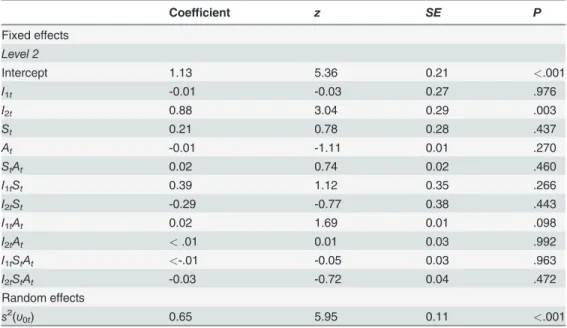
The final model was the same as in the toy-task (seeEquation 2) revealing similar results. Nei-ther participants’sex nor age had an influence on the higher probability of the cute face being cho-sen across all conditions, allp’s. 098. Furthermore, the probability of the cute face being chosen was lower for Caucasian infant compared to puppy faces,α02= 0.88,z= 3.03,p= .003. The differ-ence between Caucasian and African infants did not reach significance,α01= -0.01,z= -0.03, p= .976. All results are displayed inTable 6.
Brief discussion
As expected, cute infants were more frequently chosen in the toy-donation task and in the hy-pothetical adoption task, irrespective of the ethnicity and species of the stimulus faces and in-dependent of the sex and age of the participants. In this study we tested preferences for cute infants belonging to the same ethnicity as the observer, belonging to a different ethnicity, and Fig 2. Descriptive statistics of Study 1: Adoption-Task.Relative frequencies are presented for cute and less cute faces being chosen for each stimulus category and separately for male and female participants.
to a different species. For all these faces we observed the same result: cute faces were preferred. In the toy-task the cute compared to less cute dog puppies and Caucasian infants were more strongly preferred than the African infants. In the more personally relevant decision such as in the hypothetical adoption task the infants’ethnicity had no differential effect on the preference for cute infants. However, the influence of cuteness was more pronounced in decisions related to dog puppies compared to infants of the own species.
Study 2: Cuteness and Health
The findings of Study 1 revealed that if cute and less cute faces of African or Caucasian infants, or dog puppies are presented, cuter faces are preferred in a hypothetical adoption and a hypo-thetical donation paradigm. This effect occured for faces of different ethnicities and species ir-respective of the observer characteristics. A possible reason for this preference is the positive relation between cuteness and health [16,22,27,29–33]. If an infant looks cute, it is assumed that it is healthy, implying that parental investment is lower. To test whether the perception of health and cuteness is related across ethnicities and species we conducted Study 2.
Methods
Participants. Participants were the same as in Study 1. Study 2 was conducted immediate-ly after Study 1. Due to storage problems the data of 45 participants could not be anaimmediate-lyzed, Table 6. Results of Study 1 (Adoption-Task).
Coefficient z SE P
Fixed effects
Level 2
Intercept 1.13 5.36 0.21 <.001
I1t -0.01 -0.03 0.27 .976
I2t 0.88 3.04 0.29 .003
St 0.21 0.78 0.28 .437
At -0.01 -1.11 0.01 .270
StAt 0.02 0.74 0.02 .460
I1tSt 0.39 1.12 0.35 .266
I2tSt -0.29 -0.77 0.38 .443
I1tAt 0.02 1.69 0.01 .098
I2tAt <.01 0.01 0.03 .992
I1tStAt <-.01 -0.05 0.03 .963
I2tStAt -0.03 -0.72 0.04 .472
Random effects
s2(υ
0t) 0.65 5.95 0.11 <.001
I1tandI2tare Indicator or Dummy variables indicating the stimulus category (I1t: 1 = African infants,
0 = Caucasian infants;I2t: 1 = dog puppies, 0 = Caucasian infants).Strepresents participants’sex (0 = male, 1 = female).Aindicates participants’age (0 = mean age of the sample).
Robust estimators were used for statistical inference with respect tofixed effects and variance components to account for possible violations of model assumptions, such as normality of Level-2 residuals. Degrees of freedom were computed based on the Satterthwaite’s Approximation to account for the moderate sample size at Level 2 [46]. Therefore, the degrees of freedom were not necessarily integers and could vary across tests independent of the number of parameters.
resulting in 145 subjects (71 female, 74 male). Participants’age ranged between 15 and 68 years (M= 26,SD= 10.3).
Stimuli. The stimuli consisted of the faces used in Study 1. All stimuli had a size of 400 x 400 pixels and appeared at a resolution between 113.49 and 128.65 PPI. Students used their own laptops to collect the data and thus screen size and resolution varied.
Procedure. All pictures were randomly presented in two different blocks. In the first block the task was to evaluate the health of each face on a Likert-like rating scale ranging from 1 (rarely ill) to 7 (very often ill). In the second block the task was to rate the cuteness of each in-fant or puppy on Likert-like rating scale ranging from 1 (not at all cute) to 7 (very cute). The presentation duration of each picture was limited by participant’s response.
Results
As in the pre-study, we analyzed the data using multilevel regressions for repeated measure-ments to analyze the response of each participant to each single face instead of having to aver-age the ratings for each infant across participants. The dependent variable was the cuteness rating score. The null-model revealed a significant proportion of inter-individual variance in cuteness evaluation across all experimental conditions,s2(β0t) = 0.32,z= 7.85,SE= 0.04,p< .001. The intra class correlation was 0.09,s2(it) = = 3.08,z= 92.88,SE= 0.03,p<.001, legiti-mating a multilevel regression analysis.
The predictors on Level 1 were the grand mean-centered illness rating score (Hit), the two Indicator variables representing African infants (I1it) and puppies (I2it), and both interaction terms (HitI1itandHitI2it). As in Study 1, we used Caucasian infants as reference category, en-abling us to compare the effects of the own ethnicity with effects of another ethnicity as well as between the own and another species. The Level 2 predictors were participant sex and grand mean-centered age (seeEquation 3).
Yit¼b0tþb1tHitþb2tI1itþb3tI2itþb4tHitI1itþb5tHitI2itþit
8bjtðj¼0; :::;5Þ:b
jt¼aj0þaj1Stþaj2Atþaj3StAtþujt
ð3Þ
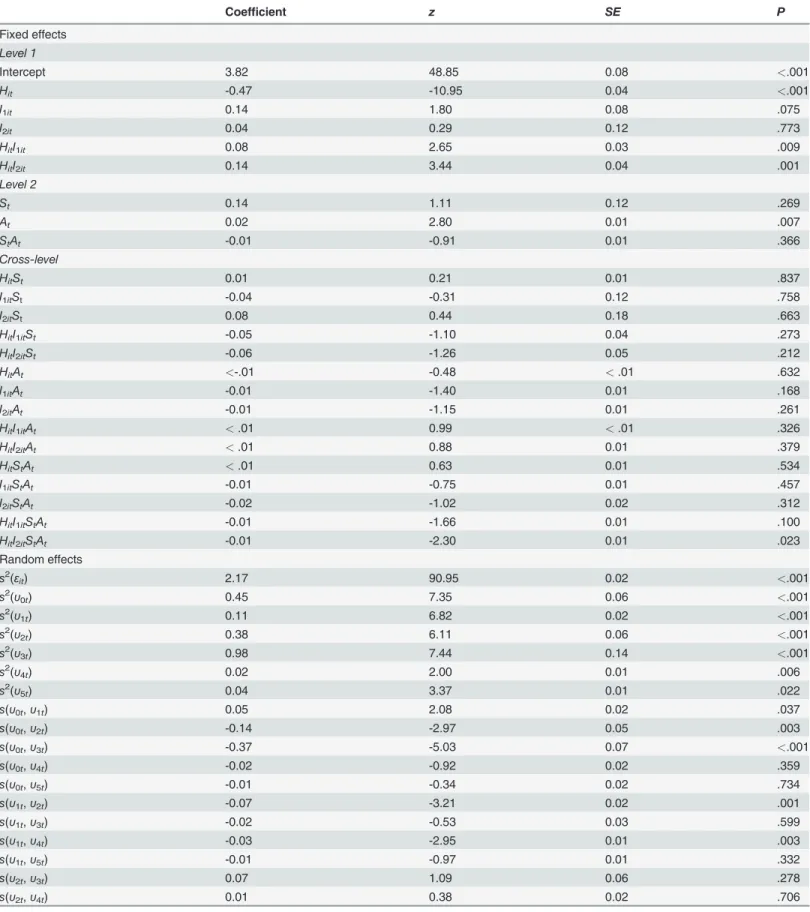
The descriptive statistics are shown inTable 7. For interpreting the following effects all other predictors have to be held constant. The results revealed that there was no significant dif-ference in cuteness evaluation of Caucasian compared to African infants,α20= 0.14,z= 1.80,
p= .075, and no significant difference in cuteness evaluation of Caucasian infants compared to puppies,α30= 0.04,z= 0.29,p= .773. There was also no difference in cuteness ratings given by male and female participants,α01= 0.14,z= 1.11,p= .269. Surprisingly, participants’age had a
positive effect on cuteness evaluation. Older subjects gave higher cuteness ratings,α02= 0.02,
z= 2.80,p= .007. All results are presented inTable 8.
As expected, the cuteness rating score was closely associated with the mean centered illness score,α10= -0.47,z= -10.95,p<.001, indicating that the higher the perceived illness, the lower
the cuteness was rated. Furthermore, the interactions between illness and the Indicator variable 1 (African) and 2 (puppies) reached statistical significance,α40= 0.08,z= 2.65,p= .009 andα50=
0.14,z= 3.44,p= .001, reflecting that the negative association between perceived illness and cuteness is weaker for African infants and dog puppies compared to Caucasian infants.
Furthermore, there was a significant 4-way interaction between health, sex, age, and Dummy variable 2,α53= -0.01,z= -2.30,p= .023 indicating that for older females the
Brief discussion
The results revealed that perceived illness has a negative influence on perceived cuteness irre-spective of ethnicity and species. Moreover, we observed a differential effect of cuteness on per-ceived health depending on the ethnicity and species of the faces. For human participants the strongest association between perceived health and cuteness was within the own ethnicity.
General Discussion
In the present research we investigated preferences for cute infant faces of different ethnicities and different species in two different tasks (Study 1). Using a 2 alternative forced-choice para-digm, participants chose the infant to whom they would rather give a toy and which infant they would prefer to adopt. We found that cuter infants were generally more frequently chosen. In a subsequent study we examined the relationship between perceived cuteness and perceived health (Study 2). Here we found that perceived frequency of illness was negatively associated with cuteness. The findings of both studies were comparable for faces of African and Caucasian infants and dog puppies.
This is the first study revealing that cute infants are preferred even if these infants belong to another ethnicity or species than the observer. This preference was evident in a task where par-ticipants were asked to choose the infant to whom they would rather give a toy and in a hypo-thetical adoption task. We found that men and women across various ages responded in a similar way, suggesting that cues of infant cuteness are perceivable for both men and women and influence personally relevant altruistic decisions.
The findings of this study underline the universality of infant cuteness originally described by Konrad Lorenz [1], [see also23,24]. Previous work showed that altering paedomorphic characteristics such as enlarging the eyes or changing the height of the forehead influences preferences and decisions [e.g.2,3]. We extended these findings by showing that subjective cuteness evaluation of natural, unmanipulated infant faces influences choices in a hypothetical adoption and toy-donation task. At least in humans, subjective cuteness evaluations seem to trigger pro-social behavior patterns independent of the infant’s ethnicity and even independent of its species [see also the findings of25,26].
According to the results of Study 2, the association between perceived health and cuteness may possibly account for this finding. For adults it has often been suggested that attractiveness is a sign of good genes and health [especially in female faces, e.g.40,41]. Yamamoto et al. [29] found evidence of a similar relationship between infant cuteness and health: healthy infants were rated to look cuter than infants suffering from Down’s syndrome or fetal alcoholic syn-drome. Furthermore, Volk and colleagues [16,22] found a positive association between Table 7. Descriptive statistics of Study 2.
partcipant sex cuteness rating health rating
Caucasian infants male 4.01±1.7 3.59±1.6
female 4.19±1.9 3.53±1.7
African infants male 3.79±1.7 4.24±1.6
female 3.92±1.9 4.18±1.6
dog puppies male 3.86±1.9 3.88±1.6
female 4.10±2.0 3.89±1.6
Means and standard deviations of the cuteness and health rating scores are presented. The range for each rating was 1 to 7 (not at all cute to very cute, rarely ill to very often ill).
Table 8. Results of Study 2.
Coefficient z SE P
Fixed effects
Level 1
Intercept 3.82 48.85 0.08 <.001
Hit -0.47 -10.95 0.04 <.001
I1it 0.14 1.80 0.08 .075
I2it 0.04 0.29 0.12 .773
HitI1it 0.08 2.65 0.03 .009
HitI2it 0.14 3.44 0.04 .001
Level 2
St 0.14 1.11 0.12 .269
At 0.02 2.80 0.01 .007
StAt -0.01 -0.91 0.01 .366
Cross-level
HitSt 0.01 0.21 0.01 .837
I1itSt -0.04 -0.31 0.12 .758
I2itSt 0.08 0.44 0.18 .663
HitI1itSt -0.05 -1.10 0.04 .273
HitI2itSt -0.06 -1.26 0.05 .212
HitAt <-.01 -0.48 <.01 .632
I1itAt -0.01 -1.40 0.01 .168
I2itAt -0.01 -1.15 0.01 .261
HitI1itAt <.01 0.99 <.01 .326
HitI2itAt <.01 0.88 0.01 .379
HitStAt <.01 0.63 0.01 .534
I1itStAt -0.01 -0.75 0.01 .457
I2itStAt -0.02 -1.02 0.02 .312
HitI1itStAt -0.01 -1.66 0.01 .100
HitI2itStAt -0.01 -2.30 0.01 .023
Random effects
s2(εit) 2.17 90.95 0.02 <.001
s2(υ0t) 0.45 7.35 0.06 <.001
s2(υ
1t) 0.11 6.82 0.02 <.001
s2(υ2t) 0.38 6.11 0.06 <.001
s2(υ3t) 0.98 7.44 0.14 <.001
s2(υ4t) 0.02 2.00 0.01 .006
s2(υ
5t) 0.04 3.37 0.01 .022
s(υ0t,υ1t) 0.05 2.08 0.02 .037
s(υ0t,υ2t) -0.14 -2.97 0.05 .003
s(υ0t,υ3t) -0.37 -5.03 0.07 <.001
s(υ0t,υ4t) -0.02 -0.92 0.02 .359
s(υ0t,υ5t) -0.01 -0.34 0.02 .734
s(υ1t,υ2t) -0.07 -3.21 0.02 .001
s(υ1t,υ3t) -0.02 -0.53 0.03 .599
s(υ1t,υ4t) -0.03 -2.95 0.01 .003
s(υ1t,υ5t) -0.01 -0.97 0.01 .332
s(υ2t,υ3t) 0.07 1.09 0.06 .278
s(υ2t,υ4t) 0.01 0.38 0.02 .706
perceived cuteness and health across healthy Asian and Caucasian infants. We extended these findings by comparing cuteness and illness ratings of Caucasian and African infants and dog puppies. Specifically, we compared the magnitude of the health-cuteness association for infants of the own (Caucasian) and a different ethnicity (African) as well as for infants of a different species (dogs). For all stimulus classes we found a negative association between perceived fre-quency of illness and cuteness, but the association was strongest for infant faces of the own eth-nicity. A potential explanation might be that although cuteness is a universal facial
characteristic it is more common to invest and breed offspring of one’s own kin, that is off-spring that shares genes and physical characteristics. Infants belonging to the own ethnicity naturally share more common characteristics. Importantly, different baseline levels of cuteness do not explain this finding because we found no overall difference in cuteness evaluation be-tween Caucasian and African infants and Caucasian infants and puppies. Taking into account the results of Study 2, the preferences for cute infants found in Study 1 are potentially explained by smaller costs for raising a cute compared to a less cute infant because cute babies seem healthier.
None of our studies revealed systematic differences between male and female observers. This is in contrast to various studies reporting sex differences in the processing of cuteness and in reactions towards infants [15,19,29,34,35,42–45]. For instance, compared to men, women smile more when seeing a cute baby [19], they extend viewing time when cute faces are pre-sented [34, but see43,45], and they are more sensitive towards cuteness differences in infant faces [15]. No sex differences are reported for cuteness evaluation [19,43], and emotional re-sponses towards infants [19]. Furthermore, Golle et al. [23, Exp.1] did not find evidence for a different coding mechanism of cuteness in male and female participants. The results of the present study further support the assumption that men and women generally perceive cues of cuteness in a similar way, and that cuteness positively influences both sexes.
Surprisingly, we found a significant influence of participants’age on cuteness evaluation and a high-order interaction between participants’age, sex, infant face category, and perceived health. These findings might be explained by different lifetime experiences with children or age-related differences in cuteness perception and processing [cf.35]. To the best of our Table 8. (Continued)
Coefficient z SE P
s(υ2t,υ5t) 0.01 0.28 0.02 .783
s(υ3t,υ4t) -0.02 -0.65 0.03 .515
s(υ
3t,υ4t) <-.01 -0.06 0.03 .955
s(υ4t,υ5t) <-.01 -0.07 0.01 .948
I1itandI2itare Indicator or Dummy variables indicating the stimulus category (I1it: 1 = African infants, 0 = Caucasian infants;I1it: 1 = dog puppies,
0 = Caucasian infants).Hitreflects the health state (0 = mean assessment of perceived health across all stimuli and participants, a positive value indicates perceived above-average illness frequency).Strepresents participants’sex (0 = male, 1 = female).Atindicates participants’age (0 = mean age of the sample). For interpreting the coefficients all other predictor variables have to be held constant.
An unstructured covariance structure was used for the random part at Level 2. Hence, the variances and covariances of Level 2 residuals were estimated without any constraints. Robust estimators were used for statistical inference with respect tofixed effects and variance components to account for possible violations of model assumptions, such as normality of Level-2 residuals. Degrees of freedom were computed based on the Satterthwaite’s Approximation to account for the moderate sample size at Level 2 [46]. Therefore, the degrees of freedom were not necessarily integers and could vary across tests independent of the number of parameters.
knowledge there are no studies that have systematically investigated the influence of partici-pants’age and cuteness evaluation. Future research is necessary to shed light on these effects.
In this study we used natural portraits on human infants and dog puppies. By asking people to assess the cuteness of a series of faces, we compiled two sets of infant faces for each category: faces that were perceived as being particularly cute and faces that were perceived as being less cute. As expected, people highly agreed on which faces were cute and which ones were less cute. To further quantify the cuteness of each infant face we applied anthropometric measures to our natural stimuli [cf.2]. Interestingly, we found expected differences in“babyfacedness”
only between cute and less cute Caucasian infants. For African infants and dog puppies the anthrompometric features of faces that were rated to be very cute and faces that were rated as being less cute did not systematically differ. So, while the method used by Glocker et al. [2] seems to be useful to parametrically manipulate the cuteness of infants, it seems less advanta-geous to quantify cuteness in natural (unmanipulated) baby faces, especially when including faces of different ethnicities and species. As Glocker et al. [2] themselves conceded, the features of a natural face may vary in objective cuteness measurements. That is, unmanipulated infants often combine some high and some low baby schema features. We believe that using natural, unmanipulated photographs is a more ecologically valid approach than using parametrically manipulated images because, rather than being interested in specific babyfacedness measure-ments or in describing the features that constitute a cute face, we were interested in actual cute-ness perception and in what ways cutecute-ness perception might influence behavioural intentions (i.e., hypothetical adoption and donation of a toy).
There are some limitations of the present research. First, the stimuli we used were not con-trolled for sex and age. Second, we only used stimuli with a large cuteness difference in Study 1. If we had presented face pairs with smaller cuteness differences the forced choice task would have been more difficult which would have possibly lead to different results (e.g., gender differ-ences might be observed). Third, we draw conclusions about cuteness preferdiffer-ences across eth-nicities and species while investigating only Caucasian participants. We also note that we can not exclude the possibility that our findings are based on in- and out-group differences. Fur-thermore, we did not control for participants’experiences neither with faces of African infants nor with faces of dog puppies. Future research is necessary to establish whether our findings are transferable across age and sex of infant faces, whether they are transferable to participants of other ethnicities, and to find out whether it is an ethnicity or in-group and out-group phe-nomenon. Despite these limitations we are able to draw conclusions about choices and ratings of naturalistic infant face stimuli varying in perceived cuteness, ethnicity, and species. Across infant faces of various natural categories and different tasks we found a preference for the cute ones and a significant association between perceived health state and cuteness evaluation. This relationship between cuteness and health may account for general cuteness preferences.
Supporting Information
S1 Dataset. Dataset of the pre-study.
(TXT)
S2 Dataset. Dataset of Study 1: Toy-Task.
(TXT)
S3 Dataset. Dataset of Study 1: Adoption-Task.
(TXT)
S4 Dataset. Dataset of Study 2.
(TXT)
Author Contributions
Conceived and designed the experiments: JG FP JSL. Performed the experiments: JG FP. Ana-lyzed the data: JG. Contributed reagents/materials/analysis tools: JSL FWM. Wrote the paper: JG FP JSL FWM.
References
1. Lorenz K. Die angeborenen Formen möglicher Erfahrung. [The innate forms of potential experience.]. Z Tierpsychol. 1943; 5:94–125.
2. Glocker ML, Langleben DD, Ruparel K, Loughead JW, Gur RC, Sachser N. Baby schema in infant faces induces cuteness perception and motivation for caretaking in adults. Ethology. 2009; 115:257– 263. PMID:22267884
3. Sternglanz SH, Gray JL, Murakami M. Adult preferences for infantile facial features—Ethological ap-proach. Anim Behav. 1977; 25:108–115. PMID:855947
4. Karraker KH, Stern M. Infant physical attractiveness and facial expression—effects on adult percep-tions. Basic Appl Soc Psych. 1990; 11:371–385.
5. Stephan CW, Langlois JH. Baby beautiful—adult attributions of infant competence as a function of in-fant attractiveness. Child Dev. 1984; 55:576–585. PMID:6723448
6. Dion KK, Berscheid E, Walster E. What is beautiful is good. J Pers Soc Psychol. 1972; 24:285–290. PMID:4655540
7. Fullard W, Reiling AM. An investigation of Lorenz's "Babyness". Child Dev. 1976; 47:1191–1193. 8. Ritter JM, Langlois JH. The role of physical attractiveness in the observation of adult child interactions
—eye of the beholder or behavioral reality. Dev Psychol. 1988; 24:254–263.
9. Langlois JH, Ritter JM, Casey RJ, Sawin DB. Infant attractiveness predicts maternal behaviors and atti-tudes. Dev Psychol. 1995; 31:464–472.
10. Dion KK. Children's physical attarctiveness and sex determinants of adult punitiveness. Dev Psychol. 1974; 10:772–778.
11. Elder GH, van Nguyen T, Caspi A. Linking family hardship to children's lives. Child Dev. 1985; 56:361– 375. PMID:3987413
12. Badr LK, Abdallah B. Physical attractiveness of premature infants affects outcome at discharge from the NICU. Infant Behav Dev. 2001; 24:129–133.
13. Glocker ML, Langleben DD, Ruparel K, Loughead JW, Valdez JN, Griffin MD, et al. Baby schema mod-ulates the brain reward system in nulliparous women. P Natl Acad Sci USA. 2009; 106:9115–9119. doi:
10.1073/pnas.0811620106PMID:19451625
14. Karraker KH, Vogel DA, Lake MA. Parents' gender-stereotyped perceptions of newborns: The eye of the beholder revisited. Sex Roles. 1995; 33:687–701.
15. Lobmaier JS, Sprengelmeyer R, Witten B, Perrett DI. Female and male responses to cuteness, age and emotion in infant faces. Evol Hum Behav. 2010; 31:16–21.
17. Luo LZ, Lee K, Li H. Are children’s faces really more appealing than those of adults? Testing the baby schema hypothesis beyond infancy. J Exp Child Psychology. 2011; 110:115–124. doi:10.1016/j.jecp.
2011.04.002PMID:21536307
18. Hildebrandt KA, Fitzgerald HE. Gender bias in observers' perceptions of infant's sex: It's a boy most of the time. Percept Motor Skill. 1977; 45:472–474.
19. Hildebrandt KA, Fitzgerald HE. Adults responses to infants varying in perceived cuteness. Behav Pro-cess. 1978; 3:159–172. PMID:686436
20. Hildebrandt KA, Fitzgerald HE. Facial feature determinants of perceived infant attractiveness. Infant Behav Dev. 1979; 2:329–339.
21. Chin SF, Wade J, French K. Race and facial attractiveness: Individual differences in perceived adopt-ability of children. J Cult Evol Psychol. 2006; 4:215–229.
22. Volk AA. Chinese infant facial cues. J Evol Psychol. 2009; 7:225–240.
23. Golle J, Lisibach S, Mast FW, Lobmaier JS. Sweet puppies and cute babies: Perceptual adaptation to babyfacedness transfers across species. Plos One. 2013; 8.
24. Little AC. Manipulation of infant-like traits affects perceived cuteness of infant, adult and cat faces. Ethology. 2012; 118:775–782.
25. Nittono H, Fukushima M, Yano A, Moriya H. The power of kawaii: Viewing cute images promotes a careful behavior and narrows attentional focus. Plos One. 2012; 7.
26. Sherman GD, Haidt J, Coan JA. Vieweing cute images increases behavioral carefulness. Emotion. 2009; 9:282–286. doi:10.1037/a0014904PMID:19348541
27. Parsons CE, Young KS, Parsons E, Dean A, Murray L, Goodacre T, et al. The effect of cleft lip on adults' responses to faces: Cross-species findings. Plos One. 2011; 6.
28. Zebrowitz LA, Montepare JM, Lee HK. They don't all look alike: Differentiating same versus other race individuals. J Pers Soc Psychol. 1993; 65:85–101. PMID:8355144
29. Yamamoto R, Ariely D, Chi W, Langleben DD, Elman I. Gender differences in the motivational process-ing of babies are determined by their facial attractiveness. Plos One. 2009; 4.
30. Waller KL, Volk A, Quinsey VL. The effects of infant fetal alcohol syndrom facial features on adoption preference. Human Nature. 2003; 15:101–117.
31. Volk AA, Lukjanczuk JM, Quinsey VL. Influence of infant and child facial cues of low body weight on adults' ratings of adoption preference, cuteness, and health. Inf Mental Hlth J. 2005; 26:459–469. 32. Volk AA. The Influence of Infant Facial Cues on the Elicitation of Feelings of Patemal Care in Adults.
Department of Psychology. National Library of Canada: Queen's University, Kingston, Ontario; 2001. p. 92.
33. Volk AA, Quinsey VL. Cues of high and low body weight negatively influence adults' perceptions and ratings in the hypothetical adoption paradigm. ScientificWorldJournal. 2006; 6:1574–1582. PMID:
17160342
34. Hahn AC, Xiao DK, Sprengelmeyer R, Perrett DI. Gender differences in the incentive salience of adult and infant faces. Q J Exp Psychol. 2013; 66:200–208. doi:10.1080/17470218.2012.705860PMID:
22928658
35. Sprengelmeyer R, Perrett DI, Fagan EC, Cornwell RE, Lobmaier JS, Sprengelmeyer A, et al. The cutest little baby face: A hormonal link to sensitivity to cuteness in infant faces. Psychol Sci. 2009; 20:149– 154. doi:10.1111/j.1467-9280.2009.02272.xPMID:19175530
36. American Psychological Association. Ethical principles of psychologists and code of conduct. American Psychologist. 2002; 57:1060–1073. PMID:12613157
37. Hoffman L, Rovine MJ. Multilevel models for the experimental psychologist: Foundations and illustra-tive examples. Behav Res Methods. 2007; 39:101–117. PMID:17552476
38. Bosker R, Snijders T. Multilevel analysis: An introduction to basic and advanced multilevel modeling. 2nd ed. Thousand Oaks, CA: Sage Publications; 2011.
39. McKelvey R, Zavoina W. A statistical model for the analysis of ordinal level dependent variables. J Math Sociol. 1975; 4:103–120.
40. Rhodes G. The evolutionary psychology of facial beauty. Annu Rev Psychol. 2006; 57:199–226. PMID:
16318594
41. Weeden J, Sabini J. Physical attractiveness and health in western societies: A review. Psychol Bull. 2005; 131:635–653. PMID:16187849
43. Parsons CE, Young KS, Kumari N, Stein A, Kringelbach ML. The motivational salience of infant faces is similar for men and women. Plos One. 2011; 6.
44. Cardenas RA, Harris LJ, Becker MW. Sex differences in visual attention toward infant faces. Evol Hum Behav. 2013; 34:280–287.
45. Charles NE, Alexander GM, Saenz J. Motivational value and salience of images of infants. Evol Hum Behav. 2013; 34:373–381.

![Table 4. Objective measures of baby schema (cf. Glocker et al. [2]).](https://thumb-eu.123doks.com/thumbv2/123dok_br/18344948.352410/7.918.51.870.132.389/table-objective-measures-baby-schema-cf-glocker-et.webp)