Latino Retail Entrepreneurship in Minnesota:
Implications for Extension Educators
Hye-Young Kim Kim K. P. Johnson
University of Minnesota
Ju-Young M. Kang
University of Hawaii
Ji Young Lee
State University of New York at Oneonta
Minnesota has become a “new destination” state for Latino migrants in the United States. What has made Latinos in Minnesota successful? In a narrower sense, what has provided them with a route out of poverty and an alternative to unemployment or discrimination in the labor market? Our purpose was to (a) compile characteristics associated with the Latino community and successful Latino-owned retail businesses in Minnesota, (b) identify unique problems encountered by Latino retail entrepreneurs, and (c) develop recommendations to overcome obstacles encountered. To meet our objectives, we employed two methods: a Delphi study with Latino community leaders and a case study with Latino retail entrepreneurs. Implications for Extension educators are discussed.
Keywords: Latino, retail, entrepreneurship, Extension, case study, Delphi method
Introduction
Minnesota has become a “new destination” state for Latino migrants in the United States. In 2008, the U.S. Census Bureau estimated the size of Minnesota’s Latino population had grown to more than 200,000. By 2015, Latinos are expected to be the largest minority group in Minnesota, representing 5.7% of the total population (StarTribune, 2009). As the Latino population in
Minnesota increases, so does their economic power, estimated at more than $3 billion in revenues (Corrie, 2008; Hughes, 2004).
The influx of Latinos to Minnesota has been accompanied by a rapid growth in Latino-owned and operated businesses. Latino-owned firms in Minnesota have increased by 350% since 1990 (Fennelly & Huart, 2010). Latino monetary contributions to Minnesota are significant, as
$97.8 million in annual payroll (U.S. Census Bureau, 2006). In addition, they contribute an estimated $283 million to state revenue through payment of personal taxes (Corrie, 2008). During the next twenty years, the number of Latinos in the prime tax base of Minnesota is predicted to grow over 300% (Corrie, 2008).
What has made Latinos in Minnesota successful? In a narrower sense, what has provided them with a route out of poverty and an alternative to unemployment or discrimination in the labor market? Prior research in the area of ethnic entrepreneurship suggests that the economic success of earlier immigrant groups in the U.S., such as the Chinese, Japanese, Koreans, Jews, Italians, and Greeks, is largely due to their ownership of retail businesses (Fairlie & Woodruff, 2007). In the extant literature, however, few researchers have paid attention to Latino retail
entrepreneurship, perhaps because Latinos are often assumed to be migrant laborers (Zarrugh, 2007). There is a dearth of research about the contextual/environmental and individual factors in which Latino retail businesses operate. Given the potential impact of ethnic retail activities on the growth and stability of the Latino community, it is important to deepen our understanding of Latino retail entrepreneurship.
With this goal in mind, we conducted an outreach research project designed to provide beneficial insight to Extension educators1 who promote economic development and job creation in Latino neighborhoods. Our purpose was to (a) compile characteristics associated with the Latino community and successful Latino-owned retail businesses in Minnesota, (b) identify unique problems encountered by Latino retail entrepreneurs, and (c) develop recommendations to overcome obstacles encountered. Specific research questions addressed in this paper were:
• RQ1: What are the most critical problems/issues Latino retail entrepreneurs are facing in Minnesota?
• RQ2: What implications can be drawn for Extension educators from the data analysis on RQ1?
Literature Review
Ethnic Entrepreneurship
In general, the term ethnic entrepreneurship refers to small- and medium-size businesses owned by ethnic or immigrant entrepreneurs. The evolution of ethnic businesses is affected by
numerous factors, including the economic situation, job opportunities, ethnic population, education level of entrepreneurs, and location of businesses (Volery, 2007). For example, low
1
barriers to entry related to capital and educational qualifications influence immigrants’ business entry decisions and leads to the growth of ethnic entrepreneurship (Volery, 2007), while
discrimination or language barriers impede it.
Researchers have utilized two perspectives in their investigations of ethnic entrepreneurship. Disadvantage theory suggests that immigrants have significant disadvantages (e.g., lack of capital, language skills, education, and knowledge of the local culture). These disadvantages propel ethnic minorities to seek self-employment as an alternative to unemployment (Fregetto, 2004). Cultural theory suggests that immigrants bring culturally-determined characteristics that influence their ability to be successful entrepreneurs, such as dedication to hard work, acceptance of risk, compliance with social value patterns, membership in a strong ethnic community, and an orientation towards self-employment (Masurel, Nijkamp, Vindigni, 2004). Both theories suggest that individual, cultural, and situational factors impact entrepreneurial behavior (Fregetto, 2004).
Latino Entrepreneurship
In the U.S., Latino business numbers are rising (Nash, 2008). Entrepreneurship encourages social and economic mobility for Latino immigrants and also contributes to the economic dynamism of the U.S. (Smith, 2010). In spite of the fact that Latinos are the fastest growing minority segment in the U.S. (Blancero, DelCampo, & Marron, 2007) and the proliferation of Latino-owned businesses and their contribution to the U.S. labor market, limited scholarly attention has been given to Latino entrepreneurship (Robles & Cordero-Guzmán, 2007). Given that most Latino immigrants move into traditional immigrant states, such as California, New York, Texas, and Illinois, most researchers have paid attention to Latino ethnic entrepreneurship in Los Angeles, New York City, Chicago, and Miami (Kandel & Cromartie, 2004). Recently, Latino immigrants have migrated to new urban and rural places, such as Georgia, North Carolina, Utah, and Nevada (Kandel & Cromartie, 2004). As such, researchers have been interested in understanding Latino entrepreneurship in new places including the Midwestern states (Kandel & Cromartie, 2004).
friends for business knowledge (e.g., location, permits, suppliers, and laws) as well as for financial support (Smith, 2010; Waldinger, Aldrich, & Ward, 1990).
Motivation. Researchers have documented both personal and social motivations for starting a business. Latino entrepreneurs in Utah were motivated to start a business to provide a better life for their children, to earn a living, or to provide ethnic-based goods and services to other Latinos (Smith, 2010). Interestingly, some retailers indicated that the increase in acceptance of Latinos in the community influenced their decision to start a business (Smith, 2010). Some Latino entrepreneurs who were women noted that they were motivated to run a business by negative experiences at prior jobs (Zarrugh, 2007) and by the desire to have flexibility so that they could both work and care for their children.
Business characteristics and marketing activities. Latinos in the U.S. operate a range of businesses. Key retail sectors in Utah included restaurants and financial-real estate, followed by automotive-electronic repair, car dealerships, clothing stores, yard/property maintenance,
groceries and bakeries, and beauty (Smith, 2010). Similarly, for Latino entrepreneurs in Virginia, the central retail industry also included restaurants and retail of ethnic foods and other products (e.g., clothing and music), followed by service, beauty salons, and repair/care of automobiles. The majority of Missouri’s Latino entrepreneurs were engaged in retail, construction, and service businesses (Missouri Economic Research and Information Center, 2005).
Prior to starting their businesses, Latino entrepreneurs in Utah often worked in manufacturing such as printing, mailing, and window fabrication. Similarly, Latino retailers in Virginia had worked or owned a business (e.g., barber shop) in their country of origin or in the U.S. prior to running their current businesses (Smith, 2010). Those operating retail businesses reported having worked in their parents’ business prior to coming to the U.S. (Zarrugh, 2007).
Latinos relied heavily on other Latinos in starting and operating their businesses. Smith (2010) noted that Latino retailers (a) targeted Latinos as customers, as evidenced by their product offerings, and hired Latino employees; (b) relied on business resources including ethnic-based social networks that provided assistance in securing financial capital, recruiting workers, accessing clientele, securing locations and equipment, advertising, and obtaining information about licenses and permits; and (c) used Spanish-based media (e.g., Spanish radio and
newspapers) were generally used as business resources as well.
range of business challenges for Latinos that exist for any entrepreneur. These challenges include difficulty generating business ideas, completing necessary documents, following local regulations, obtaining licenses and permits, obtaining start-up money, managing business finances, marketing, and recruiting/retaining workers. Because of difficulties with obtaining bank loans, most Latino retailers relied on personal savings, credit cards, or alternative financial institutions. Smith (2010) also noted that language was another challenge for Latino
entrepreneurs, as there were difficulties related to working with English-speaking customers, as well as understanding sufficient English to obtain the requisite permits and licenses necessary not only to run a business, but also to prepare tax forms (Missouri Economic Research and Information Center, 2005).
Methods
To meet our research objectives, we employed two methods: a Delphi study with Latino
community leaders and a case study with Latino retail entrepreneurs. In the Delphi study, Latino community leaders served as experts to assist in problem identification, issue clarification
relevant to Latino retail entrepreneurship, and evaluation of the community support system. We used expert opinion as a screening mechanism for the main data collection from Latino retail entrepreneurs in the case study.
Delphi Method (Study 1)
The Delphi method is a qualitative research tool that relies on a group of independent experts (Okoli & Pawlowski, 2004). It is considered a useful method for eliciting and aggregating expert opinion whenever judgmental information is indispensable (Rowe & Wright, 2001). We
employed the Delphi technique for two main reasons: (a) it structures a group communication process so that the process is effective in allowing a group of experts, as a whole, to deal with a complex problem; and (b) it avoids direct confrontation of the experts, with facilitating the gradual formation of a considered opinion (Okoli & Pawlowski, 2004).
Participants were asked to complete questionnaires in two rounds. For the first round, initial phone calls to Latino community leaders were conducted to solicit participation in exchange for a $100 gift card. Four Latino community leaders responded to our web survey with 18 open-ended questions, yielding a response rate of 50.0%. The open-open-ended questions asked the experts to identify (1) Latino retail entrepreneur characteristics, (2) business characteristics and
doing, they were encouraged to reach consensus by revising their earlier answers. The selected sample consisted of eight Latino community leaders of organizations within the state.
Case Study (Study 2)
Case study is a type of design within qualitative research wherein the researcher explores a case over time through detailed and in-depth interviews (Yin, 1984). The selected sample consisted of 26 Latino retail entrepreneurs within the state. The community leaders who participated in the Delphi study assisted us in constructing the sampling frame. Initial phone calls or emails to Latino retail entrepreneurs were conducted to solicit participation in exchange for a $100 gift card. Five Latino retail entrepreneurs responded to our in-depth interviews yielding a response rate of 19.2%. The open-ended questions asked the participants to identify (1) characteristics of the Latino community in Minnesota, (2) their personal characteristics as successful Latino retail entrepreneurs, (3) their business and marketing practices, (4) obstacles and strategies, and (5) recommendations or suggestions for other Latino retail entrepreneurs. The interviews were audio-taped and transcribed. Inter-rater reliability was calculated at 96.01%. Finally, a content analysis was performed to assess the emerging themes from the narrative text.
Results
Participant Characteristics
Four Latino experts (one male and three females) participated in the Delphi study. Participants had between 4 and 11 years of work experience with Latino small business owners. Three participants had graduate degrees. Participants had worked as a business consultant, a CEO, and a loan program director. They had assisted Latino small business owners in terms of technical support, business planning, mentorship, networking, minority certification, accounting, and taxes.
Five Latino retail entrepreneurs (i.e., three males and two females) participated in the case study (age range 37 to 59). Participants had between 10 and 20 years of work experience. They had worked in Minnesota as owners of restaurants, grocery stores, and retail services. Their highest education levels varied from middle school to four years of college.
Delphi Method (Study 1)
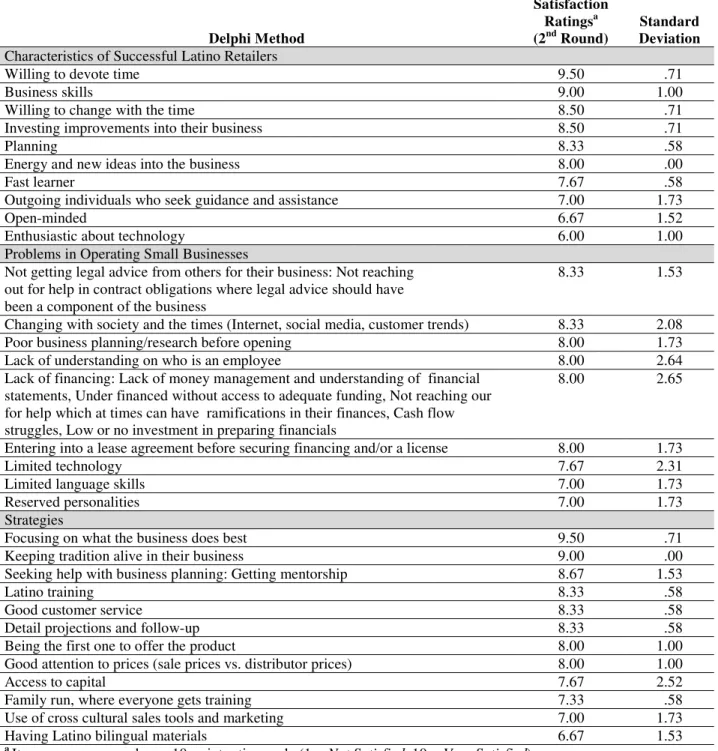
daycares. Latino retailers self-start businesses through community loans or purchase existing businesses from other Latino owners; self-started businesses are more successful. In addition, Latino community leaders reported that the primary problems faced by Latino retailers in
operating their businesses are lack of access to capital and financing and legal assistance, lack of business planning/information, and limited language and technology skills.
Table 1. Satisfaction Ratings for Response Codification for Delphi Method
Delphi Method
Satisfaction Ratingsa (2nd Round)
Standard Deviation Characteristics of Successful Latino Retailers
Willing to devote time 9.50 .71
Business skills 9.00 1.00
Willing to change with the time 8.50 .71
Investing improvements into their business 8.50 .71
Planning 8.33 .58
Energy and new ideas into the business 8.00 .00
Fast learner 7.67 .58
Outgoing individuals who seek guidance and assistance 7.00 1.73
Open-minded 6.67 1.52
Enthusiastic about technology 6.00 1.00
Problems in Operating Small Businesses
Not getting legal advice from others for their business: Not reaching out for help in contract obligations where legal advice should have been a component of the business
8.33 1.53
Changing with society and the times (Internet, social media, customer trends) 8.33 2.08
Poor business planning/research before opening 8.00 1.73
Lack of understanding on who is an employee 8.00 2.64
Lack of financing: Lack of money management and understanding of financial statements, Under financed without access to adequate funding, Not reaching our for help which at times can have ramifications in their finances, Cash flow struggles, Low or no investment in preparing financials
8.00 2.65
Entering into a lease agreement before securing financing and/or a license 8.00 1.73
Limited technology 7.67 2.31
Limited language skills 7.00 1.73
Reserved personalities 7.00 1.73
Strategies
Focusing on what the business does best 9.50 .71
Keeping tradition alive in their business 9.00 .00
Seeking help with business planning: Getting mentorship 8.67 1.53
Latino training 8.33 .58
Good customer service 8.33 .58
Detail projections and follow-up 8.33 .58
Being the first one to offer the product 8.00 1.00
Good attention to prices (sale prices vs. distributor prices) 8.00 1.00
Access to capital 7.67 2.52
Family run, where everyone gets training 7.33 .58
Use of cross cultural sales tools and marketing 7.00 1.73
Having Latino bilingual materials 6.67 1.53
a
To overcome these obstacles, Latino community leaders made several recommendations. The most important strategies were seeking advice from community organizations for business idea assessment and a feasibility analysis, as well as creating a business plan. Specifically, they recommended creating accurate/modest cash flow projections to reflect business growth in the next two years. They also suggested testing out the business in an incubator space for a year or two to see if small business retailers were able to finance an expansion. Figuring out commercial space options, understanding the target marketplace, and looking at several financing options were important recommendations for improving Latino retailers’ business strategies. They also reported that Latino retailers needed to obtain formal business education/training, follow all regulations, and use bilingual materials.
With regard to the future of Latino retail entrepreneurs, Latino community leaders reported that although the Latino retail market was expanding at a slow rate, the economy has influenced the number of Latino immigrants within the state. The next generation of Latinos will create market growth in Minnesota in the near future.
Case Study (Study 2)
The characteristics of the Latino community in Minnesota identified by Latino entrepreneurs included that it was an advantageous place to raise a family, there were good community organizations that provide advice for developing and maintaining small businesses, and that it was a growing community. Consistent with prior research (Nash, 2008; Smith, 2010), however, the Latino retail entrepreneurs we interviewed tended to rely on ethnic resources and ethnic solidarity between co-ethnics because they had generally started a business with a lack of resources and financial assistance. They also tended to rely on trusted relationships with their family or friends to operate their businesses. For example, they gained information about business locations, business permits, commercial laws, management practices, and reliable suppliers from their family and friends. Further, one participant indicated that the Latino business community had not yet fully developed. Needing further expansion was a community in which Latino entrepreneurs help each other out, share ideas, or hold events together for professional networking and information sharing. They stressed that there are many small businesses opening with a lack of strategic planning and education.
significant relevant job experiences; and try to give back to their communities (e.g., scholarship donations for Latino high school graduates and college students).
In terms of business characteristics and marketing activities, the Latino entrepreneurs were utilizing radio commercials, reviewing Web pages, and implementing image and reputation marketing strategies through brand logo, guerilla marketing strategies, coupons, promotions involving the family (i.e., kids eat free), and low pricing strategies. Further, realizing the importance of technology, they were conducting sales online for carryout, as well as using their register system to track customer purchases per transaction and sales per customer. Their management philosophy included a customer orientation, cleanliness, service, and quality. In addition, their target market was broader than just the Latino market, as they were trying to penetrate the mainstream market. To overcome these obstacles, it was recommended that the Latino retail entrepreneurs create a strategic business plan, obtain ongoing business
education/training to become experts, learn the laws and regulations related to running a business, and continually seek advice from consultants in community organizations.
Discussion and Implications
Although Latino retail entrepreneurship is a fast-growing segment in Minnesota, we found that Latino retail entrepreneurs still faced significant challenges, including a lack of business
planning, access to capital and networking, access to good suppliers, and marketing performance analysis. This finding points to several ways that Extension educators could stimulate the
growth of Latino representation in the retail business sector. First, Extension educators should understand that Latino retail entrepreneurs are a heterogeneous group. Some Latino retail entrepreneurs may have little formal education and limited English abilities and have different needs than the bilingual, successful Latino entrepreneurs. Extension educators can develop differentiated communication, networking, recruitment, and programming to enhance services to these different Latino audiences. Further, local Extension offices need to be well-equipped for this differentiation; the needs of the less (vs. more) assimilated Latino entrepreneurs should be assessed, and differential programming demands should be reflected in budgeting, resource allocation, and professional development.
Third, Extension educators can work closely with policy makers to (a) increase the state budget in its support of Latino retail entrepreneurship and establish a financial infrastructure for Latino retail entrepreneurs; (b) develop non-asset-based loan or funding programs for Latino retail business start-ups at the state level; and (c) find a means to deal with undocumented retail
workers in a state that benefit both the state (e.g., payment of income taxes), as well as the Latino retail workforce.
Finally, Extension educators can help Latino entrepreneurs to implement strategic business plans (i.e., accounts, operations, legislation, macro-environmental trend analysis, forecasting and demand measurement, and/or competitive positioning) and provide diverse business tools (i.e., bilingual regulatory aids, database of financial sources, and/or technical assistance). In addition, Extension organizations can further develop culturally-adapted programs to offer and promote. In addition to individual competence, Extension organizations can invest in hiring
bilingual/bicultural personnel, providing professional development opportunities, and developing bilingual/bicultural educational resources (Herndon et al., 2013).
This research should be considered with some limitations in mind. First, this is exploratory and descriptive research based on the Delphi method and the case study method conducted with a small number of Latino community leaders and entrepreneurs. Also, this research captures the experiences of successful Latino retail entrepreneurs in Minnesota. Therefore, it is not feasible to generalize the findings to all Latino entrepreneurs in other industry sectors or other contexts.
References
Blancero, D. M., DelCampo, R. G., & Marron, G. F. (2007). Perception of fairness of
psychological contracts by Hispanic business professionals: An empirical study in the United States. International Journal of Management, 24, 364–375.
Corrie, B. P. (2008). Ethnic capital and Minnesota’s future. Retrieved from http://www.ethnictrends.info/pdfs/EthnicCapitalLiberians.pdf
Fairlie, R. W., & Woodruff, C. (2007). Mexican entrepreneurship: A comparison of self-employment in Mexico and the United States. Retrieved from http://www.nber.org /chapters/c0100.pdf
Fennelly, K., & Huart, A. (2010, March). The economic impact of immigrants in Minnesota.
Northwest Area Foundation. Retrieved fromhttp://www.hhh.umn.edu/people /kfennelly/pdf/eco_impacts_report_2010.pdf
Herndon, M. C., Behnke, A. O., Navarro, M., Daniel, J. B., & Storm, J. (2013). Needs and perceptions of Cooperative Extension educators serving Latino populations in the South.
Journal of Extension, 51(1), 1FEA7. Retrieved from http://www.joe.org/joe/2013february /a7.php
Hughes, A. (2004). Minnesota’s Hispanic market grows along with population. Minnesota Public Radio. Retrieved fromhttp://news.minnesota.publicradio.org/features/2004 /06/17_hughesa_business/
Kandel, W. H., & Cromartie, J. (2004). New patterns of Hispanic settlement in rural America.
United States Department of Agriculture Rural Development Research Report, 99, 1–44. Retrieved from http://www.ers.usda.gov/ersDownloadHandler.ashx?file=/media
/561319/rdrr99_1_.pdf
Masurel, E., Nijkamp, P., & Vindigni, G. (2004). Breeding places for ethnic entrepreneurs: A comparative marketing approach. Entrepreneurship & Regional Development, 16(1), 77– 86. doi:10.1080/0898562042000205045
Missouri Economic Research and Information Center (2005, April). Latino entrepreneurs in Missouri: Policy implications for small business assistance programs. Missouri Economic Research and Information Center, Missouri Department of Economic Development.
Retrieved from http://www.missourieconomy.org/pdfs/latino_entrepreneurs.pdf Nash, B. J. (2008). Immigrant entrepreneurs: Talent, technology, and jobs. Region Focus, Fall,
20–22.
Okoli, C., & Pawlowski, S. D. (2004). The Delphi method as a research tool: An example, design considerations and applications. Information & Management, 42(1), 15–29.
doi:10.1016/j.im.2003.11.002
Raijman, R., & Tienda, M. (1999). Immigrants’ socioeconomic progress post-1965: Forging mobility or survival? New York, NY: Russell Sage Foundation.
Robles, B. J., & Cordero-Guzmán, H. (2007). Latino self-employment and entrepreneurship in the United States: An overview of the literature and data sources. The ANNALS of the American Academy of Political Science, 613(1), 18–31. doi:10.1177/0002716207303541 Rowe, G., & Wright, G. (2001). Expert opinions in forecasting: The role of the Delphi technique.
In J. S. Armstrong (Ed.), Principles of forecasting: A handbook for researchers and practitioners (pp. 125–144). Boston, MA: Kluwer Academic.
Smith, R. A. (2010). Latino entrepreneurs in nontraditional destinations: The case of Northern Utah (Doctoral dissertation). Retrieved from http://digitalcommons.usu.edu/etd/814 StarTribune. (2009, January 26). Hispanics expected to become Minnesota’s largest minority
group in 10 years. Retrieved from http://www.startribune.com/local/38429674
U.S. Census Bureau. (2006, August). Hispanic-owned firms: 2002 economic census. Retrieved from http://www.census.gov/prod/ec02/sb0200cshisp.pdf
Volery, T. (2007). Ethnic entrepreneurship: A theoretical framework. In L. P. Dana (Ed.),
Waldinger, R., Aldrich, H., & Ward, R. (1990). Opportunities, group characteristics, and strategies. In R. Waldinger, H. Aldrich, & R. Ward (Eds.), Ethnic entrepreneurs: Immigrant business in industrial societies (pp. 13–48). London, England: Sage. Yin, R. K. (1984). Case study research: Design and methods. Newbury Park, CA: Sage.
Zarrugh, L. H. (2007). From workers to owners: Latino entrepreneurs in Harrisonburg, Virginia.
Human Organization, 66(3), 240–248.
Hye-Young Kim is an Assistant Professor in the Retail Merchandising Program at the University of Minnesota. Kim’s research interests include strategic retail management and ethnic minority entrepreneurship.
Kim K. P. Johnson is a Professor in the Retail Merchandising Program at the University of Minnesota. Her teaching and research interests include consumer behavior related to apparel and social responsibility.
Ju-Young M. Kang is an Assistant Professor in the Fashion Design and Merchandising Program at the University of Hawaii. Kang’s research interests center on retail entrepreneurship and consumer behavior in e-commerce.
Ji Young Lee is an Assistant Professor in Fashion and Textiles at the State University of New York at Oneonta. Lee’s research interests include corporate social responsibility and consumer behavior in the multichannel environment.
Acknowledgement