http://dx.doi.org/10.1590/S0085-56262014000100003
Sais Hübner, 1816 is an unmistakable Neotropical
ge-nus of the Ithomiini (Nymphalidae, Danainae)
characteri-zed by the long discal cell of the hindwing, elongated to
nearly seven eights of the wing length, and the condition of
the Sc and R of the female hindwing, coalesced almost to
the end of the discal cell (Fox 1967). The genus has been
long acknowledged as belonging to Mechanitina, a subtribe
recently recognized as monophyletic by Willmott & Freitas
(2006). The genus encompasses two species: S. browni
Takahashi, 1977, distributed in southeastern Colombia and
southern Venezuela (Takahashi 1977; Neild 2008), and Sais
rosalia (Cramer, 1779), widely distributed throughout South
America, from northern Colombia to southern and
south-eastern Brazil, with eleven recognized subspecies (Lamas
2004). Sais rosalia can be distinguished from S. browni by
strong differences in color pattern, venation of the wings
and by the presence of a long, instead of short, downward
spine in the tip of the valva of S. rosalia (D’Almeida & Fox
1941; Fox 1967; Takahashi 1977; Neild 2008). Sais rosalia
flies low and slowly in the shade in somewhat open forest
areas near swamps, rivers or streams, occasionally
search-ing for flowersearch-ing plants and restsearch-ing on the undergrowth in
the forest edges (Collenette & Talbot 1928). The species
uses as host plant a vine of the genus Lycianthes (Dunal)
Hassl. (Solanaceae) and their immature stages are
gener-ally similar to other described Mechanitina (Drummond &
Brown 1987; Freitas & Brown 2002).
MATERIAL AND METHODS
The distribution map and the information presented here
are based on personal observations by the authors, original
de-scriptions and type localities of the taxa involved, 413
speci-mens deposited in four collections from Brazil, Paraguay and
Peru, and literature data (D’Almeida & Fox 1941; Fox 1967;
Brown & Mielke 1967, 1968; Brown 1979; Brown 1987;
La-mas 1994a,b,c,d; Mielke & Casagrande 1992, 1998; Freitas &
Brown 2002; Motta 2002; Garwood et al. 2007); the taxonomy
follows Lamas (2004) and Willmott & Freitas (2006), modified
after Wahlberg et al. (2009), who treated Ithomiini as a tribe,
downranking previously recognized tribes to subtribes. The
sche-matic illustrations of the habitus of the taxa are based on
photo-graphs of type specimens (Warren et al. 2013). The collections
examined and their acronyms are as follows: CE-MTG/IB –
Colección de Entomología, Museo de la Tierra Guaraní, Itaipú
Binacional, Hernandarias, Paraguay; CMNH – Carnegie
Mu-seum of Natural History, Pittsburgh, United States; DZUP –
Coleção Entomológica Pe. Jesus S. Moure, Universidade
Fede-ral do Paraná, Curitiba, Brazil; IOC – Instituto Oswaldo Cruz,
Rio de Janeiro, Brazil; MfN – Museum für Naturkunde, Berlin,
Germany; MNHNPY – Museo Nacional de Historia Natural
del Paraguay, San Lorenzo, Paraguay; MUSM – Museo de
Historia Natural, Universidad Nacional Mayor de San Marcos,
Lima, Peru; NHM – Natural History Museum, London, England;
NHRM – Naturhistoriska Riksmuseet, Stockholm, Sweden.
Notes on the geographic distribution and subspecific taxonomy of
Sais
rosalia
(Cramer) (Lepidoptera, Nymphalidae, Ithomiini), including the
first records in Paraguay
Sergio D. Ríos Díaz
1, Fernando M. S. Dias
2, Mirna M. Casagrande
2, Olaf H. H. Mielke
2& Gerardo Lamas
31Museo Nacional de Historia Natural del Paraguay, Sucursal 1 Campus, Central XI, San Lorenzo, Paraguay. Facultad de Ciencias Exactas y
Naturales. Universidad Nacional de Asunción. Corresponding author. [email protected]
2Departamento de Zoologia, Universidade Federal do Paraná, Laboratório de Estudos de Lepidoptera Neotropical, Caixa Postal 19.020.
81531–980 Curitiba-PR, Brazil. [email protected]; [email protected]; [email protected]
3Universidad Nacional Mayor de San Marcos, Museo de Historia Natural, Departamento de Entomología. Apartado 14–0434. Lima, Perú.
[email protected], [email protected]
ABSTRACT.Notes on the geographic distribution and subspecific taxonomy of Sais rosalia (Cramer) (Lepidoptera, Nymphalidae,
Ithomiini), including the first records in Paraguay. This paper provides comments on the subspecific taxonomyand geographic distribution of Sais rosalia (Cramer, 1779) (Lepidoptera, Nymphalidae, Ithomiini), as well as an up-to-date distributional map,
complemented with unpublished distributional data based on specimens deposited in the Coleção Entomológica Pe. Jesus S. Moure, Curitiba, Brazil and the Museo de Historia Natural, Lima, Peru. The following synonyms are proposed: Sais rosalia camariensis Haensch, 1905 syn. rev. as junior subjective synonym of Papilio rosalia Cramer, 1779 and Sais rosalia brasiliensis
Talbot, 1928 syn. rev. as junior subjective synonym of Sais rosalia rosalinde Weymer, 1890. Additionally, the first country
12
Ríos Díaz et al.
RESULTS AND DISCUSSION
Paraguayan records.
The first records of Sais rosalia
from Paraguay (Figs. 1–3, 6) are two specimens from Refugio
Biológico Mbaracayú, Department of Canindeyú, collected
in March, 2004 (deposited in the CE-MTG/IB) (Figs. 2–3);
another specimen was photographed and collected by the first
author in a degraded forest patch in Hernandarias,
Depart-ment of Alto Paraná, in December, 2011 (deposited in the
MNHNPY) (Fig. 1). The specimens from Paraguay agree
perfectly with the holotype of S. r. brasiliensis Talbot, 1928,
a subspecies originally described from the state of Mato
Grosso, Brazil (Fig. 6).
These are to date the southernmost records for Sais
rosalia, a species generally regarded in the literature as
“Ama-zonian”, but also present in very restricted and local
popula-tions in the Atlantic interior forests, and intrusions of riparian
forests within the Cerrado Biome. These records from
Para-guay are not totally unexpected, as there are specimens
col-lected on the left (east) banks of the Paraná River, in the
border municipality of Guaíra, Paraná, Brazil; there is a single
specimen caught in August, 1923, deposited in the DZUP
and labeled “Guaíra, Alto [Upper] Paraná”. Additionally, Olaf
H. H. Mielke and Herbert Miers collected a large series of
56 specimens in February, 1978, in the now extinct Parque
Nacional das Sete Quedas, and 12 more specimens were
collected in the following years in the same region by Olaf
H. H. Mielke and Mirna M. Casagrande, before the whole
area was flooded by the reservoir of the Itaipu dam in 1982.
The tributaries of the Paraná River and the Paraná River
itself were extensively collected in the past and recently by
the authors and other collectors, and no new specimens were
caught in the state of Paraná until recently, when three
speci-mens were collected in the municipality of Diamante do
Norte, one in October, 2009 and two in January, 2011, and a
larger series of 22 specimens was collected and many more
seen in the municipality of Alto Paraíso in October, 2012 (16
specimens deposited in the DZUP and 6 in MUSM). The
Parque Nacional do Iguaçu, the largest remnant of Atlantic
interior forest in the state, and several localities in the
Misiones province, Argentina, were also extensively sampled
through the years and no specimens of Sais rosalia were ever
recorded (R. Greve, pers. comm., E. Núñez-Bustos, pers.
comm.).
As regards neighboring areas along the River Paraná and
its tributaries, there is still no record of Sais rosalia in the
state of Mato Grosso do Sul (Brown 1987) and the most
re-cent record in the state of São Paulo is a single specimen
collected in the municipality of Teodoro Sampaio, in the
Parque Estadual Morro do Diabo, in August, 1989 (Mielke
& Casagrande 1998), although there are records of Sais
rosalia in other localities of the state of São Paulo from older
collections (Fig. 6). As Brown & Mielke (1967, 1968) and
the available material suggest, Sais rosalia seems to be a very
localized, but abundant species in small, particular locations
and seasons.
Taxonomy and geographic distribution of the
subspe-cies.
As noted by Fox (1967), S. rosalia is so intraspecifically
variable that it is difficult to separate into diagnosable
sub-species and there seems to be little consensus on which name
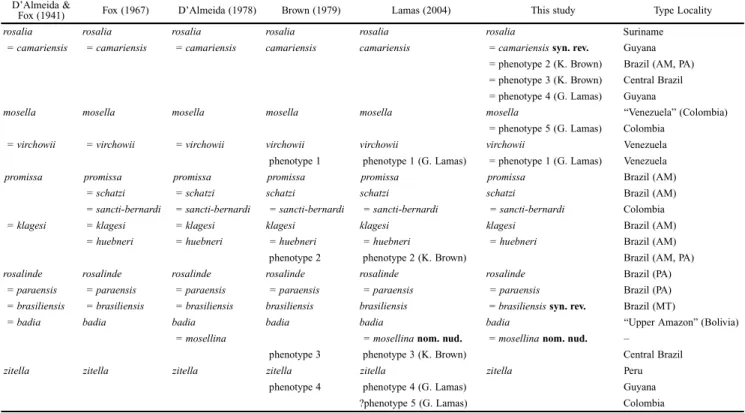
to apply to each phenotype (Table I). Significant individual
variation can be observed even in specimens from a single
locality and date. Fifteen names, including one nomen
nu-dum, were proposed to describe that variation, although eleven
names are currently regarded as valid (Lamas 2004). Other
four (Brown 1979) or five (Lamas 2004) undescribed
sub-species have also been listed (Table I), but no new taxon was
described since 1953 (Bryk 1953).
The last comprehensive revisions of the genus were
car-ried out by D’Almeida & Fox (1941) and Fox (1967). While
the former recognized five subspecies, S. r. rosalia (Cramer,
1779), S. r. promissa Weymer, 1883, S. r. mosella (Hewitson,
1867),
S. r. zitella (Hewitson, 1868), and S. r. rosalinde
(Weymer, 1890) (= S. paráensis [sic] Haensch, 1905), the
latter recognized six, adding S. r. badia Haensch, 1905 as
valid (Table I). If one follows the arrangement proposed by
D’Almeida & Fox (1941) and Fox (1967), the specimens from
Paraguay and southern and southeastern Brazil would be
iden-tified as S. r. rosalinde. In fact, this is the name usually
adopted by most authors who identified specimens from these
localities (e.g. Brown & Mielke 1967, 1968; Brown 1987;
Mielke & Casagrande 1998; Freitas & Brown 2002; Motta
2002). However, based on the series of specimens deposited
in the DZUP and MUSM, the characters used by Talbot (in
Collenette & Talbot 1928) to differentiate S. r. brasiliensis
from S. r. rosalinde (as “paraensis”) – reduction of the
forew-ing yellow postdiscal band and of the hindwforew-ing black discal
spots above, and diminished size of the hindwing white
mar-ginal spots below – are subject to individual and not
geo-graphical variation. Brown (1979) suggests a new subspecies
(“phenotype 3”, Table I) occurring in the states of Mato
Grosso, Pará and Amazonas, Brazil, which conforms to the
above described variation. Such variation does not appear to
have a clinal nature or geographic correlation, since the same
variation is observable along its entire distributional range.
Therefore S. r. brasiliensis
syn. rev.
is considered herein a
junior subjective synonym of S. r. rosalinde.
one from Bolivia (Cochabamba) are housed at MUSM. Sais
rosalia badia seems to be associated with the southeastern
Peruvian and northwestern Bolivian Amazon River basin (i.e.
Rio Madeira drainage), which includes the Purus, Madre de
Dios, Beni and Mamoré Rivers and the west drainage of the
Guaporé River (Fig. 6).
Of the other taxa not previously associated with S. r.
rosalinde, S. r. mosella and S. r. virchowii Dewitz, 1877
rep-resent two geographically isolated populations in north South
America, the first occurring in extreme northern Colombia,
the second extending from central Colombia and
northwest-ern Venezuela, east to the Orinoco River delta (Fig. 6).
D’Almeida & Fox (1941), Fox (1967) and D’Almeida (1978)
agree that they represent the same subspecies. Brown (1979)
suggested the presence of a new subspecies (“phenotype 1”,
Table I, Fig. 6) in the Catatumbo region of Venezuela but, as
discussed by Neild (2008), the phenotype occurring in that
region most likely represents intergrades between
popula-tions of S. r. mosella and S. r. virchowii, although no typical
mosella have been found in Venezuela.
Sais rosalia rosalia occurs in northeastern and southern
Venezuela east of the Orinoco River delta, Guyana, Suriname,
French Guiana, the Brazilian states of Roraima, Amazonas
and Pará north of the Amazon River, and in northwestern
Maranhão, southeast of the Amazon delta (Fig. 6) (D’Almeida
& Fox 1941; Fox 1967; D’Almeida 1978). Brown (1979) and
Lamas (2004) recognize S. r. rosalia and S. r. camariensis as
two distinct subspecies, separated by the Essequibo River,
Guyana: S. r. camariensis to the west and S. r. rosalia to the
east of that river (Brown 1979). However, examining the types
of those names and a series of 43 specimens deposited in the
DZUP and the MUSM, S. r. camariensis Haensch, 1905
syn.
Figs. 4–5. Sais rosalia (Cramer, 1779) from Óbidos, Pará, Brazil; phenotype suggested as a new subspecies by Brown (1979) and Lamas (2004). 4. Dorsal. 5. Ventral. Scale bar = 1cm.Figs. 1–3. Sais rosaliarosalinde Weymer, 1890 from Paraguay. 1. Live male specimen from Hernandarias, Department of Alto Paraná. 2–3. Male specimen from Mbaracayú, Department of Canindeyú. 2. Dorsal. 3. Ventral. Scale bar = 1cm.
1
2
3
14
Ríos Díaz et al.
nov.
is recognized as a junior subjective synonym of S. r.
rosalia. Brown (1979) suggests the occurrence of an
undescribed subspecies (“phenotype 4”, Table I, Fig. 6)
simi-lar to S. r. rosalia, but with a mostly black hindwing, in
south-eastern Guyana. The undescribed subspecies is probably just
a melanic form of S. r. rosalia. Another undescribed
subspe-cies (“phenotype 2”, Table I, Fig. 6), occurring between the
junction of the Negro and Solimões Rivers, and the Trombetas
River is suggested by Brown (1979). There are in the DZUP
a series of three specimens from Óbidos, Pará, which agree
perfectly with the illustration presented by Brown (1979) for
this undescribed taxon. All three specimens are similar to S.
r. rosalia, but with very narrow yellow postdiscal band in the
forewing and generally darker in color (Figs. 4–5). A
pos-sible original syntype of rosalia in Leiden (ex Calkoen), from
Surinam, also has a narrow FW yellow postdiscal band.
Six names where proposed to describe specimens from
the western part of the Amazon basin, although only four are
currently accepted as valid (Table I): S. r. klagesi Avinoff,
1926 (= S. promissa race huebneri
Zikán, 1941), S. r.
promissa,
S. r. schatzi Zikán, 1941 (= S. rosalia
sancti-bernardi [sic] Bryk, 1953) and S. r. zitella. Fox (1967) and
D’Almeida (1978) retained only two of these: S. r. zitella,
distributed in the extreme west of the state of Amazonas,
western Acre, extreme southeastern Colombia, eastern
Ec-uador, and central and northern Peru; and S. r. promissa, in
southern and southwestern Amazonas, central and eastern
Acre, northern Rondônia, extreme northern Peru and
south-ern Colombia. Both taxa are easily characterized by the large
black longitudinal stripes between some veins of the hindwing
and the darker, brownish red color of the base of the wings.
Examining the types, 32 specimens deposited in the DZUP
and 34 specimens in MUSM, S. r. zitella generally has the
yellow postdiscal band narrow and the submarginal orange
area well developed along the whole outer margin of the
forewing, while S. r. promissa has the yellow postdiscal band
wide and the submarginal orange area rudimentary or
ab-sent. There is, however, much individual variation and
inter-mediate specimens between these phenotypes, especially in
the triple boundary between Brazil, Peru, and Colombia,
where the two phenotypes occur sympatrically, in various
combinations. Nevertheless, S. r. zitella appears to be
asso-ciated with the Napo and Ucayali basins in Peru, and the
upper Juruá basin in Brazil, and S. r. promissa with the lower
Putumayo and Caquetá Rivers in Colombia (Içá and Japurá
Rivers in Brazil, respectively) and other rivers to the south of
the Solimões and the Amazon River in Brazil, east to the
Madeira River (Fig. 6).
Of the two remaining currently recognized taxa only S. r.
schatzi is clearly distinct, being lighter in color when
com-pared with S. r. promissa and S. r. zitella; with wide postdiscal
yellow band, and without submarginal orange band on the
forewing, and mostly orange hindwing with reduced black
discal spots. Sais rosalia schatzi occurs along the upper
Ne-gro and Vaupés Rivers (Uaupés River in Brazil) and
tributar-ies in the extreme northwest of the state of Amazonas,
southern Venezuela, southeastern Colombia and in extreme
northern Peru (Brown 1979; Neild 2008). This subspecies
Table I. Subspecific taxonomy of Saisrosalia (Cramer, 1779) according to some authors and their type localities. Equal signs indicate synonyms; author names in parenthesis indicate the authority of phenotypes previously supposed to be new taxa, according to Lamas (2004); country names in quotation marks and parenthesis indicate spurious type locality and probable type locality, respectively. Question mark indicates a taxon with an unknown phenotype and distribution. AM: Amazonas; PA: Pará; MT: Mato Grosso.
D’Almeida &
Fox (1941) Fox (1967) D’Almeida (1978) Brown (1979) Lamas (2004) This study Type Locality
rosalia rosalia rosalia rosalia rosalia rosalia Suriname
= camariensis = camariensis = camariensis camariensis camariensis = camariensissyn. rev. Guyana = phenotype 2 (K. Brown) Brazil (AM, PA) = phenotype 3 (K. Brown) Central Brazil = phenotype 4 (G. Lamas) Guyana
mosella mosella mosella mosella mosella mosella “Venezuela” (Colombia) = phenotype 5 (G. Lamas) Colombia
= virchowii = virchowii = virchowii virchowii virchowii virchowii Venezuela phenotype 1 phenotype 1 (G. Lamas) = phenotype 1 (G. Lamas) Venezuela
promissa promissa promissa promissa promissa promissa Brazil (AM)
= schatzi = schatzi schatzi schatzi schatzi Brazil (AM)
= sancti-bernardi = sancti-bernardi = sancti-bernardi = sancti-bernardi = sancti-bernardi Colombia
= klagesi = klagesi = klagesi klagesi klagesi klagesi Brazil (AM)
= huebneri = huebneri = huebneri = huebneri = huebneri Brazil (AM)
phenotype 2 phenotype 2 (K. Brown) Brazil (AM, PA)
rosalinde rosalinde rosalinde rosalinde rosalinde rosalinde Brazil (PA)
= paraensis = paraensis = paraensis = paraensis = paraensis = paraensis Brazil (PA)
= brasiliensis = brasiliensis = brasiliensis brasiliensis brasiliensis = brasiliensissyn. rev. Brazil (MT)
= badia badia badia badia badia badia “Upper Amazon” (Bolivia)
= mosellina = mosellinanom. nud. = mosellinanom. nud. –
phenotype 3 phenotype 3 (K. Brown) Central Brazil
zitella zitella zitella zitella zitella zitella Peru
phenotype 4 phenotype 4 (G. Lamas) Guyana
intergrades with S. r. rosalia in the northern part of its
distri-bution (Fig. 6) (Neild 2008). Conversely, Sais rosalia klagesi
is very similar to S. r. promissa but occurs in the middle and
lower Solimões (Amazon River), Purus and Madeira Rivers
(Fig. 6) (Brown 1979), representing the darker phenotype
with wide postdiscal yellow band and without the
submar-ginal dark orange band on the forewing.
The use and usefulness of the subspecies rank is a
conten-tious matter (Wilson & Brown 1953; Mallet 2007) and
sub-species recognition and delimitation are highly subjective
practices, even more considering mimetic species with high
individual variation and intermediate phenotypes in
intraspe-cific hybridization zones. However, the subspecies concept may
prove useful for those interested in intraspecific geographical
variation and parapatric speciation models. Such a concept is
helpful as a means of describing the variability in the biology
and ecology of infraspecific units (Lanyon 1982), such as
varia-tion in behavior, host plant use, morphology, biogeography,
and genetic composition (Brown 1975).
Material examined. Sais rosalia badia. “Ober Amazon” (Holotype of
16
Ríos Díaz et al.
men, DZUP). PERU. Madre de Dios: R.N. Tambopata, 27.X.1991, Mielke leg. (1 specimen, DZUP); R.N. Tambopata, 28.X.1991, Casagrande leg. (1 specimen, DZUP); Tambopata, I.1995. Fratello leg. (2 specimens, MUSM); Puerto Maldonado, 23.X.1975, Schunke leg. (1 specimen, MUSM); 15 km E Puerto Maldonado, 7.XI.1988. Lamas leg. (1 speci-men, MUSM); 15 km E Puerto Maldonado, 20.VI.1989. Lamas leg. (1 specimen, MUSM); Boca Río La Torre, 23.IX.1981, Lamas leg. (1 speci-men, MUSM); Boca Río La Torre, 2.X.1981, Lamas leg. (1 specispeci-men, MUSM); Boca Río La Torre, 3.X.1981, Lamas leg. (1 specimen, MUSM); Boca Río La Torre, 27.X.1981, Lamas leg. (1 specimen, MUSM); Boca Río La Torre, 22.X.1982, Lamas leg. (1 specimen, MUSM); Boca Río La Torre, 2.III.1983, Lamas leg. (1 specimen, MUSM); Boca Río La Torre, 17.IX.1989, Lamas leg. (1 specimen, MUSM); Pampas del Heath, 16.VI.1992, Lamas leg. (1 specimen, MUSM); Pampas del Heath, 18.VI.1992, Lamas leg. (1 specimen, MUSM); Río Los Amigos, 7.VII.2003, Peña leg. (1 specimen, MUSM); Río Los Amigos, 23.VIII.-15.IX.2008, Carbonel leg. (1 specimen, MUSM). Ucayali: Río Purus, San Bernardo, 30.V.-8.VI.2000, Hocking leg. (1 specimen, MUSM). Sais rosalia klagesi. BRAZIL. Amazonas: Huitanaa, III.1922, Klages leg. (Type of Sais rosalia klagesi Avinoff, 1926, CMNH); Rio Purus, IV.1927, Zikán leg. (Holotype of Saispromissa r. huebneri Zikán, 1941, IOC). Sais rosalia mosella. COLOMBIA. “Venezuela” (Syntype of Ithomia mosella
Hewitson, 1867, NHM). Sais rosalia promissa. BRAZIL. Acre: Médio Juruá (1 specimen, DZUP); Fonte Boa, XI.1937, Wuderpfemmig leg. (3 specimens, DZUP); Tarauacá, 30.XII.1957, Ebert leg. (1 specimen, DZUP); Tarauacá, 26.V.1977, Ebert leg. (4 specimens, DZUP). Amazonas: Tabatinga, 1881 (Lectotype of Sais promissa Weymer, 1883, MfN); Ben-jamin Constant, VIII. 1942, Parko leg. (1 specimen, DZUP); São Paulo de Olivença, 6.IV.1961, Kesselring leg. (1 specimen, DZUP); São Paulo de Olivença, X.1961. Ebert ex-coll. (1 specimen, DZUP); São Paulo de Olivença, XII.1961, Ebert ex-coll. (1 specimen, DZUP); Rio Japura, Copaçu, II.1964, Büche leg. (1 specimen, MUSM). Sais rosalia rosalia.
BRAZIL. Amapá: Serra do Navio, 26.VII.2007, Mielke & Casagrande leg. (4 specimens, DZUP). Amazonas: 7.VI.2010, Mielke & Casagrande leg. (4 specimens, DZUP); Ararão, Padauari, 10.VII.2010, Mielke & Casagrande leg. (6 specimens, DZUP); Negro, Carvalho leg. (1 speci-men, DZUP). Pará: Óbidos, IV.1969, Kesselring leg. (3 specimens, DZUP); Puxuri, Paru do Leste, 18.VII.1952, Carvalho leg. (3 specimens, DZUP); Puxuri, Paru do Leste, 2.VIII.1952, Carvalho leg. (1 specimen, DZUP); Trompetas, IBDF, 7.XII.1978, Rauy leg. (1 specimen, DZUP). Roraima: 10km E, 2º50’ N 60º35’W, 12.XI.1979, Gifford leg. (5 specimens, DZUP); Catrimani, 1º45’N 62º17’W, 9.XI.1979, Gifford leg. (2 specimens, DZUP); Ilha de Maracá, 14.XI.1979, Gifford leg. (2 specimens, DZUP); Ilha de Maracá, 20.XI.1979, Gifford leg. (1 specimen, DZUP); Ilha de Maracá, 21.XI.1979, Gifford leg. (4 specimens, DZUP); Ilha de Maracá, 22.XI.1979, Gifford leg. (3 specimens, DZUP); Ilha de Maracá, 23.XI.1979, Gifford leg. (1 specimen, DZUP); Ilha de Maracá, 31.VIII.1987, Mielke & Casagrande leg. (7 specimens, DZUP); Ilha de Maracá, 2.XII.1987, Mielke & Casagrande leg. (2 specimens, DZUP). FRENCH GUIANA. (2 specimens, DZUP). Inini: Maripasoula, 17.XII.1986 (1 specimen, MUSM); Maripasoula, 3.V.1987 (1 specimen, MUSM). GUIANA. Cuyuni-Mazaruni: Camaria (Lectotype of Sais camariensis Haensch, 1905, MfN). Upper Takutu-Upper Essequibo: Rupununi Cattle, Essequibo-Demerara, IV.1940 (1 specimen, DZUP). SURINAME. Marowijne: Anapaike, Rio Lawa, 27.XI.1963, Malkin leg. (1 specimen, MUSM). Sipaliwini: Tijgerdam, IV.1966, De la Fontaine leg. (Neotype of Papilio rosalia Cramer, [1779], CMNH) VENEZUELA.
Amazonas: Ocama, 16.IV.1965, Fernández leg. (MUSM). Sais rosalia rosalinde. BRAZIL. Amazonas: Negro (1 specimen, DZUP). Espírito Santo: Linhares, IX.1981, Elias leg. (5 specimens, DZUP); Linhares, IX.1982, Elias leg. (4 specimens, DZUP). Goiás: Campinas, 16.XII.1935 (2 specimens, DZUP); Córrego Paciencia, 30.VI.1980 (1 specimen, DZUP); Goiás Velho, 20.VI.1976, Gifford leg. (1 specimen, DZUP); Goiânia, 24.V.1969, Brown leg. (3 specimens, MUSM); Goiânia, 11.X.1969, Brown leg. (6 specimens, MUSM); Nova Gloria, 2.IX.1978 (1 specimen, DZUP). Mato Grosso: Tombador, S Diamantino, 20-27.VIII.1927, Collenette leg. (Holotype of Sais rosalia brasiliensis
Tal-bot, 1928, NHM); Arinos, Faz, São João, 31.VII.1979, Furtado leg. (2 specimens, DZUP); Arinos, Faz, São João, 24.VIII.1985, Furtado leg. (1 specimen, DZUP); Barra do Garças, 25.VII.1968, Elias leg. (10 speci-mens, DZUP); Barra do Garças, 16.I.1977, Elias leg. (2 specispeci-mens, DZUP); Chapada dos Guimarães, 26.VI.1972, Mielke & Brown leg. (1 specimen, DZUP); Paraguai, 14.IV.1974, Furtado leg. (1 specimen, DZUP); Paraguai, 29.VII.1974, Ebert leg. (2 specimens, DZUP); Serra Norte, 8.IX.1978, Gifford leg. (1 specimen, DZUP); Xingu, 18.VII.1978, Gifford leg. (11 specimens, DZUP); Xingu, 20.VII.1978, Gifford leg. (3 specimens, DZUP); Barra do Tapirapé, XI.1964, Malkin leg. (1 specimen, DZUP). Minas Gerais: Doce, III.1951, Machado leg. (1 specimen, DZUP); Doce, 20.IX.1974 (5 specimens, DZUP); Paracatu, 15.V.1969, Ebert leg. (1 speci-men, DZUP); Paracatu, 13.IX.1969, Ebert leg. (1 specispeci-men, DZUP); P.E. do Rio Doce, 14.XII.1971, Ebert leg. (1 specimen, DZUP); P.E. do Rio Doce, 8.IX.1972, Ebert leg. (1 specimen, DZUP); P.E. do Rio Doce, 14.XII.1972, Ebert leg. (1 specimen, DZUP); P.E. do Rio Doce, 19.I.1974, Ebert leg. (1 specimen, DZUP); P.E. do Rio Doce, 19.II.1972, Ebert leg. (1 specimen, DZUP); P.E. do Rio Doce, 13.V.1974, Ebert leg. (1 speci-men, DZUP); P.E. do Rio Doce, 19.XII.1974, Ebert leg. (1 specispeci-men, DZUP). Pará: Rio Tocantins, 22.IX.1875 (Holotype of Sais rosalia rosalinde Weymer, 1890, MfN); 1.II. 1895 (Lectotype of Sais paraensis
Haensch, 1905, MfN) Alcocaba, Tucuruí (1 specimen, DZUP); Belém Brasilia, km 567, 3.IX.1978, Gifford leg. (1 specimen, DZUP); Jacareacanga, 13.IX.1978, Gifford leg. (1 specimen, DZUP); Redenção, 19.VII.1976 (1 specimen, DZUP); Rio Ari, km 1288 Cuiabá-Santarém, 19.VII.1978, Callaghan leg. (1 specimen, MUSM). Paraná: E.E. Caiuá, 6.X.2009, Carneiro, Dias, Dolibaina & Leite leg. (1 specimen, DZUP); E.E. Caiuá, 28.I.2012, Dolibaina & Salik (2 specimens, DZUP); Fazenda Lupus, 3.X.2012, LELM & Lamas leg. (16 specimens, DZUP); Guaíra, 1.V.1980, Mielke & Casagrande leg. (2 specimens, DZUP); Guaíra, 5.III.1981, Mielke & Casagrande leg. (9 specimens, DZUP); Guaíra, 8.X.1982, Mielke & Casagrande leg. (1 specimen, DZUP); Paraná, 8.VIII.1923 (1 specimen, DZUP); P.N. das Sete Quedas, 16.II.1978, Mielke & Casagrande leg. (56 specimens, DZUP); P.N. Ilha Grande, 3.X.2012, Lamas leg. (5 specimens, MUSM); P.N. Ilha Grande, 4.X.2012, Lamas leg. (1 specimen, MUSM). Rondônia: Pimenta Bueno, V-VI.1970, Brown leg. (3 specimens, DZUP); Pimenta Bueno, VI.1970, Brown leg. (3 speci-mens, MUSM); Pimenta Bueno, VIII.1970, Brown leg. (5 specispeci-mens, DZUP); Pimenta Bueno, VIII-IX.1970, Brown leg. (3 specimens, DZUP); Pimenta Bueno, IX-X.1970, Brown leg. (1 specimen, DZUP); Pimenta Bueno, 4.VI.1971, Ebert leg. (2 specimens, DZUP); Pimenta Bueno, 9.VI.1971, Ebert leg. (1 specimen, DZUP); Vilhena, 21.IX.1978, Gifford leg. (1 specimen, DZUP). São Paulo: 15.V.1962, Ebert leg. (1 specimen, DZUP); Auanhandava, VI.1950, Berla leg. (2 specimens, DZUP); Dos Dourados, 3.III.1951, Hashimoto leg. (1 specimen, DZUP); Ilha Solteira, 16.VII.1972, Mielke & Brown leg. (4 specimens, DZUP); P.E. Morro do Diabo, 19.VIII.1989, Mielke & Casagrande leg. (1 specimen, DZUP).
Tocantins: Ilha do Bananal, Gifford leg. (1 specimen, DZUP); Ilha do Bananal, 7.IX.1978 Gifford leg. (3 specimens, DZUP);Ilha do Bananal, 14.VI.1979, Gifford leg. (2 specimens, DZUP); Ilha do Bananal, 21.VI.1979 Gifford leg. (6 specimens, DZUP); Ilha do Bananal, 22.VI.1979 Gifford leg. (1 specimen, DZUP); Ilha do Bananal, 23.VI.1979 Gifford leg. (3 specimens, DZUP); Ilha do Bananal, 21.VI.1979 Gifford leg. (6 specimens, DZUP); Ilha do Bananal, 24.VI.1979 Gifford leg. (5 speci-mens, DZUP); Ilha do Bananal, 29.VI.1979 Gifford leg. (6 specispeci-mens, DZUP); Ilha do Bananal, 11.IX.1979 Gifford leg. (1 specimen, DZUP); Ilha do Bananal, IX.1980 Gifford leg. (2 specimens, DZUP). PARAGUAY.
Alto Paraná: Hernandarias, 28.XII.2011, Ríos Díaz leg. (1 specimen, MNHNPY). Canindeyú: Refugio Mbaracayú, 20.III.2004, Drechsel leg. (2 specimens, CE-MTG/IB).Sais rosalia schatzi. BRAZIL. Amazonas: São Gabriel da Cachoeira, V.1933, Zikán leg. (Lectotype of Sais rosalia schatzi
Lequerica leg. (5 specimens, MUSM). COLOMBIA. Vaupés: San Bernardo, 6.VI.1924 (Type of S. rosalia sancti-bernardi Bryk, 1953,
NHRM). Sais rosalia virchowii. VENEZUELA. Barinas: Barinitas, El
Mijao, 1.III.1965, Fernández & Rosales leg. (1 specimen, MUSM).
Carabobo: Yuma, 12.II.1976, Fernández & Rosales leg. (2 specimens, MUSM); Yuma, 18.VII.1981, Lamas leg. (1 specimen, MUSM); Puerto Cabello, Virchow leg. (Holotype of Sais rosalia var. virchowii Dewitz, 1877, MfN) Zulia: Misión El Rosario, 12-13.I.1977, Loly. Salcedo & Clavijo leg. (1 specimen, MUSM). Sais rosalia zitella. BRAZIL. Acre:
D’Almeida ex-coll. (1 specimen, DZUP); Cruzeiro do Sul, 9.VII.1975, Ebert leg. (1 specimen, DZUP); Japiim, Pentecostes, 8.V.2011, Mielke & Casagrande leg. (1 specimen, DZUP); Juruá, May ex-coll. (1 specimen, DZUP); Juruá, VII.1973 (1 specimen, DZUP); Juruá, 7.VIII.1973, Ebert leg. (1 specimen, DZUP); Juruá, 11.IX.1973 (3 specimens, DZUP); Juruá, 10.VII.1975 (2 specimens, DZUP); Juruá, 15.III.1979 (1 specimen, DZUP); Liberdade, 15.V.2011, Mielke & Casagrande leg. (6 specimens, DZUP).
Amazonas: Benjamin Constant, II.1942, Parko leg. (1 specimen, DZUP); Benjamin Constant, VIII.1942, Parko leg. (2 specimens, DZUP); Eirunepê, Gregório, 10.V.2011, Mielke & Casagrande leg. (11 specimens, DZUP); Tabatinga, 10.V.1947, D’Almeida ex-coll. (2 specimens, DZUP). PERU.
Loreto: Nauta (Holotype of Ithomia zitella Hewitson, 1868, NHM); Ca-nal de Puinahua, 2,37km ENE de Bretaña, 22-23.X.2012, Grados leg. (2 specimens, MUSM); Boca Río Samiria, 9.VI.1990, Lamas leg. (1 men, MUSM); Río Samiria, E.B. Pithecia, 8.XI.1979, Pacheco leg. (1 speci-men, MUSM); Río Samiria, Cocha Shinguito, 19.VI.1990, Silva leg. (1 specimen, MUSM); Río Samiria, cerca de Gloria, 5.X.2002, Joron leg. (5 specimens, MUSM); Buenos Aires (frente a Iquitos), 4.X.1975, Lobin leg. (1 specimen, MUSM); Iquitos, Padre Isla, XII.1984, Arévalo leg. (1 specimen, MUSM); Río Ampiyacu, Pebas, IX.1991, Lequerica leg. (2 specimens, MUSM); Río Chambira, II.1993, Büche leg. (1 specimen, MUSM); Río Marañón, San Regis, 9.VIII.2002, Ramirez leg. (1 speci-men, MUSM); Río Morona, XI.1996, Büche leg. (1 specispeci-men, MUSM); Río Nanay, Mishana, E.B. Callicebus, 17.VII.1984, Lamas leg. (2 speci-mens, MUSM); Río Napo, Sucusari, XII.1997, Büche leg. (1 specimen, MUSM); Río Putumayo, Soplín Vargas, 20.V.2010, Ramirez leg. (1 speci-men [transitional to S. r. schatzi], MUSM); Río Sucusari,
Explornapo-ACEER, 12.IX.1995, Harvey leg. (1 specimen, MUSM); Río Utoquinía, Santa Sofía, 29-31.VII.1974, Lamas leg. (7 specimens, MUSM); Río Yarapa, Libertad, 14.IV.1988, Hornabrook leg. (1 specimen, MUSM); Yanamonos, 80 Km E Iquitos, 22.VII.1998, Lamas & Mallet leg. (1 speci-men, MUSM); Zona Reservada Sierra del Divisor, Río Yaquirana, 24.5km SW de Constitución, 14-18.III.2009 (1 specimen, MUSM). San Martín: Navarro, 14.VIII.1974, Lamas leg. (1 specimen, MUSM). Ucayali:
Pucallpa, 30.V.1974, Schunke leg. (1 specimen, MUSM); Pucallpa, 12.VII.1974, Schunke leg. (1 specimen, MUSM).
ACKNOWLEDGEMENTS
We thank Arnaldo Cabrera (Itaipú Binacional) and María
Elena Ferreira (FACEN) for their assistance during the
revi-sion of the CE-MTG/IB specimens, as part of the Facultad de
Ciencias Exactas y Naturales, Universidad Nacional de
Asun-ción/Itaipú Binacional 2012 Curatorial project, as well as to
the authorities of both institutions; Ezequiel Núñez-Bustos and
Roberto R. Greve, for confirming the lack of records of Sais
rosalia in Argentina and in the Parque Nacional do Iguaçu
area (Paraná, Brazil), respectively; André Victor Lucci Freitas,
Universidade Estadual de Campinas, for additional
unpub-lished records and valuable comments; members of the
Labora-tório de Estudos de Lepidoptera Neotropical (LELN-UFPR)
for additional help; and the Conselho Nacional de
Desenvol-vimento Científico e Tecnológico (CNPq, Brazil) for financial
help to FMSD, MMC and OHHM.
REFERENCES
Brown, K.S. 1975. Geographical patterns of evolution in Neotropical Lepidoptera. Systematics and derivation of known and new Heliconiini (Nymphalidae: Nymphalinae). Journal of Entomology Series B, Taxonomy 44: 201–242.
Brown, K.S. 1979. Ecologia geográfica e evolução nas florestas neotro-picais. São Paulo, Universidade Estadual de Campinas, xxxi+265 p. Brown, K.S. 1987. Zoogeografia da região do Pantanal Mato-Grossense, p. 137–178. In: Anais do I Simpósio sobre Recursos Naturais e Sócio-Econômicos do Pantanal. Brasília, Embrapa, DDT. Brown, K.S. & Mielke, O.H.H. 1967. Lepidoptera of the Central Brazil
Plateau. I. Preliminary list of Rhopalocera: Introduction, Nymphalidae, Libytheidae. Journal of the Lepidopterists’ Society 21: 77–106. Brown, K.S. & Mielke, O.H.H. 1968. Lepidoptera of the Central Brazil Plateau.
III. Partial list for the Belo Horizonte area, showing the character of the south-eastern “blend zone”. Journal of the Lepidopterists’ Society 22: 147–157.
Bryk, F. 1953. Lepidoptera aus dem Amazonasgebiete und aus Peru gesammelt von Dr. Douglas Melin und Dr. Abraham Roman. Arkiv för Zoologi (N.S.) 5: 1–268.
Collenette, C.L. & Talbot, G. 1928. Observations on the bionomics of the Lepidoptera of Matto Grosso, Brazil. Transactions of the Entomological Society of London 76: 391–416.
D’Almeida, R.F. 1978. Catálogo dos Ithomiidae americanos (Lepidoptera). Curitiba, Departamento de Zoologia, Setor de Ciên-cias Biológicas, Universidade Federal do Paraná, iv+405 p. D’Almeida, R.F. & Fox, R.M. 1941. A revision of the genus Sais Hübner
(Lepidoptera: Ithomiinae). Scientific Publications of theReading Public Museum and Art Gallery 3: 1–5.
Drummond III, B.A. & Brown Jr, K.S. 1987. Ithomiinae (Lepidoptera: Nympha-lidae): summary of known larval food plants. Annals of the Missouri Botanical Garden 74:341–358.
Fox, R.M. 1967. A monograph of the Ithomiidae (Lepidoptera). Part III. The tribe Mechanitini Fox. Memoirs of the American Entomological Society 22: 1–190.
Freitas, A.V.L. & Brown, K.S. 2002. Immature stages of Sais rosalia (Nym-phalidae, Ithomiinae). Journal of the Lepidopterists’ Society 56: 104–106. Garwood, K., Lehman, R, Carter W. & Carter, G. 2007. Butterflies of Southern Amazonia. A photographic checklist of common species. McAllen, RiCalé Publishing, viii+274 p.
Lamas, G. 1994a. Butterflies of the Explorer’s Inn Reserve, p. 62–63. In: Foster, R.B., Carr, J.L. & Forsyth, A.B. (Eds.). The Tambopata-Can-damo Reserved Zone of Southeastern Perú: A Biological Assessment.
RAP Working Papers 6, ii+184 p.
Lamas, G. 1994b. Butterflies of the Pampas del Heath, p. 73–74. In: Foster, R.B., Carr, J.L. & Forsyth, A.B. (Eds.). The Tambopata-Candamo Reserved Zone of Southeastern Perú: A Biological Assessment. RAP Working Papers 6, ii+184 p.
Lamas, G. 1994c. List of Butterflies from Tambopata (Explorer’s Inn Re-serve), p. 162–177. In: Foster, R.B., Carr, J.L. & Forsyth, A.B. (Eds.).
The Tambopata-Candamo Reserved Zone of Southeastern Perú: A Biological Assessment. RAP Working Papers 6, ii+184 p. Lamas, G. 1994d. List of Butterflies From Pampas del Heath, p. 178–184. In:
Foster, R.B., Carr, J.L. & Forsyth, A.B. (Eds.). The Tambopata-Candamo Reserved Zone of Southeastern Perú: A Biological Assessment. RAP Working Papers 6, ii+184 p.
Lamas, G. 2004. Nymphalidae. Ithomiinae, p. 172–191. In: Lamas, G. (Ed.). Atlas of Neotropical Lepidoptera.Checklist: Part 4A. Hesperioidea – Papilionoidea. xxxvi + 439 p.
Lanyon, W.E. 1982. The subspecies concept: Then, now and always. Auk 99: 603–604.
Mallet, J. 2007. Subspecies, semispecies, superspecies, p. 1–5. In: Levin, S.A. (Ed.). Encyclopedia of Biodiversity. Oxford, Elsevier. Mielke, O.H.H. & Casagrande, M.M. 1992. Lepidoptera: Papilionoidea e
18
Ríos Díaz et al.
Mielke, O.H.H. & Casagrande, M.M. 1998. Papilionoidea e Hesperioidea (Lepidoptera) do Parque Estadual do Morro do Diabo, Teodoro Sampaio, São Paulo, Brasil. Revista Brasileira de Zoologia 14: 967–1001. Motta, P.C. 2002. Butterflies from the Uberlândia region, central Brazil: Species
list and biological comments. BrazilianJournal of Biology 62: 151–163. Neild, A.F.R. 2008. The Butterflies of Venezuela. Part 2: Nymphalidae II (Acraeinae, Libytheinae, Nymphalinae, Ithomiinae, Morphinae). A comprehensive guide to the identification of adult Nymphalidae, Papilionidae, and Pieridae. Greenwich, London. Meridian Publications, 275 p.
Takahashi, M. 1977. A new species of the genus Sais (Lepidoptera: Danai-dae Transactions of the Lepidopterological Society of Japan 28: 43–45.
Received 15 October 2013; accepted 13 December 2013 Associate Editor: Rodrigo S. M. Feitosa
Warren, A.D., Davis, K.J., Stangeland, E.M., Pelham, J.P. & Grishin, N.V. 2013.Illustrated lists of American butterflies (North and South America). Available at: http://butterfliesofamerica.com/L/Neotropical.htm (accessed 4 August 2013).
Wahlberg, N., Leneveu, J., Kodandaramaiah, U., Peña, C., Nylin, S., Freitas, A.V.L. & Brower, A.V.Z. 2009. Nymphalid butterflies diversify following near demise at the Cretaceous/Tertiary boundary. Proceedings of the Royal Society B 276: 4295-4302.
Willmott, K.R. & Freitas, A.V.L. 2006. Higher level phylogeny of the Ithomiinae (Lepidoptera: Nymphalidae): classification, patterns of larval hostplant colonization and diversification. Cladistics 22: 297–368. Wilson, E.O. & Brown, W.L. 1953. The subspecies concept and its taxonomic